instrument panel Alfa Romeo MiTo 2017 Owner's Guide
[x] Cancel search | Manufacturer: ALFA ROMEO, Model Year: 2017, Model line: MiTo, Model: Alfa Romeo MiTo 2017Pages: 212, PDF Size: 4.36 MB
Page 70 of 212
36)The ABS cannot overrule the natural
laws of physics, and cannot increase the grip
available according to the condition of the
road.
37)The ABS cannot prevent accidents,
including those due to excessive speed on
corners, driving on low-grip surfaces or
aquaplaning.
38)The capability of the ABS must never be
tested irresponsibly and dangerously, in
such a way as to compromise personal
safety and the safety of others.
39)For the correct operation of the ABS, the
tyres must of necessity be the same make
and type on all wheels, in perfect condition
and, above all, of the prescribed type and
dimensions.
40)The ASR cannot overrule the natural
laws of physics, and cannot increase the grip
available according to the condition of the
road.
41)The ASR system cannot prevent
accidents, including those due to excessive
speed on corners, driving on low-grip
surfaces or aquaplaning.
42)The capability of the ASR must never be
tested irresponsibly and dangerously, in
such a way as to compromise personal
safety and the safety of others.
43)The HBA system can’t overrule the
natural laws of physics, and can’t increase
the grip available according to the condition
of the road.
44)The HBA system cannot prevent
accidents, including those due to excessive
speed on corners, driving on low-grip
surfaces or aquaplaning.45)The features of the HBA system must
never be tested in imprudent or dangerous
ways, with the possibility of putting the
safety of the driver, occupants or other road
users at risk.
46)DST is an aid for driving and does not
relieve the driver of responsibility for driving
the vehicle.TPMS (Tyre Pressure
Monitoring System)
(where provided)
47) 48) 49) 50) 51) 52) 53) 54) 55)
DESCRIPTION
The vehicle can be equipped with the tyre
pressure monitoring system T.P.M.S.
which informs the driver about the tyre
inflating condition through viewing on the
display specific warning messages.
This system comprises a radio frequency
transmitter fitted to each wheel (on the
wheel rim inside the tyre), which is able to
send information on the tyre inflation
pressure of each wheel to the control
unit.
IMPORTANT NOTES ABOUT THE TPMS
The fault indications are not stored and
will therefore not be displayed after the
engine has been switched off and then on
again.
If the fault conditions persist, the control
unit will send the relative indications to
the instrument panel only after the car
has been in motion for a short time.
68
SAFETY
Page 77 of 212
CARRYING CHILDREN SAFELY
For optimal protection in the event of an
impact, all occupants must be seated and
wearing adequate restraint systems,
including newborn and other children!
This prescription is compulsory in all EC
countries according to EC Directive
2003/20/EC.
Children below the height of 1.50 metres
and up to 12 years must be protected
with suitable restraint systems and be
seated on the rear seats. Statistics on
accidents indicate that the rear seats
offer greater safety for children.
Compared with an adult, a child's head is
larger and heavier in proportion to their
body and the child's muscular and bone
structures are not fully developed.
Therefore, correct restraint systems
other than adult seat belts are necessary
to reduce as much as possible the risk of
injuries in case of accident, braking or
sudden manoeuvre.
Children must be seated safely and
comfortably. Depending on the
characteristics of the child restraint
systems used, you are advised to keep
children in rearward facing child restraint
systems for as long as possible (at least
until 3-4 years old), since this is the most
protected position in the event of an
impact.
63) 64) 65) 66)
The choice of the most suitable child
restraint device depends on the weight of
the child; there are various types of child
restraint systems and you are advised
always to choose the one that is most
suitable for the child.
When over 1.50 m in height, from the
point of view of restraint systems,
children are considered as adults and
wear seat belts normally.
In Europe the characteristics of child
restraint systems are ruled by the
regulation ECE-R44, dividing them into
five weight groups:
Group Weight groups
Group 0up to 10 kg in
weight
Group 0+up to 13 kg in
weight
Group 1 9 - 18 kg
Group 2 15 - 25 kg
Group 3 22 - 36 kg
All restraint devices must bear the
certification data, together with the
control mark, on a label solidly fixed to
the child restraint system which must
never be removed.
Lineaccessori MOPAR® includes child
restraint systems for each weight group.These devices are recommended having
been specifically tested for Alfa Romeo
cars.
WARNING
63)SEVERE DANGER When a front
passenger airbag is fitted, do not install
rearward facing child restraint systems on
the front passenger seat. Deployment of the
airbag in an accident could cause fatal
injuries to the child regardless of the
severity of the collision. It is advisable to
always carry children in a child restraint
system on the rear seat, which is the most
protected position in the event of a collision.
64)On the sun visor there is a label with
suitable symbols reminding the user that it is
compulsory to deactivate the airbag if a
rearward facing child restraint system is
fitted. Always comply with the instructions
on the passenger side sun visor (see the
"Supplementary Restraint System (SRS) -
Airbag" paragraph).
65)Should it be necessary to carry a child on
the passenger side front seat in a rear facing
child restraint system, the passenger side
front airbag and side bag must be
deactivated through the display main menu
(see the "Display" paragraph, "Knowing the
instrument panel" chapter), verifying
deactivation by checking whether the
OFF LED has switched on in the trim
located on the dashboard. Move the
passenger's seat as far back as possible to
avoid contact between the child seat and the
dashboard.
75
Page 84 of 212
jamming of the car underneath other
vehicles or protective barriers (e.g.
underneath a truck or a guard rail) as, in
this case, the bags would offer no
additional protection with respect to the
seat belt and their deployment would be
inappropriate. Failure to activate in the
conditions described above is due to the
fact that they may not provide any
additional protection compared with seat
belts, so their activation would be
inappropriate. In these cases,
non-deployment does not indicate a
system malfunction.
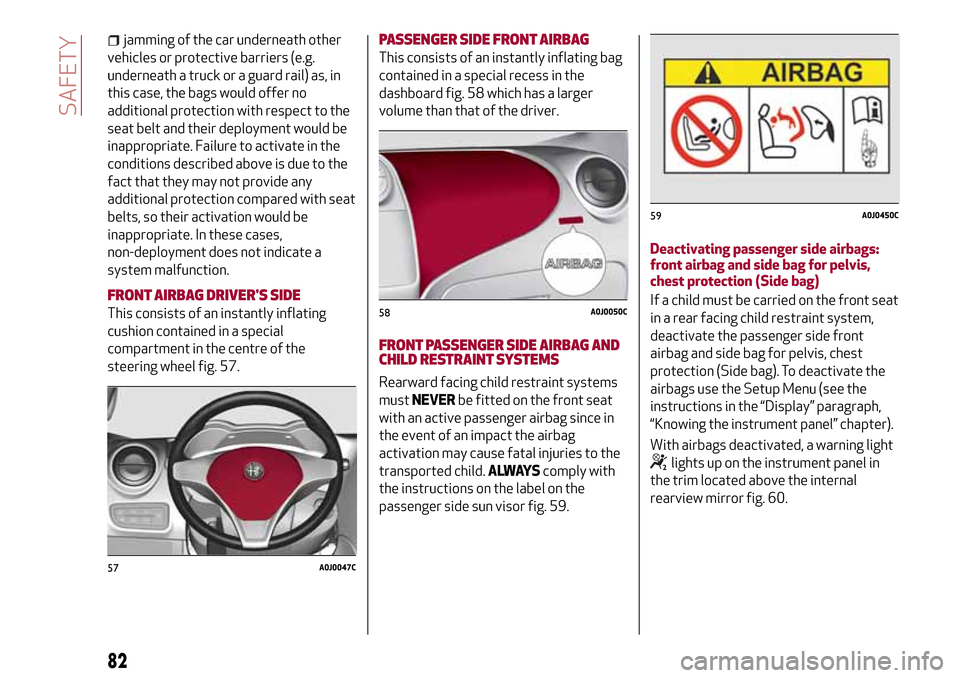
FRONT AIRBAG DRIVER'S SIDE
This consists of an instantly inflating
cushion contained in a special
compartment in the centre of the
steering wheel fig. 57.
PASSENGER SIDE FRONT AIRBAG
This consists of an instantly inflating bag
contained in a special recess in the
dashboard fig. 58 which has a larger
volume than that of the driver.
FRONT PASSENGER SIDE AIRBAG AND
CHILD RESTRAINTSYSTEMS
Rearward facing child restraint systems
mustNEVERbe fitted on the front seat
with an active passenger airbag since in
the event of an impact the airbag
activation may cause fatal injuries to the
transported child.ALWAYScomply with
the instructions on the label on the
passenger side sun visor fig. 59.Deactivating passenger side airbags:
front airbag and side bag for pelvis,
chest protection (Side bag)
If a child must be carried on the front seat
in a rear facing child restraint system,
deactivate the passenger side front
airbag and side bag for pelvis, chest
protection (Side bag). To deactivate the
airbags use the Setup Menu (see the
instructions in the “Display” paragraph,
“Knowing the instrument panel” chapter).
With airbags deactivated, a warning light
lights up on the instrument panel in
the trim located above the internal
rearview mirror fig. 60.
57A0J0047C
58A0J0050C
59A0J0450C
82
SAFETY
Page 92 of 212
STARTING THE ENGINE
93) 94) 95)
17) 18) 19) 20)
Before starting the engine, adjust the
seat, the interior rear view mirrors, the
door mirrors and fasten the seat belt
correctly.
Never press the accelerator pedal for
starting the engine.
If necessary, messages indicating the
starting procedure can be shown on the
display.
PROCEDURE FOR PETROL VERSIONS
Except Turbo TwinAir versions
Proceed as follows:
engage the handbrake and place the
gearbox lever in neutral;
fully depress the clutch pedal, without
touching the accelerator;
turn the ignition key to AVV and
release it as soon as the engine starts.
Turbo TwinAir versions
Proceed as follows:
engage the handbrake and place the
gear lever in neutral or fully press the
clutch pedal if a gear other than neutral is
engaged;
turn the ignition key to AVV and
release it as soon as the engine starts.Versions with LPG system
To properly perform the starting
procedure, refer to as previously
described.
The engine always starts up on petrol
independently of the mode previously
selected. There must therefore always be
some petrol in the tank to protect the
petrol pump and to guarantee temporary
switching from LPG to petrol operation, if
high performance is required.
IMPORTANT NOTES
Except Turbo TwinAir versions:Ifthe
engine does not start at the first attempt,
return the ignition key to STOP before
repeating the procedure.
For Turbo TwinAir versions only:Ifthe
vehicle does not start at the first
attempt, return the ignition key to STOP
and repeat the starting procedure placing
the gear lever in neutral and fully
pressing the clutch pedal.
If, with the ignition key turned to MAR,
the
symbol is shown on the display
together with the warning light
, turn
the key to STOP and then back to MAR. If
the symbol on the display is still shown,
try with the other keys provided with the
car. Contact an Alfa Romeo Dealership if
the engine still does not start.
Never leave the ignition key in
MAR-ON position when the engine is
stopped.
PROCEDURE FOR DIESEL VERSIONS
Proceed as follows:
engage the handbrake and place the
gear lever in neutral;
turn the ignition key to MAR position:
the
warning light will light up on
instrument panel;
wait for the warning light to switch off;
fully depress the clutch pedal, without
touching the accelerator;
turn the ignition key to AVV; the
warning light switches off. Waiting
too long will waste the heating work
carried out by the glow plugs. Release the
key as soon as the engine starts.
WARNING
93)It is dangerous to run the engine in
enclosed areas. The engine takes in oxygen
and releases carbon dioxide, carbon
monoxide and other toxic gases.
94)The brake servo is not active until the
engine is started, so you would need to apply
much more force than usual to the brake
pedal.
95)Do not start the engine by pushing,
towing or driving downhill. These
manoeuvres may damage the catalytic
converter.
90
STARTING AND DRIVING
Page 93 of 212
IMPORTANT
17)We recommend that during the initial
period, or during the first 1600 km
(1000 miles), you do not drive to full car
performance (e.g. excessive acceleration,
long journeys at top speed, sharp braking,
etc.).
18)When the engine is switched off never
leave the ignition device in the MAR position
to prevent useless current absorption from
draining the battery.
19)A quick burst on the accelerator before
turning off the engine serves absolutely no
practical purpose; it wastes fuel and is
damaging for the engine.
20)Warning light
will flash after starting
or during prolonged cranking to indicate a
fault with the glow plug heating system. If
the engine starts, the vehicle can be regularly
used, but an Alfa Romeo Dealership must be
contacted as soon as possible.
PARKING THE VEHICLE
96) 97)
Always remove the ignition key when
leaving the car.
When parking and leaving the car,
proceed as follows:
engage a gear (1stgear if facing uphill
or reverse if facing downhill) and leave
the wheels turned;
stop the engine and engage the
handbrake.
Block the wheels with a wedge or a stone
if the car is parked on a steep slope.
On versions equipped with Alfa TCT
transmission, before releasing the brake
pedal, wait for letter P to be displayed.
IMPORTANTNEVERleave the car with
the gearbox in neutral (or, on versions
equipped with Alfa TCT transmission,
before placing the gear lever at P).
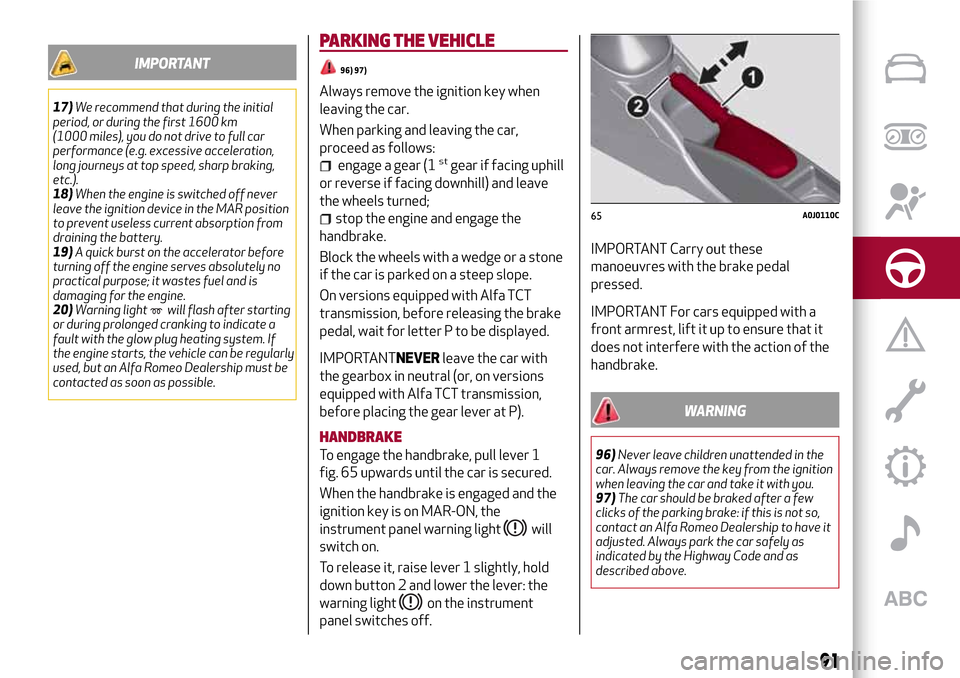
HANDBRAKE
To engage the handbrake, pull lever 1
fig. 65 upwards until the car is secured.
When the handbrake is engaged and the
ignition key is on MAR-ON, the
instrument panel warning light
will
switch on.
To release it, raise lever 1 slightly, hold
down button 2 and lower the lever: the
warning light
on the instrument
panel switches off.
IMPORTANT Carry out these
manoeuvres with the brake pedal
pressed.
IMPORTANT For cars equipped with a
front armrest, lift it up to ensure that it
does not interfere with the action of the
handbrake.
WARNING
96)Never leave children unattended in the
car. Always remove the key from the ignition
when leaving the car and take it with you.
97)The car should be braked after a few
clicks of the parking brake: if this is not so,
contact an Alfa Romeo Dealership to have it
adjusted. Always park the car safely as
indicated by the Highway Code and as
described above.
65A0J0110C
91
Page 98 of 212
SYSTEM MANUAL ACTIVATION /
DEACTIVATION
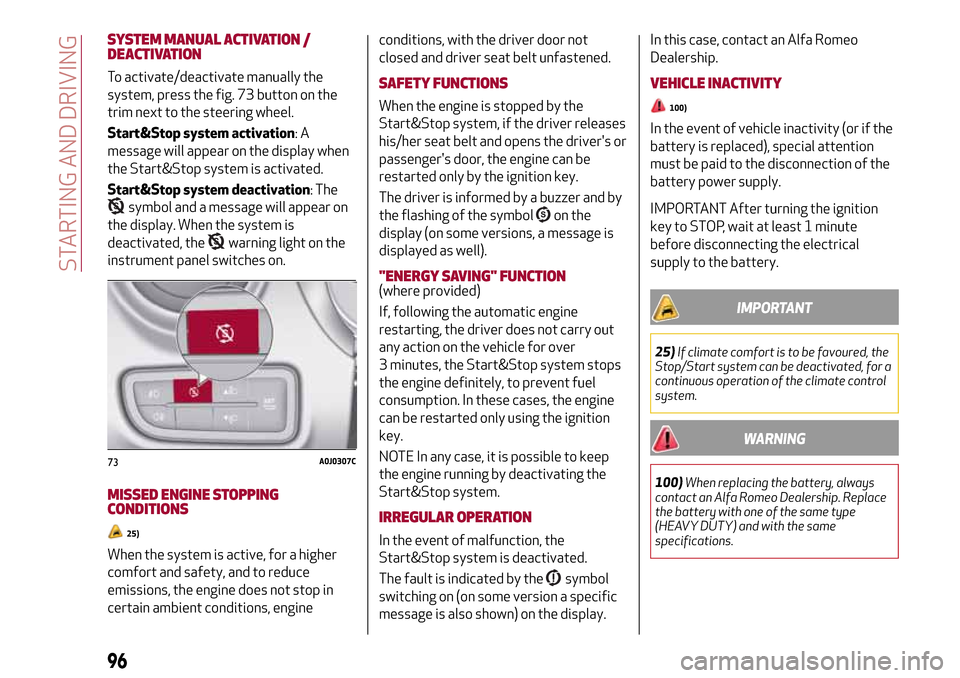
To activate/deactivate manually the
system, press the fig. 73 button on the
trim next to the steering wheel.
Start&Stop system activation:A
message will appear on the display when
the Start&Stop system is activated.
Start&Stop system deactivation: The
symbol and a message will appear on
the display. When the system is
deactivated, the
warning light on the
instrument panel switches on.
MISSED ENGINE STOPPING
CONDITIONS
25)
When the system is active, for a higher
comfort and safety, and to reduce
emissions, the engine does not stop in
certain ambient conditions, engineconditions, with the driver door not
closed and driver seat belt unfastened.
SAFETY FUNCTIONS
When the engine is stopped by the
Start&Stop system, if the driver releases
his/her seat belt and opens the driver's or
passenger's door, the engine can be
restarted only by the ignition key.
The driver is informed by a buzzer and by
the flashing of the symbol
on the
display (on some versions, a message is
displayed as well).
"ENERGY SAVING" FUNCTION(where provided)
If, following the automatic engine
restarting, the driver does not carry out
any action on the vehicle for over
3 minutes, the Start&Stop system stops
the engine definitely, to prevent fuel
consumption. In these cases, the engine
can be restarted only using the ignition
key.
NOTE In any case, it is possible to keep
the engine running by deactivating the
Start&Stop system.
IRREGULAR OPERATION
In the event of malfunction, the
Start&Stop system is deactivated.
The fault is indicated by the
symbol
switching on (on some version a specific
message is also shown) on the display.In this case, contact an Alfa Romeo
Dealership.
VEHICLE INACTIVITY
100)
In the event of vehicle inactivity (or if the
battery is replaced), special attention
must be paid to the disconnection of the
battery power supply.
IMPORTANT After turning the ignition
key to STOP, wait at least 1 minute
before disconnecting the electrical
supply to the battery.
IMPORTANT
25)If climate comfort is to be favoured, the
Stop/Start system can be deactivated, for a
continuous operation of the climate control
system.
WARNING
100)When replacing the battery, always
contact an Alfa Romeo Dealership. Replace
the battery with one of the same type
(HEAVY DUTY) and with the same
specifications.
73A0J0307C
96
STARTING AND DRIVING
Page 106 of 212
HAZARD WARNING LIGHTS
108)
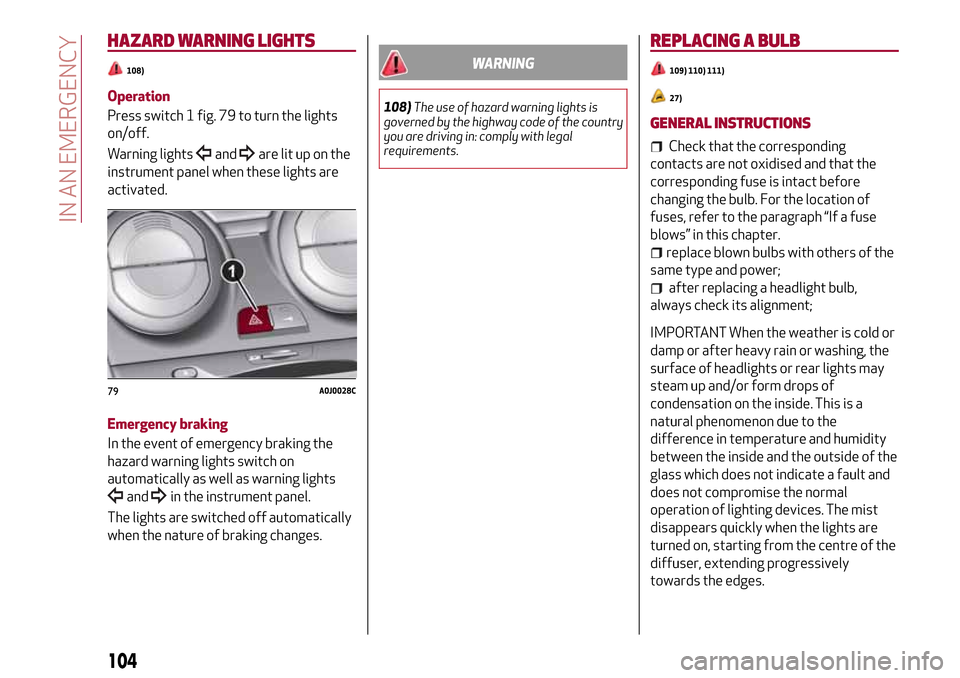
Operation
Press switch 1 fig. 79 to turn the lights
on/off.
Warning lights
andare lit up on the
instrument panel when these lights are
activated.
Emergency braking
In the event of emergency braking the
hazard warning lights switch on
automatically as well as warning lights
andin the instrument panel.
The lights are switched off automatically
when the nature of braking changes.
WARNING
108)The use of hazard warning lights is
governed by the highway code of the country
you are driving in: comply with legal
requirements.
REPLACING A BULB
109) 110) 111)
27)
GENERAL INSTRUCTIONS
Check that the corresponding
contacts are not oxidised and that the
corresponding fuse is intact before
changing the bulb. For the location of
fuses, refer to the paragraph “If a fuse
blows” in this chapter.
replace blown bulbs with others of the
same type and power;
after replacing a headlight bulb,
always check its alignment;
IMPORTANT When the weather is cold or
damp or after heavy rain or washing, the
surface of headlights or rear lights may
steam up and/or form drops of
condensation on the inside. This is a
natural phenomenon due to the
difference in temperature and humidity
between the inside and the outside of the
glass which does not indicate a fault and
does not compromise the normal
operation of lighting devices. The mist
disappears quickly when the lights are
turned on, starting from the centre of the
diffuser, extending progressively
towards the edges.
79A0J0028C
104
IN AN EMERGENCY
Page 116 of 212
Dashboard fuse boxfig. 93
DEVICE PROTECTEDFUSE AMPERE
FreeF12 –
Headlamp alignment corrector F13 5
INT/A Engine compartment control unit relays F31 5
EOBD diagnosis plug supply /Uconnect
™/ Alarm buzz / Alarm volumetric sensors /
Electrofan / TPMS system / Electric mirror controls / Climate control system controlsF36 15
Brake light switch (NA) / Instrument panel node / Headlight alignment corrector F37 5
Doors and luggage compartment central locking F38 15
Windscreen/rear window washer pump F43 20
Electric window (driver side)F47 20
Electric window (passenger side) F48 20
Parking sensors / Control lighting / Electro-chrome mirror / Rain/dusk sensor / Sun roof /
TPMS system / Cigar lighter lighting / SBR system panelF49 5
Climate control system controls / Radio system configuration /
Bluetooth®/ Brake light
switch (NC) / Clutch switch / Reverse gear switch / Airflow meter (Diesel versions) / Water in
diesel filter sensor (Diesel versions)F51 5
Instrument panel nodeF53 5
114
IN AN EMERGENCY
Page 124 of 212
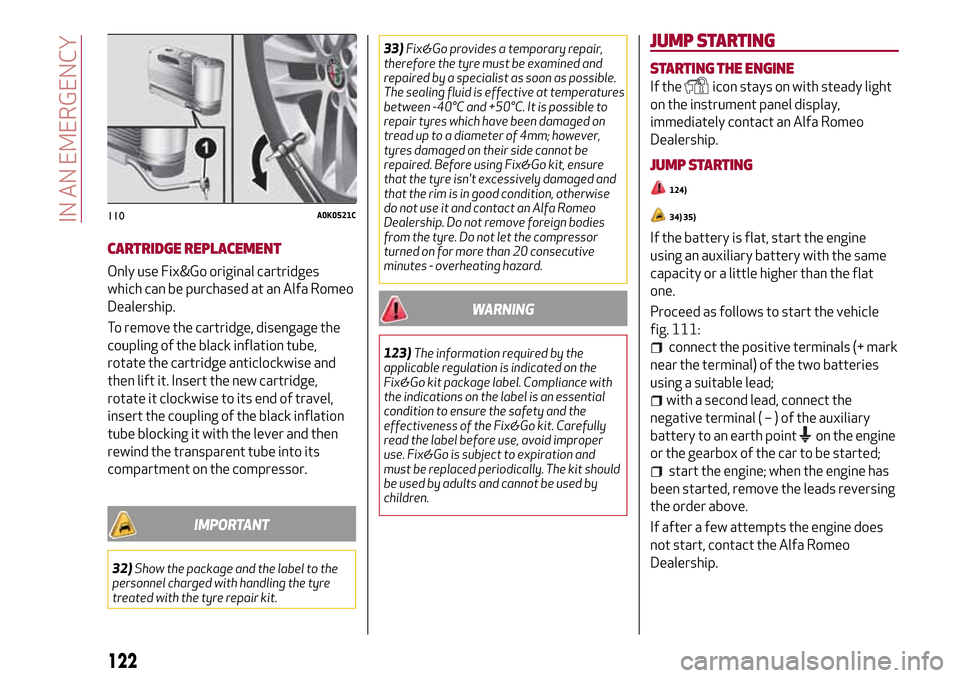
CARTRIDGE REPLACEMENT
Only use Fix&Go original cartridges
which can be purchased at an Alfa Romeo
Dealership.
To remove the cartridge, disengage the
coupling of the black inflation tube,
rotate the cartridge anticlockwise and
then lift it. Insert the new cartridge,
rotate it clockwise to its end of travel,
insert the coupling of the black inflation
tube blocking it with the lever and then
rewind the transparent tube into its
compartment on the compressor.
IMPORTANT
32)Show the package and the label to the
personnel charged with handling the tyre
treated with the tyre repair kit.33)Fix&Go provides a temporary repair,
therefore the tyre must be examined and
repaired by a specialist as soon as possible.
The sealing fluid is effective at temperatures
between -40°C and +50°C. It is possible to
repair tyres which have been damaged on
tread up to a diameter of 4mm; however,
tyres damaged on their side cannot be
repaired. Before using Fix&Go kit, ensure
that the tyre isn't excessively damaged and
that the rim is in good condition, otherwise
do not use it and contact an Alfa Romeo
Dealership. Do not remove foreign bodies
from the tyre. Do not let the compressor
turned on for more than 20 consecutive
minutes - overheating hazard.
WARNING
123)The information required by the
applicable regulation is indicated on the
Fix&Go kit package label. Compliance with
the indications on the label is an essential
condition to ensure the safety and the
effectiveness of the Fix&Go kit. Carefully
read the label before use, avoid improper
use. Fix&Go is subject to expiration and
must be replaced periodically. The kit should
be used by adults and cannot be used by
children.
JUMP STARTING
STARTING THE ENGINE
If theicon stays on with steady light
on the instrument panel display,
immediately contact an Alfa Romeo
Dealership.
JUMP STARTING
124)
34) 35)
If the battery is flat, start the engine
using an auxiliary battery with the same
capacity or a little higher than the flat
one.
Proceed as follows to start the vehicle
fig. 111:
connect the positive terminals (+ mark
near the terminal) of the two batteries
using a suitable lead;
with a second lead, connect the
negative terminal(–)oftheauxiliary
battery to an earth point
on the engine
or the gearbox of the car to be started;
start the engine; when the engine has
been started, remove the leads reversing
the order above.
If after a few attempts the engine does
not start, contact the Alfa Romeo
Dealership.
110A0K0521C
122
IN AN EMERGENCY
Page 131 of 212
SCHEDULED MAINTENANCE PLAN
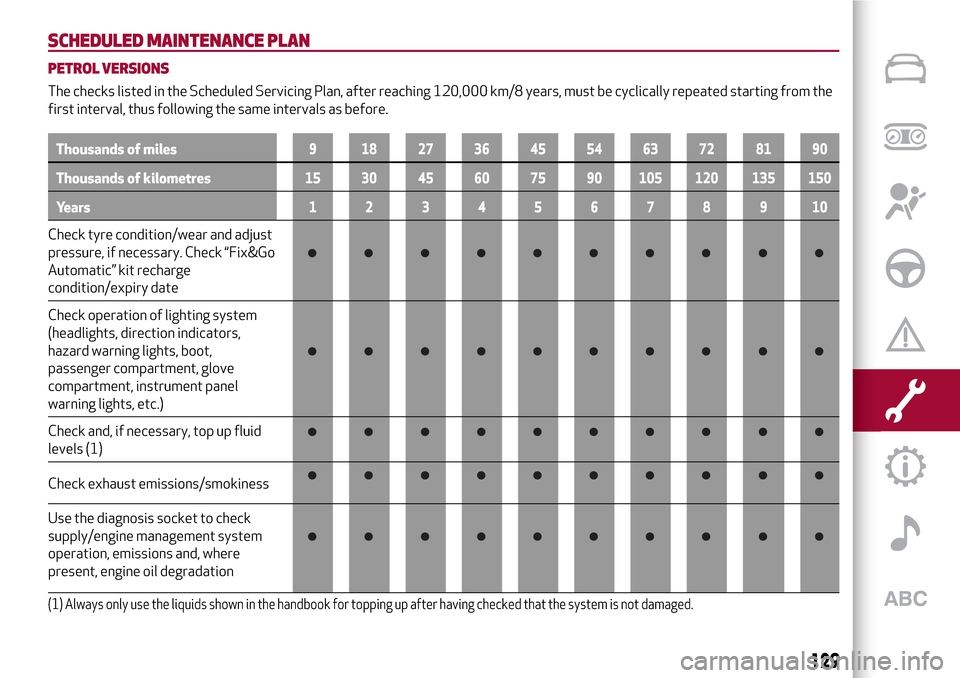
PETROL VERSIONS
The checks listed in the Scheduled Servicing Plan, after reaching 120,000 km/8 years, must be cyclically repeated starting from the
first interval, thus following the same intervals as before.
Thousands of miles9 182736455463728190
Thousands of kilometres15 30 45 60 75 90 105 120 135 150
Years12345678910
Check tyre condition/wear and adjust
pressure, if necessary. Check “Fix&Go
Automatic” kit recharge
condition/expiry date
Check operation of lighting system
(headlights, direction indicators,
hazard warning lights, boot,
passenger compartment, glove
compartment, instrument panel
warning lights, etc.)
Check and, if necessary, top up fluid
levels (1)
Check exhaust emissions/smokiness
Use the diagnosis socket to check
supply/engine management system
operation, emissions and, where
present, engine oil degradation
(1) Always only use the liquids shown in the handbook for topping up after having checked that the system is not damaged.
129