light Alfa Romeo MiTo 2017 Workshop Manual
[x] Cancel search | Manufacturer: ALFA ROMEO, Model Year: 2017, Model line: MiTo, Model: Alfa Romeo MiTo 2017Pages: 212, PDF Size: 4.36 MB
Page 94 of 212
USING THE MANUAL GEARBOX
98)
21)
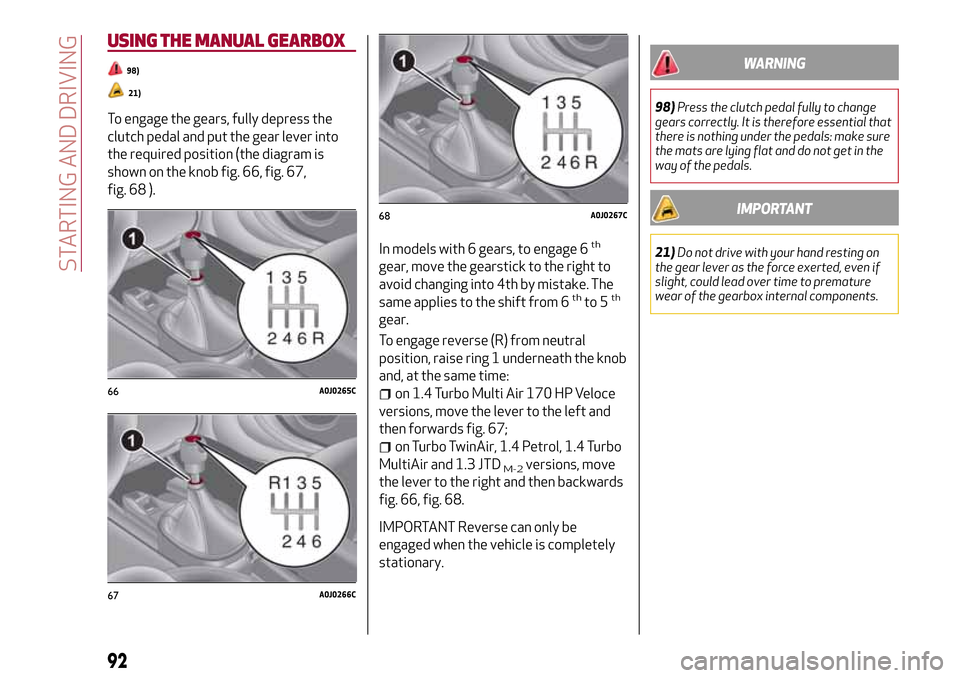
To engage the gears, fully depress the
clutch pedal and put the gear lever into
the required position (the diagram is
shown on the knob fig. 66, fig. 67,
fig. 68 ).
In models with 6 gears, to engage 6
th
gear, move the gearstick to the right to
avoid changing into 4th by mistake. The
same applies to the shift from 6
thto 5th
gear.
To engage reverse (R) from neutral
position, raise ring 1 underneath the knob
and, at the same time:
on 1.4 Turbo Multi Air 170 HP Veloce
versions, move the lever to the left and
then forwards fig. 67;
on Turbo TwinAir, 1.4 Petrol, 1.4 Turbo
MultiAir and 1.3 JTD
M-2versions, move
the lever to the right and then backwards
fig. 66, fig. 68.
IMPORTANT Reverse can only be
engaged when the vehicle is completely
stationary.
WARNING
98)Press the clutch pedal fully to change
gears correctly. It is therefore essential that
there is nothing under the pedals: make sure
the mats are lying flat and do not get in the
way of the pedals.
IMPORTANT
21)Do not drive with your hand resting on
the gear lever as the force exerted, even if
slight, could lead over time to premature
wear of the gearbox internal components.
66A0J0265C
67A0J0266C
68A0J0267C
92
STARTING AND DRIVING
Page 98 of 212
SYSTEM MANUAL ACTIVATION /
DEACTIVATION
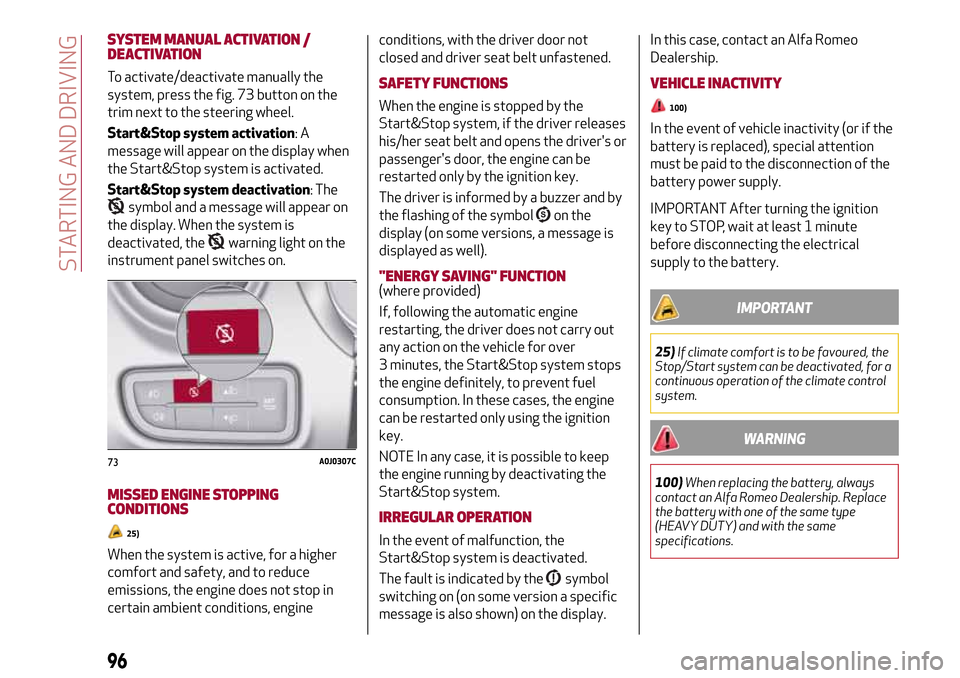
To activate/deactivate manually the
system, press the fig. 73 button on the
trim next to the steering wheel.
Start&Stop system activation:A
message will appear on the display when
the Start&Stop system is activated.
Start&Stop system deactivation: The
symbol and a message will appear on
the display. When the system is
deactivated, the
warning light on the
instrument panel switches on.
MISSED ENGINE STOPPING
CONDITIONS
25)
When the system is active, for a higher
comfort and safety, and to reduce
emissions, the engine does not stop in
certain ambient conditions, engineconditions, with the driver door not
closed and driver seat belt unfastened.
SAFETY FUNCTIONS
When the engine is stopped by the
Start&Stop system, if the driver releases
his/her seat belt and opens the driver's or
passenger's door, the engine can be
restarted only by the ignition key.
The driver is informed by a buzzer and by
the flashing of the symbol
on the
display (on some versions, a message is
displayed as well).
"ENERGY SAVING" FUNCTION(where provided)
If, following the automatic engine
restarting, the driver does not carry out
any action on the vehicle for over
3 minutes, the Start&Stop system stops
the engine definitely, to prevent fuel
consumption. In these cases, the engine
can be restarted only using the ignition
key.
NOTE In any case, it is possible to keep
the engine running by deactivating the
Start&Stop system.
IRREGULAR OPERATION
In the event of malfunction, the
Start&Stop system is deactivated.
The fault is indicated by the
symbol
switching on (on some version a specific
message is also shown) on the display.In this case, contact an Alfa Romeo
Dealership.
VEHICLE INACTIVITY
100)
In the event of vehicle inactivity (or if the
battery is replaced), special attention
must be paid to the disconnection of the
battery power supply.
IMPORTANT After turning the ignition
key to STOP, wait at least 1 minute
before disconnecting the electrical
supply to the battery.
IMPORTANT
25)If climate comfort is to be favoured, the
Stop/Start system can be deactivated, for a
continuous operation of the climate control
system.
WARNING
100)When replacing the battery, always
contact an Alfa Romeo Dealership. Replace
the battery with one of the same type
(HEAVY DUTY) and with the same
specifications.
73A0J0307C
96
STARTING AND DRIVING
Page 99 of 212
CRUISE CONTROL
(where provided)
DESCRIPTION
This is an electronic driving aid that
allows you to drive at a speed of above
30 km/h on long and straight dry roads
(e.g. motorways), at a preset speed
without having to press the accelerator
pedal. It is therefore not recommended
to use this device on extra-urban roads
with traffic. Do not use it in town.
ACTIVATING THE DEVICE
101) 102)
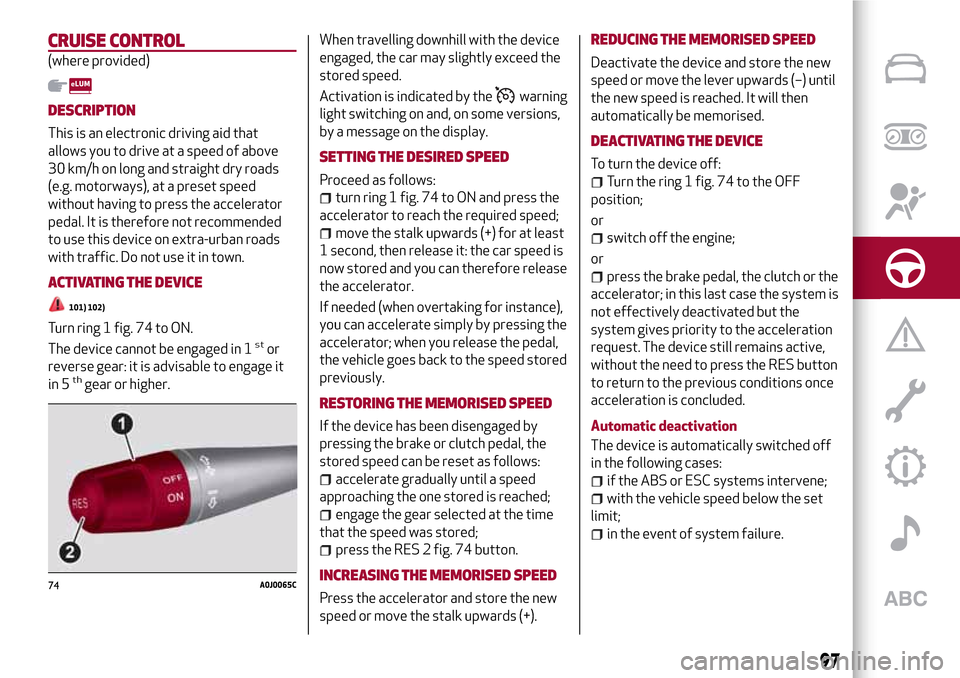
Turn ring 1 fig. 74 to ON.
The device cannot be engaged in 1stor
reverse gear: it is advisable to engage it
in 5
thgear or higher.When travelling downhill with the device
engaged, the car may slightly exceed the
stored speed.
Activation is indicated by the
warning
light switching on and, on some versions,
by a message on the display.
SETTING THE DESIRED SPEED
Proceed as follows:
turn ring 1 fig. 74 to ON and press the
accelerator to reach the required speed;
move the stalk upwards (+) for at least
1 second, then release it: the car speed is
now stored and you can therefore release
the accelerator.
If needed (when overtaking for instance),
you can accelerate simply by pressing the
accelerator; when you release the pedal,
the vehicle goes back to the speed stored
previously.
RESTORING THE MEMORISED SPEED
If the device has been disengaged by
pressing the brake or clutch pedal, the
stored speed can be reset as follows:
accelerate gradually until a speed
approaching the one stored is reached;
engage the gear selected at the time
that the speed was stored;
press the RES 2 fig. 74 button.
INCREASING THE MEMORISED SPEED
Press the accelerator and store the new
speed or move the stalk upwards (+).
REDUCING THE MEMORISED SPEED
Deactivate the device and store the new
speed or move the lever upwards (–) until
the new speed is reached. It will then
automatically be memorised.
DEACTIVATING THE DEVICE
To turn the device off:
Turn the ring 1 fig. 74 to the OFF
position;
or
switch off the engine;
or
press the brake pedal, the clutch or the
accelerator; in this last case the system is
not effectively deactivated but the
system gives priority to the acceleration
request. The device still remains active,
without the need to press the RES button
to return to the previous conditions once
acceleration is concluded.
Automatic deactivation
The device is automatically switched off
in the following cases:
if the ABS or ESC systems intervene;
with the vehicle speed below the set
limit;
in the event of system failure.
74A0J0065C
97
Page 102 of 212
INSTALLING A TOW HOOK
Contact an Alfa Romeo Dealership to
install a tow hook.
WARNING
105)The ABS with which the car is equipped
will not control the braking system of the
trailer. Particular caution is therefore
required on slippery roads.
106)Do not, under any circumstances,
modify the vehicle's braking system to
control the trailer breaking system. The
towing braking system must be completely
independent of the vehicle's hydraulic
system.
REFUELLING THE VEHICLE
During refuelling procedure, switch off
the engine, engage handbrake, rotate the
ignition key to STOP and do not smoke.
PETROL ENGINES
Only use unleaded petrol. The petrol
octane rating (RON) must not be lower
than 95. In order to prevent damage to
the catalytic converter never introduce
even the smallest amount of leaded
petrol, even in the event of an emergency.
DIESEL ENGINES
Only use diesel fuel compliant with
European specification EN590. The use
of other products or mixtures may
damage the engine beyond repair and
consequently invalidate the warranty,
due to the damage caused.
When using or parking the vehicle for a
long time in the mountains or cold areas,
it is advisable to refuel using locally
available Diesel. In this case, it is also
advisable to keep the tank over 50% full.
FUEL TANK CAP
107)
Opening
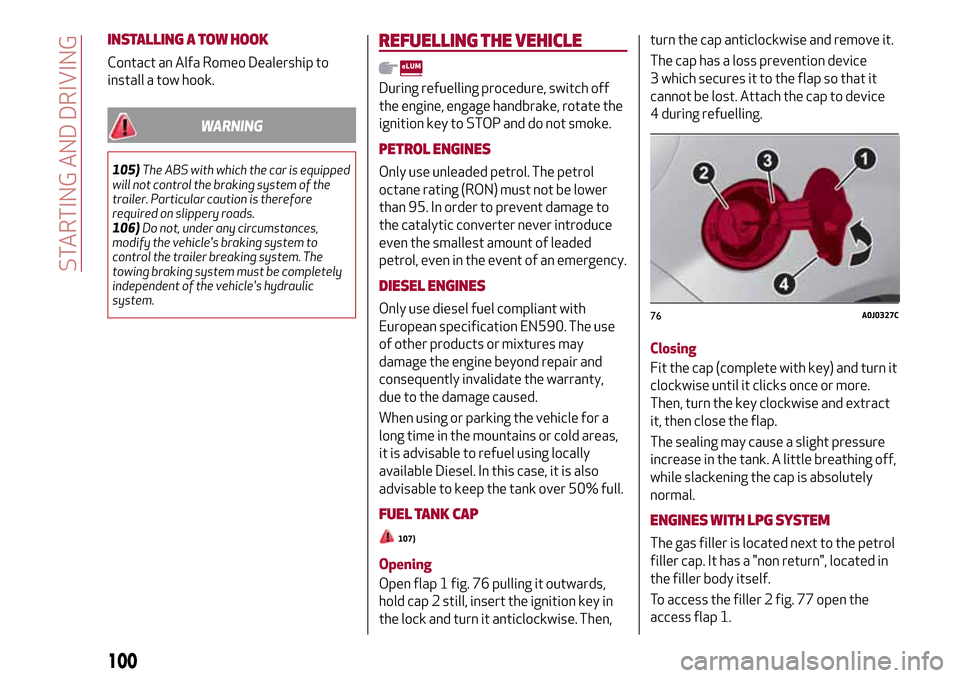
Open flap 1 fig. 76 pulling it outwards,
hold cap 2 still, insert the ignition key in
the lock and turn it anticlockwise. Then,turn the cap anticlockwise and remove it.
The cap has a loss prevention device
3 which secures it to the flap so that it
cannot be lost. Attach the cap to device
4 during refuelling.
Closing
Fit the cap (complete with key) and turn it
clockwise until it clicks once or more.
Then, turn the key clockwise and extract
it, then close the flap.
The sealing may cause a slight pressure
increase in the tank. A little breathing off,
while slackening the cap is absolutely
normal.
ENGINES WITH LPGSYSTEM
The gas filler is located next to the petrol
filler cap. It has a "non return", located in
the filler body itself.
To access the filler 2 fig. 77 open the
access flap 1.
76A0J0327C
100
STARTING AND DRIVING
Page 105 of 212
A punctured tyre or a burnt-out bulb?
At times, a problem may interfere with our journey.
The pages on emergencies can help you to deal with critical
situations independently and with calm. In an emergency we
recommend that you call the freephone number found in the
Warranty Booklet. You can also use the universal, national or
international freephone number to find your nearest Authorised
Alfa Romeo Dealership.
IN AN EMERGENCY
HAZARD WARNING LIGHTS . . . . . . .................104
REPLACING A BULB . . . . ........................104
REPLACING AN EXTERIOR BULB....................108
REPLACING FUSES . ...........................110
CHANGING A WHEEL ...........................116
"Fix&Go Automatic" KIT. . . . ......................120
JUMP STARTING . . . . ..........................122
FUEL CUT-OFF SYSTEM . ........................123
ALFA TCT TRANSMISSION - KEY REMOVAL . . . ..........124
TOWING THE VEHICLE ..........................125
Page 106 of 212
HAZARD WARNING LIGHTS
108)
Operation
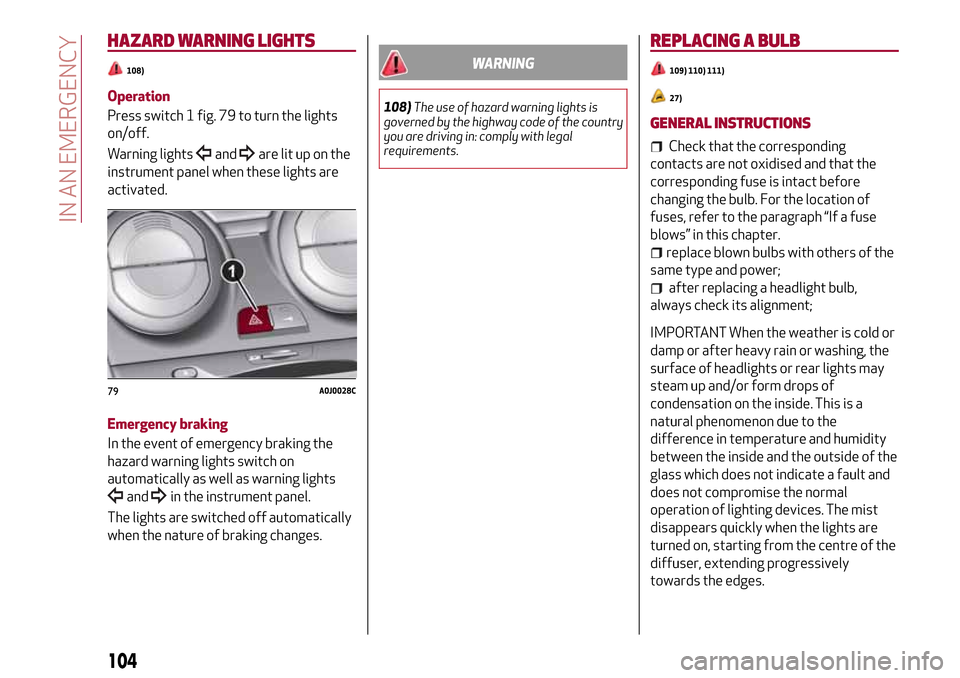
Press switch 1 fig. 79 to turn the lights
on/off.
Warning lights
andare lit up on the
instrument panel when these lights are
activated.
Emergency braking
In the event of emergency braking the
hazard warning lights switch on
automatically as well as warning lights
andin the instrument panel.
The lights are switched off automatically
when the nature of braking changes.
WARNING
108)The use of hazard warning lights is
governed by the highway code of the country
you are driving in: comply with legal
requirements.
REPLACING A BULB
109) 110) 111)
27)
GENERAL INSTRUCTIONS
Check that the corresponding
contacts are not oxidised and that the
corresponding fuse is intact before
changing the bulb. For the location of
fuses, refer to the paragraph “If a fuse
blows” in this chapter.
replace blown bulbs with others of the
same type and power;
after replacing a headlight bulb,
always check its alignment;
IMPORTANT When the weather is cold or
damp or after heavy rain or washing, the
surface of headlights or rear lights may
steam up and/or form drops of
condensation on the inside. This is a
natural phenomenon due to the
difference in temperature and humidity
between the inside and the outside of the
glass which does not indicate a fault and
does not compromise the normal
operation of lighting devices. The mist
disappears quickly when the lights are
turned on, starting from the centre of the
diffuser, extending progressively
towards the edges.
79A0J0028C
104
IN AN EMERGENCY
Page 108 of 212
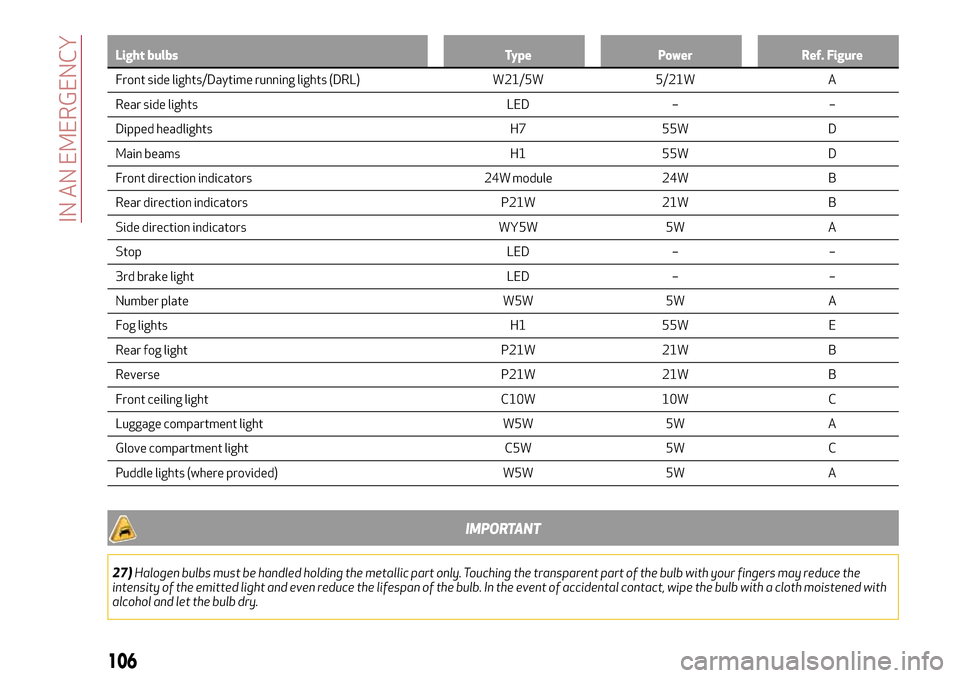
Light bulbs Type Power Ref. Figure
Front side lights/Daytime running lights (DRL) W21/5W 5/21W A
Rear side lights LED – –
Dipped headlights H7 55W D
Main beams H1 55W D
Front direction indicators 24W module 24W B
Rear direction indicators P21W 21W B
Side direction indicators WY5W 5W A
Stop LED – –
3rd brake light LED – –
Number plate W5W 5W A
Fog lights H1 55W E
Rear fog light P21W 21W B
Reverse P21W 21W B
Front ceiling light C10W 10W C
Luggage compartment light W5W 5W A
Glove compartment light C5W 5W C
Puddle lights (where provided) W5W 5W A
IMPORTANT
27)Halogen bulbs must be handled holding the metallic part only. Touching the transparent part of the bulb with your fingers may reduce the
intensity of the emitted light and even reduce the lifespan of the bulb. In the event of accidental contact, wipe the bulb with a cloth moistened with
alcohol and let the bulb dry.
106
IN AN EMERGENCY
Page 110 of 212
REPLACING AN EXTERIOR BULB
FRONT LIGHT CLUSTERS
These contain the bulbs for the side
lights/daytime running lights (DRL),
dipped beams, main beams and direction
indicators. The bulbs are arranged as
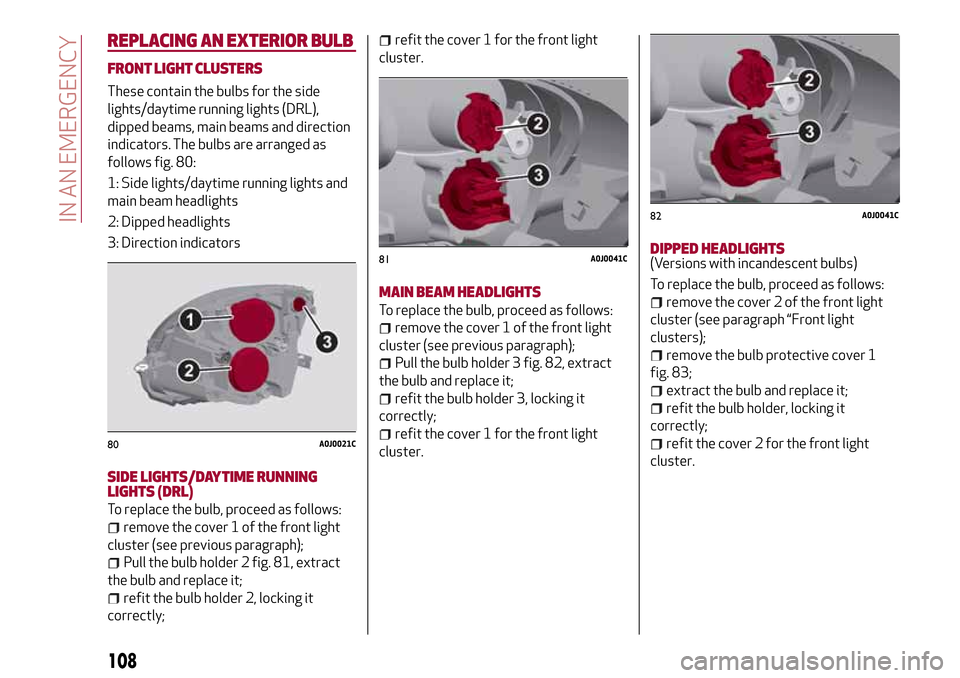
follows fig. 80:
1: Side lights/daytime running lights and
main beam headlights
2: Dipped headlights
3: Direction indicators
SIDE LIGHTS/DAYTIME RUNNING
LIGHTS (DRL)
To replace the bulb, proceed as follows:
remove the cover 1 of the front light
cluster (see previous paragraph);
Pull the bulb holder 2 fig. 81, extract
the bulb and replace it;
refit the bulb holder 2, locking it
correctly;
refit the cover 1 for the front light
cluster.
MAIN BEAM HEADLIGHTS
To replace the bulb, proceed as follows:
remove the cover 1 of the front light
cluster (see previous paragraph);
Pull the bulb holder 3 fig. 82, extract
the bulb and replace it;
refit the bulb holder 3, locking it
correctly;
refit the cover 1 for the front light
cluster.
DIPPED HEADLIGHTS(Versions with incandescent bulbs)
To replace the bulb, proceed as follows:
remove the cover 2 of the front light
cluster (see paragraph “Front light
clusters);
remove the bulb protective cover 1
fig. 83;
extract the bulb and replace it;
refit the bulb holder, locking it
correctly;
refit the cover 2 for the front light
cluster.80A0J0021C
81A0J0041C
82A0J0041C
108
IN AN EMERGENCY
Page 111 of 212
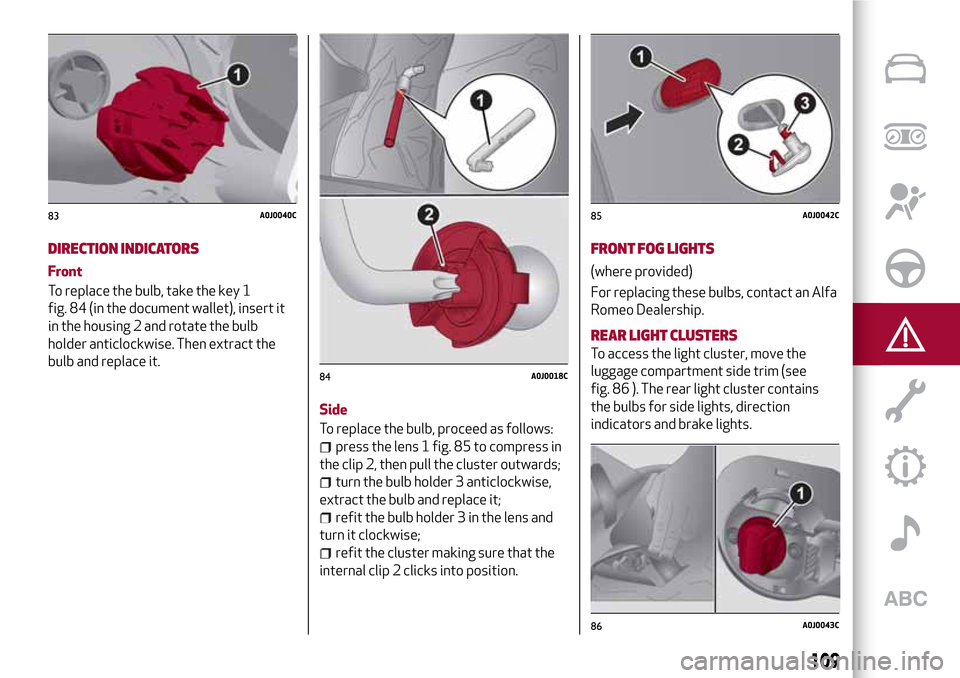
DIRECTION INDICATORS
Front
To replace the bulb, take the key 1
fig. 84 (in the document wallet), insert it
in the housing 2 and rotate the bulb
holder anticlockwise. Then extract the
bulb and replace it.
Side
To replace the bulb, proceed as follows:
press the lens 1 fig. 85 to compress in
the clip 2, then pull the cluster outwards;
turn the bulb holder 3 anticlockwise,
extract the bulb and replace it;
refit the bulb holder 3 in the lens and
turn it clockwise;
refit the cluster making sure that the
internal clip 2 clicks into position.
FRONT FOG LIGHTS
(where provided)
For replacing these bulbs, contact an Alfa
Romeo Dealership.
REAR LIGHT CLUSTERS
To access the light cluster, move the
luggage compartment side trim (see
fig. 86 ). The rear light cluster contains
the bulbs for side lights, direction
indicators and brake lights.
83A0J0040C
84A0J0018C
85A0J0042C
86A0J0043C
109
Page 112 of 212
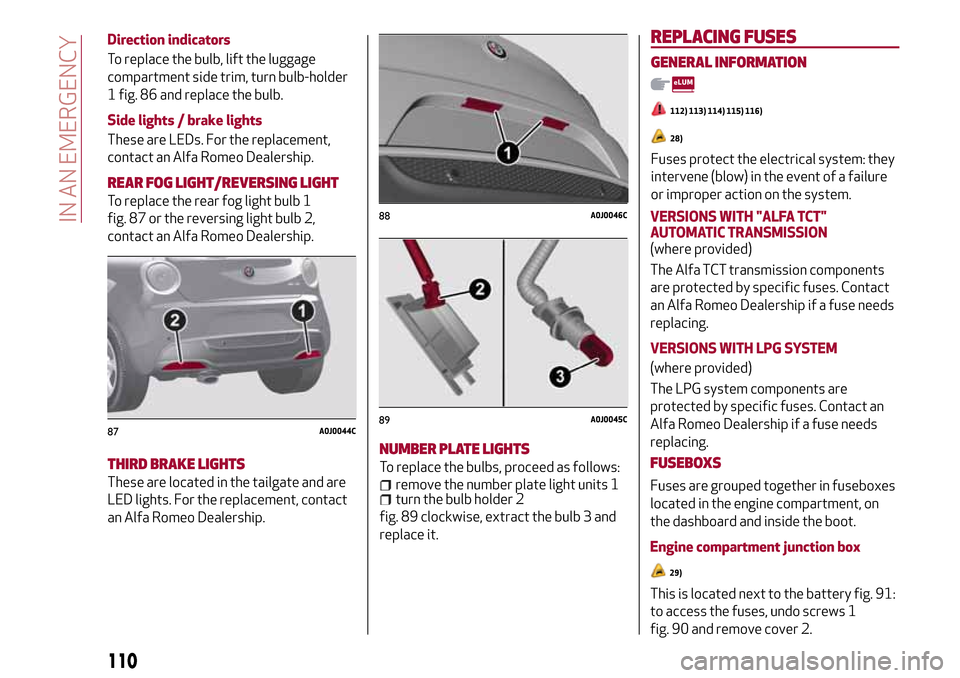
Direction indicators
To replace the bulb, lift the luggage
compartment side trim, turn bulb-holder
1 fig. 86 and replace the bulb.
Side lights / brake lights
These are LEDs. For the replacement,
contact an Alfa Romeo Dealership.
REAR FOG LIGHT/REVERSING LIGHT
To replace the rear fog light bulb 1
fig. 87 or the reversing light bulb 2,
contact an Alfa Romeo Dealership.
THIRD BRAKE LIGHTS
These are located in the tailgate and are
LED lights. For the replacement, contact
an Alfa Romeo Dealership.
NUMBER PLATE LIGHTS
To replace the bulbs, proceed as follows:
remove the number plate light units 1turn the bulb holder 2
fig. 89 clockwise, extract the bulb 3 and
replace it.
REPLACING FUSES
GENERAL INFORMATION
112) 113) 114) 115) 116)
28)
Fuses protect the electrical system: they
intervene (blow) in the event of a failure
or improper action on the system.
VERSIONS WITH "ALFA TCT"
AUTOMATIC TRANSMISSION
(where provided)
The Alfa TCT transmission components
are protected by specific fuses. Contact
an Alfa Romeo Dealership if a fuse needs
replacing.
VERSIONS WITH LPGSYSTEM
(where provided)
The LPG system components are
protected by specific fuses. Contact an
Alfa Romeo Dealership if a fuse needs
replacing.
FUSEBOXS
Fuses are grouped together in fuseboxes
located in the engine compartment, on
the dashboard and inside the boot.
Engine compartment junction box
29)
This is located next to the battery fig. 91:
to access the fuses, undo screws 1
fig. 90 and remove cover 2.
87A0J0044C
88A0J0046C
89A0J0045C
110
IN AN EMERGENCY