plug Alfa Romeo MiTo 2017 Owner's Manual
[x] Cancel search | Manufacturer: ALFA ROMEO, Model Year: 2017, Model line: MiTo, Model: Alfa Romeo MiTo 2017Pages: 212, PDF Size: 4.36 MB
Page 54 of 212
Warning lights on
panelWhat it means What to do
INJECTION/EOBD SYSTEM FAILURE
In normal conditions, when the ignition key is turned to MAR the
warning light switches on, but it should switch off as soon as the
engine is started. The operation of the
warning light may be
checked by the traffic police using specific devices. Comply with
the laws and regulations of the country where you are driving.14)
If the warning light remains on or switches on whilst driving, it
means that the injection system is not working properly. The
warning light on constantly signals a malfunction in the
supply/ignition system which could cause high exhaust emissions,
a possible loss of performance, poor driveability and high
consumption.
The warning light goes out after the fault disappears: the
indication is stored in the system.Under these conditions, the vehicle can continue
travelling at moderate speed without
demanding excessive effort from the engine.
Prolonged use of the car with the warning light
on constantly may cause damage.
Contact an Alfa Romeo Dealership as soon as
possible.
Petrol engines only
If the warning light flashes, it means that the catalytic converter
may be damaged.In this case, release the accelerator pedal to
lower the speed of the engine until the warning
light stops flashing. Continue the journey at
moderate speed, trying to avoid driving
conditions that may cause further flashing and
contact an Alfa Romeo Dealership as soon as
possible.
GLOW PLUG HEATING/GLOW PLUG HEATING FAILURE (diesel
versions)
This warning light switches on when the key is turned to MAR. It
will switch off as soon as the heater plugs have reached a preset
temperature. The engine can be started as soon as the warning
light switches off.
WARNING In mild or high temperature conditions, the warning
light comes on for a very short time only.
Glow plug preheating failure
The warning light will flash to indicate a failure in the glow plug
preheating system.Contact an Alfa Romeo Dealership as soon as
possible.
52
KNOWING THE INSTRUMENT PANEL
Page 92 of 212
STARTING THE ENGINE
93) 94) 95)
17) 18) 19) 20)
Before starting the engine, adjust the
seat, the interior rear view mirrors, the
door mirrors and fasten the seat belt
correctly.
Never press the accelerator pedal for
starting the engine.
If necessary, messages indicating the
starting procedure can be shown on the
display.
PROCEDURE FOR PETROL VERSIONS
Except Turbo TwinAir versions
Proceed as follows:
engage the handbrake and place the
gearbox lever in neutral;
fully depress the clutch pedal, without
touching the accelerator;
turn the ignition key to AVV and
release it as soon as the engine starts.
Turbo TwinAir versions
Proceed as follows:
engage the handbrake and place the
gear lever in neutral or fully press the
clutch pedal if a gear other than neutral is
engaged;
turn the ignition key to AVV and
release it as soon as the engine starts.Versions with LPG system
To properly perform the starting
procedure, refer to as previously
described.
The engine always starts up on petrol
independently of the mode previously
selected. There must therefore always be
some petrol in the tank to protect the
petrol pump and to guarantee temporary
switching from LPG to petrol operation, if
high performance is required.
IMPORTANT NOTES
Except Turbo TwinAir versions:Ifthe
engine does not start at the first attempt,
return the ignition key to STOP before
repeating the procedure.
For Turbo TwinAir versions only:Ifthe
vehicle does not start at the first
attempt, return the ignition key to STOP
and repeat the starting procedure placing
the gear lever in neutral and fully
pressing the clutch pedal.
If, with the ignition key turned to MAR,
the
symbol is shown on the display
together with the warning light
, turn
the key to STOP and then back to MAR. If
the symbol on the display is still shown,
try with the other keys provided with the
car. Contact an Alfa Romeo Dealership if
the engine still does not start.
Never leave the ignition key in
MAR-ON position when the engine is
stopped.
PROCEDURE FOR DIESEL VERSIONS
Proceed as follows:
engage the handbrake and place the
gear lever in neutral;
turn the ignition key to MAR position:
the
warning light will light up on
instrument panel;
wait for the warning light to switch off;
fully depress the clutch pedal, without
touching the accelerator;
turn the ignition key to AVV; the
warning light switches off. Waiting
too long will waste the heating work
carried out by the glow plugs. Release the
key as soon as the engine starts.
WARNING
93)It is dangerous to run the engine in
enclosed areas. The engine takes in oxygen
and releases carbon dioxide, carbon
monoxide and other toxic gases.
94)The brake servo is not active until the
engine is started, so you would need to apply
much more force than usual to the brake
pedal.
95)Do not start the engine by pushing,
towing or driving downhill. These
manoeuvres may damage the catalytic
converter.
90
STARTING AND DRIVING
Page 93 of 212
IMPORTANT
17)We recommend that during the initial
period, or during the first 1600 km
(1000 miles), you do not drive to full car
performance (e.g. excessive acceleration,
long journeys at top speed, sharp braking,
etc.).
18)When the engine is switched off never
leave the ignition device in the MAR position
to prevent useless current absorption from
draining the battery.
19)A quick burst on the accelerator before
turning off the engine serves absolutely no
practical purpose; it wastes fuel and is
damaging for the engine.
20)Warning light
will flash after starting
or during prolonged cranking to indicate a
fault with the glow plug heating system. If
the engine starts, the vehicle can be regularly
used, but an Alfa Romeo Dealership must be
contacted as soon as possible.
PARKING THE VEHICLE
96) 97)
Always remove the ignition key when
leaving the car.
When parking and leaving the car,
proceed as follows:
engage a gear (1stgear if facing uphill
or reverse if facing downhill) and leave
the wheels turned;
stop the engine and engage the
handbrake.
Block the wheels with a wedge or a stone
if the car is parked on a steep slope.
On versions equipped with Alfa TCT
transmission, before releasing the brake
pedal, wait for letter P to be displayed.
IMPORTANTNEVERleave the car with
the gearbox in neutral (or, on versions
equipped with Alfa TCT transmission,
before placing the gear lever at P).
HANDBRAKE
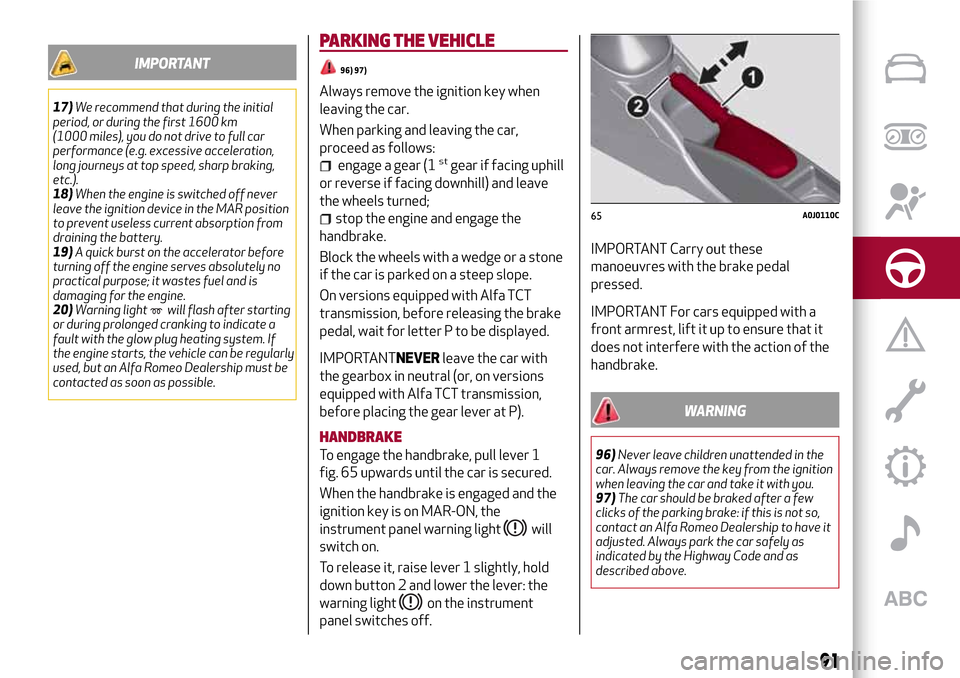
To engage the handbrake, pull lever 1
fig. 65 upwards until the car is secured.
When the handbrake is engaged and the
ignition key is on MAR-ON, the
instrument panel warning light
will
switch on.
To release it, raise lever 1 slightly, hold
down button 2 and lower the lever: the
warning light
on the instrument
panel switches off.
IMPORTANT Carry out these
manoeuvres with the brake pedal
pressed.
IMPORTANT For cars equipped with a
front armrest, lift it up to ensure that it
does not interfere with the action of the
handbrake.
WARNING
96)Never leave children unattended in the
car. Always remove the key from the ignition
when leaving the car and take it with you.
97)The car should be braked after a few
clicks of the parking brake: if this is not so,
contact an Alfa Romeo Dealership to have it
adjusted. Always park the car safely as
indicated by the Highway Code and as
described above.
65A0J0110C
91
Page 100 of 212
WARNING
101)When travelling with the device active,
never move the gear lever to neutral.
102)In case of a malfunction or failure of
the device, contact an Alfa Romeo
Dealership.
PARKING SENSORS
(where provided)
103) 104)
26)
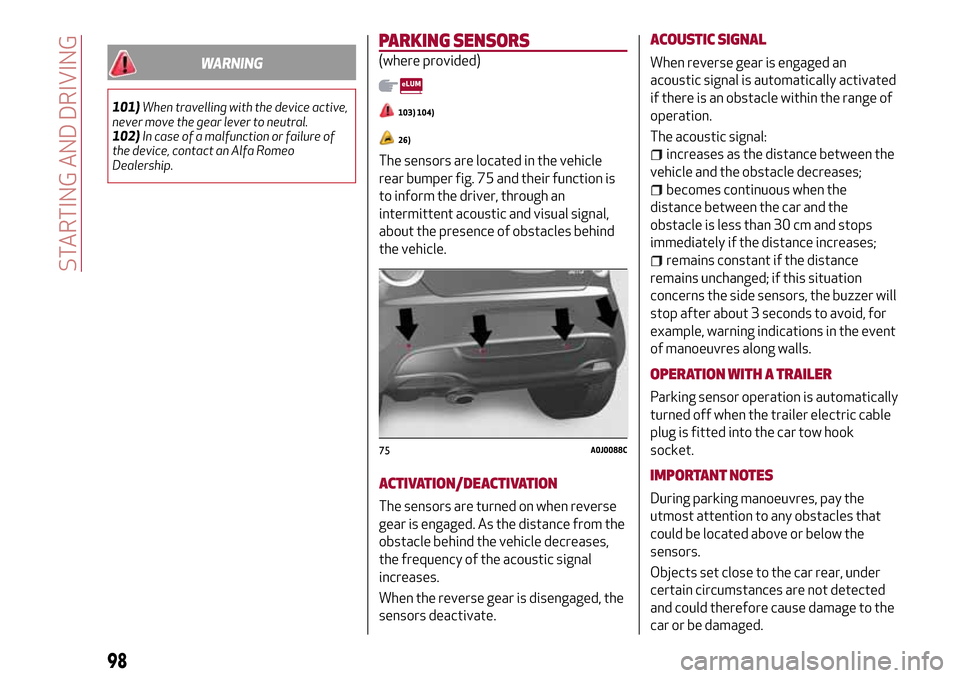
The sensors are located in the vehicle
rear bumper fig. 75 and their function is
to inform the driver, through an
intermittent acoustic and visual signal,
about the presence of obstacles behind
the vehicle.
ACTIVATION/DEACTIVATION
The sensors are turned on when reverse
gear is engaged. As the distance from the
obstacle behind the vehicle decreases,
the frequency of the acoustic signal
increases.
When the reverse gear is disengaged, the
sensors deactivate.
ACOUSTIC SIGNAL
When reverse gear is engaged an
acoustic signal is automatically activated
if there is an obstacle within the range of
operation.
The acoustic signal:
increases as the distance between the
vehicle and the obstacle decreases;
becomes continuous when the
distance between the car and the
obstacle is less than 30 cm and stops
immediately if the distance increases;
remains constant if the distance
remains unchanged; if this situation
concerns the side sensors, the buzzer will
stop after about 3 seconds to avoid, for
example, warning indications in the event
of manoeuvres along walls.
OPERATION WITH A TRAILER
Parking sensor operation is automatically
turned off when the trailer electric cable
plug is fitted into the car tow hook
socket.
IMPORTANT NOTES
During parking manoeuvres, pay the
utmost attention to any obstacles that
could be located above or below the
sensors.
Objects set close to the car rear, under
certain circumstances are not detected
and could therefore cause damage to the
car or be damaged.
75A0J0088C
98
STARTING AND DRIVING
Page 116 of 212
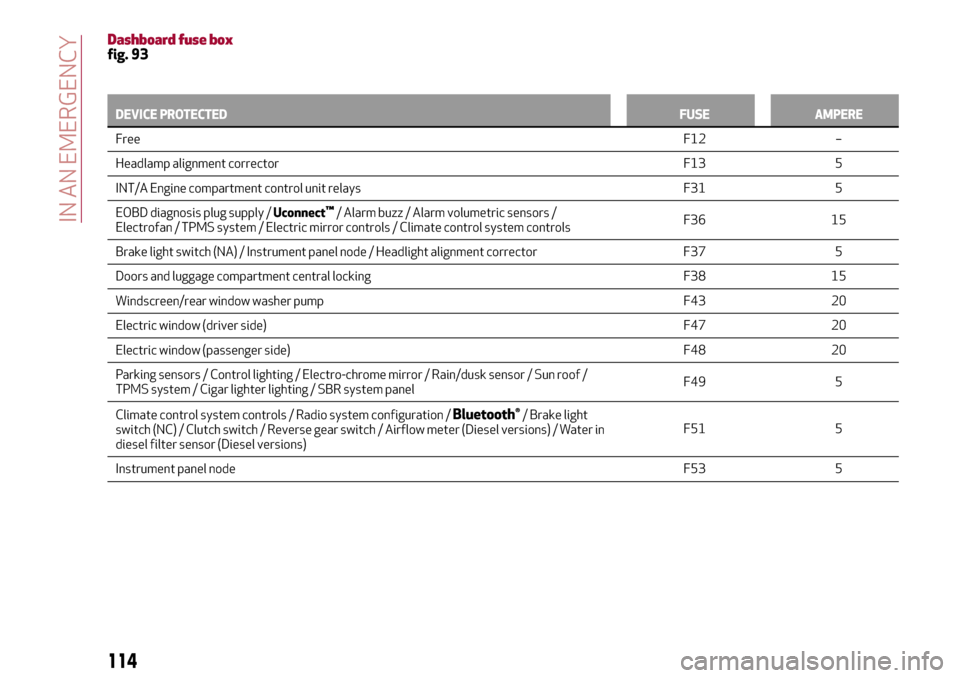
Dashboard fuse boxfig. 93
DEVICE PROTECTEDFUSE AMPERE
FreeF12 –
Headlamp alignment corrector F13 5
INT/A Engine compartment control unit relays F31 5
EOBD diagnosis plug supply /Uconnect
™/ Alarm buzz / Alarm volumetric sensors /
Electrofan / TPMS system / Electric mirror controls / Climate control system controlsF36 15
Brake light switch (NA) / Instrument panel node / Headlight alignment corrector F37 5
Doors and luggage compartment central locking F38 15
Windscreen/rear window washer pump F43 20
Electric window (driver side)F47 20
Electric window (passenger side) F48 20
Parking sensors / Control lighting / Electro-chrome mirror / Rain/dusk sensor / Sun roof /
TPMS system / Cigar lighter lighting / SBR system panelF49 5
Climate control system controls / Radio system configuration /
Bluetooth®/ Brake light
switch (NC) / Clutch switch / Reverse gear switch / Airflow meter (Diesel versions) / Water in
diesel filter sensor (Diesel versions)F51 5
Instrument panel nodeF53 5
114
IN AN EMERGENCY
Page 123 of 212
the kit from the specific compartment;
remove the adhesive label of speed 3
(see previous paragraph) and apply it in a
visible position. Wear the protective
gloves provided;
remove the cap from the valve of the
punctured tyre and connect and firmly
tighten the transparent tube of the
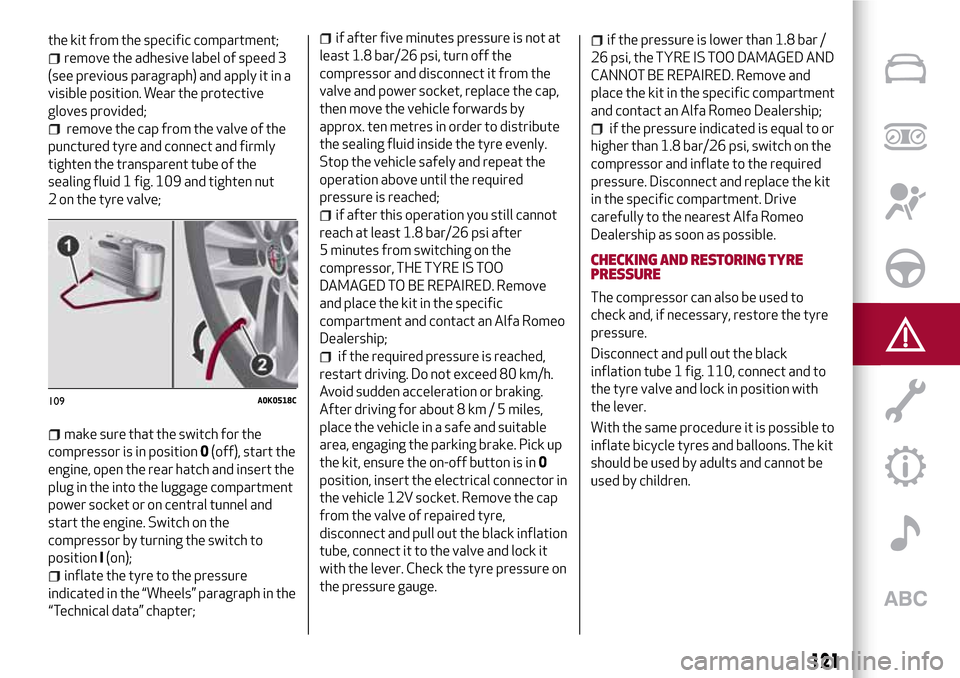
sealing fluid 1 fig. 109 and tighten nut
2 on the tyre valve;
make sure that the switch for the
compressor is in position0(off), start the
engine, open the rear hatch and insert the
plug in the into the luggage compartment
power socket or on central tunnel and
start the engine. Switch on the
compressor by turning the switch to
positionI(on);
inflate the tyre to the pressure
indicated in the “Wheels” paragraph in the
“Technical data” chapter;
if after five minutes pressure is not at
least 1.8 bar/26 psi, turn off the
compressor and disconnect it from the
valve and power socket, replace the cap,
then move the vehicle forwards by
approx. ten metres in order to distribute
the sealing fluid inside the tyre evenly.
Stop the vehicle safely and repeat the
operation above until the required
pressure is reached;
if after this operation you still cannot
reach at least 1.8 bar/26 psi after
5 minutes from switching on the
compressor, THE TYRE IS TOO
DAMAGED TO BE REPAIRED. Remove
and place the kit in the specific
compartment and contact an Alfa Romeo
Dealership;
if the required pressure is reached,
restart driving. Do not exceed 80 km/h.
Avoid sudden acceleration or braking.
After driving for about 8 km / 5 miles,
place the vehicle in a safe and suitable
area, engaging the parking brake. Pick up
the kit, ensure the on-off button is in0
position, insert the electrical connector in
the vehicle 12V socket. Remove the cap
from the valve of repaired tyre,
disconnect and pull out the black inflation
tube, connect it to the valve and lock it
with the lever. Check the tyre pressure on
the pressure gauge.
if the pressure is lower than 1.8 bar /
26 psi, the TYRE IS TOO DAMAGED AND
CANNOT BE REPAIRED. Remove and
place the kit in the specific compartment
and contact an Alfa Romeo Dealership;
if the pressure indicated is equal to or
higher than 1.8 bar/26 psi, switch on the
compressor and inflate to the required
pressure. Disconnect and replace the kit
in the specific compartment. Drive
carefully to the nearest Alfa Romeo
Dealership as soon as possible.
CHECKING AND RESTORING TYRE
PRESSURE
The compressor can also be used to
check and, if necessary, restore the tyre
pressure.
Disconnect and pull out the black
inflation tube 1 fig. 110, connect and to
the tyre valve and lock in position with
the lever.
With the same procedure it is possible to
inflate bicycle tyres and balloons. The kit
should be used by adults and cannot be
used by children.
109A0K0518C
121
Page 133 of 212
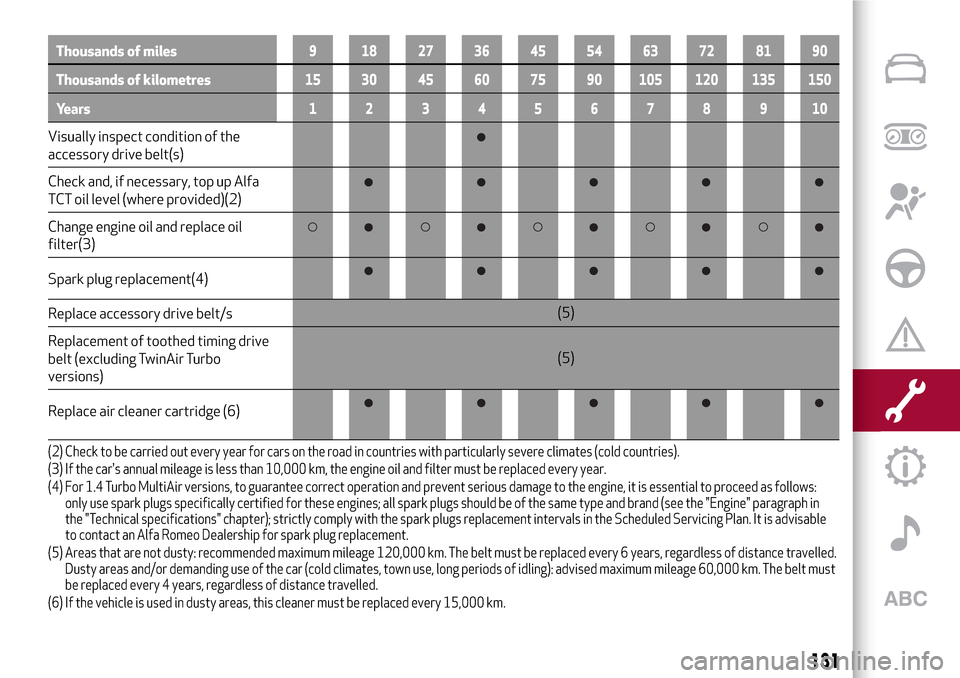
Thousands of miles9 182736455463728190
Thousands of kilometres15 30 45 60 75 90 105 120 135 150
Years12345678910
Visually inspect condition of the
accessory drive belt(s)
Check and, if necessary, top up Alfa
TCT oil level (where provided)(2)
Change engine oil and replace oil
filter(3)
Spark plug replacement(4)
Replace accessory drive belt/s(5)
Replacement of toothed timing drive
belt (excluding TwinAir Turbo
versions)(5)
Replace air cleaner cartridge (6)
(2) Check to be carried out every year for cars on the road in countries with particularly severe climates (cold countries).
(3) If the car's annual mileage is less than 10,000 km, the engine oil and filter must be replaced every year.
(4) For 1.4 Turbo MultiAir versions, to guarantee correct operation and prevent serious damage to the engine, it is essential to proceed as follows:
only use spark plugs specifically certified for these engines; all spark plugs should be of the same type and brand (see the "Engine" paragraph in
the "Technical specifications" chapter); strictly comply with the spark plugs replacement intervals in the Scheduled Servicing Plan. It is advisable
to contact an Alfa Romeo Dealership for spark plug replacement.
(5) Areas that are not dusty: recommended maximum mileage 120,000 km. The belt must be replaced every 6 years, regardless of distance travelled.
Dusty areas and/or demanding use of the car (cold climates, town use, long periods of idling): advised maximum mileage 60,000 km. The belt must
be replaced every 4 years, regardless of distance travelled.
(6) If the vehicle is used in dusty areas, this cleaner must be replaced every 15,000 km.
131
Page 144 of 212
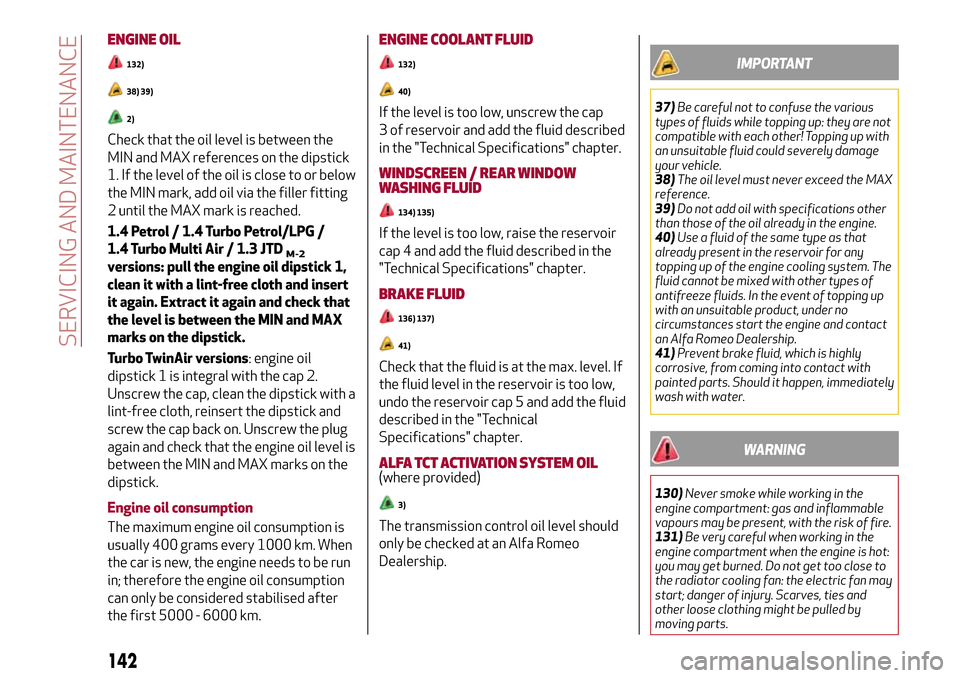
ENGINE OIL
132)
38) 39)
2)
Check that the oil level is between the
MIN and MAX references on the dipstick
1. If the level of the oil is close to or below
the MIN mark, add oil via the filler fitting
2 until the MAX mark is reached.
1.4 Petrol / 1.4 Turbo Petrol/LPG /
1.4 Turbo Multi Air / 1.3 JTD
M-2versions: pull the engine oil dipstick 1,
clean it with a lint-free cloth and insert
it again. Extract it again and check that
the level is between the MIN and MAX
marks on the dipstick.
Turbo TwinAir versions: engine oil
dipstick 1 is integral with the cap 2.
Unscrew the cap, clean the dipstick with a
lint-free cloth, reinsert the dipstick and
screw the cap back on. Unscrew the plug
again and check that the engine oil level is
between the MIN and MAX marks on the
dipstick.
Engine oil consumption
The maximum engine oil consumption is
usually 400 grams every 1000 km. When
the car is new, the engine needs to be run
in; therefore the engine oil consumption
can only be considered stabilised after
the first 5000 - 6000 km.
ENGINE COOLANT FLUID
132)
40)
If the level is too low, unscrew the cap
3 of reservoir and add the fluid described
in the "Technical Specifications" chapter.
WINDSCREEN / REAR WINDOW
WASHING FLUID
134) 135)
If the level is too low, raise the reservoir
cap 4 and add the fluid described in the
"Technical Specifications" chapter.
BRAKE FLUID
136) 137)
41)
Check that the fluid is at the max. level. If
the fluid level in the reservoir is too low,
undo the reservoir cap 5 and add the fluid
described in the "Technical
Specifications" chapter.
ALFA TCT ACTIVATIONSYSTEM OIL(where provided)
3)
The transmission control oil level should
only be checked at an Alfa Romeo
Dealership.
IMPORTANT
37)Be careful not to confuse the various
types of fluids while topping up: they are not
compatible with each other! Topping up with
an unsuitable fluid could severely damage
your vehicle.
38)The oil level must never exceed the MAX
reference.
39)Do not add oil with specifications other
than those of the oil already in the engine.
40)Use a fluid of the same type as that
already present in the reservoir for any
topping up of the engine cooling system. The
fluid cannot be mixed with other types of
antifreeze fluids. In the event of topping up
with an unsuitable product, under no
circumstances start the engine and contact
an Alfa Romeo Dealership.
41)Prevent brake fluid, which is highly
corrosive, from coming into contact with
painted parts. Should it happen, immediately
wash with water.
WARNING
130)Never smoke while working in the
engine compartment: gas and inflammable
vapours may be present, with the risk of fire.
131)Be very careful when working in the
engine compartment when the engine is hot:
you may get burned. Do not get too close to
the radiator cooling fan: the electric fan may
start; danger of injury. Scarves, ties and
other loose clothing might be pulled by
moving parts.
142
SERVICING AND MAINTENANCE
Page 145 of 212
132)If the engine oil is being topped up, wait
for the engine to cool down before loosening
the filler cap, particularly for vehicles with
aluminium cap (where provided). WARNING:
risk of burns!
133)The cooling system is pressurised. If
necessary, only replace the plug with
another original or the operation of the
system may be adversely affected. Do not
remove the reservoir plug when the engine is
hot: you risk scalding yourself.
134)Do not travel with the windscreen
washer fluid reservoir empty: the
windscreen washer is essential for
improving visibility. Repeated operation of
the system without fluid could damage or
cause rapid deterioration of some system
components.
135)Some commercial additives for
windscreen washer fluid are flammable. The
engine compartment contains hot
components which may start a fire.
136)Brake fluid is poisonous and highly
corrosive. In the event of accidental contact,
immediately wash the affected parts with
water and mild soap. Then rinse thoroughly.
Call a doctor immediately if swallowed.
137)The symbol
, on the brake fluid
container indicates if a brake fluid is
synthetic or mineral-based. Use of mineral
type fluids will damage the special rubber
seals of the braking system beyond repair.
IMPORTANT
2)Used engine oil and oil filters contain
substances which are harmful to the
environment. To change the oil and filters, we
advise you to contact an Alfa Romeo
Dealership.
3)Used transmission fluid contains
substances that are harmful to the
environment. You are advised to contact an
Alfa Romeo Dealership for oil changes.
BATTERY RECHARGING
IMPORTANT The battery recharging
procedure is given as information only. To
carry out this operation contact an Alfa
Romeo Dealership.
IMPORTANT After turning the ignition
key to STOP and having closed the
driver's side door, wait at least one
minute before disconnecting and then
reconnecting the electrical supply to the
battery.
Charging should be slow at a low ampere
rating for approximately 24 hours.
Charging for a longer time may damage
the battery.
IMPORTANT The cables of the electrical
system must be correctly reconnected to
the battery, i.e. the positive cable (+) to
the positive terminal and the negative
cable (–) to the negative terminal. The
battery terminals are marked with the
positive (+) and negative (–) symbols, and
are shown on the battery cover. The
battery terminals must also be
corrosion-free and firmly secured to the
terminals. If a "quick-type" battery
charger is used with the battery fitted on
the vehicle, before connecting it
disconnect both cables of the battery
itself. Do not use a "quick-type" battery
charger to provide the starting voltage.
The cables of the electrical system must
143
Page 156 of 212
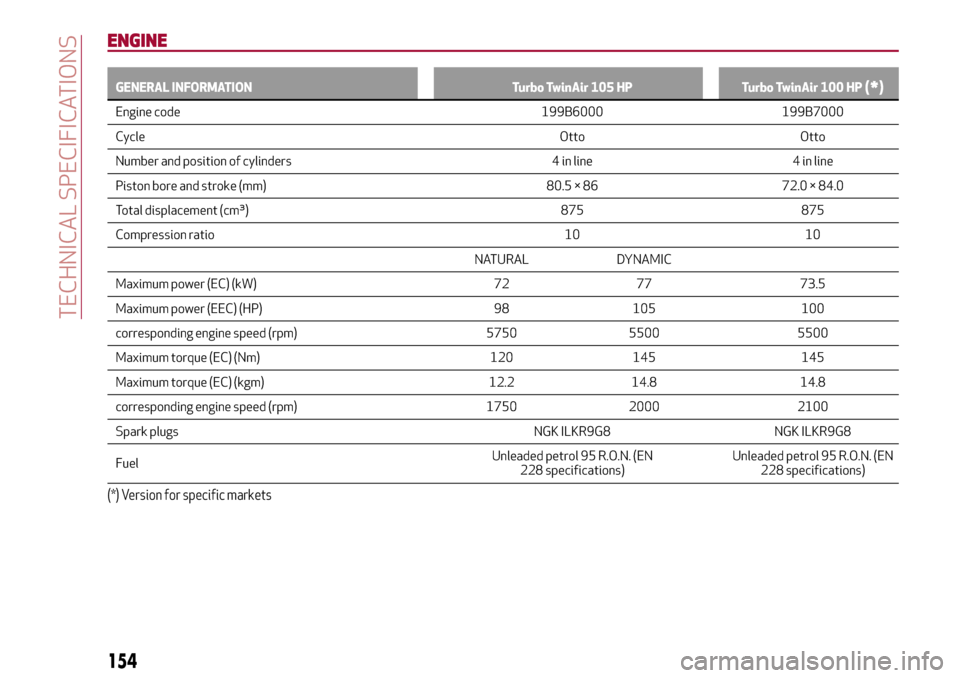
ENGINE
GENERAL INFORMATION Turbo TwinAir 105 HP Turbo TwinAir 100 HP(*)
Engine code 199B6000 199B7000
CycleOtto Otto
Number and position of cylinders 4 in line 4 in line
Piston bore and stroke (mm) 80.5 × 86 72.0 × 84.0
Total displacement (cm³) 875 875
Compression ratio 10 10
NATURAL DYNAMIC
Maximum power (EC) (kW) 72 77 73.5
Maximum power (EEC) (HP) 98 105 100
corresponding engine speed (rpm) 5750 5500 5500
Maximum torque (EC) (Nm) 120 145 145
Maximum torque (EC) (kgm) 12.2 14.8 14.8
corresponding engine speed (rpm) 1750 2000 2100
Spark plugs NGK ILKR9G8 NGK ILKR9G8
FuelUnleaded petrol 95 R.O.N. (EN
228 specifications)Unleaded petrol 95 R.O.N. (EN
228 specifications)
(*) Version for specific markets
154
TECHNICAL SPECIFICATIONS