seat belts Alfa Romeo MiTo 2017 Owner's Manual
[x] Cancel search | Manufacturer: ALFA ROMEO, Model Year: 2017, Model line: MiTo, Model: Alfa Romeo MiTo 2017Pages: 212, PDF Size: 4.36 MB
Page 17 of 212
Height adjustment
(where provided)
Move lever 2 up or down until the
required height is reached.
IMPORTANT Carry out the adjustment
whilst seated in the driver's seat.
Backrest angle adjustment
Turn knob 3 until the required position is
reached.
Lumbar adjustment
(where provided)
Turn knob 4 until the required position is
reached.
Folding the seats
(where provided)
To access the rear seats, pull handle
5 upwards: the backrest will fold
forwards and the seat will slide forwards
when you push the backrest. Moving back
the backrest will return the seat to its
original position.
Heated seats
(where provided)
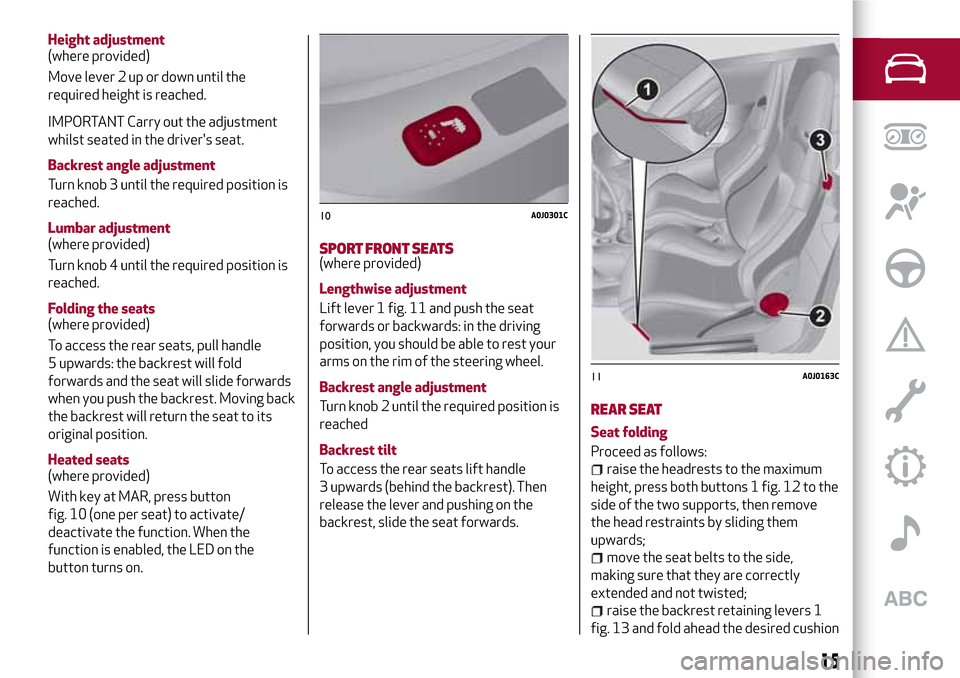
With key at MAR, press button
fig. 10 (one per seat) to activate/
deactivate the function. When the
function is enabled, the LED on the
button turns on.
SPORT FRONT SEATS(where provided)
Lengthwise adjustment
Lift lever 1 fig. 11 and push the seat
forwards or backwards: in the driving
position, you should be able to rest your
arms on the rim of the steering wheel.
Backrest angle adjustment
Turn knob 2 until the required position is
reached
Backrest tilt
To access the rear seats lift handle
3 upwards (behind the backrest). Then
release the lever and pushing on the
backrest, slide the seat forwards.
REAR SEAT
Seat folding
Proceed as follows:
raise the headrests to the maximum
height, press both buttons 1 fig. 12 to the
side of the two supports, then remove
the head restraints by sliding them
upwards;
move the seat belts to the side,
making sure that they are correctly
extended and not twisted;
raise the backrest retaining levers 1
fig. 13 and fold ahead the desired cushion
10A0J0301C
11A0J0163C
15
Page 18 of 212
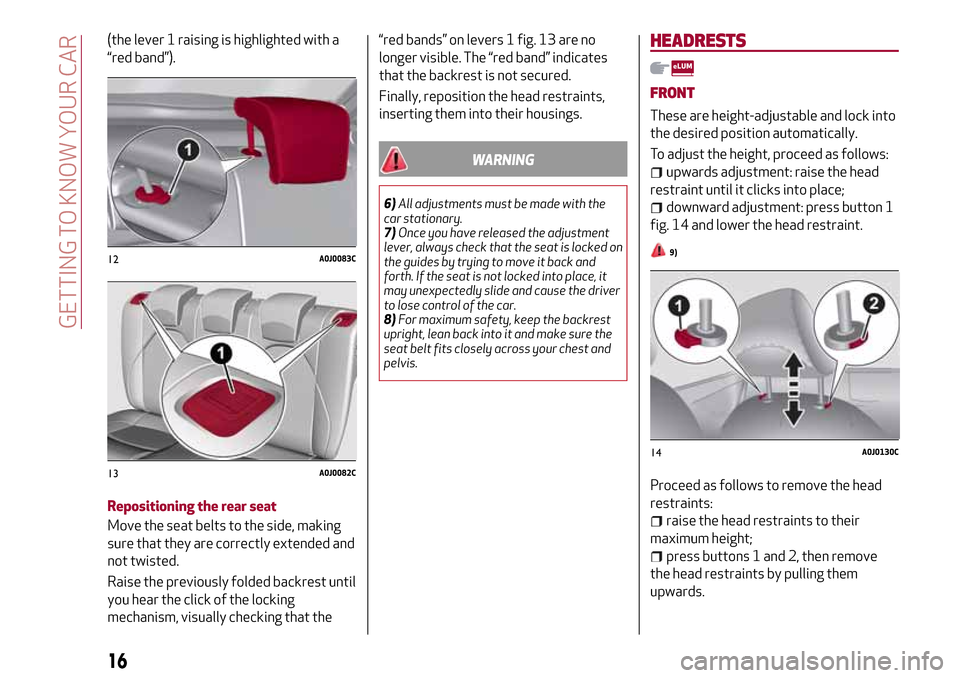
(the lever 1 raising is highlighted with a
“red band”).
Repositioning the rear seat
Move the seat belts to the side, making
sure that they are correctly extended and
not twisted.
Raise the previously folded backrest until
you hear the click of the locking
mechanism, visually checking that the“red bands” on levers 1 fig. 13 are no
longer visible. The “red band” indicates
that the backrest is not secured.
Finally, reposition the head restraints,
inserting them into their housings.
WARNING
6)All adjustments must be made with the
car stationary.
7)Once you have released the adjustment
lever, always check that the seat is locked on
the guides by trying to move it back and
forth. If the seat is not locked into place, it
may unexpectedly slide and cause the driver
to lose control of the car.
8)For maximum safety, keep the backrest
upright, lean back into it and make sure the
seat belt fits closely across your chest and
pelvis.
HEADRESTS
FRONT
These are height-adjustable and lock into
the desired position automatically.
To adjust the height, proceed as follows:
upwards adjustment: raise the head
restraint until it clicks into place;
downward adjustment: press button 1
fig. 14 and lower the head restraint.
9)
Proceed as follows to remove the head
restraints:
raise the head restraints to their
maximum height;
press buttons 1 and 2, then remove
the head restraints by pulling them
upwards.
12A0J0083C
13A0J0082C
14A0J0130C
16
GETTING TO KNOW YOUR CAR
Page 67 of 212
The chapter that you are about to read is very important: it
describes the safety systems with which the car is equipped and
provides instructions on how to use them correctly.
SAFETY
ACTIVE SAFETY SYSTEMS . . . . . . . . ................66
TPMS (Tyre Pressure Monitoring System) ................68
SEATBELTS .................................70
SBR SYSTEM (Seat Belt Reminder) . . . . ...............72
PRE-TENSIONERS . .............................73
CARRYING CHILDREN SAFELY . . . . . .................75
FITTING "UNIVERSAL" CHILD RESTRAINT SYSTEM (with seat
belts)......................................76
ISOFIX CHILD RESTRAINT SYSTEM SETUP . . . . . . . . . . . . . .79
FRONT AIRBAGS . . .............................81
SIDE AIRBAGS (SIDE BAG - WINDOW BAG) . . . . . . .........86
Page 72 of 212
WARNING
47)The presence of the TPMS does not
permit the driver to neglect regular checks
of the tyre pressure, including for the spare
wheel.
48)Tyre pressure must be checked with
tyres cold. Should it become necessary for
whatever reason to check pressure with
warm tyres, do not reduce pressure even
though it is higher than the prescribed value,
but repeat the check when tyres are cold.
49)Should one or more wheels be fitted
without sensors, the system will no longer be
available and, in addition to the TPMS
warning light flashing for less than one
minute before becoming constant, a warning
message will be shown on the display, until
4 wheels with sensors are fitted again.
50)The TPMS cannot warn of sudden
decreases in tyre pressure (for example
when a tyre bursts). In this case, stop the car,
braking with caution and avoiding abrupt
steering.
51)Replacing standard tyres with winter
tyres (and vice versa) requires TPMS
adjustment that must only be performed by
a dedicated Alfa Romeo Dealership.
52)Changes in outside temperature may
cause tyre pressures to vary. The TPMS
system may temporarily indicate
insufficient pressure. In this case, check the
tyre pressure when cold and, if necessary,
restore the inflation values.53)When a tyre is removed, it is advisable
to replace the rubber valve seal as well:
contact a dedicated Alfa Romeo Dealership.
Tyre and/or rim fitting/removal operations
require specific precautions; to avoid
damaging or fitting the sensors incorrectly,
tyre and/or rim fitting/removal operations
should only be carried out by specialised
staff. Contact a dedicated Alfa Romeo
Dealership.
54)Intense radio-frequency interference
may prevent the correct operation of the
TPMS. This condition will be indicated by a
message on the display. The message will
disappear automatically as soon as the
radio-frequency interference ceases to
affect the system.
55)The tyre repair kit (Fix&Go) provided
with the vehicle (for versions/markets,
where provided) is compatible with the
TPMS sensors; using sealants not equivalent
with that in the original kit may adversely
affect its operation. If sealants not
equivalent with the original one are used, it is
recommended to have the TPMS sensors
checked by a qualified repair centre.
SEAT BELTS
USING THE SEAT BELTS
56) 57) 58)
All vehicle seats are equipped with seat
belts with three anchor points and a
retractor.
The retractor mechanism operates
locking the belt in the event of sharp
braking or strong deceleration due to an
impact. This allows the belt strap to slide
freely and to adapt to the body of the
occupant. In the event of an accident, the
belt will lock reducing the risk of impact
inside the passenger compartment and
of being projected outside the vehicle.
The driver is responsible for respecting,
and ensuring that all the other occupants
of the vehicle also respect, the local laws
in force in relation to the use of the seat
belts.
Always fasten the seat belts before
setting off.
Using the seat belts
The belt should be worn keeping the
torso straight and rested against the
backrest.
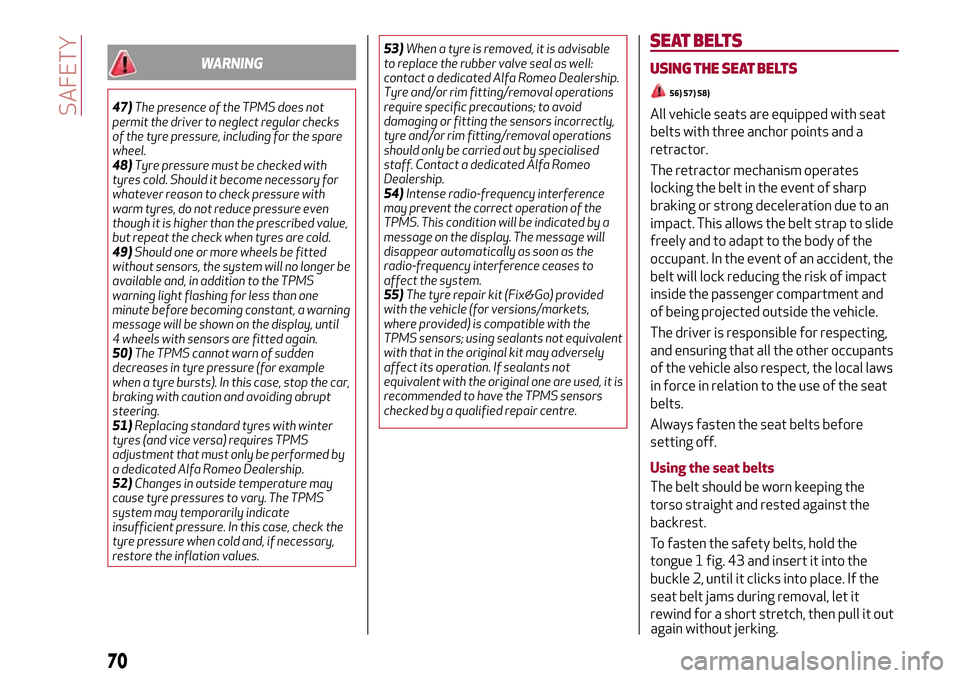
To fasten the safety belts, hold the
tongue 1 fig. 43 and insert it into the
buckle 2, until it clicks into place. If the
seat belt jams during removal, let it
rewind for a short stretch, then pull it out
70
SAFETY
again without jerking.
Page 73 of 212
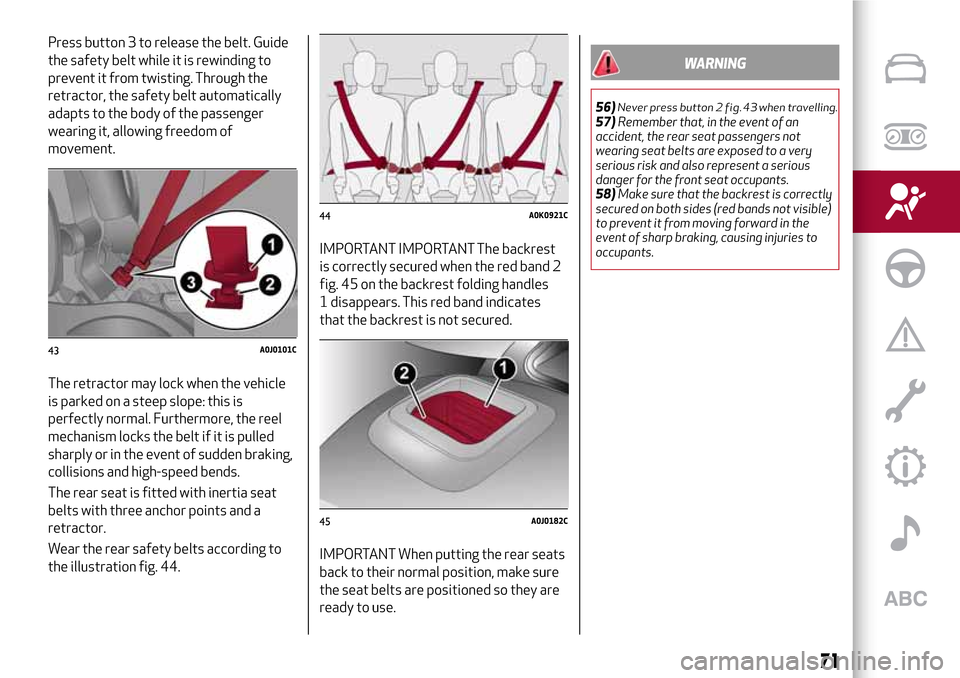
Press button 3 to release the belt. Guide
the safety belt while it is rewinding to
prevent it from twisting. Through the
retractor, the safety belt automatically
adapts to the body of the passenger
wearing it, allowing freedom of
movement.
The retractor may lock when the vehicle
is parked on a steep slope: this is
perfectly normal. Furthermore, the reel
mechanism locks the belt if it is pulled
sharply or in the event of sudden braking,
collisions and high-speed bends.
The rear seat is fitted with inertia seat
belts with three anchor points and a
retractor.
Wear the rear safety belts according to
the illustration fig. 44.
IMPORTANT IMPORTANT The backrest
is correctly secured when the red band 2
fig. 45 on the backrest folding handles
1 disappears. This red band indicates
that the backrest is not secured.
IMPORTANT When putting the rear seats
back to their normal position, make sure
the seat belts are positioned so they are
ready to use.
WARNING
56)Never press button 2 fig. 43 when travelling.57)Remember that, in the event of an
accident, the rear seat passengers not
wearing seat belts are exposed to a very
serious risk and also represent a serious
danger for the front seat occupants.
58)Make sure that the backrest is correctly
secured on both sides (red bands not visible)
to prevent it from moving forward in the
event of sharp braking, causing injuries to
occupants.
43A0J0101C
44A0K0921C
45A0J0182C
71
Page 74 of 212
SBR SYSTEM (Seat Belt
Reminder)
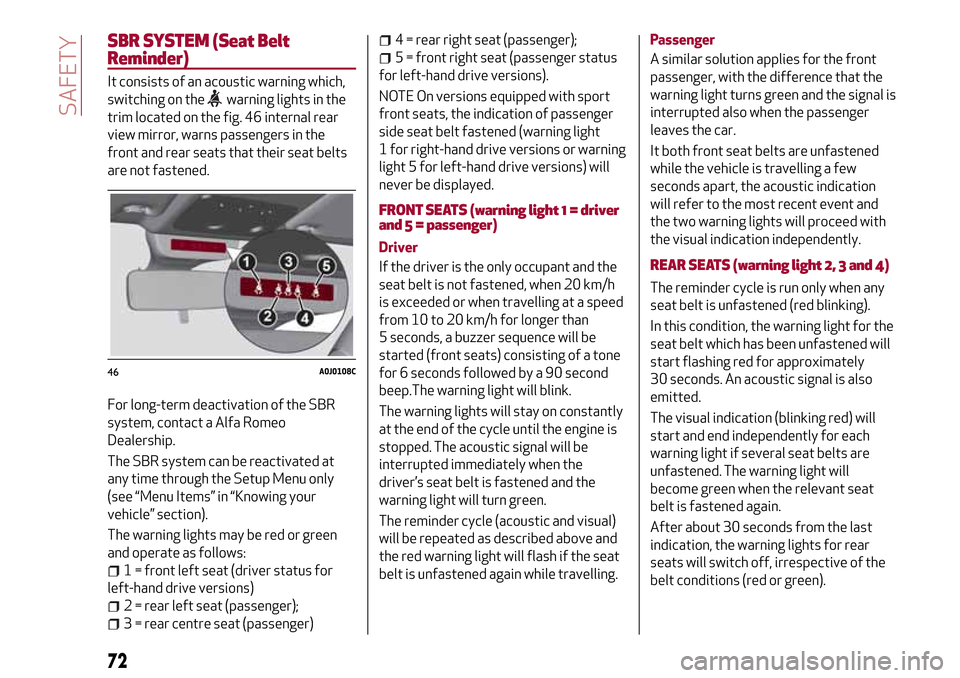
It consists of an acoustic warning which,
switching on the
warning lights in the
trim located on the fig. 46 internal rear
view mirror, warns passengers in the
front and rear seats that their seat belts
are not fastened.
For long-term deactivation of the SBR
system, contact a Alfa Romeo
Dealership.
The SBR system can be reactivated at
any time through the Setup Menu only
(see “Menu Items” in “Knowing your
vehicle” section).
The warning lights may be red or green
and operate as follows:
1 = front left seat (driver status for
left-hand drive versions)
2 = rear left seat (passenger);
3 = rear centre seat (passenger)
4 = rear right seat (passenger);
5 = front right seat (passenger status
for left-hand drive versions).
NOTE On versions equipped with sport
front seats, the indication of passenger
side seat belt fastened (warning light
1 for right-hand drive versions or warning
light 5 for left-hand drive versions) will
never be displayed.
FRONT SEATS (warning light 1 = driver
and 5 = passenger)
Driver
If the driver is the only occupant and the
seat belt is not fastened, when 20 km/h
is exceeded or when travelling at a speed
from 10 to 20 km/h for longer than
5 seconds, a buzzer sequence will be
started (front seats) consisting of a tone
for 6 seconds followed by a 90 second
beep.The warning light will blink.
The warning lights will stay on constantly
at the end of the cycle until the engine is
stopped. The acoustic signal will be
interrupted immediately when the
driver’s seat belt is fastened and the
warning light will turn green.
The reminder cycle (acoustic and visual)
will be repeated as described above and
the red warning light will flash if the seat
belt is unfastened again while travelling.Passenger
A similar solution applies for the front
passenger, with the difference that the
warning light turns green and the signal is
interrupted also when the passenger
leaves the car.
It both front seat belts are unfastened
while the vehicle is travelling a few
seconds apart, the acoustic indication
will refer to the most recent event and
the two warning lights will proceed with
the visual indication independently.
REAR SEATS (warning light 2, 3 and 4)
The reminder cycle is run only when any
seat belt is unfastened (red blinking).
In this condition, the warning light for the
seat belt which has been unfastened will
start flashing red for approximately
30 seconds. An acoustic signal is also
emitted.
The visual indication (blinking red) will
start and end independently for each
warning light if several seat belts are
unfastened. The warning light will
become green when the relevant seat
belt is fastened again.
After about 30 seconds from the last
indication, the warning lights for rear
seats will switch off, irrespective of the
belt conditions (red or green).
46A0J0108C
72
SAFETY
Page 75 of 212
All warning lights will remain off if all
the seat belts (front and rear) are already
fastened when the key it turned to MAR.
All the warning lights will come on
when at least one belt changes from
fastened to unfastened status or vice
versa.
PRE-TENSIONERS
59) 60)
The vehicle is equipped with front seat
belt pretensioners, which draw back the
seat belts by several centimetres in the
event of a strong frontal impact. This
guarantees the perfect adherence of the
seat belts to the occupant's bodies
before the retention action begins.
It is evident that the pretensioners have
operated when the belt withdraws
toward the retractor.
This car is also equipped with a second
pretensioner (fitted in the kick plate
area). Its activation is signalled by the
shortening of the metal cable.
A slight discharge of smoke may be
produced during the activation of the
pretensioner which is not harmful and
does not involve any fire hazard.
IMPORTANT To obtain the highest
degree of protection from the action of
the pretensioner, wear the seat belt tight
to the torso and pelvis.
The pretensioner does not require any
maintenance or lubrication: any changes
to its original conditions will invalidate its
efficiency. If, due to unusual natural
events (floods, sea storms, etc.), the
device has been affected by water and/or
mud, contact an Alfa Romeo Dealership
to have it replaced.
LOAD LIMITERS
To increase passenger safety, the front
seat belt reels contain a load limiter
which allows the force acting on the chest
and shoulders to be modulated during the
belt restraining action in the event of a
frontal impact.
GENERAL INSTRUCTIONS FOR USING
THE SEAT BELTS
61) 62)
Seat belts must also be worn by pregnant
women: the risk of injury in the event of
an accident is reduced for them and the
unborn child if they are wearing a seat
belt.
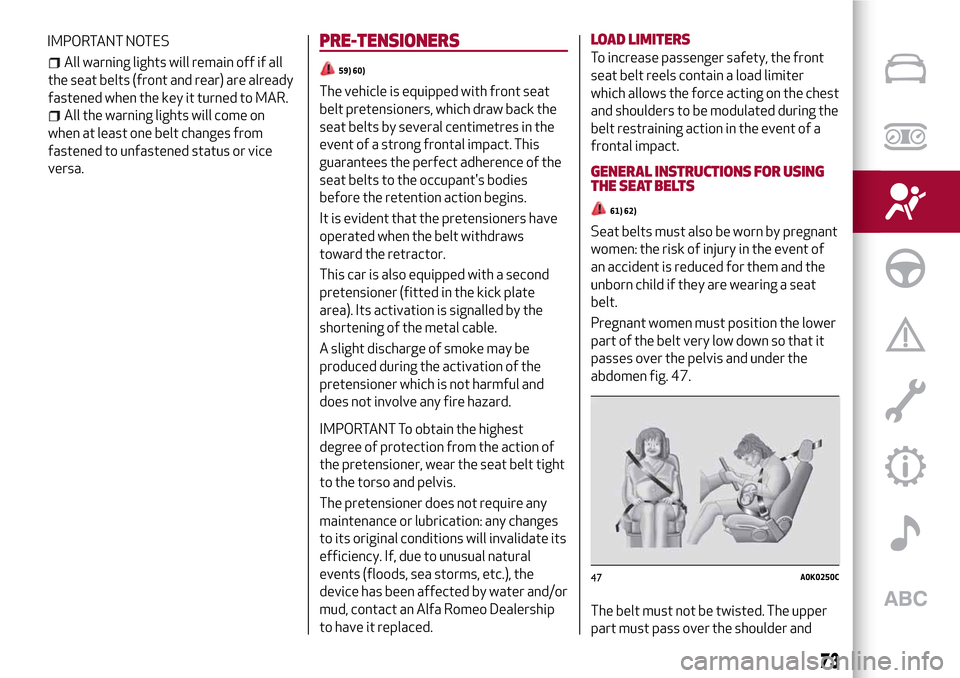
Pregnant women must position the lower
part of the belt very low down so that it
passes over the pelvis and under the
abdomen fig. 47.
The belt must not be twisted. The upper
part must pass over the shoulder and
47A0K0250C
73
IMPORTANT NOTES
Page 76 of 212

cross the chest diagonally. The lower part
must adhere to the pelvis
Each seat belt must be used by only one
person. Never travel with a child sitting
on the passenger's lap and a single belt to
protect them both fig. 49. In general, do
not place any objects between the person
and the belt.
SEAT BELTS MAINTENANCE
16)
always use the seat belt with the strap
well stretched and not twisted; make
sure that it is free to run without
obstructions;
replace the belt after an accident of a
certain severity even if it does not appear
to be damaged. Always replace the seat
belt if the pretensioners were deployed;
check seat belt operation as follows:
attach the seat belt and pull it hard;
prevent the retractors from getting
wet: their correct operation is only
guaranteed if water does not get inside;
replace the seat belt when it shows
wear or cuts.
WARNING
59)The pretensioner may be used only once.
After its activation, contact an Alfa Romeo
Dealership to have it replaced.
60)Removing or tampering with seat belt
and pretensioner components is strictly
prohibited. Any intervention on these
components must be performed by qualified
and authorised technicians. Always contact
a dedicated Alfa Romeo Dealership.
61)For maximum safety, keep the backrest
upright, lean back into it and make sure the
seat belt fits closely across your chest and
pelvis. Always fasten the seat belts for both
the front and rear seats! Travelling without
wearing seat belts will increase the risk of
serious injury and even death in the event of
an accident.
62)If the belt has been subjected to high
levels of stress, for example after an
accident, it should be changed completely
together with the attachments, attachment
fixing screws and the pretensioner. In fact,
even if the belt has no visible defects, it may
have lost its resilience.
IMPORTANT
16)Operations which lead to impacts,
vibrations or localised heating (over 100°C
for a maximum of six hours) in the area
around the pretensioner may cause damage
or make it deploy. Contact an Alfa Romeo
Dealership should intervention be necessary
on these components.
49A0K0013C
74
SAFETY
Page 77 of 212
CARRYING CHILDREN SAFELY
For optimal protection in the event of an
impact, all occupants must be seated and
wearing adequate restraint systems,
including newborn and other children!
This prescription is compulsory in all EC
countries according to EC Directive
2003/20/EC.
Children below the height of 1.50 metres
and up to 12 years must be protected
with suitable restraint systems and be
seated on the rear seats. Statistics on
accidents indicate that the rear seats
offer greater safety for children.
Compared with an adult, a child's head is
larger and heavier in proportion to their
body and the child's muscular and bone
structures are not fully developed.
Therefore, correct restraint systems
other than adult seat belts are necessary
to reduce as much as possible the risk of
injuries in case of accident, braking or
sudden manoeuvre.
Children must be seated safely and
comfortably. Depending on the
characteristics of the child restraint
systems used, you are advised to keep
children in rearward facing child restraint
systems for as long as possible (at least
until 3-4 years old), since this is the most
protected position in the event of an
impact.
63) 64) 65) 66)
The choice of the most suitable child
restraint device depends on the weight of
the child; there are various types of child
restraint systems and you are advised
always to choose the one that is most
suitable for the child.
When over 1.50 m in height, from the
point of view of restraint systems,
children are considered as adults and
wear seat belts normally.
In Europe the characteristics of child
restraint systems are ruled by the
regulation ECE-R44, dividing them into
five weight groups:
Group Weight groups
Group 0up to 10 kg in
weight
Group 0+up to 13 kg in
weight
Group 1 9 - 18 kg
Group 2 15 - 25 kg
Group 3 22 - 36 kg
All restraint devices must bear the
certification data, together with the
control mark, on a label solidly fixed to
the child restraint system which must
never be removed.
Lineaccessori MOPAR® includes child
restraint systems for each weight group.These devices are recommended having
been specifically tested for Alfa Romeo
cars.
WARNING
63)SEVERE DANGER When a front
passenger airbag is fitted, do not install
rearward facing child restraint systems on
the front passenger seat. Deployment of the
airbag in an accident could cause fatal
injuries to the child regardless of the
severity of the collision. It is advisable to
always carry children in a child restraint
system on the rear seat, which is the most
protected position in the event of a collision.
64)On the sun visor there is a label with
suitable symbols reminding the user that it is
compulsory to deactivate the airbag if a
rearward facing child restraint system is
fitted. Always comply with the instructions
on the passenger side sun visor (see the
"Supplementary Restraint System (SRS) -
Airbag" paragraph).
65)Should it be necessary to carry a child on
the passenger side front seat in a rear facing
child restraint system, the passenger side
front airbag and side bag must be
deactivated through the display main menu
(see the "Display" paragraph, "Knowing the
instrument panel" chapter), verifying
deactivation by checking whether the
OFF LED has switched on in the trim
located on the dashboard. Move the
passenger's seat as far back as possible to
avoid contact between the child seat and the
dashboard.
75
Page 78 of 212
66)Do not move the front or rear seat if a
child is seated on it or on the dedicated child
restraint systemFITTING "UNIVERSAL" CHILD
RESTRAINTSYSTEM (with seat
belts)
GROUP 0 and 0+
68) 69) 70) 71) 72)
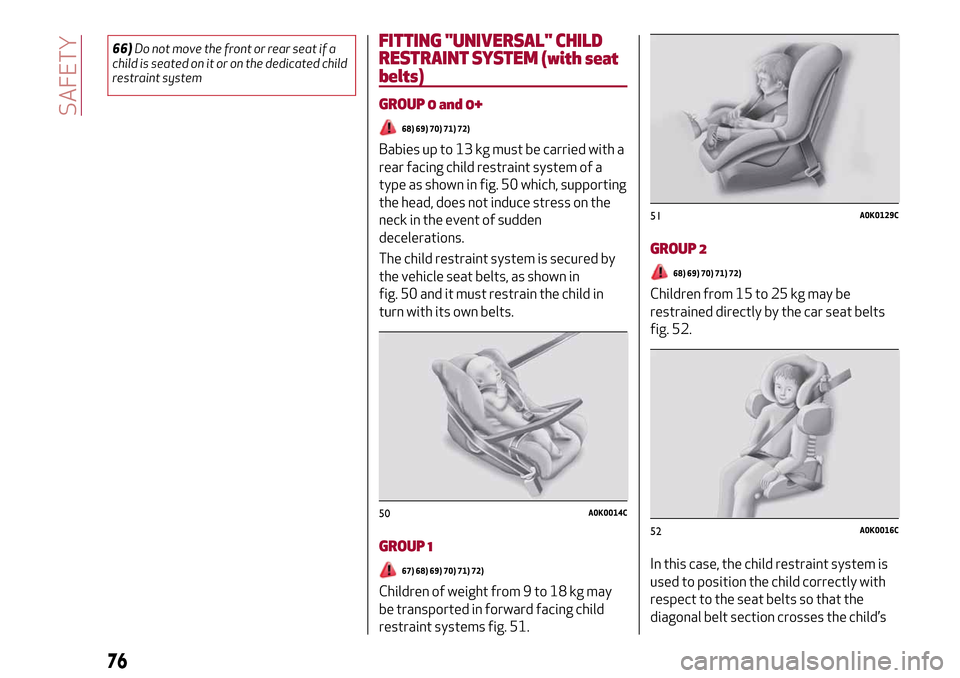
Babies up to 13 kg must be carried with a
rear facing child restraint system of a
type as shown in fig. 50 which, supporting
the head, does not induce stress on the
neck in the event of sudden
decelerations.
The child restraint system is secured by
the vehicle seat belts, as shown in
fig. 50 and it must restrain the child in
turn with its own belts.
GROUP 1
67) 68) 69) 70) 71) 72)
Children of weight from 9 to 18 kg may
be transported in forward facing child
restraint systems fig. 51.
GROUP 2
68) 69) 70) 71) 72)
Children from 15 to 25 kg may be
restrained directly by the car seat belts
fig. 52.
In this case, the child restraint system is
used to position the child correctly with
respect to the seat belts so that the
diagonal belt section crosses the child’s
50A0K0014C
51A0K0129C
52A0K0016C
76
SAFETY