battery Alfa Romeo MiTo 2020 Owner handbook (in English)
[x] Cancel search | Manufacturer: ALFA ROMEO, Model Year: 2020, Model line: MiTo, Model: Alfa Romeo MiTo 2020Pages: 212, PDF Size: 5.18 MB
Page 112 of 212
Direction indicators
To replace the bulb, lift the luggage
compartment side trim, turn bulb-holder
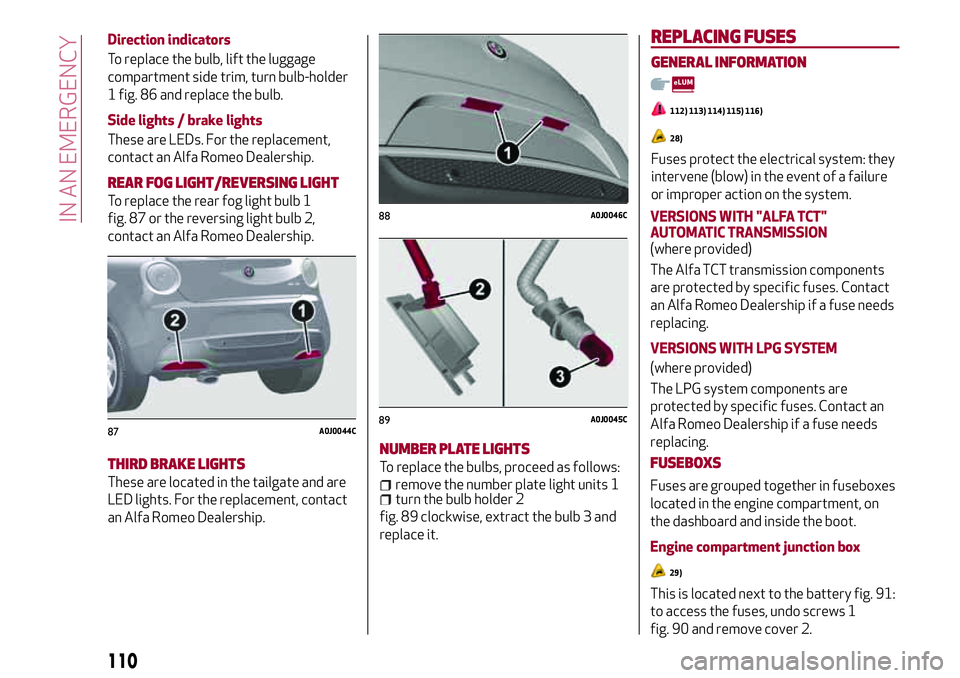
1 fig. 86 and replace the bulb.
Side lights / brake lights
These are LEDs. For the replacement,
contact an Alfa Romeo Dealership.
REAR FOG LIGHT/REVERSING LIGHT
To replace the rear fog light bulb 1
fig. 87 or the reversing light bulb 2,
contact an Alfa Romeo Dealership.
THIRD BRAKE LIGHTS
These are located in the tailgate and are
LED lights. For the replacement, contact
an Alfa Romeo Dealership.
NUMBER PLATE LIGHTS
To replace the bulbs, proceed as follows:
remove the number plate light units 1turn the bulb holder 2
fig. 89 clockwise, extract the bulb 3 and
replace it.
REPLACING FUSES
GENERAL INFORMATION
112) 113) 114) 115) 116)
28)
Fuses protect the electrical system: they
intervene (blow) in the event of a failure
or improper action on the system.
VERSIONS WITH "ALFA TCT"
AUTOMATIC TRANSMISSION
(where provided)
The Alfa TCT transmission components
are protected by specific fuses. Contact
an Alfa Romeo Dealership if a fuse needs
replacing.
VERSIONS WITH LPGSYSTEM
(where provided)
The LPG system components are
protected by specific fuses. Contact an
Alfa Romeo Dealership if a fuse needs
replacing.
FUSEBOXS
Fuses are grouped together in fuseboxes
located in the engine compartment, on
the dashboard and inside the boot.
Engine compartment junction box
29)
This is located next to the battery fig. 91:
to access the fuses, undo screws 1
fig. 90 and remove cover 2.
87A0J0044C
88A0J0046C
89A0J0045C
110
IN AN EMERGENCY
Page 124 of 212
CARTRIDGE REPLACEMENT
Only use Fix&Go original cartridges
which can be purchased at an Alfa Romeo
Dealership.
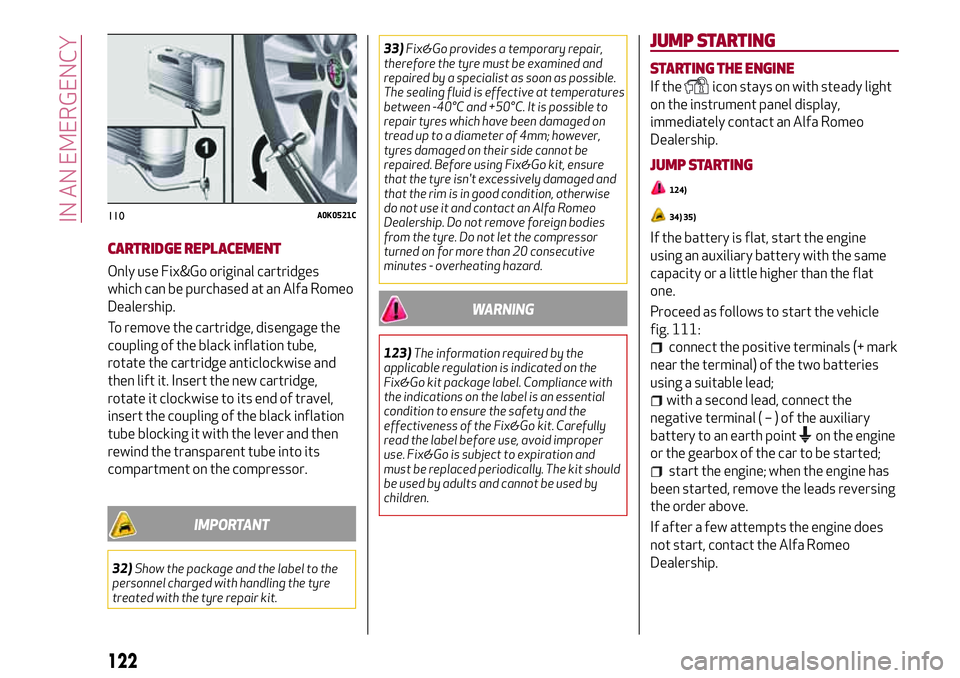
To remove the cartridge, disengage the
coupling of the black inflation tube,
rotate the cartridge anticlockwise and
then lift it. Insert the new cartridge,
rotate it clockwise to its end of travel,
insert the coupling of the black inflation
tube blocking it with the lever and then
rewind the transparent tube into its
compartment on the compressor.
IMPORTANT
32)Show the package and the label to the
personnel charged with handling the tyre
treated with the tyre repair kit.33)Fix&Go provides a temporary repair,
therefore the tyre must be examined and
repaired by a specialist as soon as possible.
The sealing fluid is effective at temperatures
between -40°C and +50°C. It is possible to
repair tyres which have been damaged on
tread up to a diameter of 4mm; however,
tyres damaged on their side cannot be
repaired. Before using Fix&Go kit, ensure
that the tyre isn't excessively damaged and
that the rim is in good condition, otherwise
do not use it and contact an Alfa Romeo
Dealership. Do not remove foreign bodies
from the tyre. Do not let the compressor
turned on for more than 20 consecutive
minutes - overheating hazard.
WARNING
123)The information required by the
applicable regulation is indicated on the
Fix&Go kit package label. Compliance with
the indications on the label is an essential
condition to ensure the safety and the
effectiveness of the Fix&Go kit. Carefully
read the label before use, avoid improper
use. Fix&Go is subject to expiration and
must be replaced periodically. The kit should
be used by adults and cannot be used by
children.
JUMP STARTING
STARTING THE ENGINE
If theicon stays on with steady light
on the instrument panel display,
immediately contact an Alfa Romeo
Dealership.
JUMP STARTING
124)
34) 35)
If the battery is flat, start the engine
using an auxiliary battery with the same
capacity or a little higher than the flat
one.
Proceed as follows to start the vehicle
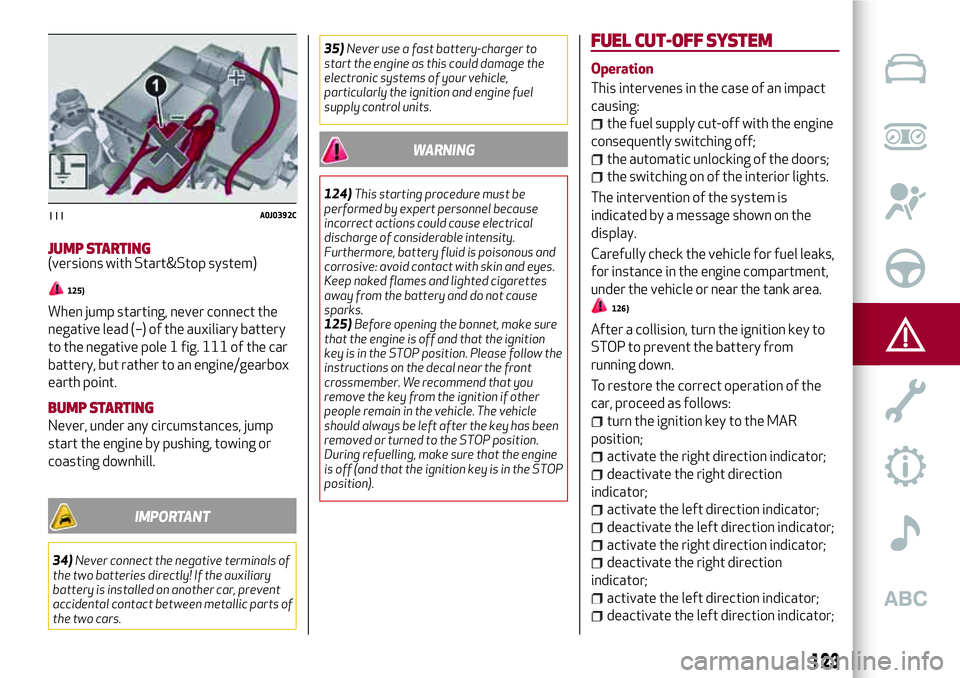
fig. 111:
connect the positive terminals (+ mark
near the terminal) of the two batteries
using a suitable lead;
with a second lead, connect the
negative terminal(–)oftheauxiliary
battery to an earth point
on the engine
or the gearbox of the car to be started;
start the engine; when the engine has
been started, remove the leads reversing
the order above.
If after a few attempts the engine does
not start, contact the Alfa Romeo
Dealership.
110A0K0521C
122
IN AN EMERGENCY
Page 125 of 212
JUMP STARTING(versions with Start&Stop system)
125)
When jump starting, never connect the
negative lead (–) of the auxiliary battery
to the negative pole 1 fig. 111 of the car
battery, but rather to an engine/gearbox
earth point.
BUMP STARTING
Never, under any circumstances, jump
start the engine by pushing, towing or
coasting downhill.
IMPORTANT
34)Never connect the negative terminals of
the two batteries directly! If the auxiliary
battery is installed on another car, prevent
accidental contact between metallic parts of
the two cars.35)Never use a fast battery-charger to
start the engine as this could damage the
electronic systems of your vehicle,
particularly the ignition and engine fuel
supply control units.
WARNING
124)This starting procedure must be
performed by expert personnel because
incorrect actions could cause electrical
discharge of considerable intensity.
Furthermore, battery fluid is poisonous and
corrosive: avoid contact with skin and eyes.
Keep naked flames and lighted cigarettes
away from the battery and do not cause
sparks.
125)Before opening the bonnet, make sure
that the engine is off and that the ignition
key is in the STOP position. Please follow the
instructions on the decal near the front
crossmember. We recommend that you
remove the key from the ignition if other
people remain in the vehicle. The vehicle
should always be left after the key has been
removed or turned to the STOP position.
During refuelling, make sure that the engine
is off (and that the ignition key is in the STOP
position).
FUEL CUT-OFFSYSTEM
Operation
This intervenes in the case of an impact
causing:
the fuel supply cut-off with the engine
consequently switching off;
the automatic unlocking of the doors;
the switching on of the interior lights.
The intervention of the system is
indicated by a message shown on the
display.
Carefully check the vehicle for fuel leaks,
for instance in the engine compartment,
under the vehicle or near the tank area.
126)
After a collision, turn the ignition key to
STOP to prevent the battery from
running down.
To restore the correct operation of the
car, proceed as follows:
turn the ignition key to the MAR
position;
activate the right direction indicator;
deactivate the right direction
indicator;
activate the left direction indicator;
deactivate the left direction indicator;
activate the right direction indicator;
deactivate the right direction
indicator;
activate the left direction indicator;
deactivate the left direction indicator;
111A0J0392C
123
Page 126 of 212
ignition key turned to the OFF
position;
turn the ignition key to the MAR-ON
position.
Versions with LPG system
In case of impact, petrol supply is
immediately cut-off, the LPG safety
valves are closed and the injection is
interrupted, switching off the engine.
WARNING
126)If, after an impact, you smell fuel or
notice leaks from the fuel system, do not
reactivate the system to avoid the risk of
fire.
ALFA TCT TRANSMISSION - KEY
REMOVAL
36)
The ignition key can be removed only if
the gear lever is in position P (Park).
If the battery is flat and the ignition key is
engaged, the latter is locked in position.
To remove the key manually, proceed as
follows:
apply the handbrake;
release the steering wheel position
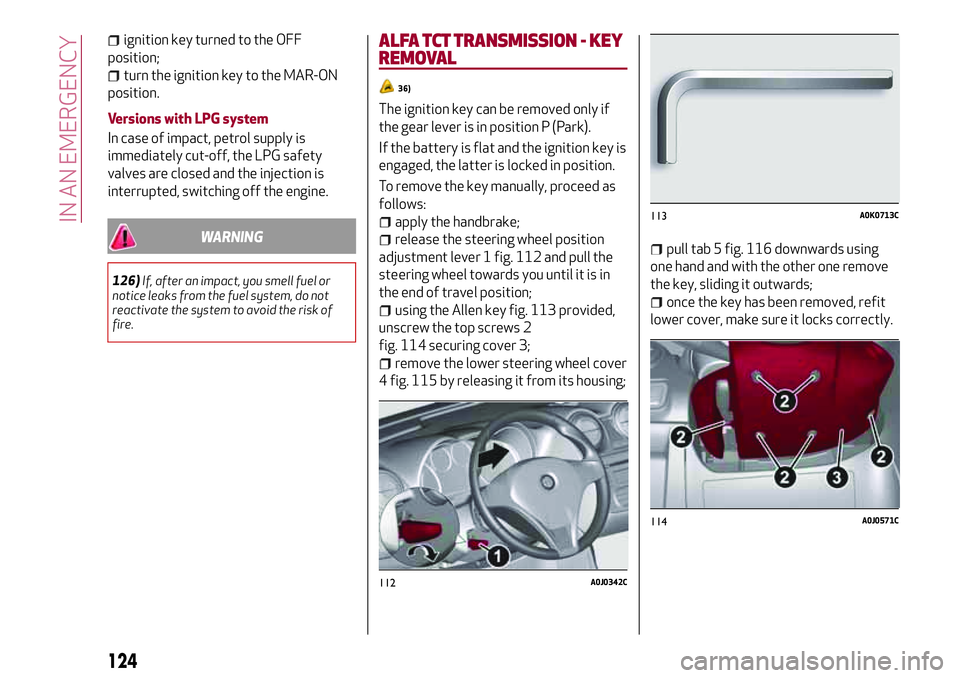
adjustment lever 1 fig. 112 and pull the
steering wheel towards you until it is in
the end of travel position;
using the Allen key fig. 113 provided,
unscrew the top screws 2
fig. 114 securing cover 3;
remove the lower steering wheel cover
4 fig. 115 by releasing it from its housing;
pull tab 5 fig. 116 downwards using
one hand and with the other one remove
the key, sliding it outwards;
once the key has been removed, refit
lower cover, make sure it locks correctly.
112A0J0342C
113A0K0713C
114A0J0571C
124
IN AN EMERGENCY
Page 129 of 212
Correct maintenance permits the performance of the car to be
maintained over time, as well as limited running costs and
safeguarding the efficiency of the safety systems.
This chapter explains how.
SERVICING AND MAINTENANCE
SCHEDULED SERVICING . . .......................128
SCHEDULED MAINTENANCE PLAN . . . . ..............129
PERIODIC CHECKS............................136
DEMANDING USE OF THE CAR . . . . . . ...............136
CHECKING LEVELS ............................137
BATTERY RECHARGING .........................143
WINDSCREEN / REAR WINDOW WIPERS . . . . . . . . .......144
BATTERY..................................146
LIFTING THE VEHICLE . .........................147
BODYWORK.................................147
INTERIOR . . . . ..............................149
Page 138 of 212
PERIODIC CHECKS
Every 1,000 km or before long trips
check and, if necessary, top up:
engine coolant, brake fluid and
windscreen washer fluid level;
tyre inflation pressure and condition;
operation of lighting system
(headlights, direction indicators, hazard
warning lights, etc.);
operation of screen wash/wipe system
and positioning/wear of windscreen/
rearscreen wiper blades
Every 3,000 km check and top up if
required: engine oil level.
IMPORTANT To find out the correct oil
quantity, always check using the dipstick.
Carry out the check with the vehicle
parked on level ground.
DEMANDING USE OF THE CAR
If the vehicle is used mainly under one of
the following conditions:
towing a trailer or caravan;
dusty roads;
short, repeated journeys (less than
7-8 km) at sub-zero outside
temperatures;
engine often idling or driving long
distances at low speeds or long periods
of inactivity;
the following checks must be carried out
more often than indicated in the
Scheduled Servicing Plan:
check front disc brake pad condition
and wear;
check cleanliness of bonnet and
luggage compartment locks, cleanliness
and lubrication of linkage;
visually inspect condition of: engine,
gearbox, transmission, pipes and hoses
(exhaust - fuel system - brakes) and
rubber elements (boots - sleeves - bushes
- etc.);
check battery charge and battery fluid
level (electrolyte);
visually inspect conditions of the
accessory drive belts;
check and, if necessary, change engine
oil and replace oil filter;
check and, if necessary, replace pollen
filter;
check and, if necessary, replace air
cleaner.
136
SERVICING AND MAINTENANCE
Page 145 of 212
132)If the engine oil is being topped up, wait
for the engine to cool down before loosening
the filler cap, particularly for vehicles with
aluminium cap (where provided). WARNING:
risk of burns!
133)The cooling system is pressurised. If
necessary, only replace the plug with
another original or the operation of the
system may be adversely affected. Do not
remove the reservoir plug when the engine is
hot: you risk scalding yourself.
134)Do not travel with the windscreen
washer fluid reservoir empty: the
windscreen washer is essential for
improving visibility. Repeated operation of
the system without fluid could damage or
cause rapid deterioration of some system
components.
135)Some commercial additives for
windscreen washer fluid are flammable. The
engine compartment contains hot
components which may start a fire.
136)Brake fluid is poisonous and highly
corrosive. In the event of accidental contact,
immediately wash the affected parts with
water and mild soap. Then rinse thoroughly.
Call a doctor immediately if swallowed.
137)The symbol
, on the brake fluid
container indicates if a brake fluid is
synthetic or mineral-based. Use of mineral
type fluids will damage the special rubber
seals of the braking system beyond repair.
IMPORTANT
2)Used engine oil and oil filters contain
substances which are harmful to the
environment. To change the oil and filters, we
advise you to contact an Alfa Romeo
Dealership.
3)Used transmission fluid contains
substances that are harmful to the
environment. You are advised to contact an
Alfa Romeo Dealership for oil changes.
BATTERY RECHARGING
IMPORTANT The battery recharging
procedure is given as information only. To
carry out this operation contact an Alfa
Romeo Dealership.
IMPORTANT After turning the ignition
key to STOP and having closed the
driver's side door, wait at least one
minute before disconnecting and then
reconnecting the electrical supply to the
battery.
Charging should be slow at a low ampere
rating for approximately 24 hours.
Charging for a longer time may damage
the battery.
IMPORTANT The cables of the electrical
system must be correctly reconnected to
the battery, i.e. the positive cable (+) to
the positive terminal and the negative
cable (–) to the negative terminal. The
battery terminals are marked with the
positive (+) and negative (–) symbols, and
are shown on the battery cover. The
battery terminals must also be
corrosion-free and firmly secured to the
terminals. If a "quick-type" battery
charger is used with the battery fitted on
the vehicle, before connecting it
disconnect both cables of the battery
itself. Do not use a "quick-type" battery
charger to provide the starting voltage.
The cables of the electrical system must
143
Page 146 of 212
be correctly reconnected to the battery,
i.e. the positive cable (+) to the positive
terminal and the negative cable (–) to the
negative terminal. The battery terminals
are marked with the positive (+) and
negative (–) symbols, and are shown on
the battery cover. The battery terminals
must also be corrosion-free and firmly
secured to the terminals.
VERSIONS WITHOUT START&STOP
SYSTEM
(where provided)
To recharge, proceed as follows:
disconnect the terminal from the
negative battery pole;
connect the charger cables to the
battery terminals, observing the polarity;
turn on the charger;
when it is recharged, turn the charger
off before disconnecting it from the
battery;
reconnect the terminal to the negative
battery pole.
VERSIONS WITH START&STOP
SYSTEM
To recharge, proceed as follows:
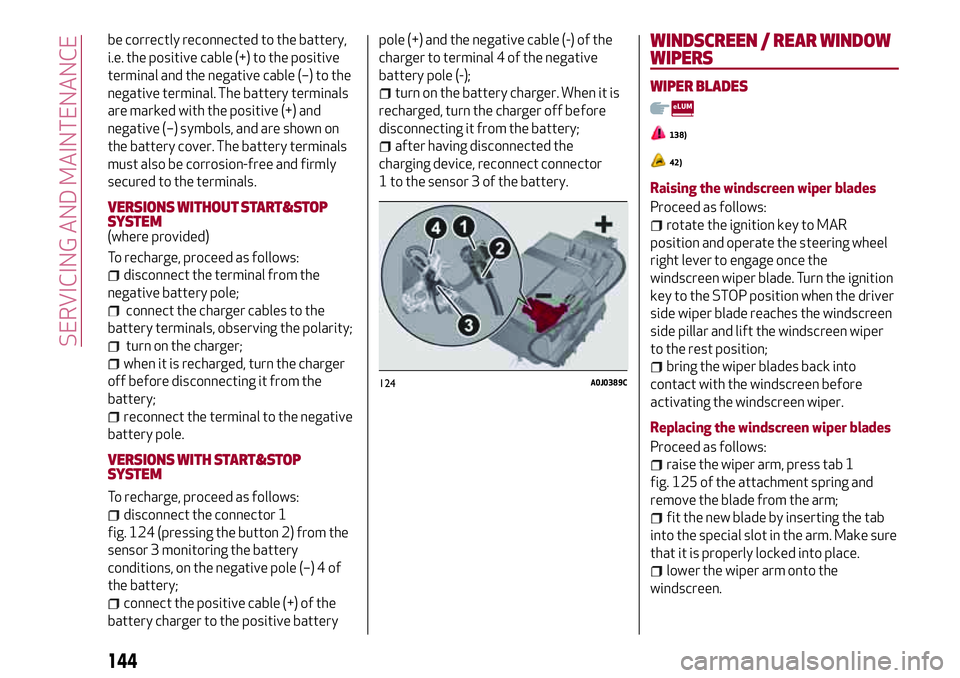
disconnect the connector 1
fig. 124 (pressing the button 2) from the
sensor 3 monitoring the battery
conditions, on the negative pole (–) 4 of
the battery;
connect the positive cable (+) of the
battery charger to the positive batterypole (+) and the negative cable (-) of the
charger to terminal 4 of the negative
battery pole (-);
turn on the battery charger. When it is
recharged, turn the charger off before
disconnecting it from the battery;
after having disconnected the
charging device, reconnect connector
1 to the sensor 3 of the battery.
WINDSCREEN / REAR WINDOW
WIPERS
WIPER BLADES
138)
42)
Raising the windscreen wiper blades
Proceed as follows:
rotate the ignition key to MAR
position and operate the steering wheel
right lever to engage once the
windscreen wiper blade. Turn the ignition
key to the STOP position when the driver
side wiper blade reaches the windscreen
side pillar and lift the windscreen wiper
to the rest position;
bring the wiper blades back into
contact with the windscreen before
activating the windscreen wiper.
Replacing the windscreen wiper blades
Proceed as follows:
raise the wiper arm, press tab 1
fig. 125 of the attachment spring and
remove the blade from the arm;
fit the new blade by inserting the tab
into the special slot in the arm. Make sure
that it is properly locked into place.
lower the wiper arm onto the
windscreen.
124A0J0389C
144
SERVICING AND MAINTENANCE
Page 148 of 212
BATTERY
The battery 6 (see previous pages) does
not require the electrolyte to be topped
up with distilled water. A periodic check
carried out at an Alfa Romeo Dealership
is, however, necessary to check
efficiency.
INSPECTING THE CHARGE AND THE
ELECTROLYTE LEVEL
139) 140) 141) 142)
43)
4)
If necessary, replace the battery with
another original battery with the same
specifications. Follow the battery
manufacturer's instructions for
maintenance.
USEFUL ADVICE FOR EXTENDING THE
LIFE OF YOUR BATTERY
To avoid draining your battery and make
it last longer, observe the following
instructions:
when you park the car, ensure that the
doors, tailgate and bonnet are closed
properly, to prevent any lights from
remaining on inside the passenger's
compartment;
switch off all roof lights inside the car:
the car is however equipped with a
system which switches all internal lights
off automatically;
do not keep accessories (e.g. radio,
hazard warning lights, etc.) switched on
for a long time when the engine is not
running;
before performing any operation on
the electrical system, disconnect the
negative battery cable.
IMPORTANT If the charge level remains
under 50% for a long time, the battery is
damaged by sulphation, reducing its
capacity and efficiency at start-up.
The battery will also be more at risk of
freezing (this can happen as early as
-10°C). Refer to the "Vehicle inactivity"
paragraph in "Starting and driving"
chapter if the vehicle is left parked for a
long time.
If, after purchasing the car, you wish to
install electrical accessories which
require permanent electrical supply (e.g.
alarm, etc.) or accessories which
influence the electrical supply
requirements, contact an Alfa Romeo
Dealership, whose qualified staff will
evaluate the overall electrical
consumption.
WARNING
139)Battery fluid is poisonous and
corrosive. Avoid contact with the skin and
eyes. Keep open flames away from the
battery and do not use objects that might
create sparks: risk of explosion and fire.
140)Using the battery with insufficient
fluid irreparably damages the battery and
may cause an explosion.
141)If the vehicle must remain unused for a
long time at a very low temperature, remove
the battery and take it to a warm place, to
avoid freezing.
142)When performing any operation on the
battery or near it, always protect your eyes
with special goggles.
IMPORTANT
43)Incorrect installation of electric and
electronic devices may cause severe damage
to your car. After purchasing your vehicle, if
you wish to install any accessories (e.g.
anti-theft, radio phone, etc.), go to an Alfa
Romeo Dealership, which will suggest the
most suitable devices and advise you
whether a higher capacity battery needs to
be installed.
146
SERVICING AND MAINTENANCE
Page 149 of 212

IMPORTANT
4)Batteries contain substances which are
very dangerous for the environment. For
battery replacement, contact an Alfa Romeo
Dealership.
LIFTING THE VEHICLE
If the car needs to be jacked up, go to an
Alfa Romeo Dealership which is equipped
with shop jacks and jack arms.
IMPORTANT Be careful when positioning
the arm of the lift for versions with side
skirts.
BODYWORK
PRESERVING THE BODYWORK
44)
5)
Paint
Touch up abrasions and scratches
immediately to prevent the formation of
rust. Maintenance of paintwork consists
of washing the car: the frequency
depends on the conditions and
environment where the car is used. For
example, it is advisable to wash the
vehicle more often in areas with high
levels of atmospheric pollution or salted
roads.
On some versions the car may be
equipped, on request, with an exclusive
opaque paint on the roof which, in order
to be maintained intact, requires special
care: see the instructions in the warning.
45)
To correctly wash the vehicle, follow
these instructions:
if the vehicle is washed remove the
aerial from the roof;
if high pressure jets or cleaners are
used to wash the car, keep a distance of
at least 40 cm from the bodywork to
avoid damage or alteration. Bear in mind
that a build up of water could cause
damage to the car in the long term;
147