maintenance Alfa Romeo MiTo 2020 Owner handbook (in English)
[x] Cancel search | Manufacturer: ALFA ROMEO, Model Year: 2020, Model line: MiTo, Model: Alfa Romeo MiTo 2020Pages: 212, PDF Size: 5.18 MB
Page 130 of 212
SCHEDULED SERVICING
Correct servicing is crucial for
guaranteeing a long life for the vehicle
under the best conditions.
For this reason, Alfa Romeo has planned
a series of checks and services at fixed
distance intervals and, where provided, at
fixed time intervals, as described in the
Scheduled Servicing Plan.
Regardless of the above, it is always
necessary to carefully follow the
instructions in the Scheduled Servicing
Plan (e.g. periodically check level of
liquids, tyre pressure, etc.).
Scheduled Servicing is offered by all Alfa
Romeo Dealerships according to fixed
time or kilometres/miles intervals. If,
during each operation, in addition to the
ones scheduled, the need arises for
further replacements or repairs, these
may be carried out with the owner's
explicit agreement only. If your vehicle is
used frequently for towing, the interval
between one service operation and the
next should be reduced.IMPORTANT NOTES
Scheduled Servicing interventions are
set out by the Manufacturer. Failure to
have them carried out may invalidate the
warranty.
It is advisable to inform the Alfa Romeo
Dealership of any small operating
irregularities without waiting for the next
service.
128
SERVICING AND MAINTENANCE
Page 131 of 212
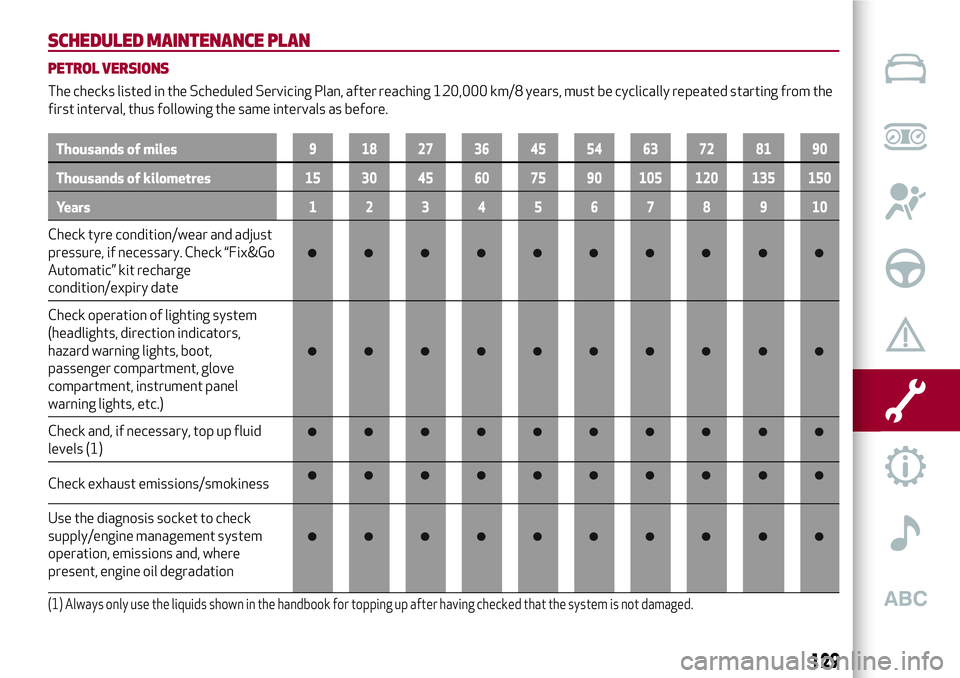
SCHEDULED MAINTENANCE PLAN
PETROL VERSIONS
The checks listed in the Scheduled Servicing Plan, after reaching 120,000 km/8 years, must be cyclically repeated starting from the
first interval, thus following the same intervals as before.
Thousands of miles9 182736455463728190
Thousands of kilometres15 30 45 60 75 90 105 120 135 150
Years12345678910
Check tyre condition/wear and adjust
pressure, if necessary. Check “Fix&Go
Automatic” kit recharge
condition/expiry date
Check operation of lighting system
(headlights, direction indicators,
hazard warning lights, boot,
passenger compartment, glove
compartment, instrument panel
warning lights, etc.)
Check and, if necessary, top up fluid
levels (1)
Check exhaust emissions/smokiness
Use the diagnosis socket to check
supply/engine management system
operation, emissions and, where
present, engine oil degradation
(1) Always only use the liquids shown in the handbook for topping up after having checked that the system is not damaged.
129
Page 132 of 212
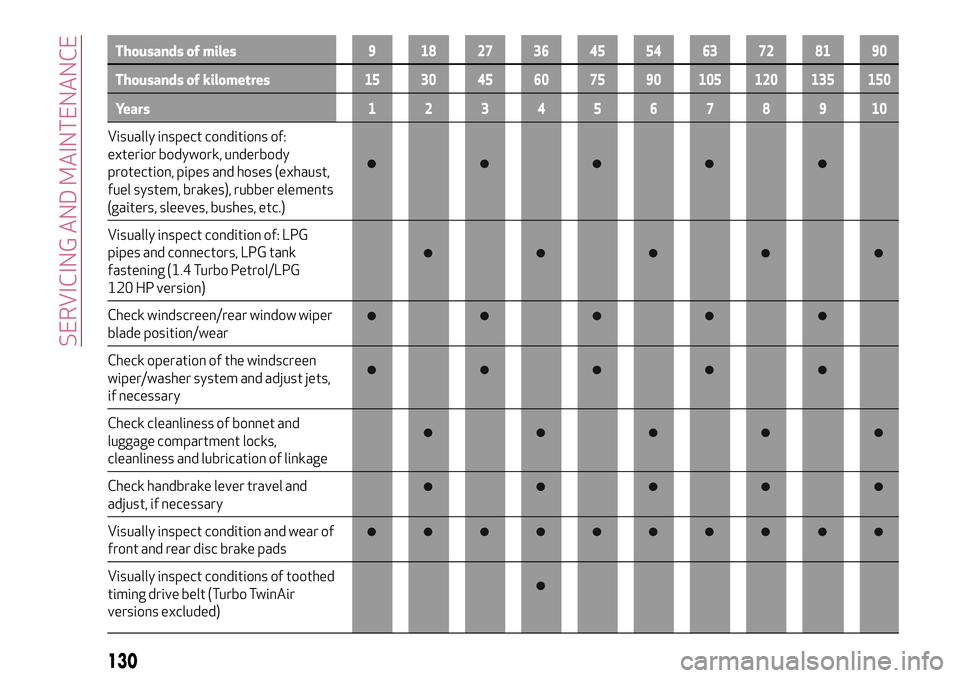
Thousands of miles9 182736455463728190
Thousands of kilometres15 30 45 60 75 90 105 120 135 150
Years12345678910
Visually inspect conditions of:
exterior bodywork, underbody
protection, pipes and hoses (exhaust,
fuel system, brakes), rubber elements
(gaiters, sleeves, bushes, etc.)
Visually inspect condition of: LPG
pipes and connectors, LPG tank
fastening (1.4 Turbo Petrol/LPG
120 HP version)
Check windscreen/rear window wiper
blade position/wear
Check operation of the windscreen
wiper/washer system and adjust jets,
if necessary
Check cleanliness of bonnet and
luggage compartment locks,
cleanliness and lubrication of linkage
Check handbrake lever travel and
adjust, if necessary
Visually inspect condition and wear of
front and rear disc brake pads
Visually inspect conditions of toothed
timing drive belt (Turbo TwinAir
versions excluded)
130
SERVICING AND MAINTENANCE
Page 134 of 212

Thousands of miles9 182736455463728190
Thousands of kilometres15 30 45 60 75 90 105 120 135 150
Years12345678910
Replace filter inside the pressure
regulator (1.4 Turbo Petrol/LPG
120 HP version)
Replace paper filter (LPG in gaseous
state) (1.4 Turbo Petrol/LPG 120 HP
version)
Change the brake fluid(7)
Replace the passenger compartment
cleaner (6) (o) (●)
(7) The brake fluid replacement has to be done every 2 years, irrespective of the mileage.
(6) If the vehicle is used in dusty areas, this cleaner must be replaced every 15,000 km.
(o) Recommended operations
(●) Mandatory operations
132
SERVICING AND MAINTENANCE
Page 136 of 212
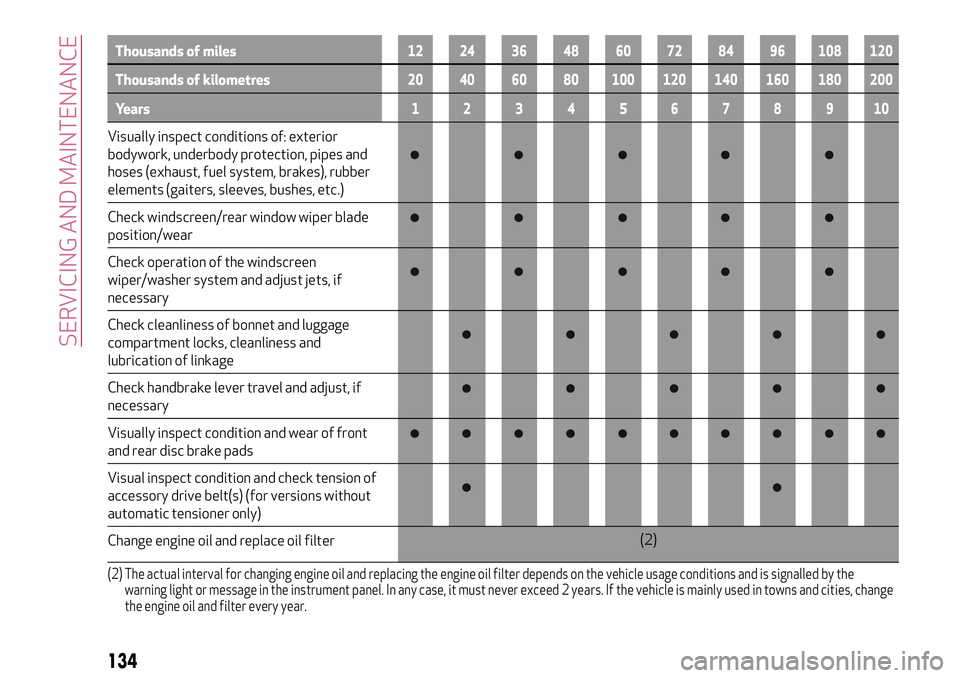
Thousands of miles12 24 36 48 60 72 84 96 108 120
Thousands of kilometres20 40 60 80 100 120 140 160 180 200
Years12345678910
Visually inspect conditions of: exterior
bodywork, underbody protection, pipes and
hoses (exhaust, fuel system, brakes), rubber
elements (gaiters, sleeves, bushes, etc.)
Check windscreen/rear window wiper blade
position/wear
Check operation of the windscreen
wiper/washer system and adjust jets, if
necessary
Check cleanliness of bonnet and luggage
compartment locks, cleanliness and
lubrication of linkage
Check handbrake lever travel and adjust, if
necessary
Visually inspect condition and wear of front
and rear disc brake pads
Visual inspect condition and check tension of
accessory drive belt(s) (for versions without
automatic tensioner only)
Change engine oil and replace oil filter(2)
(2) The actual interval for changing engine oil and replacing the engine oil filter depends on the vehicle usage conditions and is signalled by the
warning light or message in the instrument panel. In any case, it must never exceed 2 years. If the vehicle is mainly used in towns and cities, change
the engine oil and filter every year.
134
SERVICING AND MAINTENANCE
Page 138 of 212
PERIODIC CHECKS
Every 1,000 km or before long trips
check and, if necessary, top up:
engine coolant, brake fluid and
windscreen washer fluid level;
tyre inflation pressure and condition;
operation of lighting system
(headlights, direction indicators, hazard
warning lights, etc.);
operation of screen wash/wipe system
and positioning/wear of windscreen/
rearscreen wiper blades
Every 3,000 km check and top up if
required: engine oil level.
IMPORTANT To find out the correct oil
quantity, always check using the dipstick.
Carry out the check with the vehicle
parked on level ground.
DEMANDING USE OF THE CAR
If the vehicle is used mainly under one of
the following conditions:
towing a trailer or caravan;
dusty roads;
short, repeated journeys (less than
7-8 km) at sub-zero outside
temperatures;
engine often idling or driving long
distances at low speeds or long periods
of inactivity;
the following checks must be carried out
more often than indicated in the
Scheduled Servicing Plan:
check front disc brake pad condition
and wear;
check cleanliness of bonnet and
luggage compartment locks, cleanliness
and lubrication of linkage;
visually inspect condition of: engine,
gearbox, transmission, pipes and hoses
(exhaust - fuel system - brakes) and
rubber elements (boots - sleeves - bushes
- etc.);
check battery charge and battery fluid
level (electrolyte);
visually inspect conditions of the
accessory drive belts;
check and, if necessary, change engine
oil and replace oil filter;
check and, if necessary, replace pollen
filter;
check and, if necessary, replace air
cleaner.
136
SERVICING AND MAINTENANCE
Page 140 of 212

1.4 Petrol versions
120A0J0300C
138
SERVICING AND MAINTENANCE
Page 142 of 212

1.4 Turbo MultiAir versions
122A0J0283C
140
SERVICING AND MAINTENANCE
Page 144 of 212
ENGINE OIL
132)
38) 39)
2)
Check that the oil level is between the
MIN and MAX references on the dipstick
1. If the level of the oil is close to or below
the MIN mark, add oil via the filler fitting
2 until the MAX mark is reached.
1.4 Petrol / 1.4 Turbo Petrol/LPG /
1.4 Turbo Multi Air / 1.3 JTD
M-2versions: pull the engine oil dipstick 1,
clean it with a lint-free cloth and insert
it again. Extract it again and check that
the level is between the MIN and MAX
marks on the dipstick.
Turbo TwinAir versions: engine oil
dipstick 1 is integral with the cap 2.
Unscrew the cap, clean the dipstick with a
lint-free cloth, reinsert the dipstick and
screw the cap back on. Unscrew the plug
again and check that the engine oil level is
between the MIN and MAX marks on the
dipstick.
Engine oil consumption
The maximum engine oil consumption is
usually 400 grams every 1000 km. When
the car is new, the engine needs to be run
in; therefore the engine oil consumption
can only be considered stabilised after
the first 5000 - 6000 km.
ENGINE COOLANT FLUID
132)
40)
If the level is too low, unscrew the cap
3 of reservoir and add the fluid described
in the "Technical Specifications" chapter.
WINDSCREEN / REAR WINDOW
WASHING FLUID
134) 135)
If the level is too low, raise the reservoir
cap 4 and add the fluid described in the
"Technical Specifications" chapter.
BRAKE FLUID
136) 137)
41)
Check that the fluid is at the max. level. If
the fluid level in the reservoir is too low,
undo the reservoir cap 5 and add the fluid
described in the "Technical
Specifications" chapter.
ALFA TCT ACTIVATIONSYSTEM OIL(where provided)
3)
The transmission control oil level should
only be checked at an Alfa Romeo
Dealership.
IMPORTANT
37)Be careful not to confuse the various
types of fluids while topping up: they are not
compatible with each other! Topping up with
an unsuitable fluid could severely damage
your vehicle.
38)The oil level must never exceed the MAX
reference.
39)Do not add oil with specifications other
than those of the oil already in the engine.
40)Use a fluid of the same type as that
already present in the reservoir for any
topping up of the engine cooling system. The
fluid cannot be mixed with other types of
antifreeze fluids. In the event of topping up
with an unsuitable product, under no
circumstances start the engine and contact
an Alfa Romeo Dealership.
41)Prevent brake fluid, which is highly
corrosive, from coming into contact with
painted parts. Should it happen, immediately
wash with water.
WARNING
130)Never smoke while working in the
engine compartment: gas and inflammable
vapours may be present, with the risk of fire.
131)Be very careful when working in the
engine compartment when the engine is hot:
you may get burned. Do not get too close to
the radiator cooling fan: the electric fan may
start; danger of injury. Scarves, ties and
other loose clothing might be pulled by
moving parts.
142
SERVICING AND MAINTENANCE
Page 146 of 212
be correctly reconnected to the battery,
i.e. the positive cable (+) to the positive
terminal and the negative cable (–) to the
negative terminal. The battery terminals
are marked with the positive (+) and
negative (–) symbols, and are shown on
the battery cover. The battery terminals
must also be corrosion-free and firmly
secured to the terminals.
VERSIONS WITHOUT START&STOP
SYSTEM
(where provided)
To recharge, proceed as follows:
disconnect the terminal from the
negative battery pole;
connect the charger cables to the
battery terminals, observing the polarity;
turn on the charger;
when it is recharged, turn the charger
off before disconnecting it from the
battery;
reconnect the terminal to the negative
battery pole.
VERSIONS WITH START&STOP
SYSTEM
To recharge, proceed as follows:
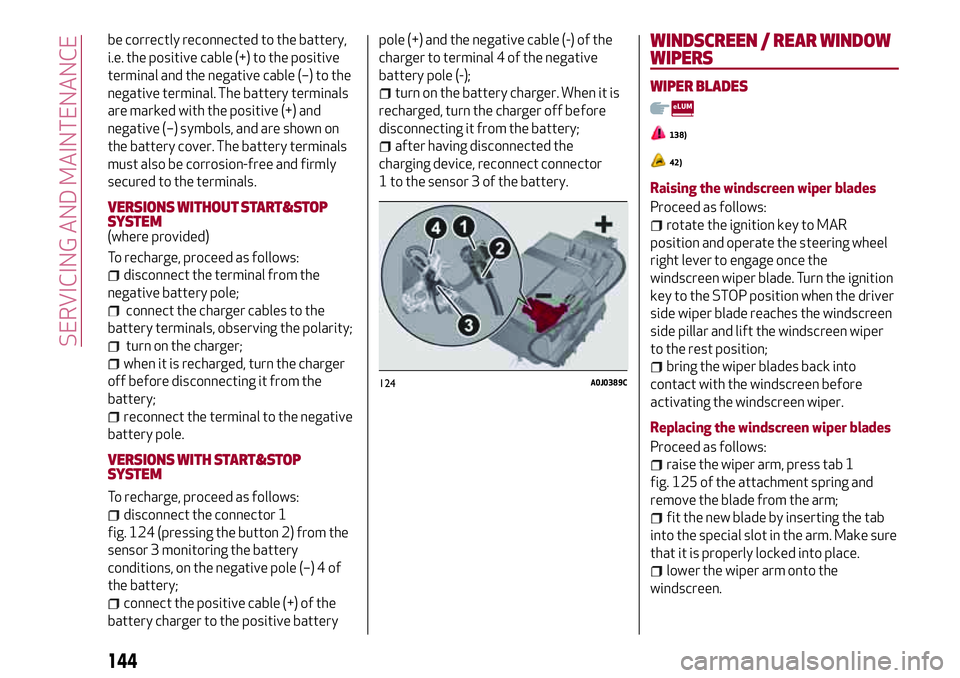
disconnect the connector 1
fig. 124 (pressing the button 2) from the
sensor 3 monitoring the battery
conditions, on the negative pole (–) 4 of
the battery;
connect the positive cable (+) of the
battery charger to the positive batterypole (+) and the negative cable (-) of the
charger to terminal 4 of the negative
battery pole (-);
turn on the battery charger. When it is
recharged, turn the charger off before
disconnecting it from the battery;
after having disconnected the
charging device, reconnect connector
1 to the sensor 3 of the battery.
WINDSCREEN / REAR WINDOW
WIPERS
WIPER BLADES
138)
42)
Raising the windscreen wiper blades
Proceed as follows:
rotate the ignition key to MAR
position and operate the steering wheel
right lever to engage once the
windscreen wiper blade. Turn the ignition
key to the STOP position when the driver
side wiper blade reaches the windscreen
side pillar and lift the windscreen wiper
to the rest position;
bring the wiper blades back into
contact with the windscreen before
activating the windscreen wiper.
Replacing the windscreen wiper blades
Proceed as follows:
raise the wiper arm, press tab 1
fig. 125 of the attachment spring and
remove the blade from the arm;
fit the new blade by inserting the tab
into the special slot in the arm. Make sure
that it is properly locked into place.
lower the wiper arm onto the
windscreen.
124A0J0389C
144
SERVICING AND MAINTENANCE