steering Alfa Romeo MiTo 2020 Owner handbook (in English)
[x] Cancel search | Manufacturer: ALFA ROMEO, Model Year: 2020, Model line: MiTo, Model: Alfa Romeo MiTo 2020Pages: 212, PDF Size: 5.18 MB
Page 23 of 212
The direction indicators are switched off
automatically when the steering wheel is
straightened.
"Lane change" function
If you wish to signal a lane change, place
the left stalk in the unstable position for
less than half a second. The direction
indicator on the selected side flashes
three times and then switches off
automatically.
"FOLLOW ME HOME" DEVICE
This device allows you to illuminate the
area in front of the car for a certain
amount of time.
Activation
With the key turned to STOP or removed,
pull the left-hand stalk 1 towards the
steering wheel within 2 minutes from
when the engine is turned off.
Each time the stalk is moved, the lights
stay on for an extra 30 seconds up to a
maximum of 210 seconds; then the lights
are switched off automatically.
When the stalk is operated, the warning
light
on the instrument panel
switches on. The display shows a
message and the time set for the
function.
The warning light comes on when the
stalk is operated and stays on until the
function is automatically deactivated.Each movement of the stalk only
increases the amount of time the lights
stay on.
Deactivation
Keep the stalk pulled towards the
steering wheel for more than 2 seconds.
EXTERNAL COURTESY LIGHTS
These light up the car and the space in
front of it when the doors are unlocked.
Activation
When the car is parked and the doors are
unlocked by pressing the
button on the
remote control (or the luggage
compartment is unlocked by pressing
), the dipped beam headlights, rear
side lights and number plate lights are
activated.
The lights stay on for approximately
25 seconds unless the doors and luggage
compartment are locked again with the
remote control or the doors (or luggage
compartment) are opened and reclosed.
In these cases they switch off after
5 seconds.
INTERIOR LIGHTS
FRONT CEILING LIGHT
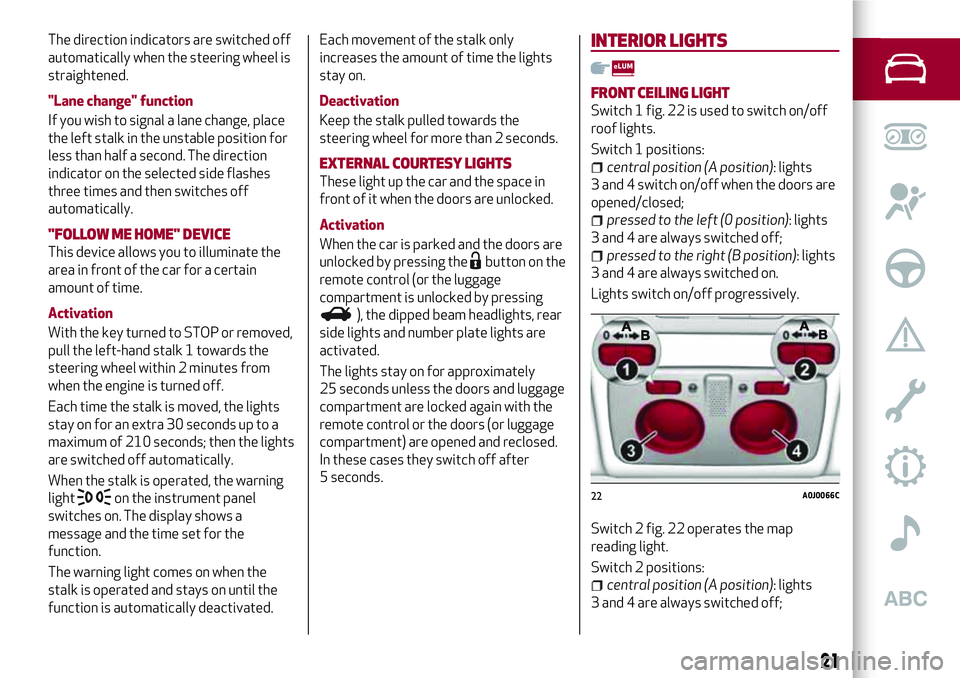
Switch 1 fig. 22 is used to switch on/off
roof lights.
Switch 1 positions:
central position (A position): lights
3 and 4 switch on/off when the doors are
opened/closed;
pressed to the left (0 position): lights
3 and 4 are always switched off;
pressed to the right (B position): lights
3 and 4 are always switched on.
Lights switch on/off progressively.
Switch 2 fig. 22 operates the map
reading light.
Switch 2 positions:
central position (A position): lights
3 and 4 are always switched off;
22A0J0066C
21
Page 24 of 212
pressed to the left (0 position): light
3 switches on;
pressed to the right (B position): light
4 switches on.
IMPORTANT Before getting out of the
car, make sure that both switches are in
the central position: when the doors are
closed the lights will switch off to avoid
draining the battery. In any case, if the
switch is left in the on position, the roof
light switches off automatically about
15 minutes after the engine has been
switched off.
ROOF LIGHT TIMING
Timing while getting into the car
The roof lights come on won unlocking,
opening and closing. The timed period is
interrupted when the ignition is turned to
"MAR-ON".
Timing while getting out of the car
The roof lights come on when the key is
removed from the ignition within
2 minutes of switching off the engine, on
opening and closing a door with the
removed key. The timing stops
automatically when the doors are locked.
WINDSCREEN / REAR WINDOW
WIPERS
This operates only with the ignition key
turned to MAR.
WINDSCREEN WASHER / WIPER
Operation
13) 14)
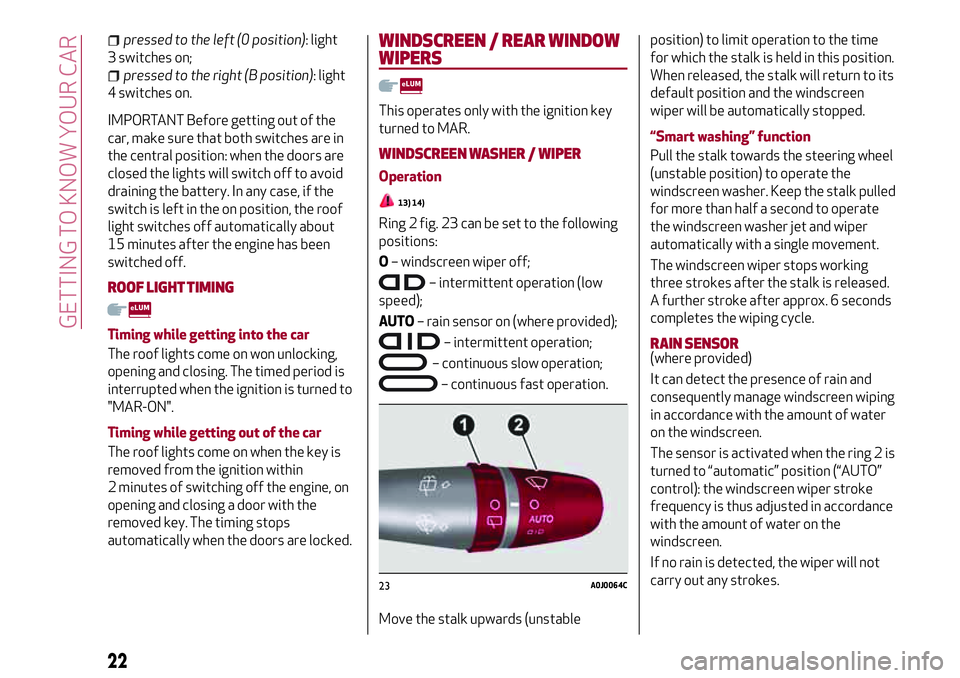
Ring 2 fig. 23 can be set to the following
positions:
O– windscreen wiper off;
– intermittent operation (low
speed);
AUTO– rain sensor on (where provided);
– intermittent operation;
– continuous slow operation;
– continuous fast operation.
Move the stalk upwards (unstableposition) to limit operation to the time
for which the stalk is held in this position.
When released, the stalk will return to its
default position and the windscreen
wiper will be automatically stopped.
“Smart washing” function
Pull the stalk towards the steering wheel
(unstable position) to operate the
windscreen washer. Keep the stalk pulled
for more than half a second to operate
the windscreen washer jet and wiper
automatically with a single movement.
The windscreen wiper stops working
three strokes after the stalk is released.
A further stroke after approx. 6 seconds
completes the wiping cycle.
RAIN SENSOR(where provided)
It can detect the presence of rain and
consequently manage windscreen wiping
in accordance with the amount of water
on the windscreen.
The sensor is activated when the ring 2 is
turned to “automatic” position (“AUTO”
control): the windscreen wiper stroke
frequency is thus adjusted in accordance
with the amount of water on the
windscreen.
If no rain is detected, the wiper will not
carry out any strokes.
23A0J0064C
22
GETTING TO KNOW YOUR CAR
Page 37 of 212
no messages or symbols are shown on
the display.
The device also acts on the dynamic car
control systems (engine, steering, ESC
system, instrument panel).
TURNING “Dynamic” MODE ON/OFF
4)
Activation
Move lever 1 upwards (to the letter “d”)
and hold in this position for 0.5 seconds
until the corresponding LED lights up or
the word “Dynamic” appears on the
display.
Deactivation
Mover the lever 1 to the "Natural"
position.
1.4 Turbo MultiAir versions
Selecting the “Dynamic” operation mode,
the turbocharger overboost feature is
enabled. The engine management control
unit allows - in relation to the position of
the accelerator pedal and for a limited
time - maximum pressure levels to be
reached inside the turbocharger, with a
consequent increase in engine torque
with respect to that which is normally
possible.
This function is particularly useful
whenever maximum performance is
required for a short time (e.g. when
overtaking).
IMPORTANT During acceleration, when
the “Dynamic” function is used the
steering may shudder, which is typical of
a sports setting.
TURNING “All Weather” MODE ON/OFF
Activation
Move lever 1 downwards (to the letter
“a”) and hold in this position for
0.5 seconds until the corresponding LED
lights up or the word “All Weather”
appears on the display.
Deactivation
To deactivate “All Weather” mode (and
return to “Natural”), carry out the same
procedure described for “Dynamic” mode,
but move lever 1 to “a”.
IMPORTANT
4)"FAST" VERSION: Considering the high
levels of vehicle performance, it is
recommended to not use the "Dynamic"
mode when driving the first kilometres with
the vehicle in order to provide the
mechanical components with the necessary
running-in period.
DYNAMIC SUSPENSION (active
shock absorber system)
This system interacts with the “Alfa DNA”
system. The “Alfa DNA” system lever
allows you to choose three different
driving settings depending on the route
type and on the road surface (see
paragraph “Alfa DNA system”).
In “Natural” and “All Weather” operating
mode, the active shock absorbers adjust
the car suspension to suit the route type
and the driving stresses, thus
considerably improving driving comfort
in particular on rough terrain.
The "Dynamic" operating mode produces
a sports driving setting characterised by
more responsive acceleration and
greater effort on the steering wheel to
give a sporty feeling. The shock absorber
damping action is also adjusted and
divided, to guarantee higher precision
and reactivity of the car, while
maintaining a good comfort level.
The driver will notice that the vehicle is
more precise when cornering and quicker
in changing direction.
35
Page 56 of 212
Warning lights on
panelWhat it means What to do
TPMS SYSTEM
Low tyre pressure
The warning light (or symbol on the display) switches on (on some
versions together with a message on the display) (together with
an acoustic signal) if the pressure in one or more tyres drops
below a preset threshold.
In this way the TPMS warns the driver that one or more tyres may
be dangerously flat and liable to puncture.In any situation in which the message on the
display is "See manual", it is ESSENTIAL to refer
to the contents of the "Wheels" paragraph in the
"Technical specifications" section, strictly
complying with the indications that you find
there.
IMPORTANT Do not continue driving with one or
more flat tyres as handling may be
compromised. Stop the vehicle, avoiding sharp
braking and steering. Replace the wheel
immediately with the spare wheel (where
provided) or carry out a prompt repair using the
dedicated kit (see the paragraph on “Replacing a
wheel” in chapter “In an emergency”) and contact
Alfa Romeo Dealership as soon as possible.
TPMS failure
This warning light switches on (on some versions together with a
message on the display) when a TPMS fault is detected.
Should one or more wheels be fitted without sensors, the display
will show a warning message until initial conditions are restored.Contact an Alfa Romeo Dealership as soon as
possible.
Check tyre pressure
The warning light switches on (on some versions together with a
message in the display) to indicate that the tyre pressure is below
the value recommended to guarantee long tyre life and low fuel
consumption. It may also indicate a slow loss of pressure.
Should two or more tyres be in the condition mentioned above,
the display will show the indications corresponding to each tyre in
sequence. In this case it is advisable to restore the correct
pressure value
54
KNOWING THE INSTRUMENT PANEL
Page 60 of 212

SYMBOLS ON THE DISPLAY
Symbol on the display What it means What to do
ALTERNATOR FAILURE
The symbol appears on the display in case of alternator
failure.If the symbol continues to be displayed, contact an Alfa
Romeo Dealership immediately.
ELECTRIC POWER STEERING FAILURE
(where provided)
The symbol appears on display in case of electric Power
Steering failure. If the symbol is still displayed (together
with a message) you will not benefit from the electric
power steering and the effort needed to turn the wheel
will be significantly increased, although it will still be
possible to steer the car.If the symbol continues to be displayed, contact an Alfa
Romeo Dealership immediately.
DOOR OPEN
(where provided)
The symbol appears on the display when one or more
doors are not completely shut. An acoustic signal is
activated with the doors open and the car moving.Close the door(s) properly.
LUGGAGE COMPARTMENT OPEN
The symbol appears on the display (together with a
message) when the luggage compartment is openClose the boot correctly.
BONNET OPEN
The symbol appears on the display (together with a
message) when the bonnet is openClose the bonnet properly.
SPEED LIMIT EXCEEDED
(where provided)
The symbol appears on the display when the vehicle
speed exceeds 120 km/h. An acoustic signal is also
emitted.Contact an Alfa Romeo Dealership as soon as possible.
58
KNOWING THE INSTRUMENT PANEL
Page 68 of 212
ACTIVE SAFETYSYSTEMS
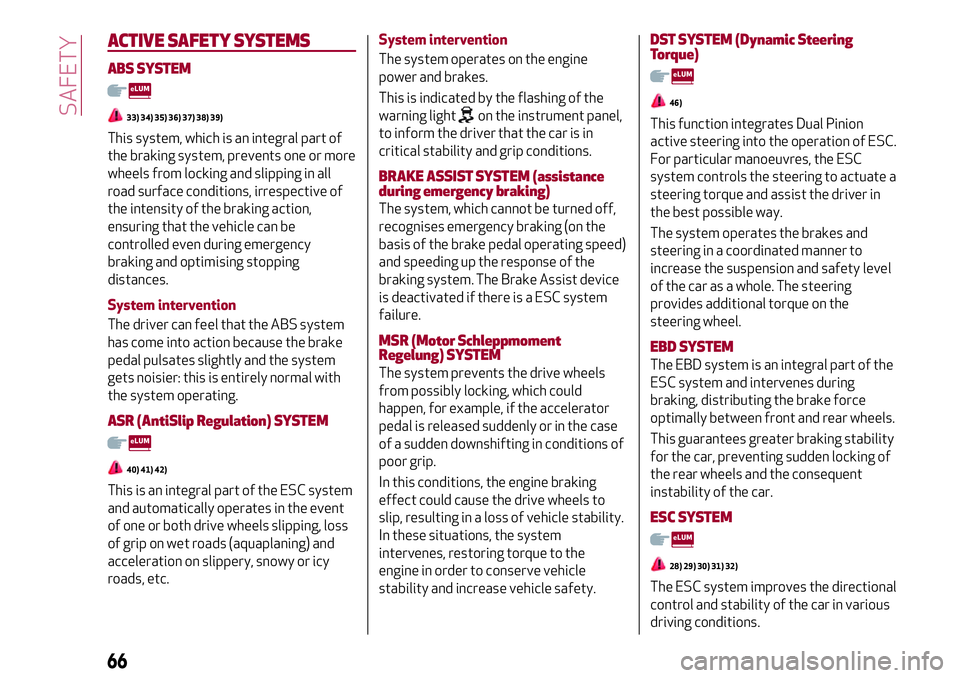
ABS SYSTEM
33) 34) 35) 36) 37) 38) 39)
This system, which is an integral part of
the braking system, prevents one or more
wheels from locking and slipping in all
road surface conditions, irrespective of
the intensity of the braking action,
ensuring that the vehicle can be
controlled even during emergency
braking and optimising stopping
distances.
System intervention
The driver can feel that the ABS system
has come into action because the brake
pedal pulsates slightly and the system
gets noisier: this is entirely normal with
the system operating.
ASR (AntiSlip Regulation)SYSTEM
40) 41) 42)
This is an integral part of the ESC system
and automatically operates in the event
of one or both drive wheels slipping, loss
of grip on wet roads (aquaplaning) and
acceleration on slippery, snowy or icy
roads, etc.System intervention
The system operates on the engine
power and brakes.
This is indicated by the flashing of the
warning light
on the instrument panel,
to inform the driver that the car is in
critical stability and grip conditions.
BRAKE ASSISTSYSTEM (assistance
during emergency braking)
The system, which cannot be turned off,
recognises emergency braking (on the
basis of the brake pedal operating speed)
and speeding up the response of the
braking system. The Brake Assist device
is deactivated if there is a ESC system
failure.
MSR (Motor Schleppmoment
Regelung)SYSTEM
The system prevents the drive wheels
from possibly locking, which could
happen, for example, if the accelerator
pedal is released suddenly or in the case
of a sudden downshifting in conditions of
poor grip.
In this conditions, the engine braking
effect could cause the drive wheels to
slip, resulting in a loss of vehicle stability.
In these situations, the system
intervenes, restoring torque to the
engine in order to conserve vehicle
stability and increase vehicle safety.
DST SYSTEM (Dynamic Steering
Torque)
46)
This function integrates Dual Pinion
active steering into the operation of ESC.
For particular manoeuvres, the ESC
system controls the steering to actuate a
steering torque and assist the driver in
the best possible way.
The system operates the brakes and
steering in a coordinated manner to
increase the suspension and safety level
of the car as a whole. The steering
provides additional torque on the
steering wheel.
EBD SYSTEM
The EBD system is an integral part of the
ESC system and intervenes during
braking, distributing the brake force
optimally between front and rear wheels.
This guarantees greater braking stability
for the car, preventing sudden locking of
the rear wheels and the consequent
instability of the car.
ESC SYSTEM
28) 29) 30) 31) 32)
The ESC system improves the directional
control and stability of the car in various
driving conditions.
66
SAFETY
Page 72 of 212
WARNING
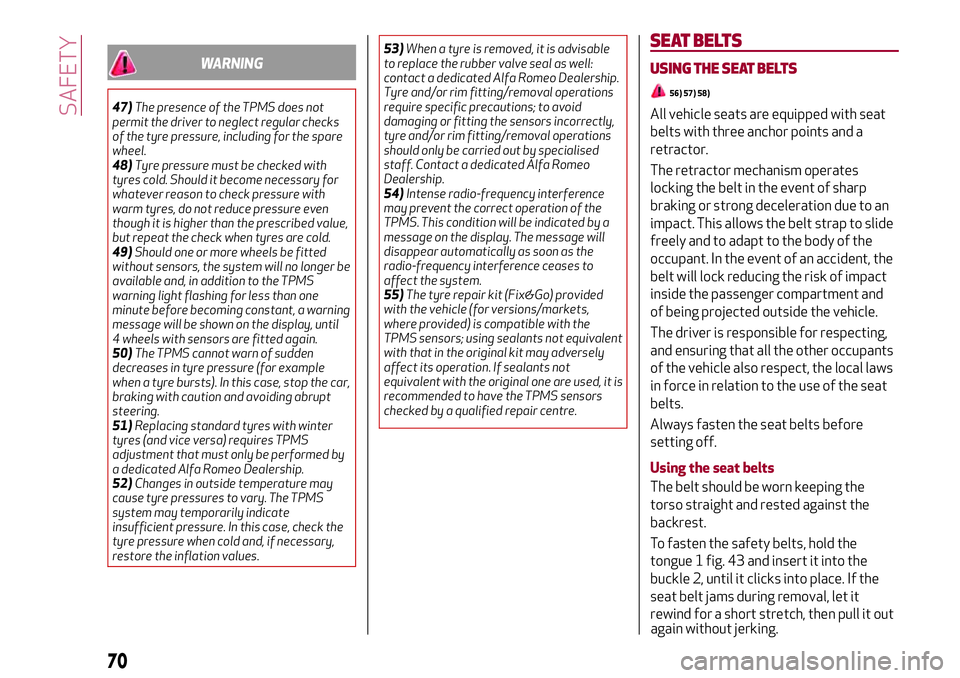
47)The presence of the TPMS does not
permit the driver to neglect regular checks
of the tyre pressure, including for the spare
wheel.
48)Tyre pressure must be checked with
tyres cold. Should it become necessary for
whatever reason to check pressure with
warm tyres, do not reduce pressure even
though it is higher than the prescribed value,
but repeat the check when tyres are cold.
49)Should one or more wheels be fitted
without sensors, the system will no longer be
available and, in addition to the TPMS
warning light flashing for less than one
minute before becoming constant, a warning
message will be shown on the display, until
4 wheels with sensors are fitted again.
50)The TPMS cannot warn of sudden
decreases in tyre pressure (for example
when a tyre bursts). In this case, stop the car,
braking with caution and avoiding abrupt
steering.
51)Replacing standard tyres with winter
tyres (and vice versa) requires TPMS
adjustment that must only be performed by
a dedicated Alfa Romeo Dealership.
52)Changes in outside temperature may
cause tyre pressures to vary. The TPMS
system may temporarily indicate
insufficient pressure. In this case, check the
tyre pressure when cold and, if necessary,
restore the inflation values.53)When a tyre is removed, it is advisable
to replace the rubber valve seal as well:
contact a dedicated Alfa Romeo Dealership.
Tyre and/or rim fitting/removal operations
require specific precautions; to avoid
damaging or fitting the sensors incorrectly,
tyre and/or rim fitting/removal operations
should only be carried out by specialised
staff. Contact a dedicated Alfa Romeo
Dealership.
54)Intense radio-frequency interference
may prevent the correct operation of the
TPMS. This condition will be indicated by a
message on the display. The message will
disappear automatically as soon as the
radio-frequency interference ceases to
affect the system.
55)The tyre repair kit (Fix&Go) provided
with the vehicle (for versions/markets,
where provided) is compatible with the
TPMS sensors; using sealants not equivalent
with that in the original kit may adversely
affect its operation. If sealants not
equivalent with the original one are used, it is
recommended to have the TPMS sensors
checked by a qualified repair centre.
SEAT BELTS
USING THE SEAT BELTS
56) 57) 58)
All vehicle seats are equipped with seat
belts with three anchor points and a
retractor.
The retractor mechanism operates
locking the belt in the event of sharp
braking or strong deceleration due to an
impact. This allows the belt strap to slide
freely and to adapt to the body of the
occupant. In the event of an accident, the
belt will lock reducing the risk of impact
inside the passenger compartment and
of being projected outside the vehicle.
The driver is responsible for respecting,
and ensuring that all the other occupants
of the vehicle also respect, the local laws
in force in relation to the use of the seat
belts.
Always fasten the seat belts before
setting off.
Using the seat belts
The belt should be worn keeping the
torso straight and rested against the
backrest.
To fasten the safety belts, hold the
tongue 1 fig. 43 and insert it into the
buckle 2, until it clicks into place. If the
seat belt jams during removal, let it
rewind for a short stretch, then pull it out
70
SAFETY
again without jerking.
Page 83 of 212
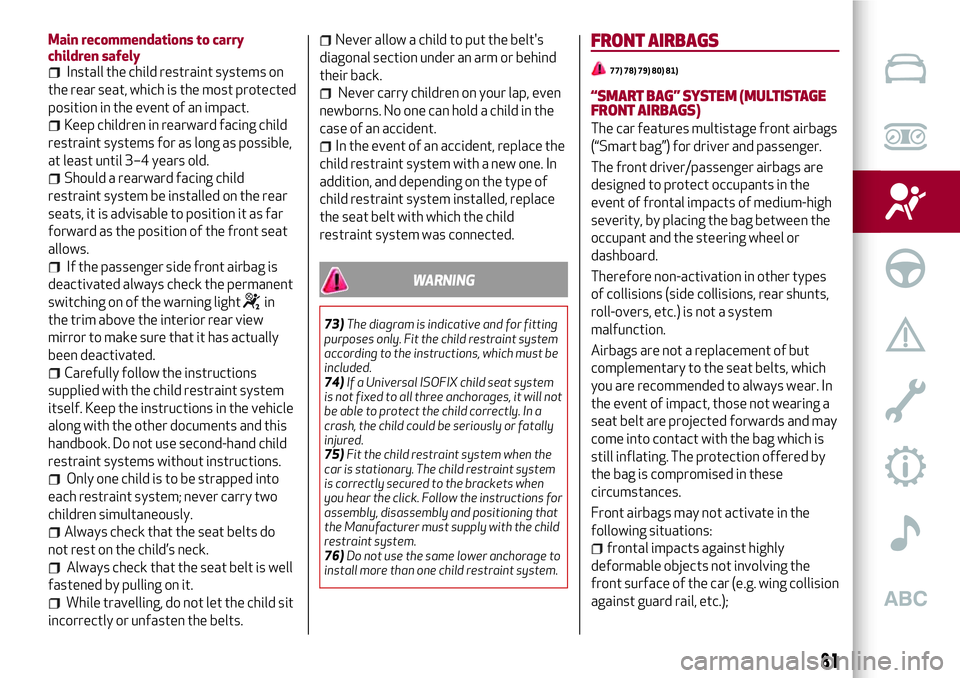
Main recommendations to carry
children safely
Install the child restraint systems on
the rear seat, which is the most protected
position in the event of an impact.
Keep children in rearward facing child
restraint systems for as long as possible,
at least until 3–4 years old.
Should a rearward facing child
restraint system be installed on the rear
seats, it is advisable to position it as far
forward as the position of the front seat
allows.
If the passenger side front airbag is
deactivated always check the permanent
switching on of the warning light
in
the trim above the interior rear view
mirror to make sure that it has actually
been deactivated.
Carefully follow the instructions
supplied with the child restraint system
itself. Keep the instructions in the vehicle
along with the other documents and this
handbook. Do not use second-hand child
restraint systems without instructions.
Only one child is to be strapped into
each restraint system; never carry two
children simultaneously.
Always check that the seat belts do
not rest on the child’s neck.
Always check that the seat belt is well
fastened by pulling on it.
While travelling, do not let the child sit
incorrectly or unfasten the belts.
Never allow a child to put the belt's
diagonal section under an arm or behind
their back.
Never carry children on your lap, even
newborns. No one can hold a child in the
case of an accident.
In the event of an accident, replace the
child restraint system with a new one. In
addition, and depending on the type of
child restraint system installed, replace
the seat belt with which the child
restraint system was connected.
WARNING
73)The diagram is indicative and for fitting
purposes only. Fit the child restraint system
according to the instructions, which must be
included.
74)If a Universal ISOFIX child seat system
is not fixed to all three anchorages, it will not
be able to protect the child correctly. In a
crash, the child could be seriously or fatally
injured.
75)Fit the child restraint system when the
car is stationary. The child restraint system
is correctly secured to the brackets when
you hear the click. Follow the instructions for
assembly, disassembly and positioning that
the Manufacturer must supply with the child
restraint system.
76)Do not use the same lower anchorage to
install more than one child restraint system.
FRONT AIRBAGS
77) 78) 79) 80) 81)
“SMART BAG”SYSTEM (MULTISTAGE
FRONT AIRBAGS)
The car features multistage front airbags
(“Smart bag”) for driver and passenger.
The front driver/passenger airbags are
designed to protect occupants in the
event of frontal impacts of medium-high
severity, by placing the bag between the
occupant and the steering wheel or
dashboard.
Therefore non-activation in other types
of collisions (side collisions, rear shunts,
roll-overs, etc.) is not a system
malfunction.
Airbags are not a replacement of but
complementary to the seat belts, which
you are recommended to always wear. In
the event of impact, those not wearing a
seat belt are projected forwards and may
come into contact with the bag which is
still inflating. The protection offered by
the bag is compromised in these
circumstances.
Front airbags may not activate in the
following situations:
frontal impacts against highly
deformable objects not involving the
front surface of the car (e.g. wing collision
against guard rail, etc.);
81
Page 84 of 212
jamming of the car underneath other
vehicles or protective barriers (e.g.
underneath a truck or a guard rail) as, in
this case, the bags would offer no
additional protection with respect to the
seat belt and their deployment would be
inappropriate. Failure to activate in the
conditions described above is due to the
fact that they may not provide any
additional protection compared with seat
belts, so their activation would be
inappropriate. In these cases,
non-deployment does not indicate a
system malfunction.
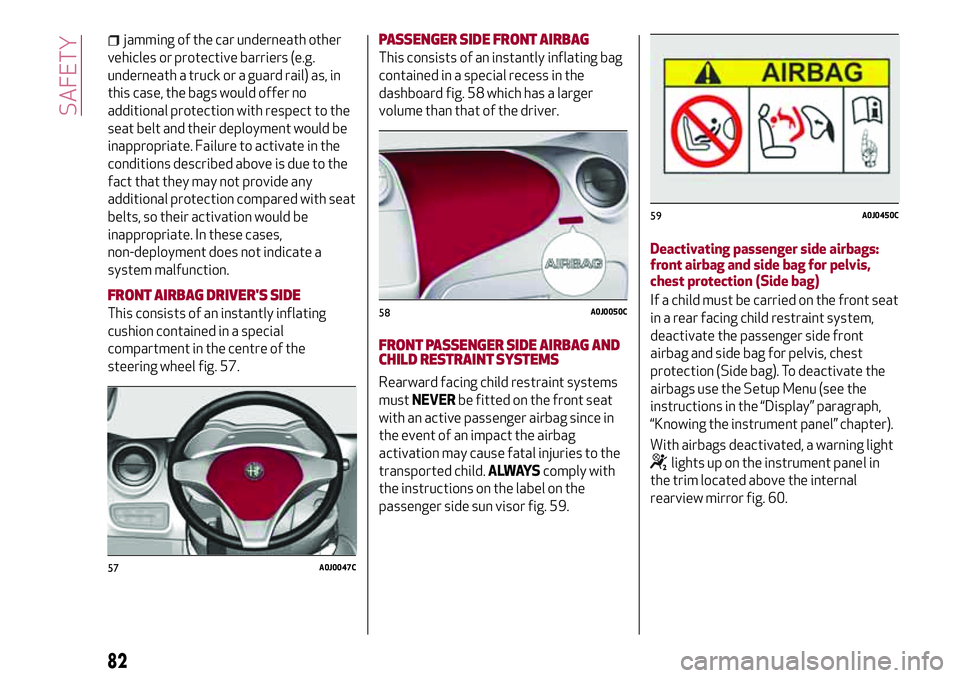
FRONT AIRBAG DRIVER'S SIDE
This consists of an instantly inflating
cushion contained in a special
compartment in the centre of the
steering wheel fig. 57.
PASSENGER SIDE FRONT AIRBAG
This consists of an instantly inflating bag
contained in a special recess in the
dashboard fig. 58 which has a larger
volume than that of the driver.
FRONT PASSENGER SIDE AIRBAG AND
CHILD RESTRAINTSYSTEMS
Rearward facing child restraint systems
mustNEVERbe fitted on the front seat
with an active passenger airbag since in
the event of an impact the airbag
activation may cause fatal injuries to the
transported child.ALWAYScomply with
the instructions on the label on the
passenger side sun visor fig. 59.Deactivating passenger side airbags:
front airbag and side bag for pelvis,
chest protection (Side bag)
If a child must be carried on the front seat
in a rear facing child restraint system,
deactivate the passenger side front
airbag and side bag for pelvis, chest
protection (Side bag). To deactivate the
airbags use the Setup Menu (see the
instructions in the “Display” paragraph,
“Knowing the instrument panel” chapter).
With airbags deactivated, a warning light
lights up on the instrument panel in
the trim located above the internal
rearview mirror fig. 60.
57A0J0047C
58A0J0050C
59A0J0450C
82
SAFETY
Page 85 of 212

With front passenger airbag on, when the
ignition key is turned to MAR, the warning
light switches on constantly for several
seconds and then it should switch off.
If the warning light
flashes, this
indicates a fault in the warning light
.
Before proceeding, contact an Alfa
Romeo Dealership to have the system
checked immediately.
Rotating the starting device to MAR, the
warning light
switches on for a few
seconds. If not, contact an Alfa Romeo
Dealership. During the first seconds, the
activation of the warning light
does
not actually show the passenger
protection status, but only tests its
correct operation. After a test of a few
seconds, the warning light will indicate
the status of the passenger airbag
protection.Passenger protection active: warning
light
off.
Passenger protection deactivated: the
warning light
switches on with a
steady light.
The warning light
may light up with
various intensity levels depending on the
vehicle conditions. The intensity may vary
during the same key cycle.
DRIVER SIDE KNEE BAG
This is located in a dedicated
compartment under the steering wheel
fig. 61. It provides additional protection
in the event of a frontal impact.
60A0J0402C
61A0J0056C
83