check oil Alfa Romeo Stelvio 2018 User Guide
[x] Cancel search | Manufacturer: ALFA ROMEO, Model Year: 2018, Model line: Stelvio, Model: Alfa Romeo Stelvio 2018Pages: 276, PDF Size: 5.79 MB
Page 215 of 276
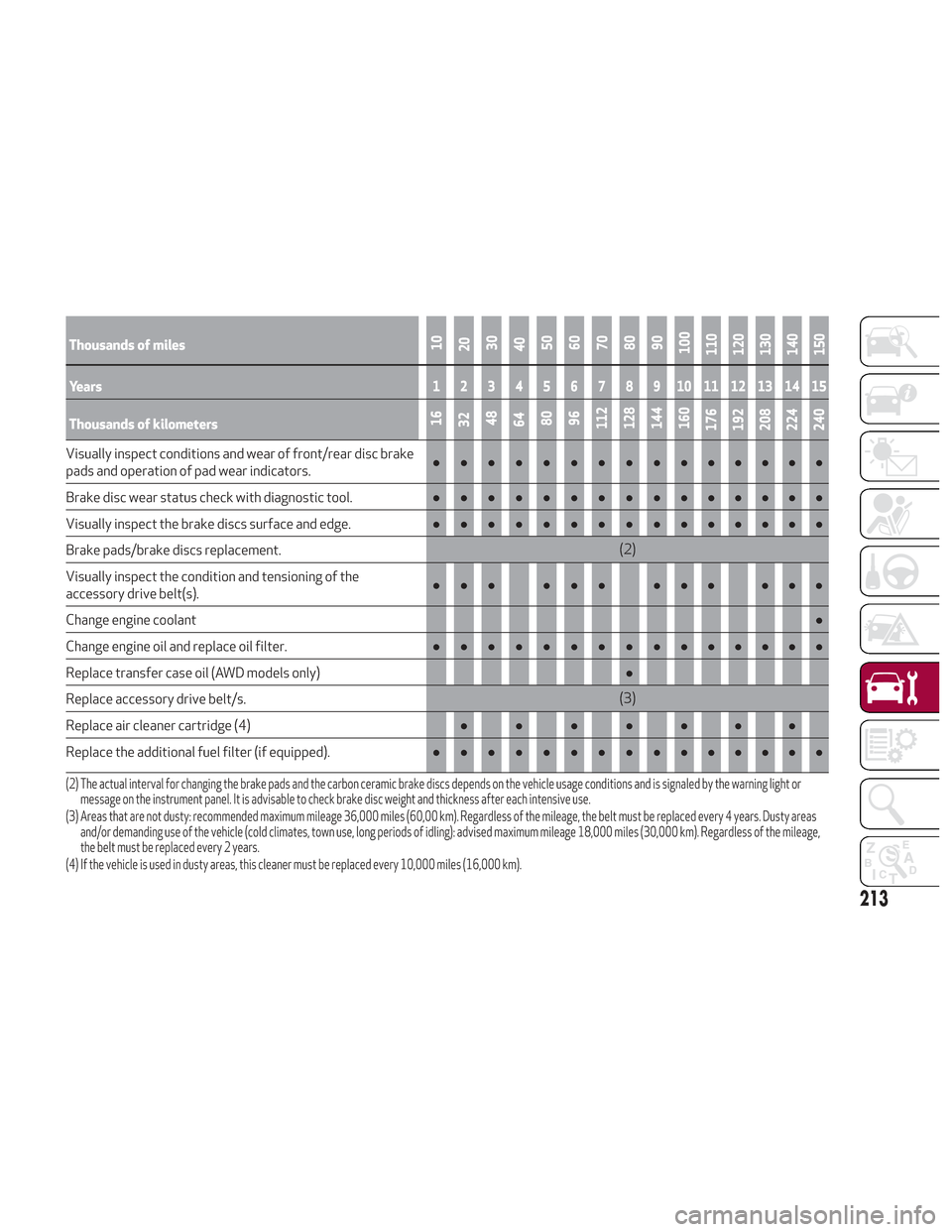
Thousands of miles10
20 30
40 50
60
70
80
90
100
110
120
130
140
150
Years123456789101112131415
Thousands of kilometers16
32 48
64 80
96
112
128
144
160
176
192
208
224
240
Visually inspect conditions and wear of front/rear disc brake
pads and operation of pad wear indicators. ●●●●●●●●●
●●●●●●
Brake disc wear status check with diagnostic tool. ●●●●●●●●●●●●●●●
Visually inspect the brake discs surface and edge. ●●●●●●●●●●●●●●●
Brake pads/brake discs replacement.
(2)
Visually inspect the condition and tensioning of the
accessory drive belt(s). ●●● ●●● ●●● ●●●
Change engine coolant ●
Change engine oil and replace oil filter. ●●●●●●●●●●●●●●●
Replace transfer case oil (AWD models only) ●
Replace accessory drive belt/s.
(3)
Replace air cleaner cartridge(4)●●●●●●●
Replace the additional fuel filter (if equipped). ●●●●●●●●●●●●●●●
(2) The actual interval for changing the brake pads and the carbon ceramic brake discs depends on the vehicle usage conditions and is signaled by the warning light or
message on the instrument panel. It is advisable to check brake disc weight and thickness after each intensive use.
(3) Areas that are not dusty: recommended maximum mileage 36,000 miles (60,00 km). Regardless of the mileage, the belt must be replaced every 4 years. Dusty areas and/or demanding use of the vehicle (cold climates, town use, long periods of idling): advised maximum mileage 18,000 miles (30,000 km). Regardless of the mileage,
the belt must be replaced every 2 years.
(4) If the vehicle is used in dusty areas, this cleaner must be replaced every 10,000 miles (16,000 km).
213
Page 217 of 276
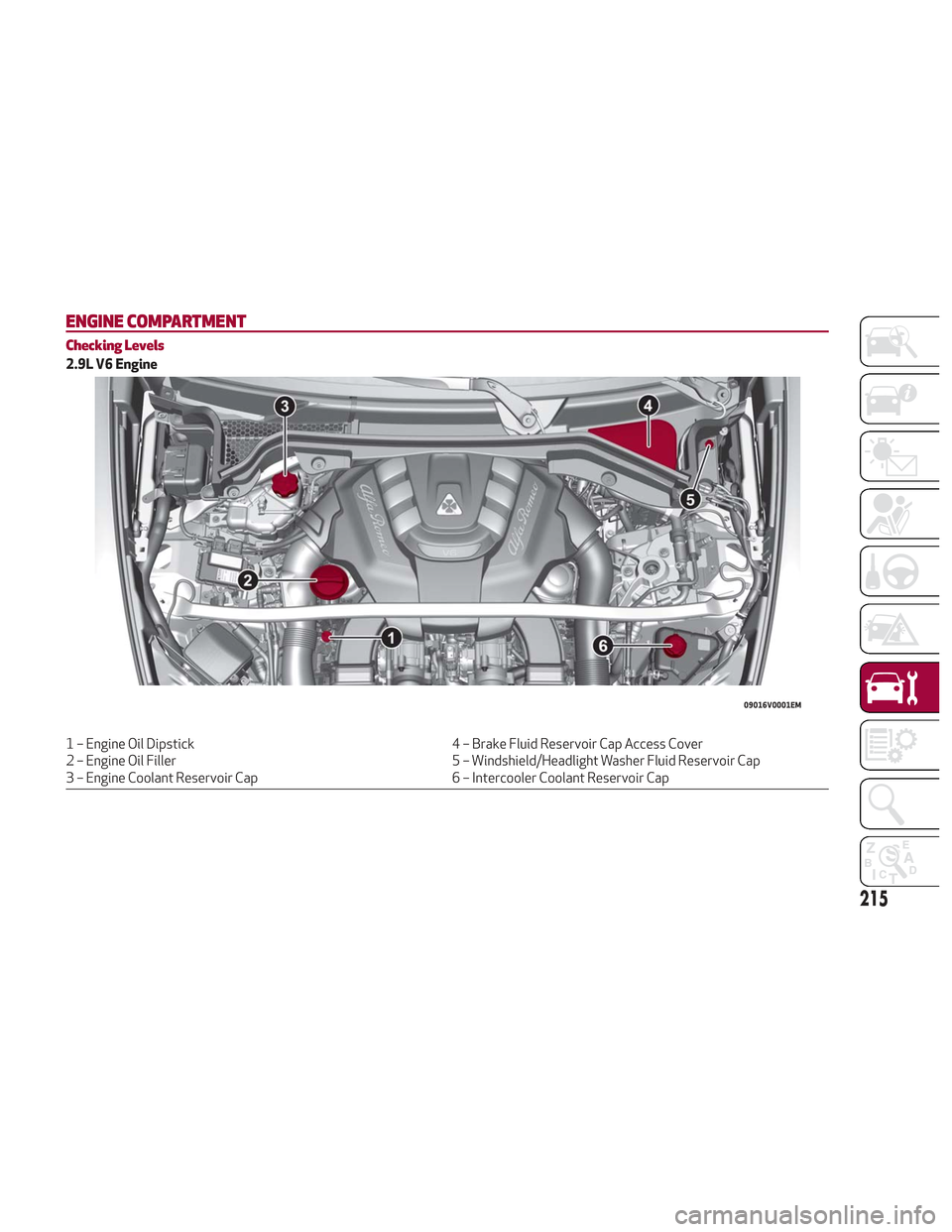
ENGINE COMPARTMENT
Checking Levels
2.9L V6 Engine
1 – Engine Oil Dipstick4 – Brake Fluid Reservoir Cap Access Cover
2 – Engine Oil Filler 5 – Windshield/Headlight Washer Fluid Reservoir Cap
3 – Engine Coolant Reservoir Cap 6 – Intercooler Coolant Reservoir Cap
09016V0001EM
215
Page 218 of 276
Engine Oil
The engine oil level can be seen on the
instrument cluster display every time the
engine is started, or on the Information
and Entertainment system display by
activating on the main menu (MENU
button) the following functions in
sequence:
1. “Apps”
2. “My Car”
3. “Oil Level”
Check on the display using the 6 notches
that the oil level is between the MIN and
MAX level: 1 notch MIN level, 6 notches
MAX level.
If the oil level is close to or below the MIN
mark, add oil gradually through the filler,
(refer to “Top-Up And Oil Level Indication
Update On Display” in this section)
considering that each notch shown on the
display corresponds to approximately
8.8floz(250ml).
Caution!
Make sure not to add too much oil when
topping off the engine. Engine oil in excess
may damage the engine. Have the vehicle
checked. Never exceed the MAX level when
topping off engine oil.
Caution!
The oil level is not refreshed immediately on
the display after topping off. Consequently,
wait for the oil level to be refreshed on the
display and follow the procedure below.
Note:Always reinstall the oil cap and
tighten to proper torque whenever it is
removed to add oil to engine. Never run
the engine with cap removed this could
cause oil to leak from engine.
Top-Up And Oil Level Indication Update
On Display
If a engine oil top-off is needed, in order
to ensure the correct indication of the oil
level on the display, leave the vehicle on
flat ground with the engine running for
approximately five minutes (temperature
higher than 176°F (80°C)) and shut the
engine off. Then, start the engine again,
and idle it for about five minutes.
Note: If you have added the specified
amount of oil and the indicator is not
reading “Full”, please contact an
authorized dealer.
Warning!
If the engine oil is being topped up, wait for
the engine to cool down before loosening the
filler cap, particularly for vehicles with
aluminium cap (if equipped). WARNING: risk
of burns!
Caution!
The oil level must never exceed the MAX
mark.
If the MAX mark is exceeded MAX (last
notch on the right turns red) after the fill-up,
go to an authorized dealer as soon as
possible to have the oil in excess removed.
Do not add oil with specifications
different from those of the oil already in the
engine.
Used engine oil and oil filters contain
substances which are harmful to the
environment. To change the oil and filters,
we advise you to contact an authorized
dealer.
Engine Coolant Fluid
If the level is too low, unscrew the cap of
the reservoir and add the fluid described
in the "Technical Specifications" chapter.
216
SERVICING AND MAINTENANCE
Page 219 of 276
Washer Fluid For Windshield/
Headlights
If the level is too low, remove reservoir
cap and lift the filler. Then, add the fluid
described in "Technical Specifications".
Note:The headlight washing system will
not work if the liquid level is low
(situation indicated by the symbol on the
instrument cluster display). The
windshield washer will keep working.
On vehicles equipped with headlight
washers, if equipped, there is a reference
notch on the dipstick: ONLY the
windshield/rear window washer operates
with the level below this reference.
Brake Fluid
Check that the fluid is at the maximum
level. If the fluid level in the tank is low,
contact your authorized dealer to have
the system checked.
Automatic Transmission Activation
System Oil
The transmission control oil level should
only be checked at your authorized
dealer.
Useful Advice For Extending The Life
Of Your Battery
To avoid draining your battery and make
it last longer, observe the following
instructions:
When you park the vehicle, ensure that
the doors and liftgate are closed properly
to prevent any lights from remaining on
inside the passenger's compartment.
Do not keep accessories (e.g. radio,
hazard warning lights, etc.) switched on for
a long time when the engine is not running.
Before performing any operation on
the electrical system, disconnect the
negative battery cable.
If you wish to install electrical
accessories after purchasing the vehicle
that require permanent electrical supply
(e.g. alarm, etc.), or accessories which
influence the electrical supply
requirements, contact your authorized
dealer, whose qualified staff will evaluate
the overall electrical consumption.
Caution!
If the charge level remains under 50% for a
long time, the battery may be damaged by
sulphation, reducing its capacity and
efficiency at start the vehicle. The battery is
also more prone to the risk of freezing (at
temperatures as high as 14°F (-10°C).
Note:After the battery is disconnected,
the steering must be initialized. The
warning light on the instrument panel
switches on to indicate this. To carry out
this procedure, simply turn the steering
wheel all the way from one end to the
other, and then turn it back to the central
position.
Battery
The battery does not require the
electrolyte to be topped up with distilled
water. A periodic check carried out at an
authorized dealer, however, is necessary
to check efficiency.
Follow the battery manufacturer's
instructions for maintenance.
Replacing The Battery
If necessary, replace the battery with
another original battery with the same
specifications. Follow the battery
manufacturer’s instructions for
maintenance.
217
Page 221 of 276
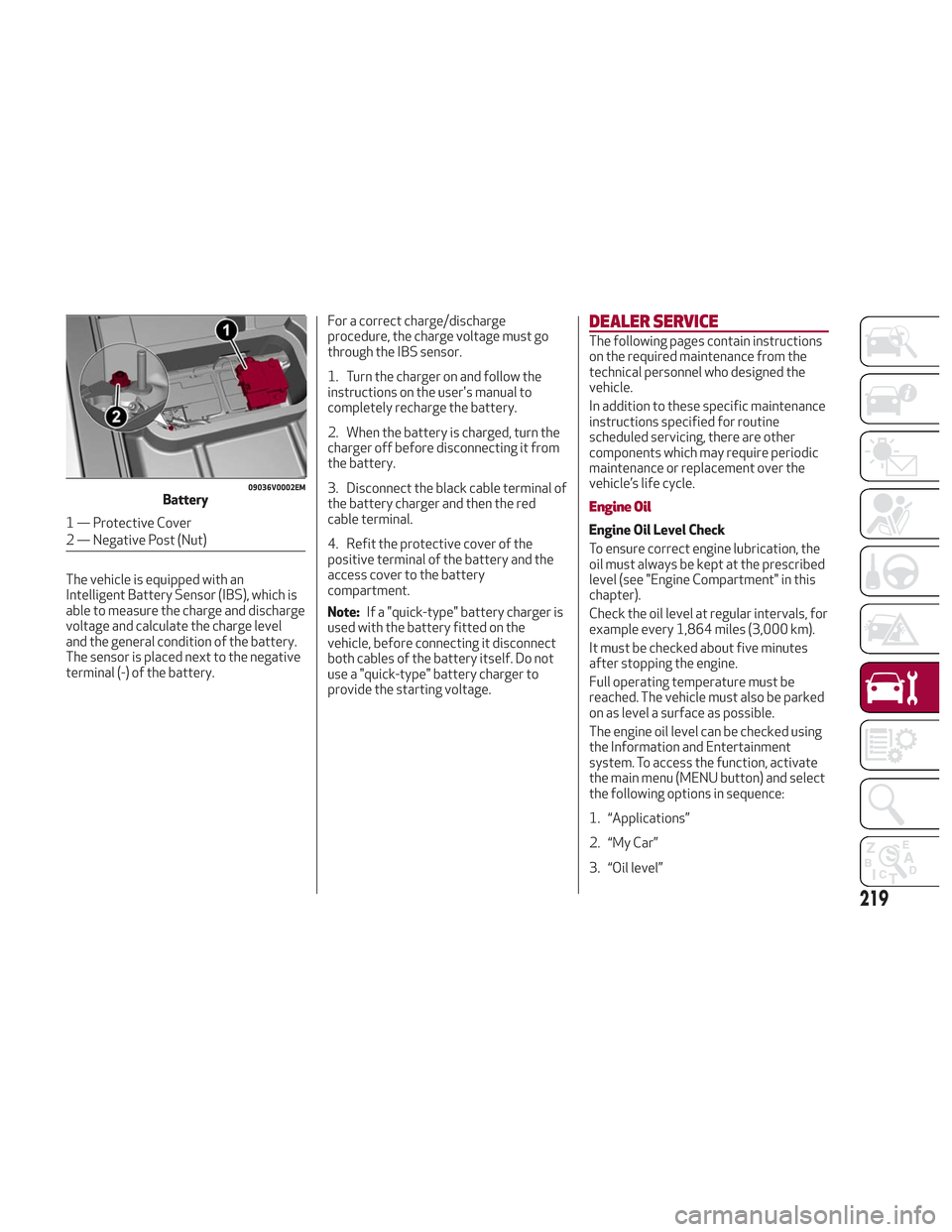
The vehicle is equipped with an
Intelligent Battery Sensor (IBS), which is
able to measure the charge and discharge
voltage and calculate the charge level
and the general condition of the battery.
The sensor is placed next to the negative
terminal (-) of the battery.For a correct charge/discharge
procedure, the charge voltage must go
through the IBS sensor.
1. Turn the charger on and follow the
instructions on the user's manual to
completely recharge the battery.
2. When the battery is charged, turn the
charger off before disconnecting it from
the battery.
3. Disconnect the black cable terminal of
the battery charger and then the red
cable terminal.
4. Refit the protective cover of the
positive terminal of the battery and the
access cover to the battery
compartment.
Note:
If a "quick-type" battery charger is
used with the battery fitted on the
vehicle, before connecting it disconnect
both cables of the battery itself. Do not
use a "quick-type" battery charger to
provide the starting voltage.
DEALER SERVICE
The following pages contain instructions
on the required maintenance from the
technical personnel who designed the
vehicle.
In addition to these specific maintenance
instructions specified for routine
scheduled servicing, there are other
components which may require periodic
maintenance or replacement over the
vehicle’s life cycle.
Engine Oil
Engine Oil Level Check
To ensure correct engine lubrication, the
oil must always be kept at the prescribed
level (see "Engine Compartment" in this
chapter).
Check the oil level at regular intervals, for
example every 1,864 miles (3,000 km).
It must be checked about five minutes
after stopping the engine.
Full operating temperature must be
reached. The vehicle must also be parked
on as level a surface as possible.
The engine oil level can be checked using
the Information and Entertainment
system. To access the function, activate
the main menu (MENU button) and select
the following options in sequence:
1. “Applications”
2. “My Car”
3. “Oil level”
09036V0002EMBattery
1 — Protective Cover
2 — Negative Post (Nut)
219
Page 222 of 276
Ensure that the oil level is within the
interval on the dipstick between the
minimum and maximum limits
(Quadrifoglio only).
Changing The Engine Oil
See the "Maintenance Plan" for the
correct servicing intervals.
Choice Of Engine Oil Type
To ensure optimal performance and
maximum protection in all operating
conditions, it is advised to use certified
engine oils. Refer to "Fluid And
Lubricants" in "Technical Specifications"
for further information.
Additives For Engine Oil
It is strongly recommended not to use
additives (other than leak detection dyes)
with the engine oil.
The engine oil is a product designed
specially for the vehicle and its
performance may be deteriorated
through the use of further additives.
Disposal Of Used Engine Oil And Filters
For the disposal of the engine oil and
filters, contact the appropriate body to
determine local regulations.
Note:Used engine oil disposed of
incorrectly may seriously harm the
environment.Engine Oil Filter
Replacing the Engine Oil Filter
The engine oil filter must be replaced
each time the engine oil is changed. It is
advised to replace it with a genuine spare
part, specifically designed for this
vehicle.
Air Filter
Replacing the Air Cleaner
See the "Maintenance Plan" for the
correct servicing intervals. It is advised to
replace it with a genuine spare part,
specifically designed for this vehicle.
Air Conditioning System Maintenance
To ensure the best possible performance,
the air conditioning system must be
checked and undergo maintenance at an
authorized dealer at the beginning of the
summer.
Caution!
Do not use chemicals to clean the air
conditioning system, since the internal
components may be damaged. This kind of
damage is not covered by warranty.
Replace The Cabin Air Filter
See the "Maintenance Plan" for the
correct servicing intervals. For cleaner
replacement, contact an authorized
dealer.
Warning!
Use only refrigerants and compressor
lubricants approved by the manufacturer for
your air conditioning system. Some
unapproved refrigerants are flammable and
can explode, injuring you. Other unapproved
refrigerants or lubricants can cause the
system to fail, requiring costly repairs. Refer
to Warranty Information Book, located in
your owner’s information kit, for further
warranty information.
Lubricating Moving Parts Of The
Bodywork
Ensure that the locks and bodywork
junction points, including components
such as the seat guides, door hinges (and
rollers), liftgate and hood are periodically
lubricated with lithium-based grease to
ensure correct, silent operation and to
protect them from rust and wear.
Thoroughly clean the components,
eliminating every trace of dirt and dust.
After lubricating, eliminate excess oil and
grease. Also pay particular attention to
the hood closing devices, to ensure
correct operation. During operations on
the hood, to be carried out with the
engine cold, also remember to check,
clean and lubricate the locking, release
and safety devices.
220
SERVICING AND MAINTENANCE
Page 225 of 276
Warning!
Exhaust gases can injure or kill. They
contain carbon monoxide (CO), which is
colorless and odorless. Breathing it can
make you unconscious and can eventually
poison you.
A hot exhaust system can start a fire if
you park over materials that can burn. Such
materials might be grass or leaves coming
into contact with your exhaust system. Do
not park or operate your vehicle in areas
where your exhaust system can contact
anything that can burn.
Cooling System
Warning!
You or others can be badly burned by hot
engine coolant (antifreeze) or steam from
your radiator. If you see or hear steam
coming from under the hood, do not open the
hood until the radiator has had time to cool.
Never open a cooling system pressure cap
when the radiator or coolant bottle is hot.
Keep hands, tools, clothing, and jewelry
away from the radiator cooling fan when the
hood is raised. The fan starts automatically
and may start at any time, whether the
engine is running or not.
When working near the radiator cooling
fan, disconnect the fan motor lead or turn
the ignition to the OFF mode. The fan is
temperature controlled and can start at any
time the ignition is in the ON mode.
Coolant Check
Your vehicle has two cooling systems and
they both need to be checked to ensure
they are at proper fill levels. Refer to the
“Engine Compartment” section for the
locations.
Check the engine coolant and intercooler
coolant level every oil change or before
long trips.
If there are impurities in the engine
coolant, the system must be drained,
flushed and refilled: contact an
authorized dealer.
Check the front part of the condenser to
check for any build-up of insects, leaves
or other debris. Should it be dirty, clean it
by spraying delicately with water.
Check the hoses of the engine/
intercooler cooling system to ensure that
the rubber has not deteriorated and that
there are no cracks, tears, cuts or
obstructions in the expansion tank side
and radiator side connectors. Should
there be any doubt regarding leaks from
the system (e.g. if frequent top ups are
required), have the seal checked at an
authorized dealer. With the engine off and at normal
operating temperature, check that the
cooling system radiator cap is closed
properly.Warning!
Do not open hot engine cooling system.
Never add engine coolant (antifreeze) when
the engine is overheated. Do not loosen or
remove the cap to cool an overheated
engine. Heat causes pressure to build up in
the cooling system. To prevent scalding or
injury, do not remove the pressure cap while
the system is hot or under pressure.
Do not use a pressure cap other than the
one specified for your vehicle. Personal
injury or engine damage may result.
Note: Before removing the coolant
reservoir cap, wait for the system to cool
down.
Topping Up / Draining / Flushing The
Engine/Intercooler Coolant
If the engine coolant (antifreeze) is dirty,
have cleaning and flushing carried out at
an authorized dealer.
See the "Maintenance Plan" for the
correct servicing intervals.
223
Page 226 of 276
Note:
For topping up, refer to "Fluids And
Lubricants" in "Technical Specifications"
for proper coolant specifications.
Do not use pure water, alcohol-based
coolants, corrosions inhibitors or
additional anti-rust products because
they may be incompatible with the
engine coolant and cause the clogging
of the radiator. The use of propylene
glycol-based coolant is also not
recommended.
Engine Cooling/Intercooler System Cap
To prevent loss of engine coolant, make
sure that the expansion tank cap is
closed. If it is open, screw it completely
until you reach/hear the click.
Periodically check the cap and clean it
from any foreign bodies that may have
deposited on the external surface.
Warning!
Never add coolant with the engine hot or
overheated.
Do not attempt to cool an overheated
engine by loosening or removing the cap. The
heat causes a considerable increase in
pressure in the cooling system.
To prevent damage to the engine, only
use the engine cooling circuit caps provided.
Disposal of Used Coolant
Disposal of engine/intercooler coolant is
subject to legal requirements. Contact
the appropriate body to determine local
regulations.
Note:
To prevent the fluid from being
ingested by children or animals, do not
keep it in open containers or pour it on
the ground. If ingested, contact a doctor
immediately. Eliminate any traces of
fluid from the ground immediately.
When the vehicle stops after a short
trip, steam may be seen coming out
from front of the hood. This is a normal
phenomenon which is due to the
presence of rain, snow or a lot of
moisture on the surface of the radiator.
With engine and system cold, do not
top up with coolant beyond the
maximum level indicated on the
reservoir in the engine compartment.
Braking System
In order to guarantee the efficiency of
the braking system, periodically check its
components; for this operation, contact
an authorized dealer.
See the "Maintenance Plan" for the
correct servicing intervals.
Note: Driving with your foot resting on
the brake pedal may compromise its
efficiency, increasing the risk of accidents. When driving, never keep your
foot on the brake pedal and don’t put
unnecessary strain on it to prevent the
brakes from overheating. Excess pad
wear may cause damage to the braking
system.
When an insufficient oil level is
detected, contact an authorized dealer
to have the system checked.
Always keep the cap of the brake
fluid reservoir (in the engine
compartment) completely closed.
Warning!
Use only manufacturer's recommended
brake fluid. Refer to “Fluids And Lubricants”
in “Technical Specifications” for further
information. Using the wrong type of brake
fluid can severely damage your brake
system and/or impair its performance. The
proper type of brake fluid for your vehicle is
also identified on the original factory
installed hydraulic master cylinder
reservoir.
To avoid contamination from foreign matter
or moisture, use only new brake fluid or fluid
that has been in a tightly closed container.
Keep the master cylinder reservoir cap secured
at all times. Brake fluid in a open container
absorbs moisture from the air resulting in a
lower boiling point. This may cause it to boil
unexpectedly during hard or prolonged braking,
resulting in sudden brake failure. This could
result in a collision.
224
SERVICING AND MAINTENANCE
Page 246 of 276
Engine Compartment
At the end of every winter, wash the
engine compartment thoroughly, taking
care not to aim the jet of water directly at
the electronic control units or at the
windshield wiper motors. Have this
operation performed at a specialized
workshop.
Note:The washing should take place
with the engine cold and the ignition
device in the STOP position. After the
washing operation, make sure that the
various protections (e.g. rubber caps and
guards) have not been removed or
damaged.INTERIORS
Periodically check the cleanliness of the
interior, beneath the mats, which could
cause oxidation of the sheet metal.
Seats And Fabric Parts
Remove dust with a soft brush or a
vacuum cleaner. It is advised to use a
moist brush on velvet upholstery. Rub the
seats with a sponge moistened with a
solution of water and neutral detergent.
Leather Seats
Remove the dry dirt with a chamois or
slightly damp cloth, without exerting too
much pressure.
Remove any liquid or grease stains using
an absorbent dry cloth, without rubbing.
Then clean with a soft cloth or buckskin
cloth dampened with water and mild
soap. If the stain persists, use specific
products and observe the instructions
carefully.
Note: Never use alcohol. Make sure that
the cleaning products used contain no
alcohol or alcohol derivatives, even in
small quantities.
Plastic And Coated Parts
Clean interior plastic parts with a damp
cloth (if possible made from microfiber),
and a solution of water and neutral,
non-abrasive detergent.
To clean oily or persistent stains, use
specific products free from solvents and
designed to maintain the original
appearance and color of the components.
Remove any dust using a microfiber
cloth, if necessary moistened with water.
The use of paper tissues is not
recommended as these may leave
residues.
Genuine Leather Parts
Use only water and mild soap to clean
these parts. Never use alcohol or
alcohol-based products.
Before using a specific product for
cleaning interiors, make sure that it does
not contain alcohol and/or alcohol based
substances.
Carbon Fiber Parts
To eliminate small scratches and marks
on the carbon, contact your authorized
dealer. An improperly performed
operation may irreparably damage the
carbon.
244
SERVICING AND MAINTENANCE
Page 270 of 276
Cooling SystemCoolant Capacity ...........257
Selection Of Coolant (Antifreeze) ..................... .257
Courtesy Mirror Light (Bulb Replacement) .............191
Cruise Control (Speed Control) . . . .166
Cupholder ..................67
Cupholders .................67
Customer Assistance ..........262
Daytime Running Lights ..........39
Daytime Running Lights (DRL) ......39
Defroster, Windshield ..........142
Dimensions ............... .253
Direction Indicators (Changing A Bulb) .................. .191
Disabled Vehicle Towing .........204
Door Light ..................43
Door Locks Child-Protection Door Lock —
Rear Doors ................27
Power Door Locks ...........27
Doors .....................23
Drive Train Control (DTC) System . . .104
Driving Modes ............. .158
Dynamic Steering Torque (DST) System ................ .107
Electric Park Brake ............149
Electric Remote Mirrors .........37Electric Steering Wheel Heating
.....37
Electronic Speed Control ........164
Electronic Speed Control (Cruise Control) ............. .164,166
Electronic Stability Control (ESC) System ................ .105
Emergency, In Case Of ..........198
Hazard Warning Flasher .......188
Jacking ................ .225
Jump Starting .............201
Overheating ............. .203
Towing ..............204,206
Emission Control System Maintenance ............. .101
Engine .................. .247
Block Heater ............. .149
Engine Coolant Level ........
.216
Exhaust
Gas Caution .........141
Fuel Requirements ..........255
Jump Starting .............201
Oil................... .257
Oil Selection ............. .257
Overheating ............. .203
Starting ............... .203
Engine Compartment ..........215
Engine Compartment (Washing) . . . .244
Engine Oil Level Check ............. .216
Engine Overheating ...........203 Enhanced Accident Response
Feature ..............129,207
Ethanol .................. .255
Exhaust Gas Caution ...........141
Exhaust System .............141
Exterior Lighting ............38,40
Exterior Lights ............38,143
Flashers Hazard Warning ............188
Turn Signal ............41,143
Fluid Capacities ..............257
Fluid Leaks ............... .143
Fluids And Lubricants ..........258
Forward Collision Warning (System) .110
Front Light Cluster With Main Beam Xenon Gas Discharge Headlights
(Bulb Replacement) ..........191
Front Seat Electric Heating .......31
Front Seats (Power Adjustment) ....29
Front Wipers Wiper Operation ............45
Fuel Additives ............... .256
Clean Air ............... .255
Ethanol ................ .255
Materials Added ...........256
Methanol ............... .255
Tank Capacity .............257
INDEX