Engine compartment Alfa Romeo Stelvio 2018 Owner's Guide
[x] Cancel search | Manufacturer: ALFA ROMEO, Model Year: 2018, Model line: Stelvio, Model: Alfa Romeo Stelvio 2018Pages: 276, PDF Size: 5.79 MB
Page 200 of 276
TIRE SERVICE KIT
Description
If a tire is punctured, you can make a first
emergency repair using the Tire Service
Kit located in the rear storage area under
the load platform.
1. Stop the vehicle in a position where
you can repair the tire safely. You should
be as far as possible from the side of the
road, and in a position that is not
dangerous for oncoming traffic. Turn on
the hazard warning flashers, remove the
safety triangle from the luggage
compartment, and place it at a suitable
distance from the vehicle to make other
drivers aware of your presence.
2. Verify that the valve stem (on the
wheel with the deflated tire) is in a
position that is near to the ground. This
will allow the tire repair kit hoses to reach
the valve stem and keep the tire service
kit flat on the ground.
3. Place the gear selector in PARK (P).
4. Apply the electric park brake and turn
the engine OFF.
To access the Tire Service Kit, open the
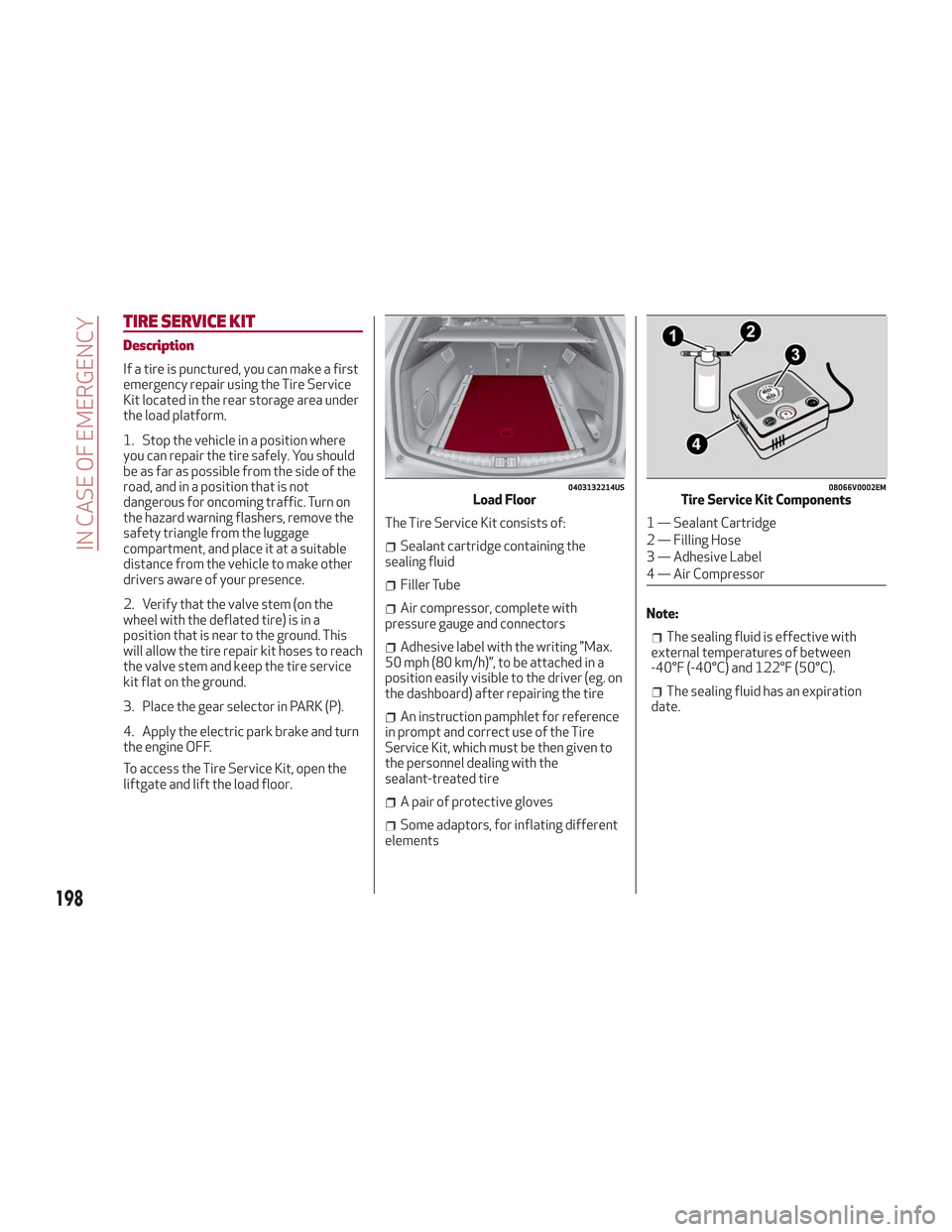
liftgate and lift the load floor.The Tire Service Kit consists of:
Sealant cartridge containing the
sealing fluid
Filler Tube
Air compressor, complete with
pressure gauge and connectors
Adhesive label with the writing "Max.
50 mph (80 km/h)”, to be attached in a
position easily visible to the driver (eg. on
the dashboard) after repairing the tire
An instruction pamphlet for reference
in prompt and correct use of the Tire
Service Kit, which must be then given to
the personnel dealing with the
sealant-treated tire
A pair of protective gloves
Some adaptors, for inflating different
elements Note:
The sealing fluid is effective with
external temperatures of between
-40°F (-40°C) and 122°F (50°C).
The sealing fluid has an expiration
date.
0403132214USLoad Floor08066V0002EMTire Service Kit Components
1 — Sealant Cartridge
2 — Filling Hose
3 — Adhesive Label
4 — Air Compressor
198
IN CASE OF EMERGENCY
Page 202 of 276
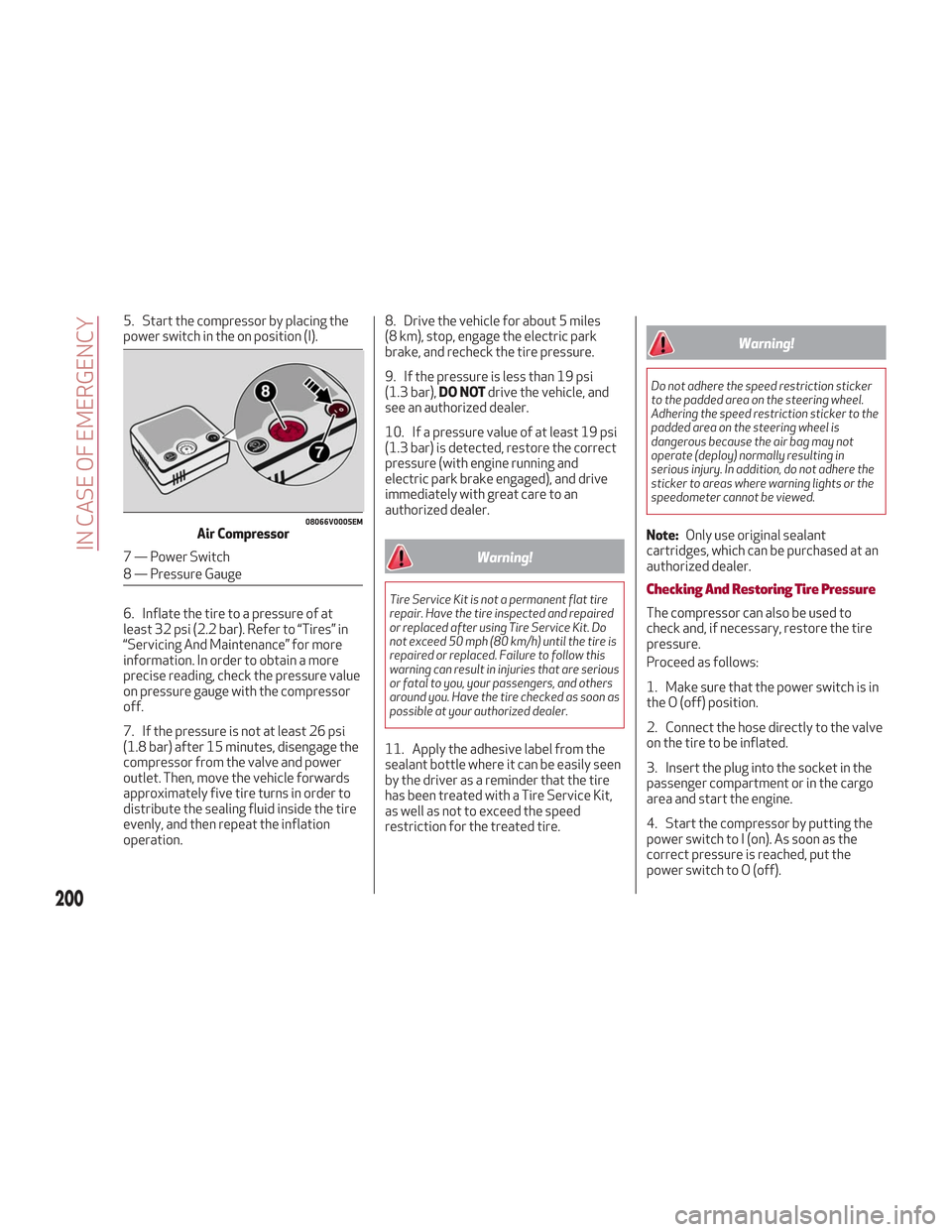
5. Start the compressor by placing the
power switch in the on position (I).
6. Inflate the tire to a pressure of at
least 32 psi (2.2 bar). Refer to “Tires” in
“Servicing And Maintenance” for more
information. In order to obtain a more
precise reading, check the pressure value
on pressure gauge with the compressor
off.
7. If the pressure is not at least 26 psi
(1.8 bar) after 15 minutes, disengage the
compressor from the valve and power
outlet. Then, move the vehicle forwards
approximately five tire turns in order to
distribute the sealing fluid inside the tire
evenly, and then repeat the inflation
operation.8. Drive the vehicle for about 5 miles
(8 km), stop, engage the electric park
brake, and recheck the tire pressure.
9. If the pressure is less than 19 psi
(1.3 bar),
DO NOTdrive the vehicle, and
see an authorized dealer.
10. If a pressure value of at least 19 psi
(1.3 bar) is detected, restore the correct
pressure (with engine running and
electric park brake engaged), and drive
immediately with great care to an
authorized dealer.
Warning!
Tire Service Kit is not a permanent flat tire
repair. Have the tire inspected and repaired
or replaced after using Tire Service Kit. Do
not exceed 50 mph (80 km/h) until the tire is
repaired or replaced. Failure to follow this
warning can result in injuries that are serious
or fatal to you, your passengers, and others
around you. Have the tire checked as soon as
possible at your authorized dealer.
11. Apply the adhesive label from the
sealant bottle where it can be easily seen
by the driver as a reminder that the tire
has been treated with a Tire Service Kit,
as well as not to exceed the speed
restriction for the treated tire.
Warning!
Do not adhere the speed restriction sticker
to the padded area on the steering wheel.
Adhering the speed restriction sticker to the
padded area on the steering wheel is
dangerous because the air bag may not
operate (deploy) normally resulting in
serious injury. In addition, do not adhere the
sticker to areas where warning lights or the
speedometer cannot be viewed.
Note: Only use original sealant
cartridges, which can be purchased at an
authorized dealer.
Checking And Restoring Tire Pressure
The compressor can also be used to
check and, if necessary, restore the tire
pressure.
Proceed as follows:
1. Make sure that the power switch is in
the O (off) position.
2. Connect the hose directly to the valve
on the tire to be inflated.
3. Insert the plug into the socket in the
passenger compartment or in the cargo
area and start the engine.
4. Start the compressor by putting the
power switch to I (on). As soon as the
correct pressure is reached, put the
power switch to O (off).
08066V0005EMAir Compressor
7 — Power Switch
8 — Pressure Gauge
200
IN CASE OF EMERGENCY
Page 203 of 276
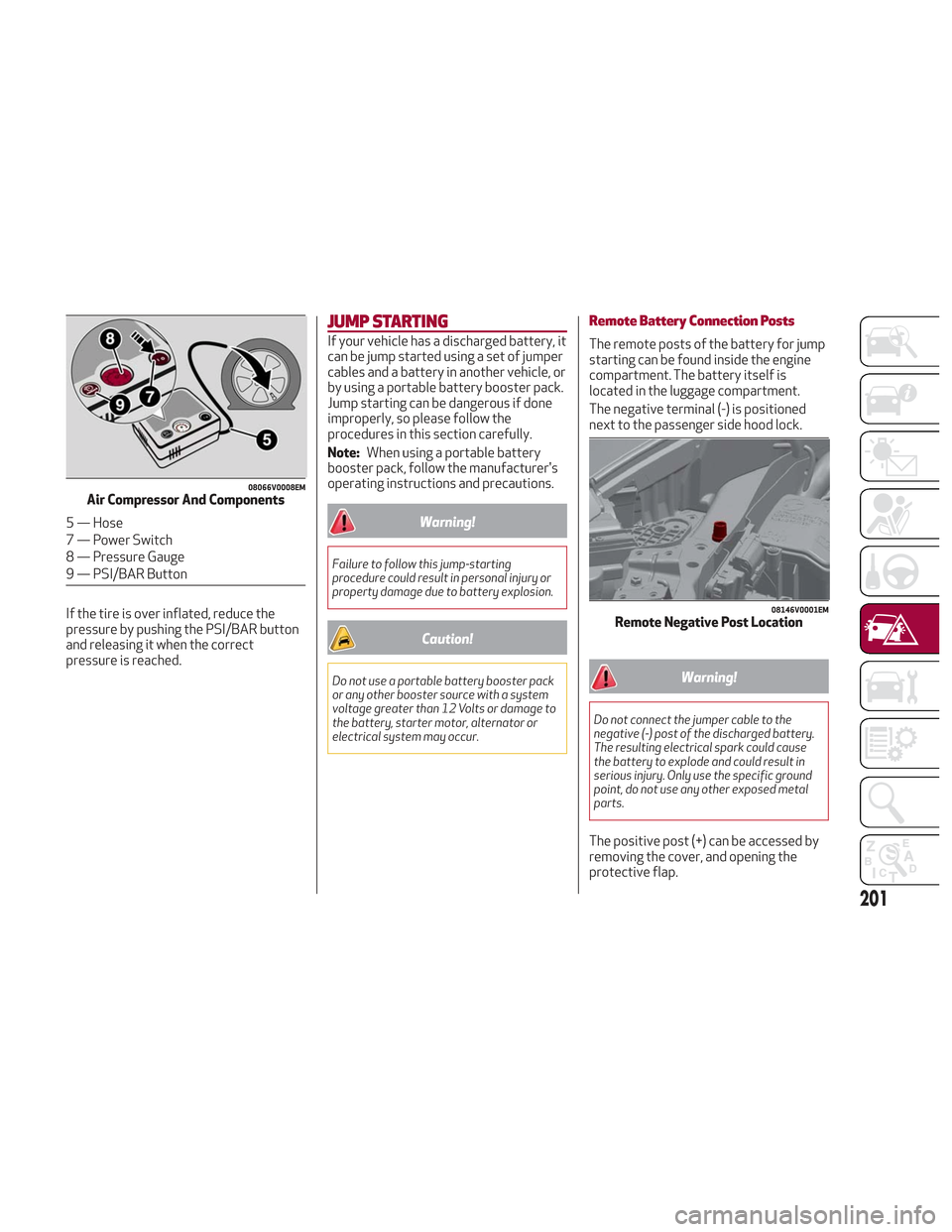
If the tire is over inflated, reduce the
pressure by pushing the PSI/BAR button
and releasing it when the correct
pressure is reached.
JUMP STARTING
If your vehicle has a discharged battery, it
can be jump started using a set of jumper
cables and a battery in another vehicle, or
by using a portable battery booster pack.
Jump starting can be dangerous if done
improperly, so please follow the
procedures in this section carefully.
Note:When using a portable battery
booster pack, follow the manufacturer's
operating instructions and precautions.
Warning!
Failure to follow this jump-starting
procedure could result in personal injury or
property damage due to battery explosion.
Caution!
Do not use a portable battery booster pack
or any other booster source with a system
voltage greater than 12 Volts or damage to
the battery, starter motor, alternator or
electrical system may occur.
Remote Battery Connection Posts
The remote posts of the battery for jump
starting can be found inside the engine
compartment. The battery itself is
located in the luggage compartment.
The negative terminal (-) is positioned
next to the passenger side hood lock.
Warning!
Do not connect the jumper cable to the
negative (-) post of the discharged battery.
The resulting electrical spark could cause
the battery to explode and could result in
serious injury. Only use the specific ground
point, do not use any other exposed metal
parts.
The positive post (+) can be accessed by
removing the cover, and opening the
protective flap.
08066V0008EMAir Compressor And Components
5 — Hose
7 — Power Switch
8 — Pressure Gauge
9 — PSI/BAR Button
08146V0001EMRemote Negative Post Location
201
Page 211 of 276
SERVICING AND MAINTENANCE
Correct servicing permits the
performance of the vehicle to be
maintained over time, as well as limited
running costs and safeguarding the
efficiency of the safety systems.
This chapter explains how.SCHEDULED SERVICING.......210
ENGINE COMPARTMENT .......215
BATTERY RECHARGING ........218
DEALER SERVICE ............219
RAISING THE VEHICLE .........225
TIRES .................. .226
DEPARTMENT OF TRANSPORTATION
UNIFORM TIRE QUALITY GRADES .241
STORING THE VEHICLE ........242
BODYWORK...............242
INTERIORS ............... .244
209
Page 214 of 276
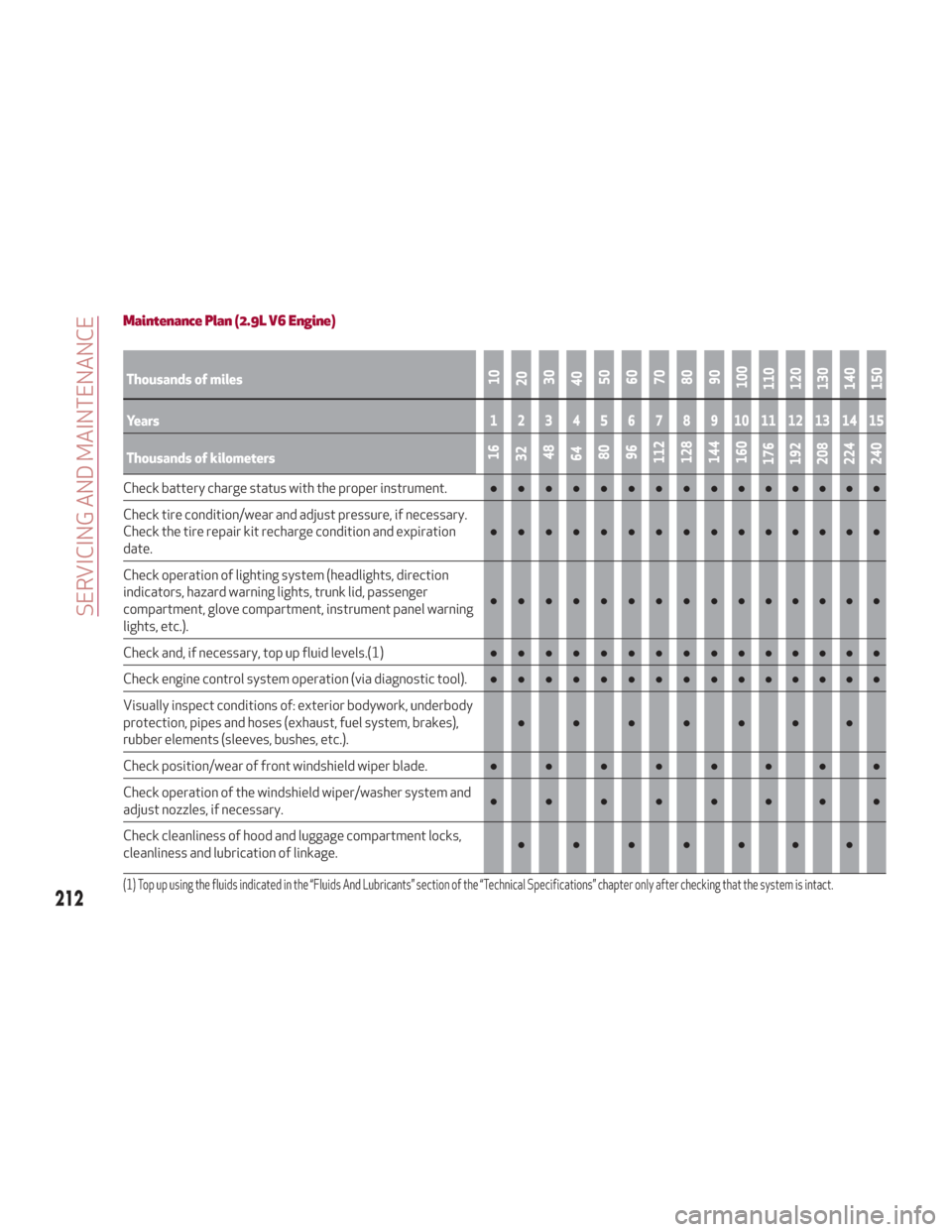
Maintenance Plan (2.9L V6 Engine)
Thousands of miles10
20 30
40 50
60
70
80
90
100
110
120
130
140
150
Years123456789101112131415
Thousands of kilometers16
32 48
64 80
96
112
128
144
160
176
192
208
224
240
Check battery charge status with the proper instrument. ●●●●●●●●●●●●●●●
Check tire condition/wear and adjust pressure, if necessary.
Check the tire repair kit recharge condition and expiration
date. ●●●●●●●●●
●●●●●●
Check operation of lighting system (headlights, direction
indicators, hazard warning lights, trunk lid, passenger
compartment, glove compartment, instrument panel warning
lights, etc.). ●●●●●●●●●
●●●●●●
Check and, if necessary, top up fluid levels.
(1)●●●●●●●●● ●●●●●●
Check engine control system operation (via diagnostic tool). ●●●●●●●●●●●●●●●
Visually inspect conditions of: exterior bodywork, underbody
protection, pipes and hoses (exhaust, fuel system, brakes),
rubber elements (sleeves, bushes, etc.). ●●●●●●●
Check position/wear of front windshield wiper blade. ●●●●●●●●
Check operation of the windshield wiper/washer system and
adjust nozzles, if necessary. ●●●●●●●●
Check cleanliness of hood and luggage compartment locks,
cleanliness and lubrication of linkage. ●●●●●●●
(1) Top up using the fluids indicated in the “Fluids And Lubricants” section of the “Technical Specifications” chapter only after checking that the system is intact.
212
SERVICING AND MAINTENANCE
Page 217 of 276
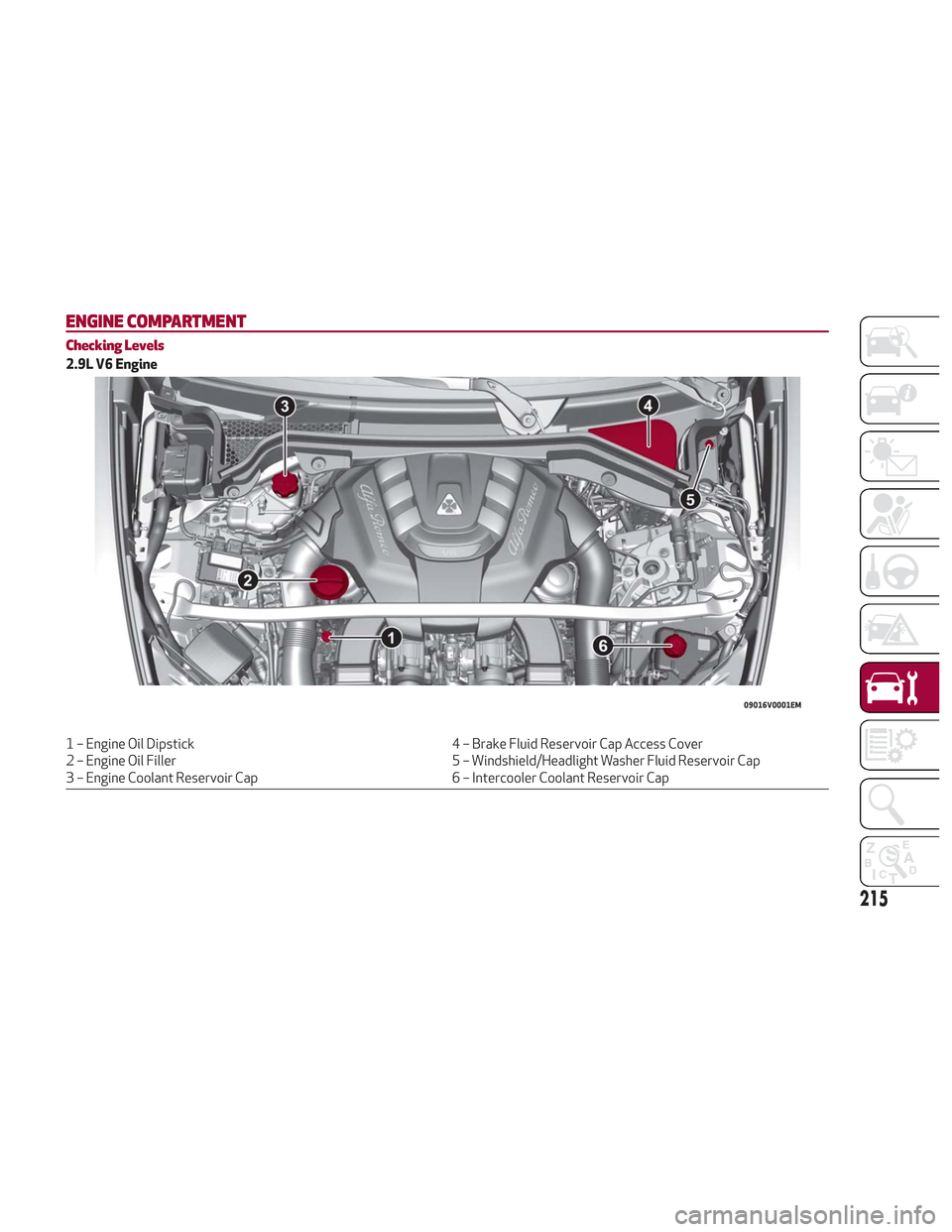
ENGINE COMPARTMENT
Checking Levels
2.9L V6 Engine
1 – Engine Oil Dipstick4 – Brake Fluid Reservoir Cap Access Cover
2 – Engine Oil Filler 5 – Windshield/Headlight Washer Fluid Reservoir Cap
3 – Engine Coolant Reservoir Cap 6 – Intercooler Coolant Reservoir Cap
09016V0001EM
215
Page 219 of 276
Washer Fluid For Windshield/
Headlights
If the level is too low, remove reservoir
cap and lift the filler. Then, add the fluid
described in "Technical Specifications".
Note:The headlight washing system will
not work if the liquid level is low
(situation indicated by the symbol on the
instrument cluster display). The
windshield washer will keep working.
On vehicles equipped with headlight
washers, if equipped, there is a reference
notch on the dipstick: ONLY the
windshield/rear window washer operates
with the level below this reference.
Brake Fluid
Check that the fluid is at the maximum
level. If the fluid level in the tank is low,
contact your authorized dealer to have
the system checked.
Automatic Transmission Activation
System Oil
The transmission control oil level should
only be checked at your authorized
dealer.
Useful Advice For Extending The Life
Of Your Battery
To avoid draining your battery and make
it last longer, observe the following
instructions:
When you park the vehicle, ensure that
the doors and liftgate are closed properly
to prevent any lights from remaining on
inside the passenger's compartment.
Do not keep accessories (e.g. radio,
hazard warning lights, etc.) switched on for
a long time when the engine is not running.
Before performing any operation on
the electrical system, disconnect the
negative battery cable.
If you wish to install electrical
accessories after purchasing the vehicle
that require permanent electrical supply
(e.g. alarm, etc.), or accessories which
influence the electrical supply
requirements, contact your authorized
dealer, whose qualified staff will evaluate
the overall electrical consumption.
Caution!
If the charge level remains under 50% for a
long time, the battery may be damaged by
sulphation, reducing its capacity and
efficiency at start the vehicle. The battery is
also more prone to the risk of freezing (at
temperatures as high as 14°F (-10°C).
Note:After the battery is disconnected,
the steering must be initialized. The
warning light on the instrument panel
switches on to indicate this. To carry out
this procedure, simply turn the steering
wheel all the way from one end to the
other, and then turn it back to the central
position.
Battery
The battery does not require the
electrolyte to be topped up with distilled
water. A periodic check carried out at an
authorized dealer, however, is necessary
to check efficiency.
Follow the battery manufacturer's
instructions for maintenance.
Replacing The Battery
If necessary, replace the battery with
another original battery with the same
specifications. Follow the battery
manufacturer’s instructions for
maintenance.
217
Page 221 of 276
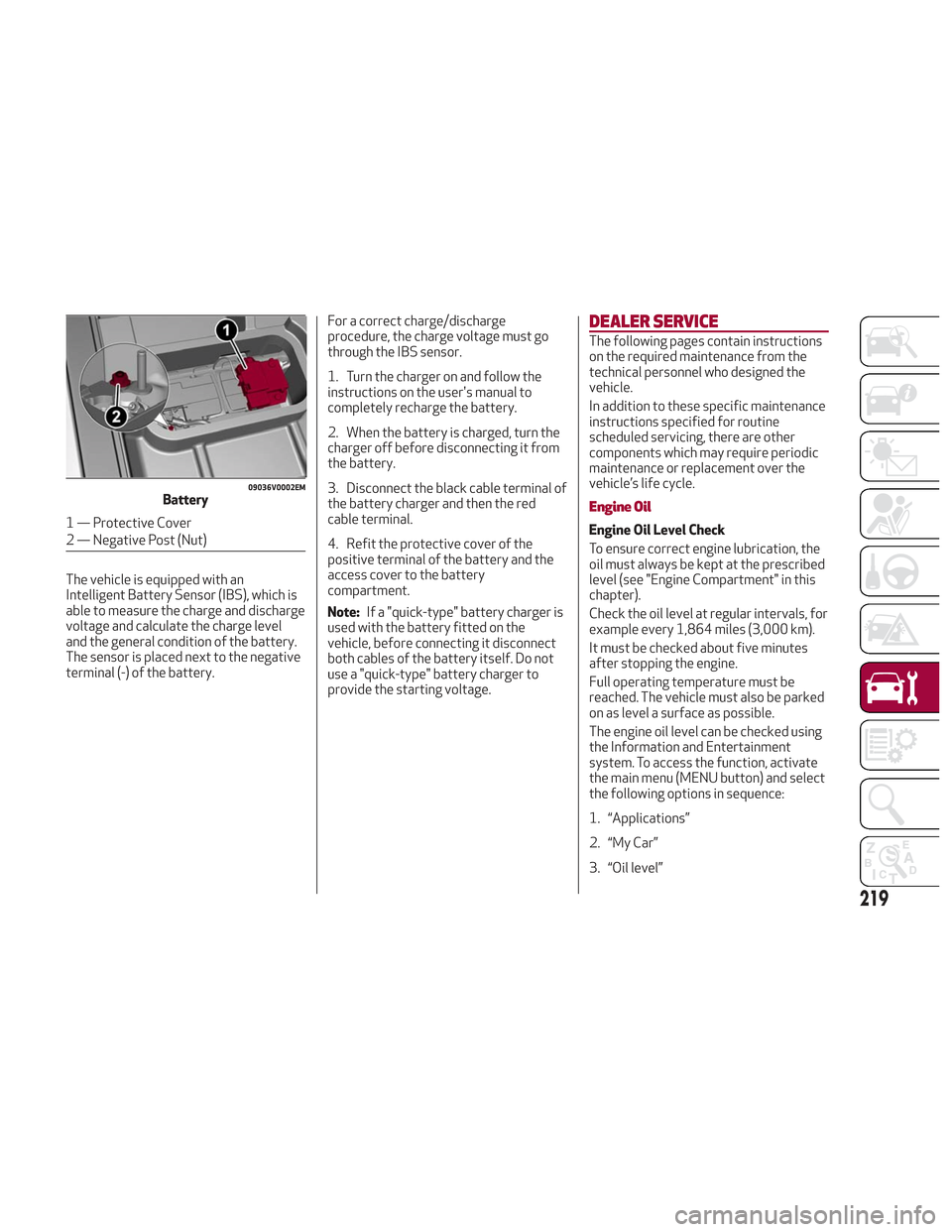
The vehicle is equipped with an
Intelligent Battery Sensor (IBS), which is
able to measure the charge and discharge
voltage and calculate the charge level
and the general condition of the battery.
The sensor is placed next to the negative
terminal (-) of the battery.For a correct charge/discharge
procedure, the charge voltage must go
through the IBS sensor.
1. Turn the charger on and follow the
instructions on the user's manual to
completely recharge the battery.
2. When the battery is charged, turn the
charger off before disconnecting it from
the battery.
3. Disconnect the black cable terminal of
the battery charger and then the red
cable terminal.
4. Refit the protective cover of the
positive terminal of the battery and the
access cover to the battery
compartment.
Note:
If a "quick-type" battery charger is
used with the battery fitted on the
vehicle, before connecting it disconnect
both cables of the battery itself. Do not
use a "quick-type" battery charger to
provide the starting voltage.
DEALER SERVICE
The following pages contain instructions
on the required maintenance from the
technical personnel who designed the
vehicle.
In addition to these specific maintenance
instructions specified for routine
scheduled servicing, there are other
components which may require periodic
maintenance or replacement over the
vehicle’s life cycle.
Engine Oil
Engine Oil Level Check
To ensure correct engine lubrication, the
oil must always be kept at the prescribed
level (see "Engine Compartment" in this
chapter).
Check the oil level at regular intervals, for
example every 1,864 miles (3,000 km).
It must be checked about five minutes
after stopping the engine.
Full operating temperature must be
reached. The vehicle must also be parked
on as level a surface as possible.
The engine oil level can be checked using
the Information and Entertainment
system. To access the function, activate
the main menu (MENU button) and select
the following options in sequence:
1. “Applications”
2. “My Car”
3. “Oil level”
09036V0002EMBattery
1 — Protective Cover
2 — Negative Post (Nut)
219
Page 224 of 276
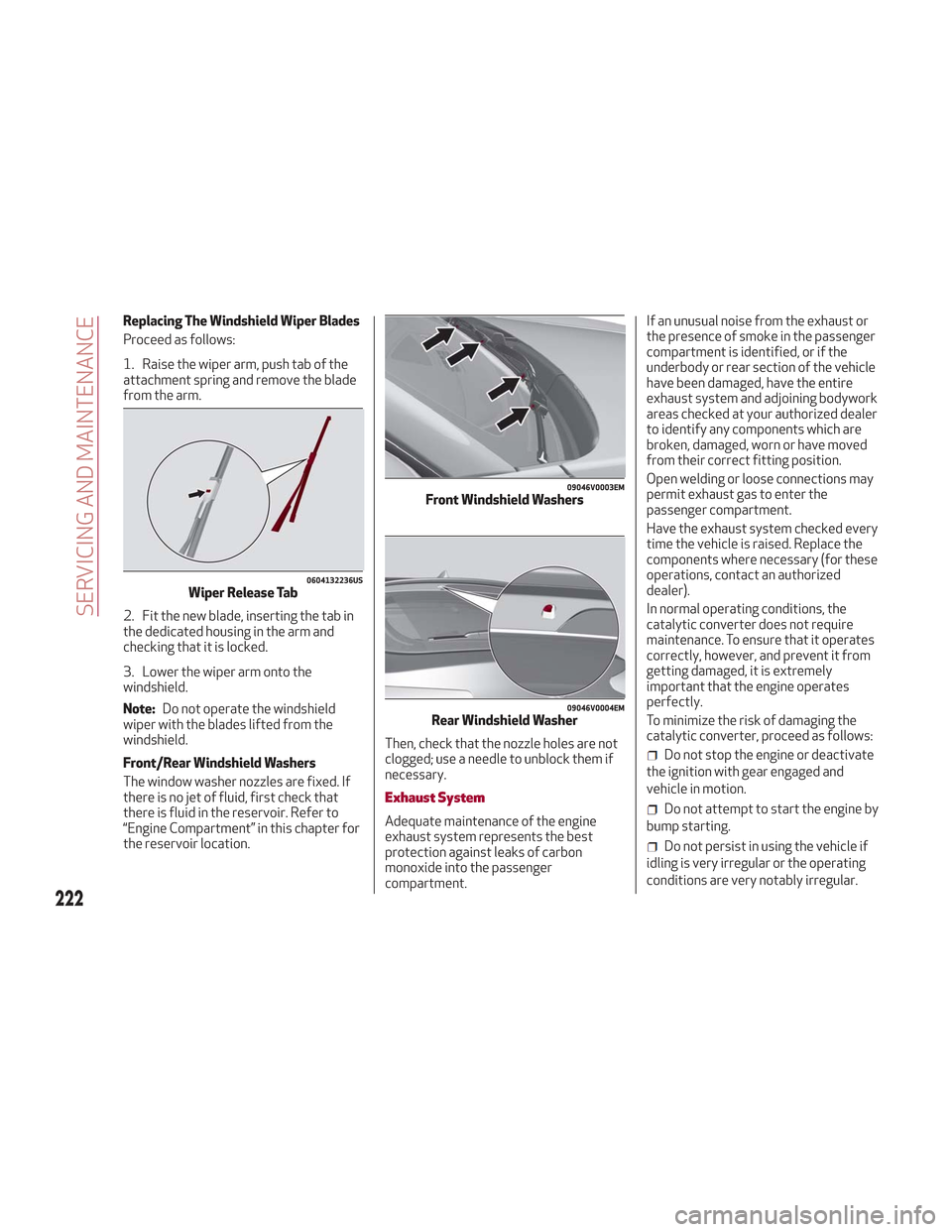
Replacing The Windshield Wiper Blades
Proceed as follows:
1. Raise the wiper arm, push tab of the
attachment spring and remove the blade
from the arm.
2. Fit the new blade, inserting the tab in
the dedicated housing in the arm and
checking that it is locked.
3. Lower the wiper arm onto the
windshield.
Note:Do not operate the windshield
wiper with the blades lifted from the
windshield.
Front/Rear Windshield Washers
The window washer nozzles are fixed. If
there is no jet of fluid, first check that
there is fluid in the reservoir. Refer to
“Engine Compartment” in this chapter for
the reservoir location. Then, check that the nozzle holes are not
clogged; use a needle to unblock them if
necessary.
Exhaust System
Adequate maintenance of the engine
exhaust system represents the best
protection against leaks of carbon
monoxide into the passenger
compartment.If an unusual noise from the exhaust or
the presence of smoke in the passenger
compartment is identified, or if the
underbody or rear section of the vehicle
have been damaged, have the entire
exhaust system and adjoining bodywork
areas checked at your authorized dealer
to identify any components which are
broken, damaged, worn or have moved
from their correct fitting position.
Open welding or loose connections may
permit exhaust gas to enter the
passenger compartment.
Have the exhaust system checked every
time the vehicle is raised. Replace the
components where necessary (for these
operations, contact an authorized
dealer).
In normal operating conditions, the
catalytic converter does not require
maintenance. To ensure that it operates
correctly, however, and prevent it from
getting damaged, it is extremely
important that the engine operates
perfectly.
To minimize the risk of damaging the
catalytic converter, proceed as follows:
Do not stop the engine or deactivate
the ignition with gear engaged and
vehicle in motion.
Do not attempt to start the engine by
bump starting.
Do not persist in using the vehicle if
idling is very irregular or the operating
conditions are very notably irregular.
0604132236USWiper Release Tab
09046V0003EMFront Windshield Washers
09046V0004EMRear Windshield Washer
222
SERVICING AND MAINTENANCE
Page 225 of 276
Warning!
Exhaust gases can injure or kill. They
contain carbon monoxide (CO), which is
colorless and odorless. Breathing it can
make you unconscious and can eventually
poison you.
A hot exhaust system can start a fire if
you park over materials that can burn. Such
materials might be grass or leaves coming
into contact with your exhaust system. Do
not park or operate your vehicle in areas
where your exhaust system can contact
anything that can burn.
Cooling System
Warning!
You or others can be badly burned by hot
engine coolant (antifreeze) or steam from
your radiator. If you see or hear steam
coming from under the hood, do not open the
hood until the radiator has had time to cool.
Never open a cooling system pressure cap
when the radiator or coolant bottle is hot.
Keep hands, tools, clothing, and jewelry
away from the radiator cooling fan when the
hood is raised. The fan starts automatically
and may start at any time, whether the
engine is running or not.
When working near the radiator cooling
fan, disconnect the fan motor lead or turn
the ignition to the OFF mode. The fan is
temperature controlled and can start at any
time the ignition is in the ON mode.
Coolant Check
Your vehicle has two cooling systems and
they both need to be checked to ensure
they are at proper fill levels. Refer to the
“Engine Compartment” section for the
locations.
Check the engine coolant and intercooler
coolant level every oil change or before
long trips.
If there are impurities in the engine
coolant, the system must be drained,
flushed and refilled: contact an
authorized dealer.
Check the front part of the condenser to
check for any build-up of insects, leaves
or other debris. Should it be dirty, clean it
by spraying delicately with water.
Check the hoses of the engine/
intercooler cooling system to ensure that
the rubber has not deteriorated and that
there are no cracks, tears, cuts or
obstructions in the expansion tank side
and radiator side connectors. Should
there be any doubt regarding leaks from
the system (e.g. if frequent top ups are
required), have the seal checked at an
authorized dealer. With the engine off and at normal
operating temperature, check that the
cooling system radiator cap is closed
properly.Warning!
Do not open hot engine cooling system.
Never add engine coolant (antifreeze) when
the engine is overheated. Do not loosen or
remove the cap to cool an overheated
engine. Heat causes pressure to build up in
the cooling system. To prevent scalding or
injury, do not remove the pressure cap while
the system is hot or under pressure.
Do not use a pressure cap other than the
one specified for your vehicle. Personal
injury or engine damage may result.
Note: Before removing the coolant
reservoir cap, wait for the system to cool
down.
Topping Up / Draining / Flushing The
Engine/Intercooler Coolant
If the engine coolant (antifreeze) is dirty,
have cleaning and flushing carried out at
an authorized dealer.
See the "Maintenance Plan" for the
correct servicing intervals.
223