parking brake Alfa Romeo Stelvio 2018 Owner's Guide
[x] Cancel search | Manufacturer: ALFA ROMEO, Model Year: 2018, Model line: Stelvio, Model: Alfa Romeo Stelvio 2018Pages: 276, PDF Size: 5.79 MB
Page 241 of 276

Caution!
Do not use scouring pads, steel wool, a
bristle brush, metal polishes or oven cleaner.
These products may damage the wheel's
protective finish. Such damage is not
covered by the New Vehicle Limited
Warranty. Only car wash soap, Mopar Wheel
Cleaner or equivalent is recommended.
Note:If you intend parking or storing
your vehicle for an extended period after
cleaning the wheels with wheel cleaner,
drive your vehicle and apply the brakes to
remove the water droplets from the
brake components. This activity will
remove the red rust on the brake rotors
and prevent vehicle vibration when
braking.
Dark Vapor Chrome, Black Satin
Chrome, or Low Gloss Clear Coat Wheels
Caution!
If your vehicle is equipped with these
specialty wheels, DO NOT USE wheel
cleaners, abrasives, or polishing compounds.
They will permanently damage this finish
and such damage is not covered by the New
Vehicle Limited Warranty. HAND WASH
ONLY USING MILD SOAP AND WATER WITH
A SOFT CLOTH. Used on a regular basis; this
is all that is required to maintain this finish.
Tire Types
All Season Tires — If Equipped
All Season tires provide traction for all
seasons (Spring, Summer, Fall, and
Winter). Traction levels may vary
between different all season tires. All
season tires can be identified by the M+S,
M&S, M/S or MS designation on the tire
sidewall. Use all season tires only in sets
of four; failure to do so may adversely
affect the safety and handling of your
vehicle.
Summer Or Three Season Tires — If
Equipped
Summer tires provide traction in both
wet and dry conditions, and are not
intended to be driven in snow or on ice. If
your vehicle is equipped with Summer
tires, be aware these tires are not
designed for Winter or cold driving
conditions. Install Winter tires on your
vehicle when ambient temperatures are
less than 45°F (7°C) or if roads are
covered with ice or snow. For more
information, contact an authorized
dealer.
Summer tires do not contain the all
season designation or mountain/
snowflake symbol on the tire sidewall.
Use Summer tires only in sets of four;
failure to do so may adversely affect the
safety and handling of your vehicle.
Warning!
Do not use Summer tires in snow/ice
conditions. You could lose vehicle control,
resulting in severe injury or death. Driving
too fast for conditions also creates the
possibility of loss of vehicle control.
Snow Tires
Some areas of the country require the
use of snow tires during the Winter. Snow
tires can be identified by a
“mountain/snowflake” symbol on the tire
sidewall.
If you need snow tires,
select tires equivalent
in size and type to the
original equipment
tires. Use snow tires
only in sets of four;
failure to do so may
adversely affect the safety and handling
of your vehicle.
Snow tires generally have lower speed
ratings than what was originally equipped
with your vehicle and should not be
operated at sustained speeds over
75 mph (120 km/h). For speeds above
75 mph (120 km/h) refer to original
equipment or an authorized tire dealer
for recommended safe operating speeds,
loading and cold tire inflation pressures.
239
Page 245 of 276

Preserving The Bodywork
Paint
Touch up abrasions and scratches
immediately to prevent the formation of
rust.
Maintenance of paintwork consists of
washing the vehicle: the frequency
depends on the conditions and
environment where the vehicle is used.
For example, it is advisable to wash the
vehicle more often in areas with high
levels of atmospheric pollution or salted
roads.
Some parts of the vehicle may be
covered with a matte paint which, in
order to be maintained intact, requires
special care.
To correctly wash the vehicle, follow
these instructions:
If high pressure jets or cleaners are
used to wash the vehicle, keep a distance
of at least 15 inches (40 cm) from the
bodywork to avoid damage or alteration.
Build up of water could cause damage to
the vehicle in the long term.
To make it easier to remove any dirt
deposits in the area where the blades are
normally located it is recommended to
position the windshield wipers vertically
(service position), for more information,
refer to “Dealer Service” in this chapter.
Wash the bodywork using a low
pressure jet of water if possible.
Wipe a sponge with a slightly soapy
solution over the bodywork, frequently
rinsing the sponge.
Rinse well with water and dry with a
leather chamois.
Dry the less visible parts (e.g. door
frames, hood, headlight frames, etc.) with
special care, as water may stagnate more
easily in these areas. Do not wash the
vehicle after it has been left in the sun or
with the hood hot: this may alter the shine
of the paintwork.
Note: Avoid parking under trees; the
resin dropped by trees makes the
paintwork go opaque and increases the
possibility of corrosion.
Exterior plastic parts must be cleaned in
the same way as the rest of the vehicle.
If washing the vehicle in a service that
moves the vehicle, for vehicles with
automatic transmissions, proceed with
the following directions:
Ensure that the vehicle is on a flat
surface
Disable the automatic engagement of
the parking brake (refer to the “Electric
Park Brake” in “Starting And Operating”
for further information).
With the vehicle stationary, the gear in
NEUTRAL (N) and the brake pedal
depressed, push the START button. Note:
The vehicle will remain in
NEUTRAL (N) for 15 minutes before
PARK (P) will be engaged automatically.
Windows
Use specific detergents and clean cloths
to prevent scratching or altering the
transparency.
Caution!
Wipe the rear window inside gently with a
cloth following the direction of the filaments
to avoid damaging the heating device.
Front Headlights
Use a soft cloth soaked in water and
detergent for washing vehicles.
Note:
Never use aromatic substances (e.g.
gasoline) or ketones (e.g. acetone) for
cleaning the plastic lenses of the
headlights.
When cleaning with a pressure
washer, keep the pressure washer at
least eight inches (20 cm) away from the
headlights.
243
Page 252 of 276
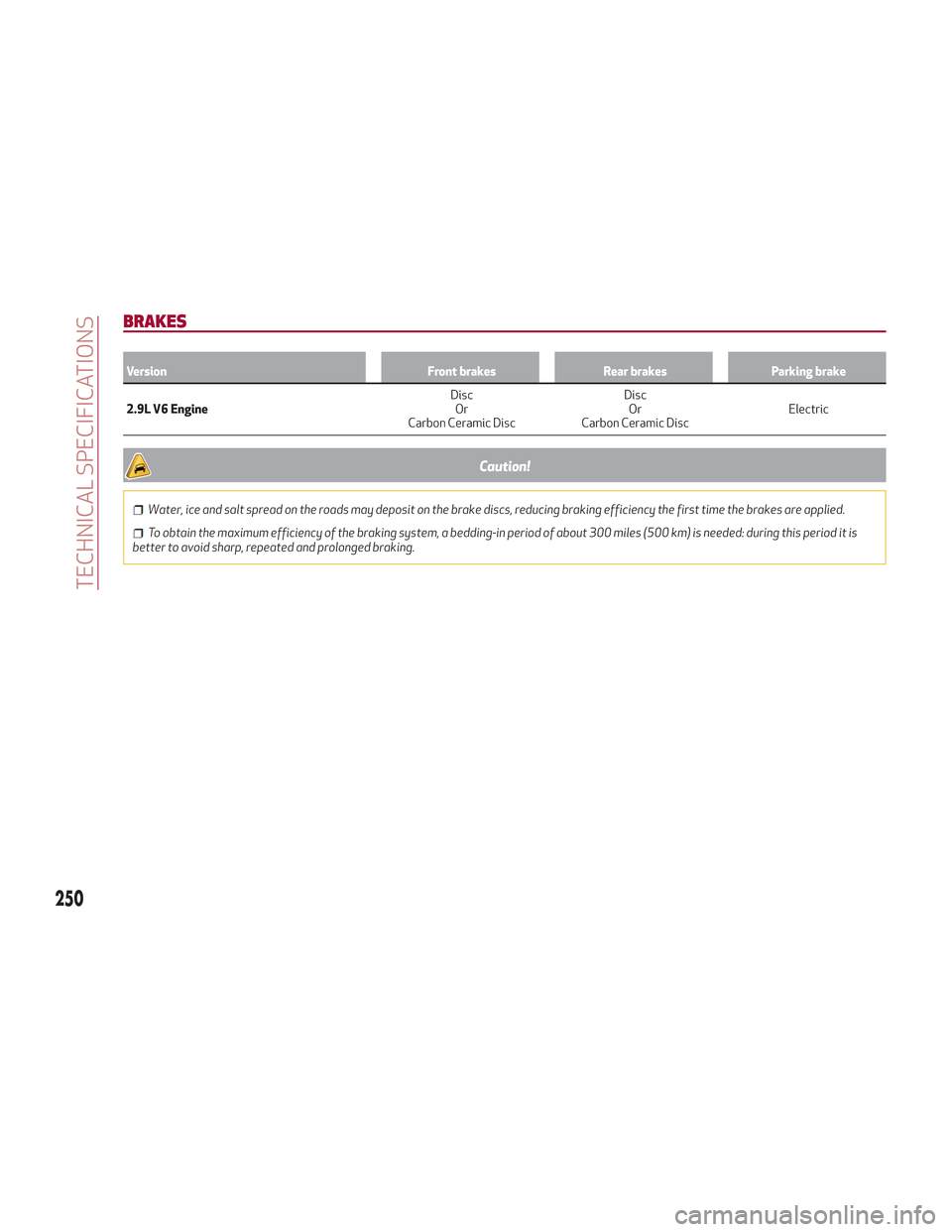
BRAKES
VersionFront brakesRear brakesParking brake
2.9L V6 Engine Disc
Or
Carbon
Ceramic DiscDisc
Or
Carbon Ceramic Disc Electric
Caution!
Water, ice and salt spread on the roads may deposit on the brake discs, reducing braking efficiency the first time the brakes are applied.
To obtain the maximum efficiency of the braking system, a bedding-in period of about 300 miles (500 km) is needed: during this period it is
better to avoid sharp, repeated and prolonged braking.
250
TECHNICAL SPECIFICATIONS