ESP Alfa Romeo Stelvio 2018 Workshop Manual
[x] Cancel search | Manufacturer: ALFA ROMEO, Model Year: 2018, Model line: Stelvio, Model: Alfa Romeo Stelvio 2018Pages: 276, PDF Size: 5.79 MB
Page 240 of 276
Warning!
Compact and collapsible spares are for
temporary emergency use only. With these
spares, do not drive more than 50 mph
(80 km/h). Temporary use spares have
limited tread life. When the tread is worn to
the tread wear indicators, the temporary use
spare tire needs to be replaced. Be sure to
follow the warnings, which apply to your
spare. Failure to do so could result in spare
tire failure and loss of vehicle control.
Full Size Spare — If Equipped
The full size spare is for temporary
emergency use only. This tire may look
like the originally equipped tire on the
front or rear axle of your vehicle, but it is
not. This spare tire may have limited
tread life. When the tread is worn to the
tread wear indicators, the temporary use
full size spare tire needs to be replaced.
Since it is not the same as your original
equipment tire, replace (or repair) the
original equipment tire and reinstall on
the vehicle at the first opportunity.
Limited Use Spare — If Equipped
The limited use spare tire is for
temporary emergency use only. This tire
is identified by a label located on the
limited use spare wheel. This label
contains the driving limitations for this
spare. This tire may look like the originalequipped tire on the front or rear axle of
your vehicle, but it is not. Installation of
this limited use spare tire affects vehicle
handling. Since it is not the same as your
original equipment tire, replace (or
repair) the original equipment tire and
reinstall on the vehicle at the first
opportunity.
Warning!
Limited use spares are for emergency use
only. Installation of this limited use spare
tire affects vehicle handling. With this tire,
do not drive more than the speed listed on
the limited use spare wheel. Keep inflated to
the cold tire inflation pressures listed on
your Tire and Loading Information Placard
located on the driver’s side B-Pillar or the
rear edge of the driver’s side door. Replace
(or repair) the original equipment tire at the
first opportunity and reinstall it on your
vehicle. Failure to do so could result in loss of
vehicle control.
Wheel And Wheel Trim Care
All wheels and wheel trim, especially
aluminum and chrome plated wheels,
should be cleaned regularly using mild
(neutral Ph) soap and water to maintain
their luster and to prevent corrosion.
Wash wheels with the same soap solution
recommended for the body of the vehicle
and remember to always wash when the
surfaces are not hot to the touch.
Your wheels are susceptible to
deterioration caused by salt, sodium
chloride, magnesium chloride, calcium
chloride, etc., and other road chemicals
used to melt ice or control dust on dirt
roads. Use a soft cloth or sponge and mild
soap to wipe away promptly. Do not use
harsh chemicals or a stiff brush. They can
damage the wheel’s protective coating
that helps keep them from corroding and
tarnishing.
Caution!
Avoid products or automatic car washes
that use acidic solutions or strong alkaline
additives or harsh brushes. Many
aftermarket wheel cleaners and automatic
car washes may damage the wheel's
protective finish. Such damage is not
covered by the New Vehicle Limited
Warranty. Only car wash soap, Mopar Wheel
Cleaner or equivalent is recommended.
When cleaning extremely dirty wheels
including excessive brake dust, care must
be taken in the selection of tire and wheel
cleaning chemicals and equipment to
prevent damage to the wheels. Mopar
Wheel Treatment or Mopar Chrome
Cleaner or their equivalent is
recommended or select a non-abrasive,
non-acidic cleaner for aluminum or
chrome wheels.
238
SERVICING AND MAINTENANCE
Page 242 of 276
While studded tires improve
performance on ice, skid and traction
capability on wet or dry surfaces may be
poorer than that of non-studded tires.
Some states prohibit studded tires;
therefore, local laws should be checked
before using these tire types.
Tire Chains (Traction Devices)
Use of traction devices require sufficient
tire-to-body clearance. Follow these
recommendations to guard against
damage.
Note:
Traction device must be of proper
size for the tire, as recommended by the
traction device manufacturer
Use on Rear Tires Only
Due to limited clearance, the
following traction devices are
recommended:
For a 285/40R20 tire, use of a
zero-clearance snow traction device
recommended.
Caution!
To avoid damage to your vehicle or tires,
observe the following precautions:
Because of restricted traction device
clearance between tires and other
suspension components, it is important that
only traction devices in good condition are
used. Broken devices can cause serious
damage. Stop the vehicle immediately if
noise occurs that could indicate device
breakage. Remove the damaged parts of
the device before further use.
Install device as tightly as possible and
then retighten after driving about ½ mile
(0.8 km).
Do not exceed 30 mph (48 km/h).
Drive cautiously and avoid severe turns
and large bumps, especially with a loaded
vehicle.
Do not drive for a prolonged period on dry
pavement.
Observe the traction device
manufacturer’s instructions on the method
of installation, operating speed, and
conditions for use. Always use the
suggested operating speed of the device
manufacturer’s if it is less than 30 mph
(48 km/h).
Do not use traction devices on a compact
spare tire.
Tire Rotation Recommendations
Tire Rotations - Do Not Rotate Tires
Due to different size tires and wheels on
front and rear axles tire rotation is not
possible.
Caution!
Damage to the vehicle may occur if front
and rear tires are rotated
In the case of irregular wear of the tires
identify the cause and correct it as soon
as possible, by contacting an authorized
dealer.
240
SERVICING AND MAINTENANCE
Page 243 of 276
DEPARTMENT OF
TRANSPORTATION UNIFORM
TIRE QUALITY GRADES
The following tire grading categories
were established by the National
Highway Traffic Safety
Administration. The specific grade
rating assigned by the tire's
manufacturer in each category is
shown on the sidewall of the tires on
your vehicle.
All passenger vehicle tires must
conform to Federal safety
requirements in addition to these
grades.
Treadwear
The Treadwear grade is a
comparative rating, based on the
wear rate of the tire when tested
under controlled conditions on a
specified government test course.
For example, a tire graded 150 would
wear one and one-half times as well
on the government course as a tire
graded 100. The relative
performance of tires depends upon
the actual conditions of their use,
however, and may depart
significantly from the norm due to
variations in driving habits, servicepractices, and differences in road
characteristics and climate.
Traction Grades
The Traction grades, from highest to
lowest, are AA, A, B, and C. These
grades represent the tire's ability to
stop on wet pavement, as measured
under controlled conditions on
specified government test surfaces
of asphalt and concrete. A tire
marked C may have poor traction
performance.
Warning!
The traction grade assigned to this
tire is based on straight-ahead
braking traction tests, and does not
include acceleration, cornering,
hydroplaning, or peak traction
characteristics.
Temperature Grades
The temperature grades are A (the
highest), B, and C, representing the
tire's resistance to the generation of
heat and its ability to dissipate heat,
when tested under controlled
conditions on a specified indoorlaboratory test wheel. Sustained high
temperature can cause the material
of the tire to degenerate and reduce
tire life, and excessive temperature
can lead to sudden tire failure. The
grade C corresponds to a level of
performance, which all passenger
vehicle tires must meet under the
Federal Motor Vehicle Safety
Standard No. 109. Grades B and A
represent higher levels of
performance on the laboratory test
wheel, than the minimum required by
law.
Warning!
The temperature grade for this tire
is established for a tire that is
properly inflated and not
overloaded. Excessive speed,
under-inflation, or excessive
loading, either separately or in
combination, can cause heat
buildup and possible tire failure.
241
Page 249 of 276
ENGINE
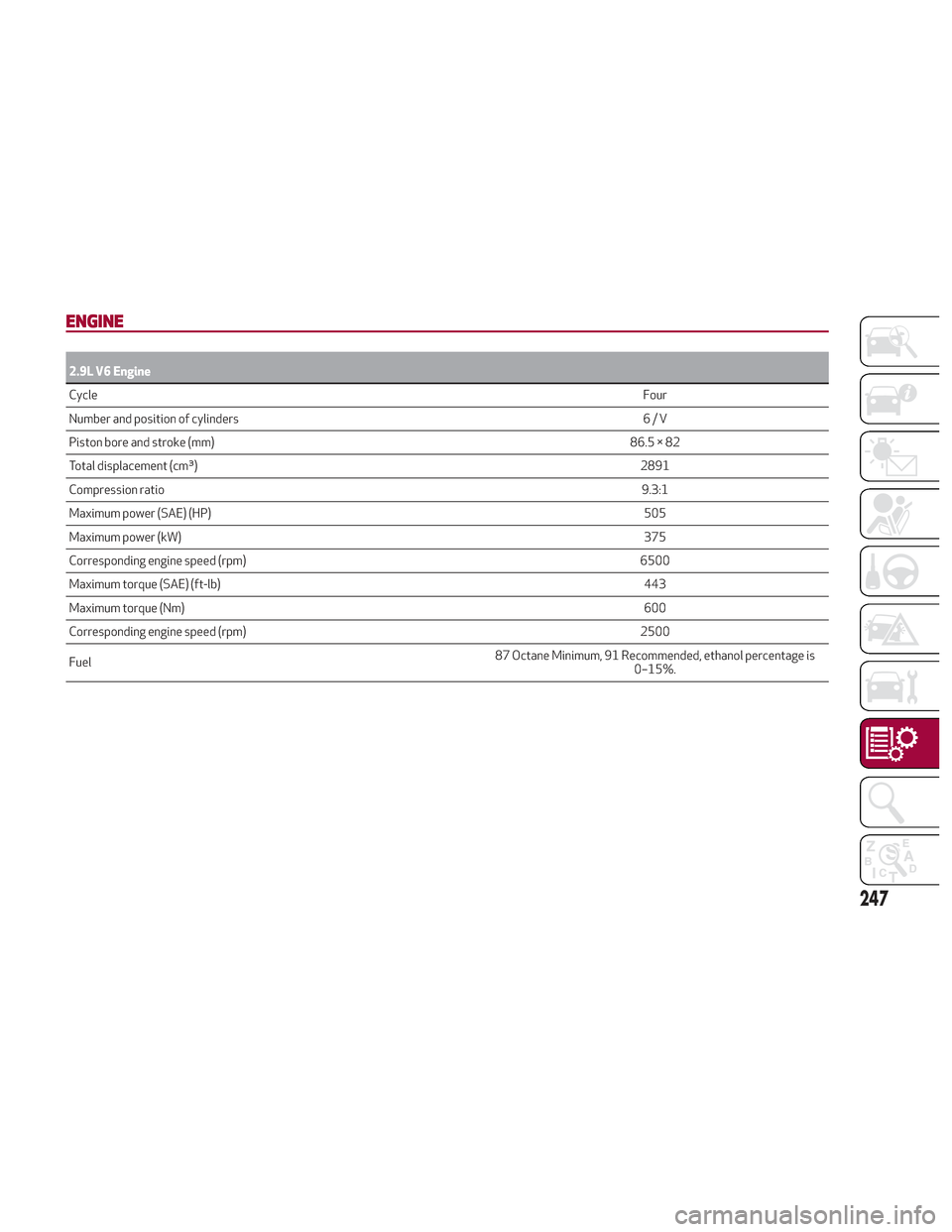
2.9L V6 Engine
CycleFo
ur
Number and position of cylinders 6/V
Piston bore and stroke (mm) 86.5 × 82
Total displacement (cm³) 2891
Compression ratio 9.3:1
Maximum power (SAE) (HP) 505
Maximum power (kW) 375
Corresponding engine speed (rpm) 6500
Maximum torque (SAE) (ft-lb) 443
Maximum torque (Nm) 600
Corresponding engine speed (rpm) 2500
Fuel 87 Octane Minimum, 91 Recommended, ethanol percentage is
0–15%.
247
Page 252 of 276
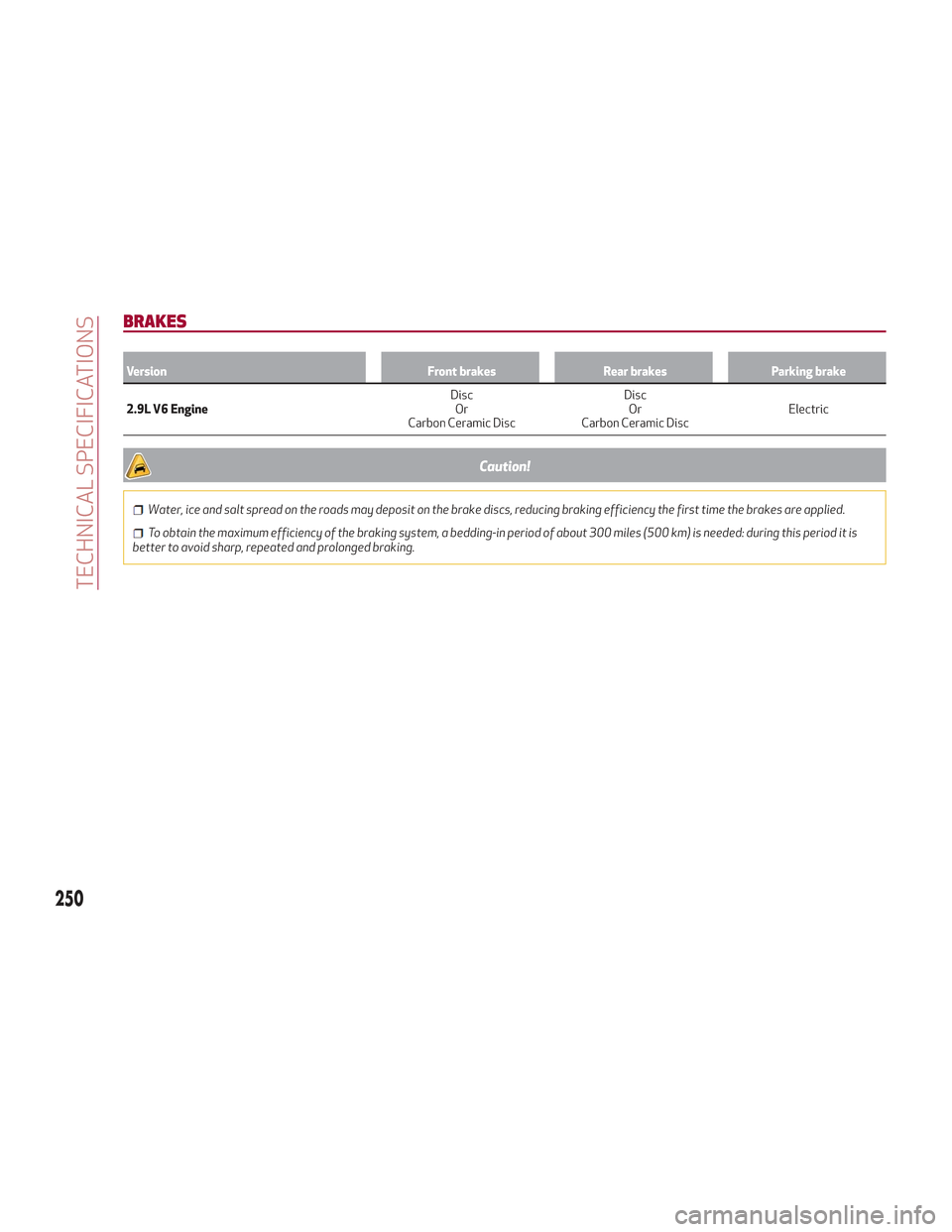
BRAKES
VersionFront brakesRear brakesParking brake
2.9L V6 Engine Disc
Or
Carbon
Ceramic DiscDisc
Or
Carbon Ceramic Disc Electric
Caution!
Water, ice and salt spread on the roads may deposit on the brake discs, reducing braking efficiency the first time the brakes are applied.
To obtain the maximum efficiency of the braking system, a bedding-in period of about 300 miles (500 km) is needed: during this period it is
better to avoid sharp, repeated and prolonged braking.
250
TECHNICAL SPECIFICATIONS
Page 256 of 276
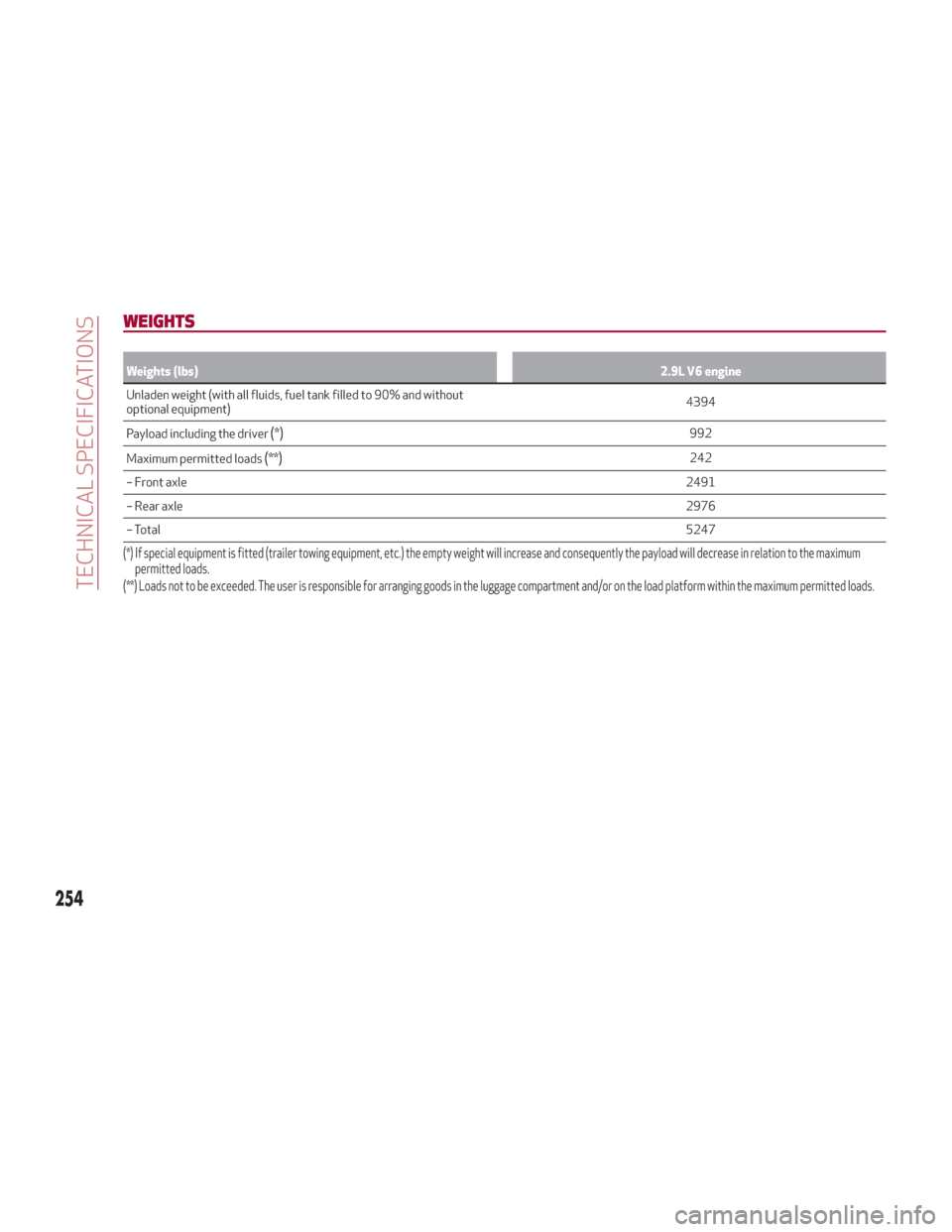
WEIGHTS
Weights (lbs)2.9L V6 engine
Unladen weight (with all fluids, fuel tank filled to 90% and without
optional
equipment) 4394
Payload including the driver
(*)992
Maximum permitted loads
(**)242
– Front axle 2491
– Rear axle 2976
– Total 5247
(*) If special equipment is fitted (trailer towing equipment, etc.) the empty weight will increase and consequently the payload will decrease in relation to the maximum
permitted loads.
(**) Loads not to be exceeded. The user is responsible for arranging goods in the luggage compartment and/or on the load platform within the maximum permitted loads.
254
TECHNICAL SPECIFICATIONS
Page 257 of 276
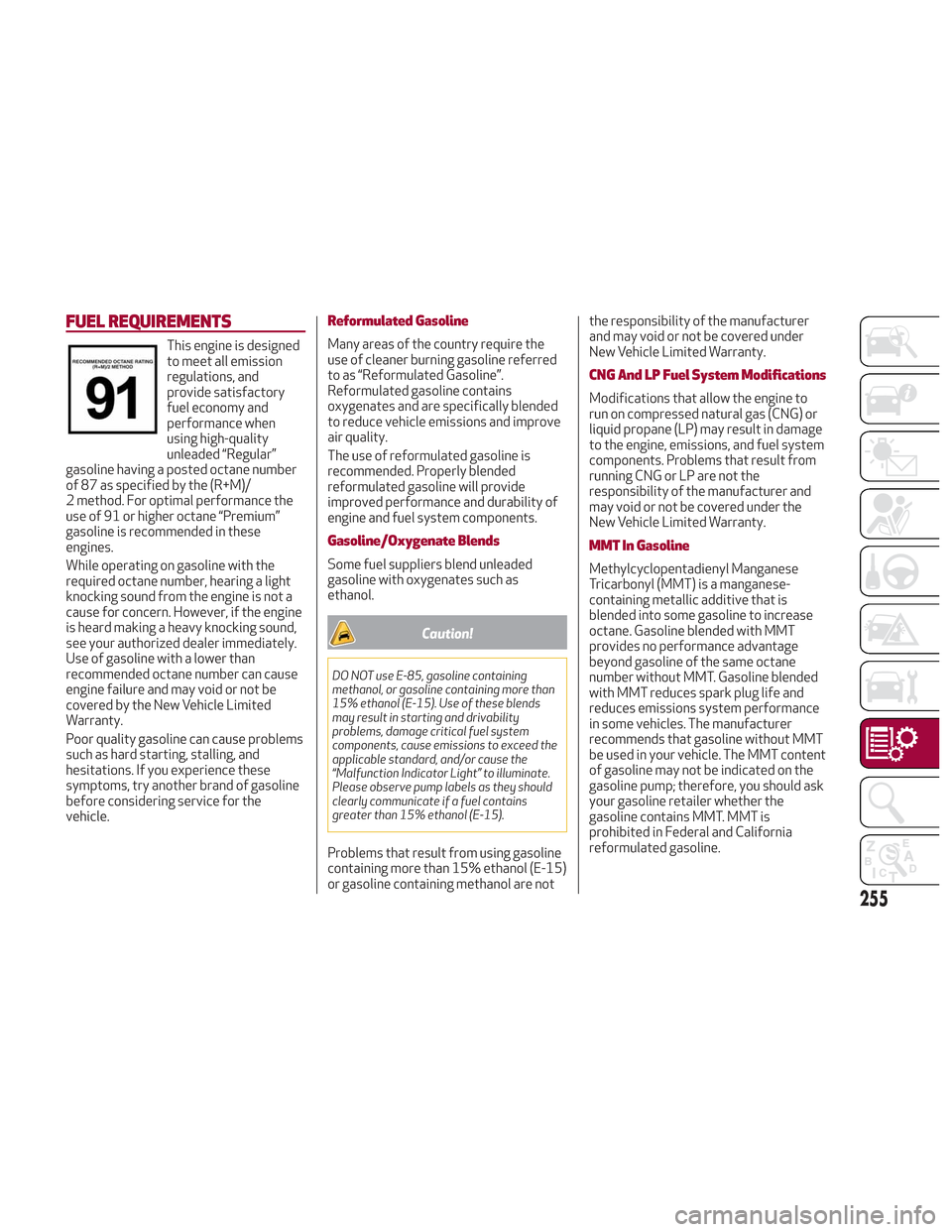
FUEL REQUIREMENTS
This engine is designed
to meet all emission
regulations, and
provide satisfactory
fuel economy and
performance when
using high-quality
unleaded “Regular”
gasoline having a posted octane number
of 87 as specified by the (R+M)/
2 method. For optimal performance the
use of 91 or higher octane “Premium”
gasoline is recommended in these
engines.
While operating on gasoline with the
required octane number, hearing a light
knocking sound from the engine is not a
cause for concern. However, if the engine
is heard making a heavy knocking sound,
see your authorized dealer immediately.
Use of gasoline with a lower than
recommended octane number can cause
engine failure and may void or not be
covered by the New Vehicle Limited
Warranty.
Poor quality gasoline can cause problems
such as hard starting, stalling, and
hesitations. If you experience these
symptoms, try another brand of gasoline
before considering service for the
vehicle.
Reformulated Gasoline
Many areas of the country require the
use of cleaner burning gasoline referred
to as “Reformulated Gasoline”.
Reformulated gasoline contains
oxygenates and are specifically blended
to reduce vehicle emissions and improve
air quality.
The use of reformulated gasoline is
recommended. Properly blended
reformulated gasoline will provide
improved performance and durability of
engine and fuel system components.
Gasoline/Oxygenate Blends
Some fuel suppliers blend unleaded
gasoline with oxygenates such as
ethanol.
Caution!
DO NOT use E-85, gasoline containing
methanol, or gasoline containing more than
15% ethanol (E-15). Use of these blends
may result in starting and drivability
problems, damage critical fuel system
components, cause emissions to exceed the
applicable standard, and/or cause the
“Malfunction Indicator Light” to illuminate.
Please observe pump labels as they should
clearly communicate if a fuel contains
greater than 15% ethanol (E-15).
Problems that result from using gasoline
containing more than 15% ethanol (E-15)
or gasoline containing methanol are not the responsibility of the manufacturer
and may void or not be covered under
New Vehicle Limited Warranty.
CNG And LP Fuel System Modifications
Modifications that allow the engine to
run on compressed natural gas (CNG) or
liquid propane (LP) may result in damage
to the engine, emissions, and fuel system
components. Problems that result from
running CNG or LP are not the
responsibility of the manufacturer and
may void or not be covered under the
New Vehicle Limited Warranty.
MMT In Gasoline
Methylcyclopentadienyl Manganese
Tricarbonyl (MMT) is a manganese-
containing metallic additive that is
blended into some gasoline to increase
octane. Gasoline blended with MMT
provides no performance advantage
beyond gasoline of the same octane
number without MMT. Gasoline blended
with MMT reduces spark plug life and
reduces emissions system performance
in some vehicles. The manufacturer
recommends that gasoline without MMT
be used in your vehicle. The MMT content
of gasoline may not be indicated on the
gasoline pump; therefore, you should ask
your gasoline retailer whether the
gasoline contains MMT. MMT is
prohibited in Federal and California
reformulated gasoline.
255
Page 258 of 276
Materials Added To Fuel
Besides using unleaded gasoline with the
proper octane rating, gasolines that
contain detergents, corrosion and
stability additives are recommended.
Using gasolines that have these additives
will help improve fuel economy, reduce
emissions, and maintain vehicle
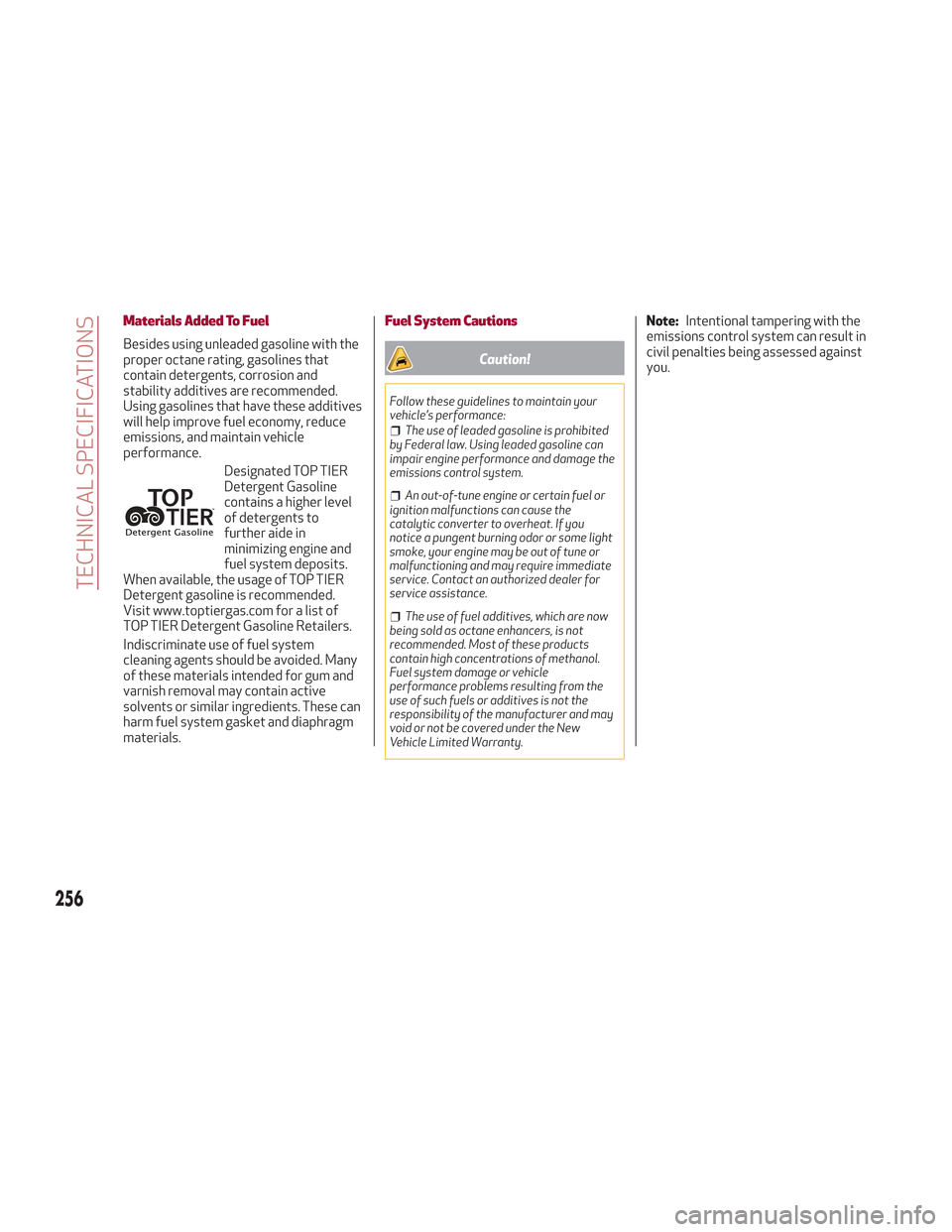
performance.Designated TOP TIER
Detergent Gasoline
contains a higher level
of detergents to
further aide in
minimizing engine and
fuel system deposits.
When available, the usage of TOP TIER
Detergent gasoline is recommended.
Visit www.toptiergas.com for a list of
TOP TIER Detergent Gasoline Retailers.
Indiscriminate use of fuel system
cleaning agents should be avoided. Many
of these materials intended for gum and
varnish removal may contain active
solvents or similar ingredients. These can
harm fuel system gasket and diaphragm
materials.
Fuel System Cautions
Caution!
Follow these guidelines to maintain your
vehicle’s performance:
The use of leaded gasoline is prohibited
by Federal law. Using leaded gasoline can
impair engine performance and damage the
emissions control system.
An out-of-tune engine or certain fuel or
ignition malfunctions can cause the
catalytic converter to overheat. If you
notice a pungent burning odor or some light
smoke, your engine may be out of tune or
malfunctioning and may require immediate
service. Contact an authorized dealer for
service assistance.
The use of fuel additives, which are now
being sold as octane enhancers, is not
recommended. Most of these products
contain high concentrations of methanol.
Fuel system damage or vehicle
performance problems resulting from the
use of such fuels or additives is not the
responsibility of the manufacturer and may
void or not be covered under the New
Vehicle Limited Warranty.
Note: Intentional tampering with the
emissions control system can result in
civil penalties being assessed against
you.
256
TECHNICAL SPECIFICATIONS
Page 265 of 276
Customer Assistance For The Hearing
Or Speech Impaired (TDD/TTY)
To assist customers who have hearing
difficulties, the manufacturer has
installed special TDD
(Telecommunication Devices for the
Deaf) equipment at its customer center.
Any hearing or speech impaired
customer, who has access to a TDD or a
conventional teletypewriter (TTY) in the
United States, can communicate with the
manufacturer by dialing
1-800-380-2479.
Canadian residents with hearing
difficulties that require assistance can
use the special needs relay service
offered by Bell Canada. For TTY
teletypewriter users, dial 711 and for
Voice callers, dial 1-800-855-0511 to
connect with a Bell Relay Service
operator.
Service Contract
You may have purchased a service
contract for a vehicle to help protect you
from the high cost of unexpected repairs
after the manufacturer's New Vehicle
Limited Warranty expires. The
manufacturer stands behind only the
manufacturer's service contracts. If you
purchased a manufacturer's service
contract, you will receive Plan Provisions
and an Owner Identification Card in the
mail within three weeks of the vehicle
delivery date. If you have any questions
about the service contract, call themanufacturer's Service Contract
National Customer Hotline at
1-800-521-9922 (Canadian residents,
call (800) 465-2001 English / (800)
387-9983 French).
The manufacturer will not stand behind
any service contract that is not the
manufacturer's service contract. It is not
responsible for any service contract
other than the manufacturer's service
contract. If you purchased a service
contract that is not a manufacturer's
service contract, and you require service
after the manufacturer's New Vehicle
Limited Warranty expires, please refer to
the contract documents, and contact the
person listed in those documents.
We appreciate that you have made a
major investment when you purchased
the vehicle. An authorized dealer has also
made a major investment in facilities,
tools, and training to assure that you are
absolutely delighted with the ownership
experience. You will be pleased with their
sincere efforts to resolve any warranty
issues or related concerns.
Warning!
Engine exhaust (internal combustion engines
only), some of its constituents, and certain
vehicle components contain, or emit,
chemicals known to the State of California
to cause cancer and birth defects, or other
reproductive harm. In addition, certain fluids
contained in vehicles and certain products of
component wear contain, or emit, chemicals
known to the State of California to cause
cancer and birth defects, or other
reproductive harm.
263
Page 269 of 276
INDEX
Accessories Purchased By TheOwner....................4
Active Safety Systems .........104
Active Torque Vectoring (ATV) System ................ .107
Adaptive Cruise Control .........166
Adaptive Cruise Control (ACC) (Cruise Control) ............166
Additives, Fuel ............. .256
AFS Function ................40
AirBag.................. .123
Advance Front Air Bag ........123
Air Bag Operation ...........125
Air Bag Warning Light ........123
Driver Knee Air Bag ..........126
Enhanced Accident
Response .............129,207
Event Data Recorder (EDR) .....207
Front Air Bag .............123
If A Deployment Occurs .......128
Knee Impact Bolsters ........125
Maintaining Your Air Bag System ..................... .131
Redundant Air Bag Warning Light ..................... .123
Side Air Bags .............126
Transporting Pets ..........141
Air Bag Light .............123,142
Air Bag Maintenance ...........131 Air Pressure
Tires .................. .233
Alarm (Security Alarm) ..........21
Alfa Active Suspension (AAS) .....161
Alfa DNA System .............158
Anti-Lock Braking (ABS) System . . .104
Antifreeze (Engine Coolant) ......257
Automatic Dimming Mirror ........37
Automatic Headlights ...........39
Automatic Temperature Control (ATC) ...................48
Automatic Transmission ........152
Auxiliary Driving Systems ........107
B-Pillar Location .............230
Battery ..................
.217
K
eyless Key Fob Replacement ....17
Battery Recharging ...........218
Belts, Seat ................ .142
Blind Spot Monitoring ..........107
Bodywork (Cleaning And Maintenance) .............242
Brakes .................. .250
Brake Fluid Level ...........217
Brightness, Interior Lights ........44
Bulbs, Light ............... .143
Camera, Rear .............. .179
Capacities, Fluid .............257
Carbon Monoxide Warning .......141Certification Label
............182
Changing A Flat Tire ...........225
Chart, Tire Sizing .............227
Check Engine Light (Malfunction Indicator Light) ............101
Checking Levels .............215
Checking Your Vehicle For Safety . . .141
Checks, Safety ..............141
Child Restraint ..............131
Child Restraints Booster Seats .............134
Child Restraints ............131
Child Seat Installation ........139
How To Stow An Unused ALR Seat
Belt .................. .138
Infants And Child Restraints . . . .133
LATCH Positions ...........135
Lower Anchors And Tethers For
Children ............... .135
Older Children And Child
Restraints .............. .133
Seating Positions ...........134
Clean Air Gasoline ............255
Cleaning Wheels ................ .238
Climate Control ............47,50
Close The Hood ...............57
Compact Spare Tire ...........237
Contract,
Service .............263