bumper Alfa Romeo Stelvio 2019 User Guide
[x] Cancel search | Manufacturer: ALFA ROMEO, Model Year: 2019, Model line: Stelvio, Model: Alfa Romeo Stelvio 2019Pages: 244, PDF Size: 4.95 MB
Page 130 of 244
system performance could be due to the
presence of: ice, snow, mud, thick paint,
on the surface of the sensor;
the sensor may detect a non-existent
obstacle ("echo interference") due to
mechanical interference, for example
when washing the vehicle, in rain (strong
wind), hail;
the signals sent by the sensor can also
be altered by the presence of ultrasonic
systems (e.g. pneumatic brake systems
of trucks or pneumatic drills) near the
vehicle;
parking assistance system
performance can also be influenced by
the position of the sensors, for example
due to a change in the ride setting
(caused by wear to the shock absorbers,
suspension), or by changing tyres,
overloading the vehicle or carrying out
specific tuning operations that require
the vehicle to be lowered;
the presence of a tow hook without
trailer, which may interfere with the
correct operation of the parking sensors.
Before using the Park Sensors system, it
is recommended to remove the tow hook
ball assembly when the vehicle is not
used for towing. Failure to comply with
this prescription may cause personal
injuries or damage to vehicles or
obstacles since, when the continuous
acoustic warning is emitted, the tow hook
ball is already in a position that is muchcloser to the obstacle than the rear
bumper. If you wish to leave the tow hook
fitted without towing a trailer, it is
advisable to contact an Alfa Romeo
Dealership for the Park Sensors system
update operations because the tow hook
could be detected as an obstacle by the
central sensors.
the presence of adhesives on the
sensors. Therefore, take care not to place
stickers on the sensors.
WARNING
120)Parking and other potentially
dangerous manoeuvres are, however,
always the driver’s responsibility. When
performing these operations, always make
sure that there are no other people
(especially children) or animals on the route
you want to take. The parking sensors are an
aid for the driver, but the driver must never
allow their attention to lapse during
potentially dangerous manoeuvres, even
those executed at low speeds.
IMPORTANT
44)The sensors must be clean of mud, dirt,
snow or ice in order for the system to
operate correctly. Be careful not to scratch
or damage the sensors while cleaning them.
Avoid using dry, rough or hard cloths. The
sensors should be washed using clean water
with the addition of car shampoo if
necessary. When using special washing
equipment such as high pressure jets or
steam cleaning, clean the sensors very
quickly keeping the jet more than 10 cm
away.
45)Have interventions on the bumper in the
area of the sensors carried out only by an
Alfa Romeo Dealership. Interventions on the
bumper that are not carried out properly
may compromise the operation of the
parking sensors.
46)Only have the bumpers repainted or any
retouches to the paintwork in the area of the
sensors carried out by an Alfa Romeo
Dealership. Incorrect paint application could
affect the operation of the parking sensors.
128
STARTING AND DRIVING
Page 140 of 244
IMPORTANT Never use cars or work
tools: the mechanism may be damaged.
IMPORTANT NOTE Do not release the
tow hook when it is attached to a trailer
or cargo-carrier.
IMPORTANT NOTE When driving without
trailer (or without a cargo-carrier), the
ball head tow hook must be removed and
the closing cap must always be inserted
in the hook mounting pipe. This applies
particularly if the tow hook reduces
visibility of the number plate or the
lighting system.
For the electrical connection, a 13 pin
12 V DC connection is to be used
(CUNA/UNI and ISO/DIN Standards).
Follow the instructions provided by the
vehicle Manufacturer and/or the tow
hook Manufacturer.
Installing the tow hook
Before inserting the tow hook, you must
remove the access cover to the tow hook
fixing position under the rear bumper.
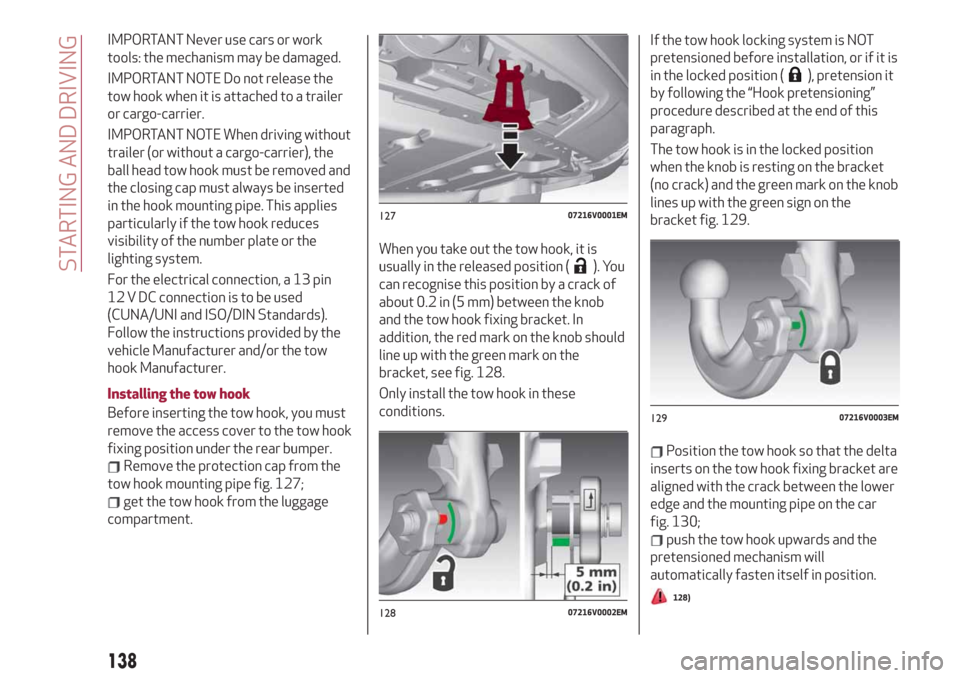
Remove the protection cap from the
tow hook mounting pipe fig. 127;
get the tow hook from the luggage
compartment.When you take out the tow hook, it is
usually in the released position (
). You
can recognise this position by a crack of
about 0.2 in (5 mm) between the knob
and the tow hook fixing bracket. In
addition, the red mark on the knob should
line up with the green mark on the
bracket, see fig. 128.
Only install the tow hook in these
conditions.If the tow hook locking system is NOT
pretensioned before installation, or if it is
in the locked position (
), pretension it
by following the “Hook pretensioning”
procedure described at the end of this
paragraph.
The tow hook is in the locked position
when the knob is resting on the bracket
(no crack) and the green mark on the knob
lines up with the green sign on the
bracket fig. 129.
Position the tow hook so that the delta
inserts on the tow hook fixing bracket are
aligned with the crack between the lower
edge and the mounting pipe on the car
fig. 130;
push the tow hook upwards and the
pretensioned mechanism will
automatically fasten itself in position.
128)
12707216V0001EM
12807216V0002EM
12907216V0003EM
138
STARTING AND DRIVING
Page 142 of 244
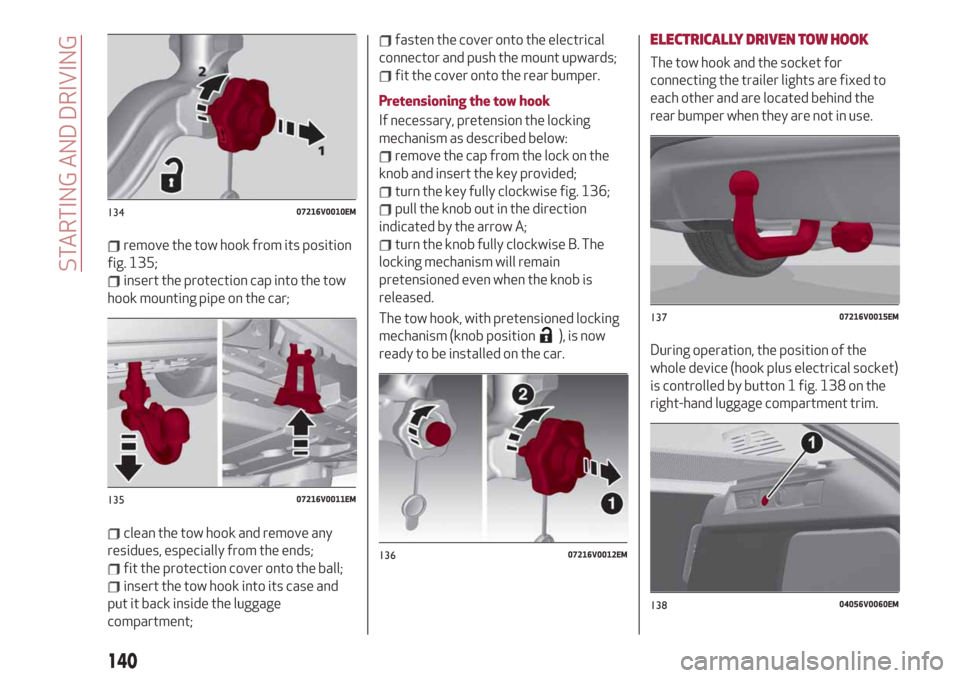
remove the tow hook from its position
fig. 135;
insert the protection cap into the tow
hook mounting pipe on the car;
clean the tow hook and remove any
residues, especially from the ends;
fit the protection cover onto the ball;
insert the tow hook into its case and
put it back inside the luggage
compartment;
fasten the cover onto the electrical
connector and push the mount upwards;
fit the cover onto the rear bumper.
Pretensioning the tow hook
If necessary, pretension the locking
mechanism as described below:
remove the cap from the lock on the
knob and insert the key provided;
turn the key fully clockwise fig. 136;
pull the knob out in the direction
indicated by the arrow A;
turn the knob fully clockwise B. The
locking mechanism will remain
pretensioned even when the knob is
released.
The tow hook, with pretensioned locking
mechanism (knob position
), is now
ready to be installed on the car.
ELECTRICALLY DRIVEN TOW HOOK
The tow hook and the socket for
connecting the trailer lights are fixed to
each other and are located behind the
rear bumper when they are not in use.
During operation, the position of the
whole device (hook plus electrical socket)
is controlled by button 1 fig. 138 on the
right-hand luggage compartment trim.
13407216V0010EM
13507216V0011EM
13607216V0012EM
13707216V0015EM
13804056V0060EM
140
STARTING AND DRIVING
Page 168 of 244
BROKEN-DOWN VEHICLE
TOWING
REAR WHEEL DRIVE (RWD) VERSIONS
It is recommended to tow the vehicle
with all four wheels lifted from the
ground on the platform of a roadside
assistance vehicle.
If a breakdown truck with platform is not
available, the vehicle must be towed with
the rear wheels LIFTED from the ground
(using a trailer or special equipment
allowing lifting of the rear wheels).
IMPORTANT Towing vehicles without
complying with the above mentioned
prescriptions can cause serious damage
to the vehicle.FOUR-WHEEL DRIVE (AWD) VERSIONS
It is recommended to tow the vehicle
with all four wheels lifted from the
ground on the platform of a roadside
assistance vehicle.
IMPORTANT Avoid lifting the front (or
rear) wheels only, using a trailer or
vehicle that allows lifting the wheels of
one axle only. Lifting the front (or rear)
wheels only while towing might damage
the transmission or the transfer unit.
IMPORTANT If a vehicle is towed without
complying with the above requirements,
the transmission and/or the transfer unit
might be seriously damaged. Damage due
to incorrect towing is not covered by
warranty.
TOWING THE VEHICLE
163) 164)
In order to be able to tow the vehicle,
which has been in an accident or has
broken down, on the road surface and
only for short distances, a tow hook is
provided in the tools container inside the
boot.
Proceed as follows to use the tow hook:
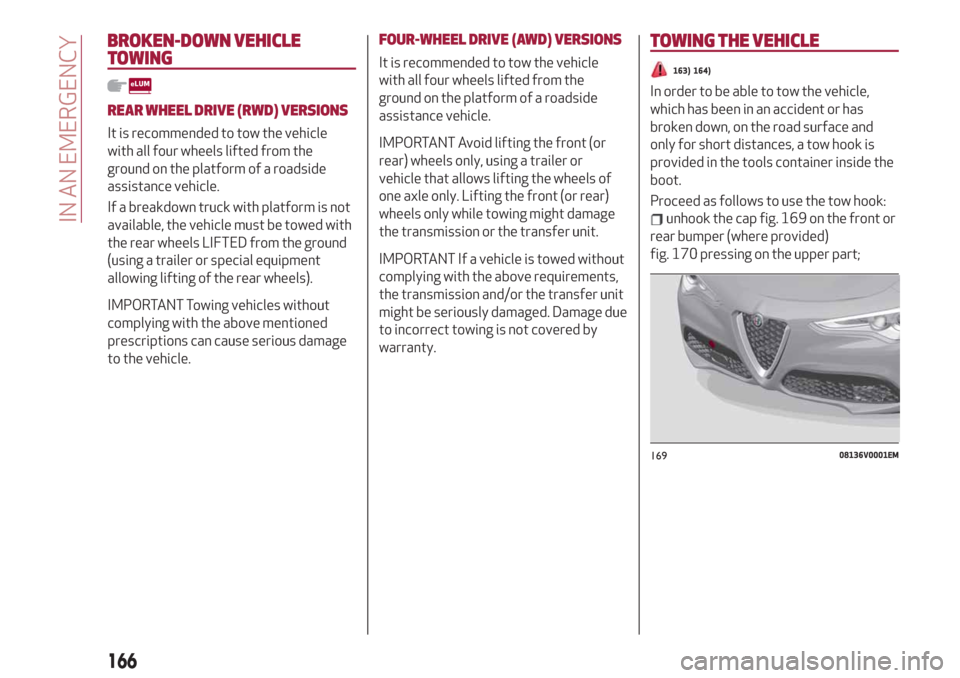
unhook the cap fig. 169 on the front or
rear bumper (where provided)
fig. 170 pressing on the upper part;
16908136V0001EM
166
IN AN EMERGENCY