check engine Alfa Romeo Stelvio 2019 User Guide
[x] Cancel search | Manufacturer: ALFA ROMEO, Model Year: 2019, Model line: Stelvio, Model: Alfa Romeo Stelvio 2019Pages: 244, PDF Size: 4.95 MB
Page 66 of 244
Symbol What it means
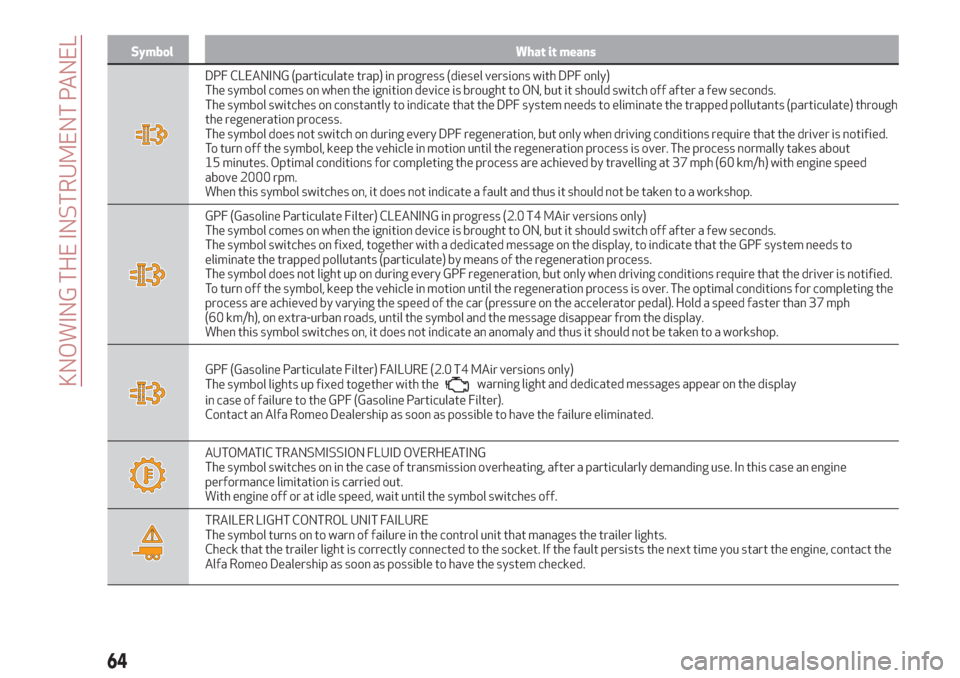
DPF CLEANING (particulate trap) in progress (diesel versions with DPF only)
The symbol comes on when the ignition device is brought to ON, but it should switch off after a few seconds.
The symbol switches on constantly to indicate that the DPF system needs to eliminate the trapped pollutants (particulate) through
the regeneration process.
The symbol does not switch on during every DPF regeneration, but only when driving conditions require that the driver is notified.
To turn off the symbol, keep the vehicle in motion until the regeneration process is over. The process normally takes about
15 minutes. Optimal conditions for completing the process are achieved by travelling at 37 mph (60 km/h) with engine speed
above 2000 rpm.
When this symbol switches on, it does not indicate a fault and thus it should not be taken to a workshop.
GPF (Gasoline Particulate Filter) CLEANING in progress (2.0 T4 MAir versions only)
The symbol comes on when the ignition device is brought to ON, but it should switch off after a few seconds.
The symbol switches on fixed, together with a dedicated message on the display, to indicate that the GPF system needs to
eliminate the trapped pollutants (particulate) by means of the regeneration process.
The symbol does not light up on during every GPF regeneration, but only when driving conditions require that the driver is notified.
To turn off the symbol, keep the vehicle in motion until the regeneration process is over. The optimal conditions for completing the
process are achieved by varying the speed of the car (pressure on the accelerator pedal). Hold a speed faster than 37 mph
(60 km/h), on extra-urban roads, until the symbol and the message disappear from the display.
When this symbol switches on, it does not indicate an anomaly and thus it should not be taken to a workshop.
GPF (Gasoline Particulate Filter) FAILURE (2.0 T4 MAir versions only)
The symbol lights up fixed together with the
in case of failure to the GPF (Gasoline Particulate Filter).
Contact an Alfa Romeo Dealership as soon as possible to have the failure eliminated.
AUTOMATIC TRANSMISSION FLUID OVERHEATING
The symbol switches on in the case of transmission overheating, after a particularly demanding use. In this case an engine
performance limitation is carried out.
With engine off or at idle speed, wait until the symbol switches off.
TRAILER LIGHT CONTROL UNIT FAILURE
The symbol turns on to warn of failure in the control unit that manages the trailer lights.
Check that the trailer light is correctly connected to the socket. If the fault persists the next time you start the engine, contact the
Alfa Romeo Dealership as soon as possible to have the system checked.
64
KNOWING THE INSTRUMENT PANELwarning light and dedicated messages appear on the display
Page 68 of 244
Symbol What it means
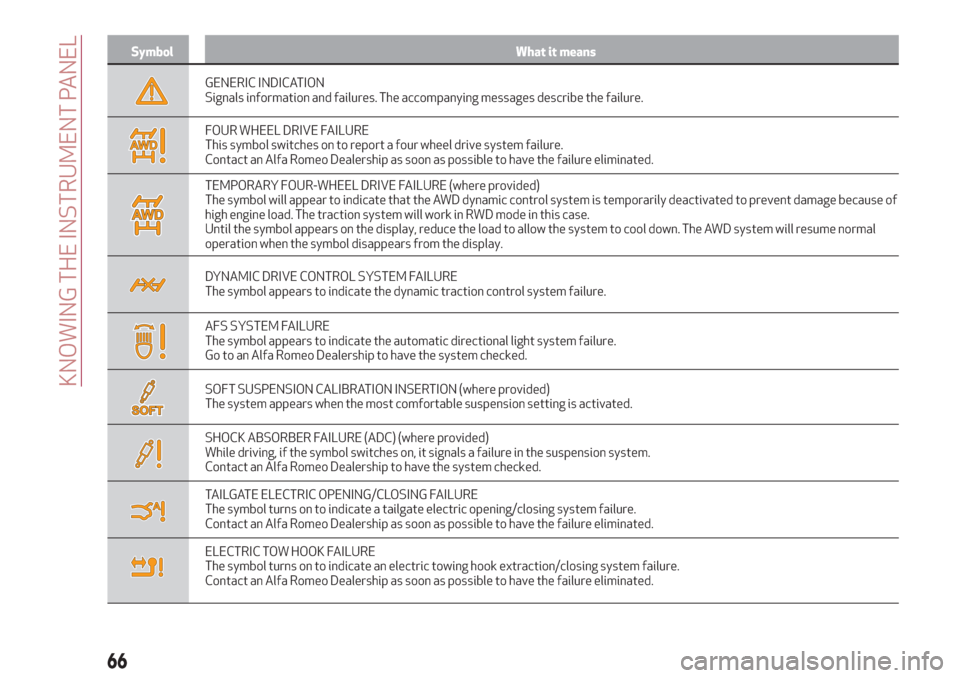
GENERIC INDICATION
Signals information and failures. The accompanying messages describe the failure.
FOUR WHEEL DRIVE FAILURE
This symbol switches on to report a four wheel drive system failure.
Contact an Alfa Romeo Dealership as soon as possible to have the failure eliminated.
TEMPORARY FOUR-WHEEL DRIVE FAILURE (where provided)
The symbol will appear to indicate that the AWD dynamic control system is temporarily deactivated to prevent damage because of
high engine load. The traction system will work in RWD mode in this case.
Until the symbol appears on the display, reduce the load to allow the system to cool down. The AWD system will resume normal
operation when the symbol disappears from the display.
DYNAMIC DRIVE CONTROL SYSTEM FAILURE
The symbol appears to indicate the dynamic traction control system failure.
AFS SYSTEM FAILURE
The symbol appears to indicate the automatic directional light system failure.
Go to an Alfa Romeo Dealership to have the system checked.
SOFT SUSPENSION CALIBRATION INSERTION (where provided)
The system appears when the most comfortable suspension setting is activated.
SHOCK ABSORBER FAILURE (ADC) (where provided)
While driving, if the symbol switches on, it signals a failure in the suspension system.
Contact an Alfa Romeo Dealership to have the system checked.
TAILGATE ELECTRIC OPENING/CLOSING FAILURE
The symbol turns on to indicate a tailgate electric opening/closing system failure.
Contact an Alfa Romeo Dealership as soon as possible to have the failure eliminated.
ELECTRIC TOW HOOK FAILURE
The symbol turns on to indicate an electric towing hook extraction/closing system failure.
Contact an Alfa Romeo Dealership as soon as possible to have the failure eliminated.
66
KNOWING THE INSTRUMENT PANEL
Page 69 of 244
Symbol What it means
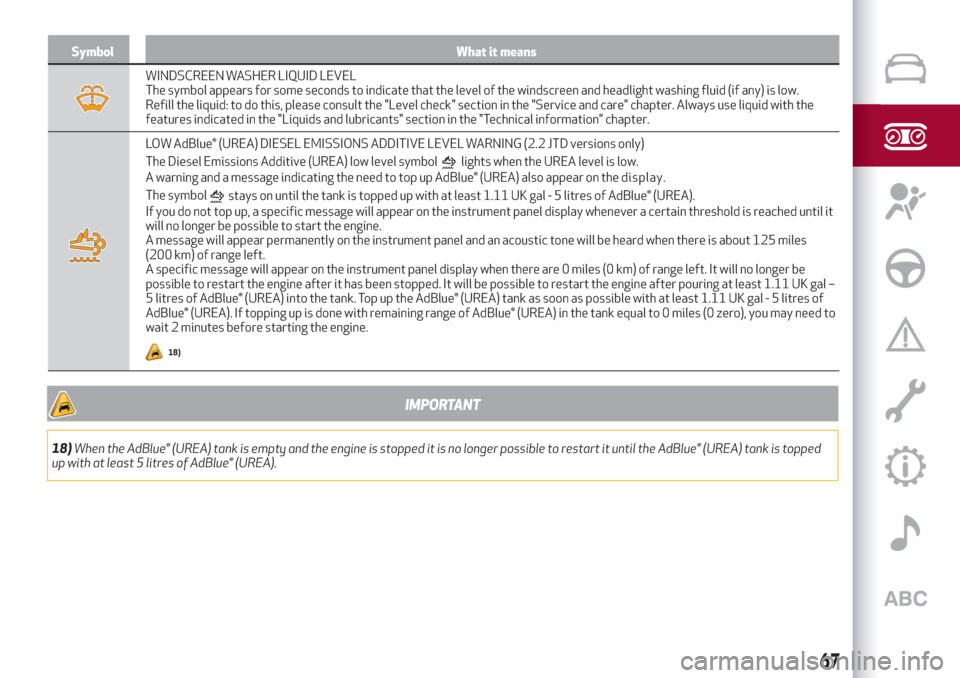
WINDSCREEN WASHER LIQUID LEVEL
The symbol appears for some seconds to indicate that the level of the windscreen and headlight washing fluid (if any) is low.
Refill the liquid: to do this, please consult the "Level check" section in the "Service and care" chapter. Always use liquid with the
features indicated in the "Liquids and lubricants" section in the "Technical information" chapter.
LOW AdBlue® (UREA) DIESEL EMISSIONS ADDITIVE LEVEL WARNING (2.2 JTD versions only)
The Diesel Emissions Additive (UREA) low level symbol
A warning and a message indicating the need to top up AdBlue® (UREA) also appear on the display.
The symbol
stays on until the tank is topped up with at least 1.11 UK gal - 5 litres of AdBlue® (UREA).
If you do not top up, a specific message will appear on the instrument panel display whenever a certain threshold is reached until it
will no longer be possible to start the engine.
A message will appear permanently on the instrument panel and an acoustic tone will be heard when there is about 125 miles
(200 km) of range left.
A specific message will appear on the instrument panel display when there are 0 miles (0 km) of range left. It will no longer be
possible to restart the engine after it has been stopped. It will be possible to restart the engine after pouring at least 1.11 UK gal –
5 litres of AdBlue® (UREA) into the tank. Top up the AdBlue® (UREA) tank as soon as possible with at least 1.11 UK gal - 5 litres of
AdBlue® (UREA). If topping up is done with remaining range of AdBlue® (UREA) in the tank equal to 0 miles (0 zero), you may need to
wait 2 minutes before starting the engine.
18)
67
lights when the UREA level is low.
IMPORTANT
18)When the AdBlue® (UREA) tank is empty and the engine is stopped it is no longer possible to restart it until the AdBlue® (UREA) tank is topped
up with at least 5 litres of AdBlue® (UREA).
Page 79 of 244
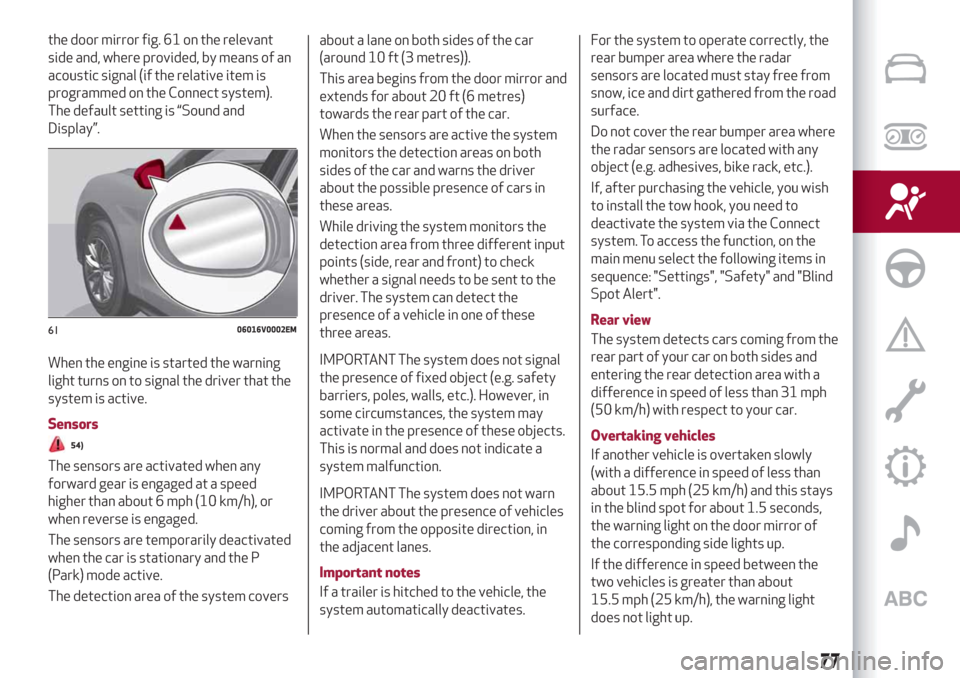
the door mirror fig. 61 on the relevant
side and, where provided, by means of an
acoustic signal (if the relative item is
programmed on the Connect system).
The default setting is “Sound and
Display”.
When the engine is started the warning
light turns on to signal the driver that the
system is active.
Sensors
54)
The sensors are activated when any
forward gear is engaged at a speed
higher than about 6 mph (10 km/h), or
when reverse is engaged.
The sensors are temporarily deactivated
when the car is stationary and the P
(Park) mode active.
The detection area of the system coversabout a lane on both sides of the car
(around 10 ft (3 metres)).
This area begins from the door mirror and
extends for about 20 ft (6 metres)
towards the rear part of the car.
When the sensors are active the system
monitors the detection areas on both
sides of the car and warns the driver
about the possible presence of cars in
these areas.
While driving the system monitors the
detection area from three different input
points (side, rear and front) to check
whether a signal needs to be sent to the
driver. The system can detect the
presence of a vehicle in one of these
three areas.
IMPORTANT The system does not signal
the presence of fixed object (e.g. safety
barriers, poles, walls, etc.). However, in
some circumstances, the system may
activate in the presence of these objects.
This is normal and does not indicate a
system malfunction.
IMPORTANT The system does not warn
the driver about the presence of vehicles
coming from the opposite direction, in
the adjacent lanes.
Important notes
If a trailer is hitched to the vehicle, the
system automatically deactivates.For the system to operate correctly, the
rear bumper area where the radar
sensors are located must stay free from
snow, ice and dirt gathered from the road
surface.
Do not cover the rear bumper area where
the radar sensors are located with any
object (e.g. adhesives, bike rack, etc.).
If, after purchasing the vehicle, you wish
to install the tow hook, you need to
deactivate the system via the Connect
system. To access the function, on the
main menu select the following items in
sequence: "Settings", "Safety" and "Blind
Spot Alert".
Rear view
The system detects cars coming from the
rear part of your car on both sides and
entering the rear detection area with a
difference in speed of less than 31 mph
(50 km/h) with respect to your car.
Overtaking vehicles
If another vehicle is overtaken slowly
(with a difference in speed of less than
about 15.5 mph (25 km/h) and this stays
in the blind spot for about 1.5 seconds,
the warning light on the door mirror of
the corresponding side lights up.
If the difference in speed between the
two vehicles is greater than about
15.5 mph (25 km/h), the warning light
does not light up.
6106016V0002EM
77
Page 82 of 244
"Med" and "Far" settings, in the event of a
potential accident, but permits more
dynamic driving of the car.
The system sensitivity setting is kept in
the memory when the engine is switched
off.
System limited operation warning
If the dedicated message is displayed, a
condition limiting the system operation
may have occurred. The possible reasons
of this limitation are something blocking
the camera view or a fault.
In this condition it will still be possible to
drive the car normally, but automatic
braking will not be available in the event
of an impending collision.
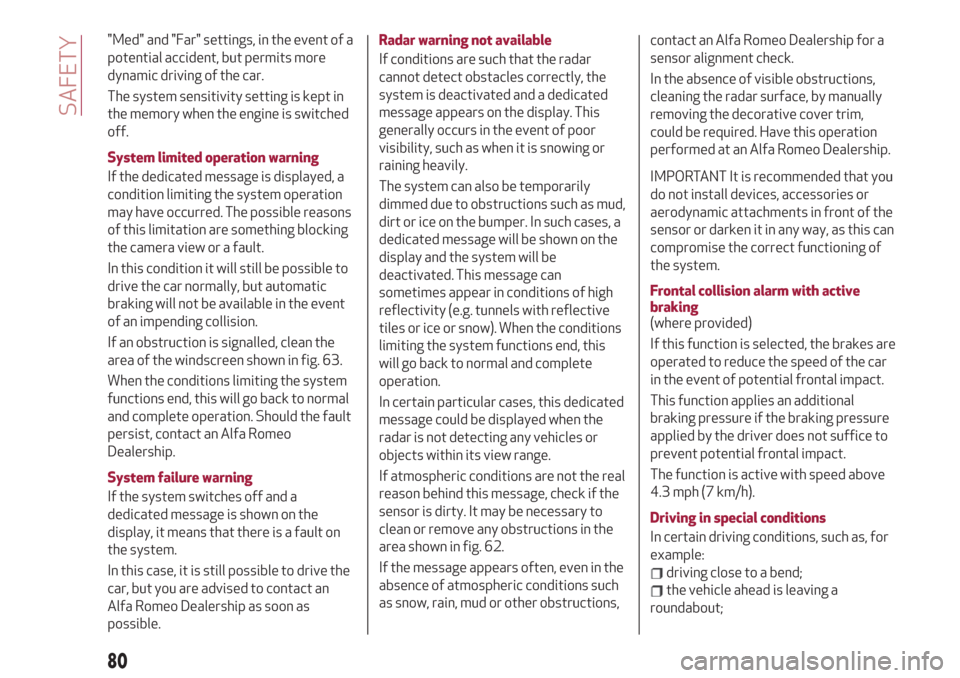
If an obstruction is signalled, clean the
area of the windscreen shown in fig. 63.
When the conditions limiting the system
functions end, this will go back to normal
and complete operation. Should the fault
persist, contact an Alfa Romeo
Dealership.
System failure warning
If the system switches off and a
dedicated message is shown on the
display, it means that there is a fault on
the system.
In this case, it is still possible to drive the
car, but you are advised to contact an
Alfa Romeo Dealership as soon as
possible.Radar warning not available
If conditions are such that the radar
cannot detect obstacles correctly, the
system is deactivated and a dedicated
message appears on the display. This
generally occurs in the event of poor
visibility, such as when it is snowing or
raining heavily.
The system can also be temporarily
dimmed due to obstructions such as mud,
dirt or ice on the bumper. In such cases, a
dedicated message will be shown on the
display and the system will be
deactivated. This message can
sometimes appear in conditions of high
reflectivity (e.g. tunnels with reflective
tiles or ice or snow). When the conditions
limiting the system functions end, this
will go back to normal and complete
operation.
In certain particular cases, this dedicated
message could be displayed when the
radar is not detecting any vehicles or
objects within its view range.
If atmospheric conditions are not the real
reason behind this message, check if the
sensor is dirty. It may be necessary to
clean or remove any obstructions in the
area shown in fig. 62.
If the message appears often, even in the
absence of atmospheric conditions such
as snow, rain, mud or other obstructions,contact an Alfa Romeo Dealership for a
sensor alignment check.
In the absence of visible obstructions,
cleaning the radar surface, by manually
removing the decorative cover trim,
could be required. Have this operation
performed at an Alfa Romeo Dealership.
IMPORTANT It is recommended that you
do not install devices, accessories or
aerodynamic attachments in front of the
sensor or darken it in any way, as this can
compromise the correct functioning of
the system.
Frontal collision alarm with active
braking
(where provided)
If this function is selected, the brakes are
operated to reduce the speed of the car
in the event of potential frontal impact.
This function applies an additional
braking pressure if the braking pressure
applied by the driver does not suffice to
prevent potential frontal impact.
The function is active with speed above
4.3 mph (7 km/h).
Driving in special conditions
In certain driving conditions, such as, for
example:
driving close to a bend;
the vehicle ahead is leaving a
roundabout;
80
SAFETY
Page 135 of 244
IMPORTANT
DO NOT EXCEED THE MAXIMUM
LEVEL: this could cause damage to the
tank. AdBlue® freezes under 12.2°F
(–11°C). Although the system is
designed to operate below the freezing
point of AdBlue®, it is advisable not to
fill the tank beyond the maximum level
because if the AdBlue® freezes the
system can be damaged. Follow the
instructions in the “Topping up AdBlue®
diesel emissions additive” paragraph in
this chapter.
If AdBlue® is spilled on painted
surfaces or aluminium, immediately
clean the area with water and use
absorbent material to collect the fluid
that has been spilled on the ground.
Do not try to start the engine if
AdBlue® was accidentally added to the
Diesel fuel tank, this can result in
serious engine damage, contact an Alfa
Romeo Dealership.
Do not add additives or other fluids
to AdBlue®, doing so could damage the
system.
The use of non-conforming or
degraded AdBlue® may lead to
indications appearing on the
instrument panel display (see “Warning
lights and messages" paragraph in the
“Knowing the instrument panel”
chapter).
Never pour AdBlue® into another
container: it could be contaminated.
In case of damage to the sewage
system of exhaust gas resulting from
the use of additives / tap water, the
introduction of diesel fuel, or at least
by not fulfilling the requirements, the
warranty expires.
If the AdBlue® runs out, see “Warning
lights and messages" paragraph in the
“Knowing the instrument panel”
chapter to continue using the car
normally.
The AdBlue® level is not updated if
the car is parked on a sloping road.
Fuels - identification of vehicle
compatibility. Graphic symbol for
consumer information in accordance
with EN16942
The symbols, shown below, make it easier
to recognise the correct fuel type to use
with your car.
Before refuelling, check the symbols
(where provided) inside the fuel filler flap
and compare them with the symbols
shown on the fuel pump (where provided).PETROL ENGINES
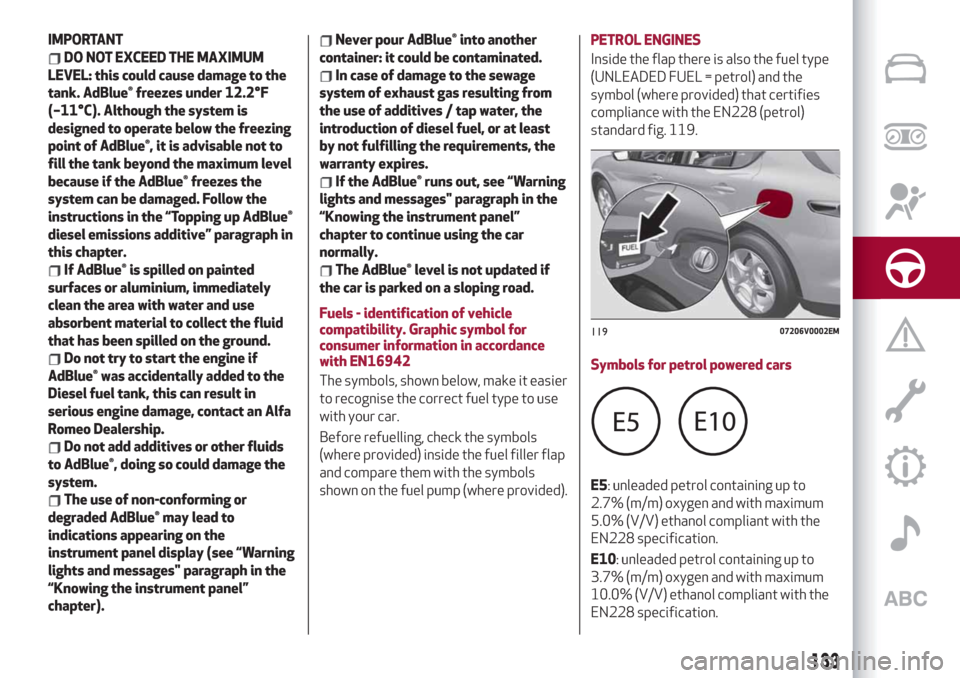
Inside the flap there is also the fuel type
(UNLEADED FUEL = petrol) and the
symbol (where provided) that certifies
compliance with the EN228 (petrol)
standard fig. 119.
Symbols for petrol powered cars
E5: unleaded petrol containing up to
2.7% (m/m) oxygen and with maximum
5.0% (V/V) ethanol compliant with the
EN228 specification.
E10: unleaded petrol containing up to
3.7% (m/m) oxygen and with maximum
10.0% (V/V) ethanol compliant with the
EN228 specification.
11907206V0002EM
133
Page 138 of 244
AdBlue® (UREA) ADDITIVE FOR
DIESEL EMISSIONS
(2.2 JTD versions only)
The car is equipped with an UREA
injection system and Selective Catalytic
Reduction to meet emission standards.
These two systems ensure compliance
with the diesel emissions requirements;
at the same time, they ensure
fuel-efficiency, handling, torque and
power. For messages and system
warnings, refer to the "Warning lights and
messages" paragraph in the "Knowing the
instrument panel" chapter.
AdBlue® (UREA) is considered a very
stable product with a long shelf life.
Stored at temperatures LOWER than
89.6° F (32 °C), it has a shelf life of at
least one year.
For more information on the AdBlue®
liquid type, see the “Fluids and lubricants”
paragraph in the “Technical
specifications” chapter.
The car is provided with an automatic
AdBlue® heating system when the engine
starts allowing the system to work
correctly at temperatures lower
than -11 °C.
IMPORTANT AdBlue® freezes at
temperatures lower than 12.2 °F (-11 °C).
SUGGESTIONS FOR DRIVING
SAVING FUEL
Below are some suggestions which may
help you save fuel and thus lower the
amount of harmful emissions released
into the atmosphere.
Vehicle maintenance
Checks and operations should be carried
out in accordance with the "Scheduled
Servicing Plan" (see chapter
"Maintenance and care").
Tyres
Check the tyre pressures at least once
every four weeks: if the pressure is too
low, consumption levels increase as
resistance to rolling is higher.
Unnecessary loads
Do not travel with an overloaded boot.
The weight of the vehicle and its
arrangement greatly affect fuel
consumption and stability.
Electric devices
Use electrical devices only for the
amount of time needed. The heated rear
window, additional headlights, screen
wipers and heater fan require a
considerable amount of energy;
increasing the current uptake increases
fuel consumption (by up to +25% in an
urban cycle).Climate control system
Using the climate control system will
increase consumption: use standard
ventilation when the temperature
outside permits.
Devices for aerodynamic control
The use of non-certified devices for
aerodynamic control may adversely
affect air drag and consumption levels.
DRIVING STYLE
Starting
Do not warm up the engine at low or high
revs when the vehicle is stationary; this
causes the engine to warm up more
slowly, thereby increasing fuel
consumption and emissions. It is
therefore advisable to move off
immediately, slowly, avoiding high
speeds: in this way the engine will warm
up more quickly.
Unnecessary actions
Avoid revving up when starting at traffic
lights or before stopping the engine. The
latter action, as well as double-
declutching, is unnecessary and causes
increased fuel consumption and
pollution.
Gear selection
Use a high gear when traffic and road
conditions allow it. Using a low gear for
faster acceleration will increase fuel
136
STARTING AND DRIVING
Page 139 of 244
consumption. In the same way, improper
use of a high gear increases consumption,
emissions and engine wear.
Max. speed
Fuel consumption considerably increases
as speed increases. Maintain a constant
speed, avoiding unnecessary braking and
acceleration, which cost in terms of both
fuel consumption and emissions.
Acceleration
Accelerating violently severely affects
consumption and emissions: acceleration
should be gradual and should not exceed
the maximum torque.CONDITIONS OF USE
Cold starting
Short journeys and frequent cold starts
do not allow the engine to reach optimum
operating temperature. This results in a
significant increase in consumption
levels (from +15 to +30% on the urban
cycle) and emissions.
Traffic and road conditions
High fuel consumption is caused by heavy
traffic, for instance when travelling in a
queue with frequent use of low gears or
in cities with many traffic lights. Winding
mountain roads and rough road surfaces
also adversely affect consumption.
Stops in traffic
During prolonged hold-ups (e.g. level
crossings) switch off the engine.
TOWING TRAILERS
126) 127)
TOW HOOK SETUP
Instructions for using the removable
ball head tow hook
IMPORTANT NOTE Before setting off,
checkthat the removable ball head tow
hook islockedcorrectly. To do this, check
the following conditions:
the green mark on the knob must
coincide with the green mark on the tow
hook fixing bracket;
the knob must be at the end of its
travel, resting on the tow hook fixing
bracket (no crack);
the lock on the knob must be locked
with the key removed. The knob cannot
be removed;
the tow hook fixing bracket must be
firmly attached to the mounting pipe on
the car. Check by shaking with a hand.
The installation procedure must be
repeated if any of these requirements is
NOT met.
If even only one of the requirements is
not met the tow hookmust notbe used,
since there is risk of causing accidents.
Contact an Alfa Romeo Dealership.
The ball head tow hook can be
fitted/removed manually without the
need for specific tools.
137
Page 161 of 244
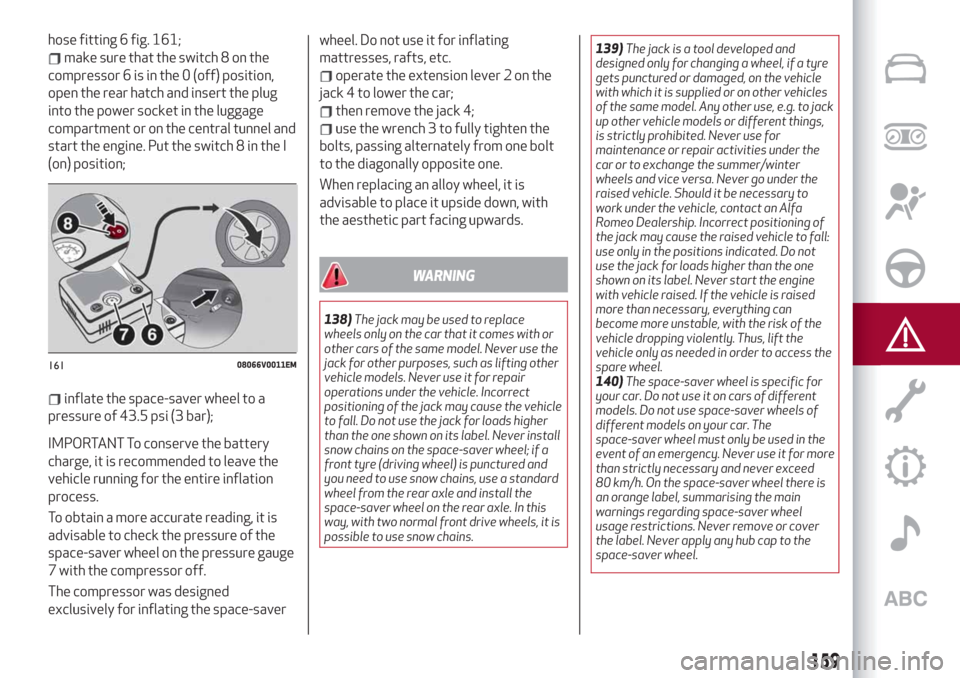
hose fitting 6 fig. 161;
make sure that the switch 8 on the
compressor 6 is in the 0 (off) position,
open the rear hatch and insert the plug
into the power socket in the luggage
compartment or on the central tunnel and
start the engine. Put the switch 8 in the I
(on) position;
inflate the space-saver wheel to a
pressure of 43.5 psi (3 bar);
IMPORTANT To conserve the battery
charge, it is recommended to leave the
vehicle running for the entire inflation
process.
To obtain a more accurate reading, it is
advisable to check the pressure of the
space-saver wheel on the pressure gauge
7 with the compressor off.
The compressor was designed
exclusively for inflating the space-saverwheel. Do not use it for inflating
mattresses, rafts, etc.
operate the extension lever 2 on the
jack 4 to lower the car;
then remove the jack 4;
use the wrench 3 to fully tighten the
bolts, passing alternately from one bolt
to the diagonally opposite one.
When replacing an alloy wheel, it is
advisable to place it upside down, with
the aesthetic part facing upwards.
WARNING
138)The jack may be used to replace
wheels only on the car that it comes with or
other cars of the same model. Never use the
jack for other purposes, such as lifting other
vehicle models. Never use it for repair
operations under the vehicle. Incorrect
positioning of the jack may cause the vehicle
to fall. Do not use the jack for loads higher
than the one shown on its label. Never install
snow chains on the space-saver wheel; if a
front tyre (driving wheel) is punctured and
you need to use snow chains, use a standard
wheel from the rear axle and install the
space-saver wheel on the rear axle. In this
way, with two normal front drive wheels, it is
possible to use snow chains.139)The jack is a tool developed and
designed only for changing a wheel, if a tyre
gets punctured or damaged, on the vehicle
with which it is supplied or on other vehicles
of the same model. Any other use, e.g. to jack
up other vehicle models or different things,
is strictly prohibited. Never use for
maintenance or repair activities under the
car or to exchange the summer/winter
wheels and vice versa. Never go under the
raised vehicle. Should it be necessary to
work under the vehicle, contact an Alfa
Romeo Dealership. Incorrect positioning of
the jack may cause the raised vehicle to fall:
use only in the positions indicated. Do not
use the jack for loads higher than the one
shown on its label. Never start the engine
with vehicle raised. If the vehicle is raised
more than necessary, everything can
become more unstable, with the risk of the
vehicle dropping violently. Thus, lift the
vehicle only as needed in order to access the
spare wheel.
140)The space-saver wheel is specific for
your car. Do not use it on cars of different
models. Do not use space-saver wheels of
different models on your car. The
space-saver wheel must only be used in the
event of an emergency. Never use it for more
than strictly necessary and never exceed
80 km/h. On the space-saver wheel there is
an orange label, summarising the main
warnings regarding space-saver wheel
usage restrictions. Never remove or cover
the label. Never apply any hub cap to the
space-saver wheel.
16108066V0011EM
159
Page 163 of 244
IMPORTANT The sealing liquid is
effective for outside temperatures
between -40°F and +122°F (-40°C and
+50°C). The sealant has an expiry date.
REPAIR PROCEDURE
147) 148) 149) 150) 151) 152) 153) 154) 155) 156)
Proceed as follows:
stop the car in a position that is not
dangerous for oncoming traffic where
you can repair the tyre safely, as far as
possible from the side of the road;
turn on the hazard warning lights;
engage the electric parking brake;
engage P (Park) mode;
stop the engine and put on the
reflective safety jacket (for your own
safety and to comply with the regulations
in force in the country where you are)
before getting out of the car.
when the situation requires it (for your
own safety and to comply with theregulations in force in the country where
you are), take the warning triangle from
the luggage compartment and position it
at a suitable distance from the car.
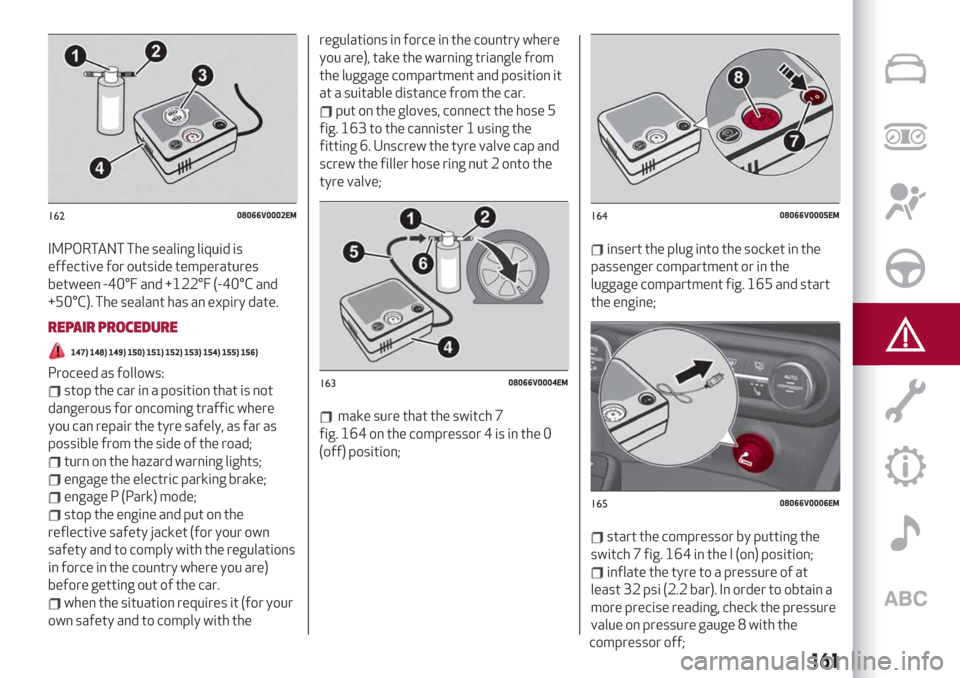
put on the gloves, connect the hose 5
fig. 163 to the cannister 1 using the
fitting 6. Unscrew the tyre valve cap and
screw the filler hose ring nut 2 onto the
tyre valve;
make sure that the switch 7
fig. 164 on the compressor 4 is in the 0
(off) position;
insert the plug into the socket in the
passenger compartment or in the
luggage compartment fig. 165 and start
the engine;
start the compressor by putting the
switch 7 fig. 164 in the I (on) position;
inflate the tyre to a pressure of at
least 32 psi (2.2 bar). In order to obtain a
more precise reading, check the pressure
value on pressure gauge 8 with the
16208066V0002EM
16308066V0004EM
16408066V0005EM
16508066V0006EM
161
compressor off;