ABS Alfa Romeo Stelvio 2019 Owner's Manual
[x] Cancel search | Manufacturer: ALFA ROMEO, Model Year: 2019, Model line: Stelvio, Model: Alfa Romeo Stelvio 2019Pages: 244, PDF Size: 4.95 MB
Page 6 of 244
USE OF THE OWNER HANDBOOK
OPERATING INSTRUCTIONS
Each time direction instructions (left/right or forwards/backwards) about the vehicle are given, these must be understood as
regarding an occupant in the driver's seat. Special cases not complying with this rule will be specified as appropriate in the text.
The figures in the Owner Handbook are provided by way of example only: this might imply that some details of the image do not
correspond to the actual arrangement of your vehicle. In addition, the Handbook has been conceived considering vehicles with
steering wheel on the left side; it is therefore possible that on vehicles with steering wheel on the right side, the position or
construction of some controls is not exactly mirror-like with respect to the figure.
To identify the chapter with the information needed you can consult the index at the end of this Owner Handbook.
Chapters can be rapidly identified with dedicated graphic tabs, at the side of each odd page. A few pages further there is a key for
getting to know the chapter order and the relevant symbols in the tabs. There is in any case a textual indication of the current chapter
at the side of each even page.
PRECAUTIONS AND WARNINGS
While reading this Owner Handbook you will find a series ofWARNINGSto prevent procedures that could damage your vehicle.
There are alsoPRECAUTIONSthat must be carefully followed to prevent incorrect use of the components of the vehicle, which could
cause accidents or injuries.
Therefore, allWARNINGSandPRECAUTIONSmust always be followed carefully.
WARNINGSandPRECAUTIONSare recalled in the text with the following symbols:
personal safety;
vehicle safety;
environmental protection.
NOTE These symbols, when necessary, are indicated besides the title or at the end of the line and are followed by a number. That
number recalls the corresponding warning at the end of the relevant section.
Page 15 of 244
IGNITION DEVICE
OPERATION
1) 2) 3) 4) 5)
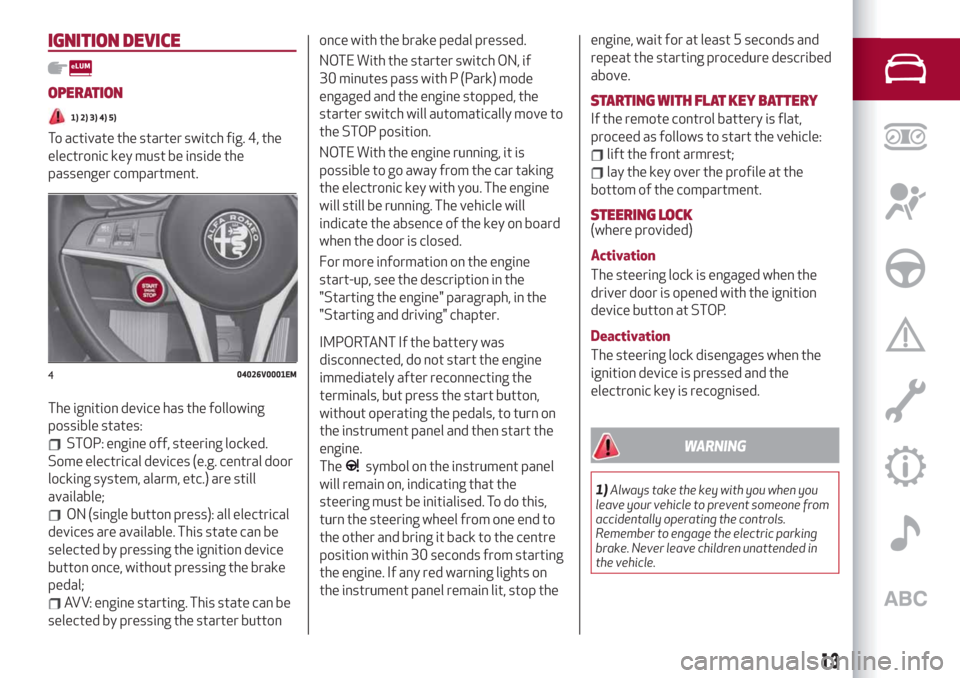
To activate the starter switch fig. 4, the
electronic key must be inside the
passenger compartment.
The ignition device has the following
possible states:
STOP: engine off, steering locked.
Some electrical devices (e.g. central door
locking system, alarm, etc.) are still
available;
ON (single button press): all electrical
devices are available. This state can be
selected by pressing the ignition device
button once, without pressing the brake
pedal;
AVV: engine starting. This state can be
selected by pressing the starter buttononce with the brake pedal pressed.
NOTE With the starter switch ON, if
30 minutes pass with P (Park) mode
engaged and the engine stopped, the
starter switch will automatically move to
the STOP position.
NOTE With the engine running, it is
possible to go away from the car taking
the electronic key with you. The engine
will still be running. The vehicle will
indicate the absence of the key on board
when the door is closed.
For more information on the engine
start-up, see the description in the
"Starting the engine" paragraph, in the
"Starting and driving" chapter.
IMPORTANT If the battery was
disconnected, do not start the engine
immediately after reconnecting the
terminals, but press the start button,
without operating the pedals, to turn on
the instrument panel and then start the
engine.
The
symbol on the instrument panel
will remain on, indicating that the
steering must be initialised. To do this,
turn the steering wheel from one end to
the other and bring it back to the centre
position within 30 seconds from starting
the engine. If any red warning lights on
the instrument panel remain lit, stop theengine, wait for at least 5 seconds and
repeat the starting procedure described
above.
STARTING WITH FLAT KEY BATTERY
If the remote control battery is flat,
proceed as follows to start the vehicle:
lift the front armrest;
lay the key over the profile at the
bottom of the compartment.
STEERING LOCK(where provided)
Activation
The steering lock is engaged when the
driver door is opened with the ignition
device button at STOP.
Deactivation
The steering lock disengages when the
ignition device is pressed and the
electronic key is recognised.
WARNING
1)Always take the key with you when you
leave your vehicle to prevent someone from
accidentally operating the controls.
Remember to engage the electric parking
brake. Never leave children unattended in
the vehicle.
404026V0001EM
13
Page 16 of 244
2)It is absolutely forbidden to carry out any
after-market operation involving steering
system or steering column modifications
(e.g. installation of anti-theft device) that
could adversely affect performance,
invalidate the warranty, cause SERIOUS
SAFETY PROBLEMS and also result in the
car not meeting type-approval
requirements.
3)Before leaving the vehicle, ALWAYS
engage the handbrake. On versions
equipped with automatic transmission,
activate mode P (Park) and press the ignition
device to set it to STOP. When leaving the
vehicle, always lock all the doors by pressing
the button on the handle.
4)For versions equipped with the Keyless
Start system, do not leave the electronic key
inside or near the car or in a place accessible
to children. Do not leave the vehicle with the
ignition device in ON position. A child could
activate the electric window winders, other
controls or even start the vehicle.
5)If the ignition device has been tampered
with (e.g. an attempted theft), have it
checked over by the Alfa Romeo Dealership
before driving again.ENGINE IMMOBILIZER
The Engine Immobilizer system prevents
unauthorised use of the vehicle
preventing to start the engine.
The system does not need to be
enabled/activated: operation is
automatic, regardless of the fact that the
vehicle's doors are locked or unlocked.
When the ignition device is set to ON, the
Engine Immobilizer system identifies the
code transmitted by the key. If the code
is recognised as valid, the Engine
Immobilizer system enables engine
starting.
When the ignition device is brought back
to STOP, the Engine Immobilizer system
deactivates the control unit controlling
the engine, thus preventing its starting.
For the correct engine starting
procedures, see the instructions in the
"Starting the engine" paragraph,
"Starting and driving" chapter.Irregular operation
If, during starting, the key code is not
correctly recognised, theicon is
displayed on the instrument panel (see
the instructions in the "Warning lights and
messages" paragraph, "Knowing the
instrument panel" chapter). This
condition leads to the engine switching
off after 2 seconds. In this case, bring the
ignition device to STOP and then to ON; if
it is still blocked, try with the other keys
provided. If it is still not possible to start
the engine, contact an Alfa Romeo
Dealership.
If the
icon is displayed while driving,
this means that the system is running a
self-diagnosis (e.g. due to a voltage drop).
If the display persists, contact an Alfa
Romeo Dealership.
14
KNOWING YOUR CAR
Page 26 of 244
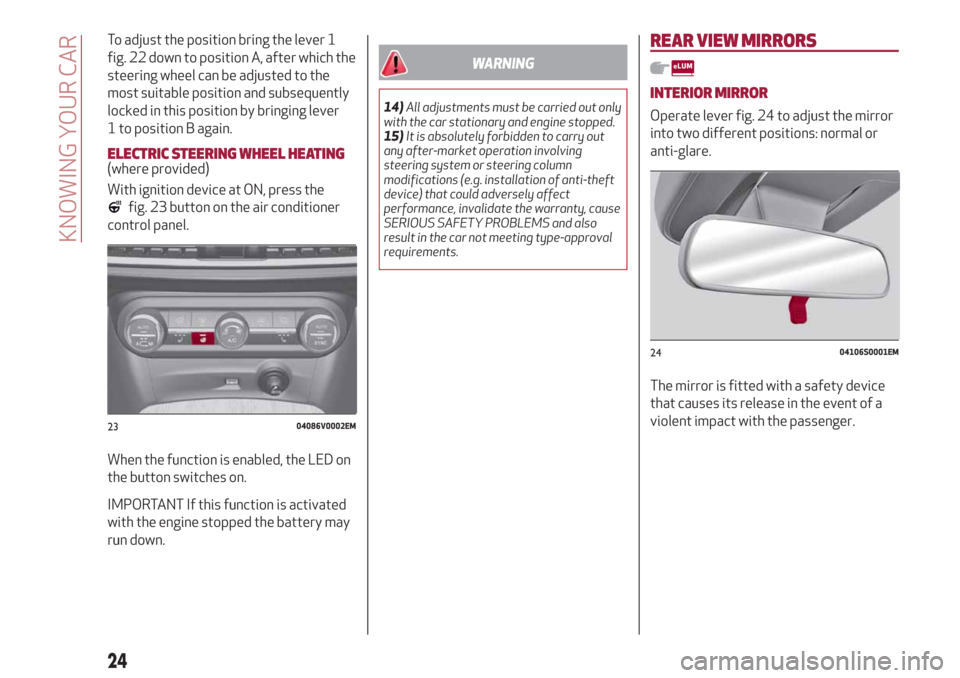
To adjust the position bring the lever 1
fig. 22 down to position A, after which the
steering wheel can be adjusted to the
most suitable position and subsequently
locked in this position by bringing lever
1 to position B again.
ELECTRIC STEERING WHEEL HEATING(where provided)
With ignition device at ON, press the
fig. 23 button on the air conditioner
control panel.
When the function is enabled, the LED on
the button switches on.
IMPORTANT If this function is activated
with the engine stopped the battery may
run down.
WARNING
14)All adjustments must be carried out only
with the car stationary and engine stopped.
15)It is absolutely forbidden to carry out
any after-market operation involving
steering system or steering column
modifications (e.g. installation of anti-theft
device) that could adversely affect
performance, invalidate the warranty, cause
SERIOUS SAFETY PROBLEMS and also
result in the car not meeting type-approval
requirements.
REAR VIEW MIRRORS
INTERIOR MIRROR
Operate lever fig. 24 to adjust the mirror
into two different positions: normal or
anti-glare.
The mirror is fitted with a safety device
that causes its release in the event of a
violent impact with the passenger.
2304086V0002EM
2404106S0001EM
24
KNOWING YOUR CAR
Page 40 of 244
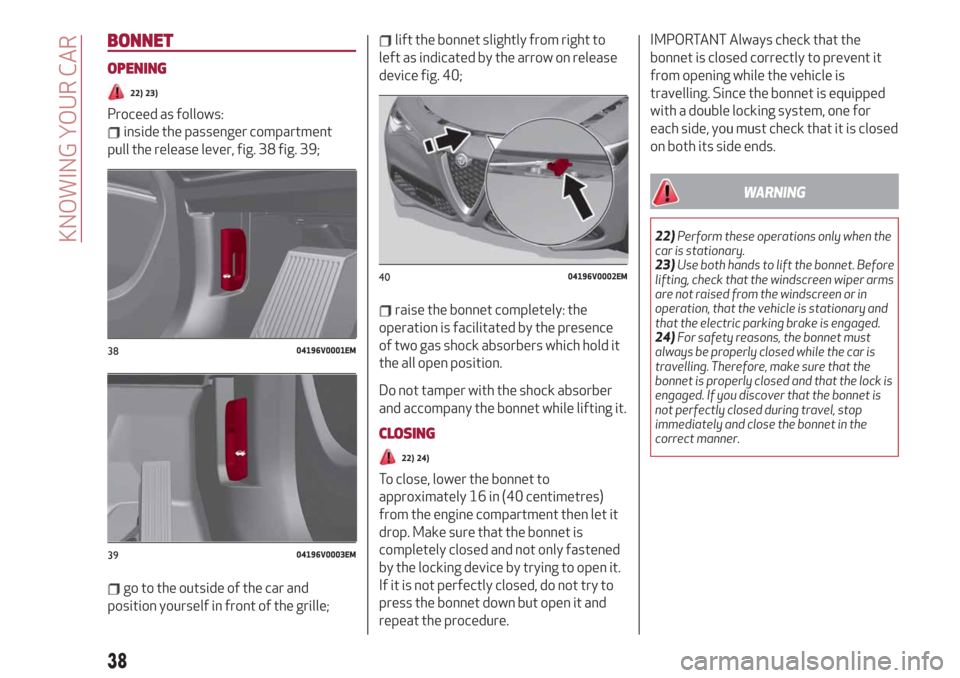
BONNET
OPENING
22) 23)
Proceed as follows:
inside the passenger compartment
pull the release lever, fig. 38 fig. 39;
go to the outside of the car and
position yourself in front of the grille;
lift the bonnet slightly from right to
left as indicated by the arrow on release
device fig. 40;
raise the bonnet completely: the
operation is facilitated by the presence
of two gas shock absorbers which hold it
the all open position.
Do not tamper with the shock absorber
and accompany the bonnet while lifting it.
CLOSING
22) 24)
To close, lower the bonnet to
approximately 16 in (40 centimetres)
from the engine compartment then let it
drop. Make sure that the bonnet is
completely closed and not only fastened
by the locking device by trying to open it.
If it is not perfectly closed, do not try to
press the bonnet down but open it and
repeat the procedure.
IMPORTANT Always check that the
bonnet is closed correctly to prevent it
from opening while the vehicle is
travelling. Since the bonnet is equipped
with a double locking system, one for
each side, you must check that it is closed
on both its side ends.
WARNING
22)Perform these operations only when the
car is stationary.
23)Use both hands to lift the bonnet. Before
lifting, check that the windscreen wiper arms
are not raised from the windscreen or in
operation, that the vehicle is stationary and
that the electric parking brake is engaged.
24)For safety reasons, the bonnet must
always be properly closed while the car is
travelling. Therefore, make sure that the
bonnet is properly closed and that the lock is
engaged. If you discover that the bonnet is
not perfectly closed during travel, stop
immediately and close the bonnet in the
correct manner.
3804196V0001EM
3904196V0003EM
4004196V0002EM
38
KNOWING YOUR CAR
Page 48 of 244
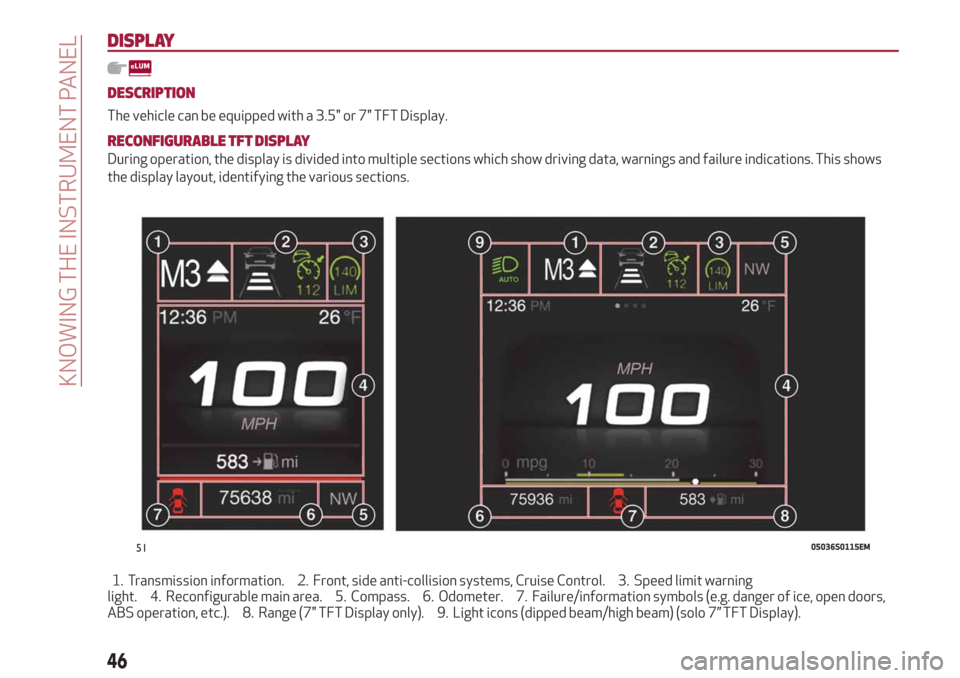
DISPLAY
DESCRIPTION
The vehicle can be equipped with a 3.5" or 7" TFT Display.
RECONFIGURABLE TFT DISPLAY
During operation, the display is divided into multiple sections which show driving data, warnings and failure indications. This shows
the display layout, identifying the various sections.
1. Transmission information. 2. Front, side anti-collision systems, Cruise Control. 3. Speed limit warning
light. 4. Reconfigurable main area. 5. Compass. 6. Odometer. 7. Failure/information symbols (e.g. danger of ice, open doors,
ABS operation, etc.). 8. Range (7" TFT Display only). 9. Light icons (dipped beam/high beam) (solo 7” TFT Display).
5105036S0115EM
46
KNOWING THE INSTRUMENT PANEL
Page 56 of 244
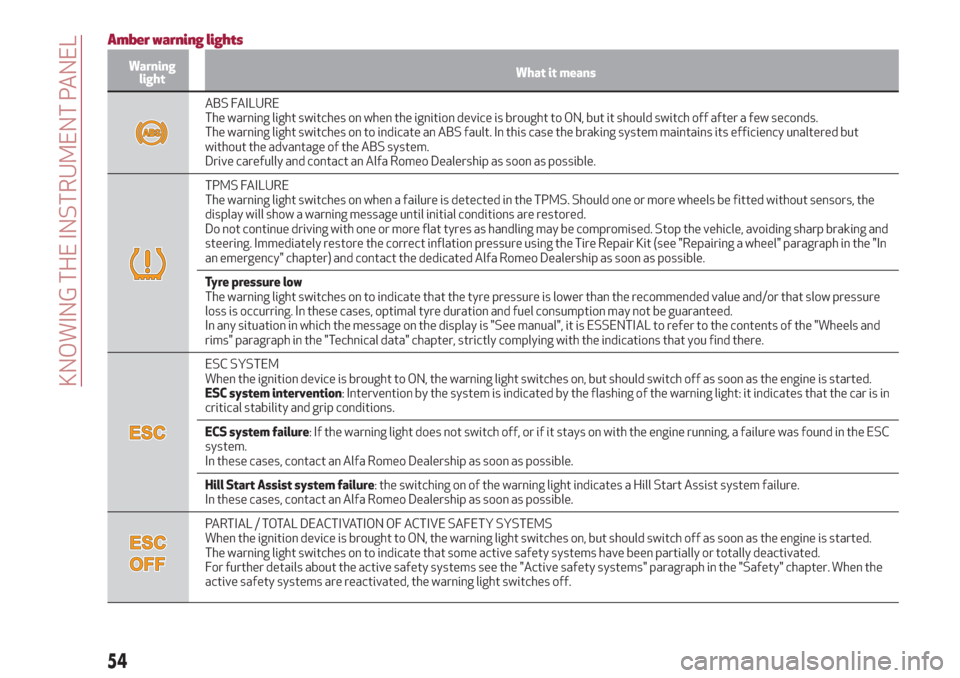
Amber warning lights
Warning
lightWhat it means
ABS FAILURE
The warning light switches on when the ignition device is brought to ON, but it should switch off after a few seconds.
The warning light switches on to indicate an ABS fault. In this case the braking system maintains its efficiency unaltered but
without the advantage of the ABS system.
Drive carefully and contact an Alfa Romeo Dealership as soon as possible.
TPMS FAILURE
The warning light switches on when a failure is detected in the TPMS. Should one or more wheels be fitted without sensors, the
display will show a warning message until initial conditions are restored.
Do not continue driving with one or more flat tyres as handling may be compromised. Stop the vehicle, avoiding sharp braking and
steering. Immediately restore the correct inflation pressure using the Tire Repair Kit (see "Repairing a wheel" paragraph in the "In
an emergency" chapter) and contact the dedicated Alfa Romeo Dealership as soon as possible.
Tyre pressure low
The warning light switches on to indicate that the tyre pressure is lower than the recommended value and/or that slow pressure
loss is occurring. In these cases, optimal tyre duration and fuel consumption may not be guaranteed.
In any situation in which the message on the display is "See manual", it is ESSENTIAL to refer to the contents of the "Wheels and
rims" paragraph in the "Technical data" chapter, strictly complying with the indications that you find there.
ESC SYSTEM
When the ignition device is brought to ON, the warning light switches on, but should switch off as soon as the engine is started.
ESC system intervention: Intervention by the system is indicated by the flashing of the warning light: it indicates that the car is in
critical stability and grip conditions.
ECS system failure: If the warning light does not switch off, or if it stays on with the engine running, a failure was found in the ESC
system.
In these cases, contact an Alfa Romeo Dealership as soon as possible.
Hill Start Assist system failure: the switching on of the warning light indicates a Hill Start Assist system failure.
In these cases, contact an Alfa Romeo Dealership as soon as possible.
PARTIAL / TOTAL DEACTIVATION OF ACTIVE SAFETY SYSTEMS
When the ignition device is brought to ON, the warning light switches on, but should switch off as soon as the engine is started.
The warning light switches on to indicate that some active safety systems have been partially or totally deactivated.
For further details about the active safety systems see the "Active safety systems" paragraph in the "Safety" chapter. When the
active safety systems are reactivated, the warning light switches off.
54
KNOWING THE INSTRUMENT PANEL
Page 67 of 244
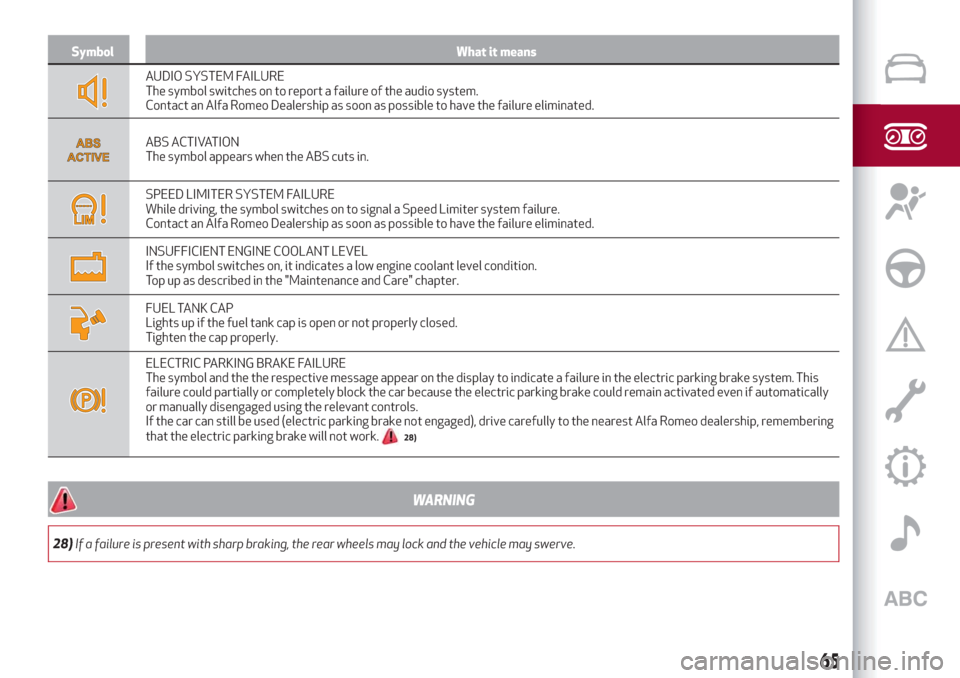
Symbol What it means
AUDIO SYSTEM FAILURE
The symbol switches on to report a failure of the audio system.
Contact an Alfa Romeo Dealership as soon as possible to have the failure eliminated.
ABS ACTIVATION
The symbol appears when the ABS cuts in.
SPEED LIMITER SYSTEM FAILURE
While driving, the symbol switches on to signal a Speed Limiter system failure.
Contact an Alfa Romeo Dealership as soon as possible to have the failure eliminated.
INSUFFICIENT ENGINE COOLANT LEVEL
If the symbol switches on, it indicates a low engine coolant level condition.
Top up as described in the "Maintenance and Care" chapter.
FUEL TANK CAP
Lights up if the fuel tank cap is open or not properly closed.
Tighten the cap properly.
ELECTRIC PARKING BRAKE FAILURE
The symbol and the the respective message appear on the display to indicate a failure in the electric parking brake system. This
failure could partially or completely block the car because the electric parking brake could remain activated even if automatically
or manually disengaged using the relevant controls.
If the car can still be used (electric parking brake not engaged), drive carefully to the nearest Alfa Romeo dealership, remembering
that the electric parking brake will not work.
28)
WARNING
28)If a failure is present with sharp braking, the rear wheels may lock and the vehicle may swerve.
65
Page 68 of 244
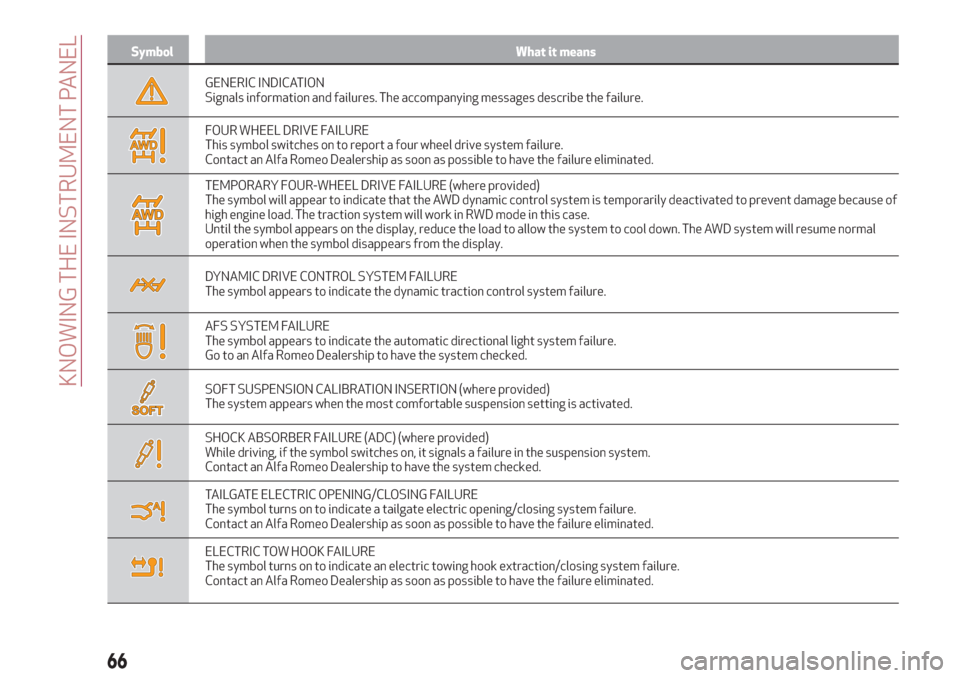
Symbol What it means
GENERIC INDICATION
Signals information and failures. The accompanying messages describe the failure.
FOUR WHEEL DRIVE FAILURE
This symbol switches on to report a four wheel drive system failure.
Contact an Alfa Romeo Dealership as soon as possible to have the failure eliminated.
TEMPORARY FOUR-WHEEL DRIVE FAILURE (where provided)
The symbol will appear to indicate that the AWD dynamic control system is temporarily deactivated to prevent damage because of
high engine load. The traction system will work in RWD mode in this case.
Until the symbol appears on the display, reduce the load to allow the system to cool down. The AWD system will resume normal
operation when the symbol disappears from the display.
DYNAMIC DRIVE CONTROL SYSTEM FAILURE
The symbol appears to indicate the dynamic traction control system failure.
AFS SYSTEM FAILURE
The symbol appears to indicate the automatic directional light system failure.
Go to an Alfa Romeo Dealership to have the system checked.
SOFT SUSPENSION CALIBRATION INSERTION (where provided)
The system appears when the most comfortable suspension setting is activated.
SHOCK ABSORBER FAILURE (ADC) (where provided)
While driving, if the symbol switches on, it signals a failure in the suspension system.
Contact an Alfa Romeo Dealership to have the system checked.
TAILGATE ELECTRIC OPENING/CLOSING FAILURE
The symbol turns on to indicate a tailgate electric opening/closing system failure.
Contact an Alfa Romeo Dealership as soon as possible to have the failure eliminated.
ELECTRIC TOW HOOK FAILURE
The symbol turns on to indicate an electric towing hook extraction/closing system failure.
Contact an Alfa Romeo Dealership as soon as possible to have the failure eliminated.
66
KNOWING THE INSTRUMENT PANEL
Page 74 of 244
ACTIVE SAFETYSYSTEMS
The vehicle may be equipped with the
following active safety devices:
ABS (Anti-Lock Brakes);
DTC (Drive Train Control);
ESC (Electronic Stability Control);
TC (Traction Control);
PBA (Panic Brake Assist);
HSA (Hill Start Assist);
AST (Alfa™ Steering Torque);
HDC (Hill Discent Control)
For the operation of the systems, see the
following pages.
ABS (Anti-lock Braking System)
This system, which is an integral part of
the braking system, prevents one or more
wheels from locking and slipping in all
road surface conditions, irrespective of
the intensity of the braking action,
ensuring that the vehicle can be
controlled even during emergency
braking and optimising stopping
distances.
The system intervenes during braking
when the wheels are about to lock,
typically in emergency braking or
low-grip conditions, when locking may be
more frequent.
The system also improves control and
stability of the vehicle when braking on a
surface where the grip of the left and
right wheels varies, or on corners.The Electronic Braking Force Distribution
(EBD) system completes the system
allowing the brake force to be distributed
between the front and rear wheels.
System intervention
The ABS equipped on this vehicle is
provided with the "Brake by wire"
(Integrated Brake System - IBS) function.
With this system, the brake pedal
command given by pressing the brake
pedal is not transmitted hydraulically but
electronically, therefore, the light
pulsation that could be felt on the pedal
with the traditional system is no longer
perceptible.29) 30) 31) 32) 33) 34)
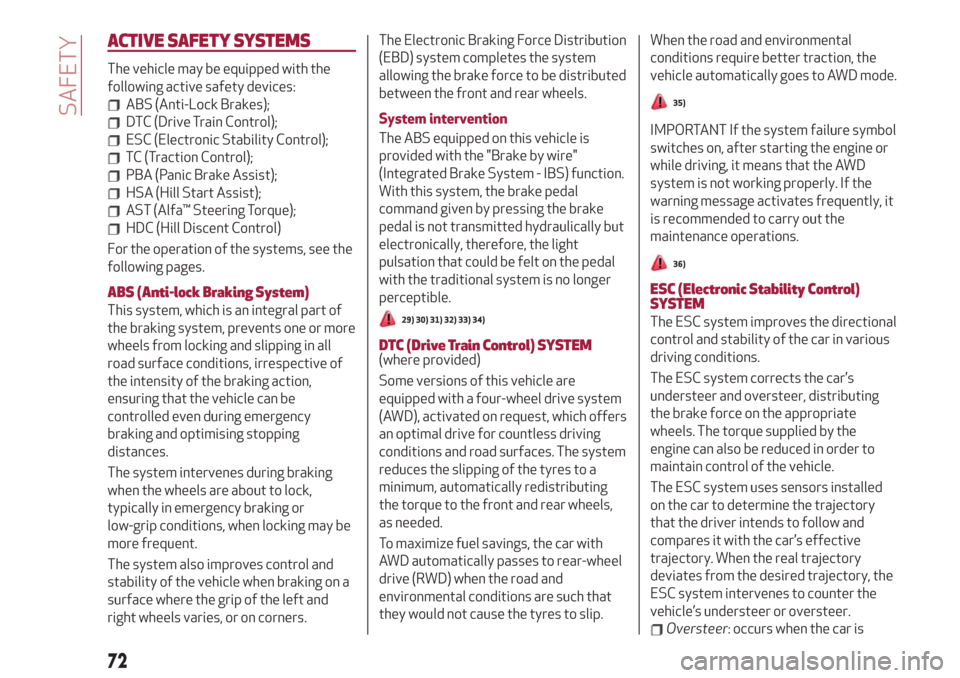
DTC (Drive Train Control)SYSTEM(where provided)
Some versions of this vehicle are
equipped with a four-wheel drive system
(AWD), activated on request, which offers
an optimal drive for countless driving
conditions and road surfaces. The system
reduces the slipping of the tyres to a
minimum, automatically redistributing
the torque to the front and rear wheels,
as needed.
To maximize fuel savings, the car with
AWD automatically passes to rear-wheel
drive (RWD) when the road and
environmental conditions are such that
they would not cause the tyres to slip.When the road and environmental
conditions require better traction, the
vehicle automatically goes to AWD mode.
35)
IMPORTANT If the system failure symbol
switches on, after starting the engine or
while driving, it means that the AWD
system is not working properly. If the
warning message activates frequently, it
is recommended to carry out the
maintenance operations.
36)
ESC (Electronic Stability Control)
SYSTEM
The ESC system improves the directional
control and stability of the car in various
driving conditions.
The ESC system corrects the car’s
understeer and oversteer, distributing
the brake force on the appropriate
wheels. The torque supplied by the
engine can also be reduced in order to
maintain control of the vehicle.
The ESC system uses sensors installed
on the car to determine the trajectory
that the driver intends to follow and
compares it with the car’s effective
trajectory. When the real trajectory
deviates from the desired trajectory, the
ESC system intervenes to counter the
vehicle’s understeer or oversteer.
Oversteer: occurs when the car is
72
SAFETY