engine ALFA ROMEO STELVIO 2021 Owners Manual
[x] Cancel search | Manufacturer: ALFA ROMEO, Model Year: 2021, Model line: STELVIO, Model: ALFA ROMEO STELVIO 2021Pages: 280, PDF Size: 10.02 MB
Page 224 of 280
SERVICING AND MAINTENANCE
222
than rest position (at the base of the wind-
shield), they will only return to rest position
following a command given using the stalk
(stalk upwards, into unstable position) or
when a speed of 3 mph (5 km/h) is exceeded.
Replacing The Windshield Wiper Blades
Proceed as follows:
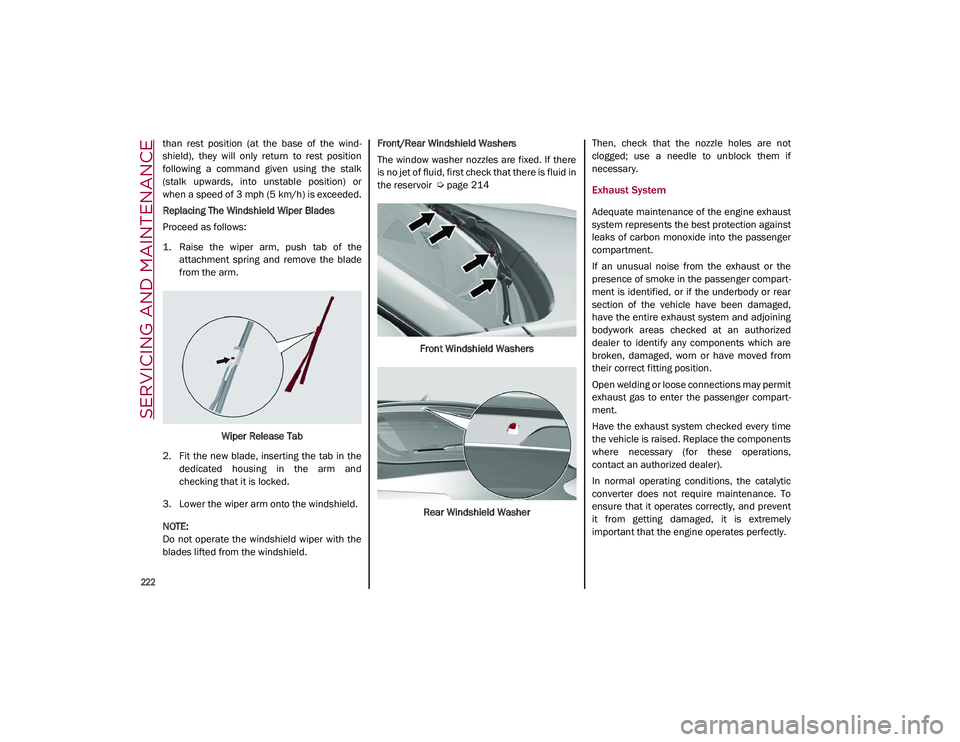
1. Raise the wiper arm, push tab of the attachment spring and remove the blade
from the arm.
Wiper Release Tab
2. Fit the new blade, inserting the tab in the dedicated housing in the arm and
checking that it is locked.
3. Lower the wiper arm onto the windshield.
NOTE:
Do not operate the windshield wiper with the
blades lifted from the windshield. Front/Rear Windshield Washers
The window washer nozzles are fixed. If there
is no jet of fluid, first check that there is fluid in
the reservoir
Ú
page 214
Front Windshield Washers
Rear Windshield Washer Then, check that the nozzle holes are not
clogged; use a needle to unblock them if
necessary.
Exhaust System
Adequate maintenance of the engine exhaust
system represents the best protection against
leaks of carbon monoxide into the passenger
compartment.
If an unusual noise from the exhaust or the
presence of smoke in the passenger compart
-
ment is identified, or if the underbody or rear
section of the vehicle have been damaged,
have the entire exhaust system and adjoining
bodywork areas checked at an authorized
dealer to identify any components which are
broken, damaged, worn or have moved from
their correct fitting position.
Open welding or loose connections may permit
exhaust gas to enter the passenger compart -
ment.
Have the exhaust system checked every time
the vehicle is raised. Replace the components
where necessary (for these operations,
contact an authorized dealer).
In normal operating conditions, the catalytic
converter does not require maintenance. To
ensure that it operates correctly, and prevent
it from getting damaged, it is extremely
important that the engine operates perfectly.
21_GU_OM_EN_USC_t.book Page 222
Page 225 of 280
223
To minimize the risk of damaging the catalytic
converter, proceed as follows:
Do not stop the engine or deactivate the
ignition with gear engaged and vehicle in
motion.
Do not attempt to start the engine by bump
starting.
Do not use the vehicle if irregular idling or
operating conditions are experienced.
Cooling System
Coolant Check
Your vehicle has two cooling systems and both
need to be checked to ensure they are at
proper fill levels
Ú
page 214.
Check the engine coolant and intercooler
coolant level every oil change or before long
trips.
If there are impurities in the engine coolant,
the system must be drained, flushed and
refilled: contact an authorized dealer. Check the front part of the condenser for any
build-up of insects, leaves or other debris.
Should it be dirty, clean by spraying delicately
with water.
Check the hoses of the engine/intercooler
cooling system to ensure that the rubber has
not deteriorated and that there are no cracks,
tears, cuts or obstructions in the expansion
tank side and radiator side connectors. Should
there be any doubt regarding leaks from the
system (e.g. if frequent top ups are required),
have the seal checked at an authorized
dealer.
With the engine off and at normal operating
temperature, check that the cooling system
radiator cap is closed properly.
NOTE:
Before removing the coolant reservoir cap,
wait for the system to cool down.
WARNING!
Exhaust gases can injure or kill. They
contain Carbon Monoxide (CO), which is
colorless and odorless. Breathing it can
make you unconscious and can eventually
poison you.
A hot exhaust system can start a fire if you
park over materials that can burn. Such
materials might be grass or leaves coming
into contact with your exhaust system. Do
not park or operate your vehicle in areas
where your exhaust system can contact
anything that can burn.
WARNING!
You or others can be badly burned by hot
engine coolant (antifreeze) or steam from
your radiator. If you see or hear steam
coming from under the hood, do not open
the hood until the radiator has had time to
cool. Never open a cooling system pres
-
sure cap when the radiator or coolant
bottle is hot.
Keep hands, tools, clothing, and jewelry
away from the radiator cooling fan when
the hood is raised. The fan starts automat -
ically and may start at any time, whether
the engine is running or not.
When working near the radiator cooling
fan, disconnect the fan motor lead or turn
the ignition to the OFF mode. The fan is
temperature controlled and can start at
any time the ignition is in the ON mode. WARNING!
Do not open hot engine cooling system.
Never add engine coolant (antifreeze)
when the engine is overheated. Do not
loosen or remove the cap to cool an over -
heated engine. Heat causes pressure to
build up in the cooling system. To prevent
scalding or injury, do not remove the pres -
sure cap while the system is hot or under
pressure.
Do not use a pressure cap other than the
one specified for your vehicle. Personal
injury or engine damage may result.
21_GU_OM_EN_USC_t.book Page 223
Page 226 of 280
SERVICING AND MAINTENANCE
224
(Continued)
(Continued)
Topping Up / Draining / Flushing The Engine/
Intercooler Coolant
If the engine coolant (antifreeze) is dirty, have
cleaning and flushing carried out at an autho
-
rized dealer.
For the correct servicing intervals
Ú
page 209.
NOTE:
For topping off, and proper coolant specifi -
cations
Ú
page 263.
Do not use pure water, alcohol-based cool -
ants, corrosions inhibitors or additional
anti-rust products because they may be
incompatible with the engine coolant and
cause the clogging of the radiator. The use
of propylene glycol-based coolant is also not
recommended.
Engine Cooling/Intercooler System Cap
To prevent loss of engine coolant, make sure
that the expansion tank cap is closed. If it is
open, screw it completely until you reach/hear
the click.
Periodically check the cap and clean it from
any foreign bodies that may have deposited on
the external surface. Disposal of Used Coolant
Disposal of engine/intercooler coolant is
subject to legal requirements. Contact the
appropriate body to determine local regula
-
tions.
NOTE:
To prevent the fluid from being ingested by
children or animals, do not keep it in open
containers or pour it on the ground. If
ingested, contact a doctor immediately.
Eliminate any traces of fluid from the
ground immediately.
When the vehicle stops after a short trip,
steam may be seen coming out from the
front of the hood. This is a normal phenom -
enon which is due to the presence of rain,
snow or a lot of moisture on the surface of
the radiator.
With engine and system cold, do not top up
with coolant beyond the maximum level
indicated on the reservoir in the engine
compartment.
Braking System
In order to guarantee the efficiency of the
braking system, periodically check its compo -
nents; for this operation, contact an autho -
rized dealer.
For the correct servicing intervals
Ú page 209.
NOTE:
Driving with your foot resting on the brake
pedal may compromise its efficiency,
increasing the risk of accidents. When driving,
never keep your foot on the brake pedal and
don’t put unnecessary strain on it to prevent
the brakes from overheating. Excess pad wear
may cause damage to the braking system.
When an insufficient oil level is detected,
contact an authorized dealer to have the
system checked.
Always keep the cap of the brake fluid reser-
voir (in the engine compartment)
completely closed.
WARNING!
Never add coolant with the engine hot or
overheated.
Do not attempt to cool an overheated
engine by loosening or removing the cap.
The heat causes a considerable increase
in pressure in the cooling system.
To prevent damage to the engine, only use
the engine cooling circuit caps provided.
WARNING! (Continued)
WARNING!
Use only manufacturer's recommended
brake fluid
Ú
page 263. Using the wrong
type of brake fluid can severely damage
your brake system and/or impair its
performance. The proper type of brake
fluid for your vehicle is also identified on
the original factory installed hydraulic
master cylinder reservoir.
21_GU_OM_EN_USC_t.book Page 224
Page 227 of 280
225
Automatic Transmission
Use only a transmission oil with the character-
istics indicated
Ú
page 263.
Special Additives
Do not use any type of additive with the auto -
matic transmission oil. The automatic trans -
mission oil is a product designed specially for this vehicle and its performance may be
compromised through the use of further addi
-
tives.
Frequency of Oil Changes
In normal vehicle operating conditions, it is not
necessary to change the transmission oil.
Replacing The Battery
If necessary, replace the battery with another
battery with the same specifications. It is
advised to contact an authorized dealer for
replacement.
Follow the battery manufacturer's instructions
for maintenance.
Fuses
General Information
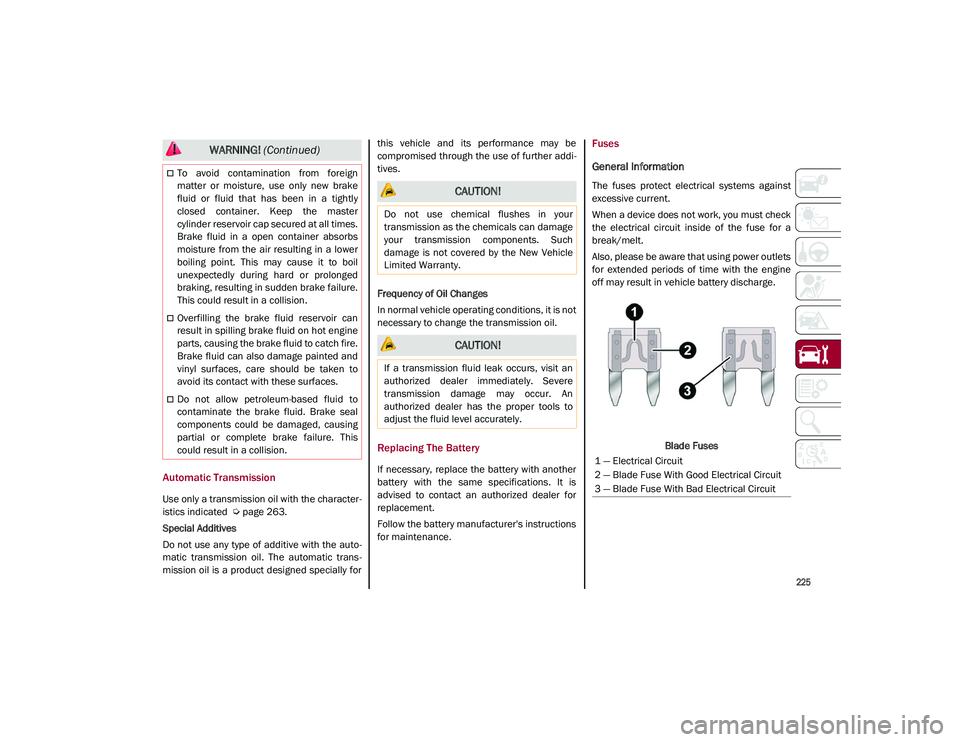
The fuses protect electrical systems against
excessive current.
When a device does not work, you must check
the electrical circuit inside of the fuse for a
break/melt.
Also, please be aware that using power outlets
for extended periods of time with the engine
off may result in vehicle battery discharge.
Blade Fuses
To avoid contamination from foreign
matter or moisture, use only new brake
fluid or fluid that has been in a tightly
closed container. Keep the master
cylinder reservoir cap secured at all times.
Brake fluid in a open container absorbs
moisture from the air resulting in a lower
boiling point. This may cause it to boil
unexpectedly during hard or prolonged
braking, resulting in sudden brake failure.
This could result in a collision.
Overfilling the brake fluid reservoir can
result in spilling brake fluid on hot engine
parts, causing the brake fluid to catch fire.
Brake fluid can also damage painted and
vinyl surfaces, care should be taken to
avoid its contact with these surfaces.
Do not allow petroleum-based fluid to
contaminate the brake fluid. Brake seal
components could be damaged, causing
partial or complete brake failure. This
could result in a collision.
WARNING! (Continued)
CAUTION!
Do not use chemical flushes in your
transmission as the chemicals can damage
your transmission components. Such
damage is not covered by the New Vehicle
Limited Warranty.
CAUTION!
If a transmission fluid leak occurs, visit an
authorized dealer immediately. Severe
transmission damage may occur. An
authorized dealer has the proper tools to
adjust the fluid level accurately.
1 — Electrical Circuit
2 — Blade Fuse With Good Electrical Circuit
3 — Blade Fuse With Bad Electrical Circuit
21_GU_OM_EN_USC_t.book Page 225
Page 228 of 280
SERVICING AND MAINTENANCE
226
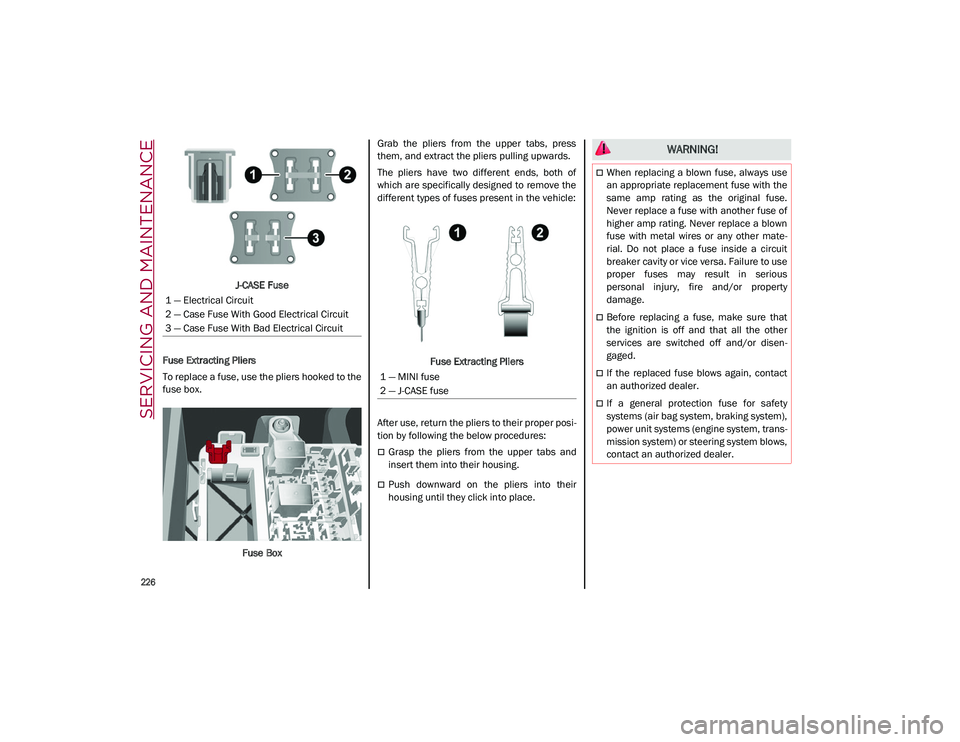
J-CASE Fuse
Fuse Extracting Pliers
To replace a fuse, use the pliers hooked to the
fuse box.
Fuse Box Grab the pliers from the upper tabs, press
them, and extract the pliers pulling upwards.
The pliers have two different ends, both of
which are specifically designed to remove the
different types of fuses present in the vehicle:
Fuse Extracting Pliers
After use, return the pliers to their proper posi -
tion by following the below procedures:
Grasp the pliers from the upper tabs and
insert them into their housing.
Push downward on the pliers into their
housing until they click into place.
1 — Electrical Circuit
2 — Case Fuse With Good Electrical Circuit
3 — Case Fuse With Bad Electrical Circuit
1 — MINI fuse
2 — J-CASE fuse
WARNING!
When replacing a blown fuse, always use
an appropriate replacement fuse with the
same amp rating as the original fuse.
Never replace a fuse with another fuse of
higher amp rating. Never replace a blown
fuse with metal wires or any other mate
-
rial. Do not place a fuse inside a circuit
breaker cavity or vice versa. Failure to use
proper fuses may result in serious
personal injury, fire and/or property
damage.
Before replacing a fuse, make sure that
the ignition is off and that all the other
services are switched off and/or disen -
gaged.
If the replaced fuse blows again, contact
an authorized dealer.
If a general protection fuse for safety
systems (air bag system, braking system),
power unit systems (engine system, trans -
mission system) or steering system blows,
contact an authorized dealer.
21_GU_OM_EN_USC_t.book Page 226
Page 233 of 280
231
*Only for basic version headlight with halogen main beam/dipped beam headlights
Replacing Exterior Bulbs
NOTE:
Only replace bulbs when the engine is off. Also
ensure that the engine is cold, to prevent the
risk of burns.
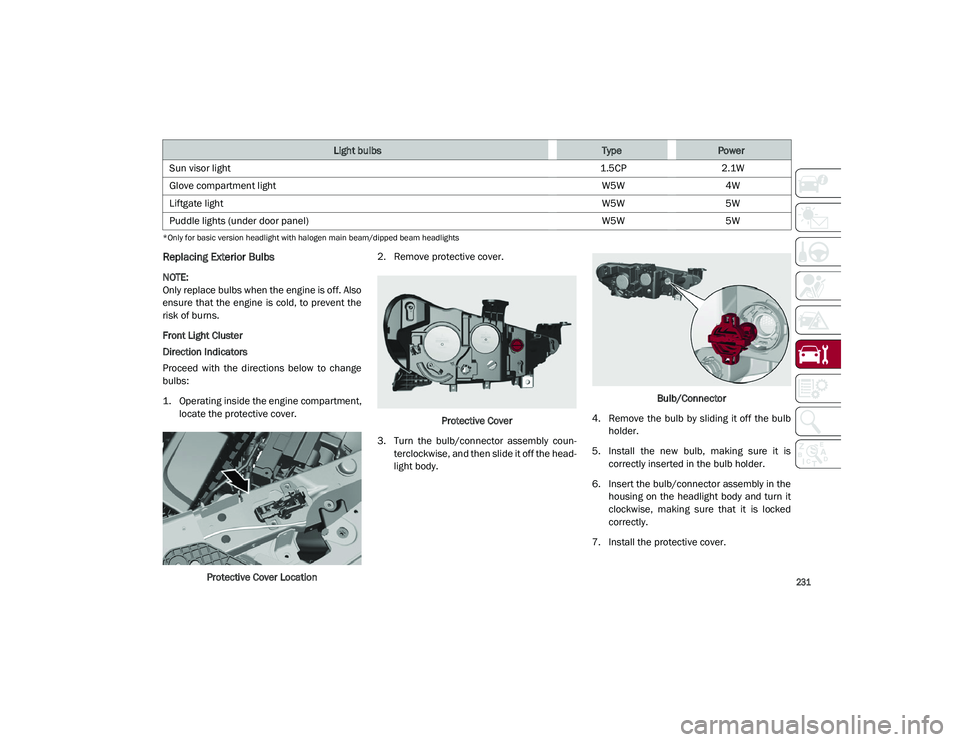
Front Light Cluster
Direction Indicators
Proceed with the directions below to change
bulbs:
1. Operating inside the engine compartment,locate the protective cover.
Protective Cover Location 2. Remove protective cover.
Protective Cover
3. Turn the bulb/connector assembly coun -
terclockwise, and then slide it off the head -
light body. Bulb/Connector
4. Remove the bulb by sliding it off the bulb holder.
5. Install the new bulb, making sure it is correctly inserted in the bulb holder.
6. Insert the bulb/connector assembly in the housing on the headlight body and turn it
clockwise, making sure that it is locked
correctly.
7. Install the protective cover.
Sun visor light
1.5CP2.1W
Glove compartment light W5W4W
Liftgate light W5W5W
Puddle lights (under door panel) W5W5W
Light bulbsTypePower
21_GU_OM_EN_USC_t.book Page 231
Page 243 of 280
241
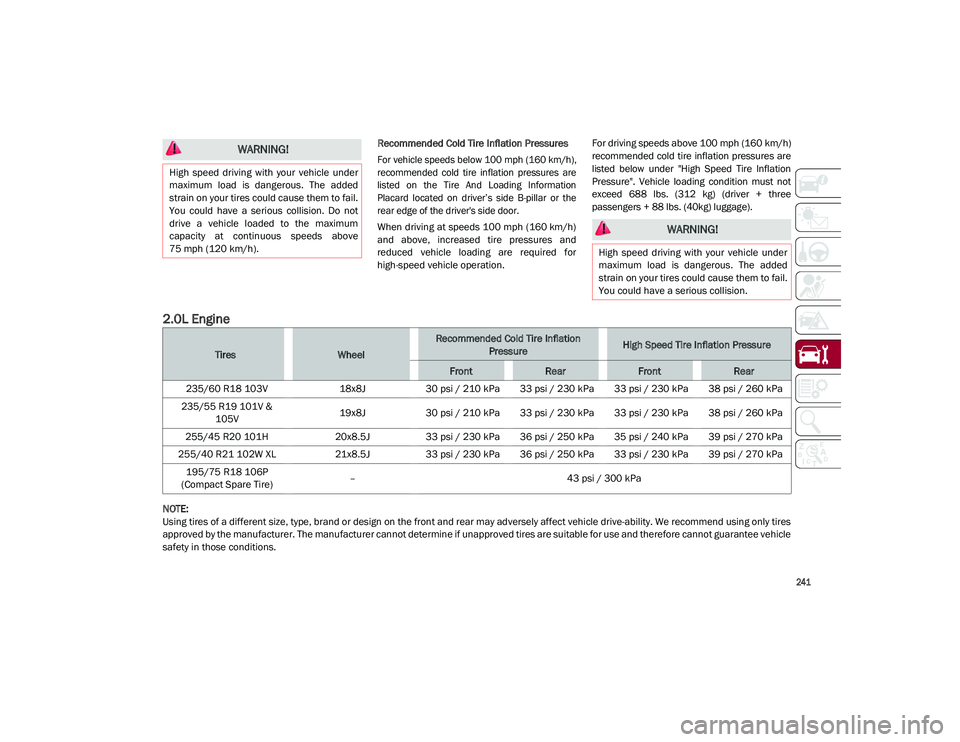
Recommended Cold Tire Inflation Pressures
For vehicle speeds below 100 mph (160 km/h),
recommended cold tire inflation pressures are
listed on the Tire And Loading Information
Placard located on driver’s side B-pillar or the
rear edge of the driver's side door.
When driving at speeds 100 mph (160 km/h)
and above, increased tire pressures and
reduced vehicle loading are required for
high-speed vehicle operation.For driving speeds above 100 mph (160 km/h)
recommended cold tire inflation pressures are
listed below under "High Speed Tire Inflation
Pressure". Vehicle loading condition must not
exceed 688 lbs. (312 kg) (driver + three
passengers + 88 lbs. (40kg) luggage).
2.0L Engine
NOTE:
Using tires of a different size, type, brand or design on the front and rear may adversely affect vehicle drive-ability. We recommend using only tires
approved by the manufacturer. The manufacturer cannot determine if unapproved tires are suitable for use and therefore cannot guarantee vehicle
safety in those conditions.
WARNING!
High speed driving with your vehicle under
maximum load is dangerous. The added
strain on your tires could cause them to fail.
You could have a serious collision. Do not
drive a vehicle loaded to the maximum
capacity at continuous speeds above
75 mph (120 km/h).
WARNING!
High speed driving with your vehicle under
maximum load is dangerous. The added
strain on your tires could cause them to fail.
You could have a serious collision.
TiresWheel
Recommended Cold Tire Inflation PressureHigh Speed Tire Inflation Pressure
FrontRearFrontRear
235/60 R18 103V 18x8J30 psi / 210 kPa 33 psi / 230 kPa 33 psi / 230 kPa 38 psi / 260 kPa
235/55 R19 101V & 105V 19x8J
30 psi / 210 kPa 33 psi / 230 kPa 33 psi / 230 kPa 38 psi / 260 kPa
255/45 R20 101H 20x8.5J33 psi / 230 kPa 36 psi / 250 kPa 35 psi / 240 kPa 39 psi / 270 kPa
255/40 R21 102W XL 21x8.5J33 psi / 230 kPa 36 psi / 250 kPa 33 psi / 230 kPa 39 psi / 270 kPa
195/75 R18 106P
(Compact Spare Tire) –
43 psi / 300 kPa
21_GU_OM_EN_USC_t.book Page 241
Page 244 of 280
SERVICING AND MAINTENANCE
242
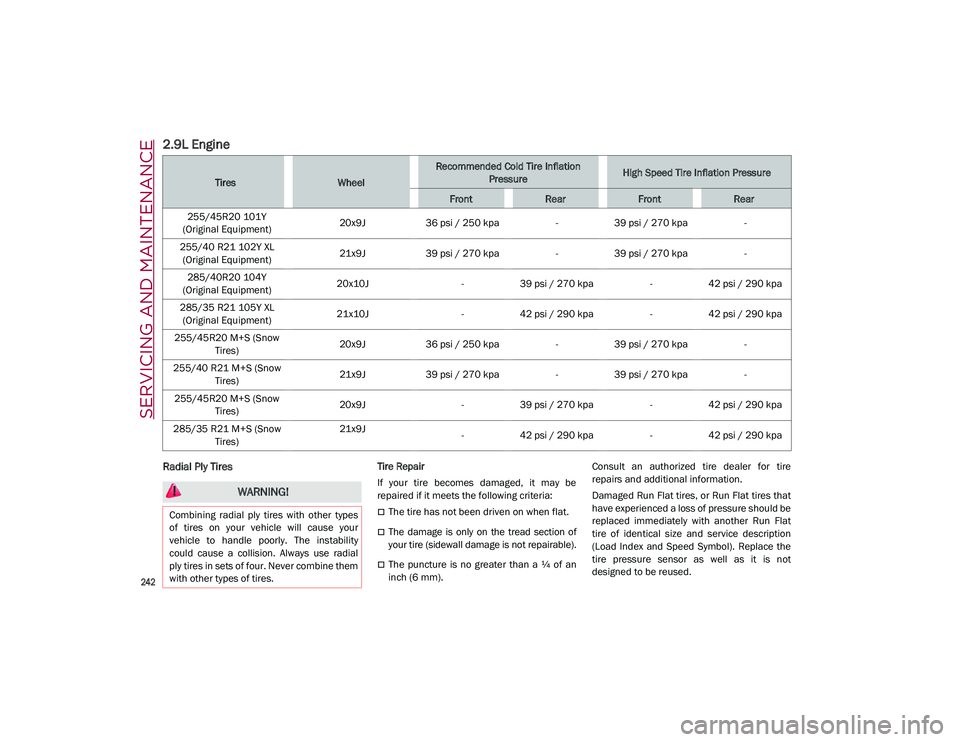
2.9L Engine
Radial Ply Tires Tire Repair
If your tire becomes damaged, it may be
repaired if it meets the following criteria:
The tire has not been driven on when flat.
The damage is only on the tread section of
your tire (sidewall damage is not repairable).
The puncture is no greater than a ¼ of an
inch (6 mm).Consult an authorized tire dealer for tire
repairs and additional information.
Damaged Run Flat tires, or Run Flat tires that
have experienced a loss of pressure should be
replaced immediately with another Run Flat
tire of identical size and service description
(Load Index and Speed Symbol). Replace the
tire pressure sensor as well as it is not
designed to be reused.
TiresWheel
Recommended Cold Tire Inflation
PressureHigh Speed Tire Inflation Pressure
FrontRearFrontRear
255/45R20 101Y
(Original Equipment) 20x9J
36 psi / 250 kpa -39 psi / 270 kpa -
255/40 R21 102Y XL (Original Equipment) 21x9J
39 psi / 270 kpa -39 psi / 270 kpa -
285/40R20 104Y
(Original Equipment) 20x10J
-39 psi / 270 kpa -42 psi / 290 kpa
285/35 R21 105Y XL (Original Equipment) 21x10J
-42 psi / 290 kpa -42 psi / 290 kpa
255/45R20 M+S (Snow Tires) 20x9J
36 psi / 250 kpa -39 psi / 270 kpa -
255/40 R21 M+S (Snow Tires) 21x9J
39 psi / 270 kpa -39 psi / 270 kpa -
255/45R20 M+S (Snow Tires) 20x9J
-39 psi / 270 kpa -42 psi / 290 kpa
285/35 R21 M+S (Snow Tires) 21x9J
-42 psi / 290 kpa -42 psi / 290 kpa
WARNING!
Combining radial ply tires with other types
of tires on your vehicle will cause your
vehicle to handle poorly. The instability
could cause a collision. Always use radial
ply tires in sets of four. Never combine them
with other types of tires.
21_GU_OM_EN_USC_t.book Page 242
Page 249 of 280
247
(Continued)
tires only in sets of four; failure to do so may
adversely affect the safety and handling of
your vehicle.
Snow tires generally have lower speed ratings
than what was originally equipped with your
vehicle and should not be operated at
sustained speeds over 75 mph (120 km/h).
For speeds above 75 mph (120 km/h) refer to
original equipment or an authorized tire dealer
for recommended safe operating speeds,
loading and cold tire inflation pressures.
While studded tires improve performance on
ice, skid and traction capability on wet or dry
surfaces may be poorer than that of
non-studded tires. Some states prohibit
studded tires; therefore, local laws should be
checked before using these tire types.
Tire Chains and Traction Devices
It is possible to fit 13 mm chains on all the
tires except for R20.
Use of traction devices require sufficient
tire-to-body clearance. Follow these recom-
mendations to guard against damage.
NOTE:
Traction device must be of proper size for
the tire, as recommended by the traction
device manufacturer.
Use on rear tires only.
Check the tension of the snow chains after
the first few meters have been driven.
Using snow chains with tires with non-orig -
inal dimensions may damage the vehicle.
Using different tires sizes or types (M+S,
snow, etc.) between the front and rear axles
may adversely affect vehicle driveability,
with the risk of losing control of the vehicle
and resulting accidents.
Tire Rotation Recommendations
Tires on the front and rear axles of vehicles
operate at different loads and perform
different steering, driving, and braking func -
tions. For these reasons, they wear at unequal
rates. These effects can be reduced by timely
rotation of tires. Rotation will increase tread
life, maintain traction levels and contribute to
a smooth, quiet ride.
To resolve this problem, tires should be
rotated at each service interval (approximately
every 10,000 miles [16,000 km]). More
frequent rotation is permissible if desired. The
reasons for any rapid or unusual wear should
be corrected prior to rotation being performed.
Tire Rotations Not Recommended — If
Equipped
Due to different size tires and wheels on front
and rear axles tire rotation is not possible for:
2.0T GME Engine equipped with a different
front and rear tire size.
CAUTION!
To avoid damage to your vehicle or tires,
observe the following precautions:
Because of restricted traction device
clearance between tires and other
suspension components, it is important
that only traction devices in good condi -
tion are used. Broken devices can cause
serious damage. Stop the vehicle immedi -
ately if noise occurs that could indicate
device breakage. Remove the damaged
parts of the device before further use.
Install device as tightly as possible and
then retighten after driving about ½ mile
(0.8 km).
Do not exceed 30 mph (48 km/h).
Drive cautiously and avoid severe turns
and large bumps, especially with a loaded
vehicle.
Do not drive for a prolonged period on dry
pavement.
Observe the traction device manufac -
turer’s instructions on the method of
installation, operating speed, and condi -
tions for use. Always use the suggested
operating speed of the device manufac -
turer’s if it is less than 30 mph (48 km/h).
Do not use traction devices on a compact
spare tire.
CAUTION! (Continued)
21_GU_OM_EN_USC_t.book Page 247
Page 251 of 280
249
test wheel. Sustained high temperature
can cause the material of the tire to
degenerate and reduce tire life, and
excessive temperature can lead to
sudden tire failure. The grade C corre-
sponds to a level of performance, which
all passenger vehicle tires must meet
under the Federal Motor Vehicle Safety
Standard No. 109. Grades B and A
represent higher levels of performance
on the laboratory test wheel, than the
minimum required by law.
STORING THE VEHICLE
If the vehicle is left inactive for longer than a
month, the following precautions should be
observed:
Park the vehicle in an area that is covered
and dry, and well-ventilated if possible.
Slightly open the windows.
Check that the Electric Park Brake (EPB) is
not activated.
Carry out the “Liftgate Emergency Opening”
procedure
Ú
page 62.
Disconnect the negative battery terminal
and check the battery charge. Repeat this
check once every three months during
storage.
If the battery is not disconnected from the
electrical system, check its state of charge
every 30 days.
Clean and protect the painted parts using
protective wax.
Clean and protect the shiny metal parts using
special compounds available commercially.
Sprinkle talcum powder on the windshield
wiper rubber blades, and lift them off the
glass.
Cover the vehicle with a fabric or perforated
plastic sheet, paying particular care not to
damage the painted surface by dragging
any dust that may have accumulated on it.
Do not use compact plastic sheets, as they
do not allow humidity to evaporate from the
surface of the vehicle.
Inflate tires to +7.25 psi (+0.5 bar) above
the standard prescribed pressure and
check it periodically.
Do not drain the engine cooling system.
Any time the vehicle is left inactive for two
weeks or more, operate the air conditioning
system with engine idling for at least five minutes, setting external air and with fan
set to maximum speed. This operation will
ensure appropriate lubrication for the
system, thus minimizing the possibility of
damage to the compressor when the
system is operated again.
NOTE:
After cycling the ignition to STOP and having
closed the driver side door, wait at least one
minute before disconnecting the electrical
supply from the battery. When reconnecting
the electrical supply to the battery, make sure
that the ignition is in the STOP position and the
driver’s side door is closed.
BODYWORK
Protection Against Atmospheric Agents
The vehicle is equipped with the best available
technological solutions to protect the body -
work against corrosion.
These include:
Painting products and systems which give
the vehicle resistance to corrosion and
abrasion.
Use of galvanized (or pre-treated) steel
sheets, with high resistance to corrosion.
Spraying of plastic parts, with a protective
function in the more exposed points: under
door, inner wing, edges, etc.
WARNING!
The temperature grade for this tire is
established for a tire that is properly inflated
and not overloaded. Excessive speed,
underinflation, or excessive loading, either
separately or in combination, can cause
heat buildup and possible tire failure.
21_GU_OM_EN_USC_t.book Page 249