engine ALFA ROMEO STELVIO 2022 Owners Manual
[x] Cancel search | Manufacturer: ALFA ROMEO, Model Year: 2022, Model line: STELVIO, Model: ALFA ROMEO STELVIO 2022Pages: 256, PDF Size: 10.17 MB
Page 232 of 256
SERVICING AND MAINTENANCE
230
TEMPERATURE GRADES
The temperature grades are A (the
highest), B, and C, representing the
tire's resistance to the generation of
heat and its ability to dissipate heat,
when tested under controlled conditions
on a specified indoor laboratory test
wheel. Sustained high temperature can
cause the material of the tire to
degenerate and reduce tire life, and
excessive temperature can lead to
sudden tire failure. The grade C
corresponds to a level of performance,
which all passenger vehicle tires must
meet under the Federal Motor Vehicle
Safety Standard No. 109. Grades B and
A represent higher levels of
performance on the laboratory test
wheel, than the minimum required by
law.
STORING THE VEHICLE
If the vehicle is left inactive for longer than a
month, the following precautions should be
observed:
Park the vehicle in an area that is covered and
dry, and well-ventilated if possible. Slightly
open the windows.
Check that the Electric Park Brake (EPB) is not
activated.
Carry out the “Liftgate Emergency Opening”
procedure
Ú
page 59.
Disconnect the negative battery terminal and
check the battery charge. Repeat this check
once every three months during storage.
If the battery is not disconnected from the
electrical system, check its state of charge
every 30 days.
Clean and protect the painted parts using
protective wax.
Clean and protect the shiny metal parts using
special compounds available commercially.
Sprinkle talcum powder on the windshield
wiper rubber blades, and lift them off the
glass.
Cover the vehicle with a fabric or perforated
plastic sheet, paying particular care not to
damage the painted surface by dragging any
dust that may have accumulated on it. Do not
use compact plastic sheets, as they do not
allow humidity to evaporate from the surface
of the vehicle.
Inflate tires to +7.25 psi (+0.5 bar) above the
standard prescribed pressure and check it
periodically.
Do not drain the engine cooling system.
Any time the vehicle is left inactive for two
weeks or more, operate the air conditioning
system with engine idling for at least five
minutes, setting external air and with fan set to
maximum speed. This operation will ensure
appropriate lubrication for the system, thus
minimizing the possibility of damage to the
compressor when the system is operated
again.
NOTE:
After cycling the ignition to STOP and having
closed the driver side door, wait at least one
minute before disconnecting the electrical supply
from the battery. When reconnecting the elec-
trical supply to the battery, make sure that the
ignition is in the STOP position and the driver’s
side door is closed.
WARNING!
The traction grade assigned to this tire is
based on straight-ahead braking traction
tests, and does not include acceleration, cor -
nering, hydroplaning, or peak traction charac -
teristics.
WARNING!
The temperature grade for this tire is estab -
lished for a tire that is properly inflated and not
overloaded. Excessive speed, under-inflation,
or excessive loading, either separately or in
combination, can cause heat buildup and pos-
sible tire failure.
22_GU_OM_EN_USC_t.book Page 230
Page 234 of 256
SERVICING AND MAINTENANCE
232
Engine Compartment
At the end of every Winter, wash the engine
compartment thoroughly, taking care not to aim
the jet of water directly at the electronic control
units or at the windshield wiper motors. Have this
operation performed at a specialized workshop
Ú
page 200.
NOTE:
The washing should take place with the engine
cold and the ignition device in the STOP position.
After the washing operation, make sure that the
various protections (e.g. rubber caps and guards)
have not been removed or damaged.
INTERIORS
Periodically check the cleanliness of the interior,
beneath the mats, which could cause oxidation of
the sheet metal.
SEATS AND FABRIC PARTS
Remove dust with a soft brush or a vacuum
cleaner. It is advised to use a moist brush on
velvet upholstery. Rub the seats with a sponge
moistened with a solution of water and neutral
detergent.
Cleaning heat press images on seats —
if equipped:
Due to the color, opacity and wear-resistant
protection with which the heat press images on
some seats are made, they may be subject to
temporary scratching if they are touched by finger
nails, keys, or other hard objects. In such cases,
the visible signs do not impair the profiled
images, and can easily be removed by wiping the affected area with a microfiber cloth moistened
with water (not dry) to restore the seat to its
original condition. The microfiber cloth must not
have been previously soaked in other substances
or detergents.
LEATHER SEATS
Remove the dry dirt with a chamois or slightly
damp cloth, without exerting too much pressure.
Remove any liquid or grease stains using an
absorbent dry cloth, without rubbing. Then clean
with a soft cloth or buckskin cloth dampened with
water and mild soap. If the stain persists, use
specific products and observe the instructions
carefully.
NOTE:
Never use alcohol. Make sure that the cleaning
products used contain no alcohol or alcohol deriv
-
atives, even in small quantities.
PLASTIC AND COATED PARTS
Clean interior plastic parts with a damp cloth (if
possible made from microfiber), and a solution of
water and neutral, non-abrasive detergent.
To clean oily or persistent stains, use specific
products free from solvents and designed to
maintain the original appearance and color of the
components.
Remove any dust using a microfiber cloth, if
necessary moistened with water. The use of
paper tissues is not recommended as these may
leave residues.
ALCANTARA PARTS — IF EQUIPPED
Alcantara parts maintenance procedure:
Treat the surface with a microfiber cloth
moistened with mild marseille soap and water,
taking care to apply a uniform light pressure
over the entire area (do not rub vigorously).
Rinse and wring out the microfiber cloth, and
pass it over the entire area again.
Let it dry, and then brush gently with a soft
brush.
GENUINE LEATHER PARTS
Use only water and mild soap to clean these
parts. Never use alcohol or alcohol-based
products.
Before using a specific product for cleaning
interiors, make sure that it does not contain
alcohol and/or alcohol based substances.
CARBON FIBER PARTS
To eliminate small scratches and marks on the
carbon, contact an authorized dealer. An
improperly performed operation may irreparably
damage the carbon.
CAUTION!
Precautions have been taken to safeguard all
parts and connections however, the pressures
generated by these machines is such that
complete protection against water ingress
cannot be guaranteed.
22_GU_OM_EN_USC_t.book Page 232
Page 235 of 256
233
For the enthusiasts, the technician, or those who
just want to know every detail of their vehicle,
useful information on understanding how your
vehicle works is contained in this chapter and
illustrated with data, tables, and graphics.
VEHICLE IDENTIFICATION
NUMBER (VIN)
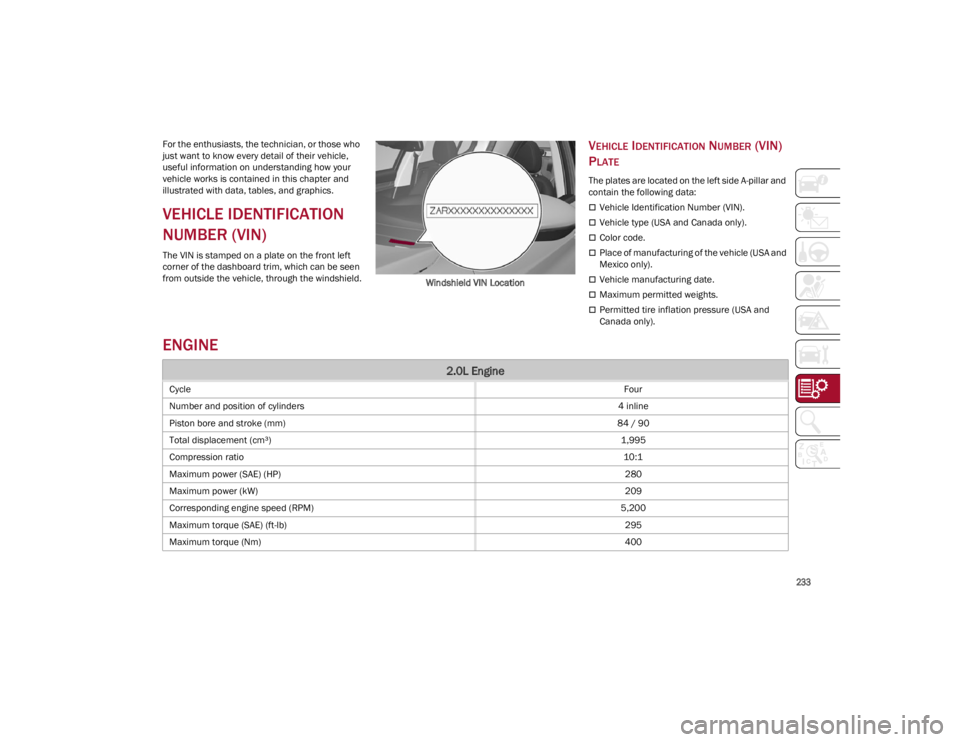
The VIN is stamped on a plate on the front left
corner of the dashboard trim, which can be seen
from outside the vehicle, through the windshield.
Windshield VIN Location
VEHICLE IDENTIFICATION NUMBER (VIN)
P
LATE
The plates are located on the left side A-pillar and
contain the following data:
Vehicle Identification Number (VIN).
Vehicle type (USA and Canada only).
Color code.
Place of manufacturing of the vehicle (USA and
Mexico only).
Vehicle manufacturing date.
Maximum permitted weights.
Permitted tire inflation pressure (USA and
Canada only).
ENGINE
2.0L Engine
Cycle Four
Number and position of cylinders 4 inline
Piston bore and stroke (mm) 84 / 90
Total displacement (cm³) 1,995
Compression ratio 10:1
Maximum power (SAE) (HP) 280
Maximum power (kW) 209
Corresponding engine speed (RPM) 5,200
Maximum torque (SAE) (ft-lb) 295
Maximum torque (Nm) 400
22_GU_OM_EN_USC_t.book Page 233
Page 236 of 256
234
POWER SUPPLY
Corresponding engine speed (RPM)2,250 - 4,000
Fuel 87 Octane Minimum (R+M)/2 Method, 91 Recommended, ethanol
percentage is 0–15%.
2.9L Engine
Cycle Four
Number and position of cylinders 6 / V
Piston bore and stroke (mm) 86.5 × 82
Total displacement (cm³) 2,891
Compression ratio 9.3:1
Maximum power (SAE) (HP) 505
Maximum power (kW) 375
Corresponding engine speed (RPM) 6,500
Maximum torque (SAE) (ft-lb) 443
Maximum torque (Nm) 600
Corresponding engine speed (RPM) 2,500
Fuel 87 Octane Minimum (R+M)/2 Method, 91 Recommended, ethanol
percentage is 0–15%.
Power supply
2.0L Engine Electronic timed sequential injection with knock control
2.9L Engine Phased sequential electronic injection with knock control and variable
intake valve actuation
2.0L Engine
22_GU_OM_EN_USC_t.book Page 234
TECHNICAL SPECIFICATIONS
Page 237 of 256
235
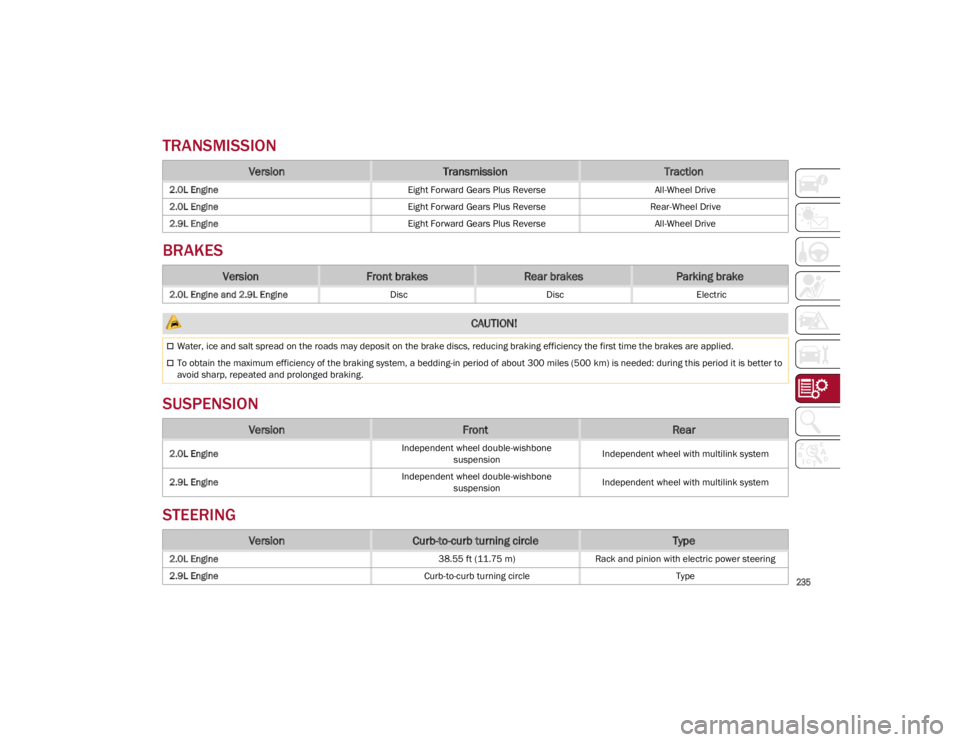
TRANSMISSION
BRAKES
SUSPENSION
STEERING
VersionTransmissionTraction
2.0L EngineEight Forward Gears Plus Reverse All-Wheel Drive
2.0L Engine Eight Forward Gears Plus Reverse Rear-Wheel Drive
2.9L Engine Eight Forward Gears Plus Reverse All-Wheel Drive
VersionFront brakesRear brakesParking brake
2.0L Engine and 2.9L EngineDiscDiscElectric
CAUTION!
Water, ice and salt spread on the roads may deposit on the brake discs, reducing braking efficiency the first time the brakes are applied.
To obtain the maximum efficiency of the braking system, a bedding-in period of about 300 miles (500 km) is needed: during this period it is better to
avoid sharp, repeated and prolonged braking.
VersionFrontRear
2.0L Engine Independent wheel double-wishbone
suspension Independent wheel with multilink system
2.9L Engine Independent wheel double-wishbone
suspension Independent wheel with multilink system
VersionCurb-to-curb turning circleType
2.0L Engine
38.55 ft (11.75 m)Rack and pinion with electric power steering
2.9L Engine Curb-to-curb turning circleType
22_GU_OM_EN_USC_t.book Page 235
Page 240 of 256
TECHNICAL SPECIFICATIONS
238
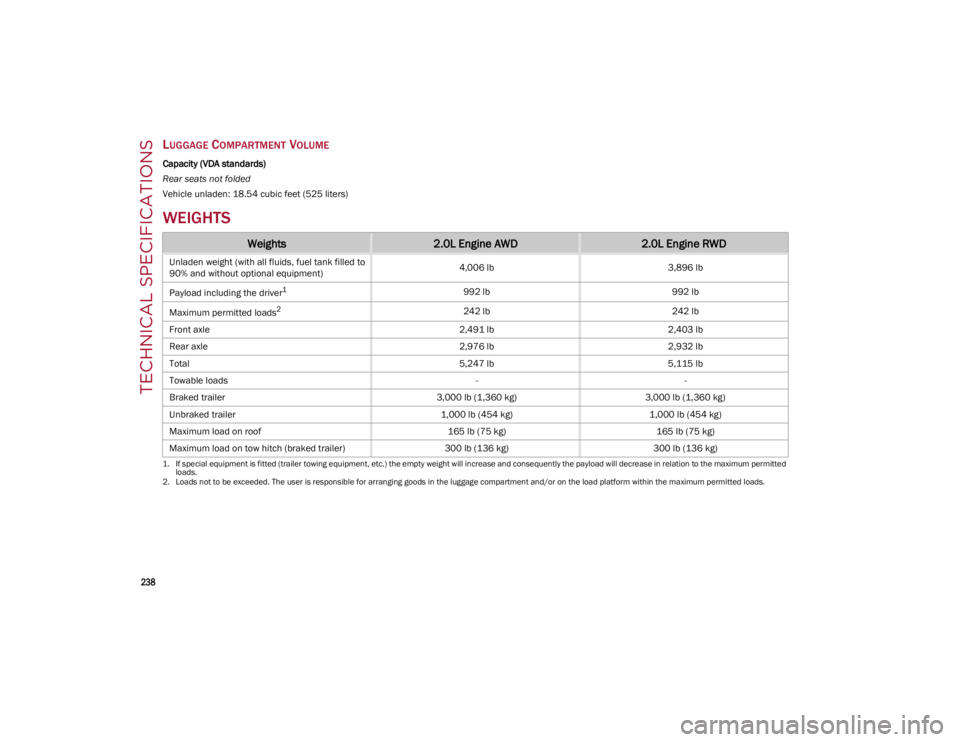
LUGGAGE COMPARTMENT VOLUME
Capacity (VDA standards)
Rear seats not folded
Vehicle unladen: 18.54 cubic feet (525 liters)
WEIGHTS
Weights2.0L Engine AWD2.0L Engine RWD
Unladen weight (with all fluids, fuel tank filled to
90% and without optional equipment) 4,006 lb
3,896 lb
Payload including the driver
1
1. If special equipment is fitted (trailer towing equipment, etc.) the empty weight will increase and consequently the payload will decrease in relation to the maximum permitted loads.
992 lb 992 lb
Maximum permitted loads
2
2. Loads not to be exceeded. The user is responsible for arranging goods in the luggage compartment and/or on the load platform within the maximum permitted loads.
242 lb 242 lb
Front axle 2,491 lb2,403 lb
Rear axle 2,976 lb2,932 lb
Total 5,247 lb5,115 lb
Towable loads --
Braked trailer 3,000 lb (1,360 kg)3,000 lb (1,360 kg)
Unbraked trailer 1,000 lb (454 kg)1,000 lb (454 kg)
Maximum load on roof 165 lb (75 kg)165 lb (75 kg)
Maximum load on tow hitch (braked trailer) 300 lb (136 kg)300 lb (136 kg)
22_GU_OM_EN_USC_t.book Page 238
Page 241 of 256

239
FUEL REQUIREMENTS
This engine is designed to meet all
emission regulations, and provide
satisfactory fuel economy and
performance when using high-quality
unleaded regular gasoline having a posted octane
number of 87 as specified by the (R+M)/2 method.
For optimal performance the use of 91 or higher
octane premium gasoline is recommended in these
engines.
While operating on gasoline with the required
octane number, hearing a light knocking sound
from the engine is not a cause for concern.
However, if the engine is heard making a heavy
knocking sound, see an authorized dealer
immediately. Use of gasoline with a lower than
recommended octane number can cause engine
failure and may void or not be covered by the New
Vehicle Limited Warranty. Poor quality gasoline can cause problems such as
hard starting, stalling, and hesitations. If you
experience these symptoms, try another brand of
gasoline before considering service for the
vehicle.
REFORMULATED GASOLINE
Many areas of the country require the use of
cleaner burning gasoline referred to as
“reformulated gasoline”. Reformulated gasoline
contains oxygenates and are specifically blended
to reduce vehicle emissions and improve air
quality.
The use of reformulated gasoline is
recommended. Properly blended reformulated
gasoline will provide improved performance and
durability of engine and fuel system components.
GASOLINE/OXYGENATE BLENDS
Some fuel suppliers blend unleaded gasoline with
oxygenates such as ethanol.
Weights2.9L engine
Unladen weight (with all fluids, fuel tank filled to 90% and without optional
equipment) 4,308 lb
Payload including the driver
1
1. If special equipment is fitted the empty weight will increase and consequently the payload will decrease in relation to the maximum permitted loads.
992 lb
Maximum permitted loads
2
2. Loads not to be exceeded. The user is responsible for arranging goods in the luggage compartment and/or on the load platform within the maximum permitted loads.
242 lb
– Front axle 2,579 lb
– Rear axle 2,976 lb
– Total 5,423 lb
Maximum load on roof 165 lb (75 kg)
CAUTION!
DO NOT use E-85, gasoline containing
methanol, or gasoline containing more than
15% ethanol (E-15). Use of these blends may
result in starting and drivability problems,
damage critical fuel system components,
cause emissions to exceed the applicable
standard, and/or cause the Malfunction
Indicator Light to illuminate. Please observe
pump labels as they should clearly
communicate if a fuel contains greater than
15% ethanol (E-15).
22_GU_OM_EN_USC_t.book Page 239
Page 242 of 256
TECHNICAL SPECIFICATIONS
240
(Continued)
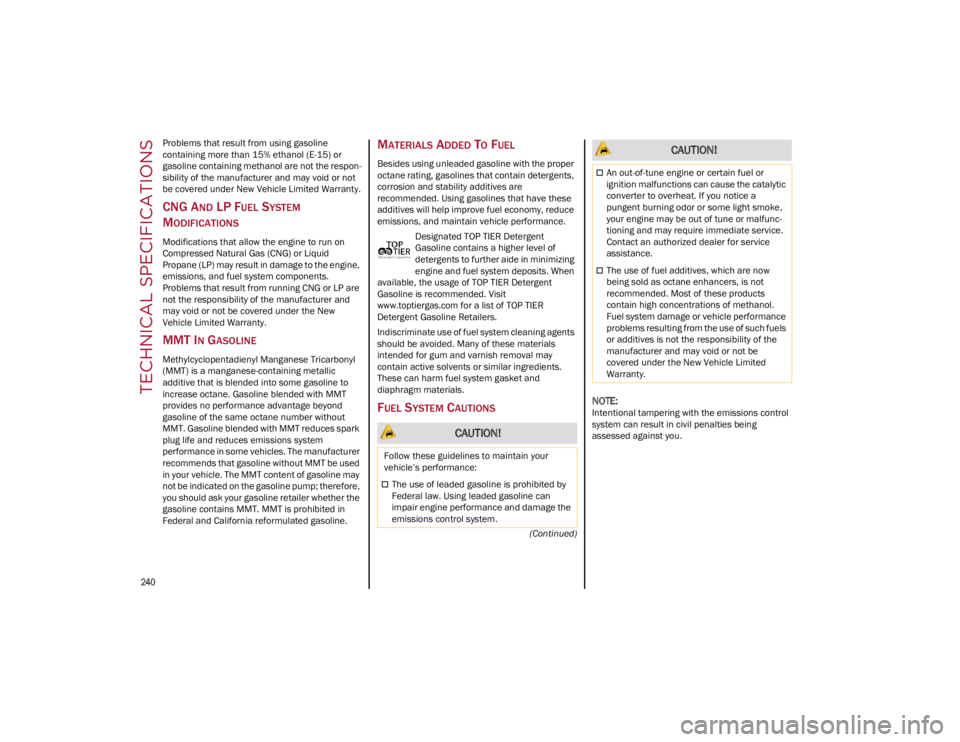
Problems that result from using gasoline
containing more than 15% ethanol (E-15) or
gasoline containing methanol are not the respon
-
sibility of the manufacturer and may void or not
be covered under New Vehicle Limited Warranty.
CNG AND LP FUEL SYSTEM
M
ODIFICATIONS
Modifications that allow the engine to run on
Compressed Natural Gas (CNG) or Liquid
Propane (LP) may result in damage to the engine,
emissions, and fuel system components.
Problems that result from running CNG or LP are
not the responsibility of the manufacturer and
may void or not be covered under the New
Vehicle Limited Warranty.
MMT IN GASOLINE
Methylcyclopentadienyl Manganese Tricarbonyl
(MMT) is a manganese-containing metallic
additive that is blended into some gasoline to
increase octane. Gasoline blended with MMT
provides no performance advantage beyond
gasoline of the same octane number without
MMT. Gasoline blended with MMT reduces spark
plug life and reduces emissions system
performance in some vehicles. The manufacturer
recommends that gasoline without MMT be used
in your vehicle. The MMT content of gasoline may
not be indicated on the gasoline pump; therefore,
you should ask your gasoline retailer whether the
gasoline contains MMT. MMT is prohibited in
Federal and California reformulated gasoline.
MATERIALS ADDED TO FUEL
Besides using unleaded gasoline with the proper
octane rating, gasolines that contain detergents,
corrosion and stability additives are
recommended. Using gasolines that have these
additives will help improve fuel economy, reduce
emissions, and maintain vehicle performance.
Designated TOP TIER Detergent
Gasoline contains a higher level of
detergents to further aide in minimizing
engine and fuel system deposits. When
available, the usage of TOP TIER Detergent
Gasoline is recommended. Visit
www.toptiergas.com
for a list of TOP TIER
Detergent Gasoline Retailers.
Indiscriminate use of fuel system cleaning agents
should be avoided. Many of these materials
intended for gum and varnish removal may
contain active solvents or similar ingredients.
These can harm fuel system gasket and
diaphragm materials.
FUEL SYSTEM CAUTIONS
NOTE:
Intentional tampering with the emissions control
system can result in civil penalties being
assessed against you.
CAUTION!
Follow these guidelines to maintain your
vehicle’s performance:
The use of leaded gasoline is prohibited by
Federal law. Using leaded gasoline can
impair engine performance and damage the
emissions control system.
An out-of-tune engine or certain fuel or
ignition malfunctions can cause the catalytic
converter to overheat. If you notice a
pungent burning odor or some light smoke,
your engine may be out of tune or malfunc-
tioning and may require immediate service.
Contact an authorized dealer for service
assistance.
The use of fuel additives, which are now
being sold as octane enhancers, is not
recommended. Most of these products
contain high concentrations of methanol.
Fuel system damage or vehicle performance
problems resulting from the use of such fuels
or additives is not the responsibility of the
manufacturer and may void or not be
covered under the New Vehicle Limited
Warranty.
CAUTION!
22_GU_OM_EN_USC_t.book Page 240
Page 243 of 256
241
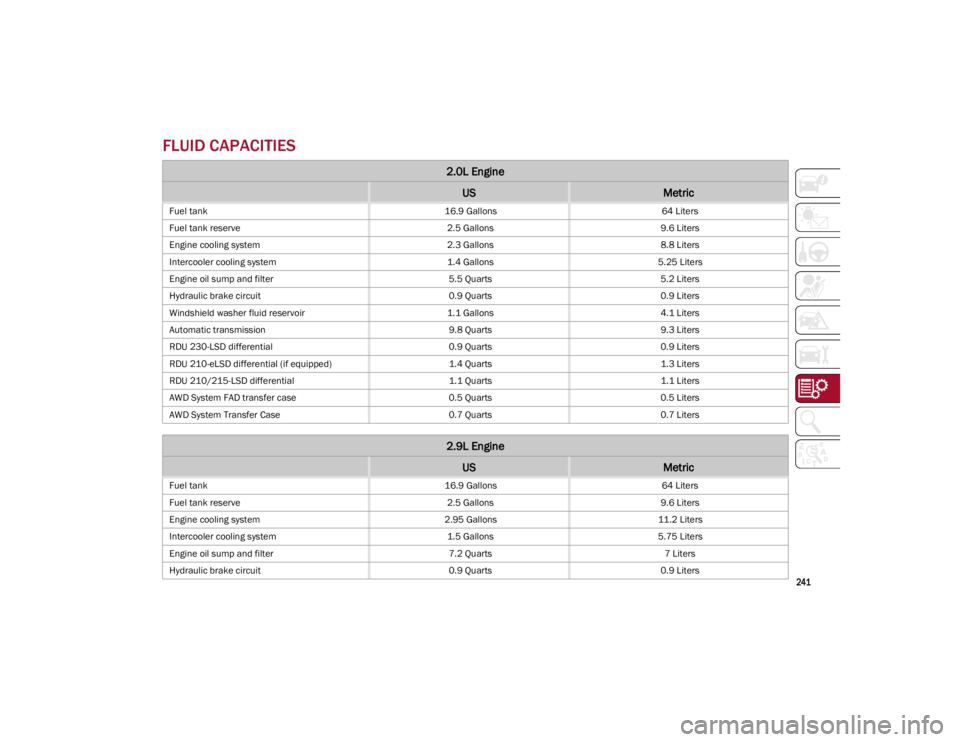
FLUID CAPACITIES
2.0L Engine
USMetric
Fuel tank16.9 Gallons64 Liters
Fuel tank reserve 2.5 Gallons9.6 Liters
Engine cooling system 2.3 Gallons8.8 Liters
Intercooler cooling system 1.4 Gallons5.25 Liters
Engine oil sump and filter 5.5 Quarts5.2 Liters
Hydraulic brake circuit 0.9 Quarts0.9 Liters
Windshield washer fluid reservoir 1.1 Gallons4.1 Liters
Automatic transmission 9.8 Quarts9.3 Liters
RDU 230-LSD differential 0.9 Quarts0.9 Liters
RDU 210-eLSD differential (if equipped) 1.4 Quarts1.3 Liters
RDU 210/215-LSD differential 1.1 Quarts1.1 Liters
AWD System FAD transfer case 0.5 Quarts0.5 Liters
AWD System Transfer Case 0.7 Quarts0.7 Liters
2.9L Engine
USMetric
Fuel tank 16.9 Gallons64 Liters
Fuel tank reserve 2.5 Gallons9.6 Liters
Engine cooling system 2.95 Gallons11.2 Liters
Intercooler cooling system 1.5 Gallons5.75 Liters
Engine oil sump and filter 7.2 Quarts7 Liters
Hydraulic brake circuit 0.9 Quarts0.9 Liters
22_GU_OM_EN_USC_t.book Page 241
Page 244 of 256
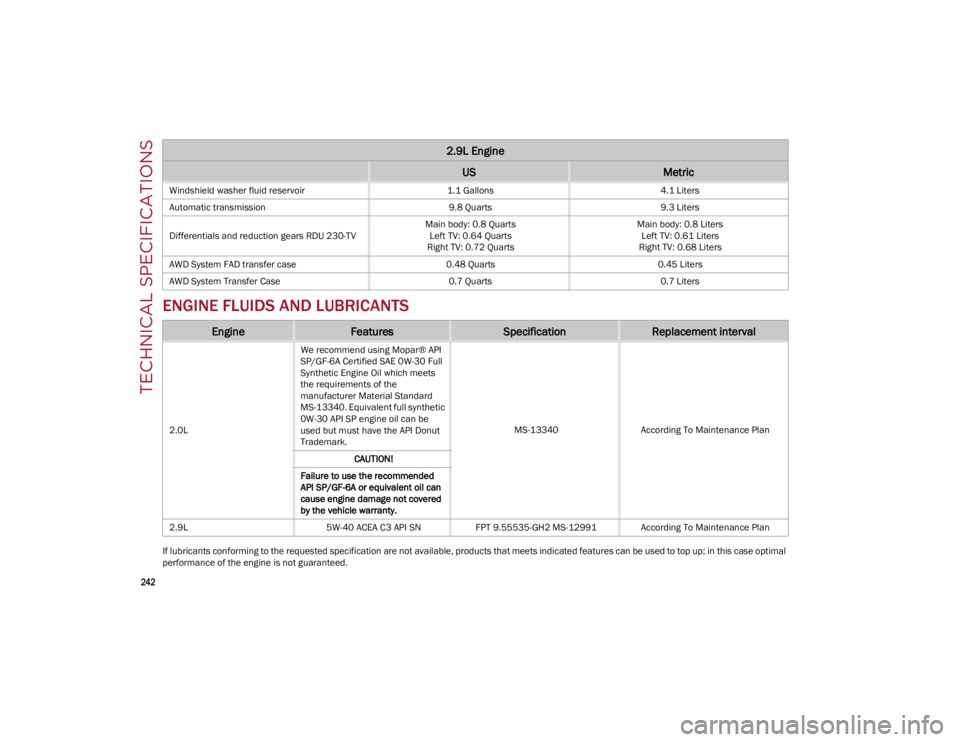
TECHNICAL SPECIFICATIONS
242
ENGINE FLUIDS AND LUBRICANTS
If lubricants conforming to the requested specification are not available, products that meets indicated features can be used to top up; in this case optimal
performance of the engine is not guaranteed.Windshield washer fluid reservoir
1.1 Gallons4.1 Liters
Automatic transmission 9.8 Quarts9.3 Liters
Differentials and reduction gears RDU 230-TV Main body: 0.8 Quarts
Left TV: 0.64 Quarts
Right TV: 0.72 Quarts Main body: 0.8 Liters
Left TV: 0.61 Liters
Right TV: 0.68 Liters
AWD System FAD transfer case 0.48 Quarts0.45 Liters
AWD System Transfer Case 0.7 Quarts0.7 Liters
EngineFeaturesSpecificationReplacement interval
2.0LWe recommend using Mopar® API
SP/GF-6A Certified SAE 0W-30 Full
Synthetic Engine Oil which meets
the requirements of the
manufacturer Material Standard
MS-13340. Equivalent full synthetic
0W-30 API SP engine oil can be
used but must have the API Donut
Trademark. MS-13340
According To Maintenance Plan
CAUTION!
Failure to use the recommended
API SP/GF-6A or equivalent oil can
cause engine damage not covered
by the vehicle warranty.
2.9L 5W-40 ACEA C3 API SNFPT 9.55535-GH2 MS-12991 According To Maintenance Plan
2.9L Engine
USMetric
22_GU_OM_EN_USC_t.book Page 242