fuel pressure AUDI A3 2011 Owner´s Manual
[x] Cancel search | Manufacturer: AUDI, Model Year: 2011, Model line: A3, Model: AUDI A3 2011Pages: 320, PDF Size: 75.79 MB
Page 255 of 320
Tires and wheels -________________ l'fFI
• The tire p ress ure s s ho uld onl y be chec ked and adjus ted whe n the
ti res are col d. T he sli ghtly rais e d pre ssu res o f w arm t ires must not b e
r e d uced .
• Adju st the tire p re ssu re to t he lo ad you are ca rry ing .
• Reinstall the valve stem cap o n the valve .
When should I check the tire pressure?
The corre ct tire press ure is especially importa nt at high speeds. The
pressu re s ho uld t heref ore be chec ked at least onc e a month an d
always be fore start ing a journey . Do not fo rget to check t he t ire p res
s u re for the spar e w hee l~
pag e 2 71.
When should I adjust the tire pressures?
Ad jus t the tire pr ess ur e to th e load you ar e carry ing . Af ter chang ing a
w hee l
or replac ing w heels yo u have to adjust the t ire press ures on all
w heels. In addi tion, you must th en ini tia lize the ne w tire press ures in
the t ire pressure monito ring system *~
page 264 .
& WARNING
Incorrect tire pressures and/or underinflation can lead sudden tire
failure, loss of control, collision, serious personal injury or even death.
• When the warning symbol{__, appears in the instrument
cluster , stop and inspect the tires.
• Incorrect tire pressure and/or underinflation can cause
increased tire wear and can affect the handling of the vehicle and
stopping ability.
• Incorrect tire pressure s and/or underinflation can also lead to
sudden tire failure, including a blowout and sudden deflation,
causing loss of vehicle control.
• The driver is responsible for the correct tire pressures for all
tires on the vehicle. The applicable pressure values are located on
a sticker on the driver 's side 8-pillar or on the inside of the fuel
filler flap .
Safety first
& WARNING (cont inued )
• Only when all tires on the vehicle are filled to the correct pres
sure, the tire pressure monitoring system* can work correctly.
• The use of incorrect tire pressure values can lead to accidents or
other damage . Therefore it is essential that the driver observe the
specified tire pressure values for the tires and the correct pres
sures for the function of the tire pressure monitoring system*.
• Always inflate tires to the recommended and correct tire pres
sure before driving off .
• Driving with underinflated tires bend more, letting them get
too hot resulting in tread separation, sudden tire failure and loss
of control.
• Excessive speed and/overloading can cause heat build-up,
sudden tire failure and loss of control.
• If the tire pressure is too low or too high, the tires will wear
prematurely and the vehicle will not handle well.
• If the tire is not flat and you do not have to change a wheel
immediately, drive at reduced speed to the nearest service station
to check the tire pressure and add air as required .
0 Note
Driving witho ut valve stem caps can cause damage to the tire valves.
T o preven t this, always ma ke sure that fa ctor y in sta lled val ve s te m
caps on all wheels a re secure ly mounted on the va lve.
c£> For the sake of the environment
Under infla ted ti res will also increase t he fue l cons umption .•
Tires and vehicle Load Limits
T he re are limits to the amo unt of load or weight that a ny vehicle and
any tire c an car ry. A veh icle t hat is ove rload ed w ill not handle well and ..,_
Vehicle care Technical data
Page 256 of 320
_L_T.:...:..: i r~ e:.: s~ a:::. n:..:..:: d:.....: w..:...:. h::e:.: e::.:: ls::::._ ______________________________________________ _
is more difficult to stop. Overloading can not only lead to loss of
vehicle control, but can also damage important parts of the vehicle
and can lead to sudden tire failure, including a blowout and sudden
deflation that can cause the vehicle to crash.
Your safety and that of your passengers also depends o n making sure
that load limits are not exceeded. Vehicle load includes everybody
and everything in and on the vehicle. These load limits are techn ically
referred to as the veh icle's
Gross Vehicle Weight Rating ("GVWR").
Th e "GVWR" includes the weight of the basic vehicle, all factory
installed accessories, a full tank of fuel, o il, coolant and other fluids
plus maximum load. The maximum load includes the number of
passenge rs that the vehicle is intended to carry ("seating capacity")
with an assumed weight of 150 lbs (68 kg) for each passenger at a
designated seating posit ion and the total weight of any luggage in
the vehicle. If you tow a trailer, the weight of the trailer hitch and the
tongue weight of the loaded trailer must be included as part of the
vehicle load.
T he Gross Axle Weight Rating ("GAWR") is the maximum load that
can be applied at each of the vehicle's two ax les.
The Gross Vehicle We ight Rating and the Gross Axle Weight Rat ing
are listed on the safety compliance sticker label located e ithe r on the
dr iver's s ide B-pillar or on the inside of the fuel filler flap. Your Audi
has 5 seating positions, 2 in the front and 3 in t he rear for total
seating capacity of 5. Each seating position has a safety belt
=> page 135, "Safety belts".
The fact that there is an upper limit to your veh icle's Gross Veh icle
Weight Rating means that the total weight of whatever is being
carried in the veh icle (in cluding the weight of a trailer hitch and the
tongue weight of the loaded trailer) is limited . The more passengers
in the vehicle or passengers who are heavier than the standard
we ights assumed mean that less we ight can be carr ied as luggage.
Th e tire pressure label on your A udi also lists the maximum combined
we ight of all of the occupants and luggage or other cargo that the
vehicle can carry. For the location of the labe l=>
page 249, fig. 171.
& WARNING
Overloading a vehicle can cause loss of vehicle control, a crash or
other accident, serious personal injury, and even death.
• Carrying more weight than your vehicle was designed to carry
will prevent the vehicle from handling properly and increase the
risk of the loss of vehicle control.
• The brakes on a vehicle that has been overloaded may not be
able to stop the vehicle within a safe distance.
• Tires on a vehicle that has been overloaded can fail suddenly,
including a blowout and sudden deflation, causing loss of control
and a crash.
• Always make sure that the total load being transported -
including the weight of a trailer hitch and the tongue weight of a
loaded trailer -does not make the vehicle heavier than the
vehicle's Gross Vehicle Weight Rating .•
Determining correct load limit
Use the example below to calculate the
total weight of the passengers and luggage
or other things that you plan to transport so
that you can make sure that your vehicle
will not be overloaded. ._
Page 260 of 320

lfflJ,.___T_ ir_e_ s _ a_ n _ d_ w_ h_e_ e_ ls _______________________________________________ _
(j)
®
®
U.S . DOT tire identification number
Audi Orig inal tire
Tire ply composition and materials used
Max imum load rating
Treadwear, traction and temperature grades
@ Maximum permissible inflation pressure
The tires and rims are essential parts of the vehicle's design. The tires
and r ims approved by Audi are spec ially matched to the characteris
tics of the vehicle and can make a major contribution to good road
holding and safe handling when in good condition and properly
inflated =>& .
We recommend that all work on tires and wheels be performed by an
authorized Audi dealer. They are familiar with recommended proce
dures and have the necessary special tools and spare parts as well as
the proper facilit ies for disposing of the old tires.
Authorized Audi dea lers have the necessary information about tech
nical requirements for installing or chang in g ti res and rims.
Replacing tires and wheels
Tires should be replaced at least in pairs and not ind ividually (for
example both front tires or both rear t ires together).
Be sure to read and heed the tir e pressure monitoring system*
information=>
page 264.
Always buy replacement radial tires that have the same specifications
as the tires approved for your veh icle by Audi . Replacement tires must
always have the same load rating specification as the original equip
ment or approved opt iona l tires listed in the table=>
page 249.
Audi-approved spec ification tires are specially matched to your
vehicle and its load limits, and can contribute to the important road
holding, driv ing characteristics, and safety of the vehicle. The table (=>
page
249) lists specifications of the tires approved for the Aud i
models covered by your Owner's Literature.
The tire pressure label located either on driver's side B-p illar or inside
the fuel filler flap(=>
page 249, fig. 172) lists the specifications of
the original equipment tires installed on your ve hicle at the time it
was manufactured.
Federal law requires tire manufact urers to place standardized infor
mation on the sidewall of all tires =>
page 2 5 7, fig. 17 5. This i nfor
mation identifies and describes the fundamental characteristics, the
quality grade of the tire and also provides a t ire identification number
for safety standard certification and in case of a reca ll.
Tire specifications
Knowledge of tire specificat ions makes it easie r to choose the correct
tires. Rad ial tires have the tire specifications marked on the s idewall,
for examp le:
P225 / 45 R 17 91H XL
This contains the following informat ion:
P I ndicates the tire is for passenger cars (where applicable)
225 Nominal tire width in mm of the tire from s idewall edge to side-
wa ll edge. In gene ral, the large r the number, the wider the tire
45 Height/width ratio in pe rcent (aspect ratio)
R Tire construction: Radial
17 Rim diameter code (in inches)
91 Load rating code
H Speed rating letter code
XL (or "xl", "EXTRA LOAD" or "RF") indicates that the tire is "Rein
forced" or an "Extra Load" tire
M+S (or "M/S") Indicates that the t ire has some mud and snow capa
bili ty
The tires could a lso have the information of direction of rotation
=>page 245.
Page 267 of 320
________________________________________________ T_ i_ re _ s_ a_ n_d_ w_ h_ e_ e_l _s _ ........
As an added safety feature, your vehicle has been equipped with a tire
pressure monitoring system (TPMS) that ill uminates a low tire pres
sure telltale when one or more of your tires is signif icantly under
inflated . Accordingly, when the low tire pressure telltale illuminates,
you should stop and check your tires as soon as possible, and inflate them to the proper pressure. Driving on a significantly under-inflated
ti re causes the tire to overheat and can lead to tire fa ilure. Unde r
inf lation also reduces fuel efficiency and tire tread life, and may
affect the vehicle's handling and stopping ability.
Please note that the TPMS is not a substitute for proper tire mainte
nance, and it is the driver's responsibility to maintain correct tire
pressure, even if under -inflation has not reached the level to trigger
illumination of the TPMS low tire pressure te lltale.
Your vehicle has also been equipped with a TPMS malfunction ind i
cator to indicate when the system is not operating properly. The
TPMS malfunction indicator is combined w ith the low tire pressure
telltale . When the system detects a malfunction, the telltale will
flash for approximate ly one minute and then remain continuously
illuminated. This sequence will continue upon subsequent vehicle
start -ups as long as the malfunction exists.
When the ma lfunction indicator is illum inated, the system may not
be able to detect or signa l low tire pressure as intended. TPMS
ma lfunctions may occur for a var iety of reaso ns, includ ing the instal
lation of replacement or alternate tires or wheels on the vehicle that
prevent the TPMS from functioning properly. Always check the TPMS
malfunction telltale after replacing one or more tires or wheels on
yo ur vehicle to ensure that the replacement or alternate tires and
wheels allow t he TPMS to continue to funct io n properly .•
Vehicle OP-eration
App lies to vehicl es: wi th t ire p ress ure m onit ori ng syst em
Tire pressure indicator appears
The tire pressure indicator in the instrument cluster
informs you if the tire pressure is too low or if there is a
system malfunction.
Fig. 176 Display:
under inflation
warning
Fig . 17 7 Display:
System malfunction
Using the ABS sensors, the tire pressure monitoring system compares
the tire tread circumference and vibration characteristics of the indi
vidual tires.
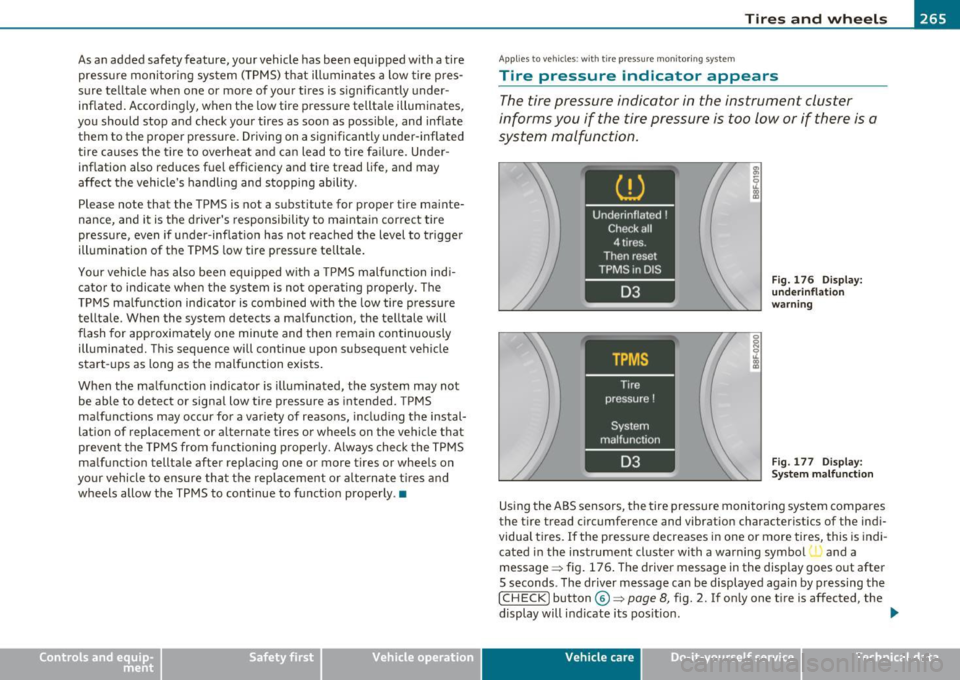
If the pressure decreases in one or more tires, this is indi-
cated in the instrument cluster with a warning symbol and a
message ~ fig. 176 . The driver message in the display goes out after
5 seconds . The driver message can be displayed again by pressing the
I CHECK) button©~ page 8, fig. 2. If on ly one tire is affected, the
display will i ndicate its pos it ion. ._
Vehicle care Do-it-yourselt service iTechnical data
Page 285 of 320
_______________________________________________ F_u _s_ e_ s_ a_ n_ d_ b_u _ l_ b _ s __ _
Equipment No. II Equipment
Amps
Manual headlight beam adjustment, automatic Diagnostic connector, rain sensor, air condition-
headlight beam adjustment, AFS control mod-
16 ing (control module), tire pressure monitor dis-10
1 ule, engine components, light switch (switch 10 play (control module)
-lig hti ng/i llum i nation), diagnosis socket 1 7 Ant i-theft alarm warning system 5
Automatic transmission, control module for CAN 18 Diagnose Starter 5
data transfer (gateway), electro-mechanical
19 All Whee l Drive 10 steering, shift gate automatic transmission, 2 10 engine relay, fuel tank control unit, engine con-22 Blower fan 40
trol unit, brakes control (ABS), Electronic Stabili-23 Driver's side power window, front 30 zation Program (ESP), Anti-Slip Regulation (ASR)
3 Airbag 5 24 Power outlet front 20
Air-conditioning (pressure sensor, air quality sen-25 Rear window defogge r 30
sor), button for Electronic Stabilization Program 26 Power outlet in luggage compartment 20
(ESP), Anti-Slip Regulation (ASR), tire pressure 27 Fuel tank control module, fuel pump 15
monitor display, oil level sensor, back-up light
28 Power window, rear 30 4 switch, front seat heating, parking aid, seat-s
occupancy recognition (on USA vehicles), garage 33 Sliding/pop-up roof 20
door opener, automatic mirror dimming, head-
Lumbar support
10 light assistant, heated windshield washer noz-
zles, air conditioning (control module)
3 7 Hea ted seats, front 20
--
5 AFS headlights (left side) 5 38 Passenger side power window, front 30
AFS headlights (right side) 5 39 Specia l function interface 5
9
Navigat ion system, radio system 15 40 Starter 40
digital radio, cell phone, TV equipment 7,5 Rear window wiper 15
11
Automatic mirror dimming, headlight assistant 10 Body control module 20
12 Central locking (front doors) 10 47 Ce ll phone package (VDA interface) 5
13
Central locking (rear doors) 10
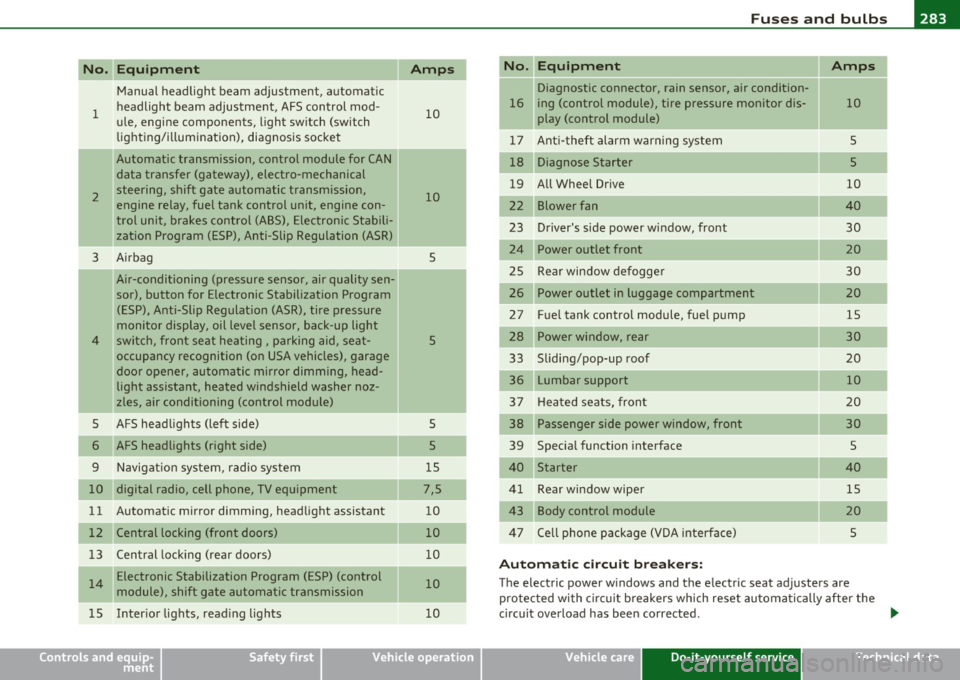
A uto m atic c ircu it bre ake rs :
14 Electronic Stabilization Program (ESP) (control 10 The electric power w indows and the electric seat adjusters are
module), shift gate automatic transmission protected with circuit b reakers which reset automatically after the
1 5 Inter ior lights, read ing lights 10 circuit overload has been corrected . ...
Safety first Vehicle care Do-it-yourself service Technical data
Page 309 of 320

------------------------------------------~A~ LE P '.!:h ~a~ b~e~ t~ic ~a~ l~ in~ d ~ e~x ~ _lffl'II
Coolant system ....... ... .. .. .. .. .. . 234
Cooling System
Expansion tank .................. 235
Cru ise control .............. ... ..... 110
Changing speed ................. . 111
Presetting your speed .......... .. . 111
Switching off ............. .. .... . 112
Switching on ........... ......... 110
Warning/indicator lights ... .... .... 14
Cup holder ............ ...... .. .. .. .. 89
Cup holders front ........ ...... .. .. .. .. .. .. .. 89
Current fuel mileage ................ .. 21
D
Damp ing
See Audi magnetic ride ......... ... 112
Data ....... .... ...... .. .... .. .. .. . 296
Data recorder ................. .. ... 188
Date display .. .. .. ............... .... . 9
Daytime running lights ............... . S6
Daytime running lights (Canada) ........ 56
Declaration of compliance Cell phone package ............ .. . 303
Electronic immobilizer ... .. .. .. .. . 303
Homel ink® un iversal remote control . 303
Remote control key ............... 303
Ti re pressure monitoring system ... . 303
def What does this mean when it appears in
the trip odometer display? ......... 10
Defective light bulb warn ing . .. .. .. .. .. 36
Controls and equip
ment Safety first
Defogg
ing the windows ....... .... ... . 98
Defrosting the windows ............... 98
Defrosting/defogging w indows ..... ... 101
Determining correct load limit . ...... .. 254
Diesel engine Add ing engine oil .. .... .. ......... 233
Changing engine oil .. .. ........... 233
Engine oil . ... .... .... ........... 233
Diesel fuel .. .................... ... 220
Diesel particulate filter. . . . . . . . . . . 34, 199
Digital clock . .. ............. .. .... .... 9
Setting the time ............ ....... 9
Digital compass . ................ ... . 71
Dimensions ..... .... ............... 295
Dipstick Reading the dipstick p roperly ..... .. 231
Direct Shift Gearbox Emergency release ............... 121
Distance .... .... .. .... .............. 22
Doors, power locks .... ... .. .. ........ 43
Driver information ................... 31
Driver Information System Menu display ............ ......... 22
Driver information system
Gearshift indicator ............. .. . 19
Menu button . ....... .... .. .. .. .. . 24
Open door or front lid wa rning .. .. .. . 18
Outside temperature display ........ 18
Red symbols ................... ... 30
Service interval display ............. 27
Setting . ................ .. .. .. ... 2s
Sound system display .. .. .......... 18 Trip computer
... ... ..... ... . ... .. 21
yellow symbols .. ................ . 30
Driver seat
See Seating position ...... ..... ... 126
Driving safely .. .. .. .. ............. . 124
Driving through water .... .... .. .. .. . 198
Duplicate key ...... . .. ............... 38
E
Efficiency program . ... .. .. ........... 25
Fuel economy messages ............ 26
Other equipment ... ............... 26
Elapsed time ... ...... ............. .. 21
Electrically heated front seats .. .... .. . 103
Electro-mechanical power assist ... 17, 193
Electronic differential lock (EDL) How the system works .. .... ...... 189
Warning/indicator lights ... .. ... ... 16
Electronic immobilizer . . . . . . . . . . . . 10, 40
Electronic power control
EPC warning/indicator light ......... 13
Electronic speed limiter ........ ...... . 20
Electronic Stability Program ... .... .. . 188
Electronic stabilization program (ESP)
Warning/indicator lights ..... .. .. .. 14
Emergency flasher Warning/indicator lights ... .. ... ... 14
Emergency flashers ... .. .. .... ....... 59
Emergency operation panoramic sliding sunroof ........ .. 53
Rear lid .......................... 46
Vehicle operation Vehicle care Do-it-yourself service Technical data
Page 316 of 320
-Alphabetical inde x -~ =-.::..::..:.==.:.....:.:...:.=.=.:.: ___________________ _
Seats
Number of seats
135
Selector lever positions
Automatic transmission . . . . . . . . . . .
115
Service and disposal
Safety belt pretensioner .. .........
144
Service interval display .. .............. 27
Service position fo r windshield wipers ... 68
Set menu .................. ... .. .. . 25
Setting
Date display ................. .. .. ..
9
Digital clock .............. ... .. .. .. 9
Side airbags
Description . ....................
161
How they work .................. 162
Side curtain airbags .... .. .. .. .. ..... 164
Description .. .. ................. 164
How they work . .. ...... ......... 165
Safety instructions ............ ... 166
S ide marker lights ..... .............. 56
Ski sack .. .. .... .. .. ................ 85
Snow chains 262
90
Sockets .. .. .. .. .. .. .. .... .. .. .. ... .
Sound system Rep lacing . ... ..... ..............
302
Sound system display . .. ... ........ .. . 18
Sources of information about child restraints
and their use ........... ...... ..
186
Spare tire .. .................... ... 271
Spare wheel
See Spare tire ............ .... ... 271
Speed rating letter code .... .. ... .... 259
Speed warning ... .. ..... ..... ..... .. 35
Speed wa rning system ......... ... .. .. 28
Speedometer . . . . . . . . . . . . . . . . . . . . . . . 10
Starting assistance ........... .. .. ... 288
Starting on hills
H ill hold assist ........... .. .. .. .
110
Starting the engine .......... .. . 106, 107
What should I do if the engine does not
start? ....... .... .. .... .......
107
Steel wheels ................ .. .... . 212
Steering ................... .. .... . 105
Locking the steeringi ........ ...... 106
See also Electro-mechanical power assist .
17,193
Steering wheel column
Ad'
t' JUS rng .... .... .. .. .. .... .... .
Steps for determining correct load limit
Stopping the engine ... ............. .
Storage ............. ... ... . ... ... . .
105
254
108
91
Compartments in the door trims ..... 93
Cup holder rear center armrest .... .. 89
Glove compartment ....... .. .... .. 92
Small objects ......... .... .. .... .. 92
Storage compartment
Increasing size ..... .... .... .. .. ..
81
Sun visors .......................... 63
Sunroof
See panoramic sliding sunroof ..... .. 51
Switches
Emergency flasher ........ .. .. .. ..
59
Switching the air conditioner (automatic)
on/off ......... ... .. .... ........
97
Symbols
T
Red symbols in the center display 30
Yellow symbols in the center display .. 30
Tachometer . . . . . . . . . . . . . . . . . . . . . . . . . 8
Tailgate
See Rear lid .. .. .. .. .............. 45
Technical modificat ions . ....... .. .. .. 302
Temperature
Climate controls . . . . . . . . . . . . . . . . . .
98
Setting for the driver's and front passen-
' 'd ger s s1 e ..... ... ............... 98
Tether anchors .. .... .. ............. 184
Tether strap ........... .. .... .... .. 184
Th e first 1,000 miles (1,500 km) and
afterwards ... .......... ... . ...
197
Tie-downs .............. ........ 82, 132
Tips for the environment
Saving fuel ...... .. .. .. ......... .
89
Tire pressure .... ....... ...... .... .. 252
T ir e pressure monitoring system ..... . 264
Loss of air pressure ............ 13, 265
Malfunction ... .... ............. . 265
Resetting tire pressures .. ......... 267
Warning light ............. .. . ... . 36
Ti re service life .. .. .. .. .............
Tires .................. ... .. .. ' .. .
Replacing .. ............ .... .... .
Service life . .... .. .. .. .. ..... .. . .
speed rating letter code .......... .
Tir e manufacturing date .. ........ .
256
245
257
256
259
259