oil AUDI A3 2011 Owner´s Manual
[x] Cancel search | Manufacturer: AUDI, Model Year: 2011, Model line: A3, Model: AUDI A3 2011Pages: 320, PDF Size: 75.79 MB
Page 109 of 320
_________________________________________________ O_ n_ t_ h_ e_ r _o_ a_d _ __.fflll
Starting and stopping the engine
Starting the engine
The engine can only be started with your original Audi
key.
N ... q
i
Vehicles with a gasoline engine:
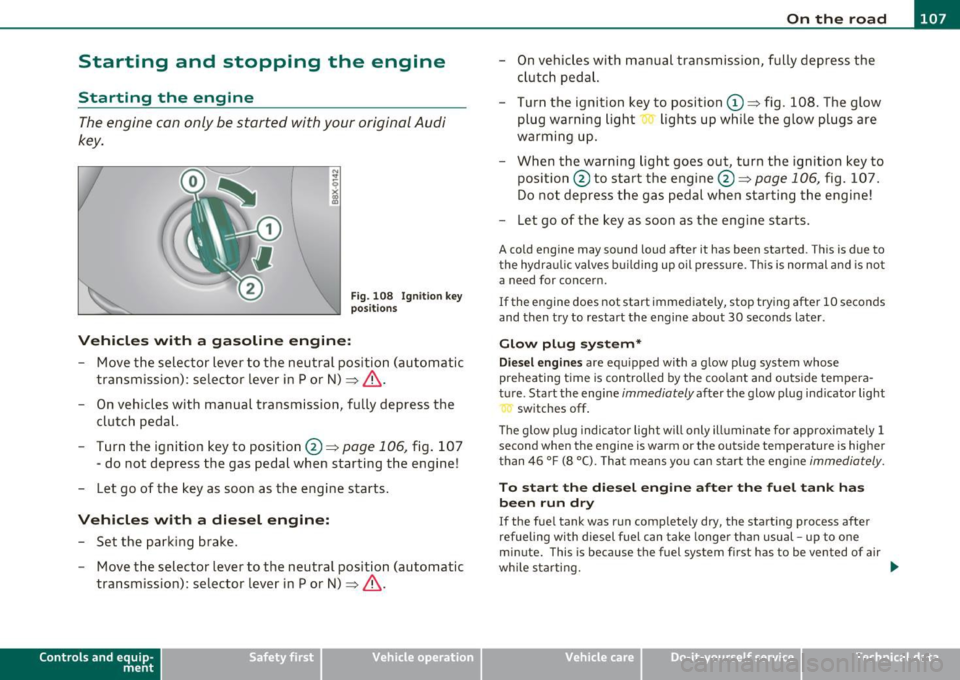
Fig . 10 8 Ignition key
p osit ion s
- Move the selector lever to the neutra l position (automatic
transmission): selector lev er in P or N) =>
& .
- On vehicles with manual transmission, fully depress the
clutch pedal.
- Turn the ignition key to position@ =>
page 106, fig. 10 7
- do not depress the gas pedal when star ting t he engine!
- Let go of the key as soon as the engine starts .
Vehicles with a diesel engine:
- Set the park ing b rake .
- Move the selector lever to the neutral position (automatic
transmission): selector lever in P or N) =>
& .
Con tro ls a nd e quip
m en t Vehicle
OP-eration
- On vehicles with manual transmission , fu lly depress the
cl utch peda l.
- Turn the ignition key to posi tion
(D => fig . 108. The g low
plug warning light lights up whi le the glow plugs are
warming u p.
- When the warning light goes out, turn the ig nition key to
posi tion @to start the engine @ =>
page 106, fig. 107 .
Do not depress t he gas pedal when starting t he engine!
- Let go o f the key as soon as the engi ne starts.
A cold engine may sound loud after it has been started . Th is is due to
t he hydra ulic valves buil ding up oil p ress ure. This is normal and is not
a need for concern.
If the engine does not start immediately, stop try ing after 10 seconds
and then try to restart the engine about 30 seconds later .
Glow plug system*
Diesel engines are equipped with a glow p lug system whose
preheating t ime is con trolled by the coo la nt and outs ide tempera
t u re . Start the engine
immediately af ter the glow p lug ind icator light
sw itches off .
Th e g low pl ug indica tor light w ill only ill uminate fo r approximately 1
second when the engine is warm or the outs ide temperature is higher
than 46 °F (8 °C). Tha t means yo u ca n sta rt the engi ne
immediately.
To start the diesel engine after the fuel tank has
been run dry
If the fue l tank was run complete ly dry, the start ing process after
refueling with diesel fuel can take longe r than usual -up to one
minute. This is because the fuel system first has to be vented of air
wh ile starting. _,.
Vehicle care Do-it-yourselt service Technical data
Page 194 of 320
Intelligent technology
'-----------------------------------------------
& WA RNING (conti nu ed )
• Do not "ride the brakes " by re sting your foot on the pedal when
you do not intend to brake . Thi s may cause the brakes to overheat,
premature wear and increased stopping distance.
• Under certain climatic and operating condition s such as
pa ssing through water, dr iving in heavy rain or after washing the
vehicle, the effectiveness of the brake s can be reduced . In winter ,
ice can accumulate on the brake pads , linings , discs and drums .
Carefully apply brakes for a te st. Brakes will dry and ice coatings
will be cleaned off after a few careful brake applications.
• Driving for an extended period of time on salt-covered roads
without using your brakes can al so affect br aking efficiency. Clean
off accumulated salt coating from brake disc s and pads with a few
careful brake applic ations.
• If you damage the front spoiler , or if you in stall a different
spoile r, be sure the air flow to the front brakes is not obstructed.
Otherwi se th e brake system could overheat reducing the effective
ness of the entire brake system.
• Failure of one brake circuit will impair the braking capability
resulting in an inc reased stopping distance. Avoid driving the
vehicle and have it towed to the nearest authorized Audi dealer or
qualified wo rkshop .
.J
Brake booster
T h e brake booste r adds ext ra braking p ower.
The brake booster works with vacuum pressure which is created on ly
w hen the eng ine is ru nnin g=>&.
& WARNING
• Never let the vehicle roll to a stop with the engine shut off.
• If the brake boo ster i s not working , for example when towing
your veh icle , or because the brake booster has somehow been
& W ARNING (continued )
damaged , the brake pedal must be p ressed considerably harder to
make up for the la ck of booster assi stan ce. •
Functioning of Anti-Lock Brake System
{ABS)
ABS prevents the wheels from l ockin g up under br aking.
Th e ABS contr ibutes effectively to vehicle co ntrol s ince it prevents t he
w heels from
locking when the brakes are applied . This means that the
veh icle rema ins steerable and is less likely to skid .
With ABS you do not need to pump the brake. Just hold the brake
pedal down .
However, do no t expect that the ABS shortens bra king d istance under
all circumstances . When dr iv ing on grave l or on newly falle n snow on
top of icy s urfaces, braking d istance may be even longer, therefo re,
under these circumstances, it is especially important that yo u drive
slowly and with g re at c are.
How the ABS system works
An au tomatic c hec k is made when a speed of about 4 mp h (6 km/ h) is
reached. When t his happens, a pump ing noise can be heard.
If an ind ivi dual wheel begi ns to rot ate too s low ly in relat ion to ve hicle
speed and tends to loc k, t he ABS automatically reduces brake pres
s ur e to p revent t hat wheel from lo cking.
T hi s au tomatic adjustment p rocess w ill cause a
s light vibration of
the bra ke pedal and some noises to a lert you that vehicle speed must
be adapted to ex isting road and traffic co nditions .
& WARNING
Although the ABS is very effective, always remember that braking
capability is limited by tire traction. Always adjust your driving ...
Page 200 of 320
Driving and environment
New brake pads have to be "burnished in" before they have optimal
grab ~& .
Dur ing the break-in period, you should avoid putting severe loads on
the bra kes. Severe loads incl ude, for example, sudden hard braking,
in part icu lar at very high speeds or, for examp le, on mountain passes .
& WARNING
Until they develop th e ma ximum "bite " for b est stopp ing pow er,
the surfaces on new brake pads require some "breaking-in" during
the in itial 100 to 150 mile s (150 to 200 kilometers ) of normal
city dr iving. You can compensate for this by p ress ing the brake
pedal more firml y. Thi s applies whenever n ew pads are in stalled .•
Driving through water on roads
---
N ote the following to avoid vehicle damage when driving through
water, fo r example on flooded roads:
• Th e wate r mus t not be any higher th an the bottom of the ve hicl e
body.
• Do not dr ive faster t han wal king speed.
& WARNING
After driving through water, mud , slush, etc ., th e brak es may be
slow to take effect because of wet brake rotors and pads . Dry the
brakes first by braking carefully to restore the full braking effect .
0 Note
Vehicle components such as the engine, transmission, suspension or
electrical system can be severely damaged by driving thro ugh water.
W Tips
• Check t he dept h of the wa ter before dr iv in g thro ugh it.
• Do not stop the vehicle, drive in reverse or sw itch the engine off
when driving through wate r.
• Keep in m ind t hat on coming vehicles may cre ate w aves t hat raise
the water level and make it too deep for your vehicle to drive thro ugh
safe ly.
• Avoid dr iv in g through sa lt water because it can cause corros ion. •
Catalytic converter
It is very important that y our emiss ion con trol system
(ca talyti c converte r) is func tioning pr operly to ensure
that your vehicle is running i n an environm entally sou nd
manner.
- Always use lead-fre e gasoline => page 219, "Fu el supply".
- Never run the ta nk down a ll the way to empty .
- Never p ut too much mo tor o il in your engine=>
pag e 232,
"Adding engine oil~" -
- Neve r try to pu sh- or tow-start you r vehicle.
T he catalytic converter is an efficient "clean- up" device b uilt into the
exhaust system of the veh icle. The cata lytic converter b urns many of
t he poll uta nts in the e xhaust g as before they are released in to the
atmosphe re.
Th e ex clusive use o f unleaded fuel is c ritic ally impor tant for the life of
the cata lytic converte r and proper f unction ing of the engi ne. ..,
Page 201 of 320
_____________________________________________ D _r_ i_v _i_,ng and environment
& WARNING
• Do not park or operate the vehicle in areas where the hot
exhaust sy stem may come in conta ct with dry gra ss, bru sh, fuel
s pill or oth er mater ial wh ich can caus e a fire .
• Do not apply additional under co ating or ru stproofing on or
near the exhaust manifold, exhaust p ipes, catalytic converter or
heat shield s. During driving, the sub stance u sed for undercoating
c ould overheat and cause a fire .
0 Note
• Be aware that j ust one tank fi lling w it h le aded fuel w ill already
seriously degra de the performance of the catalyt ic converter .
• Do not exceed the correct engine o il leve l~
page 23 2.
• Do not dr ive until t he f uel tank be comes comp lete ly empty. The
eng ine could misfire . Unburned fue l cou ld also get into the exhaust
sys tem and t his co uld cause t he ca talyt ic conver ter to ove rhe at.
• Do not t urn off the ignition while the vehicle is moving .
• Do not continue to operate your vehicle under these conditions, as
otherwise fuel can reach the cata lytic converter. This cou ld resu lt in
over heat ing of the converter, req uir ing its rep lacemen t.
• T o ass ure efficient operation of the Emission Contro l System :
- Have your ve hicle maintai ned properly and in accordance with
t he se rvi ce recommenda tions in your Warran ty
& M ain tenance
book let .
- Lack o f prope r mai ntena nce as well as improper use of the
vehicle w ill impa ir the f unct io n of the emission control system and
co uld lead to damage .
<£> For the sake of the environment
Even when the Emission Contro l System is operating p roperly, the
exhaust gas ca n have a sulfur-like exhaust gas smell under some
ope rating states. This depends on the s ulfur content o f the fue l being
Controls and equip
ment Safety first Vehicle operation
used
. Using a differe nt brand of fuel may help, or filling the tank with
lead-free supe r grade g asoline .•
A pp lies to ve hicle s: with d ie se l pa rtic ul at e f ilte r
Diesel particu ate filter
The diese l particulate filte r filters nearly all of the soot part icles out
of the exhaust. The filte r cleans itself a utomat ically under normal
dr iv ing cond itions . If the fi lter cannot clea n itself (for example,
because you are only driving short distances), the filter becomes
clogged w it h soot and the symbol fo r the diese l particulate fi lter
ill uminates ~
page 34.
& WARNING
• Do not park your vehicle over flammable materials such as
grass or leaves because the high temperature of the diesel partic
ulate filter could start a fire .
• Do not apply an underbody prot ectant in the exhaust system
area or a fire could start.
[I) Tips
• When the diesel partic ulate f ilter becomes sat urated, the engine
speed increases to approx ima tely 1 ,S00 rpm w hile the vehicle is in
motion to initiate t he cleanin g of the diesel particulate fi lter auto
matically w it h out the wa rning lamp ligh ting up. If the war ning lamp
st ill appears, you sho uld drive to a qualified workshop. •
Avoid damaging the vehicle
When you are driving on poor roads, or ove r curbs, steep ramps, etc .,
m ake ce rta in t hat low-ly ing pa rt s such as spoilers and exhaust system
parts do not bottom out and get damaged.
Vehicle care Do-it-yourself service Technical data
Page 203 of 320
Driving and environment
------------------------------------------------'
you start the engine and avoid running at high RPMs while the engine
is still warming up.
0 Note
Do not leave engine idling unattended after starting. If warning
lights should come on to indicate improper operation, they would go
unheeded. Extended idling also produces heat, which could result in
overheat ing or other damage to the vehicle or other property.•
Regular maintenance
A badly tuned engine unnecessarily wastes a lot of fuel.
- Have your vehicle serviced at regular intervals.
By having your vehicle regularly serviced by an authorized Audi dealer
helps to ensure that it runs properly and economically. The condition
of your vehicle not on ly affects its safety and ability to hold its value,
it also affects
fuel consumption .
Check your oil each time you fill your tank.
The amount of oil used is related to engine load and speed.
It is normal for the oil consumption of a new engine to reach its
lowest value after a certain mi leage has been driven.
You must drive you r vehicle about 3,000 miles (5,000 kilometers)
before you can properly assess oil consumption.
Thi s also applies to fuel consumption and engine output.
0 Note
• Have your vehicle maintained properly and in accordance with the
service recommendations in your Warranty
& Maintenance booklet.
Lack of proper maintenance as well as improper use of the vehicle will
impa ir the function of the emission control system and could lead to
damage.
Controls and equip ment Safety first Vehicle operation
•
Do not alter or remove any component of the Emission Control
System unless approved by the manufacturer.
• Do not a lter or remove any device, such as heat shie lds, switches,
ignition w ires, va lves, which are designed to protect your vehicle 's
Emission Control System and other important vehicle components.
Fewer short tr ips
Fuel consumption will always be relatively high on short
trips.
- Try to avoid driving short distances with a cold engine.
The engine and catalytic converter have to reach their optimal oper
ating temperature
to reduce fuel consumption and noxious emis
sions effectively .
• Just after starting, a cold eng ine in a mid-size car burns the fuel at
a poor rate of 6-8 miles per gallon (30-40 l/l00km). Half a mile down
the road, the mileage improves to 12 MPG (20 l/100 km). It will take
the engine no less than
two and a half miles (4 km) of driving to
warm up to its proper operat ing temperature and operate at an
economic mileage . This explains why taking the car for sho rt trips is a
rather wasteful convenience .
• Th e
outside temperature is also critical in this regard . Your car
consumes more fuel in the winter than in the summer.
Vehicle care Do-it-yourself service Technical data
Page 209 of 320
____________________________________________ C_l_e _a_ n_ i n--= g=--- a_n_ d----' p,__ r_o _t_ e_ c_ t_ i _o_ n __ lffll'II
High temperatures, as from exposure to intense sunlight, intensify
the corrosive effect particularly when humidity is high as well.
Under certa in circumstances,
weekly washing may be necessary .
Under other conditions, a month ly washing and waxing may be
adequate.
After the winter, the underside of the vehicle should be thoroughly
washed, preferably in a profess ional car wash.
& WARNING
Always read and heed all WARNINGS and other information
=> page 206.
0 Note
You should remove debris (such as insects) from the headlight lenses
on a regular basis, for example when refueling yo ur vehicle. Never
clean the headlights with a dry cloth or sponge. Use a wet cloth or
sponge. It is best to use soapy wate r.•
Automatic car wash
The vehicle can be washed in almost any modern auto
matic car wash.
The vehicle paint is so durable that the vehicle can normally be
washed without problems in an automatic car wash. However, the
effect on the paint depends to a large extent o n the design of the
facility, the filtering of the wash water, the type of wash and care
material, e tc. If the paint has a dull appearance after going through
the car wash or is scratched, bring this to the attention of the oper
ator immediately .
If necessary, use a different car wash.
Before going through a car wash, be sure to take the usual precau
tions such as closing the windows and panoramic sliding sunroof*.
Remove ante nna if applicable.
Safety first
If you have installed additional accessories on the vehicle - such as
spoilers, roof rack, etc. - it is best to ask the car wash operator if these
should be removed.
& WARNING
Always read and heed all WARNINGS and other information
=>page 206. •
Washing the vehicle by hand
A lot of water is needed when washing a vehicle by hand.
-Before you start wash ing, ma ke sure you have read and
understood the WARNINGS ~
& in "General informa
tion" on
page 206.
-First soak all dried dirt until it is soft, then rinse it off.
- As you clean your vehicle, start with the roof and work your
way down to the bottom, using a sponge, a sponge glove
or a clean brush.
- Rinse the sponge or the sponge glove often, flushing it
clean each time.
- Use special car shampoo only for very persistent dirt.
- Rinse the car thoroughly with water .
- Use a chamois leather to gently wipe the exter ior dry .
Use a separate sponge for cleaning the whee ls, door s ills and other
regions exposed to road dirt. In this way, you will not scratch the
paint with coarse particles imbedded in the sponge the next time you
wash the car . .,,
Vehicle care Technical data
Page 212 of 320
lffl!l,.___C_ le_ a_n_ i _n_ g=- a_ n_d__, p_ ro_ t_e _c_ t_ i_ o _ n ___________________________________________ _
Dirt and marks on the trim str ips should be removed with a pH
balanced
cl eani ng agen t (d o no t use a chr ome cleaner). Au thori ze d
Audi dealers carry cleaning products w hich have bee n tested fo r use
on yo ur vehicle an d are not harmful to the environment.
T o avoid co rrosion on the exte rio r trim s trips, o nly a pH-b alanced
so lution should be used for the windshield washer.
& WARNING
Always read and heed all WARNINGS and other information
~ page 206 . •
Plastic and vinyl
P lastic nee ds special care.
Use a clean, damp cloth or s ponge to remove d ust and light surface
dirt . For other soil, use a lukewarm all-purpose cleaning solution or a
m ild saddle soap fo r viny l tr im . Remove water spots and traces o f
soap with a clean, damp cloth or sponge. Use a clean, soft cloth to rub
dry.
Grease , tar or oi l stains can be removed with a clean cloth o r sponge
soa ke d wi th all- pur pose cleaner or wi th a so lvent des igned especially
to clean v inyl.
Occas ionally app ly a colorless v inyl or leather p reservative to retain
t he m ateria l's luster and p liabili ty.
& WARNING
Always read and heed all WARNINGS and other information
~page 206 . •
Aluminum trim
Use on ly neutral-pH products to remove spots and depos its from
alum inum su rfaces. Chro m e care produ cts an d alka line cle aners will
attack aluminum surfaces and ca n damage them over t ime .
& WARNING
Always read and heed all WARNINGS and other information
~page 206 . •
Touch-up paint
M inor paint damages should be touched up immedia tely.
- Use e ither a touch-up paint st ick o r spray p ain t to cover
minor scratches a nd nicks.
Your author ized A udi d ea le r has touch- up paint fo r minor scratches
and stone ch ips. Sc ra t ch es should be touched up soon afte r they
occur to preve nt corros ion .
If a s pot start s to ru st, however, a sim ple touch-up job will not be
enoug h. T he affected surface must be sanded smooth and coated
w it h an an ti- rus t pr ime r before the pai nte d finish can be restore d.
Th e number fo r the o rigina l veh icle pain t can be found o n the vehicle
ide ntificat io n label ~
page 294.
& WARNING
Always read and heed all WARNINGS and other information
~page 206 . •
Page 213 of 320
Cleaning and protection -
---------------=---------=----
Windows
Clear vision to all sides.
Clean all windows regularly to remove road film and carwash
wax buildup.
- Remove snow from windows using a brush.
- Use a plastic ice scraper to remove ice from windows and
mirrors.
- Remove other residue on the w indows with a spray-on
glass cleaner .
- Wipe the windows dry with a clean piece of cloth or
kitchen paper towel.
T he best way to remove snow from w indows and mirrors is to use a
brush. Use a non-abrasive plastic ice s craper - be tter st ill, a spray
deicer -to remove ice from windows and mirrors.
Th e w indows must not be cleaned with insect remover or wax since
these can interfere with the function of the w indshield wiper blades
(chatte r) .
Oil, grease or s ilicone residue can be removed with glass cleane r or
s ili cone remover. Howeve r, wax residue requires the use of a specially
formulated solvent . Please contact your author ized Aud i dealer for
advice on safe products for wax remova l.
W indows shou ld also be cleaned on the inside at regu lar i nte rvals.
Never dry windows w ith the same chamo is that you use to dry painted
surfaces. Wax res idue on the chamois ca n impa ir v is ion t hrough the
windows .
& WARNING
• The w ind shi eld must not be tr eated with water -rep ellent
m aterial s. They can in cre a se glare und er poor vi sibilit y co ndition s
Safety first
& WA RNING (continu ed)
such as wetne ss , dar kne ss, or when the sun is low on the ho rizon .
In addition , th ey can cau se the wind shield wip ers to c hatt er.
• Always r ea d and heed all WARNING S and othe r in fo rm ation
~ pag e 206 .
0 Note
• Never use warm o r hot wate r to remove snow and ice from
windows and mirrors . This could cause the glass to crack.
• To prevent damage to the w ires of the rear defogger, do not place
any adhesive stickers on the inside of the rear window over the wires.
• T o help prevent dirt from scratching the w indow, always scrape in
a forward direction - pushing the scraper away from you -never back
and forth .•
Weatherstrips
Complete car care includes the weatherstrips as well .
-Apply a suitable rubber conditioner to the weatherstrips
from time to t ime .
To be able sea l properly, the weatherstrips around the hood, doors,
rear l id, etc. must remain pliable . Spray the weatherstrips with sili
cone or coat t hem with talc um powder or g lycerine to retain the flex
ibility of the rubber and to p ro tect them agai nst free zing in the
winter .
& WARNING
Alway s read and heed all WARNINGS and other inform ation
~ page 206 .
Vehicle care Technical data
Page 216 of 320
IJIII Cleaning and protection
-----=---=------------------------------
carpets and floor mats, since other fabric surfaces could be harmed
by brushes.
Normal surface sta ins can be cleaned using a commercially available
foam cleaner. Spread the foam on the surface of the fabric with a soft
sponge and work it in gently. Do not saturate the fabr ic. Then pat the
foam dry using absorbent, dry cloths (e.g. microfiber cloth) and
vacuum it after it has dried comp lete ly.
Cleaning stains
Stains caused by beverages (e .g. coffee, fruit juice, etc.) can be
treated with a mild detergent solut ion. Apply the detergent solution
w ith a sponge. In the case of stubbo rn stains, a detergent paste can
be applied directly to the stain and worked into the fabric. After
wa rds, use copious amounts of clean water to remove the remaining
detergent. Apply the water with a damp cloth or sponge and pat the
fabric dry with an absorbent, dry cloth .
Sta ins from chocolate or makeup should have detergent paste (e .g.
ox-gall soap) rubbed into them . Afterwards, remove the soap with
water (damp sponge).
Alcohol can be used to treat stains from grease, oil, lipstick or a ball point pen. Melted grease or dye must be patted off using absorbent
material. It may be necessary to retreat the areas with detergent
paste and water.
In the case of genera l soiling of t he upholstery and cover mater ia l, we
recommend hiring a specialist that has the equipment to clean the
seat covers and other fab ric surfaces by shampooing and spray
extraction.
& WARNING
Always read and heed all WARNINGS and the information
=> page 206.
W Tips
Open Velcro fasteners on your clothing can damage the seat cover.
Please make sure that Velcro fasteners are closed .•
Plastic parts and instrument panel
- Always use a clean cloth moistened in clear water.
Always use a clean cloth moistened in clear water to clean these
areas. For persistent dirt use an A udi approved
solvent-free plastic
cleaner/protectant .
& WARNING
Solvents can change the properties of some plastics and make it
harder for the airbag to deploy.
• Never clean the instrument panel or the surface of Airbag
modules with cleaning products that contain solvents.
• Products containing solvents will make the surface of this part
porous.
• Serious injuries can result if plastic parts come loose when the
airbag is deployed.
• Always read and heed all WARNINGS and the information
=>page 206 .
0 Note
Cleaning agents contain ing solvents will attack the material and can
change the way it behaves. •
Page 217 of 320
Cleaning and protection -
---------------=---------=----
Appli es to veh icles : with n atural leathe r
Natural leather
Audi makes great efforts to maintain the properties,
na tural look and feel of interior leather .
General
We offer many different types of leather on our vehicles . Most are
different types of nappa leather, which has a smooth s urface and
comes in various colors.
Th e intensity of the color determines the visual cha racter istics and
appearance .
If the surface of the leat her has a typical natural look,
then the leather is a nappa leather that has been left in a relatively
natura l condition. This leathe r offers pa rticu la rly good comfo rt and
breathes wel l. Fine veins, closed gra ins, insect b ites, sk in fo lds, and
s u btl e var iations in co lor remai n visible . These c harac ter istics demon
strate that the mater ial is natural.
N atural nappa leather is not covered by a color fin ish . It is the refore
more sensitive to soiling and wea r, which is something you need to
consider if children, animals or other factors might prove to be partic
ular ly hard on the leather .
By contrast, leather types that are covered by a colored fin ish layer
are more dur able. This h as a pos it ive e ffect on t he leather 's resist ance
to wear and so iling in daily use . On the other hand, the typical charac
t eris tics of na tura l leather are ba rely o r not app aren t. H oweve r, this
does not mean that the leather itself is of inferior quality.
Care and handling
Because of the exclusive nature of the types of leather that Audi uses
and the ir un ique properties (such as sensitivi ty to oils, gre ase, soiling,
etc.), you will need to be somewhat careful with these leathe rs, a nd
a ce rtain type of care is req uired. For example, dark clo thing mate
r ials can discolor leather seats (especially if such clothing is damp and
was not dyed cor rect ly). Dust and dirt particles in pores, folds, and
seams can have a n ab rasive effect and ca n damage the leathe r
surface as well as weaken seams.
Safety first
The leather should be cleaned regularly as needed . After having been
used for a rela tively long time, yo ur leat her seats w ill acq uire a rich
aged fi nish. This is a characteristic of natural leather and a s ign of
true quality .
I n orde r to maintain the va lue of this nat ural p rodu ct over t he life of
your vehicle, you should fo llow the recommendations be low:
0 Note
• To keep your leather from b leach ing out, do not allow it to be
exposed to b right s unl igh t fo r long pe riod s of time. If yo u have to
leave t he veh icle parked outside for long periods, cover the leather to
protect it from direct exposure to sunlight.
• Sharp objects on cloth ing, such as zippers, rivets or sharp pieces
on belts can le ave pe rm an ent sc ratches o r scrape mar ks on the
surface of the leather.
[I] Tips
• After each t ime you clean the leather and at regular intervals, use
a leathe r preservat ive creme that con tains UV -bloc ke rs and that
works into the leather. This creme will nourish and mo istur ize the
leather, helping it to b reathe and s tay supp le . It also he lps to build up
a p rotect ive coa ting on the surface .
• C lean the leather every 2 -3 months, a nd clean any areas that get
soiled .
• Remove fresh marks made by ballpoint pens, ink, lipstick, shoe
polish, etc . as soon as poss ible.
• P reserve t he colo r of t he lea ther as needed by us ing a specia l
co lored leather care creme to touch up areas of uneven color. •
Vehicle care Technical data