parking brake AUDI A3 2011 Owner´s Manual
[x] Cancel search | Manufacturer: AUDI, Model Year: 2011, Model line: A3, Model: AUDI A3 2011Pages: 320, PDF Size: 75.79 MB
Page 118 of 320
lffllL--_T.:...:.. r.:::a :..:.n.:.. s=-.:.. ":..:':..:. is = s:..:.io .::...;. n_;__ __________________________________________________ _
& WARNING
• Neve r place the select or lever in the R or P position while the
vehicle is moving · ris k of an accident!
• With the eng ine running, it is necessary to hold the vehicle
with th e fo ot brake in all selector lever position s (exc ept P and N),
because e ven at idle speed the transfer of power is never
completely interrupted -the vehicle " creep s". If the vehicle is
stationary and th e transmission is engaged, the engine shou ld
never be speeded up unintentionall y (e.g . manuall y from under
the hood ). Otherwise the vehicle will immediate ly start to mov e -
sometimes e ven if the parking brake is firml y applied -risk of an
accident!
• Before you or other person s open the hood and work on a
running engine , the selector lever must be moved to P and the
parking brake applied firmly -risk of an accident! Follow the
warning stickers~
page 218, "Engine c ompartment ".
W Tips
If you have inadve rtently shifting into N w hil e the vehicle is moving,
you should remove your foot from the accelerator and wait until the
eng ine speed has dropped to idle be fore shifti ng back to Dor 5 . •
A ppli es to veh icles : wi th S tron ic ®
Selector lever lock
The selector lever lock prevents a gear from being
engaged accidentally and unintention ally setting the
vehicle in motion.
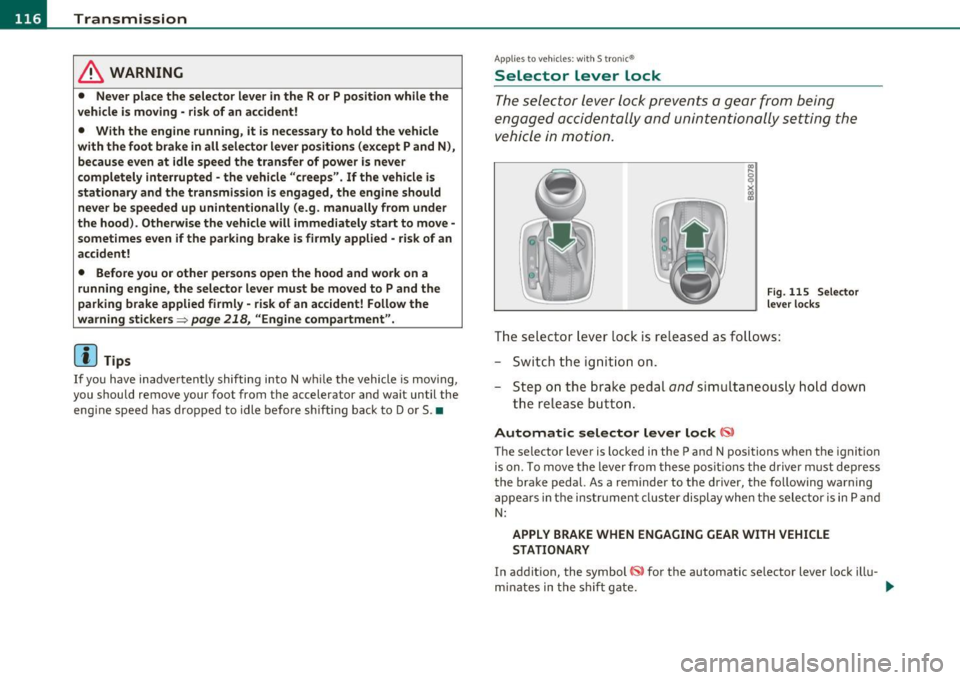
.. ... 0 'i'
i
Fi g. 11 5 Se lector
le ver l ocks
The selector lever lock is re leased as fo llows:
- Switc h th e ign it io n on.
- Step o n the brak e peda l
and simult aneous ly ho ld down
th e relea se b utto n.
Automatic selector lever lock
The selector lever is locked in the P and N positions when the ignition
is on. To move the lever from these posit ions the d river must dep ress
the bra ke pedal. As a reminder to the driver, the fo llowing warning
a ppea rs in the instrument cluster display when the selector is in P and
N:
APPLY BRAKE WHEN ENGAGING GEAR WITH VEHICLE
STATIONARY
I n addit ion, the symbol for the automatic se lector lever lock ill u-
mi nates in the s hift gate. .,_
Page 119 of 320

____________________________________________________ T _r_a _n_ s_m _ i_s _s_ i_ o _ n _ ___.fflll
The selector lever lock is effective only when the vehicle is stationary
and at speeds below 5 km/h. At highe r speeds, the lock in the N posi
tion is automatically switched off.
The selector lever is not locked when rapid shifts are made through
the N position (e.g . from R to D) . T h is allows you to "rock" the vehicle
if it becomes stuck. If the lever is in the N position for more than
1 second with the brake pedal not depressed, the selector lock
engages automatically.
Release button
The release button in the selector lever handle prevents accidental
shifts into certain selector lever pos itions. When you press the
release button, the selector lever lock is cancelled. In the illustration,
the positions in which the release button has to be pressed are h igh
lighted in color::::>poge
116, fig . 115 .
Ignition k ey remo val l ock
The ignition key can only be remove after the ignition is switched off
if the selector lever is in P. As long as the ignit ion key is removed, the
selector lever is locked in P.
[ i ) Tips
If the selector lever does not engage, there is a malfunction . The
eng ine is disabled to prevent the vehicle from driv ing off unintention
ally. To allow the selector lever to engage again, proceed as follows:
Press and release the brake pedal.•
Contro ls a nd e quip
m en t Vehicle
OP-eration
Applies to vehicles : w ith S tronic®
Driving Notes
The forward gears are shifted up or down automatically .
Starting from stop
-Step on and hold the brake pedal.
Fig. 116 Section from
ce nter conso le:
Selector lever with
r elease button
- Hold the release button (button in selector lever) down,
move the selector lever to the desired position, for
example D =:;,
page 115, and relea.se the button.
- Release the brake pedal and accelerate=:;,& .
Stopping temporarily
-Bring the vehicle to a full stop with the brake, e.g . at
traffic signals.
- Do not accelerate .
Parking
-Step on and hold the brake pedal=:;,&.
- Apply the parking brake firmly.
- Hold the release button down, move the selector lever to
P and release the button. .,.
Vehicle care Do-it-yourselt service iTechnical data
Page 120 of 320
lffll.___T_ r_a _n_ s_m _ i_s _s _ i_o _n ___________________________________________________ _
Stopping on an incline
- Always
hold t he vehicle with the footbrake or parking
b rake in order to preve nt "ro llback "=> & . Do not try to
p reve nt t he v ehicle from ro lli ng back by re vving th e e ngine
whi le it is in gea r.
Starting on a hill
- Apply the hand bra ke fi rmly.
- With t he eng ine in gear , gra dually acce lerate a nd release
the hand bra ke.
T he eng ine c an only be started with the selector leve r in P or N
=>
page 107 . At low amb ient temperatures (14 °F /-10 °(), it i s only
possible to start the engine with the selector lever in P.
W hen pa rking on leve l grou nd , it is suff ic ient to p lace the se lector
lever in P. On a steeply sloping road, you shou ld f irst app ly the
par king brake firmly and then p lace t he selecto r leve r in P. T his way,
you do not overload the paw l mechanism and it is easier to move the
selector lever out of P.
& WARNING
• Never leave your vehicle with the engine running while in ge ar.
If you must lea ve your vehicle with the engine running, set the
parking brake and engage the park lo ck .
• When the eng ine i s running and the transmi ssio n is in gear (D ,
Sor R ) or in "tiptronic " mode, it is ess ential that you stop the
v ehicle with the footbrake. When idling , the transmiss ion of
power doe s not stop completely -the vehicle "creeps".
• Do not a ccelerate when you change the selector leve r position
with th e vehicle stationary and the engine runn ing -risk of an acci
dent!
• Never place the selector lever in the R or N position wh ile the
v ehicle is moving -risk of a n accident!
& WARNING (continued )
• If you have to bring your vehicle to a stop while on an incline ,
keep the foot brake depressed all the way down so that the vehicle
does not start to roll backward. You should never hold the veh icle
using the clutch if you are going to b e stopped on an incline. If you
do , the clutch will start to slip when it o verheats c aused by the
c onstant overload . Thi s is danger ous be cau se if the vehicl e start s
to roll backward , you could cause an accident. If the clutch should
s tart to slip, you will fee l the vehicle "jerk " and the selector lever
d isplay w ill start blinking.
• Befor e driving down a st eep slope, reduc e your speed and shift
i nto a lower gear w ith "tipt ronic ".
• Do not ride the brakes or apply the brake pedal too often or too
long . Constant b raking causes the brakes to overheat and
s ub stantially reduces braking performan ce, in creases braking
d istance or causes complete failure of the b rake system . •
A pplie s to v eh icl es: wit h S tro nic transm iss ion and Hi ll De scen t A ss ist
Hill Descent Assist
Hill Descent Assist helps the driver when driving down
inclines.
H ill Descent Assist is activated by pressing the brake while
descending when the se lector lever is in
D /S . The S tronic transmis
sion a utomat ically s hifts down to a gear s uitable fo r the in cl ine. H ill
Descent Assist attempts to mainta in the cu rrent vehicle speed when
t he br aking oc curs, as far as physical and technical l imi ts allow.
It
may be necessary to adjust the speed using the brakes .
Hi ll Descent Assist switches off w hen the incline levels out or when
the gas pedal is pressed.
On vehicles with cruise control*=>
page 110, Hill Descent Assist is
also activa ted when the speed is set.
~
Page 207 of 320
Parking on a slope
Do not park with a trailer on a slope. If it cannot be
avoided, do so only after doing the following:
When parking:
-Apply the foot brake.
- Have someone place chocks under both the vehicle and the
trailer wheels.
- With chocks in place, slowly release the brakes until wheel
blocks absorb the load.
- Turn the wheels towards the curb.
- Apply the parking brake.
- Place an automatic transmission in
P, respectively a
manual transmission in first or reverse gear.
When restarting after parking:
- Start the engine .
- Shift transmission into gear .
- Release the parking brake and slowly pull out and away from the wheel blocks .
- Stop and have someone retrieve the wheel blocks.
[I] Tips
If you move the selector lever of the automatic transmiss ion to P
before applying the parking brake and before blocking the wheels,
you may have to use more force later to move the leve r out of the
P
position. •
Controls and equip ment Safety first Vehicle operation
Vehicle care Do-it-yourself service Technical data
Page 228 of 320

___ C_ h_ e_c _k _i _ n _g ~ a_n _d_ f_il _l_in _ g _________________________________________ _
Closing the engine hood
- Pull the hood down until the pressure from the strut is
reduced.
- Let the hood
drop down and latch in place . Do not try to
push it shut;
it may fail to engage=> &.
& WARNING
A hood that is not completely latched could fly up and block your
view while driving.
• When you close the engine hood, check it to make sure the
safety catch has properly engaged. The hood should be flush with
the surrounding vehicle body parts.
• If you notice while driving that the hood is not secured prop
erly, stop at once and close it. •
Working in the engine compartment
Be especially careful whenever you work in the engine
compartment!
Whenever you must perform any work in the engine compartment,
for example checking and filling different fluids, there is a risk of
injury, burns and accidents. To prevent personal injury always
observe the following WARNINGS. The engine compartment of any
vehicle is a hazardous area!~
&
& WARNING
To help avoid injury, before you check anything under the hood :
• Turn off the engine.
• Remove the ignition key.
• Set the parking brake fully.
& WARNING (continued)
• Move selector lever of automatic transmission to "P" (Park);
put manual transmission in Neutral.
• Always let the engine cool down. Hot components will burn
skin on contact.
• To reduce the risk of being burned, never open the hood if you
see or hear steam or coolant escaping from the engine compart
ment. Wait until no steam or coolant can be seen or heard before
carefully opening the hood.
• Keep children away from the engine compartment.
• Never spill fluids on hot engine components. They can cause a
fire.
• Never touch the radiator fan. The auxiliary electric fan is
temperature controlled and can switch on suddenly.
• Never open the coolant reservoir cap when the engine is still
warm. The coolant system is pressurized and hot coolant could
spray out!
• Protect your face, hands and arm from steam or hot engine
coolant by placing a thick rag over the cap when you open the
coolant reservoir.
• If work on the fuel system or the electrical system is necessary:
-Always disconnect the battery .
- Never smoke or work near heaters or open flames. Fluids in
the engine compartment could start a fire.
- Keep an approved fire extinguisher immediately available.
• To avoid electrical shock and personal injury while the engine is
running or being started, never touch:
- Ignition cables
- Other components of the high voltage electronic ignition
system.
• If you must perform a check or repair with the engine running: .,_
Page 229 of 320
___________________________________________ C..:__ h:..:.e ..:.c :..:. k.:.... i..:....n :..::g~ a:..:.n..:.... d::.:....: f..:. i.:..:ll :.:.i.:...:n ~g !...._.....Jfflll
& W ARNING (co ntinued )
-First, fully appl y the parking brake , move sele ctor lev er of
automatic tran smission to "P" (Park ); put manual transmis
sion in Neutral.
- Always use extreme caution to prev ent clothing , jewelry, or
long hair from getting caught in the radiator fan , V-belt s or
other moving p art s, or from contacting hot part s. Tie back hair
before starting , and do not wea r clothing that will h ang or
droop into the engine.
• Minimize expo sure to emission and chemical hazards~& .
& WARNING
California Proposition 65 Warning:
• Engine exh aust, some of its constituents , and certain vehicle
c omponents contain or emit ch e mical s known to the State of Cali
fornia to cause can cer and birth defects and rep roductive harm . In
addition , certain fluids contained in vehicle s and certain product s
of component wear contain or emit chem icals known to the State
of California to cau se cancer and birth defect s or other reproduc
tive harm.
• Battery posts, terminal s and related acce ssories contain lead
and lead compounds, chemicals known to the State of California
to cause cancer and reproductive harms . Wash hand s after
handling .
0 Note
When adding fluids, always make sure that they are pou red into the
proper co ntainer or filler opening, otherwise serio us damage to
vehicle systems w ill occur.
Vehicle OP-eration
ffi For the sake of the environment
To detect lea ks i n time, inspect the veh icle floor pan from unde rneath
reg ularly. If yo u see spots from oil or other vehicle fluids, have your
veh icle inspected
b y an au thori zed Au di dea le r. •
Engine compartment
A pp lies to vehicles : w it h 2.0 l t urbo. 4 -cyl ind er en gi ne
2.0 Liter, 4-cylinder turbo gasoline engine
(200 hp)
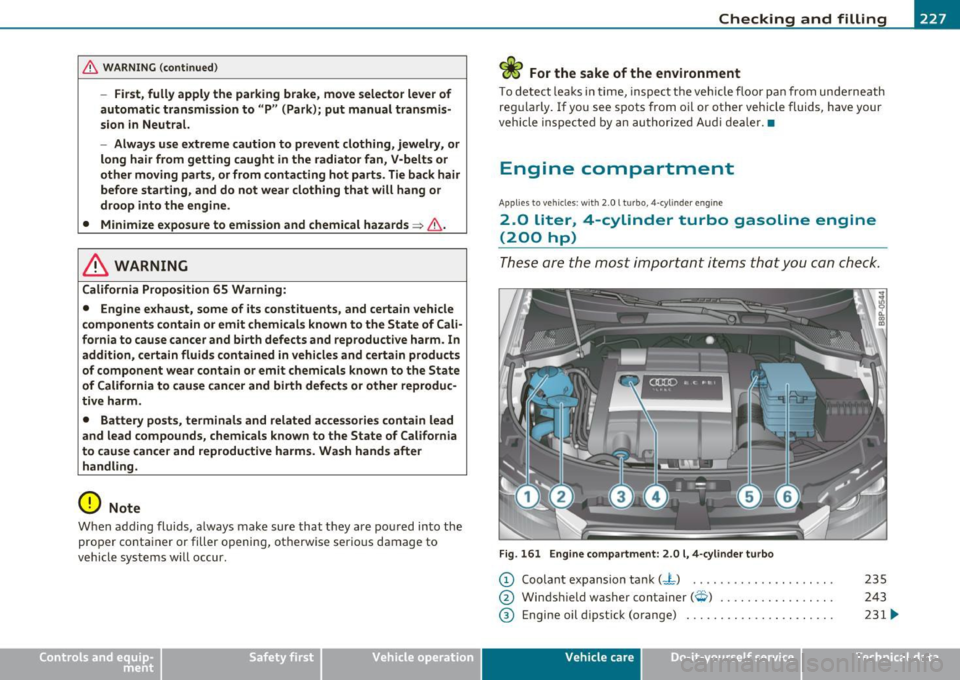
The se are the most importan t it ems that you can c hec k.
Fig . 16 1 Engi ne c om part men t: 2 .0 I , 4 -c yli nder t urbo
© Coolant expansion tank (-L ) ... ................. .
@ Windshield washer container (W ) .... .... .. .. .. .. .
® Engine oil dipst ick (orange) . ... .. .... .... ... ... . .
Vehicle care Do-it-yourselt service 235
243 231 ~
iTechnical data
Page 274 of 320
-What do I do now? Pllf...__ ______________ _
& WARNING (continued)
no circumstances should you store the spare wheel or jack and
tools uns ecured in the passenger compartment. Thi s could cause
serious personal injury to passengers in the vehicle in case of a
c ollision.
• The compact spare ti re is for temporary use only and is so
marked on the sidewalls .
• Do not d riv e at speeds e xceeding 50 mph (80 km/h ) with the
compact spare wheel mounted . Also rapid acceleration, hard
braking and hard corne ring must be avoided to help prevent loss
of vehicle control.
• Any continuous road use of the compact spare tire may result
in tire failure, los s of vehicle control and injury to vehicle occu
pants.
• Do not put a snow chain on your compact spare tire. Due to the
smaller tire size, the chain will not fit properly and can thus
damage your vehicle. You could also lose th e chain, as well as
control of the vehicle .
• If you have a flat front tire in road cond itions which require
snow chains , first remove the undamaged rea r wheel and mount
the compact spare wheel in its place . Then remove the damag ed
front wheel, take the snow chains off it and attach them to the
wheel taken from the rear. Thi s wheel can now be mounted on the
front with its snow chains. Check and adjust tire pressure
promptly.
• Never use two or more compact spare tires at the same time .
0 Note
When using the compact spare wheel, note the following:
• After i nstalling the compact spare w heel, the t ire inflation pres
sure should be checked and, if necessary, increased to 60 ps i
(4.2
bar). •
The load carry ing capac ity is marked on t he tire sidewalls and
mus t not be excee ded.
• After installing the compact spare wheel, make sure that yo u
remoun t the fla t ti re in its sto rage are a properly.
• The compact spare tire should be properly remo unted in its
st ora ge area as soo n as th e s tand ard road ti re c an be repla ced.
• Beca use the compact spare tire was specif ically des igned for your
veh icle, it must not be use d on any other veh icle . Likew ise, compact
spare wheels from other vehicles m ust not be used on your vehicle.
• Th e compac t spare tire must not be mounted on any other w heels,
nor m ust standard t ires, snow tires, wheel covers or tr im rings be
used w ith the compact spa re wheel.
If suc h use is a ttempted, damage
to these items or othe r vehicle components may occur.
[ i ] Tips
Check the inflation p ress ure o f the compact spare tire (60 psi/4.2
bar) pe riodic ally to kee p t he ti re read y for use. •
Wheel change
Before changing a wheel
Observe the f oll owing pre cautions for your own and your
passenger's safety when changing a whee l.
- After you exper ience a t ire fa ilure, pu ll t he ca r well away
from movin g traf fic and try to reach
level grou nd before
you stop => & .
- All p asse ngers s hou ld
leave the car a nd move to a safe
locat ion (for instance, beh ind th e guardrai l) => & .
- Apply the
parking brake fi rmly=> &.
Page 275 of 320
What do I do now? -________________ Vflll
- Move selector lever to position Pon an automatic trans
mission; put manual transmission in
first gear=> &.
-If you are towing a trailer: unhitch the trailer from your
vehicle.
- Take the
tool and the spare tire=> page 270 out of the
luggage compartment.
& WARNING
You or your passengers could be injured while changing a wheel if
you do not follow these safety precautions:
• If you have a flat tire, move a safe distance off the road. Turn
off the engine, turn the emergency flasher on and use other
warning devices to alert other motorists.
• Make sure that passengers wait in a safe place away from the
vehicle and well away from the roadway and traffic.
• To help prevent the vehicle from moving suddenly and possibly
slipping off the jack, always fully set the parking brake and block
the wheel diagonally opposite the wheel being changed. When one front wheel is lifted off the ground, placing the automatic
transmission in "P" (Park), or engaging a gear in a manual trans
mission will
not prevent the vehicle from moving.
• Before you change a wheel, be sure the ground is level and
firm. If necessary, use a sturdy board under the jack .
• After installing the spare wheel, make sure that you remount
the flat tire/wheel in its storage area properly and tighten the
knurled retaining screw securely. •
Safety first
Changing a wheel
When you change a wheel, follow the sequence described
below step-by-step and exactly in that order.
1. Remove the decorative wheel cover*. For more details see
also =>
page 274, "Decorative wheel covers" or
=> page 275, "Wheels with cap-covered wheel bolts".
2. Loosen the
wheel bolts=> page 276.
3. Locate the proper mounting point for the jack and align the jack below that point=>
page 276.
4.
Lift the car with the jack=> page 2 76.
5. Take the
flat wheel off and then put the spare on
=> page 278.
6. Tighten all wheel bolts lightly.
7.
Lower the vehicle with the jack.
8. Use the wheel bolt wrench and
firmly tighten all wheel
bolts=>
page 276.
9. Put the decorative
wheel cover* back on.
& WARNING
Always read and head all WARNINGS and information~ & in
"Raising the vehicle" on
page 276 and~ page 279. •
After changing a wheel
A wheel change is not complete without the following
actions.
- Store and secure the replaced wheel in the spare wheel
well. .,._
Vehicle care Do-it-yourself service Technical data
Page 279 of 320
_____________________________________________ W __ h_a _ t_ d_o_ I_ d _ o_ n_o_ w_ ? _ ___.fl'I
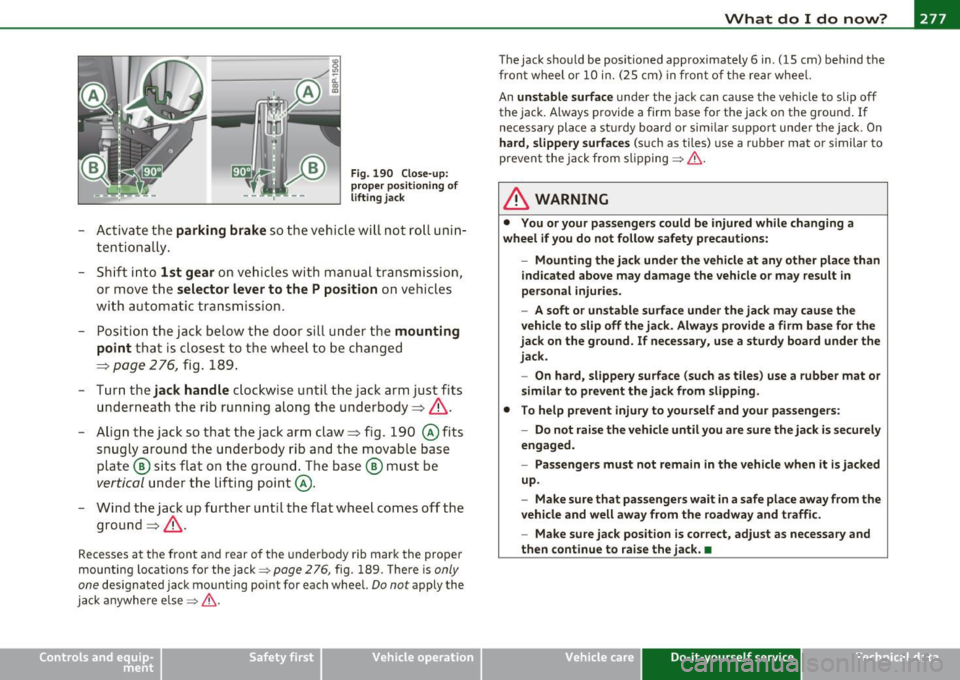
F ig. 190 Close -u p :
pro per po sit io ning of
lifting ja ck
- Activate t he parking brake so the vehicle wi ll not ro ll unin
tentionally .
- S hift into 1st gear on vehicles wit h manua l tra nsmiss ion,
o r mov e the selector lever to the P position on vehicles
with automatic transmissio n.
- Position t he jack be low the door sill under the mounting
point that is closest to the whe el to be chang ed
~ page 276, fig . 189 .
- Turn the jack handle cloc kwise un til the jack arm just fits
underneath t he rib running along t he under body
~ &, .
- Align the jack so that the jack arm claw~ fig . 190 @fits
snugly a round the underbody rib an d the mova ble base
plate ® sits flat o n the groun d. T he base ® must be
vertical unde r th e lifting point @.
- W ind the jac k up fu rt h er u ntil the flat whee l co mes o ff the
groun d~ &, .
Recesses at the front and rear of the u nderbody rib mark the proper
mounting lo cat io ns for the jack =>
page 2 76, fig. 189. The re is only
one
designated jack mount ing point for each wheel. Do not apply the
j a ck anywhe re else:::::, &.
Vehicle OP-eration T
he jack shou ld be posi tioned appro ximately 6 in . (15 cm) behind the
front wheel or 10 i n. ( 25 cm) in fron t of t he rea r w heel.
An
un stable surface u nder the jack can cause the vehicle to slip off
the jack. Always provide a firm base for the jack on the grou nd .
If
necessary pla ce a st urdy boar d or sim ilar su ppo rt unde r the jack. On
hard , slippery surf aces (s uch as ti les) use a rubber mat or s imilar to
preven t the j ack from sli pping =>& .
& WARNING
• You or your passengers could be injured while changing a
wheel if you do not follow safety precautions:
-Mounting the jack under the vehicle at any other place than
indicated above may damage the vehicle or may result in
personal injuries.
- A soft o r unstable surface under the j ack may cause the
vehicle to slip off the ja ck . Alway s provide a firm base for the
jack on the ground.
If necessary, use a sturdy board under the
jack.
- On hard , slippery surface (such as tiles ) use a rubbe r mat or
similar to prevent the ja ck from slipping.
• To help prevent injury to yourself and your pa ssengers:
- Do not raise the vehicle until you are sure the j ack i s securely
engaged.
- Passengers must not remain
in the vehicle when it is ja cked
up.
- Make su re that passengers wait in a safe place away from the
vehicle and well away from the roadway and traffic.
- Make sure jack position is correct, adjust as necessary and
then continue to raise the jack. •
Vehicle care Do-it-yourself service iTechnical data
Page 285 of 320
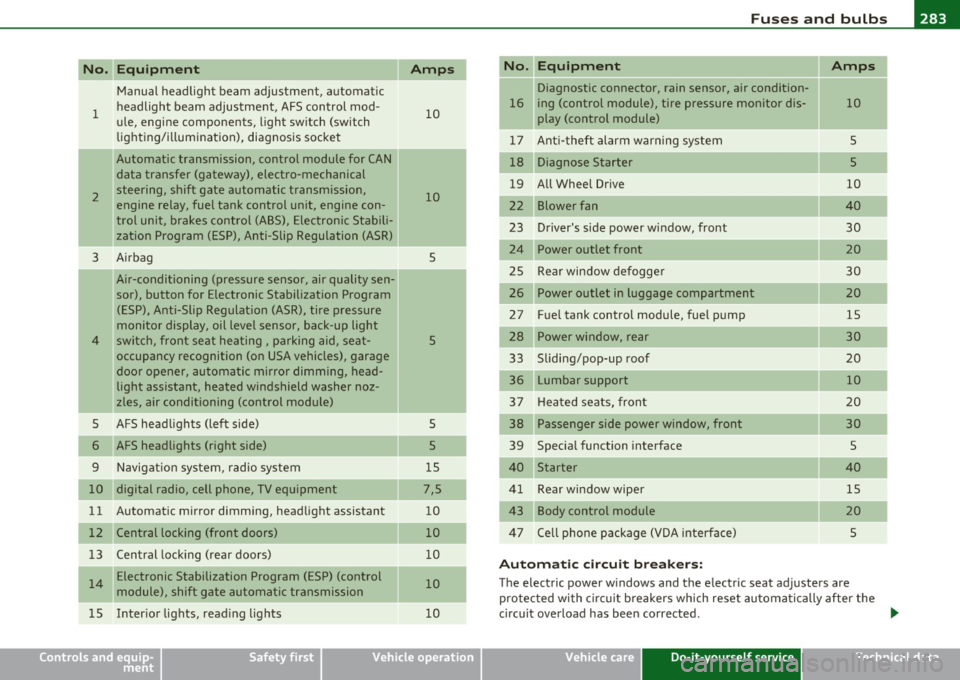
_______________________________________________ F_u _s_ e_ s_ a_ n_ d_ b_u _ l_ b _ s __ _
Equipment No. II Equipment
Amps
Manual headlight beam adjustment, automatic Diagnostic connector, rain sensor, air condition-
headlight beam adjustment, AFS control mod-
16 ing (control module), tire pressure monitor dis-10
1 ule, engine components, light switch (switch 10 play (control module)
-lig hti ng/i llum i nation), diagnosis socket 1 7 Ant i-theft alarm warning system 5
Automatic transmission, control module for CAN 18 Diagnose Starter 5
data transfer (gateway), electro-mechanical
19 All Whee l Drive 10 steering, shift gate automatic transmission, 2 10 engine relay, fuel tank control unit, engine con-22 Blower fan 40
trol unit, brakes control (ABS), Electronic Stabili-23 Driver's side power window, front 30 zation Program (ESP), Anti-Slip Regulation (ASR)
3 Airbag 5 24 Power outlet front 20
Air-conditioning (pressure sensor, air quality sen-25 Rear window defogge r 30
sor), button for Electronic Stabilization Program 26 Power outlet in luggage compartment 20
(ESP), Anti-Slip Regulation (ASR), tire pressure 27 Fuel tank control module, fuel pump 15
monitor display, oil level sensor, back-up light
28 Power window, rear 30 4 switch, front seat heating, parking aid, seat-s
occupancy recognition (on USA vehicles), garage 33 Sliding/pop-up roof 20
door opener, automatic mirror dimming, head-
Lumbar support
10 light assistant, heated windshield washer noz-
zles, air conditioning (control module)
3 7 Hea ted seats, front 20
--
5 AFS headlights (left side) 5 38 Passenger side power window, front 30
AFS headlights (right side) 5 39 Specia l function interface 5
9
Navigat ion system, radio system 15 40 Starter 40
digital radio, cell phone, TV equipment 7,5 Rear window wiper 15
11
Automatic mirror dimming, headlight assistant 10 Body control module 20
12 Central locking (front doors) 10 47 Ce ll phone package (VDA interface) 5
13
Central locking (rear doors) 10
A uto m atic c ircu it bre ake rs :
14 Electronic Stabilization Program (ESP) (control 10 The electric power w indows and the electric seat adjusters are
module), shift gate automatic transmission protected with circuit b reakers which reset automatically after the
1 5 Inter ior lights, read ing lights 10 circuit overload has been corrected . ...
Safety first Vehicle care Do-it-yourself service Technical data