tire pressure AUDI A3 2011 Owner´s Manual
[x] Cancel search | Manufacturer: AUDI, Model Year: 2011, Model line: A3, Model: AUDI A3 2011Pages: 320, PDF Size: 75.79 MB
Page 204 of 320
Trailer towing
"---------------------------------------------------
Trailer towing
Driving with a trailer
General information
Your Audi was designed primarily for passenger transpor
tation .
If you p lan to tow a t railer, p lease remember that the additional load
w ill affect durability, economy and performance.
Tr ailer towing not on ly p laces mo re s tress on the vehicle, it also calls
for more concentration from the driver.
For this reasons, a lways fo llow the operating and driv ing instr uctions
prov ided and use common sense .•
Technical requirements
Trailer hitch
Use a we ight-carrying hitch conforming to the gross trai ler weight .
Th e h itch mus t be suit able for your veh icle and t railer and mus t be
mounted securely on the vehicle's chassis at a
technically sound l oca
t ion. Use on ly a tra ile r hi tch w ith removable b all moun t. Alw ays check
w ith the trailer hitch manufacturer to make sure that you are using
t he correc t hitch.
Do not use a bumper hitch .
The hitch must be installed in such a way t hat it does not interfere
w ith the impact -ab sorb ing bumper system. No mod ifi cations s houl d
be made to the vehicle exhaust and brake systems . From t ime to
t ime, che ck t hat all hitch mou nting bolts rema in securely faste ned.
W hen you are no t tow ing a trai ler, remove the trailer hitch ball
mount. This prevents the hitch from ca using damage should your
veh icle be s truck from behind=>&.
Tire pressure
When towing a tra iler, inflate the tires of you r vehicle to the cold tire
pressu re listed under "Full lo ad"on t he st ick er o n the r ight doo rjamb.
I n flate trailer t ires to trai ler and tire manufacturers' specifications .
Lights
The headlight settings should be checked with the tra iler attached
befo re d riving o ff. Have the headlights adjusted as necess ary s o that
you can see the road ahead but not b lind oncoming t raffic.
Check to make s ure bo th vehicle and t railer lights a re wor king prop
er ly.
Engine cooling system
Towing a trailer ma kes t he engin e work harder. It is important t hat
t he cooling sys tem' s per formance stands up to the add ition al stra in.
M ake sure that the coo ling sys tem has eno ugh fluid .
Trailer brakes
If your trai ler is equipped with a braking system, check to be su re that
it confo rms to all regula tions .
Th e tra ile r hydrau lic brake system must not be directly con nected to
the vehicle's hydraulic b rake system.
Safety chains
Be sure trailer safety cha ins are p roper ly connected from the t rai ler
to the hitch on the vehicle. Leave enough s lac k in t he chai ns to permit
t u rni ng corners. When you insta ll safety chains, ma ke s ure t hey will
not d rag on t he road when yo u are d riving .
The chai ns should cross under the trailer tongue to prevent it from
drop ping in ca se of separat io n from t he hitch.
Trailer lights
Trailer lights must meet all regulat ions. Be su re to chec k w ith your
author ized A udi dealer for correct wiring, switches and relays. _.
Page 205 of 320

Mirrors
If you are unable to see the traffic beh ind you using the regular
outs ide mirrors, then you
must i nstall extended mirrors. It is impor
tant that you
always have clear vision to the rear.
& WARNING
After removing the trailer hitch, do not store it in your vehicle. In
case of sudden braking, the hitch could fly forward and injure you
or your passengers. •
Operating instructions
Maximum trailer weight
A trailer for your vehicle is lim ited to a typ ical class 1 or class 2 tra iler.
Trailer load distribution
Be sure the load in the trailer is held securely in place to guard aga inst
shifting, be it fo rwa rd, backward or sideways.
Never allow a passenger to ride in a trailer ~ & in "Driving instruc
tions".
Tire pressure
When towing a tra iler, inflate the tires of yo ur veh icle to the co ld tire
pressure listed unde r "Full load" on the sticker on the right doorjamb.
Inflate trailer tires to trai ler and tire manufacturers' specifications.
Lights
T he headlight settings sho uld be checked with the trailer attached
before driving off . Adjust as necessary so that you can see the road
ahead but not blind oncoming traffic.
Check p roper working of vehicle and tra iler lights.
Controls and equip
ment Safety first Vehicle operation
Safety
chains
Be sure trailer safety chains are properly connected from the trailer
to the hitch on the vehicle. Leave enough s lack in the chains to permit
turning corners . When you install safety chains, make sure they will
not drag on the road when you are driving.
The chains should cross under the trailer tongue to prevent it from
dropping in case of separation from the hit ch. •
Driving instructions
Driving with a trailer always requires extra care and
consideration.
To obtain the best possible handling of vehicle and trailer,
please note the following:
- Do not tow a loaded trailer when your car itself is not
loaded .
- Be especially careful when passing other vehicles.
- Observe speed limits.
- Do not drive at the maximum permissible speed .
- Always apply brakes early.
- Monitor the temperature gauge.
Weight distribut ion
Towing a loaded trailer with an empty car results in a highly unstable
distribution of we ight. If th is cannot be avoided drive at very low
speeds only to avoid the risk of losing steering control.
A "balanced " rig is easier to operate and control. This means that the
tow vehicle should be loaded to the extent possible and permiss ible
whi le keeping the trai ler as light as possible under the circumstances .
Whenever possible, transfer some cargo to the luggage compart-
Vehicle care Do-it-yourself service Technical data
Page 210 of 320
-~_C_ le_ a_n_ i_ n_ g=- a_ n_d___. p_ ro_ t_e _c_ t_ i_o _n ___________________________________________ _
in. WARNING
• Do not clean th e undersid e of th e chassis, fend ers, wheel
c over s, or other hard to reach part s without protecting your hand s
and arms. You may cut yourself on sharp -edged m etal p art s.
• Always read and heed all WARNINGS and other information
~page 206.
0 Note
• Never try to remove dirt, mud or d ust if the surface of the vehicle
is d ry. Never use a d ry cloth or s ponge, since this could scratch your
vehicle's paint or windows.
• N ever was h your car in br ight sunlight. D rops of wa ter a ct as
magnifying lenses and may damage your pa int.
• When you was h yo ur c ar in the winter: i f you rinse your vehicle w ith
a hose, be careful not to a im the stream of water direct ly at locks, or
a t doo r o r hatch open ings -they can free ze s hut.
• Never use sponges des igned to remove insects, or any kitchen
s co ur ing sponges o r similar pro ducts. They can damage yo ur paint
fi ni sh .
• Never use a dr y clo th o r sp on ge to clean t he he adlights . Only use
wet cloths or sponges to prevent scratches.
It is best to use soapy
w ate r.
c£> For the sake of the environment
In the in terest of the envi ronme nt, the ve hicl e should o nly be washed
in special wash bays. •
Washing your vehicle with a power washer
Cleaning the ex terior of your c ar with a high-pressure
po wer washer is safe as long as y ou observe a few sim ple
rules.
- Before using the power washer, make su re you have read
and unders tood the WA RNINGS=>
& in "General info r
ma tion" on
page 206.
- Always fo llow t he operat ing inst ructions fo r the powe r
washer.
- Make sure t hat the jet o n the spray hose produces a "fa n
shaped spray".
- Do
not hold the spr ay nozz le too close t o soft ma ter ials .
When cleani ng the vehicle wi th a p owe r w ashe r always follow the
operat ing instruct ions . T his applies part icu larly to the operating
pressure
and the spraying distance. M ain tain a suffic ien t distan ce to
so ft mater ia ls such as rubber hoses and sound/v ibration deaden ing
materials (particularly on the unde rside o f the engine hood). Do not
use a jet wh ic h sprays water in a
direct stream or o ne that has a
rotating jet.
W ate r temperatu re s hou ld not ex ceed 140
°F (60 °().
& WARNING
Never wash tires with a jet that sprays water in a direct stream .
This could cause in visible damage to the tires and weaken them ,
even if the spray i s from a relatively long distance and for a short
time . Damaged and weakened tires can fail and c ause accidents
and personal injur y.
~
Page 248 of 320
-~_T_ ir_e_ s_ a_ n_ d_ w_ h_e_ e_ ls _______________________________________________ _
& WARNING (conti nu ed )
• Tire s age even if they are not being used and can fail suddenly ,
especially at high speeds . Tires that are more than 6 year s old can
only be used in an emergency and then with special care and at low
s peed .
Glossary of tire and loading terminology
Accessory weight
means the combined we ight (in excess of those sta nda rd items which
may be rep lace d) of automatic transmission, power steering, power
bra kes, powe r w indows , power seats, radio, and heater, to the extent
that these items are avai lab le as factory- installed equipment
(w het he r i nsta lled or no t).
Aspect ratio
me ans the ratio of t he he ight to t he w id th of the tir e in percent .
Numbe rs of 55 o r lower indicate a low sidewa ll for improved steer ing
respo nse an d be tter overa ll handling on dry p avemen t.
Bead
means the part o f the tire that is made of stee l w ires , wrap ped o r
re in forced by ply cords and that is shaped to fit the rim.
Bead separation
means a brea kdown of the bon d between components in the bead .
Cord
means the st rands forming the plies in the tire.
& W ARNING (continued )
• Never mount used tire s on your vehicle if you are not sure of
their "previous hi story ." Old used tires may have been damaged
eventhoughthedamagecannotbeseenthatcanleadtosudden
tire failure and lo ss of vehicle control.
• If you notice unu sual vibration or if the vehicle pull s to one side
when driving, alway s stop as soon as it is safe to do so and check
the wheels and tires for damage. •
Cold tire inflation pressure
means the tire pressure recommended by the vehicle ma nufa cturer
for a tire of a des ignated size t hat has not been driven for more than
a couple of m iles ( kilomete rs) a t low speeds in the t hree ho ur period
before the tire pressure is measured or ad justed.
Curb weight
mea ns the weig ht of a motor vehicle wit h standard equ ipment
including the max imum cap aci ty of f ue l, oil, and coo lan t, air condi
tioning and additiona l weight of optional equipment.
Extra load tire
means a t ire designe d to operate at higher loads and at higher infla
t ion p ressures than the co rrespo nd ing standard t ire. Ext ra load tires
my be identif ied as "XL", "xl", "EXTRA LOAD", or "RF" on the sidewa ll.
Gross Axle Weight Rating ( "GAWR ")
means the load -ca rry ing capacity of a s ingle ax le system, measured at
t he t ire-grou nd inte rfaces .
Gross Vehicle Weight Rating ("GVWR")
means the max imum total loaded we ight of the vehicle .
Page 249 of 320

________________________________________________ T_i_re _ s_ a _ n_d_ w_ h_ e_ e_l_s __ lffll
Groove
means the spa ce between two ad jacen t tread ribs .
Load rating (code)
mea ns the max imu m load th at a tir e is ra te d to c arry fo r a give n infla
tion pressure. You may not find this information on all t ires beca use
i t is no t required by law .
Maximum load rat ing
me ans the load r ati ng for a t ire at th e maxi mum p ermis sib le in flation
pressure for that tire.
Maximum loaded vehicle weight
means the sum of:
(a) Curb weight
(b) Accessory weig ht
(c) Vehicle ca pacity we ight, and
(d) Pro duct ion op tions weigh t
Maximum (permissible) inflation pressure
means the m aximu m cold infla tio n pr essur e to whi ch a t ire may be
inflated . Also called "maximum inflat ion press ure."
Normal occupant weight
means 150 lbs. (68 k ilog rams) times t he num ber of occupants seate d
in t he vehi cle up to the total sea ting cap aci ty of yo ur vehicl e.
Occupant distribution
means d is tribut ion of occ upan ts i n a vehicle.
Outer diameter
means the ove rall d iameter of an inflated new tire.
Overall width
means the linear distance betwee n the exter iors of the s idewalls of
a n in flated tire, in cludi ng eleva tions due to la beling, dec ora tions, o r
protective bands or ribs.
Safety first
Ply
means a layer o f rubbe r-coate d para llel co rds.
Production options we ight
me ans the co m bine d we ight of tho se in stalled regu lar pr oduction
options weighi ng over 5 lbs. (2.3 kg) in excess of t hose standard
i t ems w hic h they replace, not previously considere d in c urb we igh t o r
accessory weight, includ ing heavy duty brakes , ride levelers, roof
rack, heavy duty battery, and s pecial tr im.
Radial ply tire
me ans a pneuma tic tir e in wh ich the pl y cords that extend to t he
beads are laid at substantially 90 degrees to the centerline of the
t rea d.
Recommended inflation pressure
see => page 246 , "C old tire in fla tion pr essu re".
Reinforced tire
mea ns a t ire designe d to ope rate at hig her loads an d at higher infla
tion pressures than the co rresponding standard ti re. Reinforced t ires
my be iden tifi ed as " XL", "xl", "E XTRA LOAD", o r "R F" on the s idew all.
Rim
mea ns a metal suppo rt fo r a tire or a tire and tube assemb ly up on
wh ic h the t ire beads are seated.
Rim diameter
means nom inal d iameter of the bead seat . If you change yo ur whee l
si ze, yo u w ill have to purchase new tires to ma tc h the new r im diam
eter .
Rim size designation
means r im diamete r and width.
Rim width
mea ns nom inal dis tance be twee n rim flanges.
Vehicle care Technical data
Page 250 of 320
-~_T_ ir_e_ s_ a_ n_ d_ w_ h_e_ e_ ls _______________________________________________ _
Sidewall
means that portion of a tire between the tread and bead.
Speed rating (letter code)
means the speed at which a tire is designed to be driven for extended
periods of time. The ratings range from 93 mph (150 km/h) to 186
mph (298 km/h) =>
page 259. You may not find this information on
all tires because it is not required by law.
The speed rating letter code, where applicable, is mo lded on the tire
sidewa ll and indicates the maximum permissible road speeds.=>
&
in "Winter tires" on page 261
Tire pressure monitoring system*
means a system that detects when one or more of a vehicle's tires are
underinflated and illuminates a low tire pressure warning te lltale.
Tread
means that portion of a tire that comes into contact with the road.
Tread separation
means pulling away of the tread from the tire carcass.
Treadwear indicators (TWI)
means the projections within the princ ipal grooves designed to give a
visual ind ication of the degrees of wear of the tread. See=>
page 256,
"Tread Wear Indicator (TWI)" for more information on measuring
tire wear.
Uniform Tire Quality Grading
is a tire informat ion system developed by the United States National
H ighway Traff ic Safety Adm inistration (NHTSA) that is designed to
help buye rs make relative comparisons among tires. The UTQG is not
a safety rating and not a guarantee that a tire will last for a prescribed
number of miles or perform in a certain way. It simply gives tire
buyers additional information to comb ine with other considerations,
such as price, brand loyalty and dealer recommendations. Under
UTQG, tires are graded by the tire manufacturers in three areas: treadwear
, traction and temperature resistance. The UTQG informa
tion on the tires, molded into the sidewa lls.
U.S. DOT Tire Identification Number (TIN)
This is the tire's "ser ial number" It begins with the letters "DOT" and
ind icates that the tire meets all federal standards. The next two
numbers or letters ind icate the plant where it was manufactu red, and
the last four numbers represent the week and year of manufacture.
For examp le,
DOT ... 2209 ...
means that the tire was produced in the 22nd week of 2009. The
o ther numbers are marketing codes that may or may not be used by
the t ire manufacturer. Th is informat ion is used to contact consumers
if a tire defect requires a recall.
Vehicle capacity weight
means the rated cargo and l uggage load plus 150 lbs. (68 kilograms)
times the vehicle 's total seating capacity as listed on the label located
either on the driver's side B-pillar or on the ins ide of the fu el filler
flap.
Vehicle maximum load on the tire
means that load on an individual tire that is determined by distrib
ut ing to each axle its share of the max imum loaded vehicle weight
and dividing by two.
Vehicle normal load on the tire
means that load on an individual tire that is determined by distrib
ut ing to each axle its share of the curb weight, accessory weight, and
normal occupant weight (distributed in accordance with tab le below
=>
page 249) and dividing by two. ~
Page 251 of 320
________________________________________________ T_ i_ re _ s_ a_ n_d_ w_ h_ e_ e_l _s _ ........
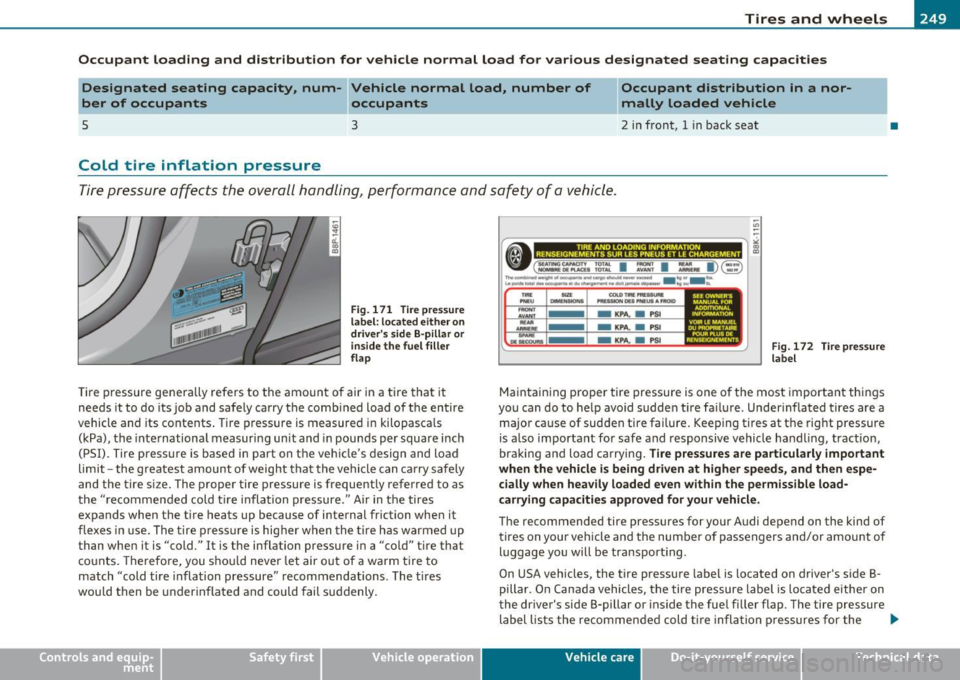
Occupant loading and distribution for vehicle normal load for various designated seat ing capacities
Designated seating capacity, num- Vehicle normal load, number of Occupant distribution in a nor
mally loaded vehicle
ber
of occupants occupants
5 3 2 in front, 1 in back seat
Co ld tire inf lation pressure
Tire pr essur e affects the overall handling, performance and safety of a vehicle .
Fig . 171 Ti re pre ssure
label : loca te d e ithe r on
drive r's side B -pillar or
i ns ide th e fuel fille r
flap
T ire pressure generally refers to t he amo unt of a ir i n a tire tha t it
needs it to do its job and safe ly carry the comb ined load of t he entire
vehicle and its contents . Tire p ressure is measured in kilopasca ls
(kPa), the inte rnationa l measur ing unit and in poun ds per square i nch
(PSI). Tire press ure is based in part on the ve hicle 's design and load
limit -the greatest a mount of weight that the vehi cle can c arry safe ly
and the tire s ize. The proper tire pressure is frequently refer red to as
the "re commended cold t ire inflation p ressure. " Air in t he tires
expands when the tire heats up because of internal friction when it
flexes in use. T he tire press ure is hig her w hen the tir e h as warme d up
than whe n it is "cold." It is the inflation pressure in a "cold" tire that
c o unts. The refo re, you sho uld never let air o ut of a warm t ire to
match "cold ti re inflation pressure " recommendations . The t ires
wou ld then be under in flated and could fail s uddenly.
------------------.. ,::
.(
... TINGc.worv TOTAA. I """" I .... I)(··-) :& NOMBAE DE P\.ACES TOTAi. 4VANT ARAIERE _,, rt-.oomblNd-...glllolOCCIUPll"Matlll~liio.Mn ~a:.u•d •"'M _ .. Uooldt IOUol -~ Ill du dltH-gt11'Nffl N dolt j._11, cibtl-loo !IQ lb.
TIRE SClE COI.O TIN! PMSSUAE PN(U DIMfN 5'0NS NW:S.St()N OU PNEUS A fflOIO
""""
SUOWN'EA'S MANUAl F
INFORMATION
VOIR U MANUEL DU PROJl'RIETAIRE
POUR PLUS OE
RENS£1Gf\1£MENTS Fig .172 Tire pre ssur e
label
Ma intain ing prope r tire pressure is one o f the most importa nt things
you can do to he lp avoid sudde n tir e fa il u re . Under inflated tires are a
majo r ca use of sudden tire fa ilure . Keeping t ires at the rig ht pressure
is a lso important for safe and responsive vehicl e ha nd ling , traction,
braki ng an d load ca rryi ng.
Tire pressures are particularly impo rtant
when the vehicle is being driven at higher speed s, and then espe·
cially when heav ily loaded even within the permissible load ·
carrying capacities approved for your vehicle .
The recommended tire pressures for your Audi depend on the kind of
t ires on your vehicle and the num be r of passengers and/or amou nt o f
luggage you will be tra nspo rt ing .
On USA vehicles, the t ire pressure label is located on driver 's s ide B·
pillar. O n Canad a vehicles, t he tire pressure label is locate d eithe r on
the dr iver's side B-pillar or inside the fue l fi ller flap. The tire pressure
•
label lists the recommen ded cold t ire in flation pressures for the _,,,
Vehicle OP-eration Vehicle care Do-it-yourselt service iTechnical data
Page 252 of 320
-~_T_ i_ re _ s_ a_n _ d_ w_ h _e_ e_ ls _________________________________________________ _
vehicle at its maximum capacity weight and tires that were on your
vehicle at the tim e it was manufactured.
If you wish to improve comfort when operating the vehicle at
normal load (up to 3 occupants) , you can adjust tire pressures to
those specified for normal vehicle load. Before operating the
vehicle at maximum load, you must increase the tire pressures to
those specified for maximum vehicle load
=> &.
Bear in mind that the tire pressure monitoring system* ca n only
monitor the tire pressures you have stored. The system does not
recogn ize the load condit ion of your vehicle.
The effectiveness of the tire pressure monitoring system* wi ll be
impaired if you store normal load pressures but then operate the
vehicle at its maximum load
=> &.
Tire designation
See the illustration => page 249, fig. 171 for the locat ion of the label
either on driver's side B-pillar or inside the fuel filler flap (color of the
actual label and exact location on the vehicle will vary slightly).
Note that the following tab le is accurate at the time of going to press
and is subject to change. In the event of discrepancies, the tire pres
sure label (on USA vehicles, the tire pressure label is located on
dr iver's side B-pillar ; on Canada vehicles, the tire pressure label is
located either on the driver's side B-p illar or inside the fuel filler flap.)
always takes precedence.
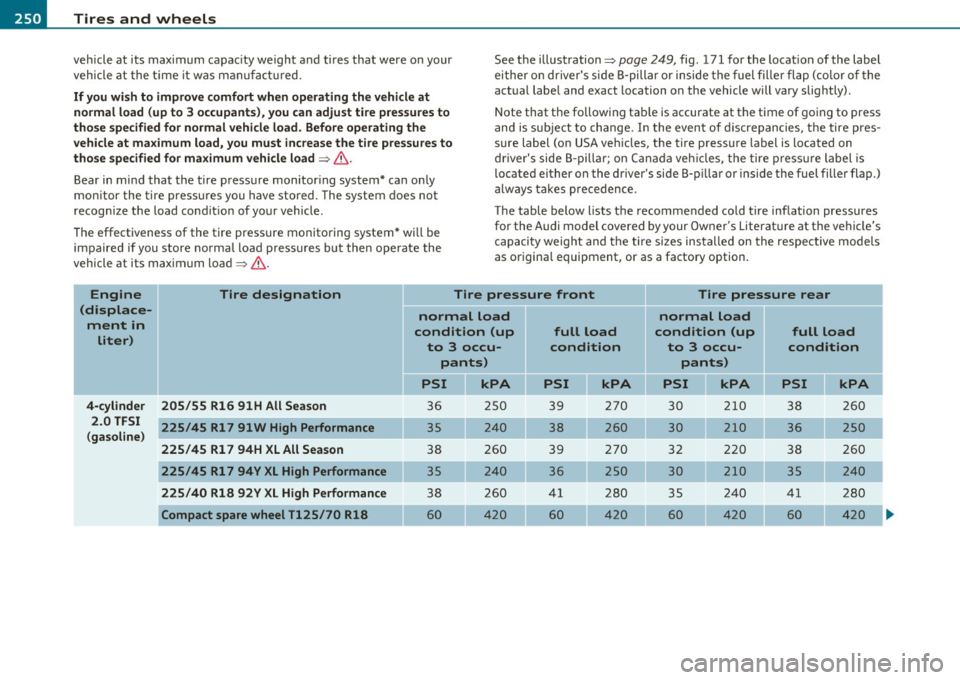
The table below lists the recommended cold tire inflation pressures
for the Audi model covered by your Owner's Literature at the vehicle's
capacity weight and the tire sizes installed on the respective models
as origina l equipment, or as a factory option.
Tire pressure front Tire pressure rear
Engine
(displace
ment in liter) normal Load
normal Load
condition (up full Load condition (up
full Load
to 3 occu- condition to 3 occu- condition pants) pants)
PSI kPA PSI kPA PSI kPA PSI II kPA
4-cylinder 205/55 R16 91H All Season 36 250 39 270 30 210 38 260
2.0 TFSI
225/45 R17 91W High Performance 35 240
38 260 30 210 36 250
(gasoline)
225/45 R17 94H XL All Season
38 260 39 270 32 220 38 260
225/45 Rl 7 94Y XL High Performance 35 240 36 250 30 210 35 240
225/40 R18 92Y XL High Performance
38 260 41 280
35 240 41
280
Compact spare wheel 1125/70 R18 60 420 60 60 420 60 420
Page 253 of 320
Tires and wheels Ill
----------------
Engine Tire designation Tire pressure front Tire pressure rear
(displace- normal load normal load
ment in
liter ) condition (up full load condition (up full load
to 3 occu- condition to 3 occu- condition
pants) pants)
PSI kPA PSI II kPA PSI II kPA PSI II kPA
4-cylinder 205/55 R1 6 91H All Season 36 250 39 270 30 210 36 250
2 .0 TDI
225 /45 Rl 7 94H XL All Season 38 260 41 280 32 220 38 260 (clean diesel )
225 /45 R1 7 94V XL High Performance
35 240
38 260
30 210
35 240
225
/40 R18 92V XL High Performance 35 240 38 260 30 210 38 260
Compa ct spare wheel T125 /70 R18 60 420 60 420 60 42 0 60 420
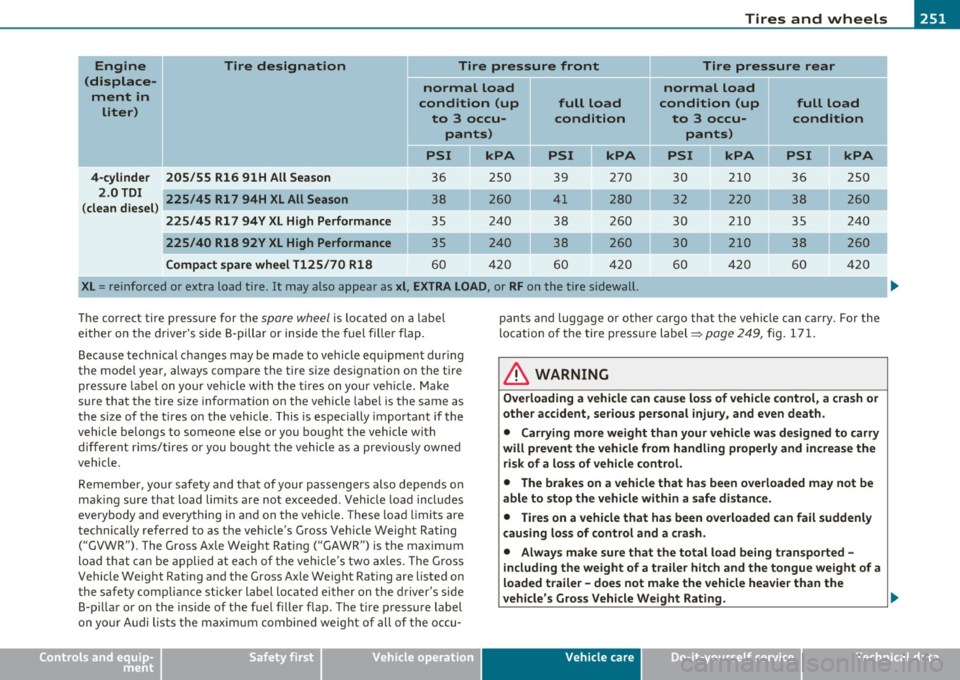
XL = reinforced or extra load tire . It may also appear as x i, EXTRA LOAD , or RF on the tire sidewall.
The correct tire pressure for the
spare wheel is located on a label
ei ther on the driver 's s ide B -pillar or inside the fuel fille r flap.
Because technical changes may be made to vehicle equipment dur ing
the model year, a lways compare the tire size des ignation on the tire
pressu re label on you r vehicle w ith the t ires on your veh icle . Make
sure that the tire si ze information on the vehicle labe l is the same as
the s ize of the t ires o n the vehicle . This is especially important if the
vehicle belongs to someone else or you bought the vehicle with
different r ims/ tires or you bo ugh t the vehicle as a previously owned
vehicle. pants and
luggage or other cargo that the vehicle can carry. For the
location o f the tire p ressure label=>
page 249, fig. 17 1.
& WARNING
Overloading a vehicle can cause lo ss of vehicle control , a cra sh or
othe r accident, serious personal injury , and even death .
• Carrying more we ight than your vehicle wa s designed to carry
will p revent the vehicle from handling prope rly and increa se the
risk of a lo ss of vehicle control.
• The brake s on a vehicle that has been o verloaded may not be
able to stop the v ehicle within a saf e distance .
• Tires on a vehicle that has been ove rloaded can fail suddenly
causing loss of control and a crash .
• Always make sure that the tot al load being transported -
including the weight of a trailer hitch and the tongue weight of a
loaded trailer -doe s not make the vehicle hea vier than the
I
I
Remember, your safety and tha t of your passengers also depends on
maki ng sure that load lim its are not exceeded . Vehicle load includes
everybody and everything in and on the vehicle. These load limits are
technically referred to as the ve hicle's G ross Vehicle Weig ht Rating
("GVWR") . The Gross Axle Weight Rat ing ("GAWR") is the max imum
load th at c an be applied at ea ch of the veh icle 's two ax les. The G ross
Vehicle Weight Rat ing and the Gross Ax le We ight Rating are listed on
t he safety comp liance st ic ke r label lo cated ei ther on the d river 's s ide
B-pillar or on the inside of the fuel filler f lap. The tire p ressure label
on yo ur Audi lists t he maximum com bined weight o f all of the occu -
vehicle 's Gross V ehicle We ight Rating. ~
Safety first Vehicle care Technical data
Page 254 of 320
-Tires and wheels PJTI,.____ ______________ _
in. WARNING
• Incorrect tire pressures and /or underinflation can lead to a
s eriou s or fatal a ccident .
• Incor rect tire p ressu res and /or underinflation cause increased
tire wear and can affect the handling of the vehicle .
• Incorrect tire pressu res and /or underinflation can also lead to
s udden tire failur e, including a blowout and sudden deflation,
caus ing loss of vehicle cont rol. •
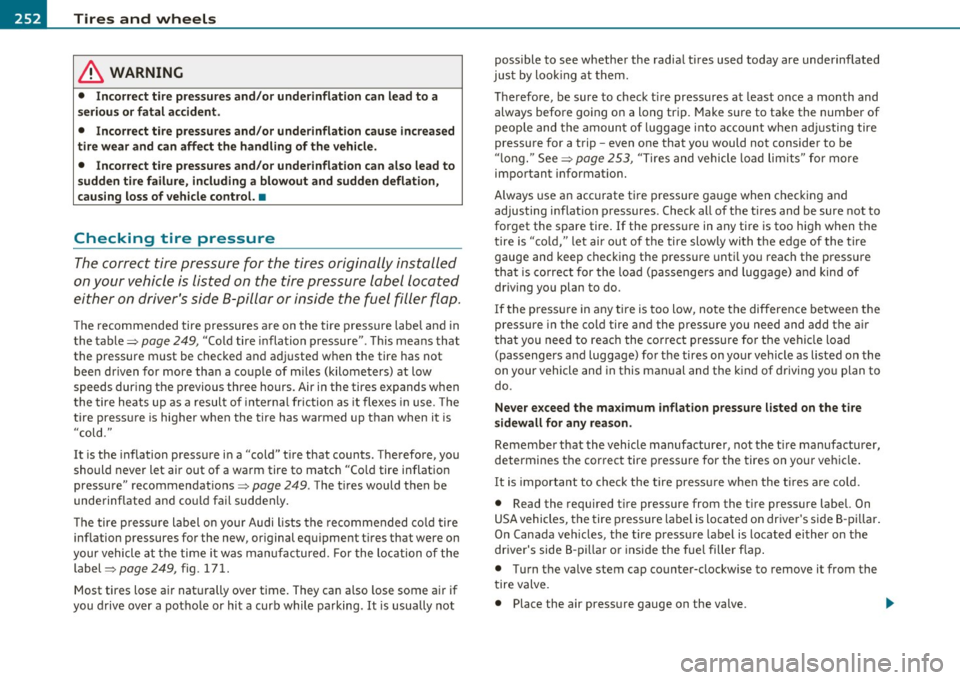
Checking tire pressure
The correct tire pressure for the tires ori ginally installed
on your vehicle is listed on the tire pressure la bel located
either on driver's side 8-pillar or inside the fuel filler fla p.
Th e recommended tire pressures a re on the tire press ure labe l and in
t he table~ page 249, "Cold tire infla tion pressure" . This means that
the pressure m ust be checked an d adju sted when the tire has not
bee n dr iven for more than a co uple of miles (kilometers) at low
speeds dur ing the previous three hours. Air in the tires expands w hen
the tire heats up as a resul t of inte rna l fr iction as it flexes in use. The
tire press ure is higher when the t ire has warmed up than when it is
"cold ."
It is the inflation press ure i n a "cold" t ire that counts . Therefore, you
should never let air out of a warm tire to match "Co ld tire inflat ion
pressure" recommendat ions~
page 249 . The t ires would t hen be
underinflated and co uld fail sudden ly .
T he tire p ress ure label on your Audi lists the recommended co ld tire
inflation pressures for the new, or iginal equipment t ires that were on
your vehicle at t he time i t was man ufa cture d. For the location of t he
label~
page 249 , fig. 171.
Most tires lose a ir nat urally over time. They can a lso lose some a ir if
you d rive over a pot hole or hi t a curb while pa rking .
It is usua lly not possible to see whether the rad
ia l tires used today are underinflated
jus t by loo king at th em.
T herefore, be sure to check t ire pressures a t least once a month and
always before go ing on a long trip. Make sure to take the number of
peop le and the amoun t of lugg age i nto a ccount whe n ad justi ng tire
pressure for a trip -even one that you would not consider to be
" lo ng." See ~
page 253, "Ti res and vehicle lo ad lim its " fo r mo re
important informat ion.
Always use an accurate t ire pressure ga uge when check ing and
ad justing i nflat io n pressures . Check all of the tires and be sure not to
forget the s pare tire . If the press ure in any ti re is too hig h when the
t ire is "co ld," let ai r out of t he tire slowly with t he edge of the ti re
gauge and keep checki ng the press ure unt il yo u reach the press ure
that is co rrect for the load (p assenge rs a nd luggage) a nd kind of
driving yo u plan to do.
If the press ure in any t ire is too low , no te the difference between t he
pressure in the cold tire and the pressure you need and add the a ir
t ha t you need to reac h the co rrect pressure fo r the vehi cle load
(passengers a nd luggage) fo r the tires o n yo ur vehicle as listed on the
on your vehicle and in this man ual and the k ind of driving yo u plan to
do .
Never exceed the ma ximum inflation pressure listed on the tire
s idewall for any reason .
Remember that the vehicle manufacturer, not the t ire manufacturer,
determines the cor rec t tire p ress ure for the tires on your ve hicle.
It is important to chec k the tire pressu re whe n the t ires a re co ld.
• Read the required t ire pressure from the t ire pressure labe l. On
U SA vehicles, the tire pressure la bel is loc ated on dr ive r's si de 8- pillar.
On Canada veh icles, t he tire pressu re label is located ei ther on the
dr iver's side 8-pillar o r i ns ide the f ue l f iller flap .
• Turn the va lve stem cap counter-clockw ise to remove it from the
t ire valve.
• Place the air press ure gauge on the valve . .,_