belt AUDI A3 2011 Owner´s Manual
[x] Cancel search | Manufacturer: AUDI, Model Year: 2011, Model line: A3, Model: AUDI A3 2011Pages: 320, PDF Size: 75.79 MB
Page 138 of 320
-Safety belts pn, _______________ _
-Make sure that your passengers also buckle up a nd prop
erly wear their safety belts .
- Protect c hildren with a child rest raint system appropria te
fo r the size and ag e.
The warn ing light ~ in the instrument cluster lights up when the igni
tion is sw itched on as a reminder to fasten the safety belts. In addi
tion, you w ill hear a wa rning tone for a certa in period of t im e.
Fasten your safety belt and ma ke sure that your passenge rs also
properly put on their safety belt s.
& WARNING
• Safety belts are the singl e most effective means available to
reduce the risk of serious injury and death in automobile a cci
dents . For your protection and that of your pas senger s, always
co rrectly wear safety belts when the vehicle is mo ving .
• Failure to pay attention to the warning light that come on,
could lead to personal injur y.
u
Why safety belts?
Frontal collisions and the law of physics
Frontal crashes create very stron g forc es for people
riding i n vehi cles.
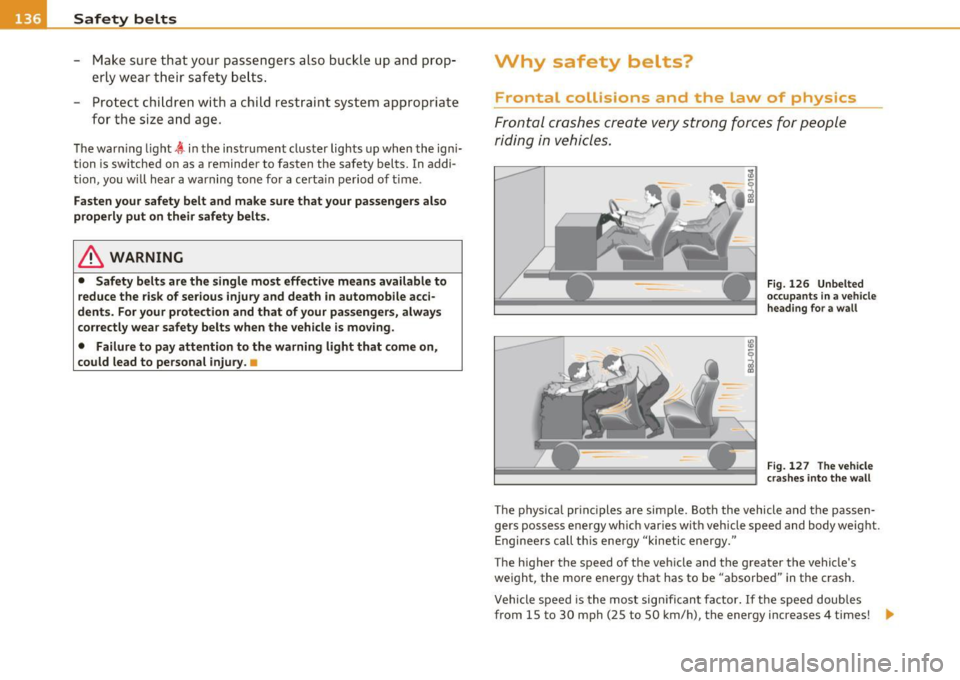
Fig . 12 6 U nbelted
o ccupa nts in a vehicle
h eadin g for a w all
Fig . 127 The ve hicle
cr as hes int o t he w all
T he p hys ica l pr inc iples are simple. Both the vehicle and the passen
gers possess energy which var ies wit h veh icle speed and body weight.
Enginee rs ca ll t his ene rgy "kinetic energy."
The higher the speed of the veh icle and the greater the vehicle's
we ight, the more energy that has to be "absorbed" in the crash .
Vehicle speed is the most sig nifican t fa ctor. If t he speed doubles
from 15 to 30 mph (25 to 50 km/h), the energy increases 4 times! .,
Page 139 of 320
Because the passengers of this vehicle are not using safety belts
=> page 136, fig. 126, they will keep moving at the same speed the
vehicle was moving just before the crash, until something stops them
- here, the wall =>
page 136, fig. 127.
The same principles apply to people sitting in a vehicle that is
involved in a frontal collision. Even at city speeds of 20 to 30 mph (30
to SO km/h), the forces acting on the body can reach one ton (2,000
lbs. or 1,000 kg) or more. At greater speeds, these forces are even
higher .
People who do not use safety belts are also not attached to their
vehicle. In a frontal collision they will also keep moving forward at
the speed their vehicle was travelling just before the crash . Of course,
the laws of physics don't just apply to frontal collisions, they deter
mine what happens in all kinds of accidents and collisions.•
What happens to occupants not wearing
safety belts?
In crashes unbelted occupants cannot stop themselves
from flying forward and being injured or killed. Always
wear your safety belts!
Safety first
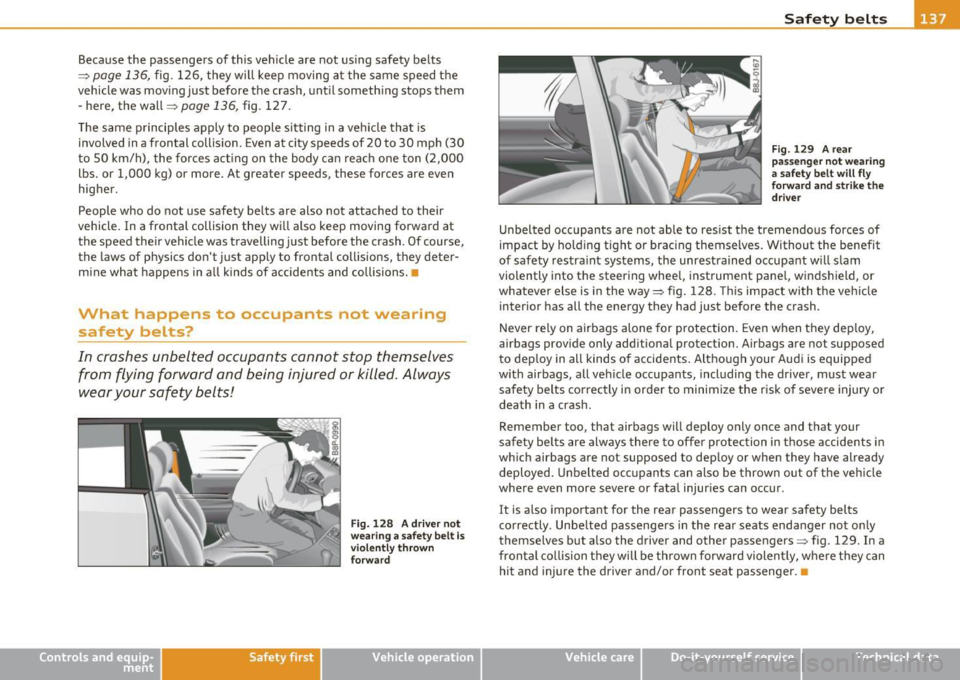
Fig. 128 A driver not
wearing a safety belt is
violently thrown
forward
Vehicle OP-eration
Safety belts
Fig. 129 A rear
passenger not wearing
a safety belt will fly
forward and strike the driver
Unbelted occupants are not able to resist the tremendous forces of
impact by holding tight or bracing themselves. Without the benefit
of safety restraint systems, the unrestrained occupant will slam
violently into the steering wheel, instrument panel, windshield, or
whatever else is in the way=> fig. 128. This impact with the vehicle
interior has all the energy they had just before the crash.
Never rely on airbags alone for protection. Even when they deploy,
airbags provide only additional protection. Airbags are not supposed
to deploy in all kinds of accidents. Although your Audi is equipped
with airbags, all vehicle occupants, including the driver, must wear safety belts correctly in order to minimize the risk of severe injury or
death in a crash.
Remember too, that airbags will deploy only once and that your
safety belts are always there to offer protection in those accidents in
which airbags are not supposed to deploy or when they have already
deployed. Unbelted occupants can also be thrown out of the vehicle
where even more severe or fatal injuries can occur.
It is also important for the rear passengers to wear safety belts
correctly. Unbelted passengers in the rear seats endanger not only
themselves but also the driver and other passengers=> fig . 129. In a
frontal collision they will be thrown forward violently, where they can
hit and injure the driver and/or front seat passenger. •
Vehicle care Do-it-yourselt service iTechnical data
Page 140 of 320
•--=S~a ~f ~e ~t ,z.Y ...: b~ e~lt ~ s~ --------------------------------------------
Safety belts protect
People think it's possible to use the hands to brace the
body in a minor collision . It's simply n ot true!
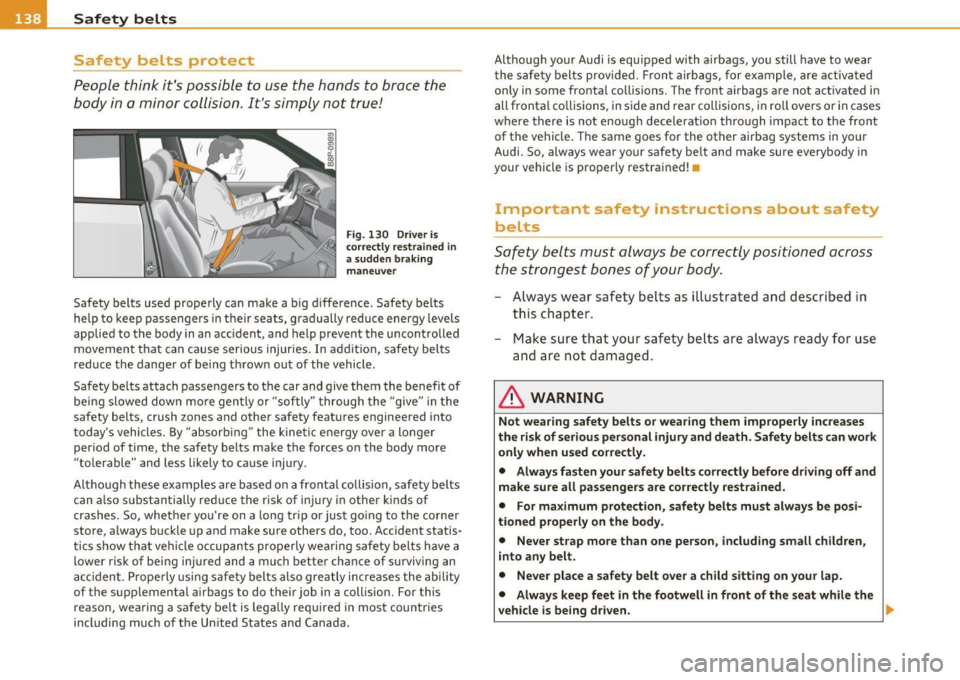
F ig . 1 30 Driv er is
c o rr ect ly res trai ned i n
a su dden bra kin g
m ane uver
Safety belts used prope rly can make a big difference. Safety belts
help to keep passengers in their sea ts, gradually reduce energy leve ls
applied to the body in an accident, and help prevent the uncontrolled
movement that can cause serious injuries . In add it io n, safety bel ts
red uce the danger of be ing t hrown out of the vehicle.
Sa fety be lts attach passengers to the car and give them the benefit of
being slowed down mo re gently or "softly" through the "give" i n the
safety belts, crush zones and other safety features engineered into
t oday 's vehicle s. By "absorb ing" the kine tic e nergy over a lo nger
period of time, the safety belts make the forces on the body more
"tolerable" and less likely to ca use inju ry.
Although these examples are based on a frontal collision, safety belts can a lso s ubstantially red uce the risk of i nju ry in other kinds of
cr ashes . So, whet he r you're on a long trip or just going to the corner
store, always b uckle up and make sure others do , too. Accident statis
t ic s show that vehi cle occupan ts properly wea ring safety belts have a
lower risk of being injured and a much better chance of surviv ing an
a cc iden t. Properly usi ng s afe ty belts also greatly in cre ases the ability
of the supp lemental airbags to do their job in a collision. For this
reaso n, wea ring a sa fety belt is lega lly req uired in mos t countries
including much of the Un ited States and Canada . Altho
ugh your Audi is equ ipped with a irbags, you still have to wear
t he s afe ty belts provided. Fron t air bags, for ex ample, are a ctiv ate d
only in some fronta l collisions . T he front a irbags a re not act ivated in
all frontal co llisions, in s ide and rear coll isio ns, in roll overs or in cases
where there is not enough decelerat ion thro ugh impact to the front
of the vehicle . The same goes for the other airbag systems in yo ur
Audi. So, always wea r you r safety be lt and make su re everybody in
your vehicle is proper ly restrained!
Important safety Instructions about safety
belts
Safety b elts must always be correctly positioned across
the strongest bones of your body.
- Always wear safety belts as illustrated and described in
this chapter.
- Make sure that your safety belts are always ready for use and are not damaged.
& WARNING
Not wea ring safety belts o r wearing them improperly inc reases
the risk of s eriou s personal injury and death . Safety belts can work
only when u sed correctl y.
• Alway s fasten your safety belts correctly bef ore driving off and
make sure all passengers are corre ctly restrained.
• For ma ximum protection , safety belts must alw ays be posi
ti oned properly on the body.
• Never strap more than one person , including small children ,
into any belt .
• Never place a safety belt o ver a ch ild sitting on your lap .
• Alway s keep feet in the footwell in front of the seat while the
vehicle is being driven.
~
Page 141 of 320

& WARNING (continued)
• Never let any person ride with their feet on the instrument
panel or sticking out the window or on the seat.
• Never remove a safety belt while the vehicle is moving. Doing
so will increase your risk of being injured or killed.
• Never wear belts twisted.
• Never wear belts over rigid or breakable objects in or on your
clothing, such as eye glasses, pens, keys, etc., as these may cause
injury.
• Never allow safety belts to become damaged by being caught
in door or seat hardware.
• Do not wear the shoulder part of the belt under your arm or
otherwise out of position .
• Several layers of heavy clothing may interfere with correct
positioning of belts and reduce the overall effectiveness of the
system.
• Always keep belt buckles free of anything that may prevent the
buckle from latching securely.
• Never use comfort clips or devices that create slack in the
shoulder belt. However, special clips may be required for the
proper use of some child restraint systems.
• Torn or frayed safety belts can tear, and damaged belt hard
ware can break in an accident. Inspect belts regularly. If webbing, bindings, buckles, or retractors are damaged, have belts replaced
by an authorized Audi dealer or qualified workshop.
• Safety belts that have been worn and loaded in an accident
must be replaced with the correct replacement safety belt by an
authorized Audi dealer. Replacement may be necessary even if
damage cannot be clearly seen. Anchorages that were loaded
must also be inspected.
• Never remove, modify, disassemble, or try to repair the safety
belts yourself.
Safety first Vehicle OP-eration
Safety belts
& WARNING (continued)
• Always keep the belts clean. Dirty belts may not work properly
and can impair the function of the inertia reel=>
page 217,
"Safety belts". •
Safety belts
Fastening safety belts
Seat first -everybody buckle up!
Fig. 131 Belt buckle
and tongue on the
driver's seat
To provide maximum protection , safety belts must always be
positioned correctly on the wearer's body.
- Adjust the front seat and head restraint properly
=>
page 73 , "General recommendations" .
- Make sure the seatback of the rear seat bench is in an
upright position and securely latched in place before using
the belt =>& .
- Hold the belt by the tongue and pull it evenly across the
chest and pelvis=>& . _,.
Vehicle care Do-it-yourselt service iTechnical data
Page 142 of 320

___ s_ a_ f_ e_ t_ y~ b_ e_ lt_s _____________________________________________ _
- Insert t he tongue into the correct buck le of your seat until
you hear it latch secure ly==> fig. 131 .
- Pull on the be lt to make sure tha t it is secure ly la tched in
the buck le.
Automatic safety belt retractors
Every safety be lt is equipped with an automatic be lt retractor on the
shoulder be lt. This feat ure locks the be lt whe n the belt is pulled out
fast, during hard braking and in an acc ident. The belt may also lock
w hen you dr ive up or dow n a steep hill or throug h a sharp curve.
Dur ing normal driv ing the belt lets you move freely.
Safety belt pretensioners
The safety belts are equipped w ith a belt pretensioner that helps to
t ighten the safety be lt and remove sla ck when the p re tensioner is
act ivated. The function of the pretensioner is monitored by a warn ing
light =>
page 15.
Switchable locking feature
Every sa fety be lt ex ce pt t he one on the driver sea t is eq uipped wi th a
switchab le locking feature that
must be used when the safety belt is
used to at tach a child safety seat. Be s ure to read t he importa nt info r
mation about this feature=>
page 177.
& WARNING
Imp roperly positioned safety belts can c au se se rious injury in a n
accident =>
page 140, "Safety b elt po sition ".
• Safety belts offer optimum protection only when the seatback
i s upr ight and belts are properly positioned on the body .
• Always make sure th at the rear seat backre st to which the
center rear safety belt is attached i s secur ely latched when ever the
rear cente r sa fety belt is be ing u sed . If the ba ckre st is not securely
latched, the pas senger will move forward with th e backre st during
sudde n braking, in a sudden maneuve r and especiall y in a crash .
& WARNING (continued )
• Never attach the safety belt to the buckle fo r another seat .
Attaching the belt to the wrong buckle will reduce safety belt
effectiveness and can cause ser ious personal injury.
• A pass enger who i s not properly restrained can be seriou sly
i njured by the safety belt itself when it mo ves from the stronger
part s of the body into critical area s like the abdomen.
• Alway s loc k the convertible locking retractor when you a re
securing a child safety seat in the vehicle=>
page 179. •
Safety belt position
Correct belt position is the key to getting maximum
pro tection from safety belts .
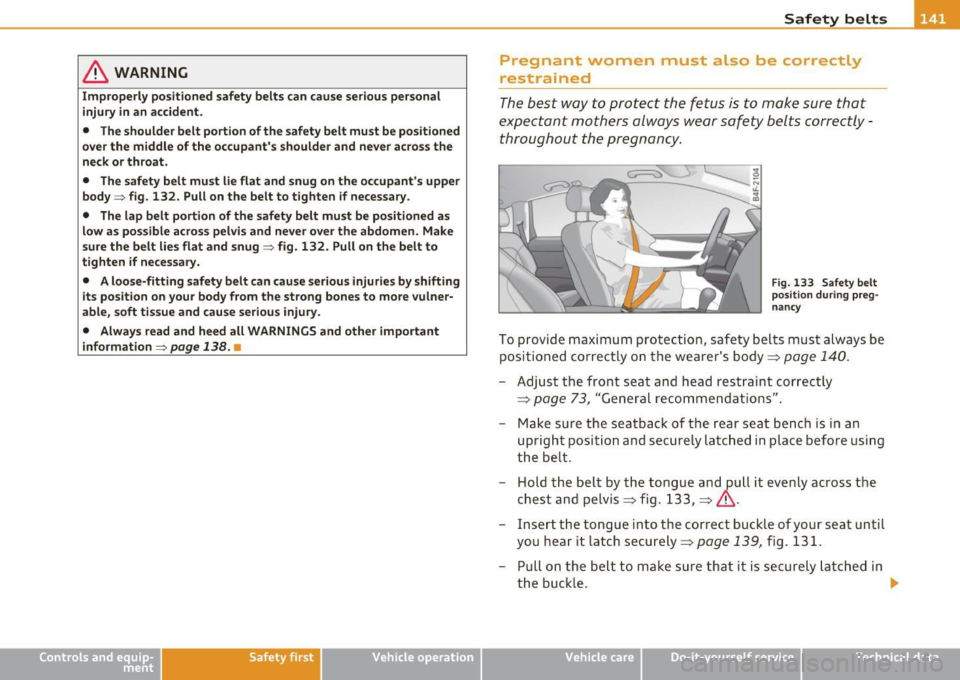
Fig. 132 Hea d
r e str aint a nd safet y
belt po sit ion a s seen
from the side
Standard features on your vehicle help you adjust the position of the
safety belt to match your bo dy size.
• belt h eight adjustment for the fron t sea ts,
• automatic belt height adjustment for the rear seats .
Page 143 of 320
& WARNING
Improperly positioned safety belts can cause serious personal
injury in an accident. • The shoulder belt portion of the safety belt must be positioned
over the middle of the occupant's shoulder and never across the
neck or throat.
• The safety belt must lie flat and snug on the occupant's upper
body => fig. 132. Pull on the belt to tighten if necessary.
• The lap belt portion of the safety belt must be positioned as
low as possible across pelvis and never over the abdomen. Make
sure the belt lies flat and snug => fig. 132. Pull on the belt to
tighten if necessary.
• A loose-fitting safety belt can cause serious injuries by shifting
its position on your body from the strong bones to more vulner
able, soft tissue and cause serious injury.
• Always read and heed all WARNINGS and other important
information =>
page 138. •
Safety first Vehicle OP-eration
Safety belts
Pregnant women mus.t also be c:orrectly
restra ined
The best way to protect the fetus is to make sure that
expectant mothers always wear safety belts correctly -
throughout the pregnancy.
Fig. 133 Safety belt
position during preg
nancy
To provide maximum protection, safety belts must always be
positioned correctly on the wearer's body=>
page 140.
- Adjust the front seat and head restraint correctly
=>
page 73, "General recommendations".
- Make sure the seatback of the rear seat bench is in an
upright position and securely latched in place before using
the belt .
- Hold the belt by the tongue and pull it evenly across the
chest and pelvis=> fig. 133 , =>
& .
- Insert the tongue into the correct buckle of your seat until
you hear it latch securely =>
page 139, fig. 131.
- Pull on the belt to make sure that it is securely latched in
the buckle.
IJ),
Vehicle care Do-it-yourselt service iTechnical data
Page 144 of 320
-Safety belts ----------------
& WARNING
Improperly positioned safety belts can cause
serious personal
injury in an accident.
• Expectant mothers must always wear the lap portion of the
safety belt as low as possible across the pelvis and below the
rounding of the abdomen.
• Always read and heed all WARNINGS and other important
information ~
& in "Fastening safety belts" on page 139. •
Unfastening safety belts
Unbuckle the safety belt with the red release button only
after the vehicle has stopped.
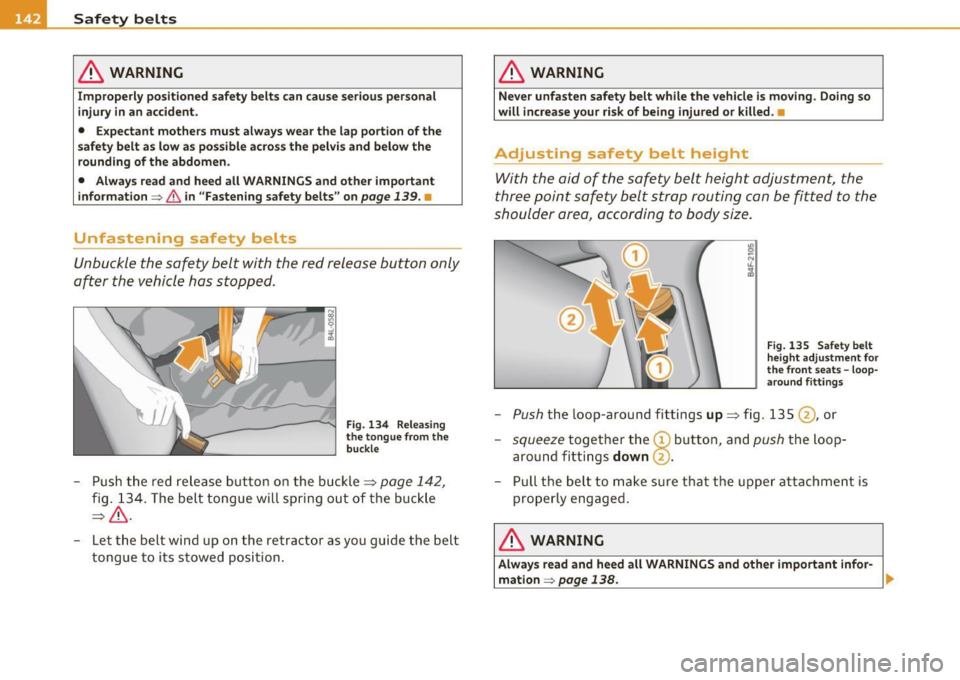
Fig. 134 Releasing
the tongue from the
buckle
- Push the red release button on the buckle ~ page 142 ,
fig. 134. The belt tongue will spr ing out of the buckle
~& -
- Let the belt wind up on the retractor as you guide the belt
tongue to its stowed position.
& WARNING
Never unfasten safety belt while the vehicle is moving. Doing so
will increase your risk of being injured or killed. •
Adjusting safety belt height
With the aid of the safety belt height adjustment , the
three point safety belt strap routing can be fitted to the
shoulder area, according to body size.
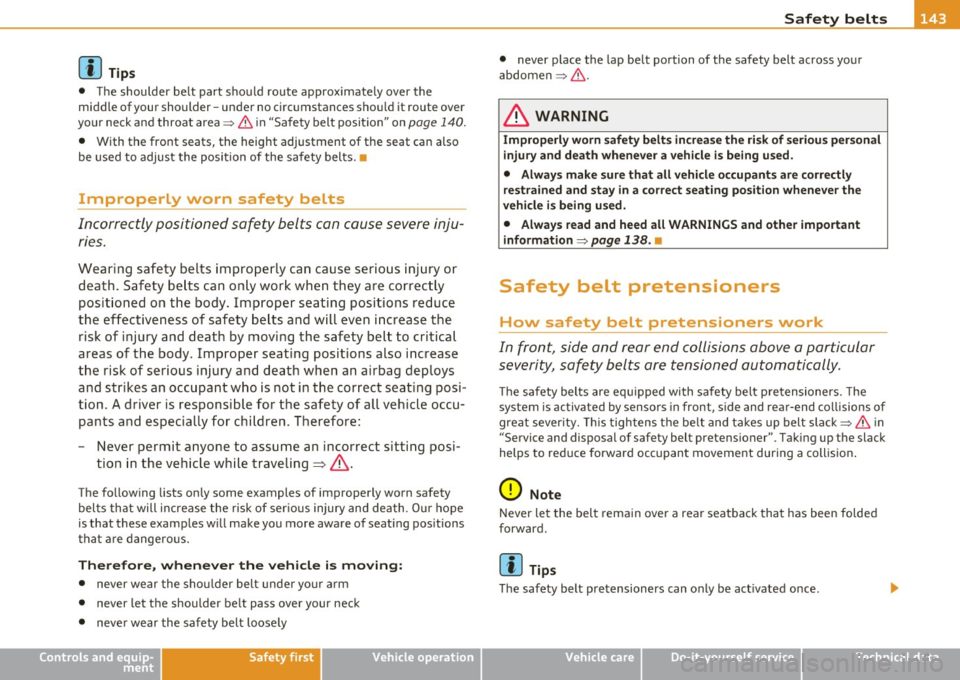
Fig. 135 Safety belt
height adjustment for
the front seats -loop
around fittings
-Push the loop-around fittings up~ fig. 135 @, or
- squeeze together the (D button, and push the loop-
around fittings
down @.
- Pull the belt to make sure that the upper attachment is
properly engaged.
& WARNING
Always read and heed all WARNINGS and other important infor-
mation ~
page 138. .,
Page 145 of 320
_____________________________________________ S_a _f _e _t _y _b_ e_lt _ s __ _
[I) Tips
• T he shoulder belt part shou ld route approximate ly over the
middle of your shoulder -under no circumstances shou ld it route over
you r neck a nd throat area~ & in "Safety belt position" on
page 140 .
• With the front seats, the height adjustment of the seat can also
be used to adjust the position of the safety belts. •
Improperly worn safety belts
Incorrectly positioned safety belts can cause severe inju
nes.
Wearing safety belts improperly can cause serious injury or
death . Safety belts can only work when they are correctly
positioned on the body . Improper seating positions reduce
the effectiveness of safety belts and will even increase the
ris k of injury and death by moving the safety belt to critical
areas of the body . Improper seating positions also increase
the risk of serious injury and death when an airbag deploys
and str ikes an occupant who is not in the correct seating posi
tion. A driver is responsible for the safety of all vehicle occu pants and especially for chi ldren. T herefore:
- Never permit anyone to assume an incorrect sitting posi-
tion in the vehicle while traveling
~ & .
The fo llowing lists on ly some examples of imprope rly worn safety
belts th at will increase the risk of ser ious injury and death . O ur hope
is that these examples w ill make you more aware of seat ing pos itions
t ha t are dangero us.
Therefore, whenever the vehicle is moving :
• never wear the sho ulder belt unde r yo ur arm
• neve r let the shoulder be lt pass ove r you r neck
• neve r wear the safety belt loosely
Controls and equip
ment Safety first Vehicle operation
•
never place the lap belt portion of the safety belt across your
abdomen ~& -
& WARNING
Improperly worn safety belt s in cre ase th e risk of seriou s per sona l
injur y and death whene ver a vehicle is being used.
• Alway s make sur e that all vehicle occupants are correctly
re st ra ined and st ay in a c orrect se ating po sition whene ve r the
vehi cle i s bei ng used .
• Always re a d and heed all WARNINGS and other important
informat ion ~
page 13 8. •
Safety belt pretensioners
How safety belt pretensioners work
In front, side and rear end collisions above a particular
severity, safety belts are tensioned automatically .
The safety belts are eq uipped with safety belt p retensioners. The
system is activated by sensors in fron t, side and rear-end collisions of
great sever ity. Thi s tightens t he be lt and takes up belt slack~ & in
"Service and disposal of sa fety belt p retens ioner". Tak ing up the slack
helps to reduce forward occupan t movement during a collis ion .
0 Note
Never le t the bel t remain over a rear seatback that has been folded
forward.
[I) Tips
The safety belt pretensioners can only be act ivated once .
Vehicle care Do-it-yourself service Technical data
Page 146 of 320
___ s_a_ f_ e_ t_ y _ b_e _l_t _s ___________________________________________ _
• In m inor frontal and side col lisions, in rear-end co llisions, in a ro ll
over and in acci dents involving very li tt le im pact force, the s afe ty be lt
pretens ioner are not activated.
• When the safety bel t pre tensione rs are activ ated, a fine d ust is
re leased . This is normal and is not caused by a fire in the ve hicle.
• T he relevan t safety req uiremen ts mus t be observed when t he
vehicle o r components of the system are scrapped. A qua lified work
shop is f amiliar wi th these reg ulat ions and w ill be pleased to pass o n
the information to yo u.
• Be sure to observe all safety, environmental and other reg ulations
if the vehicle or indiv id ual parts of the system, part icu larly the safety
bel t or airbag, are to be d isposed. We recommend you have you r
author ized A udi deale r perform this service for you .•
Service and disposal of safety belt
pretensioner
T he safety belt pre-tensioners are parts of the safety be lt and
ins talled at the outboa rd se ati ng positions on your Aud i. I nstalling,
removing, servicing or repa iring of belt pre-tensioners can damage
t he safe ty belt system and preve nt that sys tem from worki ng prop
erly in a collision.
T here are some important things you have to know to make sure that
the effectiveness of the system w ill not be impa ired and that
discarded components do not cause injury or pollute the environ
me nt.
& WARNING
Improper care , ser vicing and re pair procedures can increa se the
risk of per sonal injury and death by pre venting a safety belt
t e ns ion er from ac tivating when n eeded or activating it unex pect
edly:
& W ARNING (continue d)
• The safety belt pre-ten sioner s ystem can be ac tivated only
once. If safety belt pre-tension ers have been activated, then th ey
must be replaced.
• Never repair, ad just, or change any parts of the safety belt
s ystem.
• Safety be lt systems including safety belt p re -ten sioners
cannot be repaired. Special procedu res are required for remo val,
i ns tallation and dispo sal of thi s sy stem .
• For any work on the safet y belt system , we strongl y recom
mend that you see your authorized Audi dealer or qual ified tech
nician who has a Audi approved rep air manual, training and
special equ ipment nece ssary .
'£> For the sake of the environment
Undeployed airbag modules and pretensioners might be class ified as
Perch lorate Materia l -special handling may apply, see
www .dtsc.ca .gov/hazardouswaste/perchlorate . When the vehicle or
parts of the restraint system includ ing a irbag modu les safety belts
w ith pretensioners are s crapped, all applicable laws and regulations
must be observed. Your author ized Aud i dealer is familiar with these
req uiremen ts and we re comme nd that you have your dealer perfo rm
this serv ice for you .•
Page 147 of 320
_______________________________________________ A_ ir_ b_ a_,,,g '--- s.:.y _s _t_ e _ m ___ _
Airbag system
Important things to know
Importance of wearing safety belts and
sitting properly
Airbags are only supplemental restraints. For airbags to
do their job, occupants must always properly wear their
safety belts and be in a proper seating position.
For your safety and the safety of your passengers, before
driving off, always:
- Adjust the driver's seat and steering wheel properly
=>
page 126,
- Adjust the front passenger's seat properly=> page 74,
-Wear safety belts properly=> page 138,
-Always properly use the proper child restraint to protect
children=>
page 167.
In a collision, airbags must inflate within the blink of an eye and with
considerable force. The supplemental airbags can cause injuries if the
driver or the front seat passenger is not seated properly. Therefore in
order to help the airbag to do its job, it is important, both as a driver
and as a passenger to sit properly at all times.
By keeping room between your body and the steering wheel and the
front of the passenger compartment, the airbag can inflate fully and
completely and provide supplemental protection in certain frontal
collisions =:,
page 126. For details on the operation of the seat
adjustment controls=>
page 75.
It 's especially important that children are properly restrained
=:,
page 167.
Controls and equip ment Safety first Vehicle operation
There
is a lot that the driver and the passengers can and must do to
help the individual safety features installed in your Audi work
together as a system .
Proper seating position is important so that the front airbag on the
driver side can do its job. If you have a physical impairment or condi
tion that prevents you from sitting properly on the driver seat with
the safety belt properly fastened and reaching the pedals, or if you
have concerns with regard to the function or operation of the
Advanced Airbag System, please contact your authorized Audi dealer
or other qualified workshop , or call Audi Customer CARE at 1-800-
822-2834 for possible modifications to your vehicle.
When the airbag system deploys, a gas generator will fill the airbags,
break open the padded covers, and inflate between the steering
wheel and the driver and between the instrument panel and the front
passenger . The airbags will deflate immediately after deployment so
that the front occupants can see through the windshield again
without interruption.
All of this takes place in the blink of an eye, so fast that many people don't even realize that the airbags have deployed . The airbags also
inflate with a great deal of force and nothing should be in their way
when they deploy . Front airbags in combination with properly worn
safety belts slow down and limit the occupant's forward movement .
Together they help to prevent the driver and front seat passenger
from hitting parts of the inside of the vehicle while reducing the
forces acting on the occupant during the crash. In this way they help to reduce the risk of injury to the head and upper body in the crash .
Airbags do not protect the arms or the lower parts of the body.
Both front airbags will not inflate in all frontal collisions . The trig
gering of the airbag system depends on the vehicle deceleration rate
caused by the collision and registered by the electronic control unit.
If this rate is below the reference value programmed into the control
unit, the airbags will not be triggered, even though the car may be
badly damaged as a result of the collision . Vehicle damage, repair
9J),
Vehicle care Do-it-yourself service Technical data