starting AUDI A3 2011 Owner´s Manual
[x] Cancel search | Manufacturer: AUDI, Model Year: 2011, Model line: A3, Model: AUDI A3 2011Pages: 320, PDF Size: 75.79 MB
Page 4 of 320
Table of contents
Table of contents
Vehicle literature ..... .
About this Owner's Manual ............. ...... .
Controls and
equipment .............. .
Instruments and controls ... .
General illustration ........... .
Instruments and
warning/indicator Lights ..... .
Instruments ................ .
Warning/indicator ligh ts ...... .
Driver information display ... .
Introduction ............ ... . .
On-Board Diagno stic system
(OBD) ....................... .
T rip com puter .............. . .
Menu display ................ .
Eff iciency program ........ ... .
Service interval display ....... .
Speed warn ing system ........ .
Warning s and symbol s ... .... .
Opening and closing ......... .
Keys ........................ .
Power locking system ........ .
Doo rs, power locks ......... .. .
Power windows .............. .
Panoram ic sliding sunroof ..... .
Emergency mechanical closing for
th e panoramic sliding su nroof .. 4
s
6
7
7
8
8
11
18
18
20
21
22
2S
27
28
30
38
38
40
4 3
49
Sl
S3
Clear vision .................. .
Lights ...................... .
Interior lights ............... .
V is ion ...................... .
M irrors ... ............ ...... .
Wiper and washer sys tem .... .
D igita l compass ............. .
Seats and storage ........... .
General recommendat ions .... .
Adjust ing front seats manually .
Adjusting the power seat ..... .
Adjus ting the lumbar support ..
Head restrain ts .............. .
C ent er armrest ........... ... .
Rear seats ............. ..... .
Lug gage compartment ....... .
Roof rack• inst alla tion ....... . .
Cup holde rs ........... ...... .
Socket .................. ... .
Storage ............. ....... .
Warm and cold .............. .
Climate contro ls ...... ... .. .. .
E lectrica lly heated front seats ..
Engine preheater ............ .
On the road ............ ..... .
Steering .................... .
Ign ition lock and ign ition switch
Start in g and stopping the engine
Parking brake ............... .
Starting on hills .......... ... .
C ru ise con trol ............... .
Audi magnetic r ide ........... .
Transmission ................ .
Manual transm ission
S6
S6
60
63
63
65
71
73
73
74
75
77
77
79
80
81
86
89
90
91
95
95
103
1 03
lOS
105
106
10 7
108
110
110
112
114
114
S tronic transmission . . . . . . . . . . 115
Safety first ............... 124
Driving Safely ................. 124
Gen eral notes ................. 124
Prop er occupant seating
posit ions ...... ............ ...
126
Pedal area ............ ........ 130
Stowingluggage .............. 131
Reporting Safety Defects ..... .. 133
Safety belts .................. . 135
General notes .............. ... 135
Why safety belts? ............. 136
Safety belts ... ............... . 139
Safety belt pretensioners . . . . . . . 143
Airbag system .......... ...... 145
I mportant things to know . . . . . . 145
Front airbags . . . . . . . . . . . . . . . . . 149
Mon itoring the Advanced A irbag
System ......................
156
Side airbags .............. .... 161
Side curtain airbags . . . . . . . . . . . . 164
Child Safety ................... 167
Important things to know ...... 167
Child safety seats . . . . . . . . . . . . . . 172
Installing a chi ld safety seat . . . . 177
LA TCH Lower anchorages and
t ethers for child ren . . . . . . . . . . . .
180
Add itiona l Information . . . . . . . . . 186
Page 5 of 320
Vehicle operation ...... 188
Inte lligent tec hno logy ....... . 188
Notice abou t da ta recorded by
vehicle control modules . . . . . . . . 188
Electronic Stab ili z ati on Program
(ESP) ................ ........ 188
Braking ...................... 191
E lec tro-mec hanic al power assist 193
Dr iving with your qua ttro ® ...... 194
Energy management ........ ... 194
D rivi ng a nd env iro nm ent ...... 197
T he firs t 1,000 miles (1,500 km)
and af terwa rds ............... 197
Catalytic converter ...... ... ... 1 98
Diesel part iculate filter ......... 199
Avoid damaging the veh ic le ..... 199
Opera te your veh ic le econom ically
and m inimize pollution . . . . . . . . . 200
Trailer towing ................. 202
Driving with a trailer . . . . . . . . . . . 202
Trailer towing tips . . . . . . . . . . . . . 204
Vehicle care .......... .... 206
Cleaning and protect ion .. ..... 206
G eneral informat ion . . . . . . . . . . . 206
Care of exterior . . . . . . . . . . . . . . . 206
Care of interior ........... ..... 213
F uel sup ply and filling y our fuel
tank ....... .............. ..... 219
Gasoline ..... ......... ....... 219
Diesel fuel . . . . . . . . . . . . . . . . . . . . 220
F u el tank . ... ......... ........ 221
Checking and filling ........... 225
Engine hood . . . . . . . . . . . . . . . . . . 225
E ngine compartment .......... 227
E ngi ne oil . . . . . . . . . . . . . . . . . . . . 228
Controls and equip
ment Safety first
Engine
cooling sys tem . . . . . . . . . 234
Brake fl uid ................... 237
Battery . . . . . . . . . . . . . . . . . . . . . . 238
Windshield washer container . . . 243
T ires and whee ls .............. 245
T ires . . . . . . . . . . . . . . . . . . . . . . . . 245
Tire pressure monitoring system 264
Do-it-yourself service . 270
What do I do now? . . . . . . . . . . . 270
Jack, tools and spa re whee l . . . . . 270
Compac t spare wheel .......... 271
Wheel change ................ 272
Fuses a nd bul bs . . . . . . . . . . . . . . 281
E lec trica l fuses ............... 281
Bulbs ........................ 285
E merg ency si tuati ons . . . . . . . . . 286
G eneral . . . . . . . . . . . . . . . . . . . . . . 286
Starting by pushing or towing
Starting with jumper cables ....
General info rma tion of starting
assistance .................. .
Us e of j umper cab les ......... .
Emergency tow ing w ith
comme rcial tow truck ........ .
Lif ting the vehic le ............ .
Technical data
General in formatn on
Explanation of technical data .. .
Vehicle identification ......... .
Weights .................... .
Dimensions 286
286
287
288
289
292
294
294
294
294
295
295
Table of contents
Data .
. . . . . . . . . . . . . . . . . . . . . . . . . 296
200 hp , 2.0 liter 4-cyl. turbo
gasoline engine . . . . . . . . . . . . . . . 296
140 hp, 2.0 TOI l iter 4-cyl. turbo
clean diesel engine . . . . . . . . . . . . 298
C o nsumer Inform ati on . . . . . . . 299
Warranty coverages . . . . . . . . . . . 299
Operating your vehicle outside the
U.S.A. or Canada . . . . . . . . . . . . . . 299
Aud i Service Repair Manuals and
Li tera ture . . . . . . . . . . . . . . . . . . . . 299
Maintenance . . . . . . . . . . . . . . . . . 299
Add itional accessories,
modif ications and parts
replacemen t . . . . . . . . . . . . . . . . . 301
Alphabetical index . . . . 304
Vehicle operation Vehicle care Do-it-yourself service Technical data
Page 35 of 320
If the generator warning/indicator light shou ld also illuminate
=> page 15, t hen t he fan belt m ay be damaged .
& WARNING
• If your vehicle should break down for mechanical or other
reasons , pa rk at a safe distance from mo ving traffic, turn off the
engine and turn on the hazard warning lights=>
page 59, "Emer
gency flasher
A. ".
• Never open the hood if you see or hear steam or coolant
escaping from the engine compartment -you risk being scalded.
Wait until you can no longer see or hear steam or coolant
escaping .
• The engin e compartment of any vehicle i s a dangerou s ar ea .
Before you p erform any work in the engine compartment , turn off
the engine and allow it to cool. Follow the warning sti ckers
=> page 218 , "Engine compartment ".
0 Note
Do not continue driving if the -¥- symbol illuminates . There is a
ma lf u nction in the engine coo ling sys tem -yo u could damage your
eng ine. •
Engine oil pressure malfunction ~
The red engine oil pressure warning symbol requires
immediate se rv ice o r repair.
If the 9=r. symbo l app ears in the d is pl ay a nd flash es, th e oil
p ressure is to o lo w . In add ition to the sym bol, the f ollow ing
messag e al so a pp ea rs in the dis play :
Switch off engine and check oil level
- P ull off the road a nd stop t he ve hicle.
Controls and equip
ment Safety first
Driver information display
-
Shut the eng ine down .
- Check t he eng ine oi l level=>
page 231 .
-Contact your authorized Aud i dea le r for assis tance i f
necessary .
Engine o il level too low
If the eng ine oi l leve l is too low , top off oil to t he p roper level
=>page 232.
Engine oil level OK
If the 't'!::;r. symbol starts flashing again even thoug h the engine oil
level checks O K on t he d ipstick,
do not start driving again and do not
let the engine run at idle .
Instead, contact you r authorized Audi
dealer fo r assis tance.
[ i ] Tips
• The engine oil pressure symbol 'I=:?: is not an indic ato r for a low
engine oil level. Do not rely on it . Instead , check the oil level in your
engine at regular intervals , preferably each t ime you refuel, and
always before going on a long tr ip .
• The yellow oil level warning indication requires oil refill or
workshop service without de lay . Do not wait until the red oil pre s
s ure warning symbol~ starts to flash before you respond to the
low oil level warning _, . By then, your engine may already have
s uffered serious damage. •
Applies to vehicles: with manual trans miss ion
-;y Clutch pedal
T he indica tor lig ht illuminates if you do no t press t he cl utch pedal
when starting the engine . For safety reasons, the engine will only
sta rt when the clut ch pedal is pressed. •
Vehicle care Technical data
Page 51 of 320
Power windows
Controls
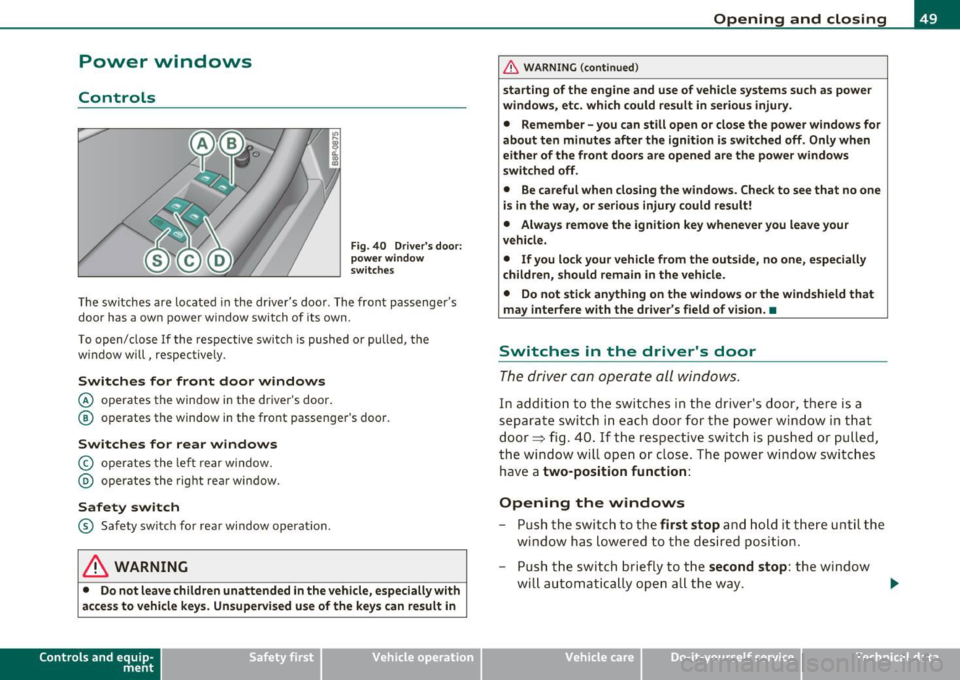
Fig. 40 Dri ver's door:
power wind ow
swit ches
T he switches are located in the dr iver 's doo r. The front passenger's
door has a own power w indow switch of its own .
T o open/ close If the respective swi tch is pu shed or pulled, the
window will, respectively .
Switches for front door windows
© operates the window in the driver's door .
@ operates the window in the front passenger's door.
Switches for rear windows
© operates the lef t r ear w indow.
@ operates the rig ht rea r window.
Safety switch
® Safety switch for rea r window operat ion .
& WARNING
• Do not leave children unattended in the vehicle, esp ecially with
ac ce ss to vehicle key s. Unsupervi sed use of the keys can re sult in
Con tro ls a nd e quip
m en t Vehicle
OP-eration
Opening and closing
& WARNI NG (continued )
starting of the engine and use of vehicle systems such as power
windows, et c. whi ch could result in seriou s injury.
• Remember -you can still open or clo se the power windows for
about ten minutes after the ignition is swit ched off . Only when
eithe r of the front doors are opened are the powe r windows
s witched off .
• Be ca reful when closing the windows . Chec k to see that no one
is in the way, or serious injury could result!
• Alway s remo ve the ignition key whene ver you leave your
veh icle.
• If you lo ck your vehicle from the out side, no one, e specially
children, should remain in the vehicle .
• Do not stick anything on the windows or the windshield that
may interfere w ith the driver 's field of vision. •
Switches in the driver 's door
The d riv er can operate all windo ws.
In additi on to th e switches i n the driver's d oor, t here is a
separate switch in each door fo r th e po wer wi ndow in that
door~ fig. 40. If the respective switc h is pus hed or p ulled ,
the window will open or c lose. The power window switc hes
have a
two-position function:
Opening the windows
- Push th e switch to th e first stop an d h old it there until the
window has l owere d to the d esired position.
- Push t he swi tch briefly to t he
second stop : the window
wi ll automati ca lly op en all th e way .
Vehicle care Do-it-yourselt service iTechnical data
Page 54 of 320
Opening and closing
Opening manually (manual operation)
- Press the switch (D => page 51, fig. 42, starting from the
"lift position" until the roof has reached the desired posi
tion.
Closing completely
- Press the switch @=> page 51, fig. 42 until the roof is
completely closed=>& .
Closing partially
- Press the switch @=> page 51, fig. 42 until the roof has
reached the desired position =>& . If the roof is almost
closed and you interrupt the operation, the roof opens
automatically to a minimum setting; this is the smallest
possible opening that can be set.
If you pa rk your vehicle in the su n, we recommend that you close the
sun blind . You should especially make certain that the panoramic
sliding sunroof is closed when the sun blind is closed when parked or
if there is a sudden rain shower.
The sun blind has two positions: comp letely open or completely
closed. The sun blind is manually operated.
& WARNING
Never close the panoramic sliding sunroof carelessly or without
watching -the re is a risk of personal injury. For this reason, always
remove the ignition key when leaving the vehicle.
[ i ] Tips
• When you park your vehicle , we generally recommend closing the
panoramic sliding sunroof and the sun blind . •
When the vehicle is parked, a wet roof should be dried lightly with
a soft cloth
before it is opened so that water does not drip into the
interior .
• In an emergency, the panoramic sliding sunroof can be closed
manually=>
page 53, "Emergency mechan ical closing for the
panoramic slidi ng sunroof". •
Appli es to vehicles : wit h pa norami c sli ding s unroo f
Comfort closing
The open roof can also be closed from the outside.
-Hold the key in the driver's door lock in the lock position
until the roof is closed=> &.
& WARNING
Never close the panoramic sliding sunroof carelessly or without
watching -there is a risk of personal injury.•
Page 58 of 320

Clear vision
Clear vision
Lights
Switching the headlights on and off ·"ti-·
!
-ti. ID
panel: light switch
Fig. SO Instrument
panel: Light swit ch
with daytime running
lights (DRL )
The light switch must not be overturned past the stops in
either direction.
Switching on automatic headlight control*
-Turn the light switch to AUTO* =:> fig. 49.
Switching on the side marker lights
- Turn the light switch to ~oo~.
Switching on the headlights and high beam
-Turn the light switch to io.
Push the high beam lever forward towards the instrument
panel=:>
page 59 .
Switching off the lights
-Turn the light switch to 0.
The headlights only work when the ignition is switched on . While
starting the engine or when switching off the ignition, the headlights
w ill go off and only the side marker lights will be on.
Daytime running lights (DRL) (USA models)
The daytime running lights can be turned on or off using this func
tion. If the function is active, the daytime running lights are turned
on automat ically when the ignition is switched on .
The daytime running lights are activated
only when the light switch is
at the
AUTO* or DRL * position .
Daytime running lights (Canada models only)
The daytime running lights are act ivated only when the light switch
~ fig. 49 is either at the O or the ~oa; position.
The daytime running lights function cannot be turned off.
Automatic headlight control*
In the switch position AUTO the automatic headlight control is
turned on . The low beams are turned on automatically through a light
sensor as soon as ambient brightness (e.g . when driving into a
tunnel) falls below a value preset at the factory. When ambient .,_
Page 106 of 320
1111....__w __ a _r_ m __ a_n_ d_ c_ o _ l_d _______________________________________________ _
• Connect the connect ing cab le to the powe r cord .
• Atta ch t he exte nsion s co rd to the co nne ctor c able. A lw ay s use a
12 gauge or heav ie r heavy-duty extension cord that can be properly
gro unded to a three -prong Groun d Faul t C ircuit (G FI) w all o utle t a nd
is not longer than 100 ft (30 meters) .
• Alw ays pl ug th e p rehe ater into an 12 0 Vol t Grou nd Faul t Circui t
(GFI) wall o utlet t hat is properly protected against rain and other
mois ture . Neve r plug t he prehea ter in to a norm al ou tle t rega rdles s of
w het her it is grounded or not .
• Alw ay s dis con nect the co nne ct ing cable and close the cover
=> page 103, fig. 105 (D be fore starting the engine.
& WARNING
Using incorrect or damaged outlet and power cords, using elec
trical accessories incorrectly or ignoring safety precautions can lead to short circuits, accidents, injuries and life-th reatening elec
tric shocks.
• Always plug the preheater into a 120 Volt Ground Fault Circuit
( GFI) wall outlet that is properly protected against rain and other
moisture.
• Always check the fuse protection of the 120 Volt power source
before using the connecting cable.
• Always use a 12 gauge or heavier heavy-duty extension cord
that can be properly grounded to a three-prong GFI outlet. The
extension cord must not be longer than 100
ft (30 meters ).
• Always connect the cable to a 120 Volt outlet that is grounded
and protected from water .
• Check the cable for damage before every use. Never use a
damaged cable. It must be replaced. Please see your authorized
Audi dealer.
• Only use the cable provided*.
• Always remove the conne cting cable before starting the
engine.
& WARNING (co ntinued )
• Never attempt to alter or repair electrical components. •
Page 108 of 320
ffl..__O_ n_ t_h _e_ r_o _ a_ d _________________________________________________ _
Ignition Lock and ignition switch
Ignition lock
The engine can be started or turned off with the ignition
key.
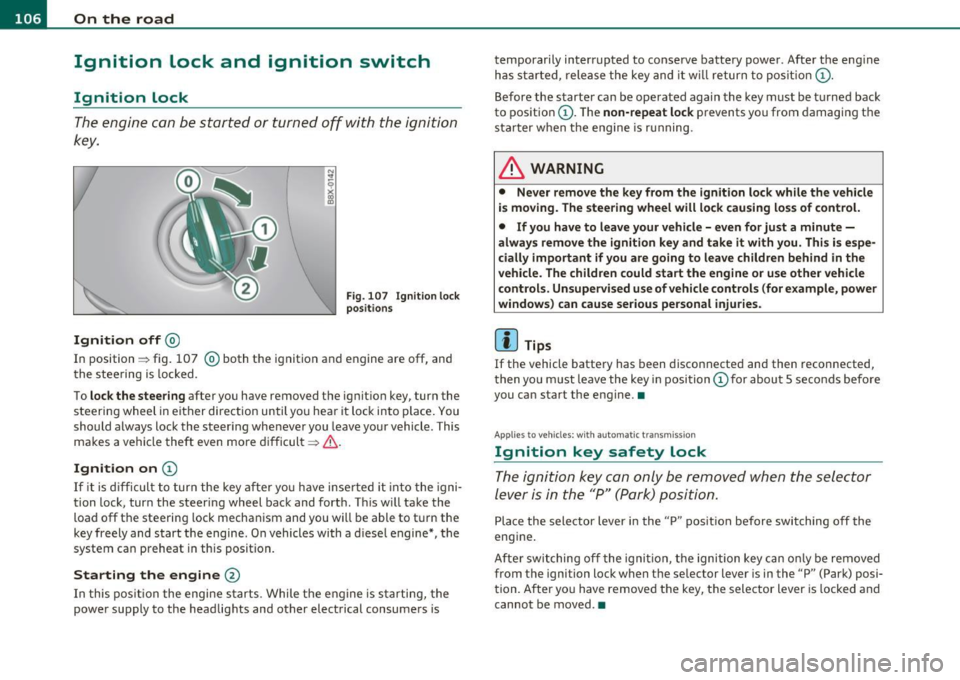
Ignition off@
Fig. 107 Ignition l ock
p ositions
In position => fig. 107 @ both the ignition and engine are off, and
the stee ring is locked .
To
lock the stee ring after you have removed the ig nit io n key, turn the
steeri ng wheel in either direction until yo u hear it lock into place . You
should always lock the steering whenever you leave your vehicle . This
makes a vehicle theft even more difficult=> & .
Ignition on (D
If it is d ifficul t to turn the key af ter yo u have inse rted it in to the igni
tion lock, tur n the steering wheel back and forth . T hi s w ill take the
load off the steering lock mechanism and you wi ll be able to t urn the
key freely and start the engine . On vehicles with a d iese l engine *, t he
system ca n preheat in this position .
Starting the engine@
In this pos it ion the engi ne s tarts. While the e ngine is s ta rting, the
power supply to the headlights and other electrical consume rs is temporarily interrupted to conserve ba
ttery power . Afte r th e eng ine
h as st arted, relea se the key and it w ill retur n to posit io n (D .
Before the starter can be operated again the key must be t urned back
to positio n (D . T he
non-repeat lock prevents you from damaging the
s ta rt er when t he e ng ine is running .
& WARNING
• Never remove the key from the ignition lock while the vehicle
i s moving . The steering wheel will lock causing loss of control.
• If you have to leave your v ehicle -even for ju st a minute -
always remove the ignition key and take it with you. This is espe·
cially important if you are going to leave children behind in the
vehicle. The children could start the engine or use other vehicle
control s. Unsupervised use of vehicle controls (for example, power
windows ) can cause serious personal injuries .
(I) Tips
If the vehicle battery has been disconnected and then reconnected,
t hen yo u m ust leave the key in posi tion (Dfor abou t
5 seco nds befo re
you can start the eng ine. •
App lies to vehicles: with automat ic transmission
Ignition key safety lock
Th e ignition k ey can only b e removed when the selector
lever is in the "P" (Park) position.
Pla ce the selector lever i n the "P " pos it ion before swit ching off the
eng ine .
Afte r sw itching of f the igni tion , th e ignition key can o nly be re moved
from the ignition lock when t he selector lever is in the "P" (Park) posi
t ion. After yo u have remove d the key, t he selector lever is locked a nd
cannot be moved .•
Page 109 of 320
_________________________________________________ O_ n_ t_ h_ e_ r _o_ a_d _ __.fflll
Starting and stopping the engine
Starting the engine
The engine can only be started with your original Audi
key.
N ... q
i
Vehicles with a gasoline engine:
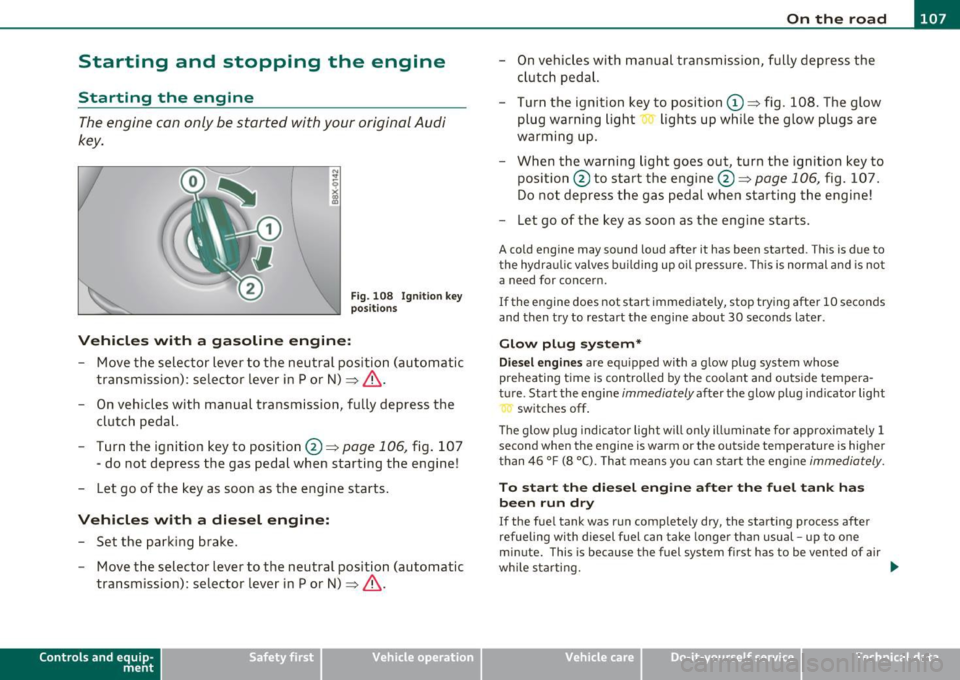
Fig . 10 8 Ignition key
p osit ion s
- Move the selector lever to the neutra l position (automatic
transmission): selector lev er in P or N) =>
& .
- On vehicles with manual transmission, fully depress the
clutch pedal.
- Turn the ignition key to position@ =>
page 106, fig. 10 7
- do not depress the gas pedal when star ting t he engine!
- Let go of the key as soon as the engine starts .
Vehicles with a diesel engine:
- Set the park ing b rake .
- Move the selector lever to the neutral position (automatic
transmission): selector lever in P or N) =>
& .
Con tro ls a nd e quip
m en t Vehicle
OP-eration
- On vehicles with manual transmission , fu lly depress the
cl utch peda l.
- Turn the ignition key to posi tion
(D => fig . 108. The g low
plug warning light lights up whi le the glow plugs are
warming u p.
- When the warning light goes out, turn the ig nition key to
posi tion @to start the engine @ =>
page 106, fig. 107 .
Do not depress t he gas pedal when starting t he engine!
- Let go o f the key as soon as the engi ne starts.
A cold engine may sound loud after it has been started . Th is is due to
t he hydra ulic valves buil ding up oil p ress ure. This is normal and is not
a need for concern.
If the engine does not start immediately, stop try ing after 10 seconds
and then try to restart the engine about 30 seconds later .
Glow plug system*
Diesel engines are equipped with a glow p lug system whose
preheating t ime is con trolled by the coo la nt and outs ide tempera
t u re . Start the engine
immediately af ter the glow p lug ind icator light
sw itches off .
Th e g low pl ug indica tor light w ill only ill uminate fo r approximately 1
second when the engine is warm or the outs ide temperature is higher
than 46 °F (8 °C). Tha t means yo u ca n sta rt the engi ne
immediately.
To start the diesel engine after the fuel tank has
been run dry
If the fue l tank was run complete ly dry, the start ing process after
refueling with diesel fuel can take longe r than usual -up to one
minute. This is because the fuel system first has to be vented of air
wh ile starting. _,.
Vehicle care Do-it-yourselt service Technical data
Page 110 of 320

ffl..__O_ n_ t_ h_e _ ro_ a_d _______________________________________________ _
& WARNING
Never start or let the engine run in a confined or enclosed area.
Exhau st fume s from the engine contain carbon monoxide, a color
less and odorless gas. Carbon monoxid e can be fatal if inhal ed.
• Never leave the engine idling unattended . An unattended
vehicle with a runn ing engine poses a danger of personal injury or
theft .
0 Note
• Avoid high engine speeds, fast acceleratio n or heavy engine loads
w hile the engine is still cold. This cou ld damage the eng ine .
• Th e engine c annot be sta rted by p ush ing or tow ing the veh icle .
~ For the sake of the environment
To avoid unnecessary engine wear and to reduce e xhaust emissions,
do not let your vehicle stand and warm up . Be ready to dr ive off imme
diately after starting your vehicle. Maintain moderate speed unti l the
eng ine is comp letely warm . Remember, the engine performs best at
operat ing temperature. •
Stopping the engine
-Turn the ignition key to position @~poge 106, fi g. 107 .
& WARNING
• Nev er turn off the engine until the vehicle has come to a
c omplete stop.
• The brake booster and servotronic only work when the eng ine
i s running . With the ignition turned off , you have to apply more
force when steering or bra king. Since you cannot st eer and stop
normally , thi s can lead to accident s and serious injuries.
& WARNING (contin u ed )
• The radiator fan can continue to run for up to 10 minute s even
a fter you have turned off the engine and removed the ignition key.
The radi ator fan can also tur n on agai n if the engine coolant heats
up be cause of intense sunlight or heat build-up in the engine
compartment.
0 Note
Do not stop the engine immed iately after hard or extended driving.
Keep t he engine run ning for approximate ly two minutes to prevent
excessive hea t build-up. •
Parking brake
Parking brake
When the parking brake is set, it prevents the vehicle
from rolling a way unintentionally .
Setting the parking brake
Fig. 109 Cente r
c o ns ole : Pa rk ing brak e
s et
- Pull t he park ing b rak e l eve r all the way up .