light AUDI A3 2012 Owner´s Manual
[x] Cancel search | Manufacturer: AUDI, Model Year: 2012, Model line: A3, Model: AUDI A3 2012Pages: 280, PDF Size: 70.11 MB
Page 209 of 280

@ For the sake of the environment
Because of the problem of proper disposal
of brake fluid as we ll as the special tools
req uired and the necessary expert ise, we
recommend that you have the brake fluid
changed by your author ized Audi dealer.
Battery
General information
All work on the battery requires technical
knowledge!
F ig . 1 64 Eng ine co mpa rtment: Batte ry w it h cover*
The battery is located in the engine compart
ment
c::> fig. 164 and is near ly m ain te nance
fre e.
The condition of the battery is checked in the
framework of the inspection.
Disconnecting the battery
The batte ry should not be disconnected. Some
ve hicl e functions such as power windows are
unavailable if the battery termina ls are dis
connected. These funct ions have to be re
l earned after the battery term inals are con
nected aga in. To prevent this, the battery
should only be disconnected from the vehicle
electrical system if absolutely necessary .
Function
Power window
one-touch up/
down function
Master key with
remote control
Reprogramming
c::, page 45, Reactivating
the system after battery
disconnection
Synchronization
~page 38
Checkin g and fillin g 207
Reprogramming
Digita l clock c::, page 11
ESP indicator light The indicator ligh t goes
out after driving a few
meters
Vehicl es not driven for long periods and
sho rt -d is tance op eration
If you do no t drive your vehicle for several
days or weeks, electrical consumers are grad
u ally scaled back or switched off . This reduces
energy use and ensures the vehicle will be
able to start after long periods of time
c::, page 167. Some convenience functions
such as opening w it h the remote control key
may not be available. These conve nience func
tions wi ll be available again once you switch
the ignit io n on and sta rt the engine. Even
whe n consume rs a re switched off, the battery
will become deeply discharged by stand -by
power consumers if the vehicle is not driven
for several months . Deep discharging results
in a chemical reaction that destroys the inside
of the battery. The battery must be charged
every month to prevent th is
c::, page 209. Do
not disconnect the battery or the anti-t heft
alarm system* will not work .
Winter operation
Cold weather places higher demands on the
battery. This results in reduced starting abili
ty. Have the battery checked and recharged if
necessary befo re the cold weather begins.
Avoid unnecessary power consumpt ion, par
ticularly in city traffic or when traveling only
short distances . Let your authorized Audi
dealer check the capacity of the vehicle bat
tery before winter sets in
c::, page 209 . A well
c harged bat tery will not o nly prevent s tarti ng
problems when the weather is cold, but will
also last longer .
(D Note
-All wo rk on the batte ry requ ires techn i
cal know le d ge. P lease con ta ct an Audi
dealership or another authorized fa cility
lill>
Page 211 of 280

-When a battery is charged, it produces
hydrogen gas which is explosive and
could cause personal injury.
- Always keep the battery well out of the
reach of children.
- Before work is done on the electrical sys
tem, disconnect the negative ground ca
ble.
- Before performing any work on the elec
trical system, switch off the engine and
ignition as well as any electrical equip
ment. The negative cable on the battery
must be disconnected. If you are just go
ing to replace a light bulb, then it is
enough to switch off the lights.
- Before disconnecting the battery, switch
off the anti-theft alarm system! Other
wise you will set off the alarm.
- When disconnecting the battery, first
disconnect the negative cable and then
the positive cable.
- Before reconnecting the battery, make
sure all electrical consumers are switch
ed off. Reconnect the positive cable first
and then the negative cable. Never inter
change the cables -this could start a fire!
- Never charge a frozen or a thawed-out
battery. It could explode! If a battery has
frozen, then it must be replaced. A dis
charged battery can freeze over at
32 °F
(0 oc).
-Mak e sure the vent hose is always attach
ed to the opening on the side of the bat
tery.
- Never use batteries which are damaged.
There is the danger of an explosion! Al
ways replace a damaged battery.
_& WARNING
California Proposition 65 Warning:
- Battery posts, terminals and related ac cessories contain lead and lead com
pounds, chemicals known to the State of
California to cause cancer and reproduc
tive problems. Wash hands after han dling.
Checking and filling 209
(D Note
- Do not disconnect the vehicle battery
when the ignition is switched on or when
the engine is running, otherwise, you will
damage electronic components in the
electrical system.
- When working on the engine, protect the
battery housing from ultraviolet (UV)
rays by not parking the vehicle in direct
sunlight .
- If your vehicle is going to stand for a
long period of time without being driven,
protect the battery from "freezing", oth
erwise it will be damaged and will then
have to be replaced
~ page 209.
Charging of battery
All work on the battery requires technical knowledge!
Fig. 165 E ngine compart ment: conne ctors for a charg
er and jump start cables
A charged battery ensures good starting per
formance . A discharged battery can
freeze at
temperatures of only
O 0C. A frozen or thawed
battery must be replaced, as the battery
housing may be cracked due to freezing and
could therefore leak acid.
.,. Always read and heed all WARNINGS be
low~ .&, and ~.&, in
Working on the bat
tery on page 208.
... Switch off the ignition and all electrical con
sumers .
.,. Make sure the area is well ventilated when
you charge the battery.
.,. Connect charger cables.
Charger cables
must always be connected POSITIVE
G to ..,.
Page 219 of 280
Tires an d wheel s 21 7
labe l and exact location on the vehicle will
vary slightly).
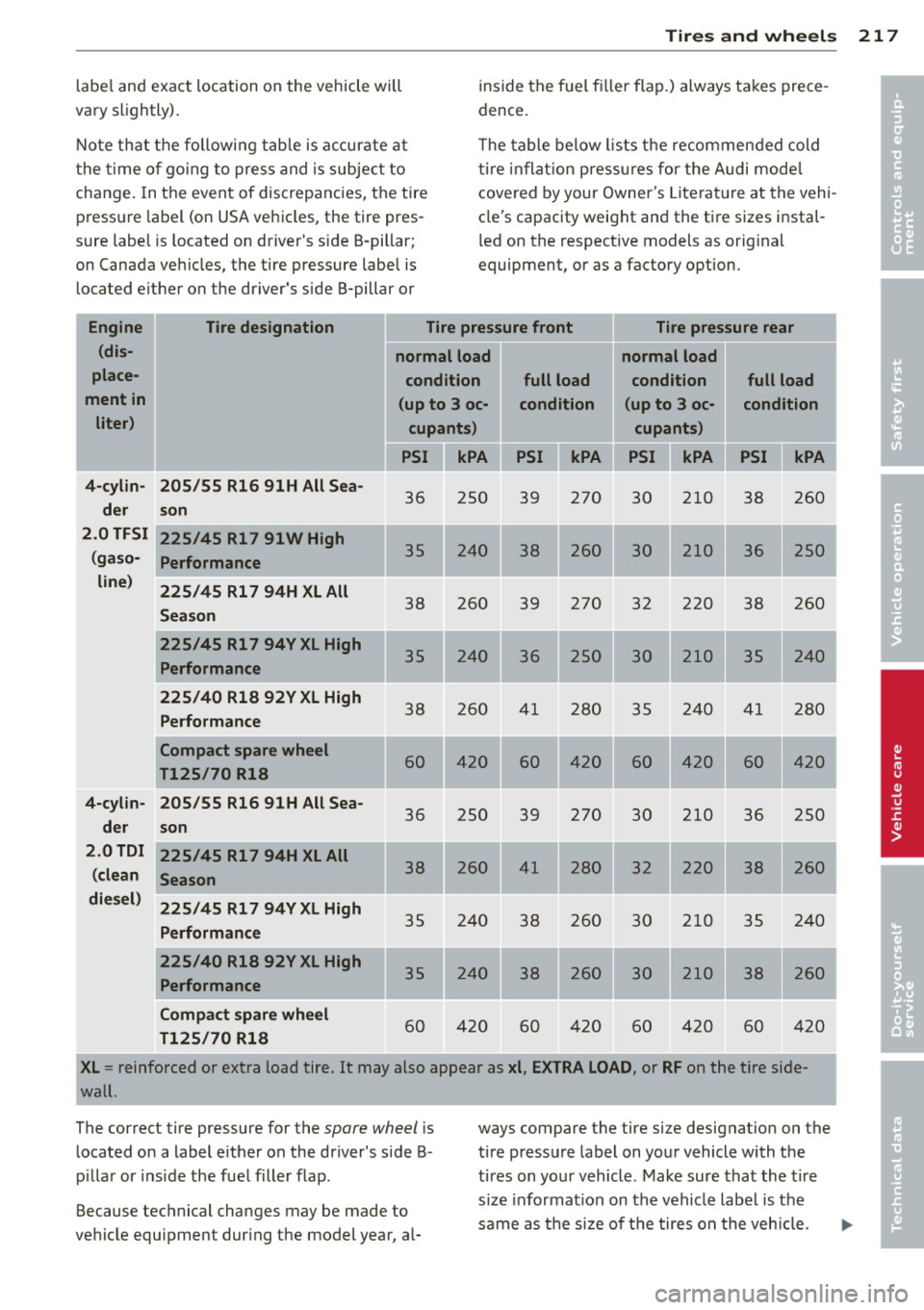
Note that the fo llowing tab le is accurate at
t he t ime o f go ing to press and is subject to
change. In the event of discrepancies, the tire
pressure label (on USA vehicles, the tire pres
sure label is located on driver's side B -pillar;
on Canada vehicles, the tire pressure label is
located e ither on the driver's side B-pillar or inside the f
uel filler flap.) always takes prece
dence.
T he table below lists the recommended cold
ti re inflat ion p ressu res for the Audi mode l
cove red by your Owner's Literat ure at the vehi
cle's capacity weight and the tir e sizes instal
l ed on the respect ive models as orig inal
equipment, or as a factory option.
Engine
(dis
place
ment in liter ) Tire designation
Tire pressure front Tire pressure rear
4- cylin
d er
2.0 TFSI (ga so
line )
4-cylin -
der
2 .0
TOI
(clean
die sel) 205
/55 Rl6 91H All Sea-
son
2 25 /45 Rl7 91W High
Performance
22S /45 Rl7 94H XL All
Season
225 /45 Rl7 94Y XL High
Performance
225 /40 Rl8 92V XL H igh
Perfo rmance
Compact spare wheel
Tl25 /70 Rl8
205 /S5 Rl6 91H All Sea-
s on
225 /45 Rl 7 94H XL All
Season
225 /4S Rl 7 94V XL High
P erformance
225 /40 Rl8 92V XL High
Performance
C ompa ct spare whe el
Tl25 /70 Rl8 no
rmal load
condition
( upto 3 oc-
cupant s)
PSI kPA
36 250
•
JI
35 2 40
38 260
35 240
38 260
60 420
36 250
38 260
35 240
35 240
60 420
normal load
full load condition full load
condition (up to 3 oc- condition
cupant s)
PSI kPA PSI kPA PSI kPA
39 270 30 210 38 260
..
38 260 30 210 36 250
"
39 270 32 220 38 260
36 250 30 210 35 240
41 280 35 240 41 280
60 420
60 420 60 420
39 270 30 210 36 250
41 280 32 220
38 260
38 260 30 210 35 240
38 260 30 210 38 260
60 420 60 420 60 420
X L = reinforced or extra load tire. It may also appear as xl, EX TRA LOAD , or RF on the tire side
wall.
The correct tire pressure for the spare wheel is
located on a label e ither on the driver's side B
p illar or i nside the fuel filler flap . ways
compare the tire size designatio n on the
tire pressure label on your vehicle with the
tires on yo ur vehicle . Make sure that the t ire
s ize informat ion on the vehicle labe l is the
I
J
•
I
Because technical changes may be made to
vehicle equipment during the model year, al- same as the size of the tires on the veh
icle. .,.
•
•
Page 221 of 280

used today are underinflated just by looking
at them.
Therefore, be sure to check tire pressures at l eas t once a mon th and always before going
on a long trip. Make sure to take the number
of people and the amount of luggage into ac
count when adjusting tire pressure for a trip -
even one that you would not consider to be
"long." See ¢
page 220, Tires and vehicle
load limits
for more important information .
A lways use an accurate tire pressure gauge
when check ing and adjusting inflation pres
sures . Check all of the tires and be sure not to
forget the spare t ire . If the pressure in any tire
is too high when the tire is "cold," let air out
of the tire slowly with the edge of the t ire
gauge and keep checking the pressure until
you reach the p ress ure th at is cor rect for the
l oad (passengers and luggage) and kind of
driving you plan to do .
I f the p ressu re in any tire is too low , note the
d ifference between the pressure in the cold
tire and the pressure you need and add the air
that you need to reach the correct pressure for
the vehicle load (passengers and luggage) for
the tires on your vehicle as listed on the on
your veh icle and in this manual and the kind
of dr iving you p lan to do.
Never e xceed the m aximum inflation pre s
su re li sted on th e tir e side wall for any rea
son.
Remember that the vehicle manufacturer, not
the tire manufacturer, determines the co rrect
tire p ressure for the tires on your vehicle .
It is important to check the tire pressure when
the tires are cold .
- Read the requ ired ti re p ressu re from the tire
pressure label. On USA veh icles, the t ire
pressure label is located on driver's side 8-
pillar . On Canada vehicles, the tire pressure
label is located either on the driver's side 8-
pillar or inside the fuel fi ller flap.
- Turn the valve stem cap counter-clockwise
to remove it from the tire valve.
- Place the air pressure ga uge on the valve.
Tire s an d wheel s 219
- The tire pressures should only be checked
and adj usted when the tires are co ld . The
slightly raised pressures of warm tires must
not be reduced.
- Adjust the tire pressure to the load you are
carrying.
- Reinstall the valve stem cap on the va lve.
When should I check the tir e pressu re?
T he co rrect tire pressu re is especially impor
tant a t high speeds. The pressure should
therefore be checked at least once a month
and always before starting a jo urney . Do not
forget to check the tire pressure for the spare
whee l
¢page 234.
When should I adjust the tire pres sur es?
Adjus t the t ire press ure to the load you a re
carrying . After changing a whee l
or rep lacing
whee ls you have to adjust the tire pressu res
on all whee ls. In addition, yo u m ust then initi
ali ze the new t ire pressures in the tire pres
sure monitoring system*¢
page 230.
A WARNING
...---
Incorrect tire pressures and/or underinfla-
tion can lead sudden tire fa ilure, loss of
control, collision, serio us personal injury
or even death.
- When the warning symbol
ti] appears in
the instrument cluster, stop and inspect
the t ires.
- Inco rrect tire pressure and/or underinfla
tion can cause increased tire wea r and
can affect the hand ling of the vehicle and
s topping abi lity.
- I nco rrect tire pressures and/or unde rin
flation can a lso lead to sudden t ire fail
ure, including a blowou t and sudden de
flation, ca using loss of vehicle contro l.
- The driver is responsib le for the correc t
tire pressures for all tires on the veh icle.
The applicable pressure values are locat
ed on a sticker on the dr iver's side 8-pil
lar or on the ins ide of the fuel filler flap. •
•
Page 233 of 280

remain continuously illuminated. This se
quence will continue upon subsequent vehicle
start-ups as long as the malfunction exists.
When the malfunction indicator is illuminat
ed, the system may not be able to detect or
signal low tire pressure as intended . TPMS
malfunct ions may occur for a variety of rea
sons, including the installation of replace
ment or alternate tires or wheels on the vehi
cle that prevent the TPMS from functioning
properly . Always check the TPMS malfunction
tellta le after replacing one or more tires or
wheels on your vehicle to ensure that the re
placement or alternate tires and wheels allow
the TPMS to continue to function properly.
Tire pressure indicator appears
Appl ies to vehicles: with tire pressur e monitoring sys te m
The tire pressure indicator in the instrument
cluster informs you if the tire pressure is too
low or if there is a system malfunction.
Fig. 172 Display : underinflation warning
Fig. 173 Display: System malfunction
Using the ABS sensors, the tire pressure moni
toring system compares the tire tread circum
ference and vibration characteristics of the in
dividual tires. If the pressure decreases in one
or more tires, this is indicated in the instru
ment cluster with a warning symbol
ti] and a
Tires and wheels 231
message r=!) fig. 172. The driver message in the
display goes out after 5 seconds. The driver
message can be displayed again by pressing
the
ICHECKI button @¢ page 10, fig . 3 . If on
ly one tire is affected, the display will indicate
its position .
The tire pressure monitoring must be reset in
the menu display each time the pressures are
adjusted (e .g. when switching between parti
al and full load pressure) or after changing or
replacing a tire on your vehicle¢
page 232.
You can find the recommended tire pressures
for your vehicle on the label on the driver's
door pillar¢
page 216.
Tire tread circumference and vibration charac
teristics can change and cause a tire pressure
warning if:
- the tire pressure in one or more tires is too
low,
- the tire has structural damage,
- the tire pressure was changed, wheels rotat- ed or replaced but the TPMS was not reset
¢page 232.
Warning symbols
ti] Loss of pressure in at least one tire¢&.
Check the tire or tires and replace or repair if
necessary. The indicator light
ti] in the instru
ment cluster also illuminates
¢page 13.
Check/correct the pressures of all four tires
and reset TPMS in the menu display .
11@1&1 (Tire Pressure Monitoring System) Tire
pressure! System malfunction . Ifll@IS, ap
pears after switching the ignition on or while
driving ¢
fig. 173 and the indicator light ti] in
the instrument cluster blinks for approx i
mately one minute and then stays on, there is
a system malfunction. See your autho rized
Audi dealer as soon as possible.
A WARNING
-If the tire pressure indicator appears in
the instrument cluster display, one or
more of your tires is significantly under
inflated. Reduce your speed immediately
and avoid any hard steering or braking ..,.
Page 239 of 280
2. Loosen the w hee l bol ts ¢ page 238.
3. Locate the proper mounting point for the
jack and align the jack below that point
¢ page 239.
4. Lift the car with the jack¢ page 239.
5. Take the flat wheel off and then put the
spare on
¢ page 240 .
6. Tighten all wheel bo lts light ly .
7 .
Low er the veh icle w ith the jack.
8 . Use the wheel bolt wrench and
firml y
tighten all whee l bolts ¢ page 238.
9. Put the decorative wh eel cov er* back on.
A WARNING -
Always read and head all WARNINGS and
information
¢ A in Raising the vehicle on
page 240
and ¢ page 241.
After changing a wheel
A wheel change is not complete without the
following actions .
.. Store and secu re the replaced wheel in the
spare wheel we ll.
.. Put the tool case and the jack back in place
in the luggage compartment .
.. Check the
tir e pres su re on the spare wheel
immediately after mounting it .
.. As soon as possible, have the
tightening
torqu es
on all wheel bolts checked with a
torque wrench. The correct tightening tor
que is 90 ft lb (120 Nm).
.. Have the flat tire
repl aced as soon as possi
ble.
@ Tips
- If yo u n otice wh ile chang ing a tire tha t
the wheel bo lts a re cor roded and diffi
cult to turn, then they should be re placed before you check the tightening
torque.
- Drive at reduced speed until you have the
tightening torques checked .
What do I do now ? 237
Full wheel covers
App lies to vehicles : with ful l wheel cove rs
T he wheel covers must be removed to access
the wheel bolts.
Remo val
.. Pull the full whe el cover off manua lly.
Installation
.. First press the full w hee l cover on to the rim
a t the cut-o ut prov ided for the va lve . Then
engage the outer edge of the
full wheel cov
er
in the steel rim.
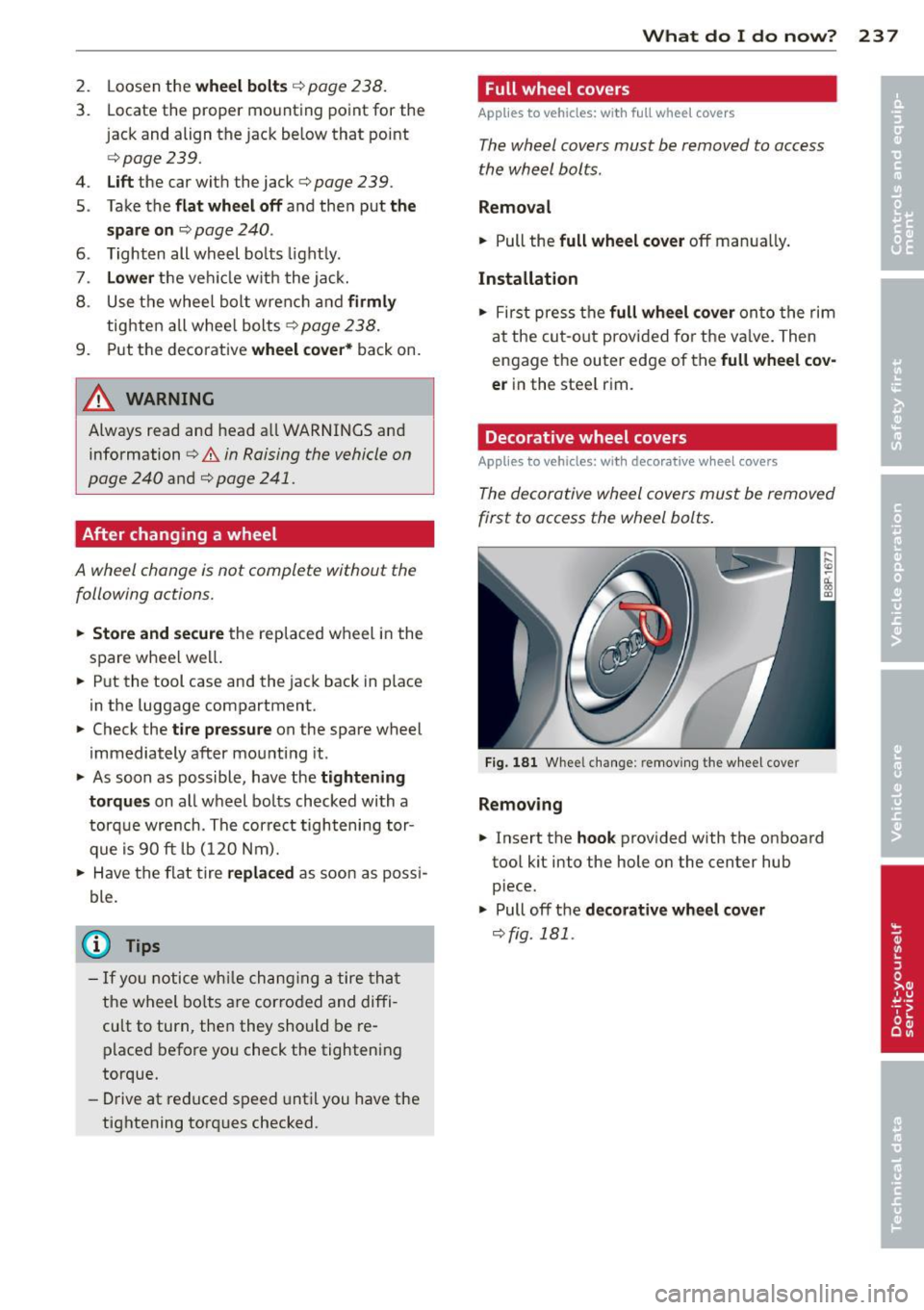
Decorative wheel covers
App lies to vehicles: with decorat ive w hee l covers
The decorative wheel covers must be removed
first to access the wheel bolts .
Fig. 181 Whee l cha nge : removing the whee l cover
Remo ving
.. Insert the hook provided with the on board
tool kit into the hole on the center hub
piece.
.. Pull off the
decorati ve wh eel cover
¢ fig . 181 .
Page 242 of 280

240 What do I do now?
& WARNING
-You or your passengers could be injured
while changing a wheel if you do not fol
low safety precautions:
- Mounting the jack under the vehicle at
any other place than indicated above
may damage the vehicle or may result
in personal injuries .
- A soft or unstable surface under the
jack may cause the vehicle to slip off
the jack. Always provide a firm base for
the jack on the ground . If necessary,
use a sturdy board under the jack.
- On hard, slippery surface (such as tiles)
use a rubber mat or similar to prevent
the jack from slipping .
- To help prevent injury to yourself and
your passengers:
- Do not raise the vehicle until you a re
sure the jack is securely engaged.
- Passengers must not remain in the ve
hicle when it is jacked up.
- Make sure that passengers wait in a
safe place away from the vehicle and
well away from the roadway and traffic.
- Make sure jack position is correct , ad
just as necessary and then continue to
raise the jack.
Taking the wheel off/putting the spare
on
Follow these instructions step-by-step for
changing the wheel
Fig. 187 Wheel c han ge: using the sc rewdrive r handle
(w ith the blade removed) to turn the bolts
... ,._
"' i
"'
Fig. 188 W hee l change : alignmen t pin inside the top
hol e
M ,._
"' d. 00
"'
After you have loosened all wheel bolts and
jacked the vehicle off the ground, perform the
following steps to remove and replace the
wheel:
Removing the wheel
.,. Use the hexagonal socket in the screwdriv·
er handle
to completely turn out the top
most wheel bolt and set it aside on a
clean
surface c;, fig. 187 .
.,. Screw the threaded end of the alignment
pin from the tool kit hand-tight into the
now vacant bolt hole <=>
fig. 188 .
.,. Then completely unscrew the other wheel
bolts as described above.
.,. Take off the wheel leaving the alignment
pin in the bolt hole
c;, &,.
Putting on the spare
.,. Lift the spare wheel up and carefully slide it
over the alignment pin to guide it in place .
.,. Use the hexagonal socket in the screwdriver
handle to screw in and tighten all wheel
bolts
slightly .
.,. Unscrew the alignment pin and insert and
tighten the remaining wheel bolt slightly
like the rest.
.,. Turn the handle on the jack counter-clock
wise to lower the vehicle until the jack is
fully released .
.,. Use the wheel bolt wrench to tighten all
wheel bolts firmly
r:::;, page 238 . Tighten
them
crosswise , from one bolt to the (ap
proximately) opposite one, to keep the
wheel centered.
Page 246 of 280
244 Fuses and bulbs
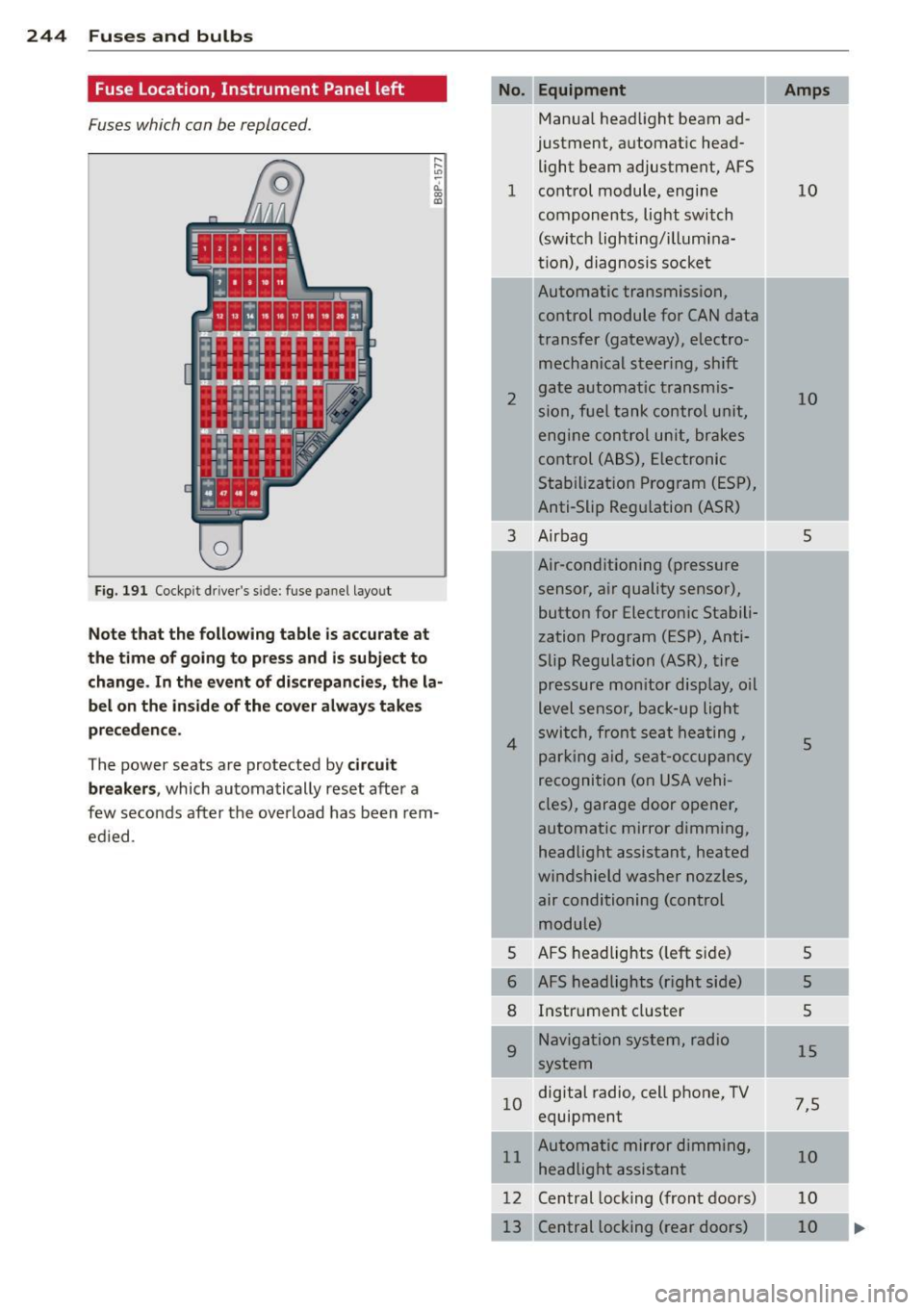
Fuse Location, Instrument Panel left
Fuses which can be replaced.
Fig. 191 Cockp it driver 's s ide: fuse pane l layout
Note that the following table is accurate at
the time of going to pr ess and i s subject to
change . In the event of d iscrepancies, the la
bel on the in side of the cover always take s
pr eceden ce .
The power seats are protected by circuit
break ers,
which automatically reset after a
few seconds after the ove rload has been rem
ed ied .
Equipment
Manua l head light beam ad
justment, a utomat ic head
light beam adjustment, AFS
1 co ntrol m odule, engine
components, light switch
(switch lighting/illumina
ti on), diagnosis socke t
2
3
4
5
6
8
9
Automatic transmission,
control module for CAN data
transfer (gateway), electro
mechanical steering, shift
gate automatic transmis
sion, fuel tank control unit,
engine control unit, brakes
control (A BS), Electronic
Stabili zation Program (ESP) ,
Anti-Slip Regulation (ASR)
Air bag
Air-conditioning (pressure
sensor, air quality sensor), button for Electronic Stabili
zation Program (ESP), Anti
Slip Regulat ion
(ASR), tire
pressure monitor display, oil
level senso r, back-up ligh t
s w itch, front se at he ati ng ,
p ark ing aid, sea t-occupancy
recognition (on USA vehi
cles), garage door opener,
automa tic mirror dimming,
headlight assistant, heated
windshield washer nozzles, air conditioning (control
module)
AFS headlights ( left si de)
AFS headlights (right side) Instr ument cluster
Navigation system, radio
system
1 0 digital
radio, cell phone, TV
equipment
11 Automatic mirror dimming,
headlight assistant
12 Central lock ing (front doors)
Central locking ( rear doors)
Amps
10
10
5
5
5
5
5
15
7 ,5
10
10
10
Page 247 of 280
No. Equ ipment
Electronic Stabilization Pro-
14
gram (ESP) (control mod-
u le), shift gate automatic
transmission
15 Interior lights, reading
lights
Diagnostic connector, rain
sensor, air conditioning
16 (control module), t
ire pres-
sure monitor d isplay (con-
trol module)
I 17
Anti-theft alarm warning
system
18 D iagnose Starter
19 All Wheel D rive
20 Audi magnetic ride
Blower fan
23
Driver's
side power window,
front
24 Power outlet front
2S Rear window defogger
26 Power outlet in luggage
compartment
27 Fuel tank control module,
fuel pump
28 Power window, rear
33 Slidi ng/pop-up roof
36 Lumbar support
37 Heated sea ts, front
1 38
Passenger side power win-
dow, front
39 Specia l func tion interface
40 Starter
41 Rear window wiper
43 Body control module
47
Ce ll phone package (V OA in-
terface)
Automatic circuit breakers:
10
10
10
5
5
10
40
30
20
30
20
15
30
20 10
20
30
5
40
15
20 5
The electri c power w in dows and the e lectr ic
seat adjusters are pro tected with circu it
breake rs which reset automatically after the
circuit overload has been corrected.
Fu se s and bulb s 245
@ Tips
-Whenever rep lacing a fuse, always con
sult the sticker on the inside of the f use
pane l cover. It contains the most up-to
date information regarding the fuse ar
rangement. If in doubt, ask your author
ized Aud i Service adviso r.
- Some of the equipment items listed are
opt ional or only available on certa in
mode l configurations.
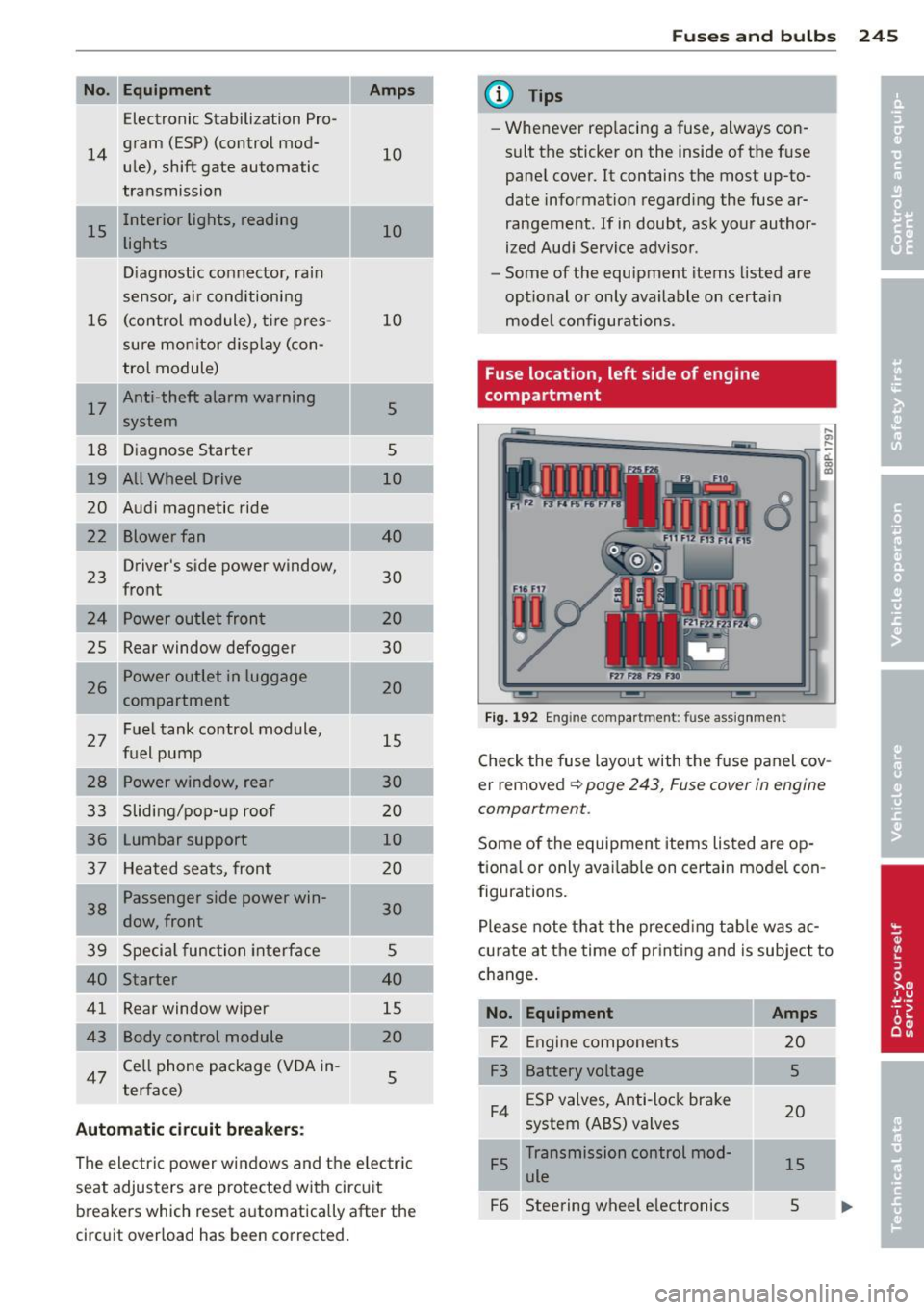
Fuse location, left side of engine
compartment
Fig . 192 En gine compar tment : fuse assig nment
,._
-d. a, a>
Check the fuse layout with the f use panel cov
er removed
¢ page 243, Fuse cover in engine
comportment.
Some of the equipmen t items listed are op
tiona l or only ava ilab le on certain model con
figurations.
Please note tha t the preced ing tab le was ac
c u rate at the time of pr int ing and is subject to
c h ange.
No. Equipment
F2 Engine compone nts
F3 Battery voltage ESP valves, Anti-lock brake
F4 system (ABS) valves
Transmission control mod
F5 ule
F6 Steering wheel e lectronics
Amps
20
5
20
15
s
Page 248 of 280
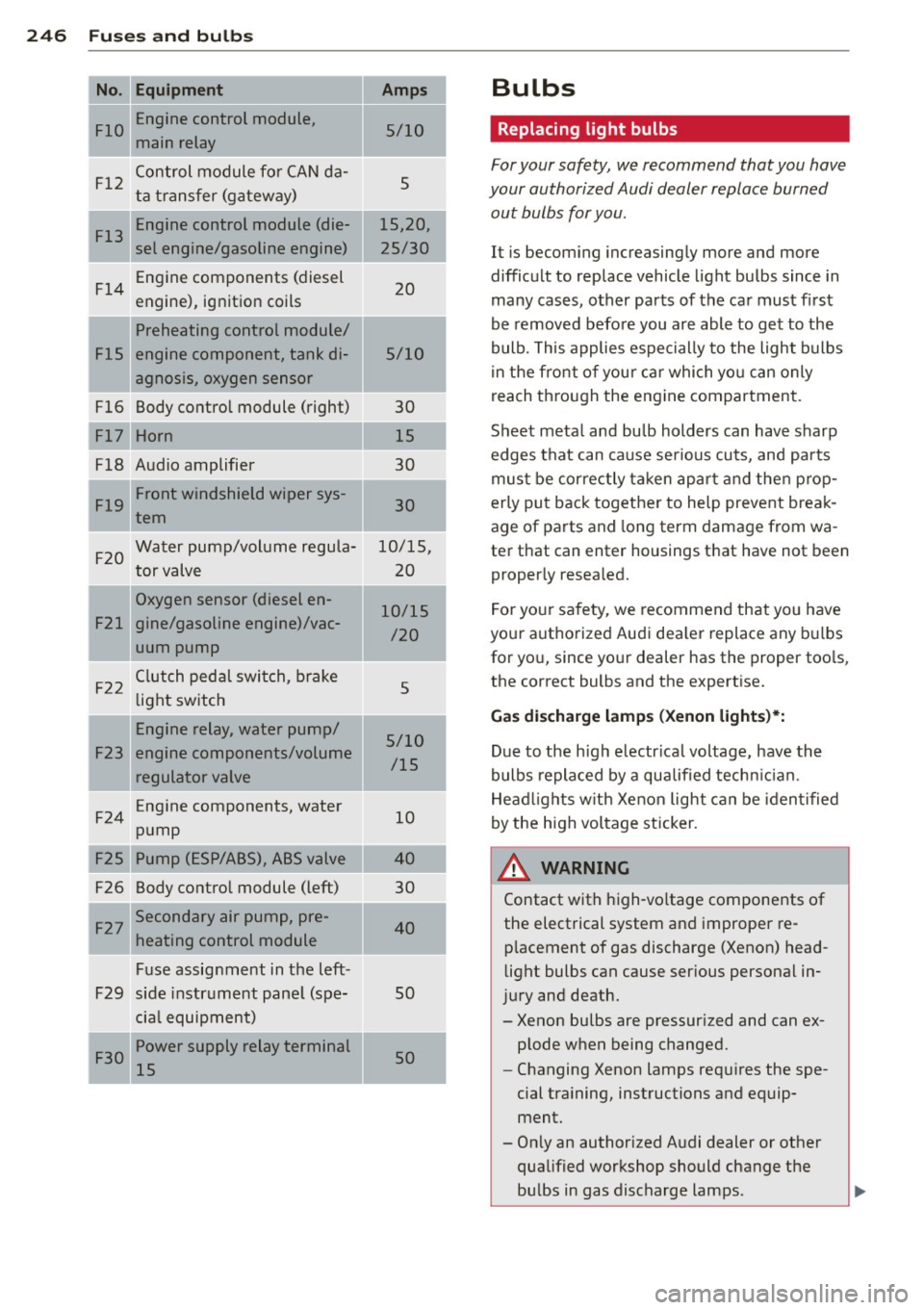
246 Fuses and bulbs
I
I
I
No. Equipment
FlO Engine control module,
main relay
Control module for CAN da
F12 ta transfer (gateway)
F13 Engine control module (die
sel engine/gasoline engine)
Fl 4 Engine components (diesel
engine), ignition coils
FlS
F16
F17
F18 Preheating control module/
engine component, tank di
agnosis, oxygen sensor
Body control module (right)
Horn
Audio amplifier
Flg Front windshield wiper sys
tem
F 2 0
Water pump/volume regula
tor valve
F22
F23
F24
F25
F26 Oxygen sensor (diesel en
gine/gasoline engine)/vac
uum pump
C
lutch pedal switch, brake
light switch
Engine relay, water pump/
engine components/volume regulator valve
Eng ine components, water
pump
Pump (ESP/ABS), ABS valve
Body control module (left)
-Amps
5/10
5
15,20,
25/30
20
5/10 30 15
--30
30
10/15, 20
10/15 /20
5
5/10
/15
10
40
-·-- --·-
30
40
F27 Secondary
air pump, pre-
heating control module
__ , ..
F29 Fuse assignment in the left
side instrument pane l (spe-
cia l equipment)
Power supply relay terminal
15 so
so
Bulbs
Replacing light bulbs
For your safety, we recommend that you have
your authorized Audi dealer replace burned
out bulbs for you.
It is becoming increasingly more and more
difficult to replace vehicle light bulbs since in
many cases, other parts of the car must first
be removed before you are able to get to the
bulb. This applies especially to the light bulbs
in the front of your ca r which you can only
reach through the engine compartment.
Sheet metal and bulb holders can have sharp
edges that can cause serious cuts, and parts
must be cor rectly taken apart and then prop
erly put back together to help prevent break
age of parts and long term damage from wa
ter that can enter housings that have not been
properly re sea led.
For your safety, we recommend that you have
your authorized Audi dea ler replace any bulbs
for you, since your dealer has the proper tools,
the correct bulbs and the expertise.
Gas discharge lamp s (Xenon lights)*:
Due to the high e lectr ica l voltage, have the
bulbs replaced by a qualified techn ic ian.
Head lights with Xenon light can be identified
by the high voltage sticker.
_& WARNING ~
Contact with high-vo ltage components of
the electrical system and improper re
placement of gas discharge (Xenon) head
light bulbs can cause serious personal in
jury and death.
- Xenon bulbs are pressur ized and can ex
plode when being changed.
- Changing Xenon lamps requires the spe
cial tra ining, instructions and equip
ment.
- On ly an authorized Audi dealer or other
qualified workshop should change the bulbs in gas discharge lamps .