air condition AUDI A3 2012 Owner´s Manual
[x] Cancel search | Manufacturer: AUDI, Model Year: 2012, Model line: A3, Model: AUDI A3 2012Pages: 280, PDF Size: 70.11 MB
Page 136 of 280

134 Airbag sys te m
Advanced Airbag System in your vehicle was
certified.
I f the front passenger seat is not occ upied,
the front airbag will not deploy, and the
PAS·
SENGER AIR B AG OFF
light will stay on. Nev
er insta ll a rearward-facing child restraint on
the front passenger seat, the safest place for
a child in any kind of child restraint is at one
of the seat ing positions on the rear seat
c:> page 123, Child restraints on the front seat
- some important things to know
and
c:> page 143, Child Safety .
If the PASSENGER AIR BAG OFF light comes
on
when one of the conditions listed above is
met, be sure to check the light regularly to
make certa in that the
PAS SENGER AIR BAG
OFF
light stays on cont inuous ly whenever the
i gnit ion is on.
If the PAS SENGER AIR BAG
OFF
li ght does not appear on and does not
stay on all the time, stop as soon as it is safe
to do so and
- react iva te the system by turning the ignition
off and then turning it on again;
- remove and re insta ll the chi ld restraint.
Make su re that the child res traint is properly
insta lled and that the safety be lt for the
front passenger seat has been correct ly
ro uted throug h the child restraint as descri
bed in the chi ld restraint man ufacturer's in
structions;
- make sure that the convertible locking fea
ture on the safety be lt for the front passen
ger seat has been activated and that the
safety belt has been pulled tight. The belt must not be loose or have loops of slack so
t h at the sensor below the safety be lt latch
on the sea t can do its job
¢ page 152.
- make sure that th ings that may increase the
we ight of t he chi ld and child safety seat are
not be ing tra nspo rted on the front passen
ger seat;
- make su re that the safety be lt tension sen
so r is not b locked. Shake t he safety be lt
l atch on the front passenger seatbac k and
forth;
- If a st rap or te ther is being used to tie the
child safety seat to the front passenger seat, make sure that
it is not so tight that it
causes the weight-sensing mat to measure
more weight than is act ually on the seat.
If the PASSENGER AIR BAG OFF light still
does not come on
and does not stay on con
tin uous ly (when the ignition is switched on),
- t ake the child res train t off the front passen-
ge r seat and ins tall it properly at one of the
rear seat positions. Have the airbag system
inspected by your authorized Audi dea ler
immed iate ly .
- move the child to a rear seat position and
make sure t hat the c hild is properly restra in
ed in a ch ild restra int that is appropriate for
its size and age.
The
PASSENGER AIR BAG OFF light should
NOT come on when t he ignit ion is on and an
adult is s itting in a proper seating position on
the front passenger seat. If the
PASSENGER
AIR BAG OFF
light comes on and stays on or
flashes fo r about 5 seconds wh ile driving, un
der these c ircumstances, make sure that:
- the adult on the front passenger seat is
properly seated on the center of the seat
cushion with his or her back up aga inst the
backrest and the backrest is not recl ined
c:> page 104, Proper seating position for the
driver,
- the adult is not tak ing weight off the seat by
holding on to the passenger assist handle
above the fron t passenger door or s upport
ing their weight on the armres t,
- t he safety belt is be ing properly wo rn and
t hat the re is not a lot o f slack in the safety
be lt webb ing,
- accessory seat covers or cushions or othe r
t hings tha t may cause an incorrec t reading
or impression on the weight-sensing mat
under the upho lstery of the seat have been
removed from the front passenger seat,
- a safety belt extender has not been left in
the safety belt latch for the front passenger
seat.
In add ition to the
PASSENGER AIR BAG OFF
light in the center of the instrument panel,
the message
PASSENGER AIR BAG OFF or
Page 145 of 280
Child Safety
Important things to know
Introduction
The rear seat is generally the safest place in a
collision .
The physical principles of what happens when
your veh icle is in a crash app ly also to chi ldren
¢ page 114, What happens to occupants not
wearing safety belts? .
But unlike adults and
teenagers, their muscles and bones are not
fu lly developed. In many respects children are
at greater risk of serious injury in crashes than
adu lts.
Because children's bod ies are not fully deve l
oped, they require restraint systems especial ly designed for their size, weight, and body
structure. Many countries and all states of the
United States and provinces of Canada have
laws requiring the use of approved child re
straint systems for infants and small children .
In a fronta l crash at a speed of 20 -35 mph
(30-56 km/h) the forces acting on a 13-pound
(6 kg) infant w ill be more than 20 t imes the
weight of the child . This means the weight of
the child would suddenly be more than
260 pounds (120 kg). Under these conditions,
on ly an appropriate chi ld restraint properly
used can reduce the risk of ser ious injury .
Child restraints, like adult safety belts, must
be used properly to be effective. Used improp
erly, they can increase the risk of serious in
jury in an accident.
Consult the child safety seat manufacturer's
instruction to be sure the seat is right for your
child 's size ¢
page 146, Important saf ety in
struc tions for using child safety seats.
P lease
be sure to read and heed all of the important
information and WARNINGS about child safe
ty, Advanced Airbags, and the installat ion of
chi ld restraints in this chapter .
There is a lot you need to know about the Ad
vanced Airbags in your vehicle and how they work when infants and children in child re-
Child Sa fet y 143
straints are on the front passenger seat . Be
cause of the large amount of important infor
mation, we cannot repeat it a ll here . We urge
you to read the detailed information in this owner's manual about airbags and the Ad
vanced Airbag System in your vehicle and the
very important information about transport
ing children on the front passenger seat .
Please be sure to heed the WARNINGS -they
are extremely important for your safety and
the safety of your passengers, especially in
fants and small chi ldren .
.A, WARNING
-Accident statistics have shown that chil
dren are generally safer in the rear seat
area than in the front seating position.
Always restrain any child age 12 and un der in the rear.
- All vehicle occupants and especially chil
dren must be restrained properly when
ever riding in a vehicle . An unrestrained
or improperly restrained chi ld could be
injured by str ikin g the interior or by be
ing ejected from the vehicle during a
sudden maneuver or impact. An un re
strained or improper ly restrained chi ld is
also at greater risk of injury or death
through contact with an inflating airbag.
- A suitable chi ld restraint properly instal
led and used at one of the rear seating
positions provides the highest degree of
protection for infants and small children
in most accident situations.
A WARNING
Children on the front seat of any car even
with Advanced Airbags can be ser iously in
jured or even killed when an a irbag in
flates. A child in a rearward-fac ing ch ild
safety seat installed on the front passen
ger seat will be ser iously injured and can
be killed if the front airbag inflates .
- The inflating airbag will h it the child
safety seat or infant carrier with great
force and will smash the child safety seat
and child against the backrest, center
armrest, or door.
•
•
Page 163 of 280
Intelligent technology Notice about data
recorded by vehicle
control modules
Your vehicle is not equipped with an Event Da
ta Recorder (EDR), installed by some manu
facturers for the express purpose of capturing
data for retrieval after an accident or crash
event. EDR's are sometimes called "crash re
corders".
Some state laws restrict the retr ieval or down
loading of data stored by EDR's that were in
stalled in a vehicle for the express purpose of
retrieving data after an accident or crash
event without the owner's consent.
Although your vehicle is not equipped with an
EDR, it is equipped with a number of electron
ic control modules for various vehicle systems
such as, for examp le, engine function, emis
sion control, as well as for the airbags and
safety belts.
These electronic control modules also record
vehicle-related data during norma l vehicle op
eration for diagnostic and repair purposes.
The recording capacity of the electronic con
trol modules is limited to data (no sound is re
corded) and only a small amount of data is ac
tually recorded over a very limited period of
time and stored when a system fault or other
condition is sensed by a control unit. Some of
the data then stored may relate to vehicle
speed, direction, braking as we ll as restraint
system use and performance in the event of a
crash or other condition. Stored data can only be read and downloaded with special equip
ment.
Electronic Stabilization
Program (ESP)
Description
ESP helps to improve road holding and vehicle
dynamics to help reduce the probability of
skidding and loss of veh icle control. It works
only when the engine is running. ESP detects
Intelligent technology 161
certain difficult driving situations, including
when the vehicle is beginning to spin (yaw)
out of control and helps you to get the veh icle
back under control by se lectively braking the
wheels, and/or reducing engine power and
providing steering ass istance to help hold the
vehicle on the driver's intended course. The in
dicator light
G] in the instrument cluster
blinks when ESP is taking action to help you
control the vehicle.
ESP has limitations. It is important to remem
ber that ESP cannot overcome the laws of
physics.
It will not always be able to help out
under all conditions you may come up against.
For example, ESP may not always be able to
help you master situations where there is a
sudden change in the coefficient of friction of
the road surface. When there is a section of dry road that is suddenly covered with water,
slush or snow, ESP cannot perform the same
way it would on the dry surface . If the vehicle
hydroplanes (rides on a cushion of water in
stead of the road surface), ESP will not be
able to help you steer the vehicle because con
tact with the pavement has been interrupted
and the vehicle cannot be braked or steered .
During fast cornering, particularly on winding
roads, ESP cannot always deal as effectively
with difficult driving situations as at lower
speeds. When towing a trailer, ESP is not able
to help you regain control as it would if you
were not tow ing a trailer.
A lways adjust your speed and driving style to
road, traffic; and weather conditions. ESP can
not override the vehicle's physical limits, in
crease the available traction, or keep a vehicle
on the road if road departure is a result of
driver inattention. Instead, ESP improves the
poss ibility of keeping the vehicle under con
trol and on the road dur ing extreme maneu
vers by using the driver's steering inputs to
help keep the vehicle going in the intended di
rection. If you are traveling at a speed that
causes you to run off the road before ESP can
provide any assistance, you may not experi
ence the benefits of ESP .
•
•
Page 173 of 280
-Have your vehicle maintained properly
and in accordance with the service rec
ommendations in your Warranty
&
Maintenance booklet.
- Lack of proper maintenance as well as
improper use of the vehicle will impair
the function of the emission control
system and could lead to damage.
@ For the sake of the environment
Even when the Emission Control System is
operating properly, the exhaust gas can
have a sulfur-like exhaust gas smell under
some operating states. This depends on
the sulfur content of the fuel being used .
Using a different brand of fuel may help,
or filling the tank w ith lead-free super
grade gasoline.
Diesel particulate filter
Ap plies to vehicles: with diesel partic ul ate filter
The diesel particulate filter filters nearly al l of
the soot part icles out of the exhaust. The fi l
ter cleans itse lf automatically under normal
driving conditions . If the fi lter cannot clean it
self (for example, because you are only driving
short distances), the filter becomes clogged
with soot and the
II symbol for the diesel
particulate filter illuminates
c> page 22.
A WARNING
- Do not park your vehicle over flammable
materials such as grass or leaves because
the high temperature of the diesel par
t icu late filter could start a fire .
- Do not apply an underbody protectant in
the exhaust system a rea or a fire could
start.
(D Tip s
-When the diesel particulate filter be
comes saturated, the engine speed in
creases to approximate ly 1,500 rpm
while the vehicle is in motion to init iate
the cleaning of the diesel particulate fil
ter a utomatically without the warning
l amp lighting up . If the warning lamp
Dri vin g and en vironm ent 171
Ill sti ll appears, you shou ld drive to a
qualified workshop .
Avoid damaging the
vehicle
When you are driving on poor roads, or over
curbs, steep ramps, etc., make certain that
low -lying parts such as spo ilers and exhaust
system parts do not bottom out and get dam
aged.
This is espec ially true for veh icles with low
slung chassis (sports chassis) and fully loaded
vehicles.
Operate your vehicle
economically and minimize pollution
General
Your personal style of driving will determine
the economy of your vehicle, as well as ex
haust and noise Levels.
Fuel economy, env ironmenta l impact, and
wear on your eng ine, brakes and tires largely
depend on three facto rs:
- your personal driving style
- operating conditions
- technical limitations
If you ant ic ipate wha t you need to do next and
drive economically, you can easily cut your
fuel consumptio n by 10-15 percent . This sec
tion wi ll give you some tips on how you can
help the env ironment and your pocketbook.
(D Tips
The consumption estimates as published
by ENVIRONMENTAL PROTECTION AGENCY
(EPA) and Transport Canada may not corre
spond to your actual consumption on the road, which will vary depending upon vehi
cle load and speed, road and weather con
dit ions, trip length, etc.
•
•
Page 180 of 280
178 Cleaning and protection
Cleaning and
protect ion
General information
Regular core preserves vehicle value .
Any automobile is exposed to industrial
fumes, corrosive road salt, etc. A well cared
for Audi can look like new many years after purchase . Regular and correct care w ill con
tr ibute to maintaining the beauty and value of
your Aud i.
Furth erm ore, goo d car e m ay b e a cond iti on
for substantiat ing a warrant y claim shou ld
c orrosion dam age or paint d efe ct s occ ur.
Your author ized Audi dealer has a variety of
d ed ica ted vehicl e-ca re product s and can ad
vise which ones to use for cleaning the exter i
or and inte rior of your vehicle .
Whether you use products recommended by
Aud i or other commercially ava ilable clean ing
agents, please make sure you apply them cor
r ectly .
A WARNING
-Cleaning agents may be poisonous. Keep
them out of the reach of children.
- Heed a ll caut ion labels.
- Always read directions on the container
before using any product . Follow the di
rect ions carefu lly.
- Most chemical cleaners are concentrated
and have to be diluted.
- Use spot removing fluids only in well
ventilated areas.
- Do not use gasoline, kerosene, d iesel
fuel, nail pol ish remover or other volati le
fluids. They may be toxic, flammab le or
haza rdous in other ways. Do not wash,
wax or dry the vehicle with the ignit ion
on or the engine running.
- Do not clean the undersides of chassis,
fenders, wheel covers, etc. without pro
tecting your hands and arms. You may
c u t yourself on sharp-edged metal parts . -
Moisture and ice on brakes may impair
brak ing eff ic iency
c::> page 163 , General
information.
Test the brakes carefully
each time you wash the vehicle .
@ For the sake of the environment
Select only environ mentally friendly clean
i ng products. Leftover cleaning products
should not d isposed of in the househo ld
waste .
Care of exterior
Washing
Frequent washing protects the vehicle .
The best protection against environmental in
fluences is
frequent washing and waxing .
How often this is required depends on:
- How much the vehicle is used
- Where the veh icle is parked (garage, in the
open under trees, etc.)
- The seasona l and weather conditions
- Environmental i nfl uences
The longer b ird droppings, insects, tree resin,
r oad and industrial gr ime, tar, soot, road salt
and other mater ials remain on the veh icle
body, the mo re lasting their destructive ef
fects w ill be .
High temperatures , as from expos ure to in
tense sun light, intensify the corrosive effect
part icularly when hum idity is high as well.
Under certa in circumstances,
we ekly washing
may be necessary. Unde r other cond itions, a
monthly washing and waxing may be ade
quate.
After the winter, the unders ide of the vehicle
should be thoroughly washed, preferably in a professional car wash .
A WARNING
Always read and heed all WARNINGS and
other info rma tion
c::> page 178 .
Page 200 of 280
198 Checking and filling
Mo dern engine lubrication has taken a quan
tum leap in the last few years. Many synthetic
oils ava ilable today provide better engine lu
brication that can outlast traditional petrole
um-based o ils, making them a smart choice
for use throughout the life of your Audi .
Whether you use synthetic or petroleum
based engine oil, the oil that yo u use must
conform to Audi 's oil quality standard
VW 502 00 (veh icles with gasoline engine)
and VW 507 00 (vehicle with diesel engine) to he lp keep your vehicle's eng ine runn ing
smoothly and help prevent the fo rmation of
harmf ul depos its , somet imes ca lled "sludge,"
that over t ime can lead to expensive repairs.
At the time of printing , engine oils availab le in
the U .S . and Canada that meet the exa cting
specifi cations o f A ud i oi l st andard VW 502 00
(vehicles wi th gaso line engine) and
VW 507 00 (vehicles with diese l engine) are
synthetic engine oils . This does not mean,
however, that every synthetic engine oil wi ll
meet Audi oil standard VW 502 00 (gasoline
engines) and VW 507 00 (d iesel engines). So
a lway s be sure that you use a n approved o il.
To help prevent the fo rmation of harmful de
posits use only oil w ith the following specifi
c ations printed on the oil conta iner:
- Ga soline engines: Audi oil standard
VWS0200
- Die sel engines: Audi oil standard
vw 50 7 00
Oil container labe ls may carry t he specifica
tion s ingly or in comb inat ion with other des ig
nations and oil qua lity standards.
Vi scosity
Eng ine oi ls are graded according to their v is
cosity . The proper v iscosity grade o il for your
engine depends on cl imactic or seasonal con
d itions w here you dr ive. Yo u can use oi l w ith a
viscosit y grade of SAE 5W-40 a cross all tem
perat ure ranges for normal d riving conditions .
H owever, if eng ine o il viscos ity grade SAE
5W-40 is not ava ilable, you can a lso use vis
cosity g rade SA E 5W-30 or SAE OW-40 as long as it meets A
udi o il quality standard
VW 502 00 (vehicles wit h gasoline engine) or
VW 50 7 00 (vehicles wit h diese l eng ine) spec
ifications.
Beca use engine o il that meets the Audi oil
sta ndard may not be availab le everywhere
when you need it, we strong ly recommend
that you a lways carry with you an extra qua rt
( li ter) of oil that express ly conforms to the
VW 502 00 (vehicles wit h gasoline eng ine) o r
VW 507 00 (vehicles w it h diesel eng ine) spec
i fication, i n case you have to top off the oi l
wh ile on the road.
App lies to vehicle s with gasoline engin e on
ly:
Only if the level of the o il is at or below the
min imum ma rk - and no o il that expressly
c onfo rms to Audi oil standa rd VW 50 2 00
specifica tions is available - may you top off
with a high quality engine o il , pre fera bly syn
t h etic-based, that meets ACEA A3 or API SM
specifications, but even then, only in viscosity
grades SAE 5W-40, SA E 5W-30, or SA E
OW-40. However, dur ing the entire time be
tween oil change interva ls, never top off with
more than a total of 0.5 qt/liter engine o il
that does not confo rm to Aud i oil spec ification
vw 502 00 .
Applies to vehicles with diesel engine only:
Only if the level of the oil is at or be low the
min imum ma rk - and no o il tha t expressly
confo rms to Audi oil standa rd VW 507 00
spe cifications is available - may you top off
wi th a high quali ty engine o il, that meets
AC EA C3 o r API CF specifica tions, but even
then , on ly in viscosity grades SAE 5W-40 , SAE
5W-30, or SAE OW-40 . However, during the
entire t ime between oil change intervals, nev
er top off with more than a tota l of 0.5 qt/li
ter engine oil that does no t conform to Aud i
o il specification VW 507 00 .
For more information about eng ine oi l that
has been approved for your veh icle, please
contact e ither your au thorized Aud i dealer or
Audi Custome r Re lations at 1 (800) 822 -2834
o r vis it our web site at www.audiusa .com or
www.aud icanada .ca. He re you w ill also find a
c ur rent l ist of oi ls (manufac turers, brand .,.
Page 201 of 280
names etc.) that conform to Audi oil standard
VW 502 00 (vehicles with gasoline engine) or
VW 507 00 (vehicles with diesel engine).
C hang ing th e engin e oil
The engine oil and oi l filter must be changed
according to the m ileage (kilomete rs) and
time inte rva ls specified in yo ur vehicle's War
ranty
& Maintenance booklet. Do not exceed
these intervals -harmful deposits from old
engine oil can reduce engine performance and
can lead to expensive eng ine repairs.
Changing the o il at the recommended inter
va ls is so very important because the lubricat
ing properties of oi l decrease gradually during
norma l vehicle use . If you are not sure when
you have your oi l changed, ask your author
ized Audi Service Advisor.
Under some circumstances the engine oi l
should even be changed more frequently.
Change o il more often if you drive mostly
short distances, operate the vehicle in dusty
areas or mostly under stop-and-go traffic con
d itions, or when you use your veh icle where
temperatures stay below freezing point for
l ong periods.
Detergent addit ives in the o il w ill make fresh
oil look dark after the eng ine has been run
n ing for a short time. This is norma l and is not
a reason to change the o il mo re often than
r ecommended.
D amage or ma lf u nction s du e to lac k of
ma int enance
It is essential that you change your oil at the
recommended interva ls using only engine oil
that complies with Audi oil standard
VW 502 00 (veh icles with gasolin e engine) or
VW 507 00 (veh icles with diese l engi ne). Yo ur
L im ited New Vehicle Warra nty does not cover
damage or ma lfunctions due to failure to fol
l ow recommended maintenance and use re
quirements as set forth in the A udi Owner's
Manual and Warranty
& Maintenance book let.
Your dealer will have to deny warranty cover age un less you present to the dea ler proof in
the form of Service or Repa ir Orders that a ll
Checking and fillin g 199
scheduled maintenance was performed in a
timely manner.
· Engine oil consumption
The engine in your vehicle depends on an ade
quate amount of oil to lubricate and cool all
of its moving parts.
In order to prov ide effective lubrication and
cooling o f inte rna l engine components, all in
ternal combustion engines consume a certain amount of oil. Oil consumpt ion varies from
engine to engine and may change sign ificantly
over the life of the engine. Typically, engines
with a spec ified break-in period (see
Q page 169) consume more oil during the
break-in pe riod than they consume after o il
consump tion has stabilized.
Under normal cond itions, the rate of oi l con
sumption depends on the quality and viscos ity
of the oil, the RPM (revolut ions per minute) at
which the engine is operated, the ambient
temperature a nd road conditions. Further fac
tors are the amount of oil dilut ion from wa ter
condensation or fue l residue and the oxida
tion level of the oi l. As any engine is subject to
wear as mi leage builds up, the oil consump
tion may increase over time until replacement
of worn components may become necessary.
With a ll these variab les coming into p lay, no
standard rate of oil consumption can be es
tablished or spec ified. There is no alternative
to regular and frequent check ing of the oil lev
el, see
Not e.
If the yellow engine oil level warning symbo l
in the instrument cluster
Ill! lights up, you
shou ld check the oil leve l as soon as possib le
with the oil dipstick q page 200 . Top off the
o il at your earliest conven ience
Q page 200.
&_ WARNING
Before you chec k anything in the engine
compartment, always read and heed al l
WARNI NGS
Q .&. in Working in the engine
compartment on page 194 .
•
•
Page 205 of 280
luggage compartment. Make sure the
container is securely stored and mount
ed.
0 Note
-If you use engine oil that does not ex
pressly conform to Audi oil specification
VW 507 00, very serious and very expen
sive damage to your vehicle 's engine will
occur . Engine damage caused by using
the wrong engine oil is not covered by
your New Vehicle limited Warranty .
- Not all commercially available oils con
form to this very rigid Audi oil quality
standard even though they may be syn
thetic-based and have the same viscosi
ty.
Engine cooling system
Coolant
T he engine coolant performs two functions: it
keeps the engine from overheating and it pro
tects the engine from freezing in the winter.
The cooling system is sealed and generally re
quires little attention.
The cooling system has been filled at the fac
tory with a permanent coolant which does not need to be changed. The coolant consists of a
mixture of water and the manufacturer's gly
col-based coolant additive Gl2++ antifree ze
with anticorrosion additives (50% for USA models; 60% for Canadian models). This mix
ture both assures the necessary frost protec
tion and protects metal components in the
engine 's cooling system from corrosion and
scaling.
It also raises the boiling point of the
coolant.
Do not reduce the concentration of the cool
ant in the summer by adding plain water.
The
proportion of coolant additive must be at
least 50% but not more than 60%
to main
tain antifreeze protection and cooling efficien
cy. If the coolant frost protection is too low,
the coolant could freeze and damage the vehi
cle heating and engine cooling system.
Checking and filling 203
For year-round driving, antifreeze is added at
the factory for temperatures down to:
--31°F(-35°C)USA
- - 40 °F ( - 40 °C) Canada.
You can mix the Gl2 ++ coolan t additive with
other additives Gl2 + or Gl2. Always check
with your authorized Audi dealer .
A WARNING
-
Before you check anything in the engine
compartment, always read and heed all
WARNINGS~
& in Working in the engine
comportment on page 194.
(D Note
- Before winter sets in, have the coolant
checked to see if the coolant additive in
your vehicle is sufficient to meet the cli
mate conditions. This is especially impor
tant if you live in a region where the
win
ter is extremely cold. If necessary, in
crease the proportion of coolant additive
to 60% .
- When adding coolant additive to your
cooling system, remember :
- We recommend using only coolant ad
ditive G 12++ (check the label) for your
vehicle. This coolant additive is availa
ble at authorized Audi dealers. Other
types of antifreeze can significantly re
duce corrosion protection. The result
ing corrosion can cause a loss of cool
ant and serious engine damage.
- Do not add any type of radiator leak seal
ant to your vehicle's engine coolant.
Adding radiator repair fluid may adverse ly affect the function and performance of
your cooling system and could result in
damage not covered by your New Vehicle
Limited Warranty.
•
•
Page 218 of 280
216 Tires and wheels
Cold tire inflation pressure
Tire pressure affects the overall handling, performance and safety of a vehicle .
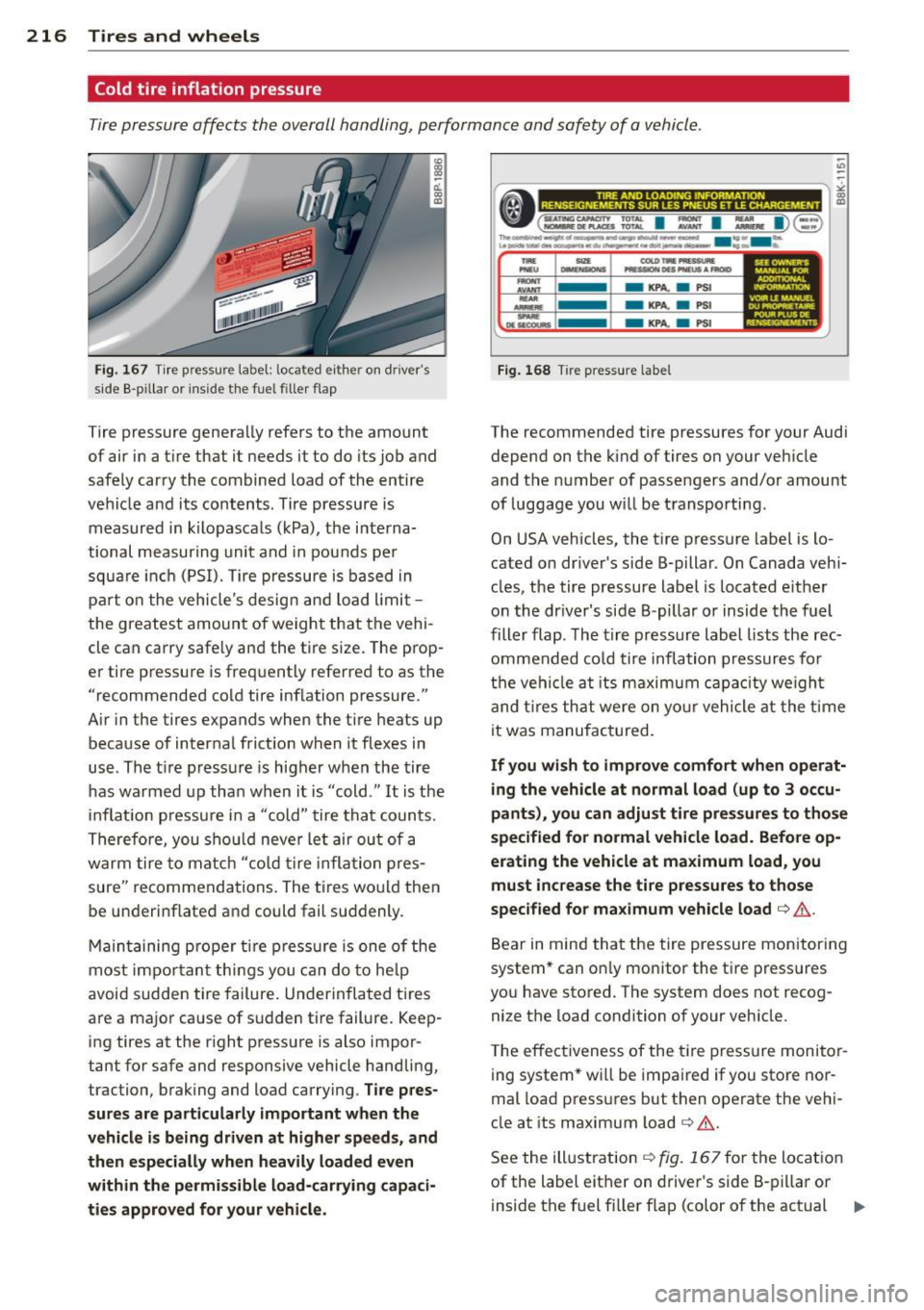
Fig. 167 Tire press ure labe l: loca ted ei the r on dr iver 's
side 8-pillar or inside the fuel filler flap
Tire pressure generally refers to the amount
of air in a tire that it needs it to do its job and
safely carry the combined load of the entire
vehicle and its contents . Tire pressure is
measured in kilopascals (kPa), the interna
tional measuring unit and in pounds per
square inch (PSI). Tire pressure is based in
part on the vehicle's design and load limit
the greatest amount of weight that the vehi
cle can carry safely and the tire size. The prop
er tire pressure is frequently referred to as the
"recommended cold tire inflation pressure."
Air in the tires expands when the tire heats up
because of internal friction when it flexes in
use . The tire pressure is higher when the tire
has warmed up than when it is "cold ." It is the
inflation pressure in a "cold " tire that counts.
Therefore, you should never let air out of a
warm tire to match "cold tire inflat ion pres
sure" recommendations. The tires would then
be underinflated and could fail suddenly .
Maintaining proper tire pressure is one of the
most important things you can do to help
avoid sudden tire failure. Underinflated tires
are a major cause of sudden tire failure. Keep
ing tires at the right pressure is also impor
tant for safe and responsive vehicle handling,
traction, braking and load carrying .
Tire pres
sures are particularly important when the
vehicle is being driven at higher speeds, and
then especially when heavily loaded even
within the permissible load -carrying capaci
ties approved for your vehicle.
,;
•(=~: I : I :,.. I)@ ~
The~-----~---w-o- ....... -e.....i -·· - u ........ -.-..,.0, ... -....,.,...tot~---....... ._.,. -..
....
-..... ...........
- KPA. a PSI
- KPA.
a PSI
- KPA. a PSI
Fig. 168 Tir e pressure label
SU OWNER'S MANUAl FOR AD0"10NAL l10N VOl!ILEMANU£1. DU _,...,
POUR Pl.US DE
REHSEKi.\'IEME NTS
The recommended tire pressures for your Audi
depend on the kind of tires on your veh icle
and the number of passengers and/or amount
of luggage you will be transporting .
On USA vehicles, the t ire pressure label is lo
cated on driver's side B-pillar . On Canada vehi
cles, the tire pressure label is located e ither
on the dr iver 's side B-pillar or inside the fuel
filler flap . The tire pressure label lists the rec
ommended cold tire inflation pressures for
the vehicle at its maximum capacity we ight
and tires that were on your vehicle at the time
it was manufactured.
If you wish to improve comfort when operat
ing the vehicle at normal load (up to 3 occu
pants), you can adjust tire pressures to those
specified for normal vehicle load. Before op
erating the vehicle at maximum load, you
must increase the tire pressures to those
specified for maximum vehicle load¢.&..
Bear in mind that the tire pressure mon itoring
system * can on ly monitor the tire pressures
yo u have stored. The system does not recog
nize the load condition of your vehicle.
T he effectiveness of the tire pressure monitor
ing system * wi ll be impaired if you store nor
mal load pressures but then operate the vehi
cle at its maximum load
¢ .&..
See the illustration ¢ fig. 167 for the location
of the label either on driver's side B-pillar or
i nside the fuel fi ller flap (color of the actual
IJI>
Page 226 of 280

224 Tire s and wheel s
handling when in good condition and properly
inflated
¢ .&..
We re commend that all wo rk on tires and
wheels be perfo rmed by an authorized A udi
deale r. T hey a re familiar with recommended
procedures and have the necessary special
too ls and spare parts as we ll as the proper fa
cilities for disposing of the old tires.
Authorized Audi dealers have the necessary
information about technica l requirements for
installing or changing tires and r ims .
Replacing t ires and whe els
Tires shou ld be rep laced at least in pairs and
not individua lly ( for examp le both front tires
or both rear tires together).
Be sure to read and heed the t ire pressure
monito ring system* info rmation
¢ page 230.
Always buy replacement radial tires that have
the same specifications as the tires approved
fo r your vehi cle by Aud i. Replacement t ires
must always have the s ame load rating speci
f ication as the or ig inal equipment or approved
optional tires listed in the table
¢page 216.
Audi-approved specification t ires are specially
matc hed to you r vehicle and its lo ad limits,
and ca n contribute to the important road ho ld
ing, d riving characteristics, and safety of the
ve hicle . The table
(¢page 216) lists specifica
tions of the t ires approved for the Audi mod
e ls covered by your Owner's Literature.
The tire press ure label located either on driv
e r's side B-p illar or inside the fue l filler flap
(¢ page 216 , fig. 168) lists the spec ificat ions
of the original equipment tires installed on
your ve hicle at the time it was manufactured.
F ederal law requires tire manufacturers to
p lace standard ized information on the s ide
wall of all tires¢
fig. 171. This information
ident ifies and describes the fundamental
characterist ics, the quality grade of the tire
and also provides a tire ident ificat ion number
for safety standard cert ificat ion and in case of
a recall.
Tire specification s
Knowledge o f ti re specifications ma kes it eas
ier to choose the correct tires. Radial ti res
have the tire specifications marked on the
sidewa ll, for examp le:
P2 25 / 45 R 17 91H XL
Th is conta ins the following information:
P Indicates the tire is for passenger cars
(where app licab le)
2 25 Nom inal tire w idth in mm of the tire
from sidewall edge to sidewall edge. In general, the larger the number, the wider
the tire
45 Height/w idth ratio in percent (aspect ra-
t io)
R Tire construct ion: Radial
1 7 Rim diameter code (in inches)
91 Load rating code
H S peed ra ting letter code
XL (or "xl", "E XTRA LOAD" or "RF") in d ic ates
that the t i re is "Re info rced" or an "E xtra
Load" t ire
M+S (or "M/5") Indicate s that the ti re has
some mud and snow capabi lity
The tires could also have the information of
direction of rotat io n
¢ page 212.
Tire manufacturing d ate
The manufacturing date is also indicated on
the tire sidewall (possibly on ly on the
inner
s ide of the wheel):
"DOT ... 2211 ... "means, for examp le, that
the tire was produced in the 22nd week of 2011.
Sp eed rating (letter c ode )
The speed rating letter code on the whee ls in
dicates the maximum permiss ible road speeds
¢ .&. in Winter tires on page 228.
P up to 93 mp h (150 km/h)
Q up to 99 mp h (1 58 km/h)
R up to 106 mph ( 170 km/h)
S up to 110 mph ( 180 km/h)
T up to 118 mph (190 km/h) U up to 124 mph (200 km/h)