fuel cap AUDI A3 2012 Owner´s Manual
[x] Cancel search | Manufacturer: AUDI, Model Year: 2012, Model line: A3, Model: AUDI A3 2012Pages: 280, PDF Size: 70.11 MB
Page 197 of 280
-Set the parking brake fully.
- Move selector lever of automatic trans-
mission to "P" (Park); put manual trans
mission in Neutral.
- Always let the engine cool down . Hot
components will burn skin on contact.
- To reduce the risk of being burned, never
open the hood if you see or hear steam
or coolant escaping from the engine
compartment . Wait until no steam or
coolant can be seen or heard before care
fully opening the hood .
- Keep children away from the engine com
partment .
- Never spill fluids on hot engine compo
nents. They can cause a fire.
- Never touch the radiator fan. The auxili
ary electric fan is temperature controlled
and can switch on suddenly.
- Never open the coolant reservoir cap
when the engine is still warm. The cool
ant system is pressurized and hot cool ant could spray out!
- Protect your face, hands and arm from
steam or hot engine coolant by placing a
thick rag over the cap when you open the
coolant reservoir .
- If work on the fuel system or the electri
cal system is necessary:
-Always disconnect the battery.
- Never smoke or work near heaters or
open flames. Fluids in the engine com
partment could start a fire.
- Keep an approved fire extinguisher im
mediately available.
- To avoid electrical shock and personal in
jury while the engine is running or being
started, never touch:
- Ignition cables
- Other components of the high voltage
electronic ignition system.
- If you must perform a check or repair
with the engine running:
- First, fully apply the parking brake,
move selector lever of automatic trans-
Checking and filling 195
mission to "P" (Park); put manual
transmission in Neutral.
- Always use extreme caution to prevent
clothing, jewelry, or long hair from get
ting caught in the radiator fan, V-belts
or other moving parts, or from contact
ing hot parts . Tie back hair before
starting, and do not wear clothing that
will hang or droop into the engine .
- Minimize exposure to emission and
chemical hazards~&. .
A WARNING
California Proposition 65 Warning:
- Engine exhaust, some of its constituents,
and certain vehicle components contain
or emit chemicals known to the State of
California to cause cancer and birth de
fects and reproductive harm. In addition,
certain fluids contained in vehicles and
certain products of component wear con
tain or emit chemicals known to the State of California to cause cancer and
birth defects or other reproductive harm.
- Battery posts, terminals and related ac
cessories contain lead and lead com
pounds, chemicals known to the State of
California to cause cancer and reproduc
tive harms. Wash hands after handling.
Q) Note
When adding fluids, always make sure that
they are poured into the proper container
or filler opening, otherwise serious dam
age to vehicle systems will occur .
@ For the sake of the environment
To detect leaks in time, inspect the vehicle
floor pan from underneath regularly . If
you see spots from oil or other vehicle flu ids, have your vehicle inspected by an au
thorized Audi dealer. •
•
Page 202 of 280
200 Checking and filling
(D Note
Driving with an insufficient oi l level is like
ly to ca use seve re damage to the eng ine.
@ Tips
- The oil pressure warning display. i s
not an indicator of the oil level. Do not
r ely on it. Instead , check the oil level in
your engine at regular intervals, pref
erably each t ime you refuel, and always
before going on a long trip .
-If you have the impression your engine
consumes excessive amo unts of oi l, we
r ecommend that yo u consult your au
thorized Aud i dea ler to have the caus e of
you r concern p rope rly diag nosed. Keep in
mi nd t hat t he accur at e measure ment of
oi l cons ump tion requires great care and
may ta ke some time. Yo ur autho rize d Au
di dea ler has inst ruct ions about how to
measure oil consumptio n accurately.
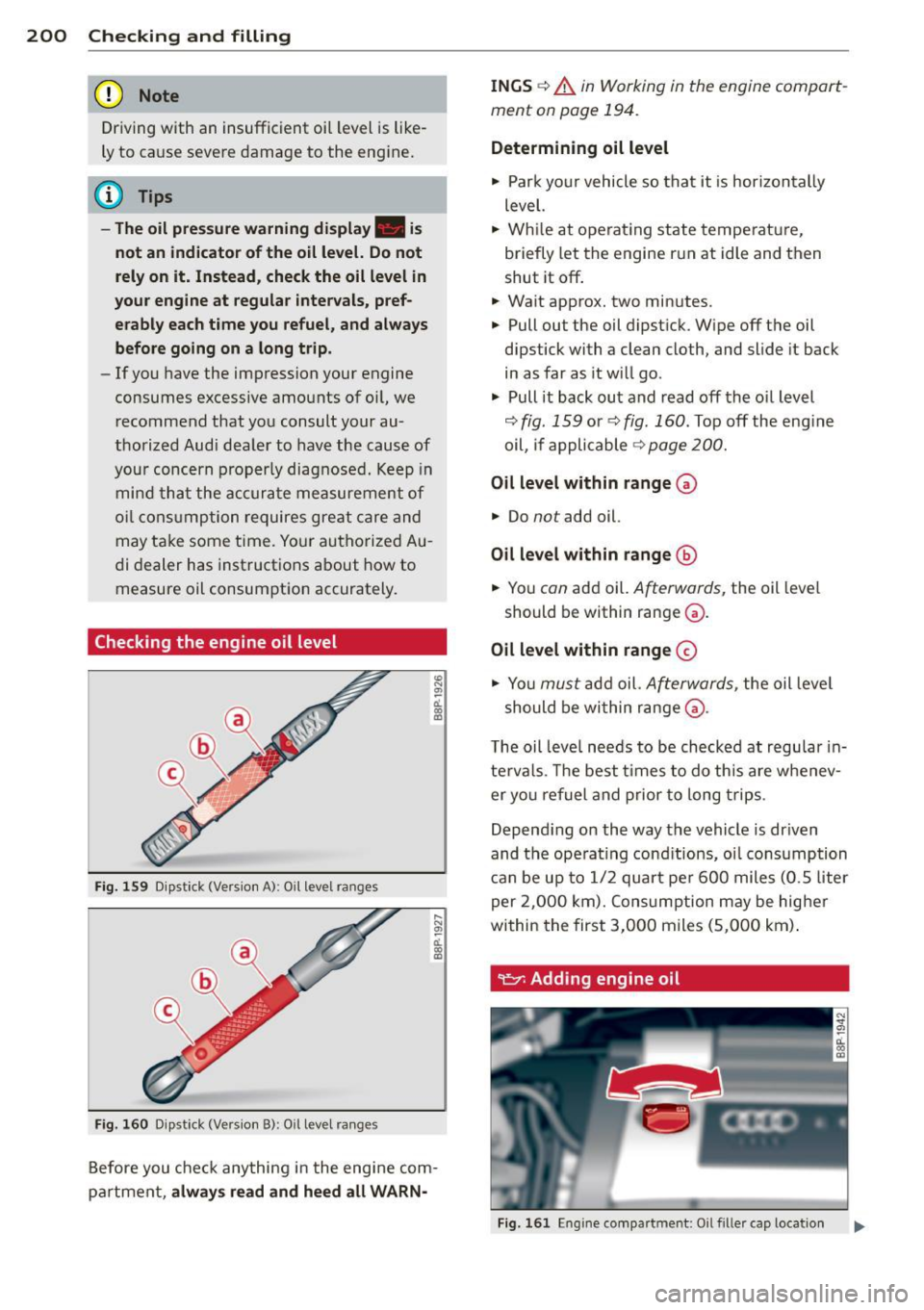
Checking the engine oil level
Fig. 15 9 Dipstick (Ve rs io n A) : Oi l level ranges
Fig . 160 Dipstick (Ve rs io n B): Oil leve l ra nges
B efore you che ck any thing i n the eng ine com
p ar tmen t,
alway s read and heed all WARN-
INGS ~ .&. in Working in the engine comport
ment on poge 19 4.
Determining oil level
• Park yo ur vehicle so tha t it is hori zo ntally
level.
• Wh ile at ope rat ing st ate tempe rat ure,
briefly let the engine r un at idle and then
shut it off .
.. Wait approx. two minutes.
.. Pull out the oil dipst ick. W ipe off t he oil
d ipstick with a clean cloth, and slide it back
in as far as it w ill go.
• Pull it back out and read off th e oil level
~ fig. 159 or ~ fig. 160. Top off the eng ine
oil, if applicable ~
poge 200.
Oil level within range 0
.. Do not add oil.
Oil level within range@
• Yo u con add oil. Afterwords, the oil leve l
should be within range
G) .
Oil level within range 0
• Yo u must ad d oil. Afterwards, the oil leve l
should be wi thin r ange
G) .
The oil level need s to be checke d at regu la r in
te rva ls. Th e be st ti mes to do th is are w henev
er you refuel and prior to long trips .
Depend ing on the way the vehicle is dr iven
and the ope ra tin g con ditions, oi l co nsumption
c a n b e up to 1/ 2 quar t pe r 600 mile s (0. 5 li ter
p er 2,000 km). Co nsumption m ay be hig he r
within the first 3,00 0 miles (5,000 km) .
'1:::7: Adding engine oil
Fi g. 16 1 Engine compa rtment: Oil filler cap location
Page 215 of 280
-Never mount used tires on yo ur vehicle if
you are not sure of their "previous histo
ry." Old used tires may have been dam
aged even though the damage cannot be
seen that can lead to sudden tire failure
and loss of vehicle control.
Glossary of tire and loading terminology
Accessory weight
means the comb ined weight (in excess of
those standard items wh ich may be rep laced)
of automa tic tra nsmission, power steering,
power br akes, power w indows, power sea ts,
radio, and heater, to the ex tent that these
items are avai lab le as factory -installed equip
ment (whether installed or not).
Aspect ratio
means the rat io of the height to the w idt h of
the tire in percent. Numbers of 55 or lower in
d icate a low sidewall fo r improved s teer ing re
sponse and better overall handling on dry
pavement.
Bead
means the pa rt of the t ire t hat is made o f
s teel wires, wrapped o r rein force d by ply cor ds
and that is shaped to fit the r im.
Bead separation
means a b reakdown of the bond between
components in the bead.
Cord
means the strands forming the plies in the
tire.
Cold tire infl ation pressure
means t he tire pressure recommended by the
vehicle manufacturer for a t ire of a designated
size that has not been dr iven for more than a
couple of miles (kilometers) at low speeds in
the three hour period before the tire pressure
i s measu red or adjusted.
Tire s an d wheel s 213
-If you notice un usua l vibration or if the
veh icle pulls to one side when driv ing, a l
ways stop as soon as it is safe to do so and check the wheels and tires for dam
age.
Curb weight
mea ns the we ight of a motor ve hicle w it h
standard equipment in cl ud ing t he maximum
capa city of fuel, o il, and coolant, ai r cond i
tion ing a nd addi tional weig ht o f optiona l
equipment .
Extra load tire
means a t ire designed to operate at higher
loads and at highe r inflat ion p ressu res tha n
th e co rresponding standard tire. Extra load
tir es my be i dent ified as "XL", "xl", "EXTRA
L O AD", or "R F" on t he sidewall.
Gross Axle Weight Rating ("GAWR ")
mea ns the load-carry ing capac ity of a s ingle
axle system, measured at the tire-ground in
te rfaces.
Gross Vehicle Weight Rating ( "GVWR ")
means the maximum total loaded we ight of
the ve hicle.
Groove
means the space between two adjacent tread
ribs.
Load rating (code )
means the maximum load tha t a t ire is rated
to carry for a given inflation press ure. Yo u
may not find this information on all tires be
ca use it is not required by law.
Maximum load rating
me ans the load r ating for a tire at the maxi
mum pe rm issi ble inf lat ion pressure for that
ti re . •
•
...
Page 217 of 280
Tires and wheels 215
Tread
means that portion of a tire that comes into
contact with the road.
Tread separation
means pull ing away of the tread from the tire
carcass .
Treadwear indicators (TWI)
means the projections within the principal
grooves designed to give a visual indication of
the degrees of wear of the tread. See
c:> page 222, Tread Wear Indicator (TWI) for
more informat ion on measuring tir e wear.
Uniform Tire Quality Grading
is a tire information system developed by the
United States National Highway Traffic Safety
Administration (NHTSA) that is designed to help buyers make relative comparisons among
tires. The UTQG is not a safety rating and not a
guaran tee that a tire will last for a prescribed
number of miles or per form in a certain way.
I t simply gives tire buyers additional informa
tion to combine with other considerations,
such as price, brand loyalty and dea ler recom
mendations. Under UTQG, tires are graded by
the tire manufacturers in three areas: tread
wear, traction and temperature resistance.
The UTQG information on the tires, molded in
to the sidewalls .
U.S. DOT Tire Identification Number (TIN)
This is the t ire's "serial number" It begins
with the letters "DOT" and indicates that the ti
re meets all federal standards. The next two
numbers or letters indicate the plant where it
was manufactured, and the last four numbers
represent the week and year of man ufacture.
For example,
DOT . .. 2211 ...
means that the tire was produced in the 22nd
week of 2011. The other numbers are market
ing codes that may or may not be used by the
tire manufacturer . This information is used to
contact consumers if a tire defect requires a
recall.
Vehicle capacity weight
means the rated cargo and luggage load plus
150 lbs. (68 kilograms) times the vehicle's to
ta l seating capacity as listed on the label lo
cated either on the driver's side B-pillar or on
the inside of the fuel filler flap.
Vehicle maximum load on the tire
means that load on an individua l tire that is
determined by distributing to each ax le its
share of the maximum loaded vehicle weight
and dividing by two.
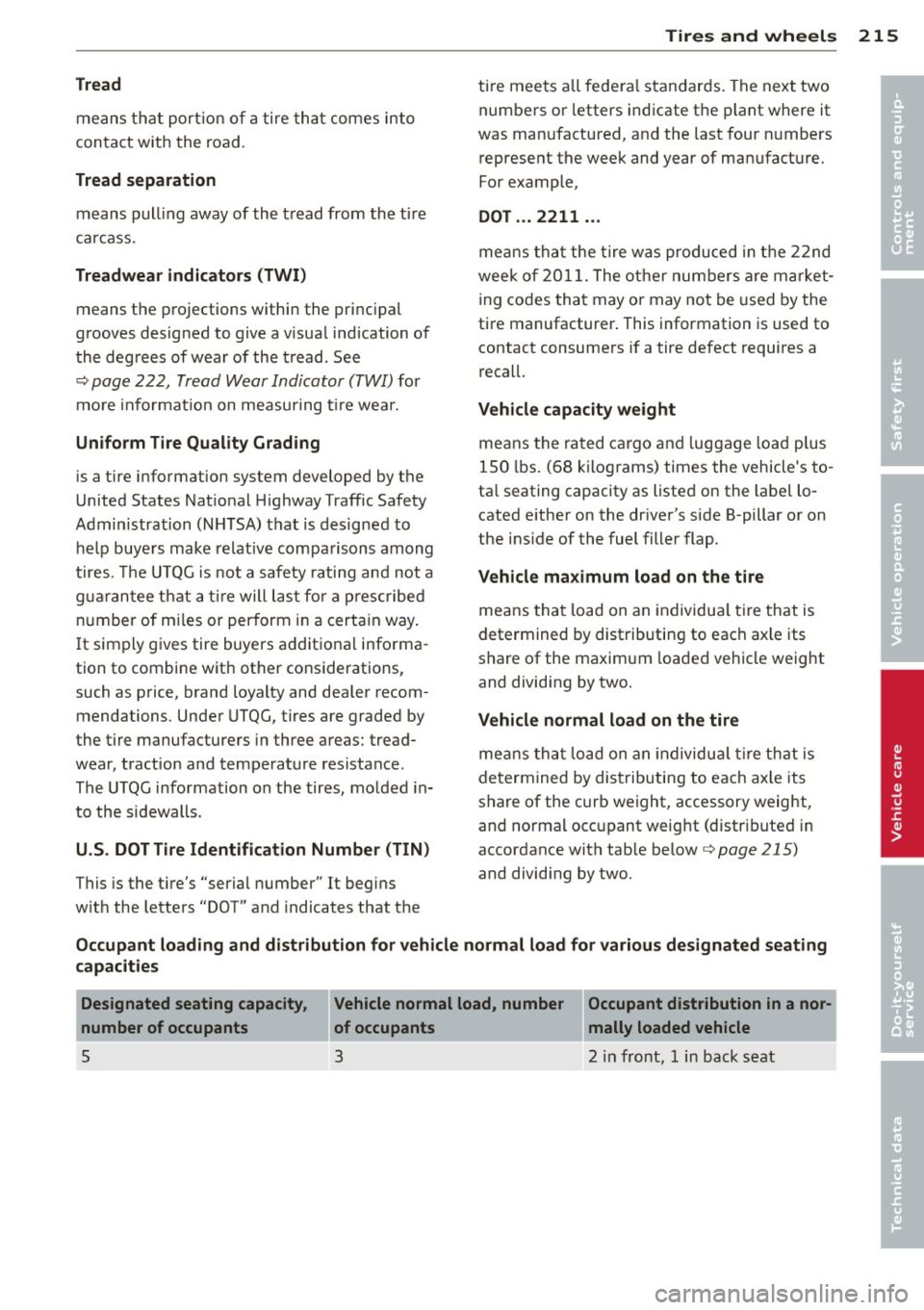
Vehicle normal load on the tire
means that load on an individua l tir e that is
determ ined by distributing to each axle its
share of the curb weight, accessory weight,
and normal occupant weight (distributed in
accordance with tab le below
c:> page 215)
and dividing by two.
Occupant loading and distribution for vehicle normal load for various designated seating
capacities
Designated seating capacity,
number of occupants
5
Vehicle normal load, number Occupant distribution in a nor-
of occupants _____ mally loaded vehicle
3 2 in front, 1 in back seat
•
•
Page 218 of 280
216 Tires and wheels
Cold tire inflation pressure
Tire pressure affects the overall handling, performance and safety of a vehicle .
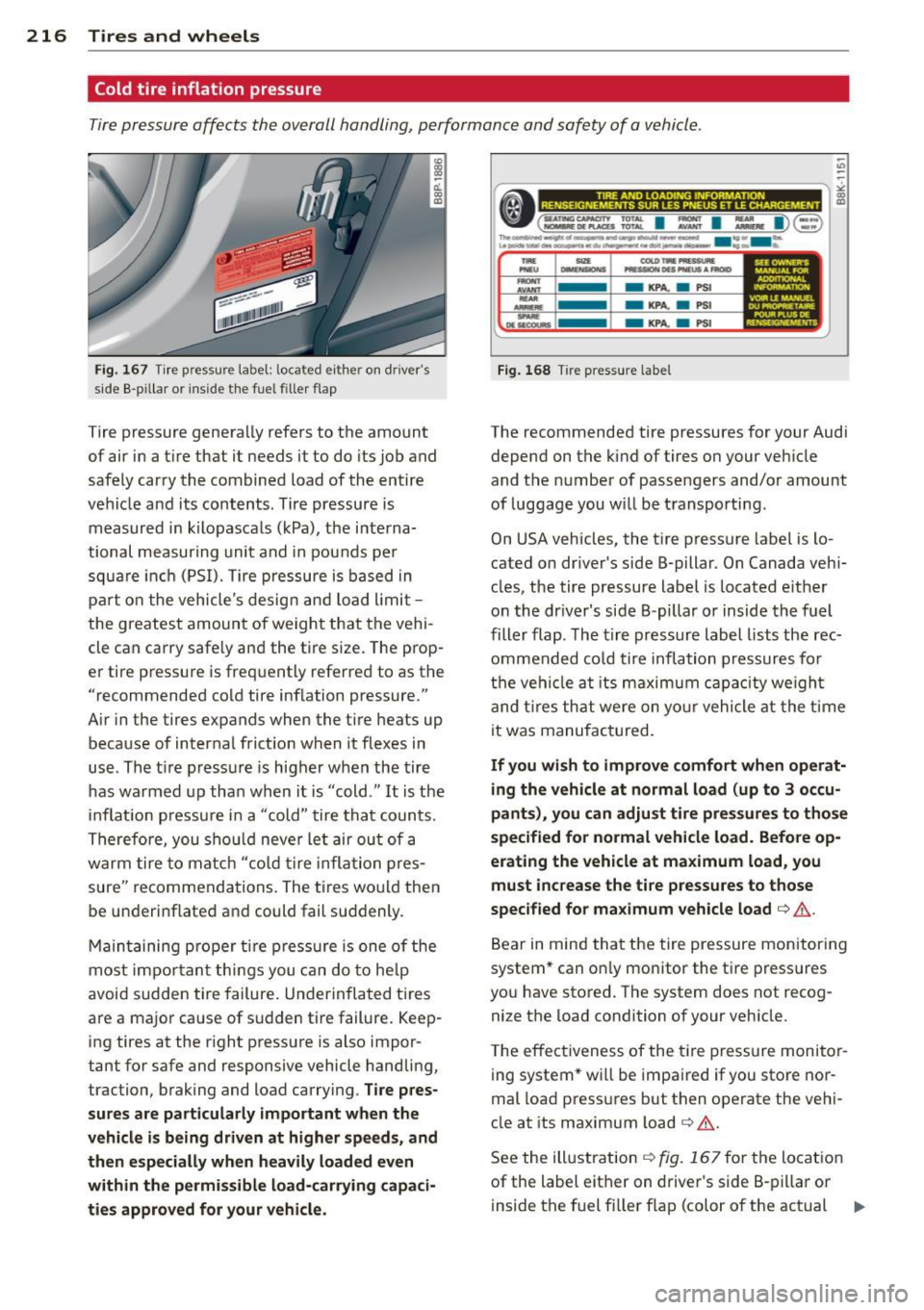
Fig. 167 Tire press ure labe l: loca ted ei the r on dr iver 's
side 8-pillar or inside the fuel filler flap
Tire pressure generally refers to the amount
of air in a tire that it needs it to do its job and
safely carry the combined load of the entire
vehicle and its contents . Tire pressure is
measured in kilopascals (kPa), the interna
tional measuring unit and in pounds per
square inch (PSI). Tire pressure is based in
part on the vehicle's design and load limit
the greatest amount of weight that the vehi
cle can carry safely and the tire size. The prop
er tire pressure is frequently referred to as the
"recommended cold tire inflation pressure."
Air in the tires expands when the tire heats up
because of internal friction when it flexes in
use . The tire pressure is higher when the tire
has warmed up than when it is "cold ." It is the
inflation pressure in a "cold " tire that counts.
Therefore, you should never let air out of a
warm tire to match "cold tire inflat ion pres
sure" recommendations. The tires would then
be underinflated and could fail suddenly .
Maintaining proper tire pressure is one of the
most important things you can do to help
avoid sudden tire failure. Underinflated tires
are a major cause of sudden tire failure. Keep
ing tires at the right pressure is also impor
tant for safe and responsive vehicle handling,
traction, braking and load carrying .
Tire pres
sures are particularly important when the
vehicle is being driven at higher speeds, and
then especially when heavily loaded even
within the permissible load -carrying capaci
ties approved for your vehicle.
,;
•(=~: I : I :,.. I)@ ~
The~-----~---w-o- ....... -e.....i -·· - u ........ -.-..,.0, ... -....,.,...tot~---....... ._.,. -..
....
-..... ...........
- KPA. a PSI
- KPA.
a PSI
- KPA. a PSI
Fig. 168 Tir e pressure label
SU OWNER'S MANUAl FOR AD0"10NAL l10N VOl!ILEMANU£1. DU _,...,
POUR Pl.US DE
REHSEKi.\'IEME NTS
The recommended tire pressures for your Audi
depend on the kind of tires on your veh icle
and the number of passengers and/or amount
of luggage you will be transporting .
On USA vehicles, the t ire pressure label is lo
cated on driver's side B-pillar . On Canada vehi
cles, the tire pressure label is located e ither
on the dr iver 's side B-pillar or inside the fuel
filler flap . The tire pressure label lists the rec
ommended cold tire inflation pressures for
the vehicle at its maximum capacity we ight
and tires that were on your vehicle at the time
it was manufactured.
If you wish to improve comfort when operat
ing the vehicle at normal load (up to 3 occu
pants), you can adjust tire pressures to those
specified for normal vehicle load. Before op
erating the vehicle at maximum load, you
must increase the tire pressures to those
specified for maximum vehicle load¢.&..
Bear in mind that the tire pressure mon itoring
system * can on ly monitor the tire pressures
yo u have stored. The system does not recog
nize the load condition of your vehicle.
T he effectiveness of the tire pressure monitor
ing system * wi ll be impaired if you store nor
mal load pressures but then operate the vehi
cle at its maximum load
¢ .&..
See the illustration ¢ fig. 167 for the location
of the label either on driver's side B-pillar or
i nside the fuel fi ller flap (color of the actual
IJI>
Page 219 of 280
Tires an d wheel s 21 7
labe l and exact location on the vehicle will
vary slightly).
Note that the fo llowing tab le is accurate at
t he t ime o f go ing to press and is subject to
change. In the event of discrepancies, the tire
pressure label (on USA vehicles, the tire pres
sure label is located on driver's side B -pillar;
on Canada vehicles, the tire pressure label is
located e ither on the driver's side B-pillar or inside the f
uel filler flap.) always takes prece
dence.
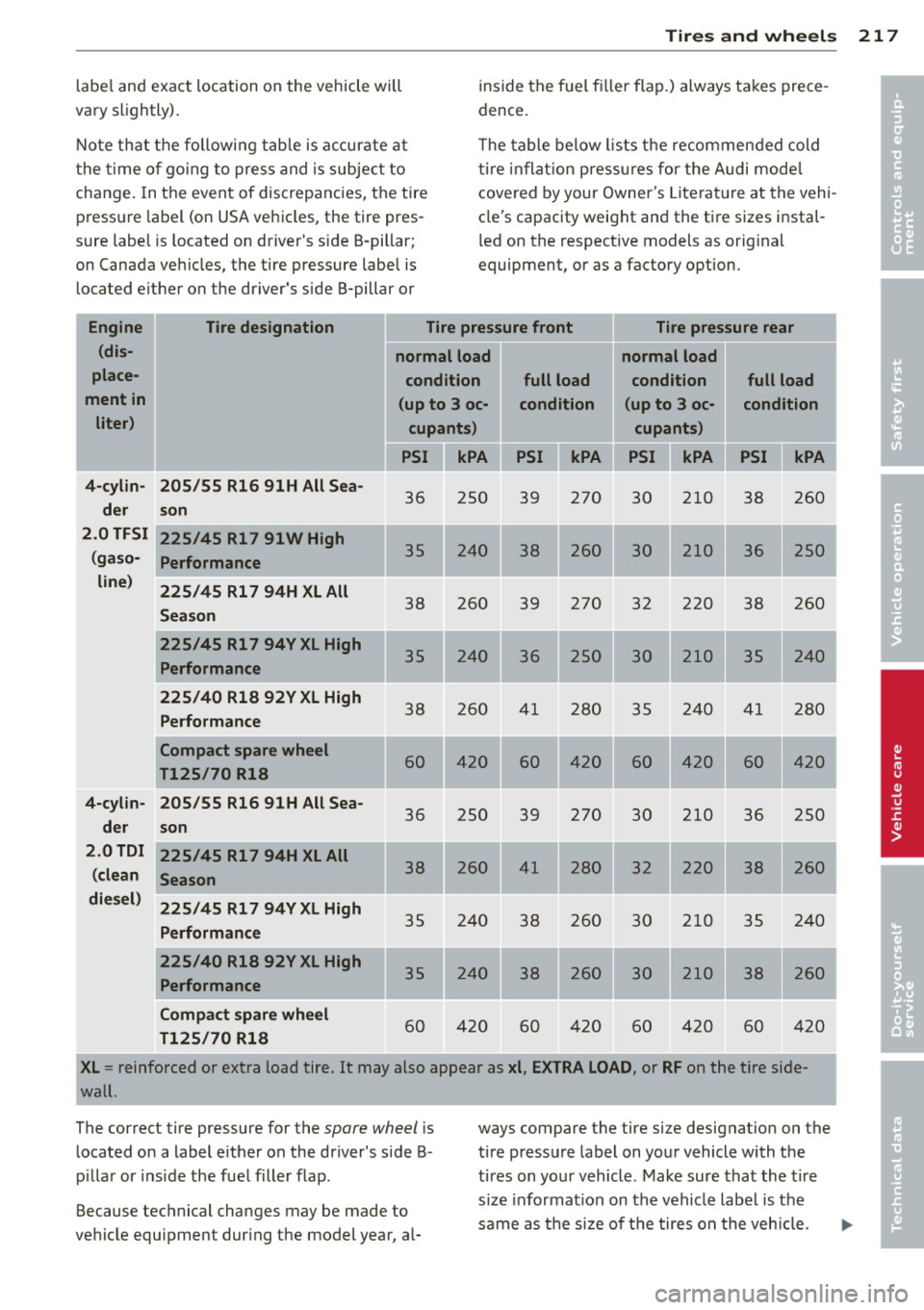
T he table below lists the recommended cold
ti re inflat ion p ressu res for the Audi mode l
cove red by your Owner's Literat ure at the vehi
cle's capacity weight and the tir e sizes instal
l ed on the respect ive models as orig inal
equipment, or as a factory option.
Engine
(dis
place
ment in liter ) Tire designation
Tire pressure front Tire pressure rear
4- cylin
d er
2.0 TFSI (ga so
line )
4-cylin -
der
2 .0
TOI
(clean
die sel) 205
/55 Rl6 91H All Sea-
son
2 25 /45 Rl7 91W High
Performance
22S /45 Rl7 94H XL All
Season
225 /45 Rl7 94Y XL High
Performance
225 /40 Rl8 92V XL H igh
Perfo rmance
Compact spare wheel
Tl25 /70 Rl8
205 /S5 Rl6 91H All Sea-
s on
225 /45 Rl 7 94H XL All
Season
225 /4S Rl 7 94V XL High
P erformance
225 /40 Rl8 92V XL High
Performance
C ompa ct spare whe el
Tl25 /70 Rl8 no
rmal load
condition
( upto 3 oc-
cupant s)
PSI kPA
36 250
•
JI
35 2 40
38 260
35 240
38 260
60 420
36 250
38 260
35 240
35 240
60 420
normal load
full load condition full load
condition (up to 3 oc- condition
cupant s)
PSI kPA PSI kPA PSI kPA
39 270 30 210 38 260
..
38 260 30 210 36 250
"
39 270 32 220 38 260
36 250 30 210 35 240
41 280 35 240 41 280
60 420
60 420 60 420
39 270 30 210 36 250
41 280 32 220
38 260
38 260 30 210 35 240
38 260 30 210 38 260
60 420 60 420 60 420
X L = reinforced or extra load tire. It may also appear as xl, EX TRA LOAD , or RF on the tire side
wall.
The correct tire pressure for the spare wheel is
located on a label e ither on the driver's side B
p illar or i nside the fuel filler flap . ways
compare the tire size designatio n on the
tire pressure label on your vehicle with the
tires on yo ur vehicle . Make sure that the t ire
s ize informat ion on the vehicle labe l is the
I
J
•
I
Because technical changes may be made to
vehicle equipment during the model year, al- same as the size of the tires on the veh
icle. .,.
•
•
Page 221 of 280

used today are underinflated just by looking
at them.
Therefore, be sure to check tire pressures at l eas t once a mon th and always before going
on a long trip. Make sure to take the number
of people and the amount of luggage into ac
count when adjusting tire pressure for a trip -
even one that you would not consider to be
"long." See ¢
page 220, Tires and vehicle
load limits
for more important information .
A lways use an accurate tire pressure gauge
when check ing and adjusting inflation pres
sures . Check all of the tires and be sure not to
forget the spare t ire . If the pressure in any tire
is too high when the tire is "cold," let air out
of the tire slowly with the edge of the t ire
gauge and keep checking the pressure until
you reach the p ress ure th at is cor rect for the
l oad (passengers and luggage) and kind of
driving you plan to do .
I f the p ressu re in any tire is too low , note the
d ifference between the pressure in the cold
tire and the pressure you need and add the air
that you need to reach the correct pressure for
the vehicle load (passengers and luggage) for
the tires on your vehicle as listed on the on
your veh icle and in this manual and the kind
of dr iving you p lan to do.
Never e xceed the m aximum inflation pre s
su re li sted on th e tir e side wall for any rea
son.
Remember that the vehicle manufacturer, not
the tire manufacturer, determines the co rrect
tire p ressure for the tires on your vehicle .
It is important to check the tire pressure when
the tires are cold .
- Read the requ ired ti re p ressu re from the tire
pressure label. On USA veh icles, the t ire
pressure label is located on driver's side 8-
pillar . On Canada vehicles, the tire pressure
label is located either on the driver's side 8-
pillar or inside the fuel fi ller flap.
- Turn the valve stem cap counter-clockwise
to remove it from the tire valve.
- Place the air pressure ga uge on the valve.
Tire s an d wheel s 219
- The tire pressures should only be checked
and adj usted when the tires are co ld . The
slightly raised pressures of warm tires must
not be reduced.
- Adjust the tire pressure to the load you are
carrying.
- Reinstall the valve stem cap on the va lve.
When should I check the tir e pressu re?
T he co rrect tire pressu re is especially impor
tant a t high speeds. The pressure should
therefore be checked at least once a month
and always before starting a jo urney . Do not
forget to check the tire pressure for the spare
whee l
¢page 234.
When should I adjust the tire pres sur es?
Adjus t the t ire press ure to the load you a re
carrying . After changing a whee l
or rep lacing
whee ls you have to adjust the tire pressu res
on all whee ls. In addition, yo u m ust then initi
ali ze the new t ire pressures in the tire pres
sure monitoring system*¢
page 230.
A WARNING
...---
Incorrect tire pressures and/or underinfla-
tion can lead sudden tire fa ilure, loss of
control, collision, serio us personal injury
or even death.
- When the warning symbol
ti] appears in
the instrument cluster, stop and inspect
the t ires.
- Inco rrect tire pressure and/or underinfla
tion can cause increased tire wea r and
can affect the hand ling of the vehicle and
s topping abi lity.
- I nco rrect tire pressures and/or unde rin
flation can a lso lead to sudden t ire fail
ure, including a blowou t and sudden de
flation, ca using loss of vehicle contro l.
- The driver is responsib le for the correc t
tire pressures for all tires on the veh icle.
The applicable pressure values are locat
ed on a sticker on the dr iver's side 8-pil
lar or on the ins ide of the fuel filler flap. •
•
Page 222 of 280
220 Tire s and wheel s
-Only when all tires on the vehicle are fi l
led to the correct pressure, the tire pres
sure monitoring system* can work correctly .
- The use of incorrect tire pressure values
can lead to accidents or other damage.
Therefore it is essential that the driver observe the specified tire pressure va lues
for the tires and the co rrect p ressu res fo r
the f unct ion of the tire pressure mo nitor
ing system*.
- Always inflate t ires to the recommended
and co rrec t tire pressu re before d rivi ng
off.
- Driv ing with under inflated ti res bend
more, lett ing them get too ho t res ulting
in tread separation, sudden t ire fail ure
and loss of control.
- E xcess ive speed and/overloading can
cause heat bui ld -up, sudden t ire fail ure
and loss of control.
- If the tire press ure is too low or too high,
the tires wi ll wear prematu rely and the
vehicle will not hand le we ll.
- If the t ire is no t flat and you do not have
to change a wheel immediate ly, drive at
reduced speed to the nearest service sta
t ion to check the tire pressure and add
air as required.
Driving without va lve stem caps can cause
damage to the tire va lves. To prevent this,
always make sure that facto ry installed
valve stem caps on all wheels are secure ly
mounted on the valve.
@) For the sake of the environment
Underinf lated tires will a lso increase t he
fue l consumption .
Tires and vehicle load limits
There are limits to the amount of load or
weight that any veh icle and any t ire ca n car ry .
A veh icle that is overloaded w ill not ha ndle
well a nd is more difficult to s top. Over load ing
c a n no t on ly lead to loss of veh icle con tro l, but can also damage important parts of the
vehicle and ca n lead to sudden tire fai lure, in
clud ing a b lowout and sudden deflation that
can cause the vehicle to crash.
Your safety an d that of your passengers also
depends on making sure that load limits are
not exceeded . Vehicle load includes everybody
and everything in and on the veh icle. These
load lim its are technically referred to as the
vehicle's
Gro ss Vehicle Weight Rating
("GVWR").
The "GVWR" includes the weight of the basic
vehicle, a ll factory installed accessories, a full
tank of fuel, o il, coolant and other fluids plus
maximum load. The max imum load incl udes
the number of passengers that the vehicle is
i ntended to car ry ("seat ing capac ity ") with an
a ss u med we igh t of 150 lbs (68 kg) for e ach
passenge r at a designated seating posi tion
and the total weight of any luggage in the ve
hicle . If you tow a trai ler, the weight of the
trai ler hitch and the tongue weight of the
loaded tra iler must be included as part of the
vehicle load.
T he
G ros s Axle Weight Rating ("GAWR") is
the maximum load that can be applied at each of the vehicle's two axles.
The Gross Vehicle Weight Rating and the Gross Ax le Weight Rating are listed on the
safety comp liance sticker label located e ither
on the dr iver's s ide B-pillar or on t he ins ide of
the fuel filler flap . Your Audi has 5 sea ting po
s itions, 2 in the front and 3 in the rear for to
tal seating capacity of 5 . Each seat ing pos ition
has a safety belt
q page 113, Safety belts.
The fac t that there is a n upper limit to your
vehicle's G ross Vehicle Weight Rating means
that the total weight of whatever is bei ng car
ried in the vehicle ( in cl ud ing the weight of a
t ra ile r hi tc h and the tongue we igh t of the
loaded trail er) is lim ite d. T he more p assen
gers in the vehicle or passengers who are
heavier than the standard weights assumed
mean that less weight can be carried as lug-
gage.
~
Page 230 of 280
228 Tires and wheels
The speed rating letter code( ¢ page 224) is
on the side wall of the tire
¢ page 223.
A WARNING
Winter tires have maximum speed limits
that may be lower than your vehicle's max
imum speed . Always know the maximum
speed before driving off. Never drive faster
than the speed permitted for your specific
winter tires. This will cause damage to the
tires leading to an accident and serious
personal injury to you and your passen
gers.
A WARNING I>=
Driving faster than the maximum speed
for which the winter tires on your vehicle
were designed can cause tire failure in
cluding a blowout and sudden deflation,
loss of control, crashes and serious per
sonal injuries. Have worn or damaged tires
replaced immediately.
- Winter tires have maximum speed rating
that may be lower than your vehicle's
maximum speed .
- Never drive faster than the speed for
which the winter or other tires installed on your vehicle are rated.
A WARNING
Always adjust your driving to the road and
traffic conditions. Never let the good ac
celeration of the winter tires and all-wheel
drive tempt you into taking extra risks . Al
ways remember :
- When braking , an all-wheel drive vehicle
handles in the same way as a front drive
vehicle.
- Drive carefully and reduce your speed on
icy and slippery roads, even winter tires
cannot help under black ice conditions.
@) For the sake of the environment
Use summer tires when weather condi
tions permit. They are quieter, do not wear
as quickly and reduce fuel consumption.
Snow chains
Snow chains may be fitted only to the front
wheels, and only to certain tire sizes . Ask your
authorized Audi dealer on which tire sizes snow chains can be used.
If you are going to use snow chains, then you
must install them on the front wheels at
least.
The snow chains must have low-profile links
and must not be thicker than 0.53 inch
(13 .5 mm) , including the lock.
Remove wheel center covers and trim discs
before putting snow chains on your vehicle
¢ (!) . For safety reasons cover caps must then
be fitted over the wheel bolts. These are avail
able from authorized Audi dealers.
A WARNING
=
Using the wrong snow chains for your vehi-
cle or installing them incorrectly can in
crease the risk of loss of control leading to
serious personal injury.
- Snow chains are available in different
sizes . Always make sure to follow the in
structions provided by the snow chain manufacturer.
- When driving with snow chains never
drive faster than the speed permitted for
your specific snow chains.
- Always observe local regulations.
(D Note
- Remove snow chains before driving on
roads not covered with snow to avoid
damaging tires and wearing the snow
chains down unnecessarily .
- Snow chains, which come into direct con
tact with the wheel rim, can scratch or damage it. Therefore, make sure that the
snow chains are suitably covered. Check
the position of the snow chains after
driving a few yards and correct if neces
sary. Follow the instructions from the
snow chain manufacturer when doing so. ..,.
Page 258 of 280
256 Genera l inform ation
Gro ss Axl e Weight Rating
The Gross Axle Weight Rating is the maxim um
l oad that can be applied at each axle of the
vehicle ~&. .
Vehicle capacity weight
The vehicle capac ity we ight (max . load) is list
ed eithe r on the dr iver's side B-pillar o r inside
the fuel filler flap.
Roof weight
The maximum perm iss ible roof we ight is 165
lb (75 kg ). The roof we ight is made up of the
weight of the roof ra ck system and the weight
of the object bei ng transpo rted
~ page 73 ,
Loading the roof rack .
A WARNING
- The actual Gross Axle Weight Rating at
the front and rear axles sho uld not ex
ceed the perm iss ib le weights, and their
combination must not exceed the Gross
Vehicle Weight Rat ing .
- Exceeding permissib le we ight ratings can
result in vehicle damage, accidents and
personal in jury.
(D Note
- The vehicle capacity weight figures app ly
when the load is distrib uted evenly in the
vehicle (passengers and luggage) . When
transporting a heavy load in the luggage
compartment , carry the load as nea r to
the rea r axle as possib le so that the vehi
cle's handling is not impa ired .
- Do not exceed the maximum permissible
axl e loads or the max imum g ross vehicl e
weig ht. Always remembe r that the vehi
cl e's handling will be affected by the ex
tra load . Therefore, adjust your speed ac
cordingly.
- Alw ays obse rve lo cal regulations.
Dimensions
-
The spe cifica tions refer to the basi c model.
D ifferen ces may oc cur depe nding on the mod- el type and options orde
red , fo r example , tire
siz es.
(D Note
When dr iv ing up steep ramps, on rough
r oads, over curbs, etc. it is important to re
member that some pa rts of your vehicle,
such as spo ile rs or exhaust system compo
nents, may be close to the ground . Be
careful not to damage them .