engine oil AUDI A3 2012 Owner´s Manual
[x] Cancel search | Manufacturer: AUDI, Model Year: 2012, Model line: A3, Model: AUDI A3 2012Pages: 280, PDF Size: 70.11 MB
Page 205 of 280
luggage compartment. Make sure the
container is securely stored and mount
ed.
0 Note
-If you use engine oil that does not ex
pressly conform to Audi oil specification
VW 507 00, very serious and very expen
sive damage to your vehicle 's engine will
occur . Engine damage caused by using
the wrong engine oil is not covered by
your New Vehicle limited Warranty .
- Not all commercially available oils con
form to this very rigid Audi oil quality
standard even though they may be syn
thetic-based and have the same viscosi
ty.
Engine cooling system
Coolant
T he engine coolant performs two functions: it
keeps the engine from overheating and it pro
tects the engine from freezing in the winter.
The cooling system is sealed and generally re
quires little attention.
The cooling system has been filled at the fac
tory with a permanent coolant which does not need to be changed. The coolant consists of a
mixture of water and the manufacturer's gly
col-based coolant additive Gl2++ antifree ze
with anticorrosion additives (50% for USA models; 60% for Canadian models). This mix
ture both assures the necessary frost protec
tion and protects metal components in the
engine 's cooling system from corrosion and
scaling.
It also raises the boiling point of the
coolant.
Do not reduce the concentration of the cool
ant in the summer by adding plain water.
The
proportion of coolant additive must be at
least 50% but not more than 60%
to main
tain antifreeze protection and cooling efficien
cy. If the coolant frost protection is too low,
the coolant could freeze and damage the vehi
cle heating and engine cooling system.
Checking and filling 203
For year-round driving, antifreeze is added at
the factory for temperatures down to:
--31°F(-35°C)USA
- - 40 °F ( - 40 °C) Canada.
You can mix the Gl2 ++ coolan t additive with
other additives Gl2 + or Gl2. Always check
with your authorized Audi dealer .
A WARNING
-
Before you check anything in the engine
compartment, always read and heed all
WARNINGS~
& in Working in the engine
comportment on page 194.
(D Note
- Before winter sets in, have the coolant
checked to see if the coolant additive in
your vehicle is sufficient to meet the cli
mate conditions. This is especially impor
tant if you live in a region where the
win
ter is extremely cold. If necessary, in
crease the proportion of coolant additive
to 60% .
- When adding coolant additive to your
cooling system, remember :
- We recommend using only coolant ad
ditive G 12++ (check the label) for your
vehicle. This coolant additive is availa
ble at authorized Audi dealers. Other
types of antifreeze can significantly re
duce corrosion protection. The result
ing corrosion can cause a loss of cool
ant and serious engine damage.
- Do not add any type of radiator leak seal
ant to your vehicle's engine coolant.
Adding radiator repair fluid may adverse ly affect the function and performance of
your cooling system and could result in
damage not covered by your New Vehicle
Limited Warranty.
•
•
Page 206 of 280
204 Checking and filling
Checking the engine coolant level
The engine coolant level can be checked with
a quick glance .
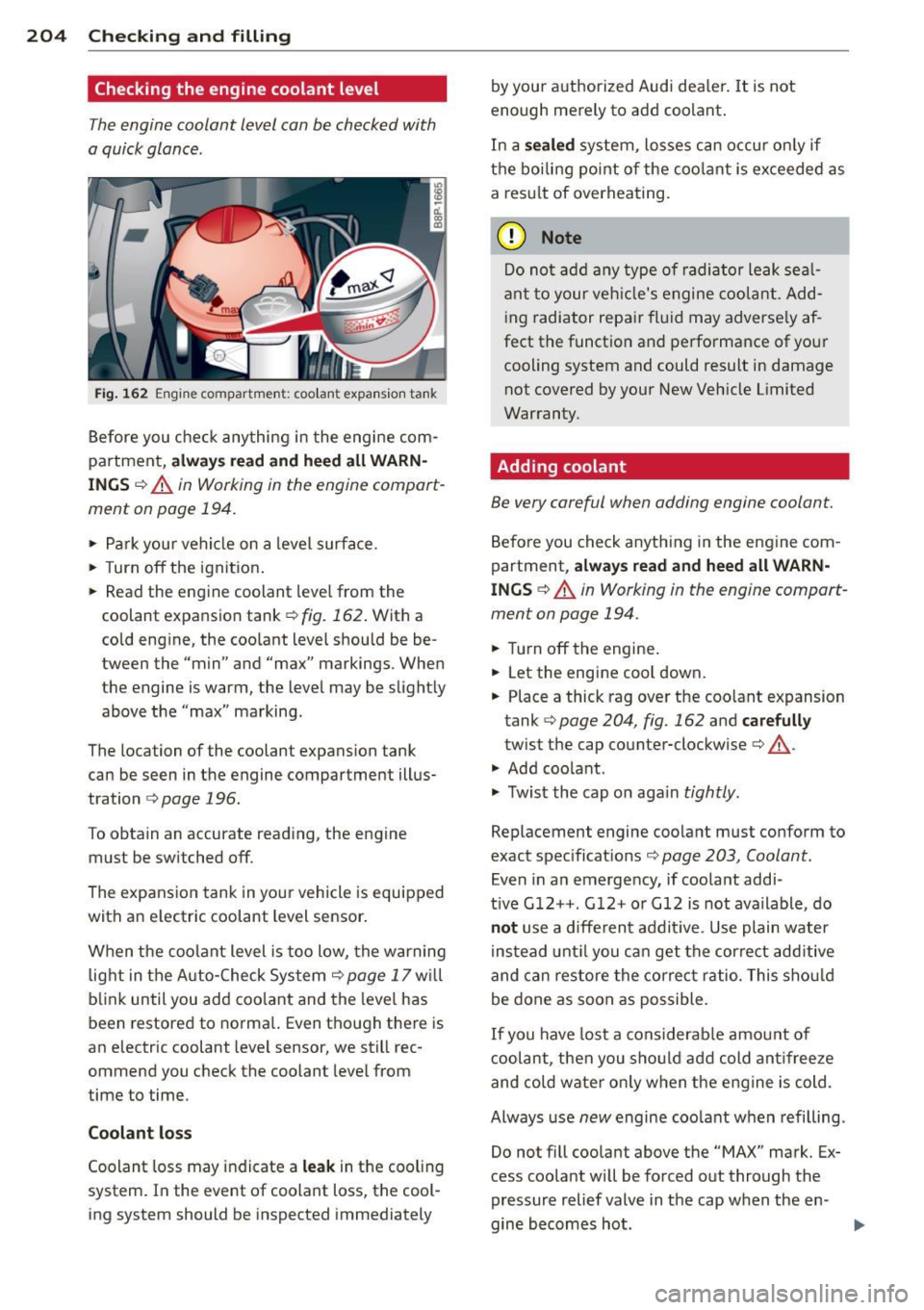
Fig. 162 Engine compartme nt: coo lant expansio n tank
Before you check anything i n the eng ine com
partment,
a lw ays rea d and h eed all WARN
ING S ¢&. in Working in the engine compart
ment on page 194.
.. Park your vehicle on a level surface.
.. Turn
off the ignit ion .
.. Read the eng ine coolant leve l from the
coolant expansion tank<=>
fig. 162 . With a
cold eng ine, the coo lant level should be be
tween the "min" and "max" markings . When
the engine is warm, the level may be slightly above the "max" marking.
The location of the coolant expansion tank
can be seen in the engine compartment illus
tration
i:> page 196.
To obtain an accurate read ing, the engine
must be switched
off.
The expansion tank in yo ur vehicle is equipped
with an e lectric coolant level sensor .
When the coolant level is too low, the warning light in the Auto -Check System
c> page 17 w ill
blink until you add coo lant and the level has
been restored to norma l. Even though there is
an electric coolant level sensor, we still rec
ommend you check the coolant level from
time to time.
Coolant lo ss
Coolant loss may indicate a le ak in the cooling
system . In the event of coolant loss, the cool
ing system should be inspected immediately by your authorized Audi dea
ler .
It is not
enough merely to add coolant .
In a
se aled system, losses can occur on ly if
the boiling point of the coo lant is exceeded as
a res ult of overheating.
(D Note
Do not ad d any type of radiator leak sea l
ant to your veh icle's engine coolant . Add
i ng radiator repair fl uid may adverse ly af
fect the funct ion and performance of your
cooling system and could result in damage not covered by your New Veh icle Limited
Warranty .
Adding coolant
Be very careful when adding engine coolant.
Before you check anything in the eng ine com
partment,
a lw ays re a d and heed all WARN
INGS c::> A in Working in the engine compart
ment on page 194 .
.. Turn off the engine .
.. Let the engine cool down.
.. Place a thick rag over the coolant expansion
tank
c::> page 204, fig . 162 and ca refull y
twist the cap counter-clockwise c::> A.
.. Add coo lant .
.. Twist the cap on aga in
tightly .
Replacement engine coolant must conform to
exact spec ificat ions
c::> page 203, Coolant.
Even in an emergency, if coolant addi-
t ive G12++ . G 12+ or G12 is not ava ilable, do
n ot use a d iffe rent addit ive. Use plain water
instead unt il you can get the correct add itive
and can restore the correct ratio. This shou ld
be done as soon as possible .
If you have lost a considerab le amou nt of
c oolant, then you sho uld add cold ant ifree ze
and co ld wate r on ly when the engine is cold.
Always use
new engine coo lant when refilling .
Do not f ill coolant above the
"MAX" mark. Ex
cess coolant will be forced out through the
pressure relief valve in the cap when the en -
gine becomes hot .
Iii>
Page 208 of 280
206 Checking and filling
Brake fluid
Checking brake fluid level
The brake fluid level can be checked with a
quick glance .
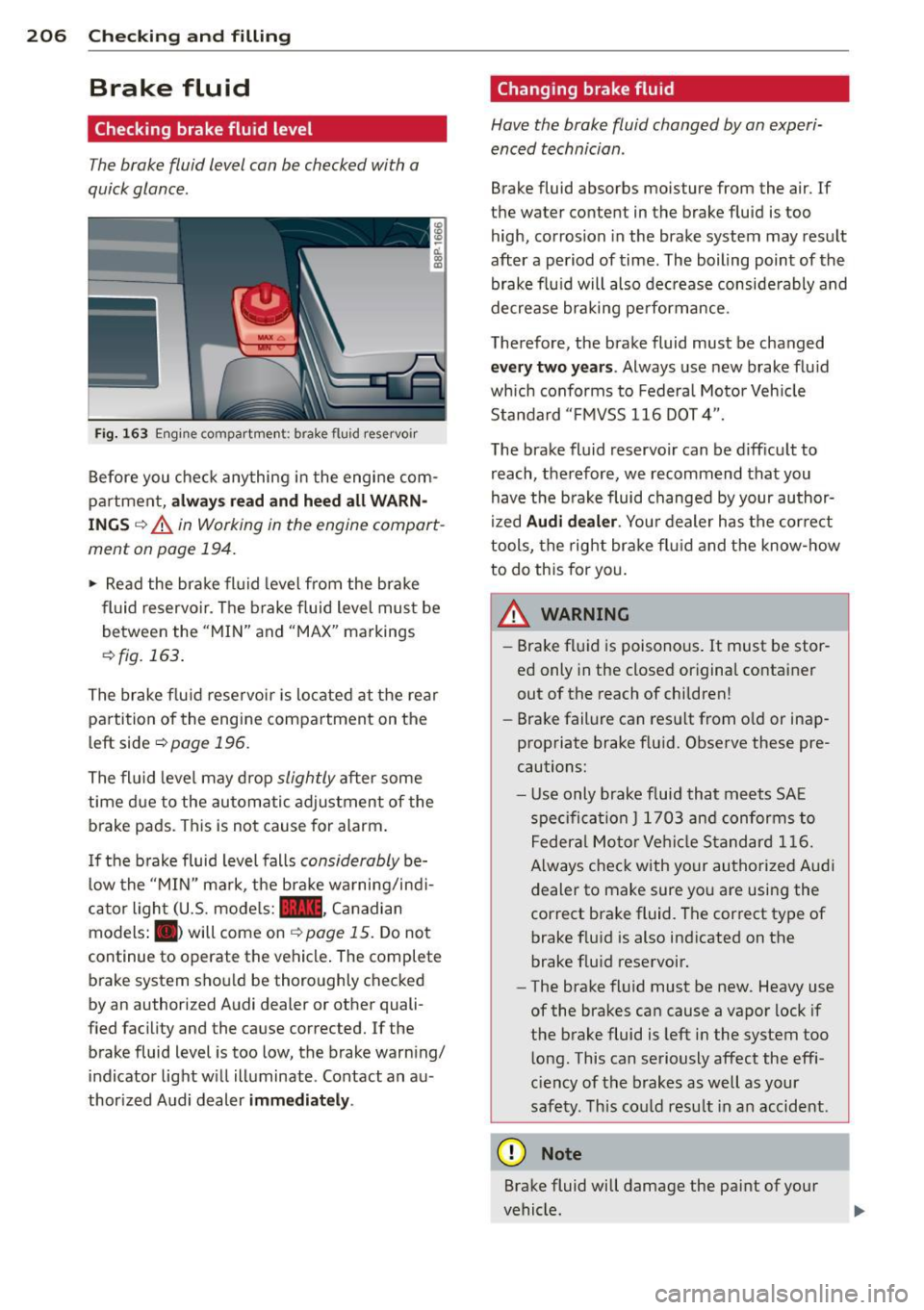
Fig. 163 Engine compartme nt: brake flu id reservo ir
Before you check anything i n the engine com
partment,
a lwa ys rea d and h eed a ll WA RN·
ING S c:> & in Working in the engine compart
ment on page
194.
~ Read the brake fluid level from the bra ke
fluid reservoir. The brake fluid Level must be
between the "MIN" and "MAX" markings
9fig. 163 .
The brake f lu id rese rvoir is located at the rear
partition of the engine compartment on the
L eft side
¢page 196.
The fluid level may drop slightly after some
time due to the automatic adjustment of the b rake pads . This is not cause for alarm .
I f the b rake fluid Level falls
considerably be
low the "MIN" mark, the brake wa rning/ind i
cator Light (U.S. models:
1111 , Canadian
models:
llllt will come on c:> page 15 . Do not
continue to operate the vehicle . The complete
brake system sho uld be thoroughly checked
by an authorized Audi dealer or other quali
fied facility and the cause corrected. If the
brake fluid level is too low, the brake warn ing/
indicator Light w ill illuminate . Contact an au
thor ized Audi dealer
imm ediatel y.
Changing brake fluid
Have the brake fluid changed by an experi
enced technician .
Brake fluid absorbs moisture from the air. If
the water content in the brake fluid is too high, corrosion in the brake system may result
after a period of time . The boiling point of the
brake flu id will also decrease conside rably and
decrease braking pe rformance.
Therefore, the brake fluid must be changed
eve ry two y ears. Always use new brake flu id
which conforms to Federal Motor Veh icle
Standard "F MVSS 116 DOT 4".
The brake fluid reservoir can be diff icult to
reach, therefore, we recommend that you
have the b rake fluid changed by your author
ized
Audi dealer . Your dealer has the correct
tools, the right brake fl uid and the know -how
to do this for you.
A WARNING
- Brake fluid is poisonous . It must be stor
ed only in the closed original container
out of the reach of children!
- Brake failure can resu lt from o ld or inap
propriate brake flu id. Observe these pre
cautions:
- Use only brake f luid that meets SA E
specifica tion
J 1 7 03 and conforms to
Federa l Moto r Ve hicl e Standard 1 16.
Always check with yo ur authorized Aud i
dealer to make sure yo u are using the
correct brake fluid. The correct type of brake f lu id is also ind icated on the
brake flu id reservoir.
- The brake fluid must be new. Heavy use
of the brakes can cause a vapor lock if
the brake fluid is left in the system too
l ong. This can seriously affect the effi
c iency of the brakes as well as your
safety. This cou ld resu lt in an accident.
(D Note
Brake fluid will damage the paint of your
vehicle .
Page 246 of 280
244 Fuses and bulbs
Fuse Location, Instrument Panel left
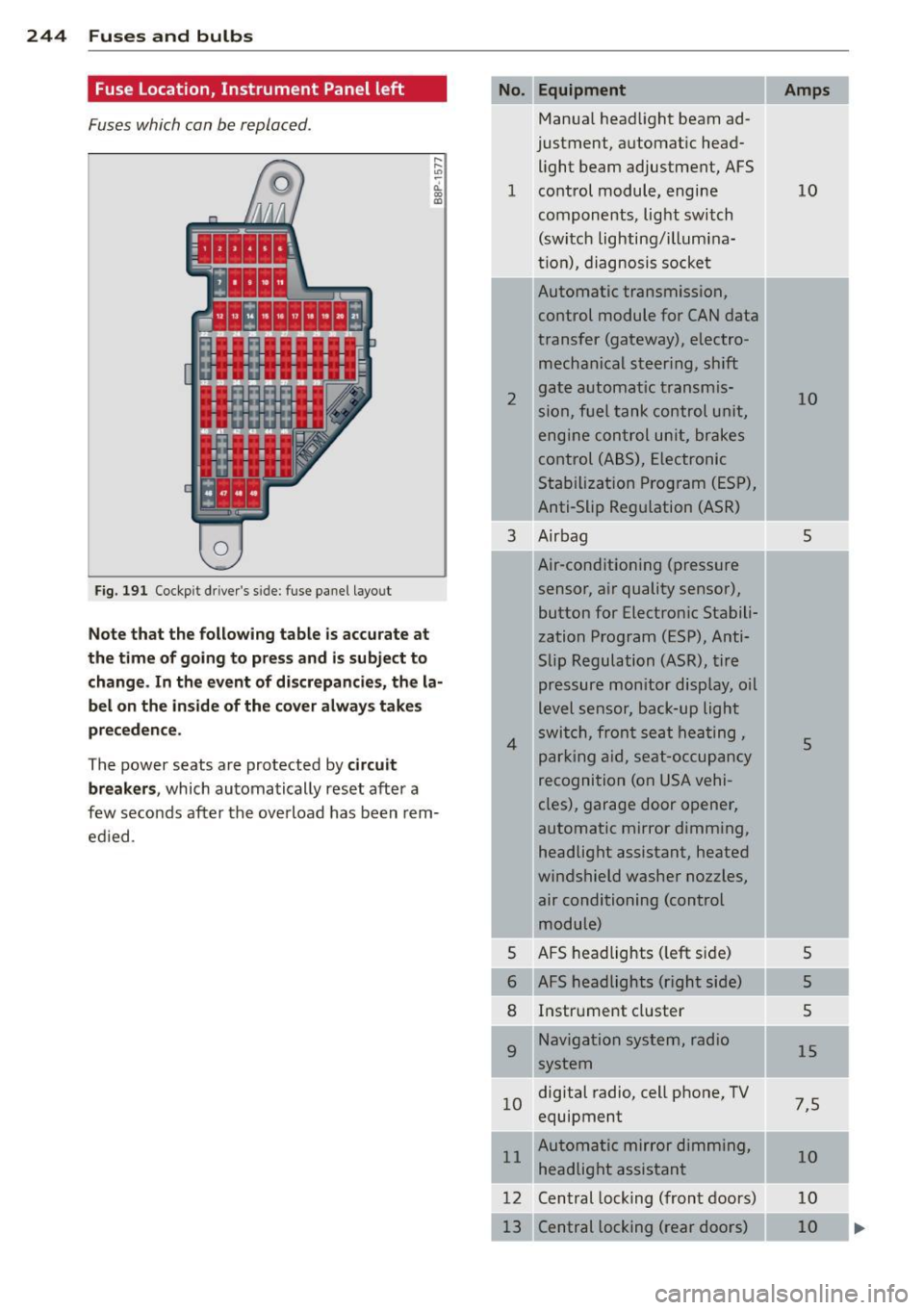
Fuses which can be replaced.
Fig. 191 Cockp it driver 's s ide: fuse pane l layout
Note that the following table is accurate at
the time of going to pr ess and i s subject to
change . In the event of d iscrepancies, the la
bel on the in side of the cover always take s
pr eceden ce .
The power seats are protected by circuit
break ers,
which automatically reset after a
few seconds after the ove rload has been rem
ed ied .
Equipment
Manua l head light beam ad
justment, a utomat ic head
light beam adjustment, AFS
1 co ntrol m odule, engine
components, light switch
(switch lighting/illumina
ti on), diagnosis socke t
2
3
4
5
6
8
9
Automatic transmission,
control module for CAN data
transfer (gateway), electro
mechanical steering, shift
gate automatic transmis
sion, fuel tank control unit,
engine control unit, brakes
control (A BS), Electronic
Stabili zation Program (ESP) ,
Anti-Slip Regulation (ASR)
Air bag
Air-conditioning (pressure
sensor, air quality sensor), button for Electronic Stabili
zation Program (ESP), Anti
Slip Regulat ion
(ASR), tire
pressure monitor display, oil
level senso r, back-up ligh t
s w itch, front se at he ati ng ,
p ark ing aid, sea t-occupancy
recognition (on USA vehi
cles), garage door opener,
automa tic mirror dimming,
headlight assistant, heated
windshield washer nozzles, air conditioning (control
module)
AFS headlights ( left si de)
AFS headlights (right side) Instr ument cluster
Navigation system, radio
system
1 0 digital
radio, cell phone, TV
equipment
11 Automatic mirror dimming,
headlight assistant
12 Central lock ing (front doors)
Central locking ( rear doors)
Amps
10
10
5
5
5
5
5
15
7 ,5
10
10
10
Page 248 of 280
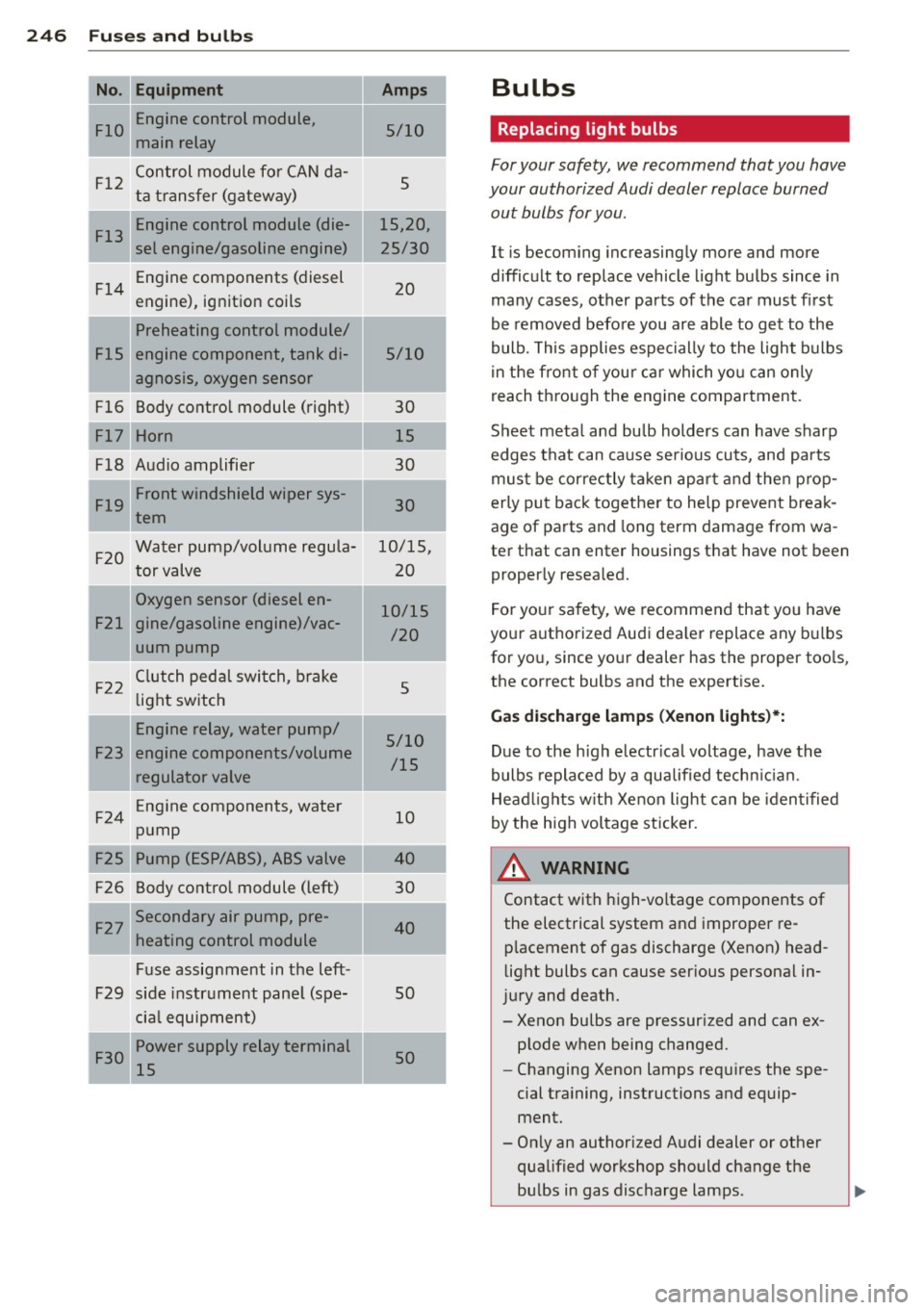
246 Fuses and bulbs
I
I
I
No. Equipment
FlO Engine control module,
main relay
Control module for CAN da
F12 ta transfer (gateway)
F13 Engine control module (die
sel engine/gasoline engine)
Fl 4 Engine components (diesel
engine), ignition coils
FlS
F16
F17
F18 Preheating control module/
engine component, tank di
agnosis, oxygen sensor
Body control module (right)
Horn
Audio amplifier
Flg Front windshield wiper sys
tem
F 2 0
Water pump/volume regula
tor valve
F22
F23
F24
F25
F26 Oxygen sensor (diesel en
gine/gasoline engine)/vac
uum pump
C
lutch pedal switch, brake
light switch
Engine relay, water pump/
engine components/volume regulator valve
Eng ine components, water
pump
Pump (ESP/ABS), ABS valve
Body control module (left)
-Amps
5/10
5
15,20,
25/30
20
5/10 30 15
--30
30
10/15, 20
10/15 /20
5
5/10
/15
10
40
-·-- --·-
30
40
F27 Secondary
air pump, pre-
heating control module
__ , ..
F29 Fuse assignment in the left
side instrument pane l (spe-
cia l equipment)
Power supply relay terminal
15 so
so
Bulbs
Replacing light bulbs
For your safety, we recommend that you have
your authorized Audi dealer replace burned
out bulbs for you.
It is becoming increasingly more and more
difficult to replace vehicle light bulbs since in
many cases, other parts of the car must first
be removed before you are able to get to the
bulb. This applies especially to the light bulbs
in the front of your ca r which you can only
reach through the engine compartment.
Sheet metal and bulb holders can have sharp
edges that can cause serious cuts, and parts
must be cor rectly taken apart and then prop
erly put back together to help prevent break
age of parts and long term damage from wa
ter that can enter housings that have not been
properly re sea led.
For your safety, we recommend that you have
your authorized Audi dea ler replace any bulbs
for you, since your dealer has the proper tools,
the correct bulbs and the expertise.
Gas discharge lamp s (Xenon lights)*:
Due to the high e lectr ica l voltage, have the
bulbs replaced by a qualified techn ic ian.
Head lights with Xenon light can be identified
by the high voltage sticker.
_& WARNING ~
Contact with high-vo ltage components of
the electrical system and improper re
placement of gas discharge (Xenon) head
light bulbs can cause serious personal in
jury and death.
- Xenon bulbs are pressur ized and can ex
plode when being changed.
- Changing Xenon lamps requires the spe
cial tra ining, instructions and equip
ment.
- On ly an authorized Audi dealer or other
qualified workshop should change the bulbs in gas discharge lamps .
Page 255 of 280

-The vehicle should never be lifted or jacked
up from underneath the engine oil pan , the
transmission housing , the front or rear
a x le or the body side members. This could
lead to ser ious damage.
- Use lifting equipment with padded contact
surfaces to avo id damage to the underbody
or chassis frame.
- Alternatively, cover the contact surfaces on
workshop hoist or floor jack w ith rubber
pads b efore lifting.
- Before dri ving over a workshop hoist, check
that the vehicle weight does not exceed the
permissible lifting capacity of the hoist .
- Before dr iving over a workshop hoist, en
sure that there is sufficient clearance be
tween the hoist and low parts of the vehi
cle .
A WARNING
To r educe the ris k of seriou s injury a nd ve
hicle da mage:
- Always lift the veh icle only at the spec ial
wor ks ho p hoi st and floor j ack lift p oin ts
ill ustra te d
c:;>page 253, fig. 199 and
c:;>page 253, fig . 20 0.
- F ailure to l ift the vehicl e at th ese poi nts
cou ld ca use the ve hicle to t ilt or fall from
a lift if there is a c ha nge in vehicle wei ght
dist rib ution and balance . This might hap
pen, for example, when heavy c ompo
nents such as the e ngine bloc k or t rans
mission are removed.
- W hen remov ing s uch heavy c omponents,
anchor veh icle to h oist or add corre
sponding we ights t o maintain the center
of g rav ity. Oth erwise, th e veh icle m ig ht
t il t o r slip off the hois t, causing serio us
p ers onal in ju ry.
Emergency situations 253
Lifting with workshop hoist and with
floor jack
T he vehicle may only be lifted at the li~ing
p oi nt s illus tra ted.
..,
---------~1::
Fig. 199 Front lifting point
Fig. 200 Rear lifting point
.,. Read and heed WAR NIN G c:;> &. in Impor
tant safety precautions on page 253 .
.,. Locate lifting points c:;> fig. 199 c:;> fig . 200 .
.,. Adjust lifting arms of workshop hoist or
fl oor jack to matc h ve hicle lift ing poi nts.
I
.,. Insert a rubbe r pad between the floo r jac k/
workshop hoist and t he lift ing poin ts .
If you must l ift your vehicle with a floor jack
to work underneath, be sure the vehicle is
safely supported on stands intended for this purpo se .
Front lifting point
The lifting poi nt is located o n the floo r pan re
inforcement about at the same leve l as the
jac k mounti ng po int
c:;> fig. 199. Do not lift
the vehicle at the vertical sill reinforcement .
Rear lifting point
The liftin g point is located on the vert ica l rein
forcement of the lower s ill for the on board
jack
c:;> fig. 200. ..,.
Page 256 of 280

254 Emergency situations
Lifting with vehicle jack
Refer to"* page 239.
(D Note
-Be aware of the following points before
lifting the vehicle:
-The vehicle should never be lifted or
jacked up from underneath the engine
oil pan, the transmission housing, the
front or rear axle or the body side members. This could lead to serious
damage.
- To avoid damage to the underbody or
chassis frame, a rubber pad must be
inserted between the floor jack and
the lift points.
- Before driving over a workshop hoist,
check that the vehicle weight does not
exceed the permissible lifting capacity
of the hoist.
- Before driving over a workshop hoist,
ensure that there is sufficient clear
ance between the hoist and low parts
of the vehicle.
Page 259 of 280
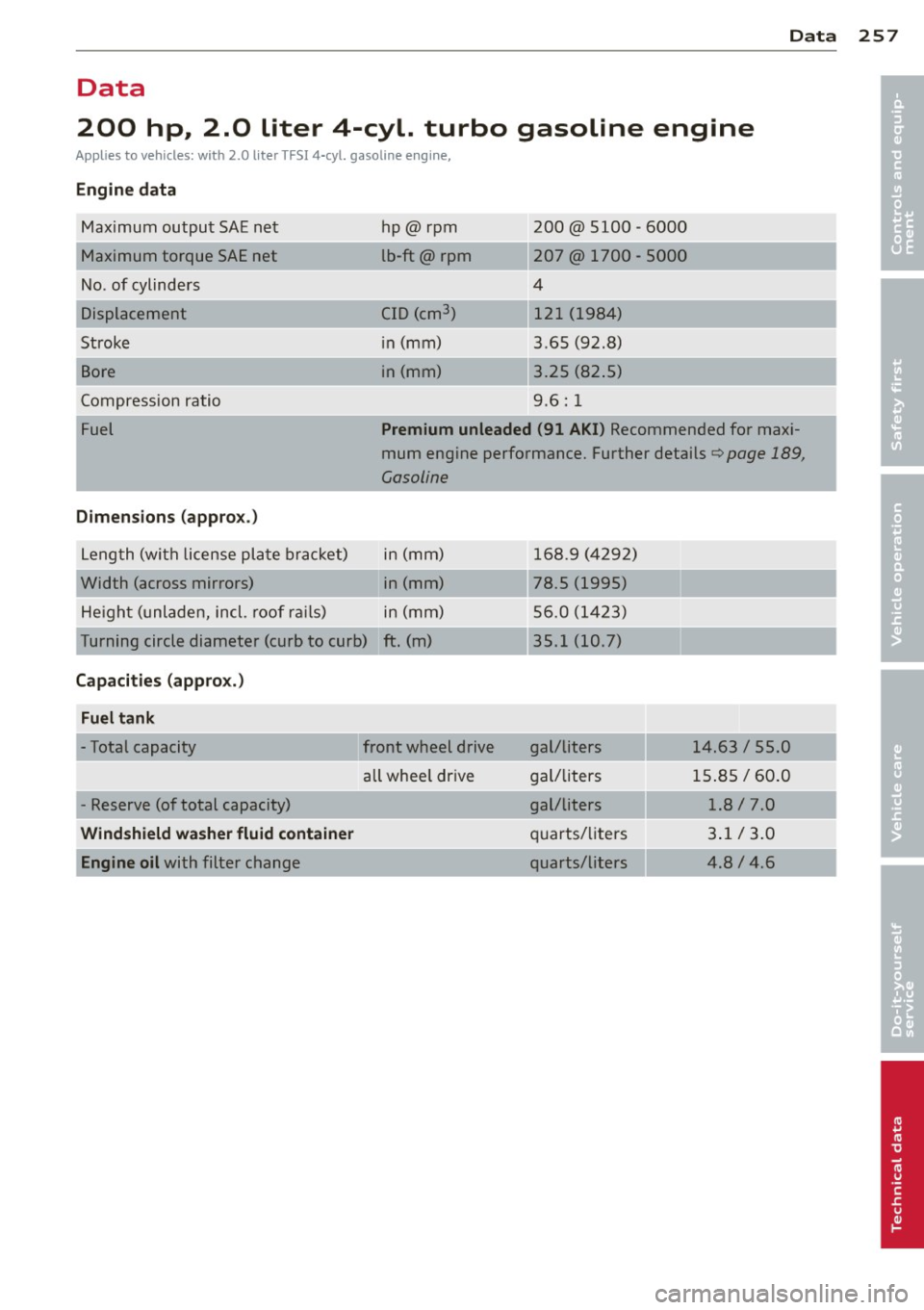
Data 257
Data
200 hp, 2.0 liter 4-cyl. turbo gasoline engine
Applies to vehicles: with 2.0 liter TFS! 4-cyl. gasoline engine,
Engine data Maximum outpu t SAE ne t
M aximum torque SAE net
No . of cylinders
Displacement
Stroke
Bore
C ompression ratio
Fuel
Dimensions (approx .)
L eng th (wit h license pl ate brac ket)
Width (across mirrors) He igh t (unladen, incl . roof r ails) 200@ 5100
-6000
hp@r pm
lb-ft@ rp m
-~--
CID (cm3
)
in (mm)
in (mm)
---·
207 @ 1700 - 5000
4
121 (1984)
3 .65 (92 .8)
3.25 (82 .5)
9 .6: 1
Premium unleaded
(91 AKI) Recommended for maxi
mum engine performance. Further details ¢page 189,
Gasoline
in (mm) 168.9 (42 92)
in (mm) 78.5 (1995)
in (mm) 56.0 (1423)
T urning circle diameter (curb to curb) ft. (m) 35.1 (10.7)
Capacities (approx.)
Fuel tank
- Total capacity
- Reserve (of total capacity)
Windshield washer fluid container Engine oil with filter change front wheel
drive
a ll whee l drive gal/liters
14.63 / 55.0
g al/liters 15.8 5 / 60 .0
gal/liters 1.8/7.0
qu arts/ liters 3 .1 / 3 .0
quarts/li ters 4.8 / 4.6
•
•
Page 260 of 280
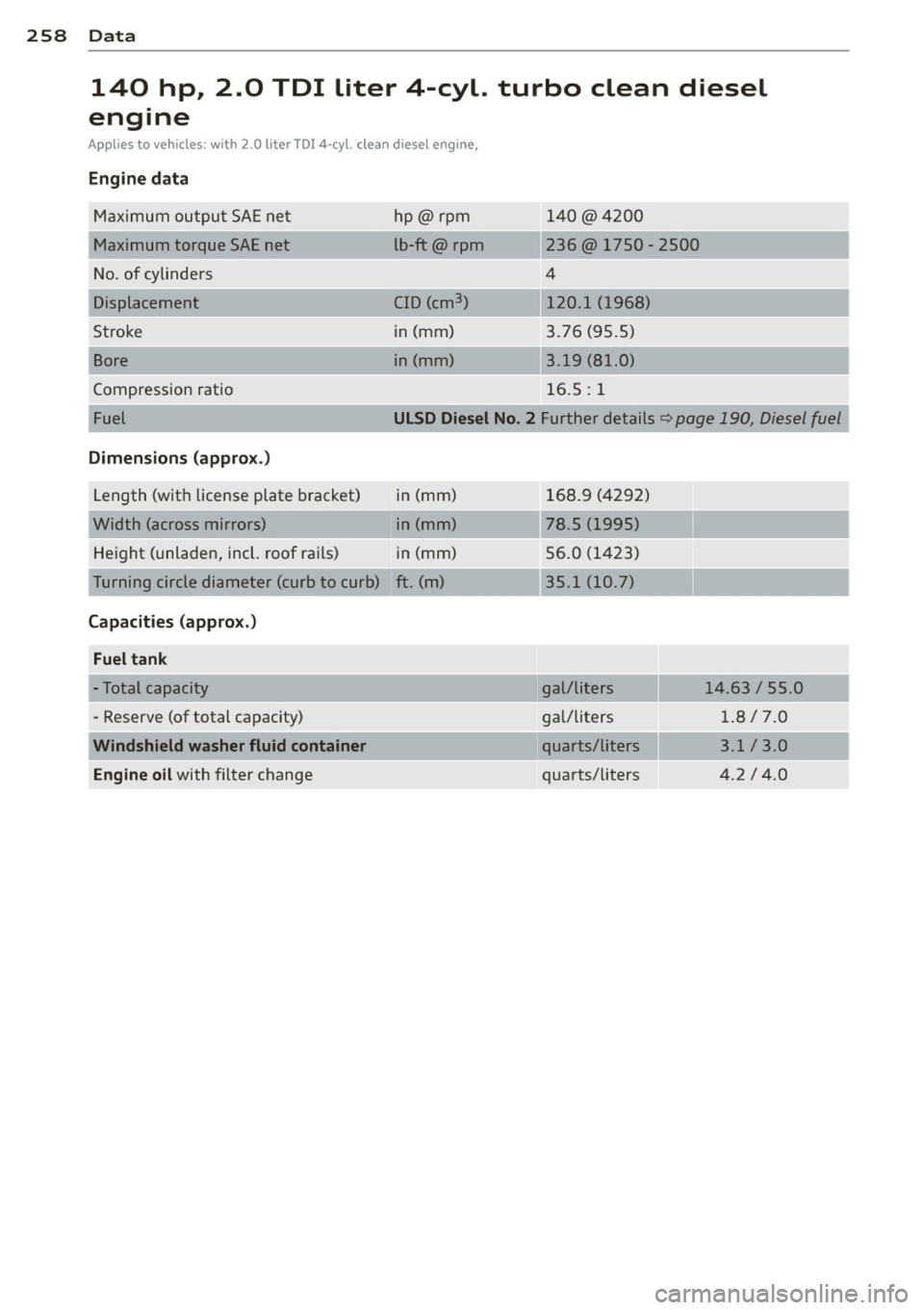
258 Data
140 hp, 2.0 TOI liter 4-cyl. turbo clean diesel
engine
App lies to vehicles: with 2.0 liter TD! 4-cyl. clea n diesel engine,
Engine dat a
Maximum ou tpu t SA E ne t hp@rpm 140 @42 00
Maximum torque SAE net lb-ft@ rpm 236@ 1750 -2500
N o. of cylinders 4
Displacement CID (cm3
) 120.1 ( 1968)
Stroke i
n (mm) 3.7 6 (9 5.5)
Bore i
n (mm) 3.19 (8 1.0)
Compression ratio 16.5: 1
Fuel ULSD Diesel No . 2 Further details c::> page 190, Diesel fuel
Dimensions (approx .)
Length (with license plate bracket) in (mm)
Width (across mirrors) in (mm)
Height (unladen, incl. roof ra ils) in (mm)
T urning circl e diameter (curb to curb) ft. (m)
Capacities (approx.)
Fuel tank
- Total capacity
- Reserve (of total capacity)
Windshield washer fluid container
Engine oil
with filter change
168.9 (4 292)
78.5 (1995)
56 .0 (1423)
35.1 (1 0.7)
gal/li te rs 1 4 .63 / 55.0
ga I/liters 1.8/7 .0
quarts/liters 3.1 / 3.0
quarts/liters 4 .2 I 4.0
Page 261 of 280
Consumer Information
Warranty coverages
Your Audi is covered by the following war
ranties :
- New Vehicle Limited Warranty
- Limited Warranty Against Corrosion Perfo-
ration
- Emissions Control System Warranty
- Emissions Performance Warranty
- California Emissions Control Warranty (USA
vehicles only)
- California Emissions Performance Warranty
(USA vehicles only)
Detailed information regarding your warran
ties can be found in your
Warranty & Mainte
nance Booklet .
Operating your vehicle
outside the U.S.A. or
Canada
Government regulations in the United States
and Canada require that automobiles meet
specific emission regulations and safety
standards. Therefore, veh icles built for the
U.S.A. and Canada differ from vehicles sold in
other countries .
If you p lan to take your vehicle outside the
continental limits of the United States or Can
ada, there is the possibility that
- unleaded fuels for vehicles with cata lytic
converter may not be available;
- fuel may have a considerably lower octane
rating. Improper fuel may cause engine
damage;
- service may be inadequate due to lack of
proper service facilities, tools or testing
equipment;
- replacement parts may not be readily availa
ble.
- Navigation systems for vehicles built for the
U.S.A. and Canada will not necessari ly work
in Europe, and may not work in other coun
tries outside of North America.
Consumer Information 259
Audi cannot be re sponsible for mechanical
damage that could result from inadequate
fuel, service or parts availability.
Q) Note
Audi cannot be responsible for mechanical
damage that could result from inadequate
fuel, serv ice or parts availab ility.
Audi Service Repair
Manuals and Literature
Audi Offic ial Factory Service Manuals and Lit
erature are published as soon as possible after
model introduction. Service manuals and lit
erature are available to o rder from the Audi
T echnical Literature Ordering Center at:
www.audi.techliterature.com
Maintenance
General
Your vehicle has been designed to help keep
maintenance requirements to a minimum.
However, a certain amount of regu lar mainte
nance is still necessary to assure your vehicle's
safety, economy and re liability .
For detailed vehicle maintenance consult your
Warranty
& Maintenance booklet.
Under difficult operating conditions, for ex
amp le at extreme ly low outside temperatures,
in very dusty regions , when towing a trailer
very frequently, etc., some service work
shou ld be performed between the intervals
specified. This applies particularly to:
- oil changes, and
- cleaning or rep lacing the air fi lter.
@ For the sake of the environment
By regularly maintaining your veh icle, you
help make sure that emission standards
are maintained, thus minimizing adverse
effects on the environment.
•
•