flat tire AUDI A3 2012 Owner´s Manual
[x] Cancel search | Manufacturer: AUDI, Model Year: 2012, Model line: A3, Model: AUDI A3 2012Pages: 280, PDF Size: 70.11 MB
Page 233 of 280

remain continuously illuminated. This se
quence will continue upon subsequent vehicle
start-ups as long as the malfunction exists.
When the malfunction indicator is illuminat
ed, the system may not be able to detect or
signal low tire pressure as intended . TPMS
malfunct ions may occur for a variety of rea
sons, including the installation of replace
ment or alternate tires or wheels on the vehi
cle that prevent the TPMS from functioning
properly . Always check the TPMS malfunction
tellta le after replacing one or more tires or
wheels on your vehicle to ensure that the re
placement or alternate tires and wheels allow
the TPMS to continue to function properly.
Tire pressure indicator appears
Appl ies to vehicles: with tire pressur e monitoring sys te m
The tire pressure indicator in the instrument
cluster informs you if the tire pressure is too
low or if there is a system malfunction.
Fig. 172 Display : underinflation warning
Fig. 173 Display: System malfunction
Using the ABS sensors, the tire pressure moni
toring system compares the tire tread circum
ference and vibration characteristics of the in
dividual tires. If the pressure decreases in one
or more tires, this is indicated in the instru
ment cluster with a warning symbol
ti] and a
Tires and wheels 231
message r=!) fig. 172. The driver message in the
display goes out after 5 seconds. The driver
message can be displayed again by pressing
the
ICHECKI button @¢ page 10, fig . 3 . If on
ly one tire is affected, the display will indicate
its position .
The tire pressure monitoring must be reset in
the menu display each time the pressures are
adjusted (e .g. when switching between parti
al and full load pressure) or after changing or
replacing a tire on your vehicle¢
page 232.
You can find the recommended tire pressures
for your vehicle on the label on the driver's
door pillar¢
page 216.
Tire tread circumference and vibration charac
teristics can change and cause a tire pressure
warning if:
- the tire pressure in one or more tires is too
low,
- the tire has structural damage,
- the tire pressure was changed, wheels rotat- ed or replaced but the TPMS was not reset
¢page 232.
Warning symbols
ti] Loss of pressure in at least one tire¢&.
Check the tire or tires and replace or repair if
necessary. The indicator light
ti] in the instru
ment cluster also illuminates
¢page 13.
Check/correct the pressures of all four tires
and reset TPMS in the menu display .
11@1&1 (Tire Pressure Monitoring System) Tire
pressure! System malfunction . Ifll@IS, ap
pears after switching the ignition on or while
driving ¢
fig. 173 and the indicator light ti] in
the instrument cluster blinks for approx i
mately one minute and then stays on, there is
a system malfunction. See your autho rized
Audi dealer as soon as possible.
A WARNING
-If the tire pressure indicator appears in
the instrument cluster display, one or
more of your tires is significantly under
inflated. Reduce your speed immediately
and avoid any hard steering or braking ..,.
Page 234 of 280

232 Tires and wheels
maneuvers. Stop as soon as possible and
check the tires and their pressures. In
flate the tire pressure to the proper pres
sure as indicated on the vehicle's tire
pressure label ¢
page 216. Driving on a
significantly under-inf lated tire causes
the tire to overheat and can lead to tire
failure. Under-inflation also is likely to
impair the vehicle's handling and stop
ping ability.
- T he driver is responsible for maintain ing
the correct tire pressures. You must
check the tire pressures regularly.
- Under certain cond itions (such as a spor
ty driving style, winter conditions or un
paved roads), the pressure monitor indi
cator may be delayed.
- Ask your authorized Audi dealer if run
flat tires may be used on your vehicle .
Your vehicle registration becomes invalid
if you use these tires when not permit
ted. Damage to your veh icle or acc idents
could also result .
(D Tips
- The tire pressure monitoring system
stops working when there is an ESP/ABS malfunction .
- Using snow chains may result in a system
malfunction.
- Tires with the identification "AO" or "RO"
have been specially matched with your
Audi. We recommend using only these
tires because they meet the highest
standards regarding safety and driving
characteristics when used correctly. Your
a uthorized Audi dea ler will g ladly pro
v ide you w ith more information.
Reset tire pressure monitoring system
(Stepl)
Applies to veh icles: w ith tire pressure monitoring system
If the tire pressure is adjusted, wheels ore ro
tated or changed, the TPMS must be reset in
the menu display.
----- ®
Fig. 174 Wipe r lever: Contro ls fo r the menu d isplay
Fig. 175 Disp lay: S ta rt m enu
I Rese t I button @ and rocker switch @
¢ fig. 17 4 functions:
To open the menu
" Press the I Reset ! button @ unt il the menu
disp lay¢
fig. 175 appears
Selections and settings
" Press the rocker switch @ to reach a menu
d isp lay. The switch is operated the same as
the display (up/down) .
Entering and confirming
" Press the I Reset I button @.
Returning to the Start menu
" Press the I Rese t I button longer than 2 sec
onds to return from any menu level to the
Start menu.
Page 236 of 280
234 What do I do now ?
What do I do now?
Jack, tools and spare
wheel
Jack and tools
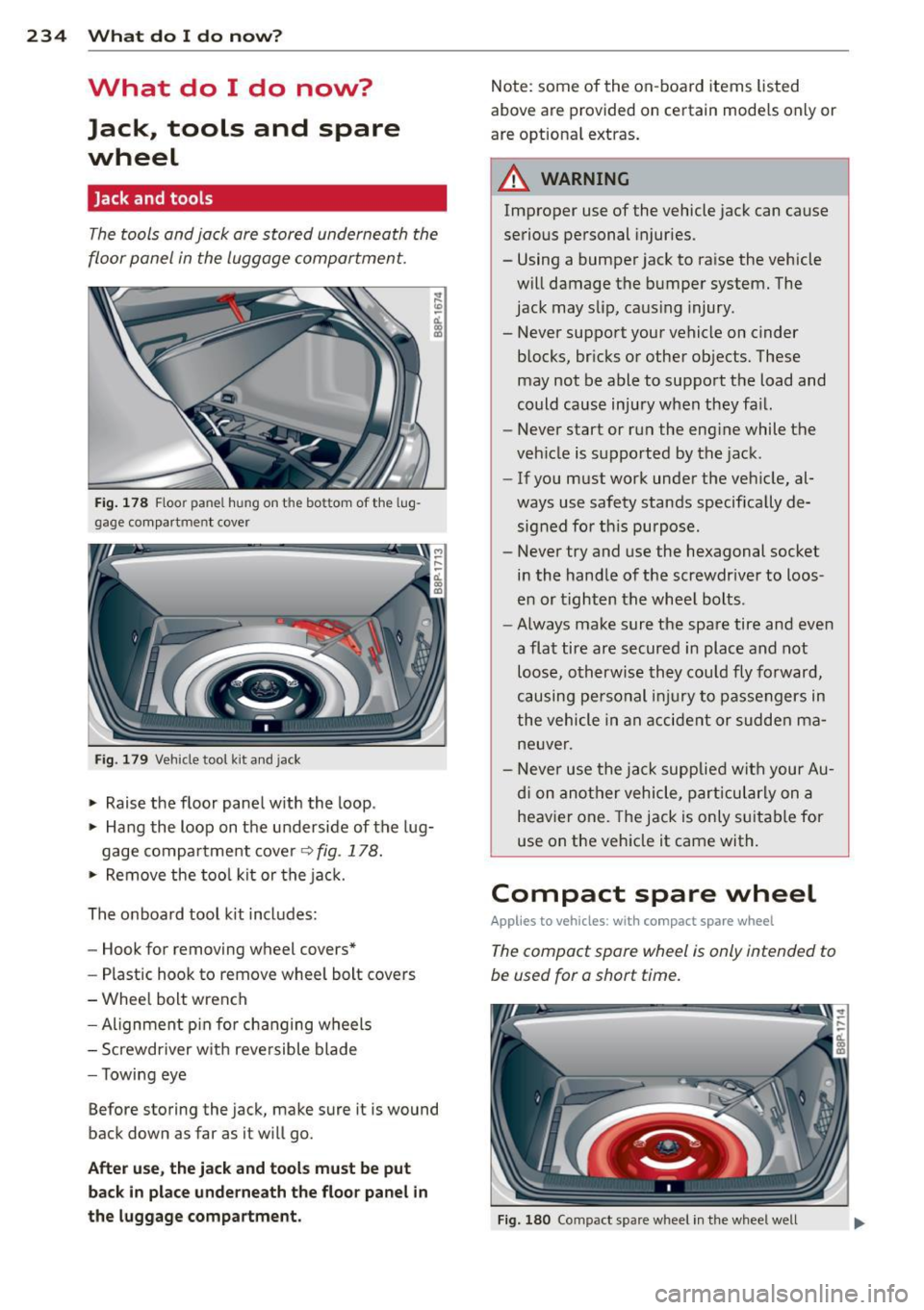
The tools and jack are stored underneath the
floor panel in the luggage compartment.
Fig . 178 Floor panel hung on the bottom of the lug
gage compartment cover
Fig. 179 Vehicle tool kit and jack
~ Raise the floor panel w ith the loop.
~ Hang the loop on the underside of the lug-
gage compartment cover
Q fig. 178.
~ Remove the too l kit or the jac k.
The onboard tool kit incl udes:
- Hook for removing wheel covers*
- Plastic hook to remove wheel bolt covers
- Wheel bolt wrench
- Alignment p in for changing wheels
- Screwdriver w ith reve rsible blade
- T owing eye
Before storing the jack, make sure it is wound
back down as far as it will go.
After u se , th e jack and tool s mu st be put
b ac k in pl ace under nea th t he floo r pan el in
t he luggag e comp artmen t.
Note: some of the on -board items listed
above are provided on certain mode ls only or
are optiona l extras.
A WARNING
-Improper use of the vehicle jack can cause
serious personal injuries.
- Using a bumper jack to raise the vehicle
will damage the bumper system. The
jack may slip, caus ing injury.
- Never support your vehicle on c inder
b locks, br icks or other objects. These
may not be able to support the load and
could cause injury when they fail.
- Never start or run the eng ine while the
veh icle is supported by the jack.
- If you must work under the veh icle, al
ways use safety stands specifically de signed fo r th is purpose.
- Never try and use the hexagonal socket
in the handle of the screwdriver to loos
en or tighten the whee l bolts.
- Always make sure the spare tire and even
a flat tire are secured in place and not
loose, otherwise they cou ld fly forward,
causing pe rsonal i njury to passengers in
the vehicle in an accident or sudden ma
neuver.
- Neve r use the ja ck supplied with your Au
d i on another vehicle, particularly on a
heav ier one. The jack is only s uitable for
use on the vehicle it came with.
Compact spare wheel
Applies to veh icles: w ith compact spare whee l
The compact spare wheel is only intended to
be used for a short time.
Fig . 180 Compact spare wheel in the wheel well
Page 237 of 280

You will find the compact spare wheel under
the floor in the luggage compartment . It is
secured w ith a large nut.
Using the compact spare wheel
The compact spa re wheel is only intended for
emergenc ies until you can reach a repair shop .
Replace i t as quickly as possible with a normal
wheel.
There are some restrictions on the use of the
compact spare wheel~ &. . The compact spare
wheel has been developed especially for your
type of vehicle . It must not be exchanged for
the compact spare whee l from another type of
vehicle.
Normal summer or winter tires must not be
installed on the compact spare whee l rim.
Snow chains
For technica l reasons, the use of snow chains
on the compact spare wheel is
n ot permitted .
If you do have to dr ive w ith snow cha ins and
have a t ire failure on a
front wheel, insta ll the
spa re wheel in place of a rear wheel. Install
the snow chains on the rear wheel and use it
to replace the defective front whee l.
Using the spare wheel
The spare wheel is only intended for emergen
cies until you can reach a repair shop. Replace
it as qu ickly as possib le with a no rmal wheel.
There are some restrict ions on the use of a
spare wheel
Q &. . The spare wheel has been
developed especially for your type of vehicle.
It m ust not be exchanged for the spare whee l
from anot her type of vehicle.
Normal summer or winter tires must not be
i nstalled on the spare wheel rim.
Snow t ires
For technical reasons, the use of snow chains
on the spare whee l is
not p erm itte d.
If you do have to drive with snow chains and
have a t ire failure on a
front wheel, insta ll the
spare wheel in place of a rear wheel. Install
What do I do now? 235
the snow chains on the rear whee l and use it
to replace the defective front wheel.
A WARNING -
A lways store jacking equipment, spare
wheel in the luggage compartment. Tight
en screw for the spare wheel secure ly. Un
der no circumstances should you store the
spa re wheel o r jack and tools unsecured in
the passenger compartment . This could
cause ser ious persona l inju ry to passen
gers in the veh icle in case of a collision .
- The compact spare tire is for temporary
use only and is so marked on the side
walls .
- Do not dr ive at speeds exceeding SO mph
(80 km/h) wi th the compact spare whee l
mounted . A lso rapid acce lerat ion, ha rd
braking and hard cornering must be
avoided to he lp prevent loss of vehicle
contro l.
- Any continuous road use of the compact
spare tire may result in tire failure, loss
of vehicle control and injury to vehicle
occupants.
- Do not put a snow chain on your compact
spare tire. Due to the smaller t ire size,
the chain will not fit properly and can
thus damage your vehicle. You cou ld also
lose the chain, as well as contro l of the
veh icle .
- If you have a flat front t ire in road condi
tions which require snow chains, first re
move the undamaged rea r whee l and
mount the compact spare wheel in its
place. Then remove the damaged front
wheel, take the snow cha ins off it and at
tach them to the whee l taken from the
rear. This wheel can now be mounted on
the front with its snow chains. Check and
adjust t ire pressure promptly .
- Never use two or more compact spare
tires at the same time.
(D Note
When using the compact spare wheel, note the fo llowing: •
•
Page 238 of 280
236 What do I do now?
-After installing the compact spare wheel,
the tire inflation pressure should be
checked and, if necessary, increased to
60 psi (4.2 bar).
- The load carrying capacity is marked on
the tire sidewalls and must not be ex
ceeded.
- After installing the compact spare wheel,
make sure that you remount the flat tire
in its storage area properly.
- The compact spare tire should be proper
ly remounted in its storage area as soon
as the standard road tire can be re placed .
- Because the compact spare tire was spe
cifically designed for your vehicle, it must not be used on any other vehicle .
Likewise, compact spare wheels from
other vehicles must not be used on your
vehicle.
- The compact spare tire must not be
mounted on any other wheels, nor must
standard tires, snow tires, wheel covers
or trim rings be used with the compact
spare wheel. If such use is attempted,
damage to these items or other vehicle
components may occur .
(D Tips
Check the inflation pressure of the com
pact spare tire (60 psi/4.2 bar) periodically
to keep the tire ready for use.
Wheel change
Before changing a wheel
Observe the following precautions for your
own and your passenger's safety when chang
ing a wheel .
.. After you experience a tire failure, pull the
car well away from moving traffic and try to
reach
level ground before you stop c:> ,&. .
.. All passengers should leave the car and
move to a safe location (for instance, behind
the guardrail)
c:> _&. .
.. Apply the parking brake firmly c:> _&. .
.. Move selector lever to position Pon an au
tomatic transmission ; put manual transmis
sion in
first gear c:> _&..
.. If you are towing a trailer : unhitch the trail
e r from your vehicle.
.. Take the
tool and the spare tire c:> page 234
out of the luggage compartment .
.&, WARNING
You or your passengers could be injured
while changing a wheel if you do not fol
low these safety precautions:
- If you have a flat tire, move a safe dis
tance off the road. Turn off the engine,
turn the emergency flasher on and use
other warning devices to alert other mo
torists.
- Make sure that passengers wait in a safe place away from the vehicle and well
away from the roadway and traffic .
- To help prevent the vehicle from moving suddenly and possibly slipping off the
jack, always fully set the parking brake
and block the wheel diagonally opposite
the wheel being changed. When one
front wheel is lifted off the ground, plac
ing the automatic transmission in "P"
(Park) , or engaging a gear in a manual
transmission will
not prevent the vehicle
from moving.
- Before you change a wheel, be sure the
ground is level and firm. If necessary,
use a sturdy board under the jack.
- After installing the spare wheel, make
sure that you remount the flat tire/wheel
in its storage area properly and tighten
the knurled retaining screw securely.
Changing a wheel
-
When you change a wheel, follow these
quence described below step-by-step and ex
actly in that order .
1. Remove the decorative wheel cover*. For
more details see also
c:> page 23 7, Deco
rative wheel covers
or c:> page 238,
Wheels with cap-covered wheel bolts.
Page 239 of 280
2. Loosen the w hee l bol ts ¢ page 238.
3. Locate the proper mounting point for the
jack and align the jack below that point
¢ page 239.
4. Lift the car with the jack¢ page 239.
5. Take the flat wheel off and then put the
spare on
¢ page 240 .
6. Tighten all wheel bo lts light ly .
7 .
Low er the veh icle w ith the jack.
8 . Use the wheel bolt wrench and
firml y
tighten all whee l bolts ¢ page 238.
9. Put the decorative wh eel cov er* back on.
A WARNING -
Always read and head all WARNINGS and
information
¢ A in Raising the vehicle on
page 240
and ¢ page 241.
After changing a wheel
A wheel change is not complete without the
following actions .
.. Store and secu re the replaced wheel in the
spare wheel we ll.
.. Put the tool case and the jack back in place
in the luggage compartment .
.. Check the
tir e pres su re on the spare wheel
immediately after mounting it .
.. As soon as possible, have the
tightening
torqu es
on all wheel bolts checked with a
torque wrench. The correct tightening tor
que is 90 ft lb (120 Nm).
.. Have the flat tire
repl aced as soon as possi
ble.
@ Tips
- If yo u n otice wh ile chang ing a tire tha t
the wheel bo lts a re cor roded and diffi
cult to turn, then they should be re placed before you check the tightening
torque.
- Drive at reduced speed until you have the
tightening torques checked .
What do I do now ? 237
Full wheel covers
App lies to vehicles : with ful l wheel cove rs
T he wheel covers must be removed to access
the wheel bolts.
Remo val
.. Pull the full whe el cover off manua lly.
Installation
.. First press the full w hee l cover on to the rim
a t the cut-o ut prov ided for the va lve . Then
engage the outer edge of the
full wheel cov
er
in the steel rim.
Decorative wheel covers
App lies to vehicles: with decorat ive w hee l covers
The decorative wheel covers must be removed
first to access the wheel bolts .
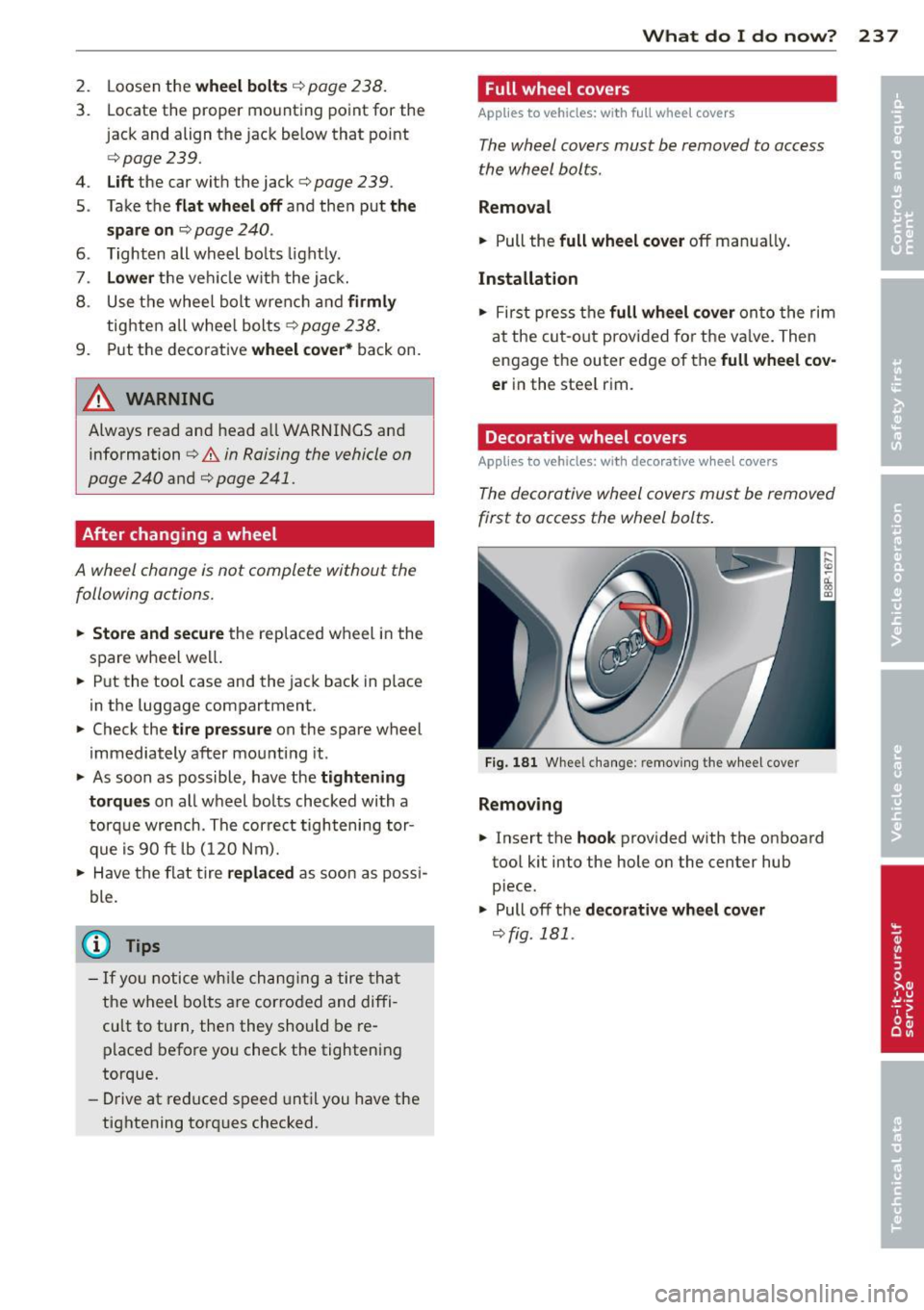
Fig. 181 Whee l cha nge : removing the whee l cover
Remo ving
.. Insert the hook provided with the on board
tool kit into the hole on the center hub
piece.
.. Pull off the
decorati ve wh eel cover
¢ fig . 181 .
Page 243 of 280

A WARNING ,~ -
When removing or install ing the wheel,
the rim could hit the brake rotor and dam
age the rotor. Work ca refully and have a
second p erson help yo u.
@ Tips
Never try and use the hexagonal socket in
the hand le of the screwdrive r to loosen or
tighten the whee l bolts .
- Pull the reversib le blade from the screw
drive r bef ore yo u use the hexagonal
socket in the handle to t urn t he whee l
bo lts.
- When mounting tires with
unidirectional
tread design
make su re the tread pat
te rn is pointed the rig ht way
¢ page 241.
-The wheel bolts should be clea n and easy
to tu rn. Che ck for dirt and corro sio n on
t he mat ing surf aces of both the whee l
and the h ub. Remove a ll dirt from these
su rfaces before remo unt ing the wheel.
Tires with unidirectional tread design
Tires with unidire ctional tread de sign must be
mounted with their tread pattern pointed in
the right direction.
Using a spare tire with a tread pattern
intended for use in a specific direction
When using a spare tire wit h a tread pa tte rn
intended for use in a specific direction , pl ease
note the following:
- The direc tion o f rota tion is marked by an a r
r ow on the side o f the tire.
- If the spare tire has to be i nst alled in the in
correct di rection in the even t of a flat tire,
use the spare tire on ly tempo rari ly since the
tire will not be ab le to ac hieve its opt imum
per formance characterist ics w ith regard to
aquapla ning, no ise and wear.
- We recommend that particular attent ion be
paid to this fact dur ing wet weather and
t h at you adjust your speed to matc h road
co ndit io ns.
What do I do now? 241
- Replace the flat ti re with a new one and
have it installed on your vehicle as soon as
possible to restore the hand ling advantages
of a properly pointed direction-dependent
tire .
Notes on wheel change
Please read the informat ion ¢ page 223, New
tires and r eplacing tires and wheels
if yo u a re
go ing to use a spa re tire w hich is different
from the ti res on yo ur vehicle.
After you change a tire :
-Check the tire pressu re on the spare imme
diately after mounting.
- Have the wheel bolt tightening torque
checked with a torque wrench as soon as
possible by your authorized Audi dealer or
a qualifi ed service station.
- On steel and alloy wheel rims, the wheel
bolts are cor rectly tightened with a torque
of 90 ft lb (120 Nm).
- If you notice while changing a tire that the
wheel bolts are corroded and difficult to
turn, then they should be replaced befor e
you check the tightening torque .
- Replace the flat tire with a new one and
have it installed on your veh icle as soon as
possible. Remount the wheel cover.
Until then, dr ive with e xtra care and at re
duced speeds .
A WARNING
-If you are go ing to e quip your vehicle
wit h tires o r rims whi ch differ from those
whi ch were fac tory inst alled, then be
sure to re ad the inform ation ¢
page 223,
New tires and replacing tires and
wheels.
- Always ma ke sure the damage d wheel o r
even a fla t tire an d the jack and tool ki t
are prope rly secu red in the luggage com
partment and are not loose in the pas
senger compartment .
- In an accident or sudden maneuver they
could fly forwa rd, injuring anyone in the
veh icle.
•
•
Page 271 of 280
Fastening
Booster seats .... ..... ... .. .. .. ... 151
Convertible ch ild safety seats ... .. .. . 149
Infant seat s ............. .... .. ... 148
F astening eyes . . . . . . . . . . . . . . . . . . . . . . 68
Flat t ire
Changing .. ................ ... ... 236
F loor mats . .. ............. .... .. ... 108
F og lights, fro nt ........... .... .. .. .. 49
Folding master key w ith remote contro l . . 34
F oot pedals . ... .... .... ... .. .. .. ... 108
F or the sake of the environment
Gasoline fumes and the envi ronment . . 19 2
L e tting you r engine w arm up . .. .. .. .. 90
Reducing engine noise by upsh ifting ear -
ly . . . . . . . . . . . . . . . . . . . . . . . . . . . . 1 0, 11
Refueling . . . . . . . . . . . . . . . . . . . . . . . . 192
Saving fue l by upshift ing early . . . . 10, 11
Using the rear w indow defogger . .. .. .. 85
Fr ont airbags
Descr ipt ion .... .. ..... ... .. .. .. ... 126
How they work . . . . . . . . . . . . . . . . . . . . 131
Fr onta l co llisions and t he laws of physics 1 14
Front seats .. ............. .... .. .... 61
Adjusting .. ................ ... ... 105
Adjust ing the manual seats . .. .. .. .. .. 62
C hi ld restra ints in the front seat . .. .. . 123
H eated seats . . . . . . . . . . . . . . . . . . . . . . 85
Fue l
Current fuel mileage . . . . . . . . . . . . . . . . 26
F uel gauge .... .. .. ...... .. .. .. .. .. 12
Fue l supp ly too low . . . . . . . . . . . . . . . . . 2 1
Fue l economy messages (eff iciency pro-
gram) . .... .. .. ............. .. .. .... 29
F ue l filler f lap
Un lock ing the fue l filler f lap by hand .. 193
F ue l gauge . . . . . . . . . . . . . . . . . . . . . . . . . 12
Fue l range . . . . . . . . . . . . . . . . . . . . . . . . . . 26
F ue l supp ly
A dditives . . . . . . . . . . . . . . . . . . . . . . . . . 189
Blended gasoline . ..... ... .. .. .. .. . 189
F ue l filler neck ........... .... .. .. . 191
Fue l gauge . ............. .... .. .... 12
Fue l tank capac ity . . . . . . . . . . . . . 12, 191
Gasoline . ............ ...... .... .. 189
Gasoline additives . ....... .. .. .. .. . 190
Octane rating ............ .... .. .. . 189
Inde x 269
Recommendation ... . .. ..... ... .. .. 189
Ref uell ing ... .. .... . ... ...... ... .. 192
U nlocking the fuel f iller flap by hand 193
Fuel tank Capaci ty .. .. .. .. ................. 191
Capacity (gallons/liters) . . . . . . . . . . . . . 12
Fuse a rra ngeme nt ................. . 244
Fuses Rep lacing . .. .. .. .. ............... 243
G
Gas discharge lamps . .. ... .... ... .. .. 246
Ga uges
E ngine cool ant tempe ratu re . . . . . . . . . . 11
F uel ga uge . . . . . . . . . . . . . . . . . . . . . . . . 12
Speedometer . . . . . . . . . . . . . . . . . . . . . . 12
Tachometer . . . . . . . . . . . . . . . . . . . . . . . 10
Tr ip odometer . .. ................. . 12
Gear recommend ation .. ......... .. .. . 24
Gearshift indicator ................. .. 24
Gearshift leve r .... .. . .. .. ..... ... .. . 96
General illustration
Instr uments and controls ....... .. .. .. 8
Generator Warning/ind icator lights ........... .. 16
G lossary of tire and loading terminology 213
G love compa rtme nt . . . . . . . . . . . . . . . . . . 76
CD-ch anger . . . . . . . . . . . . . . . . . . . . . . . . 76
Li ght ... .. .. .... .. . .. .. ..... ... .. . 51
G low plug system
Ind icator light .... ............... .. 20
Warning light .. .. ... ............ .. . 20
Gross Vehicle Weight Rating (GVWR) . .. 255
H
Head lights . .. .. .. ................. . 47
defective . . . . . . . . . . . . . . . . . . . . . . . . . . 21
Front fog lights .. .. ........... .... . 49
Switch ing off .. .. .. . .. .... .... .. .. . 47
Switching on ..... .. ..... ........... 47
Xenon headlights . .. . .. ....... ... .. . 4 7
Head restrai nts .. .. ................. 107
Adjusting ... .. ...... ............. 107
Rear seats . . . . . . . . . . . . . . . . . . . . . . . . . 65
•
•
Page 277 of 280
_______________________________ I~ n~ d:::: e~x 275
Temperature disp lay
Engine oi l .. .... .. .... ... .. .. .. .... 31
Tet he r anchors ............ .... .. ... 158
Tether strap . . . . . . . . . . . . . . . . . . . . . . . 158
The first 1,000 m iles (1,500 km) and after-
wards ..... .. .. ... .. ..... ... .. .. ... 169
Tie-downs . . . . . . . . . . . . . . . . . . . . . 68, 110
Tips for the environment
Saving fuel .............. .... .. .... 74
Tire pressure ..... .. .... ... .. .. .. ... 218
T ire pressure monitor ing system ....... 230
L oss of air pressure ............ 19,231
M alf unct io n .. ........... .. .. .. ... 23 1
Rese tting ti re press ures . . . . . . . . 232, 233
Tires ...... ...................... .. 212
Replacing ...................... .. 223
Service life . ............. .... .. ... 222
speed rat ing letter code ... .. .. .. .. .
T ire man ufacturing da te ... .. .. .. .. .
r ·f · · rre speer 1ca t1ons ..... ... .. .. .. .. .
Tread depth . .. .. ..... ... .. .. .. .. . 224
224
224
222
Uniform tire quality grading . ... .. .. . 226
W inter t ires ............. .... .. ... 227
T ires/Wheels
L ow aspect ratio t ires ... ... .. .. .. .. . 229
Tire pressure monitoring system . 19,230
Tires and vehicle load limits .. .. .. .. .. . 220
Tires and wheels
Checking tire pressure .............. 218
Cold tire i nflat ion pressure .......... 216
o· . 1mens1ons .... .. .. ..... ... .. .. .. . 223
Gene ral notes ..................... 212
Glossary of t ire and load ing te rm inolo-
gy · · · · · · · · ................. .. ... 213
New tires and wheels ... ... .. .. .. .. . 223
Replacing .. .... .. .... ... .. .. .. ... 224
Snow chains . ..... .... ... .. .. .. ... 228
T ires and vehicle load limits .. .. .. .. . 220
Wheel bolts ............. .... .. ... 229
w· t · rn er tr res ............. .... .. ... 227
Tire service life 222
Torn or frayed safety belts ............ 116
Touch-up paint
Tow ing
Fr ont eyelet
Rear eyelet 181
2 51
252
Tow truck procedures ... ... .. .. .. .. . 25 1 T
PMS
Tire pressure monitoring system
T ra ile r tow ing 231
17 4
Operating instr uctions .......... .. .. 175
T echnical requirements . . . . . . . . 174, 175
T rai le r tow ing tips . .. ... .... ... .. .. 176
Transmission 6-speed . .. .. .. .. .... ........... .. . 96
Manua l tran sm ission ................ 96
S tronic transmission ........... .... . 96
T ransport Canada . . . . . . . . . . . . . . . . . . . 111
T read Wear Indicator (TWI) .... ... .. .. 222
T rip compute r ... .. .. . .............. . 25
Tr ip odometer ... .. ................. . 12
What does it mean when dEF appears in
the tr ip odomete r display? ........ .. . 12
Turn signals ... .... ... .. .. ..... ... .. . SO
Warning/ind icator lights ........ .. .. . 22
u
Undercoating ....... . .. .. ..... ... .. 183
Un fastening safety belts ............. 118
Uni directional tires .................. 212
Uniform tire quality grading
Un locking 226
Power locking sw itch .............. .. 39
Rea r lid ... .. .. .. .... ............. . 40
Remote contro l .. ................. . 37
U sing the fold-o ut key .. ..... ... .. .. . 38
V
V ·t . ani y mir ro r . . . . . . . . . . . . . . . . . . . . . . . . 53
Vehicle-care products ............ .... 178
Vehicle battery Stationary ... .... .. . .. .. ..... ... .. 207
Vehicle electri ca l sys tem .............. 16
Vehicle identification ................ 255
Vehicle identification label ..... ... .. .. 255
Vehicle Ident ificat ion Number (VIN) .... 255
Vehicle jack . . . . . . . . . . . . . . . . . . . 234,239
Vehicle literatu re .. .... ......... .... .. S
•
•
Page 278 of 280
276 Index
w
Warn ing/indicator lights
Airbag system ........ ... .. .. .... .. 16
Anti-lock brake system (ABS) ... .. ... . 18
Brake system ...................... 15
Cruise control . . . . . . . . . . . . . . . . . . . . . . 22
Electronic power control ....... .. .. .. 19
Electronic stabilization program (ESP) .. 18
Eng ine malfunction (diesel engine) .... 20
Generato r ......................... 16
Glow plug system .................. 20
Malfunct io n I ndicator Lamp (MIL) ..... 19
Parking brake .... ....... ... .. .... .. 15
Safety belt ........... ... ... ..... .. 16
Safety systems .............. ..... .. 16
Tire pressure monitoring system .. .... 19
Turn signals ....................... 22
Warn ing lights . . . . . . . . . . . . . . . . . . 10, 13
Red symbols in the center disp lay .... .. 13
Yellow symbols in the center disp lay ... 14
War ranty coverages ................. 259
Washer reservoir ............ .. .... . 211
Washing .. .. ... . ...... ... ... ..... . 178
Automatic car wash .. ... .. .. .. .... . 179
by hand ................. .... ..... 179
General informat ion 178
with a power washer ............... 180
Waxing ...... .... ..... ... .. .. .... . 180
Wear indicator .. .... ...... ... ... .. . 222
Weights . .. .. ... .......... ...... ... 255
What happens if you wear yo ur sa fety belt
too loose? ... ... .. ..... ... .. .. .... . 11 7
What happens to unbelted occupants? .. 114
What impairs driving safety? . . . . . . . . . . 104
What should I do after chang ing a
wheel? .. .. .. ..... ........ .. .. .. .. . 219
What should I do after replacing wheels? 219
Wheel bolts Anti-theft wheel bolts .............. 238
Torque . .. ............... .. .. .. .. . 229
Wheel change . .. .. ..... ... .. .. .... . 236
Wheels .... ................. ... ... 212
Checking tire pressure .......... .... 218
Cold ti re inflat ion pressu re . . . . . . . . . . 216
General notes . . . . . . . . . . . . . . . . . . . . . 212 G
lossary of tire and loading terminolo-
gy .. ... .. .... .. .. ... .. ..... ... .. 213
New t ires and whee ls ... ..... ... .. .. 223
Tires and veh icle load limits ..... .... 220
Whee ls/Tires
Cast alloy ..... .. ... .. ..... ... .. .. 182
Stee l wheels . . . . . . . . . . . . . . . . . . . . . . 182
When must a safety be lt be replaced? .. 116
When must the airbag system be inspect-
ed? ............................... 133
When should I adjust the tire pressures? 219
When should I check the tire pressures?. 219
Where are lower anchorages located? . .. 156
Where can I find the t ire press ures for my
ca r? ...... ..... .. .. ... .. ..... ... .. 218
Why safety belts? ................... 113
Windows Cleaning .. ....................... 181
Convenience close/open feature . . . . . . . 44
Defogging . . . . . . . . . . . . . . . . . . . . . . . . . 82
Defrost ing .. .. .................. .. 82
Rapid defrosting/defogging .......... 84
Windsh ield washer container ......... 211
Windsh ie ld washer fluid . ..... ... .. .. . 21
Windsh ield w ipers
Chang ing the rear wiper blade ........ 59
Installing new wiper b lades ..... .... . 57
Se rv ice position ................. ... 5 7
Winter operation Battery .......................... 207
Coolant system ................... 203
T ires ..... .. .. .. .. ... ............ 166
Windows . .. .. .. ............. .... 181
Winter tires . .. ... . ........ ..... .... 227
All -wheel drive . .. ................ . 227
Wiper and washer system ...... .. .. .. . 55
Intermittent wiping . . . . . . . . . . . . . . . . . 55
One-tap wip ing ................ ..... 55
Rea r window wiper . . . . . . . . . . . . . . . . . . 56
Wiper b lades
Installing new wiper b lades ... ... . .. . 57
also refer to Windsh ie ld wipers .. .. .. . 59
X
Xenon-Lights . ..... .. ... ..... ... .. .. 246