warning lights AUDI A3 2012 Owner´s Manual
[x] Cancel search | Manufacturer: AUDI, Model Year: 2012, Model line: A3, Model: AUDI A3 2012Pages: 280, PDF Size: 70.11 MB
Page 105 of 280
Driving Safely
General notes
Safe driving habits
Please remember -safety first!
This chapter contains important information,
tips, instructions and warnings that you need
to read and observe for your own safety, the
safety of your passengers and others . We have
summarized here what you need to know
about safety belts, airbags, ch ild restra ints as
well as child safety. You r safety is for us
priori
ty number 1.
Always observe t he information
a nd warn ings in th is se ct ion - for yo ur own
safety as well as that of your passengers .
The information in this se ction applies to all
model ve rsion s of your veh icle . Some of the
feat ures descr ibed in th is sec tions may be
standa rd equipment on some models, or may
be optional equipment on others . If you are
not sure, ask yo ur authorized Aud i dea ler.
A WARNING
- Always make sure that you follow the in
st ruct ions and heed the WARNINGS i n
this Manual. It is in your interest and in
the inte rest of you r passengers.
- Always keep the complete Owne r's Liter
at ure in your Audi when you lend or sell
yo ur vehicle so that this important info r
mation will always be ava ilable to the
dr iver and passenge rs.
- Always keep the Owner's literature handy
so that you can find i t eas ily if you have
ques tion s.
Safety equipment
The safety features are part of the occupant
restraint syst em and work togeth er to help
redu ce the risk of injury in a wide variety of
accident situations .
Your safety and the safety of your passenge rs
should not be left to chance. Advances in
t echnology have made a var iety o f fea tures
avai lable to he lp red uce the risk of i njury in an
Dr iving Safel y 103
accident . The following is a list of just a few of
the safety features in yo ur Audi :
- sophis tic ated s afety be lts fo r driver and a ll
passenger sea ting posit ions,
- s afety bel t prete nsio ners ,
- safety belt force lim ite rs fo r the front sea ts,
- safety belt he ight adjustment systems for
the front seats ,
- automatic safety be lt height adjustment for
the rear seats,
- head restra ints for each seating posit ion,
- front airbags,
- side airbags in the front seats and outer rea r
seats *,
- side c urtai n airbags ,
- specia l LATCH an cho rages for child re-
s tr ain ts,
- he ad restra ints for each sea ting posit ion,
- adj ustab le steering colum n.
These ind iv idual safety features , can work to
gether as a system to he lp protect you and
you r passengers in a w ide range of accide nts.
T hese fe;;itures c;;innot work ;;is ;;i system if
t h ey a re not always cor re ct ly adjus ted and co r
re ct ly used .
Safety is everybody' s responsibility!
Important things to do before driving
Safety is everybody 's job! Vehicle and occu
pant safety always depends on the informed
and careful driver .
For you r safety and the safety of your passen
gers,
before driving always:
.,. Make s ure that all lights and signals are op
erating correctly .
.,. Make sure that the tire pressure is correct .
.,. Make su re that all windows are clean and
afford good v isib ility to the o utside.
.,. Sec ure a ll luggage a nd other items carefu lly
~ page 75.
.,. Mak e s ure th at nothing can interfe re wi th
t he peda ls .
.,. Adjust front seat, head restraint and mir
rors co rrectly for your height.
•
•
Page 115 of 280
Safety belts
General notes
Always wear safety belts!
Wearing safety belts correctly saves lives!
This chapter explains why safety belts are nec
essary, how they work and how to adjust and
wear them correctly.
~ Read all the information that follows and
heed all of the instructions and WARNINGS.
A WARNING
Not wearing safety belts or wearing them
improperly increases the risk of serious
personal injury and death.
- Safety belts are the single most effective
means available to reduce the risk of se
rious injury and death in automobile acci
dents. For your protection and that of
your passengers, always correctly wear
safety belts when the vehicle is moving.
- Pregnant women, injured, or physically
impaired persons must also use safety
belts. Like all vehicle occupants, they are
more likely to be seriously injured if they
do not wear safety belts. The best way to
protect a fetus is to protect the mother -
throughout the entire pregnancy.
Number of seats
Your Audi has a total of five seating positions:
two in the front and three in the rear. Each
seating position has a safety belt.
A WARNING
Not wearing safety belts or wearing them
improperly increases the risk of serious
personal injury and death.
- Never strap more than one person, in
cluding small children, into any belt. It is
especially dangerous to place a safety
belt over a child sitting on your lap.
- Never let more people ride in the vehicle
than there are safety belts available.
Safety belts 113
-Be sure everyone riding in the vehicle is
properly restrained with a separate safe
ty belt or child restraint.
~ Safety belt warning light
Your vehicle has a warning system for the
driver and front seat passenger (on USA mod
els only) to remind you about the importance
of buckling-up.
Fig. 120 Safety belt warning light in the instr ument
cl uster -enla rged
Before driving off, always:
~ Fasten your safety belt and make sure you
are wearing it properly.
~ Make sure that your passengers also buckle
up and properly wear their safety belts.
~ Protect children with a child restraint sys-
tem appropriate for the size and age .
The warning light . in the instrument cluster
lights up when the ignition is switched on as a
reminder to fasten the safety belts. In addi
tion, you will hear a warning tone for a certain period of time .
Fasten your safety belt and make sure that
your passengers also properly put on their
safety belts.
A WARNING
- Safety belts are the single most effective
means available to reduce the risk of se
rious injury and death in automobile acci
dents. For your protection and that of
your passengers, always correctly wear
safety belts when the vehicle is moving.
•
•
Page 177 of 280
must install extended mirrors. I t is important
that you
always have clear vision to the rear.
A WARNING -
After removing the tra ile r hitch, do not
store it in your vehicle. In case of s udden
braking , the hitch could fly forward and in
jure you or your passengers .
Operating instructions
Maximum trailer weight
A trailer for your ve hicle is limited to a typica l
class 1 o r class 2 trailer.
Trailer l oad di stribut ion
Be s ure the load in the trai ler is he ld sec urely
in place to guard aga inst shift ing, be it for
ward, backward or sideways.
Never allow a passenger to ride in a trailer
~ &. in Driving instructions on page 176 .
Tire pressure
When tow ing a tra ile r, i nflate the ti res of yo ur
ve hicl e to the co ld tire pressure listed u nder
"Full load" on the sticker on the r igh t door
jamb . Inflate trai ler ti res to trai ler and tire
manufacturers' specifications.
Lights
The he adlig ht setti ngs should be che cked w ith
the trailer a ttached be fore dr iv ing off . Adjus t
as necessary so that you can see the road
a h ead but not blind o ncoming traff ic .
C hec k prope r wo rking of vehicle a nd t ra ile r
lights.
Safety chains
B e s ure tra ile r safe ty cha ins are p roperly con
nected from the t railer to the hitch on the ve
hicl e. Leave e no ugh s lack in the chains to pe r
mi t turning corners . Whe n you ins tall safe ty
ch ains, m ake s ure they w ill not drag on the
road when yo u are driving .
The c ha ins shou ld cross un der th e tra ile r
t ongue to prevent it from droppi ng in case of
separat ion from the h itch.
Trailer towin g 175
Driving instructions
Driving with a trailer always requires extra
care and consideration .
To obtain the best possible handli ng of vehicle
and trailer, please note the fo llow ing:
... Do not tow a loaded t railer w hen you r ca r it
self is not loaded .
... Be especially caref ul when pass ing other ve
hicles .
... Obse rve speed lim its .
... Do not dr ive at the maximum permissib le
speed.
... Always app ly brakes e arly .
... Mon itor the tempe rature g auge.
Weight distribution
Towing a loaded t railer w ith an em pty car re
su lts in a highly unstab le distrib ution of
weig ht. If th is cannot be avoided d rive at very
l ow speed s on ly t o a void t he ri sk of losi ng
stee ring cont rol.
A "ba lanced " rig is easier to operate and con
tr ol. Th is means t hat the tow vehicle should
b e lo ade d to t he e xten t possible and per miss i
ble while keep ing t he tr ailer a s light as possi
ble under the c ircu mstances . Wheneve r poss i
ble, transfe r some ca rgo to the lugga ge com
partment of the tow vehicle w hile obse rv in g
tong ue load requ irements and vehicle load ing
consideratio ns.
Speed
The higher the speed, the mo re di fficu lt it be
comes for the driver to contro l the rig . Do not
drive at the maximum permissib le speed. Re
duce your speed even more under unfavo rable
load, weather or wind conditions - partic ularly
whe n going downhill .
Red uce veh icle speed
immediately if the trail
er shows t he slig htest s ign of sway ing.
Do not
try to stop the swaying by accelerating .
Observe speed limits . In some a reas speeds
f or vehicles tow ing tra ile rs a re lower than for
r egular veh icles .
•
•
Page 181 of 280

CD Note
You should remove debris (such as insects)
from the headlight lenses on a regular basis, for example when refueling your vehi
cle. Never clean the headlights with a dry
cloth or sponge . Use a wet cloth or
sponge.
It is best to use soapy water .
Automatic car wash
The vehicle can be washed in almos t any
modern automatic car wash .
The vehicle paint is so durable that the vehicle
can normally be washed without problems in
an automatic car wash . However, the effect on
the paint depends to a large extent on the de
sign of the facility, the filtering of the wash
water , the type of wash and care material , etc .
If the paint has a dull appearance after going
through the car wash or is scratched, bring
this to the attention of the operator immedi
ately. If necessary, use a different car wash.
Before going through a car wash, be sure to
take the usual precautions such as closing the
windows and panoramic sliding sunroof*. Re move antenna if applicable.
If you have installed additional accessories on
the vehicle -such as spoilers, roof rack, etc. -
it is best to ask the car wash operator if these
should be removed.
A WARNING
Always read and heed all WARNINGS and other information
¢ page 178.
Washing the vehicle by hand
A lot of water is needed when washing a vehi
cle by hand.
11-Before you start washing, make sure you
have read and understood the WARNINGS
¢ A in General information on page 178.
11-First soak all dried dirt until it is soft, then
rinse it off .
11-As you clean your vehicle, s tart with the
roof and work your way down to the bottom,
Cleaning and protection 179
using a sponge, a sponge glove or a clean
brush.
"" Rinse the sponge or the sponge glove often,
flushing it clean each time.
11-Use special car shampoo only for very per
sistent dirt .
11-Rinse the car thoroughly with water .
11-Use a chamois leather to gently wipe the ex-
terior dry.
Use a separate sponge for cleaning the
wheels, door sills and other regions exposed
to road dirt. In this way, you will not scratch
the paint with coarse particles imbedded in
the sponge the next time you wash the car.
A WARNING
= -
-Do not clean the underside of the chas-
sis, fenders, wheel covers , or other hard
to reach parts without protecting your hands and arms . You may cut yourself on
sharp-edged metal parts.
- Always read and heed all WARNINGS and
other information
¢ page 178.
CD Note
- Never try to remove dirt, mud or dust if
the surface of the vehicle is dry. Never
use a dry cloth or sponge, since this
could scratch your vehicle's paint or win
dows.
- Never wash your car in bright sunlight.
Drops of water act as magnifying lenses
and may damage your paint .
- When you wash your car in the winter: if
you rinse your vehicle with a hose, be
careful not to aim the stream of water
directly at locks, or at door or hatch
openings -they can freeze shut.
- Never use sponges designed to remove
insects, or any kitchen scouring sponges
or similar products. They can damage
your paint finish.
- Never use a dry cloth or sponge to clean
the headlights. Only use wet cloths or
sponges to prevent scratches. It is best
to use soapy water. •
•
Page 182 of 280
180 Cleaning and protection
@ For the sake of the environment
In the interest of the environment, the ve
hicle should on ly be washed in special
wash bays.
Washing your vehicle with a power
washer
Cleaning the exterior of your car with a high
pressure power washer is safe as long as you
observe a few simple rules .
~ Before using the power washer, make sure
you have read and understood the WARN
INGS
c::> A in General information on
page 178 .
~ Always fo llow the operating instructions for
the power washer.
~ Make sure tha t the jet o n the spray hose
produces a "fan shaped spray".
~ Do not ho ld the spray nozzle too close to
soft materia ls.
When clean ing the veh icle wit h a power wash
er
always fo llow the operating instructions .
This applies particularly to the
oper ating
pressu re
and the sp ray ing distance . Maintain
a sufficient distance to soft materials such as
rubber hoses and sound/vibrat io n deadening
materials (part icularly on the underside of the
engine hood). Do not use a jet wh ich sprays
water in a
dire ct stream or one that has a ro
ta ting
jet.
Water temperature should not exceed 140 °F
(60 °().
A WARNING
Never wash tires w it h a je t that sprays wa
t er in a direc t stream. This cou ld cause in
visib le damage to the tires and weake n
t hem, even if the spray is from a re latively
long distance and for a short time . Dam
aged and weakened t ires can fa il and cause
accidents and persona l injury.
([) Note
To avo id damag ing your vehicle, always
make sure t hat there is sufficient distance between the spray head and soft materia
ls
li ke rubber hoses, plastic parts and sound
deaden ing mater ials. Never aim the spray
head at the same point for a long time.
This also applies to cleaning headlights
and painted bumpers. Remember: the
closer the nozzle is to the surface of the
mater ia l, the greater the stress on the ma
te rial.
Waxing and Polishing
Waxing
A good wax coating protects the vehicle pain t
to a la rge ex ten t agains t the envi ronmental
f actors lis ted under
c::> page 178, Washing and
even against sli ght scratches .
You can use a liquid car wax to prote ct yo ur
paint as soon as one wee k afte r you r vehicle
has been delivered .
E ven if you regu larly use a
wa xing p rocess in
a ut oma tic car washes, we recommend tha t
yo u manually apply a coat o f wax to g ive the
paint extra protection, part icu larly if water no
l onger beads on t he clean paint.
Protect plast ic body parts with car wax in the
same w ay as the veh icle body.
D ur ing warm weather dead insects tend to
collect on the front bumper and on the fo r
wa rd area of the hood. They are much easier
to remove from p aint th at is waxed
often.
Polishing
Polish your vehicle only if the paint has lost its
sh ine and the gloss cannot be broug ht back
with wax.
If the polish used does not contain preserva
t ive compou nds, the paint must be waxed af
te rwards .
A WARNING
Always read and heed all WARNI NGS and
other info rmation
c::> page 178 .
(D Note
Do not use car wax on
Page 201 of 280
names etc.) that conform to Audi oil standard
VW 502 00 (vehicles with gasoline engine) or
VW 507 00 (vehicles with diesel engine).
C hang ing th e engin e oil
The engine oil and oi l filter must be changed
according to the m ileage (kilomete rs) and
time inte rva ls specified in yo ur vehicle's War
ranty
& Maintenance booklet. Do not exceed
these intervals -harmful deposits from old
engine oil can reduce engine performance and
can lead to expensive eng ine repairs.
Changing the o il at the recommended inter
va ls is so very important because the lubricat
ing properties of oi l decrease gradually during
norma l vehicle use . If you are not sure when
you have your oi l changed, ask your author
ized Audi Service Advisor.
Under some circumstances the engine oi l
should even be changed more frequently.
Change o il more often if you drive mostly
short distances, operate the vehicle in dusty
areas or mostly under stop-and-go traffic con
d itions, or when you use your veh icle where
temperatures stay below freezing point for
l ong periods.
Detergent addit ives in the o il w ill make fresh
oil look dark after the eng ine has been run
n ing for a short time. This is norma l and is not
a reason to change the o il mo re often than
r ecommended.
D amage or ma lf u nction s du e to lac k of
ma int enance
It is essential that you change your oil at the
recommended interva ls using only engine oil
that complies with Audi oil standard
VW 502 00 (veh icles with gasolin e engine) or
VW 507 00 (veh icles with diese l engi ne). Yo ur
L im ited New Vehicle Warra nty does not cover
damage or ma lfunctions due to failure to fol
l ow recommended maintenance and use re
quirements as set forth in the A udi Owner's
Manual and Warranty
& Maintenance book let.
Your dealer will have to deny warranty cover age un less you present to the dea ler proof in
the form of Service or Repa ir Orders that a ll
Checking and fillin g 199
scheduled maintenance was performed in a
timely manner.
· Engine oil consumption
The engine in your vehicle depends on an ade
quate amount of oil to lubricate and cool all
of its moving parts.
In order to prov ide effective lubrication and
cooling o f inte rna l engine components, all in
ternal combustion engines consume a certain amount of oil. Oil consumpt ion varies from
engine to engine and may change sign ificantly
over the life of the engine. Typically, engines
with a spec ified break-in period (see
Q page 169) consume more oil during the
break-in pe riod than they consume after o il
consump tion has stabilized.
Under normal cond itions, the rate of oi l con
sumption depends on the quality and viscos ity
of the oil, the RPM (revolut ions per minute) at
which the engine is operated, the ambient
temperature a nd road conditions. Further fac
tors are the amount of oil dilut ion from wa ter
condensation or fue l residue and the oxida
tion level of the oi l. As any engine is subject to
wear as mi leage builds up, the oil consump
tion may increase over time until replacement
of worn components may become necessary.
With a ll these variab les coming into p lay, no
standard rate of oil consumption can be es
tablished or spec ified. There is no alternative
to regular and frequent check ing of the oil lev
el, see
Not e.
If the yellow engine oil level warning symbo l
in the instrument cluster
Ill! lights up, you
shou ld check the oil leve l as soon as possib le
with the oil dipstick q page 200 . Top off the
o il at your earliest conven ience
Q page 200.
&_ WARNING
Before you chec k anything in the engine
compartment, always read and heed al l
WARNI NGS
Q .&. in Working in the engine
compartment on page 194 .
•
•
Page 211 of 280

-When a battery is charged, it produces
hydrogen gas which is explosive and
could cause personal injury.
- Always keep the battery well out of the
reach of children.
- Before work is done on the electrical sys
tem, disconnect the negative ground ca
ble.
- Before performing any work on the elec
trical system, switch off the engine and
ignition as well as any electrical equip
ment. The negative cable on the battery
must be disconnected. If you are just go
ing to replace a light bulb, then it is
enough to switch off the lights.
- Before disconnecting the battery, switch
off the anti-theft alarm system! Other
wise you will set off the alarm.
- When disconnecting the battery, first
disconnect the negative cable and then
the positive cable.
- Before reconnecting the battery, make
sure all electrical consumers are switch
ed off. Reconnect the positive cable first
and then the negative cable. Never inter
change the cables -this could start a fire!
- Never charge a frozen or a thawed-out
battery. It could explode! If a battery has
frozen, then it must be replaced. A dis
charged battery can freeze over at
32 °F
(0 oc).
-Mak e sure the vent hose is always attach
ed to the opening on the side of the bat
tery.
- Never use batteries which are damaged.
There is the danger of an explosion! Al
ways replace a damaged battery.
_& WARNING
California Proposition 65 Warning:
- Battery posts, terminals and related ac cessories contain lead and lead com
pounds, chemicals known to the State of
California to cause cancer and reproduc
tive problems. Wash hands after han dling.
Checking and filling 209
(D Note
- Do not disconnect the vehicle battery
when the ignition is switched on or when
the engine is running, otherwise, you will
damage electronic components in the
electrical system.
- When working on the engine, protect the
battery housing from ultraviolet (UV)
rays by not parking the vehicle in direct
sunlight .
- If your vehicle is going to stand for a
long period of time without being driven,
protect the battery from "freezing", oth
erwise it will be damaged and will then
have to be replaced
~ page 209.
Charging of battery
All work on the battery requires technical knowledge!
Fig. 165 E ngine compart ment: conne ctors for a charg
er and jump start cables
A charged battery ensures good starting per
formance . A discharged battery can
freeze at
temperatures of only
O 0C. A frozen or thawed
battery must be replaced, as the battery
housing may be cracked due to freezing and
could therefore leak acid.
.,. Always read and heed all WARNINGS be
low~ .&, and ~.&, in
Working on the bat
tery on page 208.
... Switch off the ignition and all electrical con
sumers .
.,. Make sure the area is well ventilated when
you charge the battery.
.,. Connect charger cables.
Charger cables
must always be connected POSITIVE
G to ..,.
Page 247 of 280
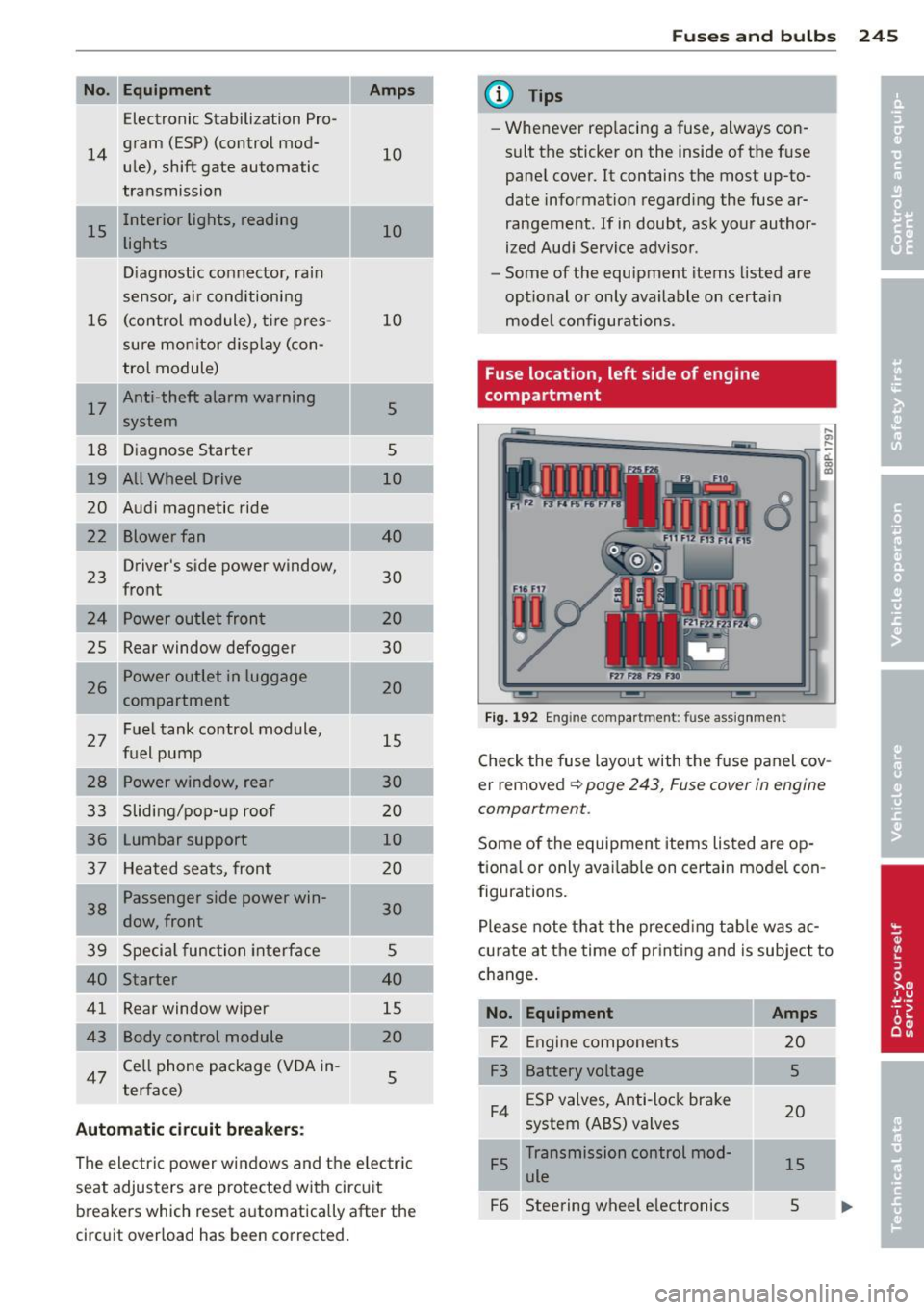
No. Equ ipment
Electronic Stabilization Pro-
14
gram (ESP) (control mod-
u le), shift gate automatic
transmission
15 Interior lights, reading
lights
Diagnostic connector, rain
sensor, air conditioning
16 (control module), t
ire pres-
sure monitor d isplay (con-
trol module)
I 17
Anti-theft alarm warning
system
18 D iagnose Starter
19 All Wheel D rive
20 Audi magnetic ride
Blower fan
23
Driver's
side power window,
front
24 Power outlet front
2S Rear window defogger
26 Power outlet in luggage
compartment
27 Fuel tank control module,
fuel pump
28 Power window, rear
33 Slidi ng/pop-up roof
36 Lumbar support
37 Heated sea ts, front
1 38
Passenger side power win-
dow, front
39 Specia l func tion interface
40 Starter
41 Rear window wiper
43 Body control module
47
Ce ll phone package (V OA in-
terface)
Automatic circuit breakers:
10
10
10
5
5
10
40
30
20
30
20
15
30
20 10
20
30
5
40
15
20 5
The electri c power w in dows and the e lectr ic
seat adjusters are pro tected with circu it
breake rs which reset automatically after the
circuit overload has been corrected.
Fu se s and bulb s 245
@ Tips
-Whenever rep lacing a fuse, always con
sult the sticker on the inside of the f use
pane l cover. It contains the most up-to
date information regarding the fuse ar
rangement. If in doubt, ask your author
ized Aud i Service adviso r.
- Some of the equipment items listed are
opt ional or only available on certa in
mode l configurations.
Fuse location, left side of engine
compartment
Fig . 192 En gine compar tment : fuse assig nment
,._
-d. a, a>
Check the fuse layout with the f use panel cov
er removed
¢ page 243, Fuse cover in engine
comportment.
Some of the equipmen t items listed are op
tiona l or only ava ilab le on certain model con
figurations.
Please note tha t the preced ing tab le was ac
c u rate at the time of pr int ing and is subject to
c h ange.
No. Equipment
F2 Engine compone nts
F3 Battery voltage ESP valves, Anti-lock brake
F4 system (ABS) valves
Transmission control mod
F5 ule
F6 Steering wheel e lectronics
Amps
20
5
20
15
s
Page 248 of 280
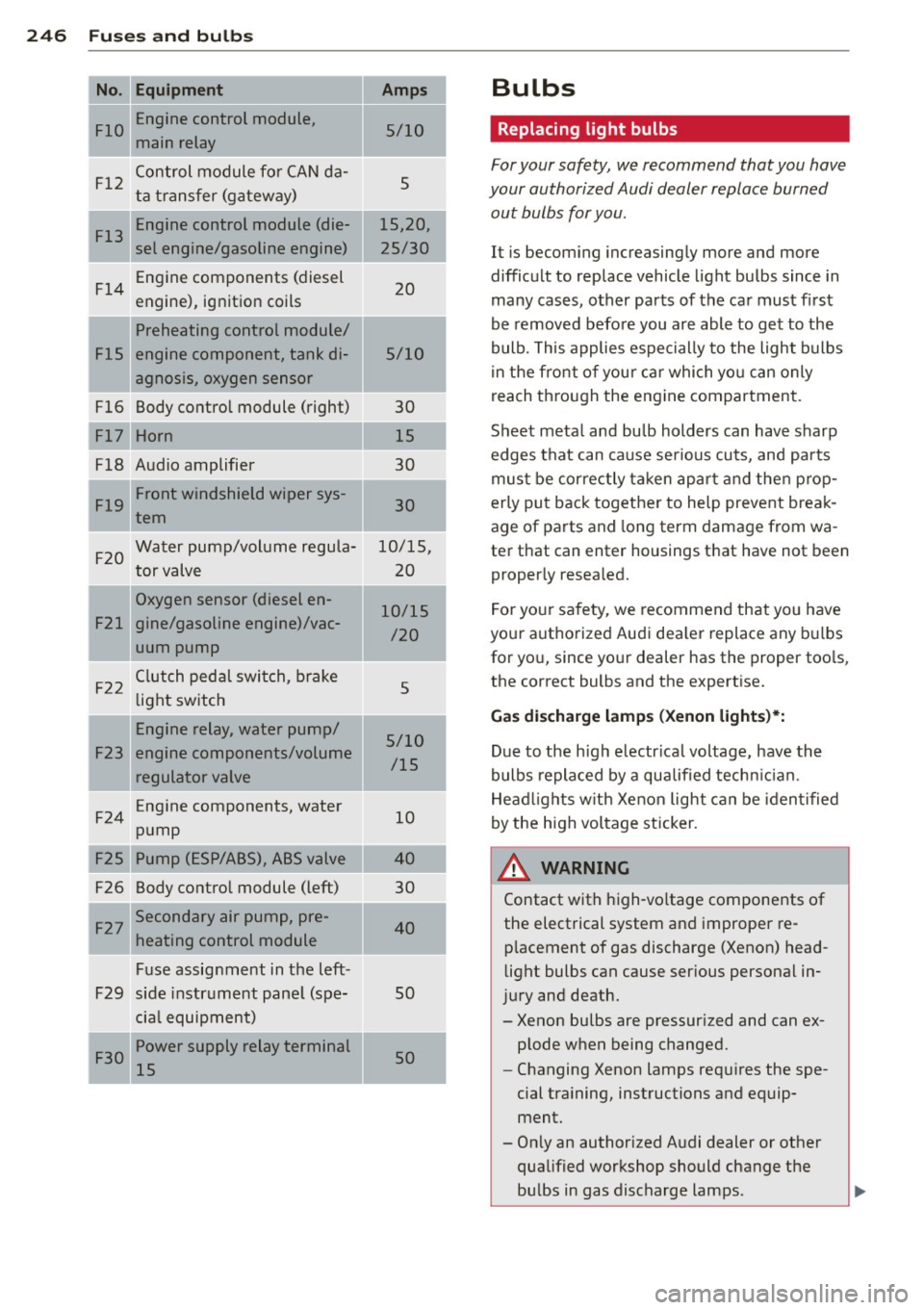
246 Fuses and bulbs
I
I
I
No. Equipment
FlO Engine control module,
main relay
Control module for CAN da
F12 ta transfer (gateway)
F13 Engine control module (die
sel engine/gasoline engine)
Fl 4 Engine components (diesel
engine), ignition coils
FlS
F16
F17
F18 Preheating control module/
engine component, tank di
agnosis, oxygen sensor
Body control module (right)
Horn
Audio amplifier
Flg Front windshield wiper sys
tem
F 2 0
Water pump/volume regula
tor valve
F22
F23
F24
F25
F26 Oxygen sensor (diesel en
gine/gasoline engine)/vac
uum pump
C
lutch pedal switch, brake
light switch
Engine relay, water pump/
engine components/volume regulator valve
Eng ine components, water
pump
Pump (ESP/ABS), ABS valve
Body control module (left)
-Amps
5/10
5
15,20,
25/30
20
5/10 30 15
--30
30
10/15, 20
10/15 /20
5
5/10
/15
10
40
-·-- --·-
30
40
F27 Secondary
air pump, pre-
heating control module
__ , ..
F29 Fuse assignment in the left
side instrument pane l (spe-
cia l equipment)
Power supply relay terminal
15 so
so
Bulbs
Replacing light bulbs
For your safety, we recommend that you have
your authorized Audi dealer replace burned
out bulbs for you.
It is becoming increasingly more and more
difficult to replace vehicle light bulbs since in
many cases, other parts of the car must first
be removed before you are able to get to the
bulb. This applies especially to the light bulbs
in the front of your ca r which you can only
reach through the engine compartment.
Sheet metal and bulb holders can have sharp
edges that can cause serious cuts, and parts
must be cor rectly taken apart and then prop
erly put back together to help prevent break
age of parts and long term damage from wa
ter that can enter housings that have not been
properly re sea led.
For your safety, we recommend that you have
your authorized Audi dea ler replace any bulbs
for you, since your dealer has the proper tools,
the correct bulbs and the expertise.
Gas discharge lamp s (Xenon lights)*:
Due to the high e lectr ica l voltage, have the
bulbs replaced by a qualified techn ic ian.
Head lights with Xenon light can be identified
by the high voltage sticker.
_& WARNING ~
Contact with high-vo ltage components of
the electrical system and improper re
placement of gas discharge (Xenon) head
light bulbs can cause serious personal in
jury and death.
- Xenon bulbs are pressur ized and can ex
plode when being changed.
- Changing Xenon lamps requires the spe
cial tra ining, instructions and equip
ment.
- On ly an authorized Audi dealer or other
qualified workshop should change the bulbs in gas discharge lamps .
Page 252 of 280

250 Emergency sit uat ions
2. Otherwise apply the hand brake and shift
into idle gear if your vehicle has manua l
transmission, and put the selector lever
into P position if your vehicle has auto
matic transmission.
3 . For both vehicles switch off all consumers
and the ig nition .
Connectin g/disco nn ecting th e jumper
cable
4 . Connect one end of the red jumper cable
to the positive term inal
(D ¢ fig . 193 of
the discharged battery @ ¢0
in General
information of starting assistance on
page 249 .
5. Connect the other end of the red jumper
cab le to the positive termina l@ of the
booster battery @.
6 . Connect one end of the black jumper ca
b le, preferably at the ground point. Other
wise, connect it to the negative terminal
@ of the booster battery @.
7 . Connect the other end of the black jumper
cab le to the
ground po int (bolt head )©
in your v ehi cle @ .
8. Route the jumper cables so that they can
not catch in any rotating parts in the en
gine compartment.
Starting the engine
9 . Start the engine of the vehicle provid ing
assistance and allow it to run at idle .
10. Now start the eng ine o f the vehicle w ith
the discharged battery, wa it for two to
three minutes unti l the engine "runs"
smoothly .
11. If the engine does not start: Stop trying
after
10 seconds and then try again after
about
30 seconds.
12 . In the veh icle that has received start as
sistance, turn on the heater blower and
the rea r window heat ing to eliminate any
voltage peaks when disconnecting. Driv
ing lights must be swi tched off!
13. Disconnect the cable whi le the engine is
running exact ly in
reverse order to that
described in¢
page 250, Connecting/dis
connecting the jumper cable.
When do ing so, make sure that the cable cannot con
tact rotating engine parts.
14. Turn the heater b lower and the rear w in-
dow heating off again .
The battery is vented to the outside to prevent gases from entering the vehicle interior .
Make sure that the jumper clamps are we ll
connected with thei r
metal ports in full con
tact
with the battery terminals .
A WARNING
To avoid serious personal injury and dam
age to the vehicle, heed all warnings and
instructions of the jumper cable manufac
turer. If in doubt, call for road service.
- Jumper cables must be long enough so
that the veh icles do not touch.
- When connecting jumper cables, make sure that they cannot get caught in any
mov ing parts in the engine compart
ment.
- Before you check anything in the engine
compartment, always read and heed all
WARNINGS ¢page 187, Engine com
partment.
{CT) Note
Improperly connected jumper cab les can
damage or destroy the generator .
- Do not use the battery negative terminal
for jump start ing or a malfunct ion could
occur in the vehicle electrical system.
- Always connect POSITIVE(+) to POSI-
TIVE(+), and NEGATIVE(-) to NEGATIVE
( - ) term inal.
- Check that all screw p lugs on the battery
cells are screwed in firm ly . If not, tighten
plugs prior to connecting clamp on nega
tive batte ry term inal.
- Please note that the procedure for con
necting a jumper cable as described
above applies specifically to t he case of
your vehicle being jump st arted. When
yo u are g iving a jump sta rt to another ve
hicle, do
not connect the minus( -) cable
to the minus (-) terminal on the dis
charged battery@¢fig.193 . Instead,