check oil AUDI A3 2015 User Guide
[x] Cancel search | Manufacturer: AUDI, Model Year: 2015, Model line: A3, Model: AUDI A3 2015Pages: 288, PDF Size: 71.46 MB
Page 216 of 288
214 Checking and Filling
you have your oil changed, ask your author
ized Audi Service Advisor.
Under some circumstances the engine oil
should even be changed more frequently .
Change oil more often if you drive mostly
short distances, operate the vehicle in dusty
areas or mostly under stop-and-go traffic con
ditions, or when you use your vehicle where
temperatures stay below freezing point for
long periods .
Detergent additives in the o il wi ll make fresh
oil look dark after the engine has been run
ning for a short time. This is normal and is not
a reason to change the oil more often than recommended .
Damage or malfunctions due to lack of
maintenance
It is essential that you change your oil at the
recommended interva ls using only engine oil
that complies with Audi oil standard
VW 502 00. Your Lim ited New Vehicle War
ranty does not cover damage or malfunctions
due to fa ilure to follow recommended mainte
nance and use requ irements as set forth in
the Audi Owner's Manual and Warranty
&
Maintenance booklet . Your dea ler will have to
deny warranty coverage un less yo u present to
the dea ler proof in the form of Service or Re
pair Orders that all schedu led maintenance
was performed in a timely manner.
Engine oil consumption
The engine in your vehicle depends on on ade
quate amount of oil to lubricate and cool all
of its moving ports.
In order to provide effective lubrication and
cooling of internal engine components , a ll in
ternal combustion eng ines consume a certain
amount of o il. Oil consumption var ies from
engine to engine and may change significantly
over the life of the eng ine . Typically, engines
with a specif ied break-in period (see
¢
page 193) consume more oil during the
b reak-in period than they consume after oil
consumption has stabilized. Under
normal conditions, the rate o f oil con
s u mption depends on the quality and viscosity
of the oil, the RPM (revolut ions per minute) at
which the engine is operated, the ambient
temperature and road conditions. Further fac
tors are the amount of oil dilut ion from water
co nd ensat ion or fuel residue and the oxida
t ion level of the oil. As any engine is subject to
wea r as mileage builds up, the oil consump
tion may increase over time until replacement
of worn components may become necessary.
With a ll these variab les coming into play, no
standard ra te of oil consumpt io n can be es
tablished or specified. There is no alternative
to regu lar and frequent check ing of the oil lev
el , see
Note.
If the yellow engine oil leve l warning symbo l
Ill in the instr ument cl uster light s up, you
shou ld check the oil leve l as soon as possible
¢
page 215. Top off the oil at your earliest
convenience
~ page 215.
A WARNING
-~
Before you check anything in the engine
compartment, always read and heed all
WARNINGS¢
page 210.
(D Note
Driving wit h an insufficient oil level is like
l y to cause severe damage to the engine.
(D Tips
-The oil pressure warning display. is
not an indicator of the oil level. Do not
rely on it. Instead, check the oil level in
your engine at regular intervals, pref
erably each time you refuel, and always
before going on a long trip .
-If you have the impression your engine
consumes excessive amounts of oil, we
recommend that you consult an author
ized Aud i dea ler to have the cause of
your concern properly diagnosed. Keep in
mind that the accurate measurement of
oil consumption requ ires great care and
may take some time. An authorized Audi ..,.
Page 217 of 288
dealer has instructions about how to measure oil consumption accurately.
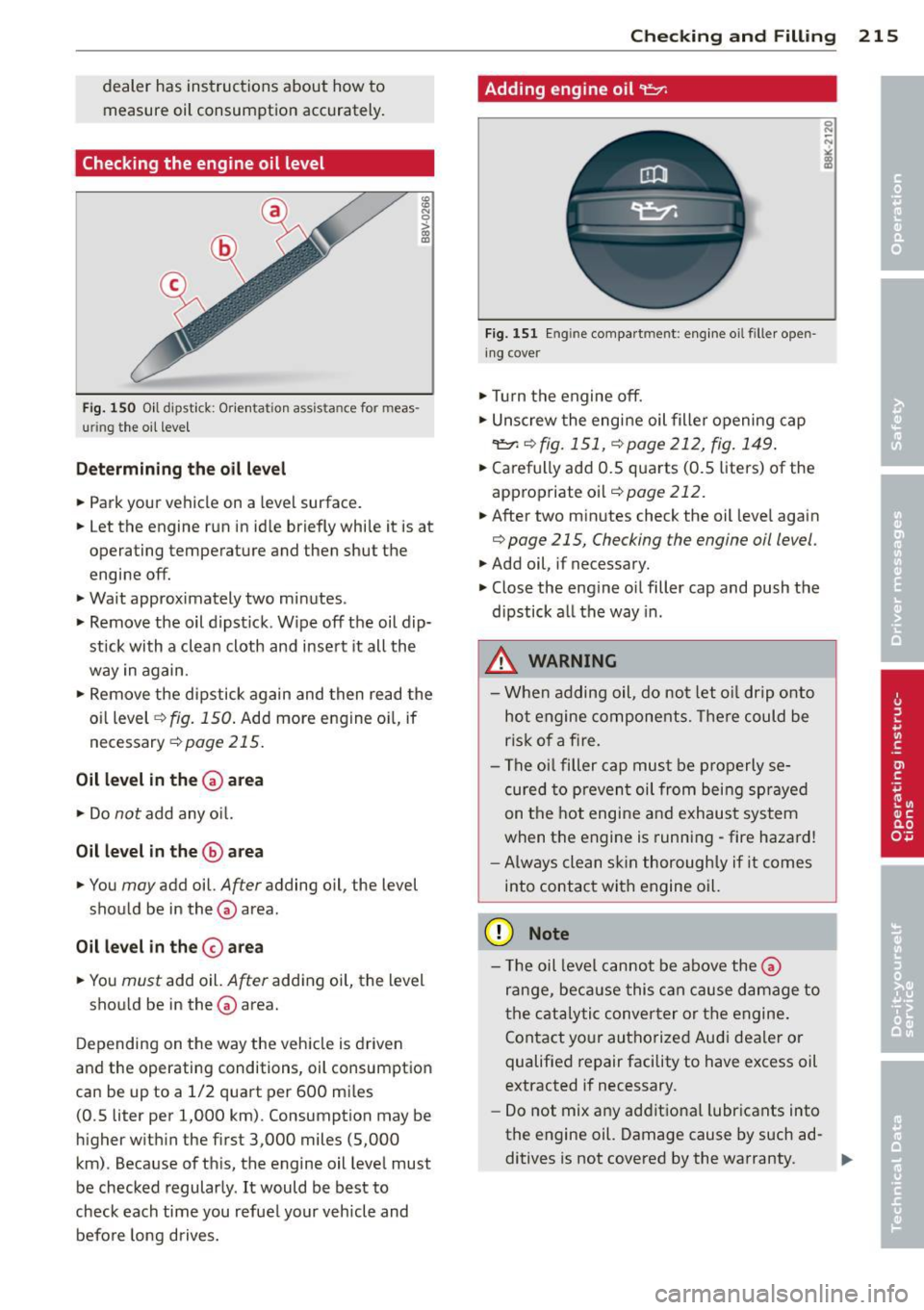
Checking the engine oil level
Fi g. 150 O il dip stick: O rienta ti on ass ist an ce for mea s·
ur ing t he oil leve l
Dete rmining th e oil l evel
• Park your vehicle on a level surface.
• Let the engine run in id le briefly while it is at
operating temperature and then shut the
engine off.
• Wait approximately two minutes .
• Remove the oil dipst ick. W ipe off the oil dip·
stick with a clean cloth and inse rt it all the
way in again.
• Remove the dipstick again and then read the
oi l level ¢
fig. 150 . Add more engine o il, if
necessary ¢
page 215.
Oil level in the G) area
• Do not add any o il.
Oil level in the @area
• You may add oil. After adding oil , the level
shou ld be in the@area.
Oil l evel in th e@ area
• You must add oil. After adding oil, the level
shou ld be in the@area.
D epending on the way the vehicle is driven
and the operating conditions, oil consumptio n
can be up to a 1/2 quart per 600 mi les
(0.5 liter per 1,000 km) . Consumption may be
h igher with in the first 3,000 miles (5,000
km) . Because of th is, the engine oil leve l must
be checked regularly . It would be best to
check each time you refue l your veh icle and
befo re long drives.
Che cking and Fillin g 215
Adding engine oil 'i=:1:
Fig. 151 E ng in e compa rtm en t: en gin e o il fil ler o pen ·
in g cover
• Tur n the engine off.
• Unscrew the engi ne oil filler opening cap
~ ¢ fig.151, ¢page 212, fig. 149 .
• Carefully add 0.5 q ua rts (0.5 liters) of the
appropriate oil¢
page 212 .
• After two m inutes check the oil leve l again
¢ page 215, Checking the engine oil level .
• Add oil, if necessa ry.
• Close the eng ine o il filler cap and push the
d ipstick al l the way in.
A WARNING
- When adding oil, do no t let o il drip o nto
hot engine components. There could be
ris k of a f ire.
- T he o il filler cap mus t be p roperly se·
cured to preven t oil from bei ng sprayed
on t he hot engine a nd exhaust system
when t he engine is running -fire haza rd!
- Always clean s kin th oroughly if it comes
into contac t with engine oil.
(D Note
- T he oil level cannot be above the@
range, beca use thi s ca n cause damage to
t he cat alytic conve rter or the engine .
Contact yo ur autho rize d Audi deale r o r
qualified repair facility to have excess oil
extracted if necessary.
- Do not mix any addit io na l lubr icants into
the engine oil. Damage cause by such ad·
ditives is not covered by the warranty .
1i1J>
Page 218 of 288
216 Check ing and F illin g
@ For the sake of the environment
-Oil should never enter the sewer system
or come into contact with the ground .
- Pay attentio n to lega l requ irements
when disposing of empty oil containers .
Changing the engine oil
We recommend that have your oil changed by
an authorized Audi dealer or a qualified serv
ice station.
Before you check anything in the engine com
partment,
a lways r ea d and heed all WARN
ING S
r=>page 210.
The engine oil must be changed according to
the intervals specified in you r Warranty
&
Maintenance book let. This is very important
because the lubricating properties of oil di
minish gradua lly during norma l veh icle use.
Under some circumstances the engine oi l
should be changed more frequently. Change
oil more often if you drive most ly short dis
tances, operate the vehicle in dusty areas or
under predominantly stop-and-go traffic con
ditions, or have your vehicle where tempera
tures remain below freezing for extended pe riods .
Detergent additives in the oil will make fresh
oil look dark after the eng ine has been run
n ing for a short time. This is normal and is not
a reason to change the oil more often than recommended.
Because of the problem of proper disposal,
along w ith the special tools and necessary ex
pertise required, we strongly recommend that
you have you r o il changed by an author ized
A udi de ale r or a q ual ified servi ce station.
If yo u choo se to c hang e your o il yo urse lf,
please note the following important informa
tion :
.8, WARNING
To reduce the ris k of persona l injury if yo u
m ust change the engine oil in your veh icle
yourself : -
Wear eye protection .
- To reduce the risk of burns from hot en -
gine oi l, let the engine cool down to the
touch.
- When removing the oil drain p lug with
your fingers, stay as far away as possible.
Always keep your forearm parallel to the
ground to help prevent hot oil from running down your arm.
- Drain the oil into a container designed
for this purpose, one large enough to
hold at least the tota l amount of oil in
your engine.
- Engine oil is poisonous. Keep it we ll out
of the reach of childre n.
- Continuous contact with used eng ine o il
is harmful to your sk in . Always protect
your skin by washing oil
off tho roughly
with soap and water.
(D Note
Never mix oil additives with your engine
oil. These additives can damage your en
gine and adversely affect your Aud i Limit
ed New Veh icle Warranty.
@ For the sake of the environment
- Before changing your oil, first make sure
yo u know where you can properly dispose
of the used oil.
- Always dispose of used eng ine oil proper
ly. Do not dump it on garden soil, wood
ed areas, into open st reams o r down
sewage drains.
- Recycle used engine oil by taking it to a
used eng ine oil collect io n fac ility in you r
are a, or contact a se rvice station.
coolant system
Coolant
The engine coolant performs two functions: it
keeps the engine from overheating and it pro tects the engine from freezing in the winter.
The cooling system is sealed and genera lly re-
quires little attention. .,..
Page 219 of 288
The cooling system has been filled at the fac
tory with a permanent coolant which does not need to be changed. The coolant consists of a
mixture of spec ia lly conditioned water and the
manufacturer's glycol-based coolant addi-
tive Gl3 antifreeze with anticorros ion addi
tives (50% fo r USA models; 60% for Canadian
models) . This mixture both assures th e neces
sary frost protect ion a nd p rotects me tal com
ponents in the engine 's coo ling system from
corrosion and scaling.
It al so raises the boil
ing po int o f the coo lant .
D o no t reduce the concentration of t he coo l
an t in the summer by ad ding plain w ate r.
The
proportion of coolant additive must be at
lea st 50 % but not more than 60%
to main
tain ant ifreeze protection and cooling efficien
cy. If the coolant frost protect ion is too low ,
the coolant cou ld free ze and damage the veh i
cle heating and eng ine cooling system.
F or yea r-round driv ing, antifreeze is added at
the facto ry for temperatures down to:
- -3 1 °F ( -3 5°C) USA
- -4 0°F ( -4 0°C) Canada.
If you must add coolant, use a m ixture of wa
ter and coolant addit ive. M ixing the coolant
addi tive wi th dist illed wate r is recom mend ed.
_& WARNING
Bef ore yo u check any thing in the e ngine
comp artme nt, alw ays re ad and hee d all
WARN INGS
¢page 210.
(D Note
- B efo re winter sets in, have the coolant
c hec ked to see if the c oolan t ad dit ive i n
you r vehi cle is su fficient t o mee t the cl i
mate cond itions. This is especially impor
tant if yo u live in a region whe re the win
ter is extremely cold. If necessary, in
crease the proport ion of coolant additive
to 60%.
- W hen addi ng coolant additive to your
cooling system, remember:
- We recommend using only coolant ad
ditive Gl2 ++ o r Gl3 ( check t he label)
-
Che cking and Fillin g 21 7
for you r vehi cle. This coolan t additive is
avai lab le at authorize d Audi dea le rs .
Ot her types of antifreeze ca n sig nifi
cantly reduce corros io n protection. The
res ulting corrosion can cause a loss of
coolant and serio us e ngine da mage .
- Do not add any type of rad iator leak seal
ant to you r vehicle's engine coolant .
Add ing radiator repair flu id may adverse
ly affect t he function and performanc e of
yo ur cooling sys tem and co uld resu lt i n
damage not covered by yo ur New Ve hicle
L imi ted W arranty.
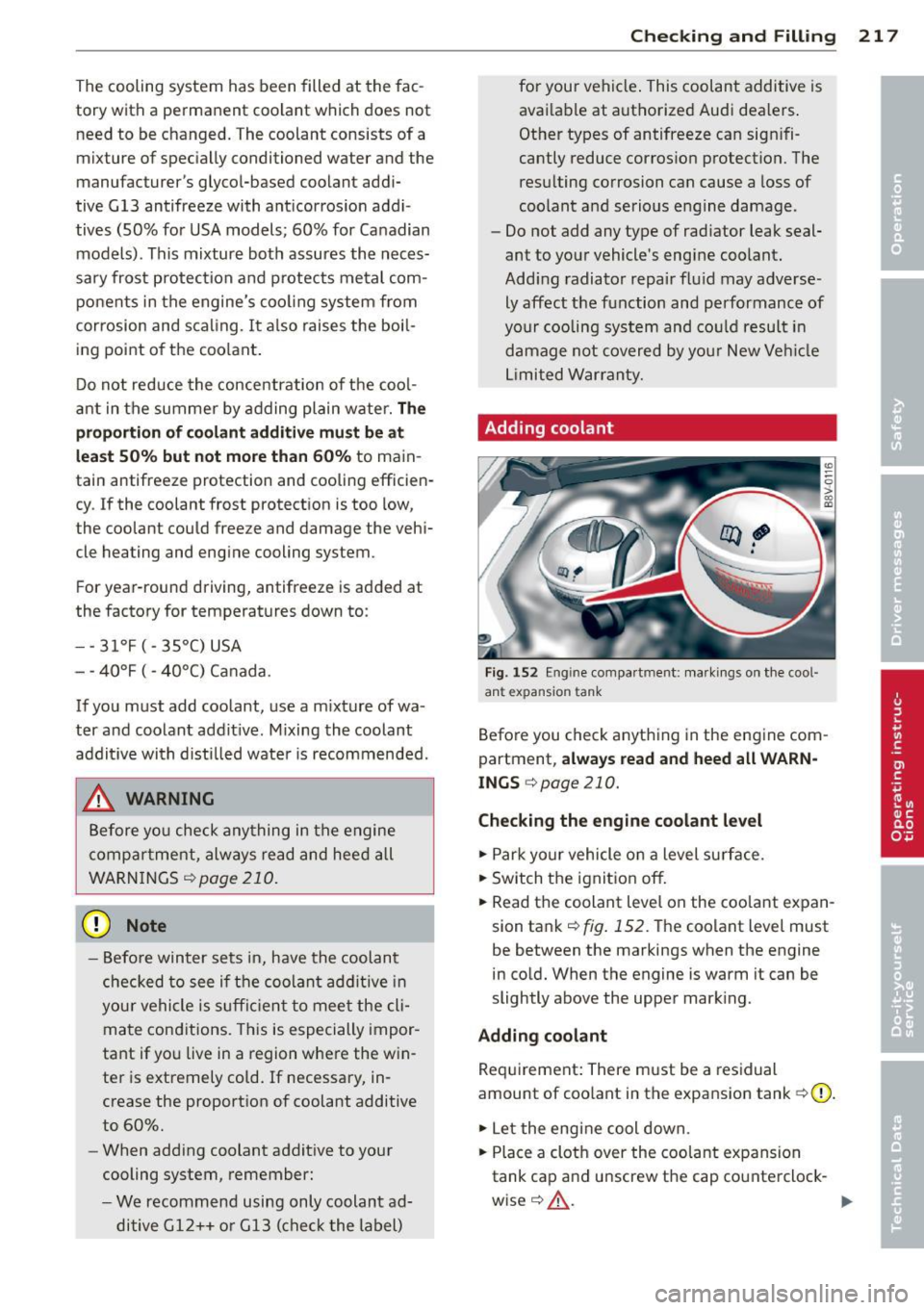
Adding coolant
Fi g. 152 En gine co mpa rtment: markin gs on t he coo l
an t e xpan sio n t ank
Befo re you check a nyt hing in the eng ine com
partment ,
alway s read and heed all WARN
INGS ¢ page 210.
Checking the engine coolant level
.,. Park yo ur vehicle o n a level su rf a ce .
.,. Switch t he ignition off.
.,. Read t he coolant leve l on the coo lant expan
sion tank ¢
fig. 152. The coolant leve l must
be between the markings when the engine
in cold. When the engine is warm it can be
slightly above the upper mark ing .
Adding coolant
Req uirement : There m ust be a res idual
amount of coo lant in the expansion tank
c::> Q) .
.,. Le t the engine cool down.
.,. Place a clot h over the coo lant expans ion
tank cap a nd u nscrew the cap co unterclock-
wise
c::> _& . ..,.
Page 221 of 288
Brake fluid
Checking brake fluid level
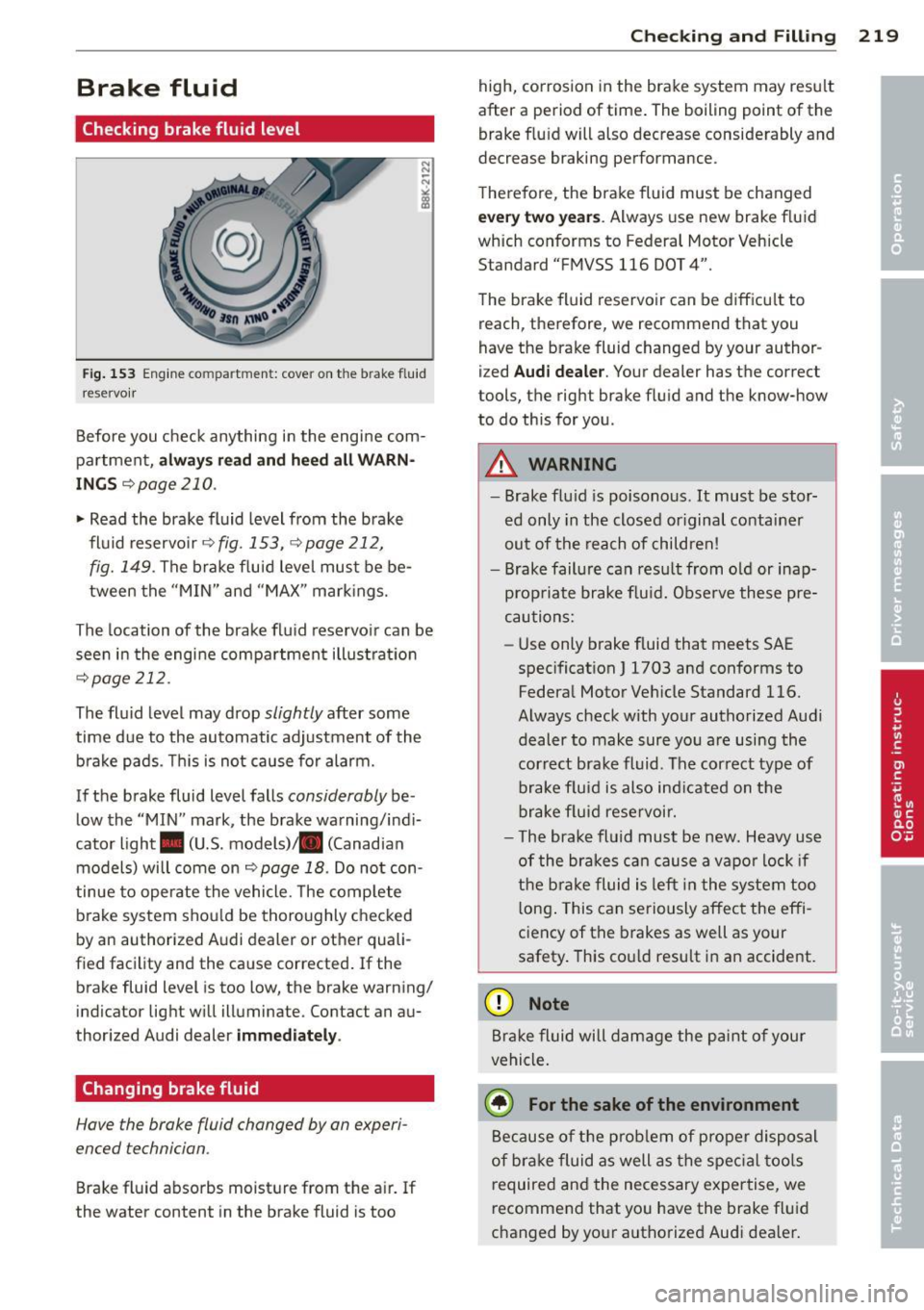
Fig . 153 Engine co mpa rtment: cove r on the b rake f lu id
reservo ir
B efore you check anything in the engi ne com
partment,
alwa ys read and heed all WARN ·
INGS r:=:,page 210 .
~ Read the brak e fluid level from the brake
fluid reservo ir
r:=;, fig . 153, r:=:, page 212,
fig. 149 .
The brake f luid leve l mus t be be
tween the "MIN" and "MAX " ma rkings.
The location of the brake flu id reservo ir can be
seen in the engi ne compa rtment illust ra ti on
¢ page 212 .
The fluid level may drop slightly after some
time due to the automatic adjustment of the b rake pads . Thi s is not cause for alarm.
If the brake fluid level falls
considerably be
low the "MIN" mark, the b rake wa rning/ind i
cato r light . (U .S . models)/ . (Canadian
models) will come on
r:=;, page 18 . Do not con
tinue to operate the vehicle. The comp lete
brake system should be thoroughly checked
by an authorized A udi dealer or other quali
f ied fac ility and the ca use corrected . If the
br ake fluid level is too low, the brake warning/
indica tor light w ill illuminate. Contact an au·
thor ized Audi dealer
immediately .
Changing brake fluid
Have the brake fluid changed by an experi
enced technician .
Brake fluid abso rbs moist ure from the air. If
the water content in the brake fluid is too
Che cking and Fillin g 219
high, co rrosion in the brake system may resu lt
after a period of time . The boiling point of the
brake f lu id will also decrease conside rably and
decrease braking performance.
T herefore, the brake fluid must be changed
eve ry two year s. Always use new brake f luid
which conforms to Federal Motor Veh icle
Standard "FMVSS 116 DOT 4".
The brake fluid reservoi r can be difficu lt to
reach, therefore, we recomm end that you
have the brake fluid changed by your author
i z ed
Audi dealer . Your dealer has the correct
tools, the right brake flu id and the know-how
to do this for you .
A WARNING
-
-Brake flu id is poisonous. It must be stor-
ed only in the closed or iginal containe r
out of the rea ch of children!
- Brake failure can resu lt from o ld or inap
p rop riate brake f lu id. Observe these pre
cautions:
- Use only brake f luid that meets SAE
spec ificat ion
J 1703 and conforms to
Federa l Motor Ve hicle Standard 116.
Always check with your authorized Audi
dealer to make sure yo u are using the
cor rect bra ke fluid. The cor rect type of
brake f luid is also i nd icated on t he
brake f lui d rese rvoir.
- The bra ke flu id must be new. Heavy us e
of the brake s can cause a vapo r lock if
the b ra ke fluid is left i n the system too
l ong . This can se riously affect the effi
ciency of the brakes as we ll as your
safety . This co uld resu lt i n an accident .
(D Note
Brak e fluid will dam age the pa int of your
vehicle .
@ For the sake of the environment
Because of the p rob lem of proper disposal
o f bra ke fluid as well as the spec ial too ls
r equired and the necessary exper tise, we
recommend that yo u have the brake flu id
changed by yo ur authorized Audi dea ler.
Page 238 of 288
236 Tires and wheels
unbalanced, resulting in vibrations you can
usually feel through the steering whee l.
Unbalanced wheels must be rebalanced to
avoid excessive wea r on steer ing, suspension
and tires . A wheel must a lso be rebalanced
when a new tire is installed.
Incorrect wheel alignment
I ncorrect wheel alignment can cause exces
sive tire wear, impair ing the safety of the veh i
cle. If tires show excess ive wear, have the
wheel alignment checked by an authorized
Audi dealer or qualified workshop.
All-wheel drive
Vehicles w ith quattro must a lways have tires
of the same size, construction and tread type.
F or details see
<=> page 190 .
A WARNING
Sudden tire failure can lead to loss of con
trol, a crash and ser ious persona l injury!
- Never drive a vehicle when the tread on
any tire is worn down to the wear indica
tors.
- Worn tires are a safety hazard, they do
not grip well on wet roads and increase
your risk of "hydroplaning" and loss of
control.
- Always keep chemicals that can cause
tire damage, such as grease, oil, gasoline
and brake fluid away from t ires.
- Tires age even if they are not being used
and can fail suddenly, especially at high
speeds. Tires that are more than 6 years
old can only be used in an emergency
and then with special care and at lower
speeds.
- Never mount used tires on your vehicle if
you are not sure of their "previous histo
ry." Old used tires may have been dam
aged even though the damage cannot be
seen that can lead to sudden tire failure
and loss o f vehicle control.
New tires and replacing tires and wheels
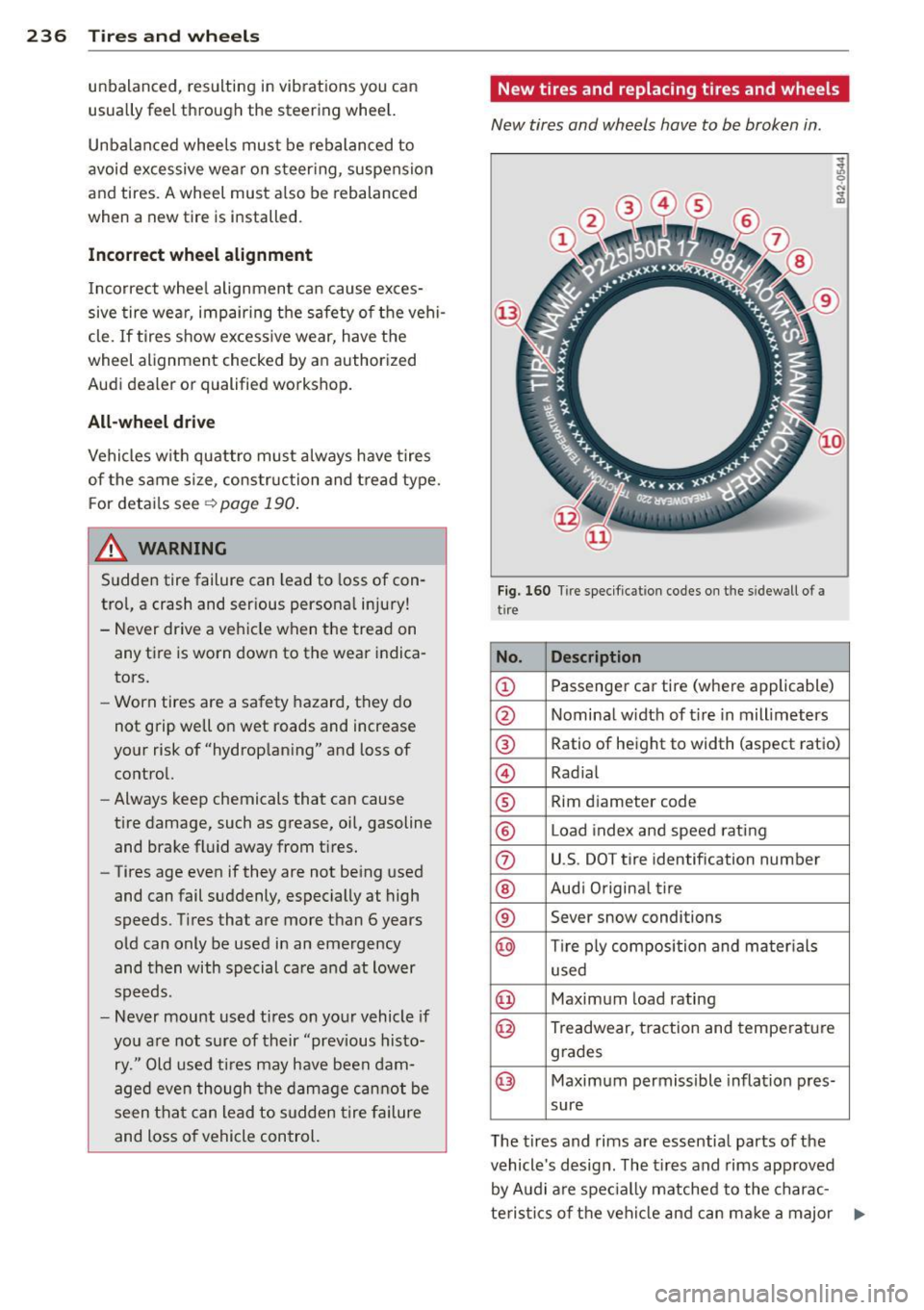
New tires and wheels have ta be broken in .
Fig. 160 Tire specificat ion codes on the s idewall of a
tire
No. Description
® Ratio of height to width (aspect ratio)
© Radial
® Rim diameter code
® L oad index and speed rating
(J) U.S . DOT tire identification number
® Audi Origina l tire
® Sever snow conditions
@ T ire ply composition and materials
used
@ Maximum load rating
@ Treadwear, traction and temperature
grades
@ Maximum permissible inflation pres-
sure
T he tires and rims are essential parts of the
vehicle 's design . The tires and rims approved
by Audi are spec ially matched to the charac
te ristics of the vehicle and can make a major .,..
Page 244 of 288
24 2 T ire s and wheel s
Where snow chains are mandatory oncer
tain roads, this normally also applies to
veh icles with all-wheel dr ive.
Wheel bolts
Wheel bolts must always be tightened to the
correct torque.
The design o f whee l bolts is matched to the
factory installed rims . If different rims are fit
ted, the correct wheel bolts with the right
length and correctly shaped bolt heads must
be used. This ensures that wheels are fitted
securely and that the brake system functions
correctly .
In certain circumstances, you may not use
wheel bolts from a different vehicle -even if it
is the same model
r=> page 270.
A WARNING
Improperly tightened or maintained wheel
bolts can become loose caus ing loss of
c ont ro l, a co llision and serious persona l in
Jury .
- Always keep the wheel bolts and the
threads in the wheel hubs clea n so the
wheel bolts can turn easily and be prop er ly t igh tened .
- Never grease or oil the wheel bo lts and
the threads in the wheel hubs. They can
become loose while d riving if greased or
oiled, even if tightened to the specified
torque.
- Only use wheel bolts that belong to the
rim being installed.
- Never use different whee ls bolts on your
vehicle.
- Always maintain the co rrect tighten ing
torq ue fo r th e wheel bo lts to reduce the
risk of a wheel loss . If the tightening tor
que of the wheel bo lts is too low, they
can loosen and come out w hen the veh i
cle is moving. If the tighteni ng torque is
too high, the whee l bolts and threads can be damaged and the whee
l can be
come loose.
@ Note
The specified torque for the whee l bolts is
90 ft lb (120 Nm) with a tolerance of± 7,4
ft lb(± 10 Nm) . Torque wheel bolts diago
nally. After changing a whee l, the torque
must be checked as soon as possible with a
torque w rench -preferably by an author
i zed Audi dealer or qualified workshop .
Low aspect ratio tires
Your Audi is factory-eq uipped w it h low aspect
ra tio tires. These tires have been tho roughly
tested and been se lected specifically fo r your
model for their superb perfo rmance, road fee l
and handling under a variety of d riving condi
t ions . Ask your author ized A udi dealer for
more details.
T he low aspect ratio of these tires is ind icated
by a numera l of
55 or less in the tire's s ize
designation. The n umera l represents the ratio
of the tire's sidewall height in relation to its
tread width expressed in percentage. Conven
t iona l tires have a he ight/w idth ratio of 60 or
more .
The performance of low-aspect -ratio tires is
particularly sens iti ve to imp roper inflation
pressure. It is therefore important that low
a spect ratio tires are inflat ed to the specified
pre ssure and that the inflation pressure i s
regularly ch ecked and maintain ed. Tire pre s·
sure s should be checked at lea st once a
m onth and always bef ore a long trip
r=> page 231, Checking tire pressure .
What you can do to avoid tire and rim
damage
Low aspect ratio tires can be d amage d more
easily by impact w ith potholes, curbs, gull ies
or ridges on t he road, particularly if the tire is
u nd eri nflated.
Page 266 of 288
264 Emergency situations
fall from a lift if there is a change in ve
hicle weight distribution and balance.
This might happen, for example, when
heavy components such as the engine
block or transmission are removed .
- When removing heavy components like
these, anchor vehicle to hoist or add cor
responding weights to maintain the cen
ter of gravity. Otherwise, the vehicle
might tilt or slip off the hoist, causing
serious personal injury.
(D Note
- Be aware of the following points before
lifting the vehicle:
-The vehicle should never be lifted or
jacked up from underneath the engine
oil pan, the transmission housing, the
front or rear axle or the body side
members. This could lead to serious
damage.
- To avoid damage to the underbody or
chassis frame, a rubber pad must be
inserted between the floor jack and
the lift points.
- Before driving over a workshop hoist,
check that the vehicle weight does not
exceed the permissible lifting capacity
of the hoist.
- Before driving over a workshop hoist,
ensure that there is sufficient clear
ance between the hoist and low parts
of the vehicle.
Page 272 of 288
2 70 Con sum er Inf ormation
in P (Park position) and the park brake is
applied.
@) For the sake of the environment
- Changing the engine settings wi ll ad
versely affect emission levels . This is det
rimental to the environment and increas
es fue l consumption .
- Always observe env ironmental regula
tions when disposing of old engine oil,
used brake fluid, dirty engine coolant,
spent batteries or worn out tires.
- Undeployed airbag modules and preten
sioners might be classif ied as Perchlo
rate Material -spec ial handling may ap
ply, see www .dtsc .ca .gov/hazardous
waste/perch lorate . When the veh icle o r
parts of the restraint system including
airbag modules safety belts wit h preten
s ioners are scrapped, all appl icable laws
and regulations must be observed. Your
a utho rized Audi dea ler is familiar with
these requirements and we recommend
that you have your dealer perform this
serv ice for you .
Additional accessories,
modifications and
parts replacement
Additional accessories and parts
replacement
Always consult an authorized Audi dealer be
fore purchasing accessories .
Your vehicle incorporates the latest safety de
sig n features ensuring a high standard of ac
tive and passive safety .
This safety could be compromised by non-ap proved changes to the veh icle. For this reason ,
if parts have to be replaced, p lease observe
the following points when installing addition
a l accessories:
Approved Audi accessor ies and genuine Audi
parts a re ava ilable from authorized Aud i deal
e rs. These dea
lers a lso have the necessary facili
ties, tools and trained specialists to install the
parts and accessories proper ly .
A WARNING
=
Using the wrong spare parts or using non-
approved accessories can cause damage to
the veh icle and ser ious perso na l injury .
- Use on ly accessories express ly approved
by Audi and genuine Audi spare parts
- These parts and accessories have been
specia lly designed to be used on your ve
h icle.
- Never install accessor ies such as tele
phone crad les or beverage ho lders on a ir
bag covers or within the airbag deploy
ment zones . Do ing so wi ll increase the
ris k of injury if a irbags are triggered in an
accident!
- Before you check anything in the engine
compa rtment, always read and heed a ll
WARNINGS
c:::> page 210 .
(D Note
-If items other than genu ine Audi spare
parts, add-on equipment and accessory
items are used o r if repair wo rk is not
performed ac cord ing to spe cified meth
ods, this c an resu lt in seve re damage to
yo ur vehicle's eng ine and body (such as
co rrosion) and adversely affect yo ur vehi
cle's warranty.
- If emergency repairs must be performe d
elsewhere , have the vehicle examined by
an authorized Audi dealer as soon as
possible.
- The manufacturer cannot be held liable
for damage wh ich occ urs due to failure
to comply with these stipu lations.
Technical Modifications
Our guidelines must be complied with when
t echnical modifica tions are made.
Always consult an authorized Audi dealer be-
fore start ing work on any modifications. ll>-
Page 278 of 288
276 Index
E
ECO mode (automatic climate control sys -
tem) . ..... .. ................ ..... .. 67
EDL
refer to Electronic differentia l lock . .. . 185
Efficiency program . . . . . . . . . . . . . . . . . . . 28
Description . ...... .......... ... .. .. 28
Fuel economy messages . . . . . . . . . . . . . 29
Other equipment . . . . . . . . . . . . . . . . . . . 29
Electrical accessories
refer to Socket ............. .. .... .. 56
Electromechanical parking brake
refer to Parking brake ............... 76
Electromechanical steering .. .. .. .. .. . 189
I ndicator lights .......... .. .. .... . 189
Electronic differential lock ... .... .... . 185
Indicator light . . . . . . . . . . . . . . . . . . . . . 22
Electronic immobilizer ....... ... .... .. 36
also refer to Immobilizer . . . . . . . . . . . . 31
E lect ronic interaxle differential lock .... 185
Electronic speed limiter ..... .. .. .. .. . . 30
Electronic stabilization control (ESC)
Indicator light . . . . . . . . . . . . . . . . . . . . . 22
Electronic Stabilization Control (ESC) ... 185
Emergency assistance .......... .... . 246
Emergency flasher .......... ... .... .. 43
Emergency flashers
I ndicator light . . . . . . . . . . . . . . . . . . . . . 25
Emergency operation Emergency braking function .. .. .. .. . . 78
Front passenger's door/rear doors . . . . . 3 7
L uggage compartment lid ........ .. . 246
Panorama sunroof ........ .. .. ...... 41
with conven ience key .... .. .. .. .. .. . . 75
Emergency release Fuel filler door .............. ... ... 209
Selector lever . . . . . . . . . . . . . . . . . . . . . 112
Emergency starting ........ .. .. .. .. . 259
Emergency towing ......... .. .. .. .. . 261
Energy management . . . . . . . . . . . . . . . . 190
Indicator light . . . . . . . . . . . . . . . . . . . . . 20
Engine Coolant .. .. ..................... . 216
Starting with jumper cables .... .... . 259
starting (button) . .. ...... .. .. .. .. . . 73 Starting (driver messages with conven-
ience key) ..... .. ................ .. 75
starting (key) . ... ................ .. 70
stopping (button) ............. ..... 74
stopping (key) ................ ..... 72
Engine compartment
Closing the hood . . . . . . . . . . . . . . . . . . 211
Opening the hood ................ . 211
Overview .. .... .. ... .......... .... 212
Safety precautions ............... .. 210
Engine control (indicator light) . . . . . . . . . 23
Engine coolant .. .. .......... ... .. .. 216
Radiator fan ... .. ... .......... .... 218
Engine oil .. ................... .... 212
adding . .. .. .. .. ... .......... .... 215
Changing . ...... ... ......... ... .. 216
Checking the oil level ... ..... ... .. .. 215
Dipstick... .. .. .. .... .... .... 212, 215
Indicator light .................... . 20
Oil consumpt ion .. ............. .. .. 214
Oil grades ..... .. ............. .... 212
Specification and viscosity ........ ... 212
Use ..... ..... .. .. .............. . 215
Engine speed limitation ( indicator light) . 23
Environment Break -in per iod . .. ... ....... ... .. .. 193
Catalytic converter ....... ...... .. .. 194
Disposing of your vehicle battery ..... 223
Driving at high speeds .......... .... 195
Driving to minimize pollution and noise 195
Fuel economy .... ................ . 195
Letting the vehicle stand and warm up . 196
Proper disposal of drained brake fluid . 219
Proper disposal of drained engine oil .. 216
Unleaded fuel .... ... .......... .... 206
What should I do with an old battery? . 223
EPC (engine control) ................ .. 23
ESC Electronic stabilization control ... .. .. 185
Post-coll is ion brake assist ..... .. .. .. 186
Sport mode ... .. ................ . 187
ESP
refer to ESC ... .. ..... ..... ... .. .. 185
Event Data Recorder (EDR) ............ 185
Exhaust tail pipes cleaning ........... 202
Exterior lighting ... ..... ..... ... .. .. . 42