weight AUDI A3 2015 Owners Manual
[x] Cancel search | Manufacturer: AUDI, Model Year: 2015, Model line: A3, Model: AUDI A3 2015Pages: 288, PDF Size: 71.46 MB
Page 6 of 288
4 Table of contents
Eme rgency towing with comme rcial
tow truck . . . . . . . . . . . . . . . . . . . . . . . 261
Lift ing vehicle . . . . . . . . . . . . . . . . . . . . 263
Technical Data . . . . . . . . . . . . . . . . . 265
Technical data . . . . . . . . . . . . . . . . . 265
Vehicle ident ificat ion . . . . . . . . . . . . . . 265
Weights . . . . . . . . . . . . . . . . . . . . . . . . 265
Dimensions. ... .. ..... ... .. .. .. .. 266
Capacit ies . . . . . . . . . . . . . . . . . . . . . . . 266
Gasoline eng ines . . . . . . . . . . . . . . . . . 267
Con sum er Inform ation . . . . . . . 2 68
Warranty coverages . . . . . . . . . . . . . . . 268
Operating your vehicle outside the
U.S.A. o r Canada . . . . . . . . . . . . . . . . . 268
Audi Service Repair Man uals and
L it erature . . . . . . . . . . . . . . . . . . . . . . . 268
M aintenance . . . . . . . . . . . . . . . . . . . . . 268
Additional accessories, modifications
and parts replacement . . . . . . . . . . . . 270
Declaration of Compliance,
Telecommunication and E lectronic
Systems . . . . . . . . . . . . . . . . . . . . . . . . 271
Inde x . . . . . . . . . . . . . . . . . . . . . . . . . . 272
Page 60 of 288
58 Seats and storage
Glove compartment
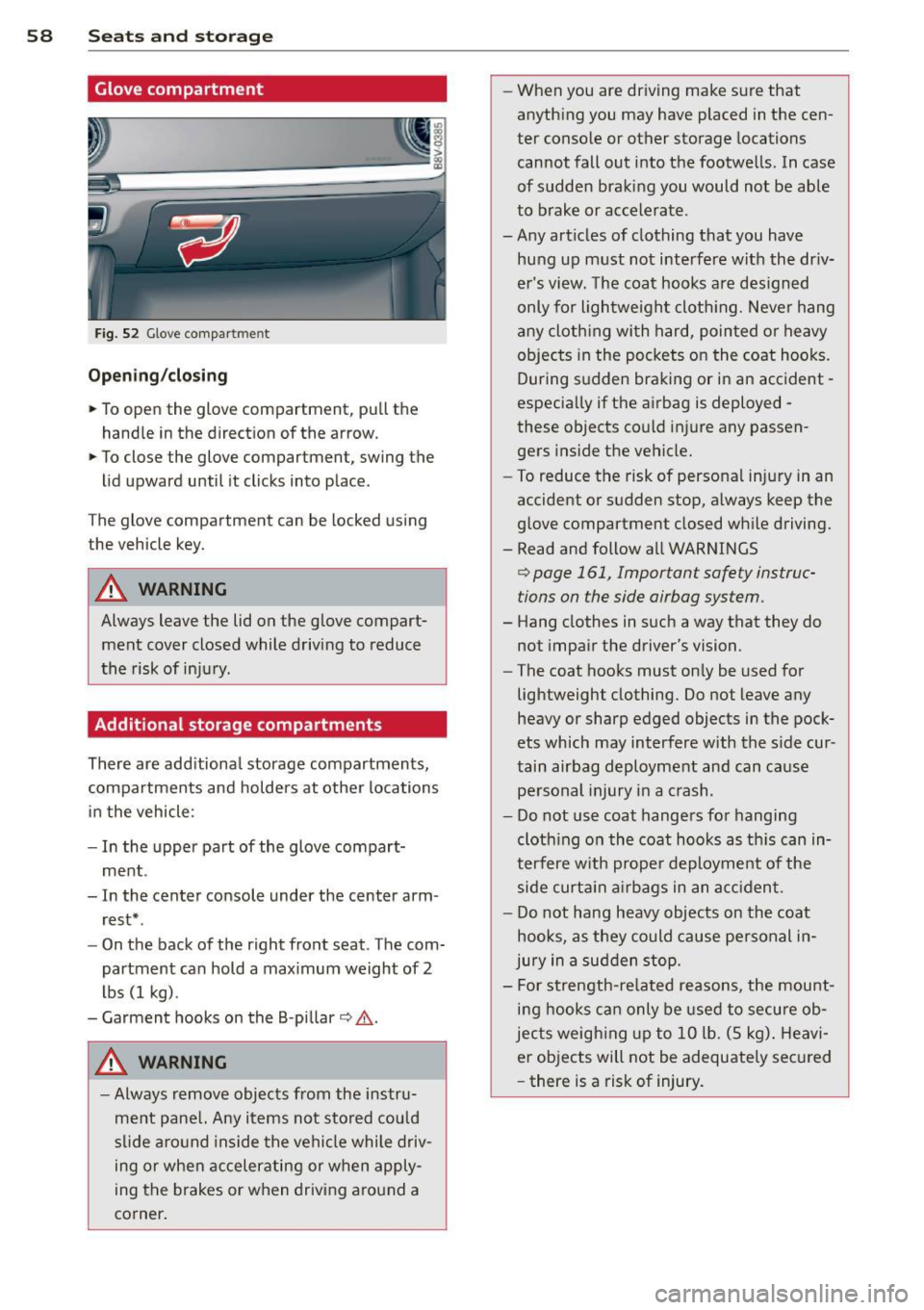
Fig. 52 Glove compa rt m en t
Open ing /closing
,,. To open the glove compartment, pull the
handle in the direct ion of the arrow.
,,. To close the glove compartment, swing the
lid upward until it clicks into place .
The glove compartment can be locked using
the vehicle key.
A WARNING
Always leave the lid on the glove compart ment cover closed while driving to reduce
the risk of in ju ry .
Additional storage compartments
There are add itiona l storage compartments,
compartments and holders at other locations
in the vehicle :
- In the upper part of the glove compart
ment .
- In the center console under the center arm rest* .
- On the back of the right front seat. The com
partment can hold a max i mum weight of 2
lbs (1 kg) .
- Garment hooks on the B -pillar
c:> A .
A WARNING
-Always remove objects from the instru
me nt pane l. Any items not stored could
s li de aro und inside the vehicle while driv
ing or when accelerating or when apply
ing the brakes or when driving a round a
corner .
-
-When you are dr iving make sure that
anyth ing you may have placed in the cen
ter conso le or other storage locations
cannot fall out into the footwells . In case
of sudden braking you would not be able
to b rake or accele rate .
- A ny articles of clothing that you have
hung up m ust not interfere with the dr iv
e r's vi ew. The coat hooks are des igned
only for lightweight cloth ing. Neve r hang
a ny cloth ing wi th hard, pointed o r heavy
objects in the pockets on the coat hooks.
During s udden braking or in an accident -
especia lly if the airbag is deployed -
these objects cou ld injure any passen
gers inside the vehicle.
- To reduce the risk of persona l in ju ry in an
accident or s udden stop, always keep the
g love compartment closed wh ile driving.
- Read and follow all WARNINGS
<=> page 161, Important safety instruc
tions on the side airbag system.
- Hang clothes in such a way that they do
not impair the driver's vision.
- The coat hooks must on ly be used for
lightweight clothing. Do not leave any heavy or sharp edged objects in the pock
ets which may interfere w ith the s ide cur
tain airbag deployment and can cause
pe rsonal injury in a crash .
- Do not use coat hange rs fo r hanging
cloth ing o n the coat hooks as th is can in
terfere w ith prope r deployment of the
side curt ain air bags in an a cciden t.
- Do not hang heavy objects on the coat
hooks, as they could cause pe rsonal in
jury in a sud den stop.
- For strength-re lated reasons, the mount
i n g hooks ca n only be used to secure ob
jects weigh ing up to 10 lb . (5 kg) . Heavi
er objects will not be adequate ly sec ured
- there is a risk of injury.
Page 62 of 288
60 Seats and st o rage
loading the roof rack
Always distribute loads evenly . Make sure
anything on the roof rack is securely tied
down.
,. Always distribute the loads on the roof rack
evenly .
,. Always attach items to the roof rack securely
before you d rive off.
The maximum perm iss ible roof we ight is
165 lb (75 kg ). The roof weight is the total of
the we ight of the roof rack, the attachments
and the cargo you are carry ing. You m ust also
not exceed the maximum load weight for the
roof rack you are using.
When us ing a roof rack system which has a
l owe r load carry ing capac ity, you must not use
up the total max imum pe rm issib le load carry
i ng capac ity specified above. Instead, you
should load the roof rack system only to the
maximum capacity specified by the manufac
turer of the roof rack system.
A WARNING
Weak, damaged or improper straps used
to secure items to the roof rack can fail
during hard braking or in a collision and
cause se rious personal injury .
- Make sure the roof rack is insta lled exact
ly as specified above¢
page 59.
-Always use suitable mounting straps for
securing items to the roof rack to help
prevent items from shift ing o r fly ing for
ward.
- Items on the roof rack must always be sec urely mounted.
- The use of a roof rack can negative ly af
fect the way a vehicle handles . Ca rgo
that is larg e, heavy, bulky, long o r flat
will have a g reater negative influence on
the vehicle's aerodynamics, center of
gravity and overal l handling. Always
dr ive slowly, avo id sudden braking and
maneuvers when transporting cargo on
the roof of your vehicle.
- Never exceed the maxim um permissible
load carrying capacity of the roof of your
veh icle, the permissible axle weights and
the permissible total weight of your vehi cle ¢
page 265, Weights.
@ For the sake of the env ironment
As a result of the increased wind resist
ance created by a roof rack, your vehicle is
us ing fuel unnecessarily . So
remove the
r oof rack after using it .
Luggage compartment
loading luggage compartment
Luggage items must be stowed securely.
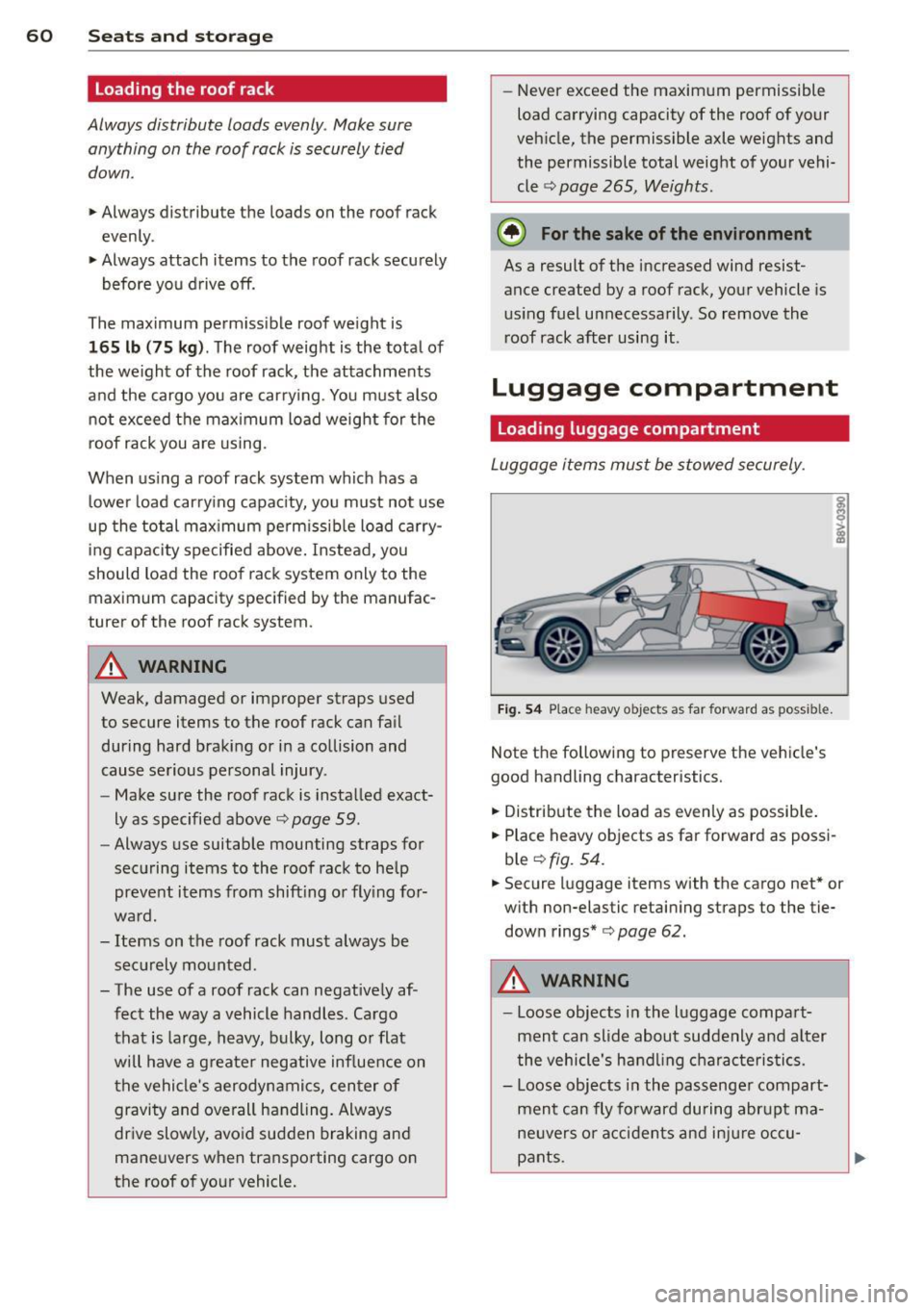
Fig . 5 4 Place heavy objects as far forward as possible.
Note the following to preserve the vehicle's
good handling characteristics.
,. Distribute the load as even ly as possib le.
,. Place heavy objects as far forward as possi
ble ¢
fig. 54.
,. Secure luggage items with the cargo net* or
w ith non-elastic retaining straps to the tie
down rings*
¢page 62.
A WARNING
-Loose objects in the l uggage compart
ment can slide about suddenly and a lter
the vehicle's hand ling cha racteristics.
- Loose objects in the passenge r compart
ment can fly forward during abr upt ma
ne uvers o r acci dents and inj ure occu
pants.
-
Page 64 of 288
62 Seats and storage
Tie-downs and cargo net
The cargo net* prevents small objects from
sliding.
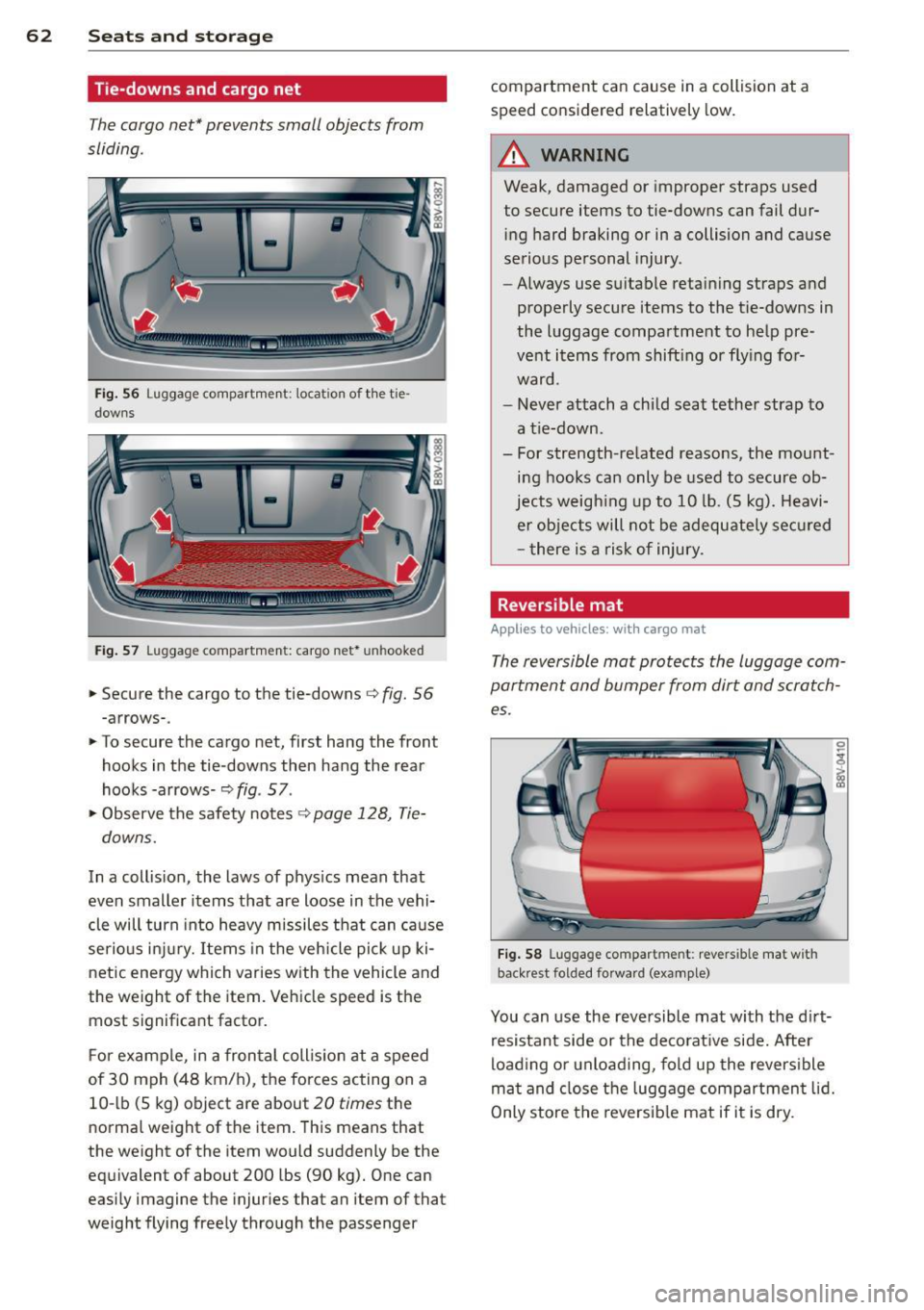
Fi g. 56 Luggage compartment: locatio n of the tie
downs
Fig . 57 Luggage compartment: cargo net* unhooked
.. Secure the cargo to the tie-downs¢ fig. 56
-arrows-.
.. To secure the cargo net, first hang the front
hooks in the tie-downs then hang the rear
hooks -arrows-~
fig. 57 .
"' Observe the safety notes ¢
page 128, Tie
downs.
In a collis ion, the laws of phys ics mean that
even smaller items that are loose in the vehi
cle will turn into heavy missiles that can ca use
serio us inj ury. Items in the vehicle pick up ki
netic energy which varies with the vehicle and
the weight of the item. Vehicle speed is the
most signif icant factor.
F or example, in a fron tal coll is io n at a speed
of 30 mph (48 km/h), the forces acting on a
10 -lb (S kg) object are about
20 times the
normal weight of the item. This means that
the weight of the item would suddenly be the
eq uivalent of about 200 lbs (90 kg). One can
eas ily imagine the injuries that an item of that
weight flying freely through the passenger compartment can cause in a collision at a
speed considered relatively
low.
_&, WARNING
-
Weak, damaged or improper straps used
to secure items to tie-downs can fail dur
i ng hard braking or in a collision and cause
se rious personal injury.
- Always use s uitable retaining straps and
properly secure items to the tie-downs in
the luggage compartment to he lp pre
vent items from shift ing or fly ing for
ward.
- Never attach a chi ld seat tether strap to
a tie-down.
- For strength-related reasons, the mount ing hooks can only be used to secure ob
jects w eigh ing up to 10 lb. (S kg). Heavi
e r objects will not be adequate ly se cu red
- there is a ris k of injury.
Reversible mat
Applies to veh icles: w ith cargo mat
The reversible mat protects the luggage com
partment and bumper from dirt and scratch es.
F ig . 58 Luggage compartment: revers ible mat with
back rest folded forward (examp le)
You can use the reversible mat with the d irt
resistant side or the deco rat ive side. After
load ing or unload ing, fold up the revers ible
m at and close t he luggage compartment lid.
Only store the reversib le mat if it is dry .
Page 130 of 288
128 Driving safety
-Place heavy objects as far forward in
the luggage compartment as possible.
- Never exceed the Gross Axle Weight Rat
ing or the Gross Vehicle Weight Rating
specified on the safety compliance stick
er on the left door jamb. Exceeding per
missible weight standards can cause the
vehicle to slide and handle differently .
- Please observe information on safe driv
ing
~ page 121.
A WARNING
To help prevent poisonous exhaust gas
from being drawn into the vehicle, always
keep the rear lid closed while driving.
- Never transport objects larger than
those fitting completely into the luggage
area because the rear lid cannot be fully
closed.
- If you absolutely must drive with the rear
lid open, observe the following notes to
reduce the risk of poisoning:
- Close all windows,
- Close the power roof",
- Open all air outlets in the instrument
panel,
- Switch off the air recirculation,
- Set the fresh air fan to the highest
speed.
A WARNING
Always make sure that the doors, all win
dows, the power roof* and the rear lid are
securely closed and locked to reduce the
risk of injury when the vehicle is not being
used.
- After closing the rear lid, always make
sure that it is properly closed and locked.
- Never leave your vehicle unattended, es
pecially with the luggage compartment
lid left open. A child could crawl into the
vehicle through the luggage compart
ment and close the rear lid becoming
trapped and unable to get out. Being
trapped in a vehicle can lead to serious
personal injury.
-
'
- Never let children play in or around the
vehicle.
- Never let passengers ride in the luggage
compartment. Vehicle occupants must
always be properly restrained in one of
the vehicle's seating positions .
(D Tips
-Air circulation helps to reduce window
fogging. Stale air escapes to the outside
through vents in the trim panel. Be sure
to keep these slots free and open.
- The tire pressure must correspond to the load. The tire pressure is shown on the
tire pressure label. The tire pressure la
bel is located on the driver's side B-pillar.
The tire pressure label lists the recom
mended cold tire inflation pressures for
the vehicle at its maximum capacity
weight and the tires that were on your
vehicle at the time it was manufactured.
For recommended tire pressures for nor
mal load conditions, please see chapter
~ page 229.
Tie-downs
The luggage compartment is equipped with
four tie-downs to secure luggage and other
items.
Use the tie-downs to secure your cargo prop
erly ~
page 12 7, Loading th e luggage com
par tment.
In a collision, the laws of physics mean that
even smaller items that are loose in the vehi
cle will become heavy missiles that can cause
serious injury. Items in the vehicle possess en
ergy which vary with vehicle speed and the
weight of the item . Vehicle speed is the most
significant factor.
For example, in a frontal collision at a speed
of 30 mph (48 km/h), the forces acting on a 10-lb (4 .S kg) object are about 20 times the
normal weight of the item . This means that
the weight of the item would suddenly be about 200 lbs. (90 kg). You can imagine the
injuries that a 200 lbs. (90 kg) item flying ..,_
Page 134 of 288
13 2 Safet y belt s
-Failure to pay attention to the warning
light that come on, could lead to person
al injury.
Why safety belts?
Frontal collisions and the law of physics
Frontal crashes create very strong forces for
people riding in vehicles.
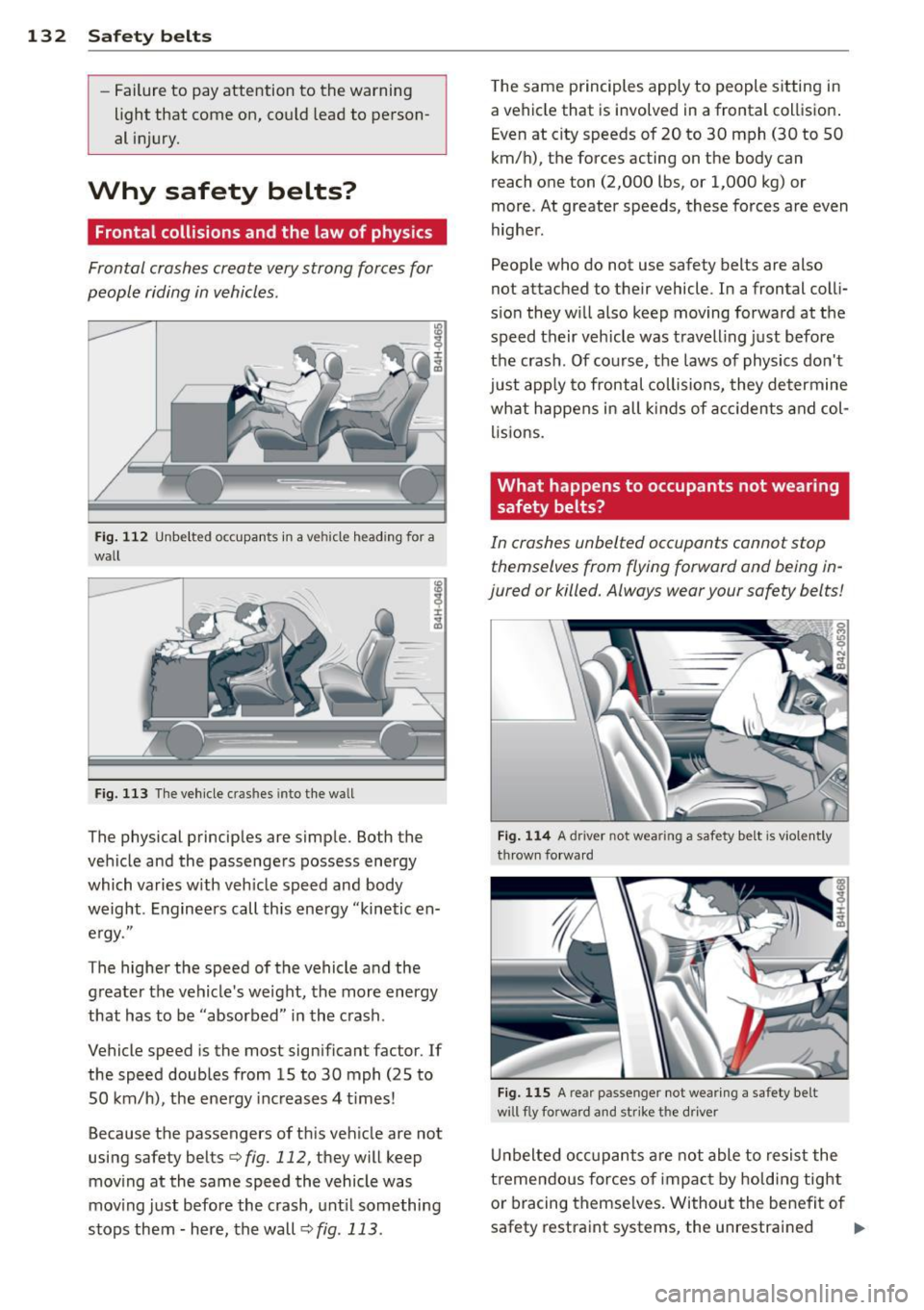
F ig. 11 2 Unbelted occ upants in a ve hicle h eading for a
wall
Fig. 1 13 Th e vehicle c rash es into t he wall
The physical principles are simp le. Both the
vehicle and the passengers possess energy
which varies w ith veh icle speed and body
weight . Engineers call this energy "kinetic en
e rgy ."
T he higher the speed of the vehicle and the
g reater the vehicle's we ight, the more energy
that has to be "absorbed" in the crash .
Vehicle speed is the most sign ificant factor.
If
the speed doubles from 15 to 30 mph (25 to
50 km/h), the energy inc reases 4 t imes!
Because the passengers of this veh icle are not
using safety belts
c::;, fig. 112, they w ill keep
mov ing at the same speed the vehicle was
mov ing just before the c rash, unt il something
stops them - here, the wall ¢
fig. 113 .
The same principles apply to people s itting in
a vehicle that is involved in a frontal collision .
Even at c ity speeds of 20 to 30 mph (30 to 50
km/h), the forces acting on the body can
reach one ton (2,000 lbs , or 1,000 kg) or
more . At greater speeds, these forces are even
highe r.
Peop le who do not use safety belts are also
not attached to their vehicle. In a frontal colli
s io n they will also keep moving forward at the
speed their veh icle was t ravell ing just before
the crash . Of co urse, the laws of physics don't
just app ly to frontal collisions, they determine
wh at happens i n all kinds of acc idents and col
lisions .
What happens to occupants not wearing
safety belts?
In crashes unbelted occupants cannot stop
themselves from flying forward and being in
jured or killed. Always wear your safety belts!
F ig . 11 4 A driver not wea ring a safety b elt is viol en tly
thrown fo rwa rd
F ig . 11 5 A rear passe nge r no t wea ring a safety be lt
w ill fl y forward a nd strike the dr iver
Un belted oc cupants a re not able to resist the
t remendous forces o f impac t by ho lding tight
o r bracing themse lves. Withou t the benefit of
safety restraint systems , the unrestrained
ll-
Page 144 of 288
142 Airbag sys te m
and dia gnostic equipmen t to pro perly re
place any a irbag in y our vehicle and
assure system eff ectiveness in a crash.
- Never permit salvaged or recycle d air
bags to be installed in your veh icle.
Child restraints on the front seat - some
important things to know
~ Be sure to read the important informat ion
and heed the WARNINGS for important de
ta ils about ch ild ren and Advanced Airbags
Qpage 166.
Even though your vehicle is equ ipped with an
Advanced Airbag System, make certain that
all c hildren, especially those 12 years and
younger, a lways ride in the back seat properly
restrained for their age and size . The airbag
on the passenger side makes the front seat a potentially dangerous place for a child to ride.
The front seat is not the safest place for a
child in a forward-facing child seat. It can be a
ve ry dangerous place for an infant or a ch ild in
a rearward-facing seat.
The Advanced Airbag System in your veh icle
has been certified to comply with the require
ments of United States Federal Motor Veh icle
Safety Standard 208 as applicable at the time
your ve hicle was manufactured.
The Standard requires the front a irbag on the
passenger side to be turned off ("sup
p ressed") if a ch ild up to about one year of
age restra ined in one of the rear-facing o r fo r
ward-facing infan t restra ints listed in Federal
M otor Vehicle Safety Standard 208 with w hich
the Advanced A irbag System in your vehicle
was certified has been installed on the front
passenger seat. Fo r a listing of the child re
straints that were used to certify compliance
with the US Safety Standard
Q page 168.
The PASSENGER AIR BAG OFF light in the in
strument panel te lls you when the front Ad
vanced Airbag on the passenger side has been turned off by the e lectronic control unit. E
ach time you switch on the ignition, the
PAS
SENGER AIR BAG O FF
light will come on for a
few seconds and :
- w ill stay on if the front passenge r seat is not
occupied,
- w ill stay on if the e lec trica l ca pa citance
meas ured by the capacitive passenger de
tection system for the front passenger seat equa ls the combined capacitance of an in
fant up to about one year of age and one of
the rearward-facing or forward-fac ing ch ild
restraints listed in Federal Motor Vehicle
Safety Standard 208 with wh ich the Ad
vanced Airbag System in your vehicle was
cert ified . For a listing of the chi ld restraints
tha t were used to certify you r vehi cle's com
p lia nce w it h t he U.S. Safety Standard
Q page 168.
-w ill stay on i f there is a small ch ild or child
restraint on the front passenge r seat,
- will go off if the front passenger seat is oc
cupied by an adult as registered by the ca
pacitive passenger de tection system
c::> page 152, Monitoring the Advanced Air·
bag System.
The PASSENGER AIR BAG OFF light comes on
when e lectrica l capacitance registered on the
front passenger seat is eq ua l to or less tha n
the comb ined capacitance of a typica l 1 year
o ld infant and one of the rearward-facing or
forward-facing chi ld restraints listed in Feder
al Motor Vehicle Safety Standard 208 with
wh ich the Advanced Airbag System in your ve
hicle was certified.
If the total electr ica l capacitance registered
on the front passenger seat is more than that
of a typical 1 year -o ld child but less than the
weight of a small adult , the front airbag on
t h e passenger side can deploy (the
PASSEN
GER AIR BAG OFF
light does not come on).
If the
PASSENGER AIR BAG OFF light does
not come on, the front airbag on the passen
ger side has not been turned off by t he e lec
t ro ni c cont ro l unit and can deploy if the con
t ro l uni t se nses an impact tha t mee ts the con-
di tions stored in its memory .
1J1>
Page 149 of 288
of a typical 1 year-old, but less than the
weight of a small adult, the front airbag on
the passenger s ide may deploy (the
P A SSEN·
GER AIR BA G OFF
light does not come on).
For example, the a irbag may depl oy if:
- a small child that is heavier than a typical 1
year-o ld child is on the front passenger seat
(regardless of whether the child is in one of
the chi ld seats listed
page 168),
-a ch ild who has outgrown child rest raints is
on the front passenger seat.
I f the front passenger airbag is turned off, the
PA SSENGER AIR BAG OFF light in the center
of the inst rument panel w ill come on and stay
on.
If the front passenger airbag deploys, the
Federal Standard requires the a irbag to meet
the " low ris k" deployment criteria to help re
d uce the risk of injury through interaction
with the airbag . "Low risk" deployment occurs
in those crashes that take place at lower de
celerations as defined in the electronic control
un it
r:::> page 152.
Alw ays remember : Even though your vehicle
is equipped with Advanced Airbags, the safest
p lace for children is properly restrained on the
back seat. Please be sure to read the impor
tant information in the sect ions that follow
and be sure to heed all of the WARNINGS .
A WARNING
To reduce the risk of injury when an airbag
inflates, always wear safety belts prope rly.
- If you are unrestrained, lean ing forward,
sitting sideways or out of position in any
way, your risk of injury is much higher.
- You w ill also receive serious injuries and
cou ld even be killed if you are up against
the a irbag or too close to it when it in
fla tes - even with an Advanced Airbag
page 140 .
A WARNING ,~
A child in a rearward -facing child seat in -
stalled on the front passenger seat will be
-
A irbag system 147
seriously injured and can be killed if the
front airbag inflates - even w ith an Ad
vanced A irbag System.
- Altho ugh the Advanced Airbag System in
your veh icle is designed to turn off the
front airbag when a rearward-facing child restraint has been installed on the
front passenge r seat, nobody can abso
lutely guarantee that dep loyment is im
possible in all conceivable s ituations that
may happen dur ing the usefu l life of your
veh icle.
- The infla ting airbag will h it the ch ild seat
or infant carrier with g reat force and will
smash the child seat and child against
the backrest, center armrest, door, or
roof.
- Always install rearward-facing chi ld re
straints on the rear seat.
- If you must install a rearward fac ing
child seat on the front passenger seat because of exceptional circumstances
and the
PASSENGER AIR BAG OFF light
does not come on and stay on, immed i·
ately insta ll the rear-fac ing child seat in a
rea r seat ing pos ition and have the airbag
system inspected by you r Audi dealer .
A WARNING
If, in except iona l circumstances, you must
install a forward-facing child restraint on
the front passenge r's seat:
- Always ma ke sure the forward-facing
seat has been designed and cer tified by
its manufacture r for use on a front se at
with a passenger fron t and s ide a irbag .
- Never put the fo rward-facing child re
straint up against or ve ry near the instru
ment panel.
- Always move the passenge r seat into its
rea rmost pos ition in the seat's fore and
aft ad justment range, as fa r away from
the airbag as possible, before installing
the forward-fac ing chi ld restraint. The
backrest must be adjusted to an upright
position .
...
•
•
•
Page 156 of 288
154 Airbag sys te m
- and i f th e e lec trica l capacitance registered
on the front passenger seat is equal to or
l ess than t he combined capacitance of a ty p
ical 1 year-old infant and one of the rear
ward-facing o r forward-facing child re
stra ints listed in Federal Motor Ve hicle Safe
ty Standard 208 w ith whic h the Adva nce d
Airbag System in your vehicle was ce rtified .
If the front passenger seat is not occupied,
the front airbag will not deploy, and the
PAS
SENGER AIR BAG OFF
li ght w ill stay on . Nev
e r i nsta ll a rearwa rd-fac ing ch ild restra int on
the front passenger seat, the safest place fo r
a child in any kind of child restraint is at o ne
of the seat ing positions on the rear seat
¢ page 142, Child restraints on the front seat
- some important things to know
and
¢ page 166, Child Safety .
If the PASSENGER AIR BAG light comes
on ...
If the PASSENGER AIR BAG OFF light comes
on when one of the cond itions listed above is
met , be sure to check the light regularly to
make certa in that the
PASSENGER AIR BAG
OFF
light stays on cont inuous ly whenever the
ignit io n is on . If t he
PASSENGER AIR BAG
OFF
l ight does not appear on and does not
stay o n all the time, s top as soon as it is safe
to do so a nd
- react ivate the system by turning the ignition
off for more than 4 seconds and then tu rn
i ng it on agai n;
- remove and re install the chi ld restraint.
Make su re that the child res traint is properly
insta lled and that the safety be lt fo r the
fron t passenger seat has been correct ly
ro uted throug h the child restrain t as descri
bed in t he chi ld restraint man ufact urer 's in
structions;
- make sure that the convertible locking fea
ture on the safety be lt fo r the front passen
ger seat has been activated and that the
safety belt has been pulled tight.
- ma ke sure that no e lectrica l device (such as
a laptop, CD playe r, electronic games device,
power inverter or seat heater for child seats)
is p laced or used on the front passenger seat
if the dev ice is connected to the 12-volt
socket or the cigarette lighter soc ket;
- ma ke s ure that no seat heater has been ret
rofitted or otherwise added to the front pas
senger seat;
- ma ke s ure that no thing can interfere with
the safety belt buck les an d that they are not
obstructed ;
- make sure that there are no wet objects (such as a wet towe l) and no water or other
liquids on the front passenger seat cushion.
If the PASSENGER AIR BAG light still
does not c ome on ...
If the PASSENGER AIR BAG OFF light still
does not come on and does not stay on con
t in uous ly (when the ignition is switched on),
- t ake the child restraint off the front passen -
ge r seat and install it proper ly at o ne of the
rear seat positions. Have the airbag system
inspected by yo ur Audi dealer immed iately.
- move the child to a rear seat position and
make sure t hat the c hil d is properly restra in
ed in a c hild restra int that is appropriate for
its size and age .
The PASSENGER AIR BAG light should
NOT come on . ..
The PASSENGER AIR BAG OFF light should
NOT come on when the ignit ion is on and an
adult is s itting in a proper seating position on
the front passenger seat. If t he
PASSENGER
AIR BAG OFF
light comes o n and s tays on o r
flashes fo r about S seconds w hile d riving, un
der these circumstances, make sure tha t:
- t he adult on the front passenge r sea t is
prope rly seated on the cente r of the seat
cushion wi th his o r her back up aga inst the
backrest and the backrest is no t re cli ned,
- t he adult is not tak ing we ight o ff the sea t by
holding on to the passenger assis t handle
above the front passenger door or s upport
ing their weight on the armrest ,
- t he sa fe ty belt is be ing properly wo rn and
t ha t the re is not a lot o f slack in the safety
be lt webbing,
- t here are no aftermar ket sea t covers or
cushions or other things (such as blankets) .,..
Page 164 of 288
162 Airbag system
-Always sit in an upright position and
never lean against the area where the
supplemental side airbag is located.
- Never let a child or anyone else rest
their head against the side trim panel
in the area where the supplemental
side airbag inflates.
- Always make sure that safety belts are
worn correctly,
- Do not let anyone sitting in the front
seat put their hand or any other parts
of their body out of the window.
- Always make sure that the side airbag
can inflate without interference.
- Never install seat covers or replace
ment upholstery over the front seat
backs that have not been specifically
approved by Audi.
- Never use additional seat cushions that
cover the areas where the side airbags
deploy.
- Damage to the original seat covers or
to the seam in the area of the side air
bag module must always be repaired
immediately by an authorized Audi
dealer.
- Objects between you and the airbag can
increase the risk of injury in an accident
by interfering with the way the airbag
unfolds or by being pushed into you as
the airbag inflates .
- Never place or attach accessories or
other objects (such as cup holders, tel
ephone brackets, or even large, bulky
objects) on the doors, over or near the
area marked "AIRBAG" on the seat backrests.
- Such objects and accessories can be
come dangerous projectiles and cause
injury when the supplemental side air
bag deploys.
- Never carry any objects or pets in the
deployment space between them and
the airbags or allow children or other passengers to travel in this position.
- Always use the built-in coat hooks only
for lightweight clothing . Never leave any
heavy or sharp-edged objects in the pockets that may interfere with side air
bag deployment and can cause personal
injury in an accident.
- Always prevent the side airbags from be
ing damaged by heavy objects knocking
against or hitting the sides of the seat
backs.
- The airbag system can only be triggered
once . If the airbag has been triggered,
the system must be replaced by an au
thorized Audi dealership.
- Damage (cracks, deep scratches etc .) to
the original seat covers or to the seam in
the area of the side airbag module must
always be repaired immediately by an au
thorized Audi dealer.
- If children are seated improperly, their
risk of injury increases in the case of an
accident
¢ page 166, Child Safety.
-Never attempt to modify any compo
nents of the airbag system in any way.
- In a side collision, side airbags will not
function properly if sensors cannot cor
rectly measure increasing air pressure in
side the doors when air escapes through
larger, unclosed openings in the door
panel.
- Never drive with interior door trim pan
els removed .
- Never drive when parts have been re moved from the inside door panel and
the openings they leave have not been properly closed.
- Never drive when loudspeakers in the
doors have been removed unless the
speaker holes have been properly
closed.
- Always make certain that openings are
covered or filled if additional speakers
or other equipment is installed in the
inside door panels.
- Always have work on the doors done by
an authorized Audi dealer or qualified
workshop.