cooling AUDI A3 2016 Owner´s Manual
[x] Cancel search | Manufacturer: AUDI, Model Year: 2016, Model line: A3, Model: AUDI A3 2016Pages: 328, PDF Size: 81.78 MB
Page 129 of 328
,....,
N
0 > co ,....,
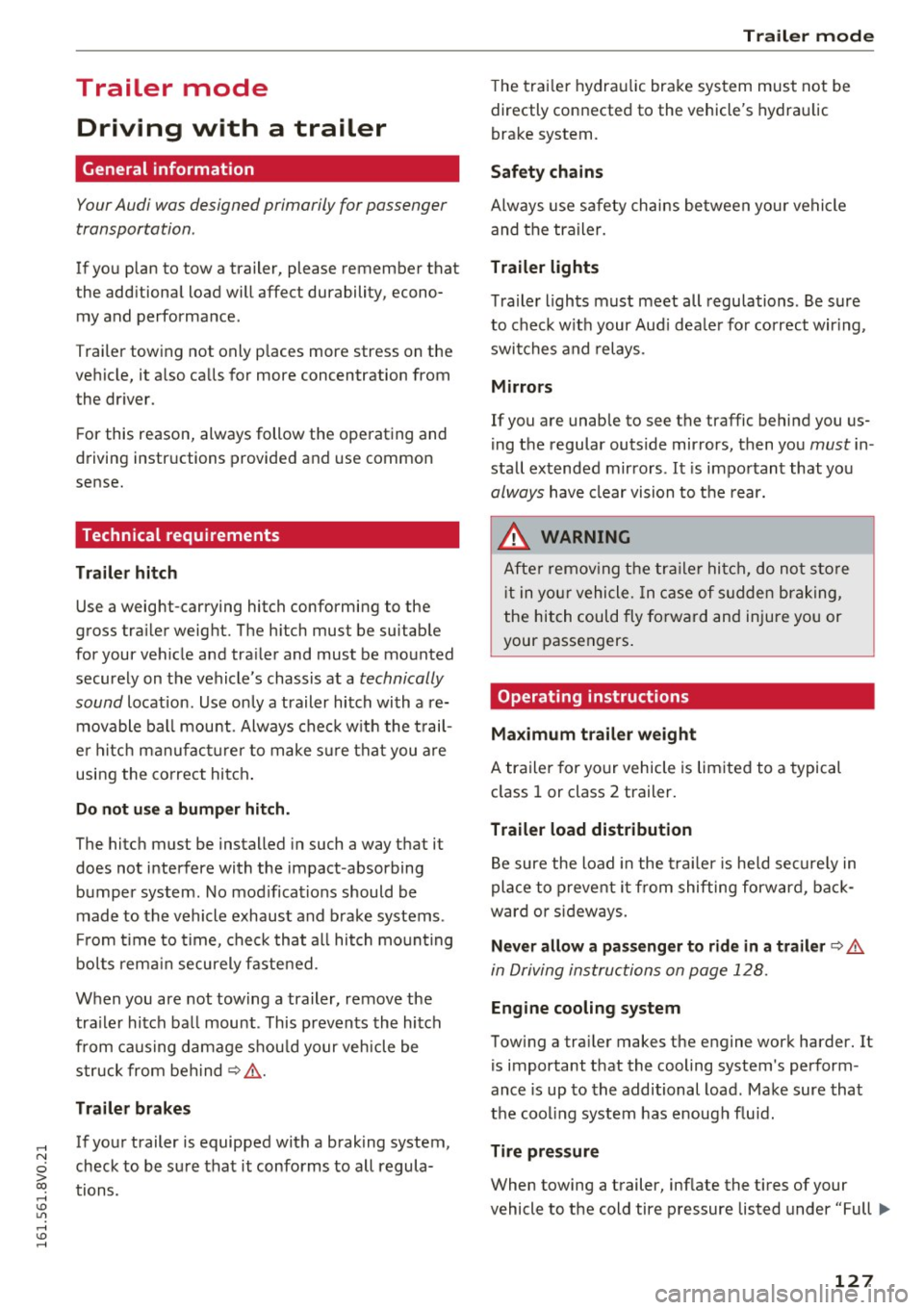
General information
Your Audi was designed primarily for passenger
transportation .
If you plan to tow a trailer, please remember that
the additional load will affect durability, econo
my and performance.
T railer towing not only places more stress on the
vehicle, it also calls for more concentration from
the driver.
For this reason, always follow the operating and
driving instructions provided and use common
sense.
Technical requirements
Trailer hitch
Use a weight-carrying hitch conforming to the
gross trailer weight. The hitch must be suitable
for your vehicle and trailer and must be mounted
securely on the vehicle's chassis at a technically
sound
location . Use only a trailer hitch with a re
movable ball mount . Always check with the trail
er hitch manufacturer to make sure that you are
using the correct hitch.
Do not use a bumper hitch.
The hitch must be installed in such a way that it
does not interfere with the impact -absorbing
bumper system . No modifications should be
made to the vehicle exhaust and brake systems .
From time to time, check that all hitch mounting
bo lts remain securely fastened.
When you are not towing a trailer,
remove the
tra iler hitch ball mount . This prevents the hitch
from causing damage should your vehicle be
struck from beh ind
~ ,&. .
Trailer brakes
If your trailer is equipped with a braking system,
check to be sure that it conforms to all regula
tions .
Trailer mode
The trailer hydraulic brake system must not be
directly connected to the vehicle's hydraulic
brake system.
Safety chains
Always use safety chains between your vehicle
and the trailer.
Trailer lights
T ra iler lights must meet all regulations . Be sure
to check with your Aud i dea ler for correct wiring,
switches and relays .
Mirrors
If you are unable to see the traffic behind you us
ing the regular outside mirrors, then you
must in
stall extended mirrors . It is important that you
always have clear vision to the rear.
,8. WARNING
After removing the trailer hitch, do not store
it in your vehicle. In case of sudden braking,
the hitch could fly forward and injure you or
your passengers.
Operating instructions
Maximum trailer weight
A trailer for your vehicle is limited to a typical
class 1 or class 2 trailer.
Trailer load distribution Be sure the load in the trailer is held securely in
place to prevent it from shifting forward, back
ward or sideways.
Never allow a passenger to ride in a trailer~.&.
in Driving instructions on page 128.
Engine cooling system
Towing a trailer makes the engine work harder. It
is important that the cooling system's perform
ance is up to the additional load. Make sure that
the cooling system has enough fluid.
Tire pressure
When towing a trailer, inflate the tires of your
vehicle to the cold tire pressure listed under "Full ..,.
127
Page 238 of 328
Checking and Filling
CJ) Note
-Only use Ad Blue that conforms to the
standard ISO 22241-1. Do not mix any addi
tives with the AdBlue and do not dilute it
with water.
- Only use refill bottles that are approved for your vehicle. Using other systems can cause Ad Blue to leak.
- Do not add Ad Blue to the diesel tank or add diesel fuel to the Ad Blue tank. Do not start
the engine under any circumstances if the
wrong fuel is filled in the tank . There is a
risk of damaging the fuel tank system and
the engine . See an authorized Audi dealer or
authorized Audi Service Facility for assis
tance.
- AdBlue attacks surfaces such as painted ve
hicle components, plastic and carpet. Re
move the fluid as quickly as possible with a
damp cloth and plenty of cold water. If the
Ad Blue has already crystallized, use warm
water and a sponge. AdBlue residue that is
not removed will crystallize and can damage
the affected surface .
- Do not store the refill bottle in the vehicle.
If it leaks, the escaping Ad Blue could dam
age the vehicle interior .
- Do not allow Ad Blue to come into contact
with clothing. If there is contact with the
fluid, flush immediately with plenty of wa
ter .
(D Tips
-You can obtain refill bottles from an author
ized Audi dealer or authorized Audi Service
Facility .
- Follow the Ad Blue manufacturer's instruc
tions for use and storage .
- A permitted refill bottle contains approxi
mately 1.9 liters of AdBlue .
- Ad Blue can freeze at very low temperatures.
If this happens, the system will not detect
that the Ad Blue was refilled and it will con
tinue to inform you of the low AdBlue level.
The message turns off as soon as the tank
thaws out again.
236
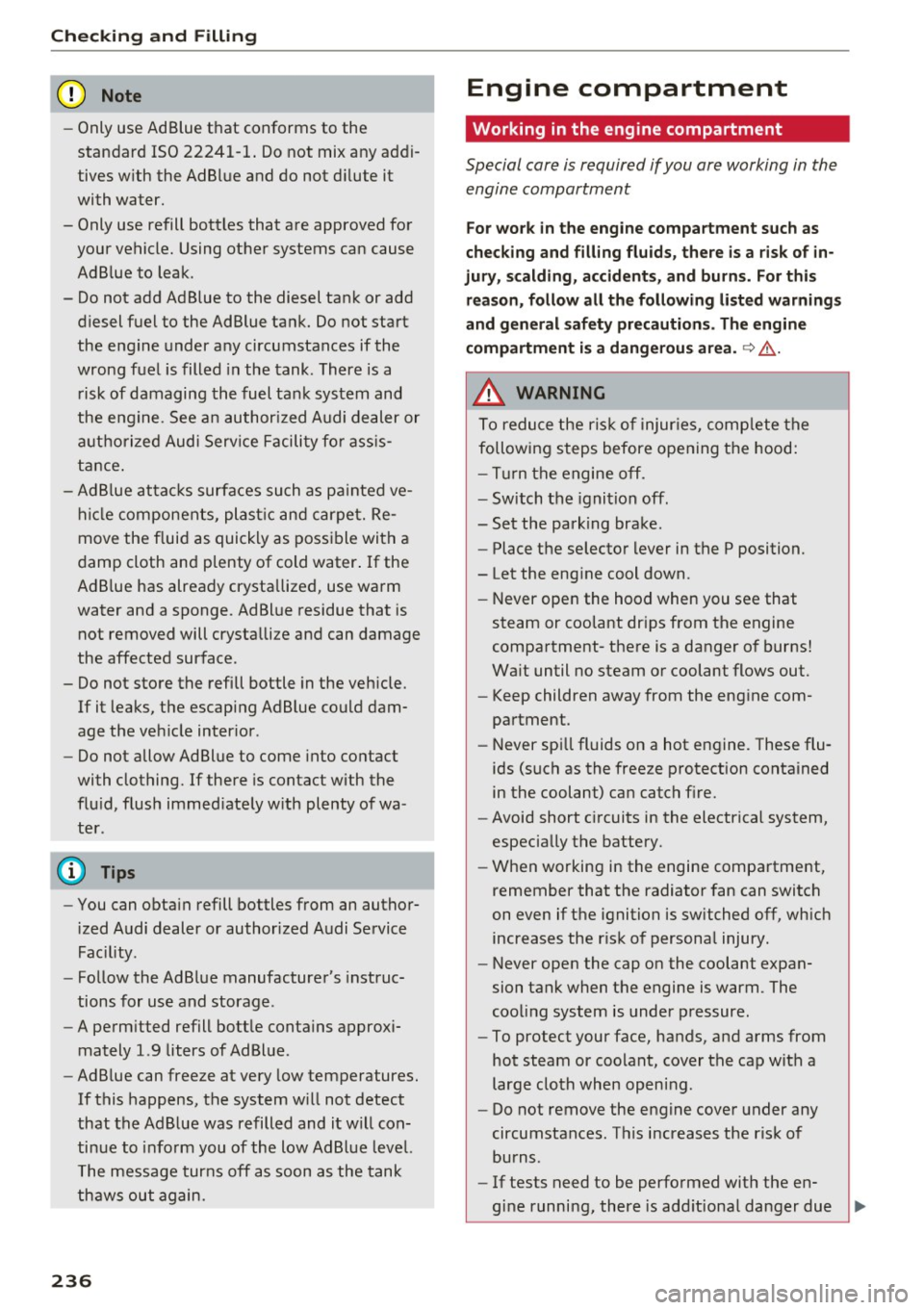
Engine compartment
Working in the engine compartment
Special care is required if you are working in the
engine compartment
For work in the engine compartment such as
checking and filling fluids, there is a risk of in
jury, scalding, accidents, and burns. For this
reason, follow all the following listed warnings
and general safety precautions. The engine
compartment is a dangerous area.
¢ .&. .
.8, WARNING
To reduce the risk of injuries, complete the
following steps before opening the hood:
- Turn the engine off.
- Switch the ignition off.
- Set the parking brake.
- Place the selector lever in the P position.
- Let the engine cool down.
- Never open the hood when you see that
steam or coolant drips from the engine
compartment- there is a danger of burns!
Wait until no steam or coolant flows out.
- Keep children away from the engine com
partment.
- Never spill fluids on a hot engine. These flu
ids (such as the freeze protection contained in the coolant) can catch fire.
- Avoid short circuits in the electrical system,
especially the battery.
- When working in the engine compartment,
remember that the radiator fan can switch
on even if the ignition is switched off, which
increases the risk of personal injury.
- Never open the cap on the coolant expan
sion tank when the engine is warm . The
cooling system is under pressure.
- To protect your face, hands, and arms from
hot steam or coolant, cover the cap with a
large cloth when opening.
- Do not remove the engine cover under any
circumstances . This increases the risk of
burns.
- If tests need to be performed with the en-
-
gine running, there is additional danger due ~
Page 246 of 328
Checking and Filling
-To reduce the risk of burns from hot engine
oil, let the engine cool down to the touch.
- When removing the oil drain plug with your
fingers, stay as far away as possible. Always
keep your forearm parallel to the ground to
help prevent hot oil from running down your
arm.
- Drain the oil into a container designed for
this purpose, one large enough to hold at least the total amount of oil in your engine .
- Engine oil is poisonous. Keep it well out of
the reach of children .
- Continuous contact with used engine oil is
harmful to your skin. Always protect your
skin by washing oil off thoroughly with soap
and water .
CD Note
Never mix oil additives with your engine oil.
These additives can damage your engine and
adversely affect your Audi Limited New Vehi
cle Warranty.
@ For the sake of the environment
-Before changing your oil, first make sure
you know where you can properly dispose of
the used oil.
- Always dispose of used engine oil properly.
Do not dump it on garden soil, wooded
areas, into open streams or down sewage
drains.
- Recycle used engine oil by taking it to a used
engine oil collection facility in your area, or
contact a service station.
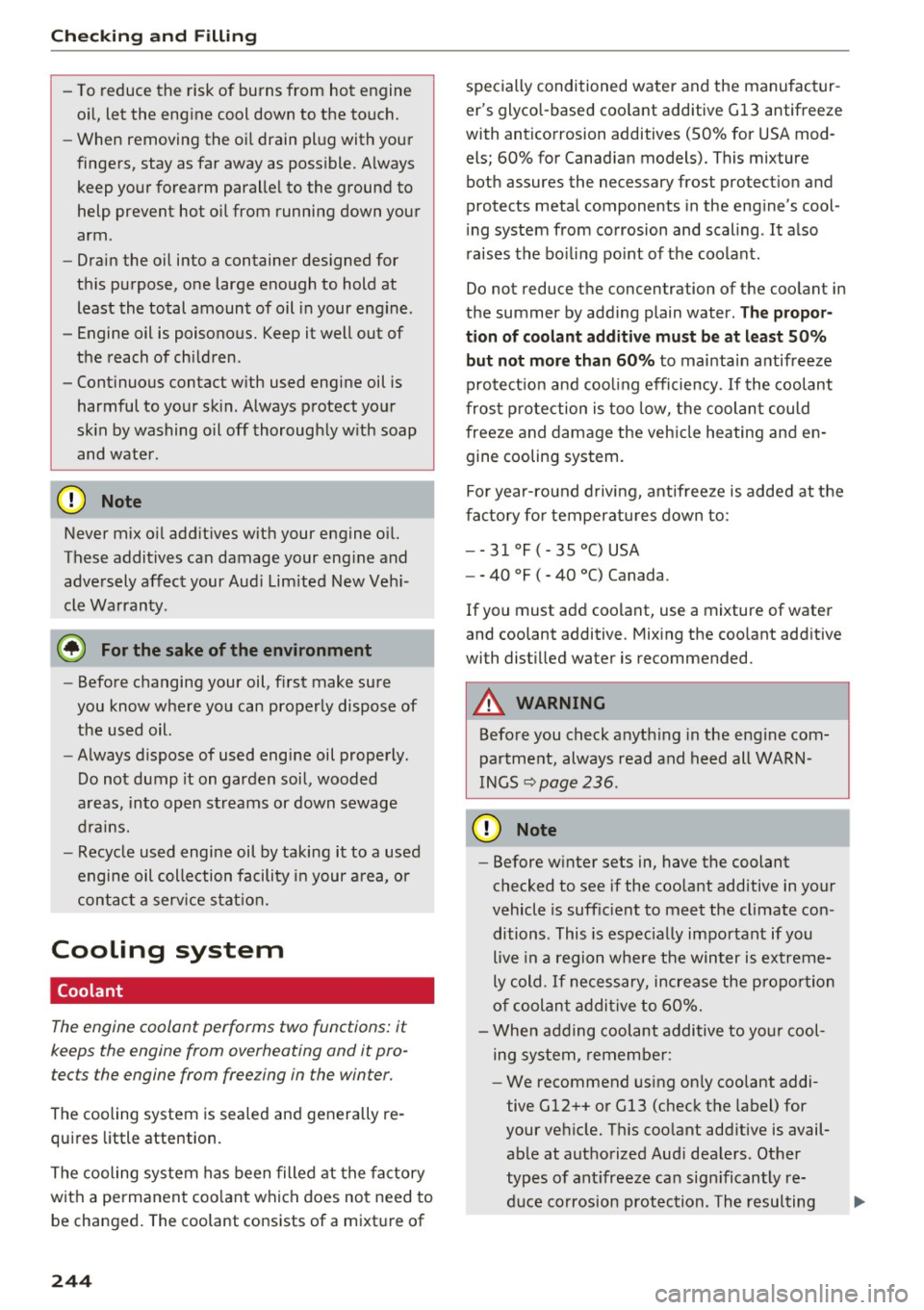
Cooling system
Coolant
The engine coolant performs two functions: it
keeps the engine from overheating and it pro tects the engine from freezing in the winter.
The cooling system is sealed and generally re
quires little attention.
The cooling system has been filled at the factory
with a permanent coolant which does not need to
be changed. The coolant consists of a mixture of
244
specially conditioned water and the manufactur
er's glycol-based coolant additive Gl3 antifreeze
with anticorrosion additives (50% for USA mod els; 60% for Canadian models). This mixture
both assures the necessary frost protection and
protects metal components in the engine's cool
ing system from corrosion and scaling. It also
raises the boiling point of the coolant.
Do not reduce the concentration of the coolant in
the summer by adding plain water.
The propor
tion of coolant additive must be at least 50%
but not more than 60%
to maintain antifreeze
protection and cooling efficiency. If the coolant
frost protection is too low, the coolant could
freeze and damage the vehicle heating and en
gine cooling system.
For year-round driving, antifreeze is added at the
factory for temperatures down to:
--31°F(-35°C)USA
- - 40 °F ( - 40 °C) Canada.
If you must add coolant, use a mixture of water
and coolant additive. Mixing the coolant additive
with distilled water is recommended.
A WARNING
Before you check anything in the engine com
partment, always read and heed all WARN
INGS
~ page 236.
CD Note
- Before winter sets in, have the coolant
checked to see if the coolant additive in your
vehicle is sufficient to meet the climate con ditions. This is especially important if you
live in a region where the winter is extreme
ly cold.
If necessary, increase the proportion
of coolant additive to 60%.
- When adding coolant additive to your cool
ing system, remember:
- We recommend using only coolant addi
tive Gl2++ or G13 (check the label) for
your vehicle. This coolant additive is avail
able at authorized Audi dealers. Other
types of antifreeze can significantly re
duce corrosion protection. The resulting
Page 247 of 328

.... N
0 > CX)
.... I.Cl U"I
.... I.Cl ....
corrosion can cause a loss of coolant and
serious engine damage .
- Do not add any type of radiator leak sealant
to your vehicle's engine coolant . Adding ra
diator repair fluid may adversely affect the
function and performance of your cooling
system and could result in damage not cov
ered by your New Vehicle Limited Warranty.
Adding coolant
F ig . 198 Engine compa rtment: mark in gs on t he coo lant
expa nsion tank
Read and follow the WARNINGS before check
ing anything in the engine compartment
¢ page 236, Working in the engine compart
ment.
Checking the engine coolant level
• Park your vehicle on a level surface .
• Switch the ignition off .
• Read the coolant level on the coolant expansion
tank
¢ fig. 198 . The coolant level must be be
tween the markings when the engine in cold .
When the engine is warm it can be slightly above the upper marking.
Adding coolant
Plug-in hybrid drive*: your vehicle has two cool
ant expansion tanks that are separate from each
other. The smaller of the two expansion tanks
must not be opened
¢ page 108. Read and fol
low the important safety precautions ¢
A in
Coolant on page 109.
Requirement: there must be a residual amount of
coolant in the expansion tank ¢(D .
• Let the engine cool down .
Checking and Filling
• Place a cloth over the coolant expansion tank
cap and unscrew the cap counterclockwise
¢ A .
• Add coolant mixed in the correct ratio
¢
page 244 up to the upper marking.
• Make sure that the fluid level remains stable.
Add more coolant if necessary.
• Close the cap securely .
A coolant loss suggests a leak. Immediately drive
your vehicle to an authorized Audi dealer or au
thorized Audi Service Facility and have the cool
i ng system inspected. If the cooling system is not
leak ing, a loss can come from the coolant boiling
through overheat ing and being pushed out of the
cooling system .
,&_ WARNING
-= -The cooling system is pressurized and can be
come very hot. To reduce the risk of burns
from hot coolant:
- Do not open the coolant expansion tank cap
with the engine hot. There is a risk of burns.
- Stop the engine and allow it to cool.
- Protect your face, hands and arms from es-
caping coolant and steam by covering the
coo lant tank cap with a large, thick cloth.
- Turn the coolant tank cap counterclockwise
slowly and keep light pressure on the cap.
- To reduce the risk of burns, do not allow any
antifreeze or coolant to drip onto the ex
haust system or hot engine components.
The ethylene glycol in engine coo lant can
catch fire under certain circumstances .
- The coolant additive and the coolant can be
dangerous to your health . For th is reason,
keep the coolant in the original container
away from children. There is a risk of poi
soning .
- When working in the engine compartment,
remember that the radiator fan can switch
on even if the ignition is switched off, wh ich
increases the risk of persona l injury.
(J) Note
Do not add coolant if the expansion tank is
empty . Air could enter the cooling system and
damage the eng ine.
If this is the case, do not ..,_
245
Page 295 of 328
.... N
0 > CX)
rl I.Cl U"I
rl I.Cl ....
No. Equipment
F43 Headlights, lighting
F44 all whee l drive
F47 Rear window wiper
F48 Outer noise amplifier
(Plug-in hybrid
drive*)
Starter, clutch sensor, headlight relay coil,
F49 high-voltage battery (Plug-in hybr id
drive*)
F53 Rear window
defogger
The power seats* are protected via
circuit break
ers
that automatically switch on after a few sec
onds after the overload has been reduced.
(D Tips
Note that the following table was accurate at
the time of printing and is subject to change.
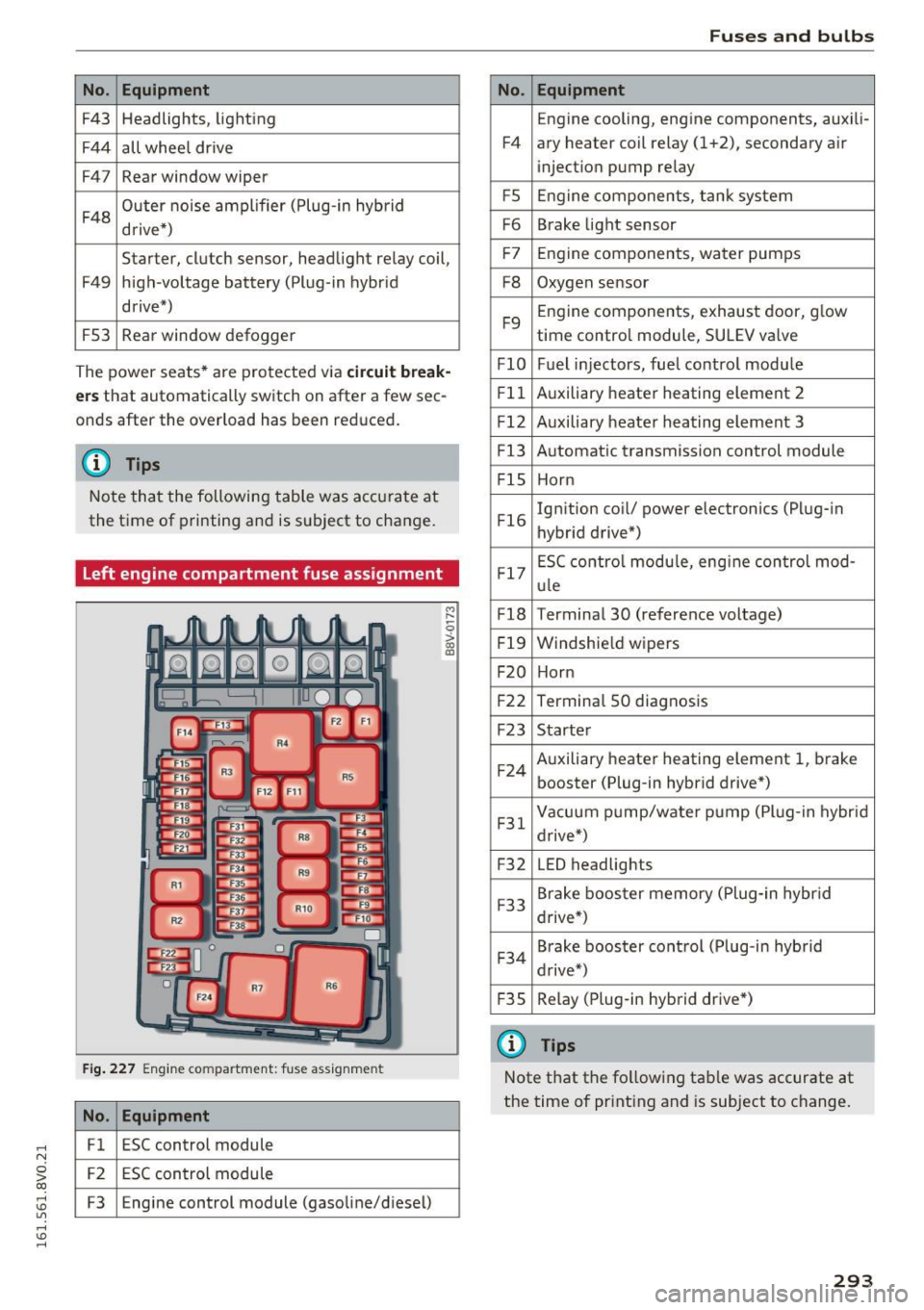
Left engine compartment fuse assignment
Fig. 227 Engine compartment: fuse assignment
No. Equipment
Fl ESC control module
F2 ESC control module
F3 Engine control module (gasoline/d iesel)
M ,-..
0
> co ID
Fuses and bulbs
No. Equipment
Engine cooling, engine components, auxili-
F4 ary heater coil relay (1+2), secondary a ir
injection pump relay
FS Engine components, tank system
F6 Brake light sensor
F7 Engine components,
water pumps
F8 Oxygen sensor
F9 Engine
components, exhaust door, glow
time control module, SULEV va lve
FlO Fuel injectors, fuel control modu le
Fll Auxiliary heater heating element 2
F l2 Auxiliary heater heating element 3
Fl3 Automatic transmission control module
FlS Horn
Fl6 Ignition coil/
power electronics (Plug-in
hybrid drive*)
Fl7 ESC control
module, eng ine control mod -
ule
Fl8 Terminal 30 (reference voltage)
F l9 Windshield wipers
F20 Horn
F22 Termina l 50 diagnosis
F23 Starter
F 24 Auxiliary heater heating element 1,
brake
booster (Plug-in hybrid drive*)
F31 Vacuum
pump/water pump (Plug-in hybrid
drive*)
F32 LED
headlights
F33 Brake booster
memory (Plug-in hybrid
drive*)
F 34 Brake
booster control (Plug -in hybrid
drive*)
F 35 Relay (Plug-in hybrid drive*)
@ Tips
Note
that the fo llowing tab le was accurate at
the time of printing and is subject to change.
293
Page 315 of 328
,....,
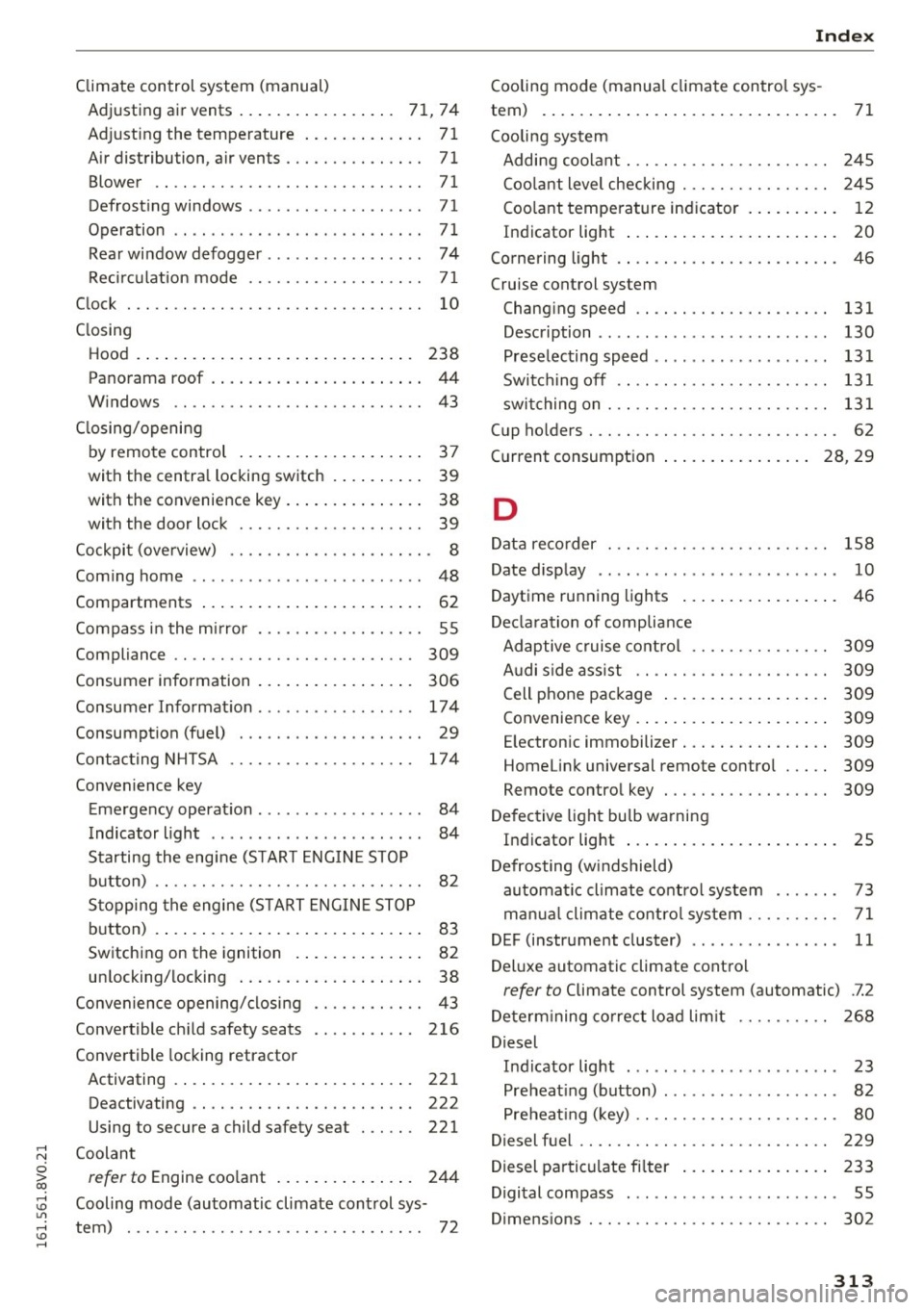
N
0 > co ,....,
Ad justing the temperature . . . . . . . . . . . . . 71
Air distribution, air vents....... ........ 71
Blower . . . . . . . . . . . . . . . . . . . . . . . . . . . . . 71
Defrosting windows . . . . . . . . . . . . . . . . . . . 71
Operation . . . . . . . . . . . . . . . . . . . . . . . . . . . 71
Rear window defogger ............... .. 74
Recirculation mode . . . . . . . . . . . . . . . . . . . 71
Clock . . . . . . . . . . . . . . . . . . . . . . . . . . . . . . . . 10
C losing
Hood . ... .. .................. ..... . 238
Panorama roof . . . . . . . . . . . . . . . . . . . . . . . 44
Windows .. .. ............... .. .. .. .. 43
C losing/opening
by remote control . . . . . . . . . . . . . . . . . . . . 3 7
with the central locking sw itch . . . . . . . . . . 39
with the convenience key. . . . . . . . . . . . . . . 38
with the door lock . . . . . . . . . . . . . . . . . . . . 39
Cockpit (overview) . . . . . . . . . . . . . . . . . . . . . . 8
Coming home . . . . . . . . . . . . . . . . . . . . . . . . . 48
Compartments . . . . . . . . . . . . . . . . . . . . . . . . 62
Compass in the mirror . . . . . . . . . . . . . . . . . . 55
Compliance . . . . . . . . . . . . . . . . . . . . . . . . . . 309
Consumer information . . . . . . . . . . . . . . . . . 306
Consumer Informat ion . . . . . . . . . . . . . . . . . 17 4
Consumption (fuel) . . . . . . . . . . . . . . . . . . . . 29
Contacting NHT5A . . . . . . . . . . . . . . . . . . . . 174
Convenience key Emergency operation . . . . . . . . . . . . . . . . . . 84
Indicator light . . . . . . . . . . . . . . . . . . . . . . . 84
Starting the engine (STAR T ENGINE STOP
button) . . . . . . . . . . . . . . . . . . . . . . . . . . . . . 82
Stopping the engine (S TART ENGINE STOP
button) . . . . . . . . . . . . . . . . . . . . . . . . . . . . . 83
Switching on the ignition . . . . . . . . . . . . . . 82
unlocking/locking . . . . . . . . . . . . . . . . . . . . 38
Conven ience opening/closing . . . . . . . . . . . . 43
Convertible child safety seats . . . . . . . . . . . 216
Convertible locking retractor
Activating . . . . . . . . . . . . . . . . . . . . . . . . . . 221
Deactivating . . . . . . . . . . . . . . . . . . . . . . . . 222
Using to secure a child safety seat . . . . . . 221
Coolant
refer to Engine coolant . . . . . . . . . . . . . . . 244
Cooling mode (automatic climate control sys-
tem) . . . . . . . . . . . . . . . . . . . . . . . . . . . . . . . . 72
Index
Cooling mode (manual climate control sys-
tem) . . . . . . . . . . . . . . . . . . . . . . . . . . . . . . . . 71
Cooling system Adding coolant . . . . . . . . . . . . . . . . . . . . . . 245
Coo lant level checking . . . . . . . . . . . . . . . . 245
Coolant temperature indicator . . . . . . . . . . 12
Indicator light . . . . . . . . . . . . . . . . . . . . . . . 20
Cornering light . . . . . . . . . . . . . . . . . . . . . . . . 46
Cruise control system Changing speed . . . . . . . . . . . . . . . . . . . . . 131
Description . . . . . . . . . . . . . . . . . . . . . . . . . 130
Preselecting speed . . . . . . . . . . . . . . . . . . . 131
Switching off . . . . . . . . . . . . . . . . . . . . . . . 131
swit ching on . . . . . . . . . . . . . . . . . . . . . . . . 131
Cup holders . . . . . . . . . . . . . . . . . . . . . . . . . . . 62
Current consumption . . . . . . . . . . . . . . . . 28 , 29
D
Data recorder . . . . . . . . . . . . . . . . . . . . . . . . 158
Date display . . . . . . . . . . . . . . . . . . . . . . . . . . 10
Daytime running lights . . . . . . . . . . . . . . . . . 46
Declaration of compliance Adaptive cruise control . . . . . . . . . . . . . . . 309
Audi s ide ass ist . . . . . . . . . . . . . . . . . . . . . 309
Cell phone package . . . . . . . . . . . . . . . . . . 309
Convenience key . . . . . . . . . . . . . . . . . . . . . 309
Electronic immobilizer. . . . . . . . . . . . . . . . 309
Homelink universal remote contro l . . . . . 309
Remote control key . . . . . . . . . . . . . . . . . . 309
Defective light bulb warning
Indicator light . . . . . . . . . . . . . . . . . . . . . . . 25
Defrosting (w indshield)
automatic climate control system . . . . . . . 73
manual climate control system....... .. . 71
DEF (instrument cluster) . . . . . . . . . . . . . . . .
11
Deluxe automatic climate control
refer to Climate control system (automatic) .7.2
Determining correct load limit . . . . . . . . . . 268
Diesel Indicator light . . . . . . . . . . . . . . . . . . . . . . . 23
Preheating (button) . . . . . . . . . . . . . . . . . . . 82
Preheat ing (key) . . . . . . . . . . . . . . . . . . . . . . 80
Diesel fuel . . . . . . . . . . . . . . . . . . . . . . . . . . . 229
Diesel particulate fi lter . . . . . . . . . . . . . . . . 233
Digital compass . . . . . . . . . . . . . . . . . . . . . . . 55
Dimensions . . . . . . . . . . . . . . . . . . . . . . . . . . 302
313
Page 325 of 328
,....,
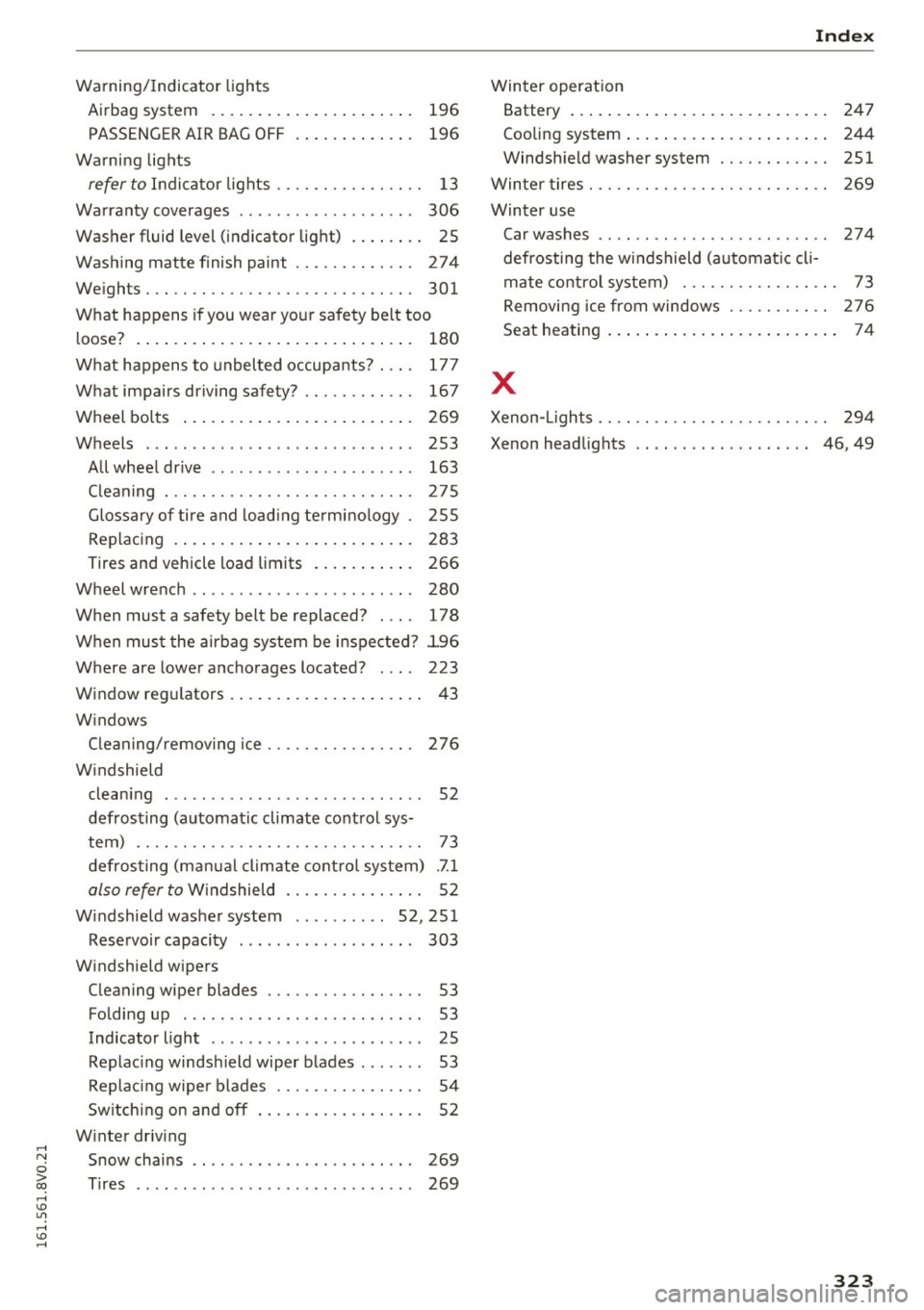
N
0 > co ,....,
Airbag system . . . . . . . . . . . . . . . . . . . . . .
196
PASSENGER AIR BAG OFF . . . . . . . . . . . . . 196
Warning lights
refer to Indicator lights . . . . . . . . . . . . . . . . 13
Warranty coverages . . . . . . . . . . . . . . . . . . . 306
Washer fluid level (indicator light) . . . . . . . . 25
Wash ing matte finish paint . . . . . . . . . . . . . 274
Weights. . . . . . . . . . . . . . . . . . . . . . . . . . . . . 301
What happens if you wear your safety belt too
loose? . . . . . . . . . . . . . . . . . . . . . . . . . . . . . .
180
What happens to unbelted occupants? . . . . 177
What impairs driving safe ty? . . . . . . . . . . . . 167
Wheel bolts . . . . . . . . . . . . . . . . . . . . . . . . . 269
Wheels ... .. .. .... .... ..... ... ... .. . 253
A ll wheel drive . . . . . . . . . . . . . . . . . . . . . . 163
C leaning . .. .. ............. .. .. .. .. . 275
Glossary of tire and loading terminology . 255
Replacing . . . . . . . . . . . . . . . . . . . . . . . . . . 283
Tires and vehicle load limits . . . . . . . . . . . 266
Wheel wrench . . . . . . . . . . . . . . . . . . . . . . . . 280
When must a safety belt be replaced? . . . . 178
When must the airbag system be inspected? l96
Where are lower anchorages located? . . . . 223
Window regu lators . . . . . . . . . . . . . . . . . . . . . 43
W indows
Cleaning/remov ing ice ......... .. .... .
276
Windshield
cleaning . . . . . . . . . . . . . . . . . . . . . . . . . . . .
52
defrosting (automatic climate control sys-
tem) . . . . . . . . . . . . . . . . . . . . . . . . . . . . . . .
73
defrosting (manual climate control system) .7.1
also refer to Windshield . . . . . . . . . . . . . . . 52
Windshield washer system .......... 52, 251
Reservoir capacity . . . . . . . . . . . . . . . . . . . 303
Windshield wipers
Cleaning wiper blades . . . . . . . . . . . . . . . . .
53
Folding up . . . . . . . . . . . . . . . . . . . . . . . . . . 53
Indicator light . . . . . . . . . . . . . . . . . . . . . . . 25
Replacing windshield wiper blades . . . . . . . 53
Replac ing wiper blades . . . . . . . . . . . . . . . . 54
Sw itch ing on and off . . . . . . . . . . . . . . . . . . 52
Winter driving
Snow chains . . . . . . . . . . . . . . . . . . . . . . . .
269
Tires . . . . . . . . . . . . . . . . . . . . . . . . . . . . . . 269
Index
Winter operation
Battery . . . . . . . . . . . . . . . . . . . . . . . . . . . .
247
Cooling system . . . . . . . . . . . . . . . . . . . . . . 244
Windshield washer system . . . . . . . . . . . . 251
Winter tires . . . . . . . . . . . . . . . . . . . . . . . . . . 269
Winter use
Car washes . . . . . . . . . . . . . . . . . . . . . . . . . 2 7 4
defrosting the windshield (automat ic cli-
mate control system) . . . . . . . . . . . . . . . . .
73
Removing ice from windows . . . . . . . . . . . 276
Seat heating . . . . . . . . . . . . . . . . . . . . . . . . . 74
X
Xenon-Lights . . . . . . . . . . . . . . . . . . . . . . . . . 294
Xenon headlights . . . . . . . . . . . . . . . . . . . 46, 49
323