instrument panel AUDI A3 2020 Owner´s Manual
[x] Cancel search | Manufacturer: AUDI, Model Year: 2020, Model line: A3, Model: AUDI A3 2020Pages: 400, PDF Size: 107.47 MB
Page 272 of 400
Airbag system
Remember too, airbags will deploy only once and
only in certain kinds of accidents - your safety
belts are always there to offer protection in those
accidents in which airbags are not supposed to
deploy or when they have already deployed, for
example when your vehicle strikes or is struck by
another after the first collision.
This is just one of the reasons why an airbag is
not a substitute for the safety belt. The airbag
system works most effectively when used with
the safety belts. Therefore, always wear your
safety belts correctly.
It is important to remember that while the sup-
plemental knee airbag system is designed to re-
duce the likelihood of serious injuries, other inju-
ries, for example, swelling, bruising and minor
abrasions and friction burns can also occur when
an airbag inflates.
The knee airbag system basically consists of:
— The electronic control module
— Two inflatable airbags (airbag and gas genera-
tor), one for the driver and one for the front
passenger
— The airbag indicator light in the instrument
panel
The knee airbag system will not deploy:
— when the ignition is switched off
— in frontal collisions when the deceleration
measured by the control unit is too low
— in side collisions
—in rear-end collisions
—in rollovers
—in the event of a system malfunction (warning/
indicator light is on) > page 238.
Z\ WARNING
— Safety belts and the airbag system can only
provide protection when occupants are in
the proper seating position > page 263.
— If the airbag indicator light > page 238
comes when the vehicle is being used, have
the system inspected immediately by your
authorized Audi dealer. It is possible that
the airbag will inflate when it is not sup-
posed to, or will not inflate when it should.
270
aa aT y1e meld
Applies to: vehicles with knee airbags
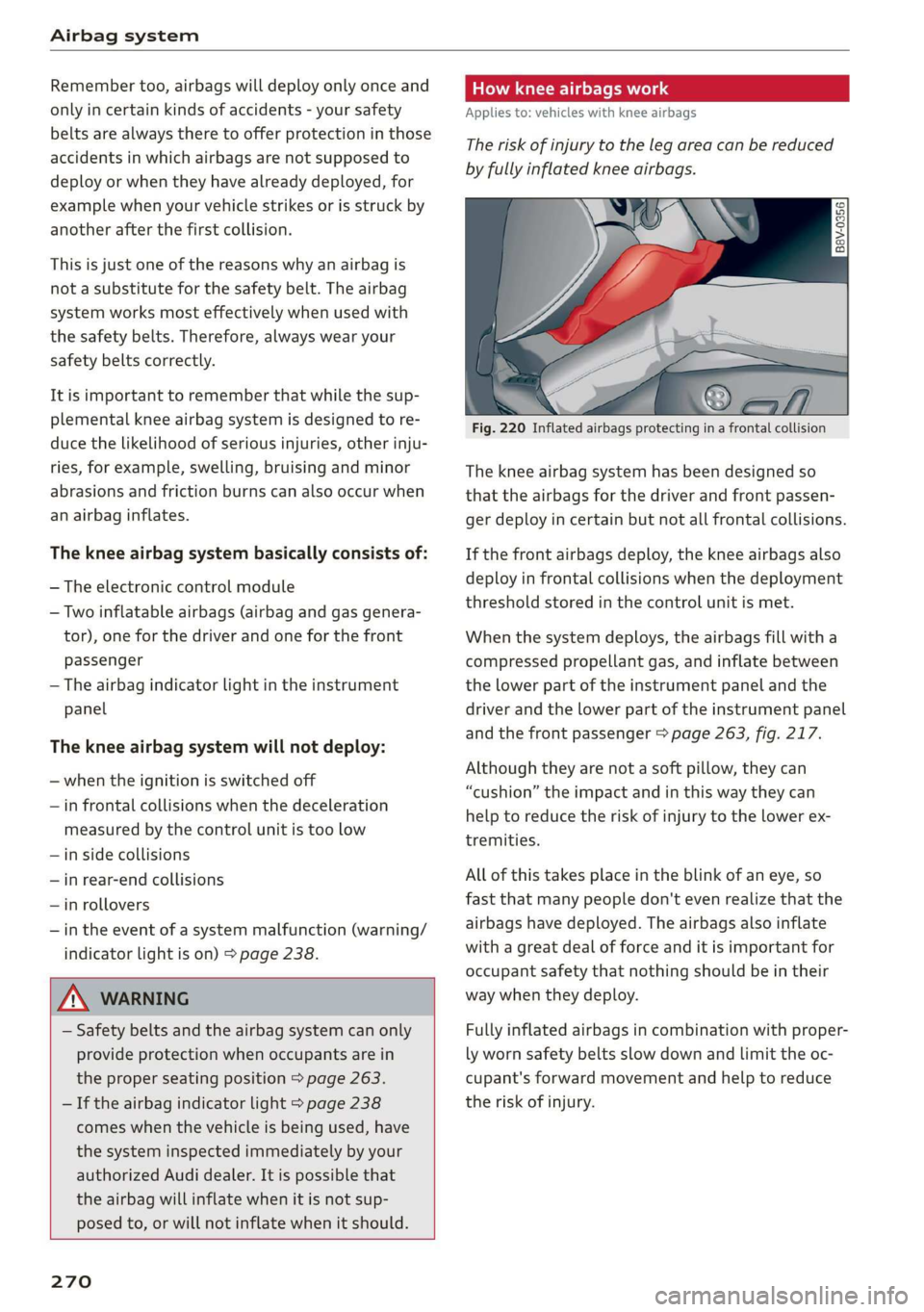
The risk of injury to the leg area can be reduced
by fully inflated knee airbags.
B8V-0356
The knee airbag system has been designed so
that the airbags for the driver and front passen-
ger deploy in certain but not all frontal collisions.
If the front airbags deploy, the knee airbags also
deploy in frontal collisions when the deployment
threshold stored in the control unit is met.
When the system deploys, the airbags fill with a
compressed propellant gas, and inflate between
the lower part of the instrument panel and the
driver and the lower part of the instrument panel
and the front passenger > page 263, fig. 217.
Although they are not a soft pillow, they can
“cushion” the impact and in this way they can
help to reduce the risk of injury to the lower ex-
tremities.
All of this takes place in the blink of an eye, so
fast that many people don't even realize that the
airbags have deployed. The airbags also inflate
with a great deal of force and it is important for
occupant safety that nothing should be in their
way when they deploy.
Fully inflated airbags in combination with proper-
ly worn safety belts slow down and limit the oc-
cupant's forward movement and help to reduce
the risk of injury.
Page 273 of 400
8V2012721BK
Airbag system
Important safety instructions on the knee bags, for example) can interfere with or
airbag system prevent proper deployment of the airbag.
Applies to: vehicles with knee airbags Small objects can be thrown through the
Airbags are only supplemental restraints. Always vehicle if the airbag deploys and injure you
wear safety belts correctly and ride in a proper or your passengers.
seating position. — Make sure there are no cracks, deep scratch-
es or other damage in the area of the instru-
There is a lot that you and your passengers must ment panel where the knee airbags are lo-
know and do to help the safety belts and airbags cated.
to provide supplemental protection. —If children are incorrectly seated, their risk
A WARNING of injury increases in a collision > page 278,
Child safety.
An inflating knee airbag can cause serious in-
jury. Wearing safety belts incorrectly and im- Side ai rbags
proper seating positions increase the risk of
serious personal injury and death whenever a Description of side airbags
hicle is bei .
weteleis beingiuced The airbag system can provide supplemental
—Thek i . .
Boao eau otecuy cu protection to properly restrained occupants.
properly if you are seated too close to any of
the airbag locations. When adjusting their
seat positions, it is important that both the
driver and the front passenger keep their
upper bodies and knees at the following
minimum safe distances:
i KR R
Ry 2 eS oO
—at least 10 inches (25 cm) between the
chest and the steering wheel/instrument
panel.
—at least 4 inches (10 cm) between the
knees and the lower part of the instru- Fig. 221 Side airbag location in the driver's seat
ment panel.
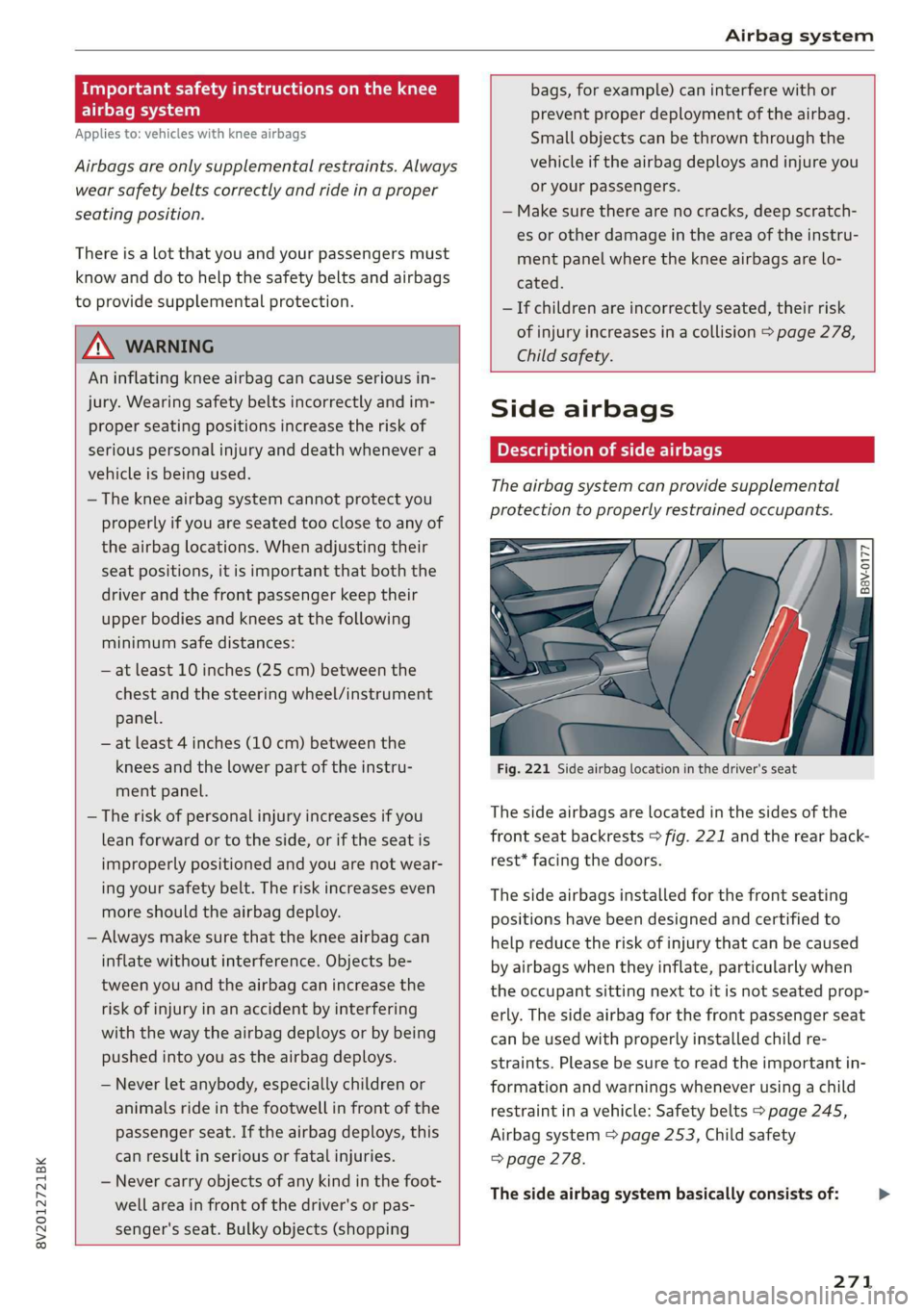
—The risk of personal injury increases if you The side airbags are located in the sides of the
lean forward or to the side, or if the seat is front seat backrests > fig. 221 and the rear back-
improperly positioned and you are not wear- rest* facing the doors.
ing your safety belt. The risk increases even The side airbags installed for the front seating
more should the airbag deploy. positions have been designed and certified to
— Always make sure that the knee airbag can help reduce the risk of injury that can be caused
inflate without interference. Objects be- by airbags when they inflate, particularly when
tween you and the airbag can increase the the occupant sitting next to it is not seated prop-
risk of injury in an accident by interfering erly. The side airbag for the front passenger seat
with the way the airbag deploys or by being can be used with properly installed child re-
pushed into you as the airbag deploys. straints. Please be sure to read the important in-
— Never let anybody, especially children or formation and warnings whenever using a child
animals ride in the footwell in front of the restraint in a vehicle: Safety belts > page 245,
passenger seat. If the airbag deploys, this Airbag system > page 253, Child safety
can result in serious or fatal injuries. => page 278.
5 vetcary ables el any Ar einite jeer The side airbag system basically consists of: >
well area in front of the driver's or pas-
senger's seat. Bulky objects (shopping
271
Page 277 of 400

8V2012721BK
Airbag system
interior in certain side impacts and vehicle roll-
overs.
The side curtain airbag system supplements the
safety belts and can help to reduce the risk of in-
jury for occupants’ heads and upper torso on the
side of the vehicle that is struck in a side colli-
sion. The side curtain airbag inflates in side im-
pacts and only when the vehicle acceleration reg-
istered by the control unit is high enough. If this
rate is below the reference value programmed in-
to the control unit, the side curtain airbag will
not be triggered, even though the car may be
badly damaged as a result of the collision. It is
not possible to define an airbag triggering range
that will cover every possible angle of impact,
since the circumstances will vary considerably be-
tween one collision and another. Important fac-
tors include, for example, the nature (hard or
soft) of the impacting object, the angle of im-
pact, vehicle speed, etc. > page 276, How side
curtain airbags work.
Aside
from their normal safety function, safety
belts work to help keep the driver or front pas-
senger in position in the event of a collision so
that the side curtain airbags can provide protec-
tion.
The airbag system is not a substitute for your
safety belt. Rather, it is part of the overall occu-
pant restraint system in your vehicle. Always re-
member that the airbag system can only help to
protect you if you are wearing your safety belt
and wearing it properly. This is another reason
why you should always wear your safety belts,
not just because the law requires you to do so
= page 245, General notes.
It is important to remember that while the side
curtain airbag system is designed to help reduce
the likelihood of serious injuries, other injuries,
for example, swelling, bruising, friction burns
and minor abrasions can also be associated with
these airbags upon deployment. Remember too,
these airbags will deploy only once and only in
certain kinds of accidents - your safety belts are
always there to offer protection.
The side curtain airbag system basically
consists of:
— The electronic control module and external side
impact sensors
— The side curtain airbags above the front and
rear side windows with ejection mitigation fea-
tures
— The airbag indicator light in the instrument
panel
The airbag system is monitored electronically to
make certain it is functioning properly at all
times. Each time you switch on the ignition, the
airbag system indicator light will come on for a
few seconds (self diagnostics).
The side curtain airbag is not activated:
— if the ignition is switched off,
— in side collisions when the acceleration meas-
ured by the sensor is too low,
—in rear-end collisions.
ZA\ WARNING
— Safety belts and the airbag system will only
provide protection when occupants are in
the proper seating position > page 54,
Front seats.
— If the airbag indicator light > page 238
comes when the vehicle is being used, have
the system inspected immediately by your
authorized Audi dealer. It is possible that
the airbag will inflate when it is not sup-
posed to, or will not inflate when it should.
275
Page 282 of 400
Child safety
— Always make sure that the PASSENGER
AIR BAG OFF light comes on and stays on
all the time whenever the ignition is
switched on.
— If the PASSENGER AIR BAG OFF light
does not come on and stay on, immediate-
ly install the forward-facing child seat ina
rear seating position and have the airbag
system inspected by your authorized Audi
dealer.
— Always buckle the child seat firmly in place
even if a child is not sitting in it. A loose
child seat can fly around during a sudden
stop or ina collision.
— Always read and heed all WARNINGS
whenever using a child restraint in a vehi-
cle > page 245, Safety belts, > page 253,
Airbag system and = page 278, Important
information.
@) Tips
Always replace child restraints that were in-
stalled in a vehicle during a crash. Damage to
a child restraint that is not visible could cause
it to fail in another collision situation.
ONE eRe emma Cle)
Your vehicle is equipped with a front “Advanced
Airbag System” in compliance with United States
Federal Motor Vehicle Safety Standard (FMVSS)
208, as well as Canada Motor Vehicle Safety
Standard (CMVSS) 208 as applicable at the time
your vehicle was manufactured.
The Advanced Airbag system in your vehicle has
been certified to meet the “low-risk” require-
ments for 3- and 6-year old children on the pas-
senger side and small adults on the driver side.
The low risk deployment criteria are intended to
reduce the risk of injury through interaction with
the airbag that can occur, for example, by being
too close to the steering wheel and instrument
panel when the airbag inflates. In addition, the
system has been certified to comply with the
“suppression” requirements of the Safety Stand-
ard, to turn off the front airbag for infants up to
12 months who are restrained on the front pas-
280
senger seat in child restraints that are listed in
the Standard.
Even though your vehicle is equipped with an Ad-
vanced Airbag system, all children, especially
those 12 years and younger, should always ride in
the back seat properly restrained for their age
and
size. The airbag on the passenger side makes
the front seat a potentially dangerous place for a
child to ride. The front seat is not the safest place
for a child in a forward-facing child safety seat. It
can be a very dangerous place for an infant or a
larger child in a rearward-facing seat.
The vehicle's Advanced Airbag System has a ca-
pacitive passenger detection system in the front
passenger seat cushion that can detect the pres-
ence of a baby or a child in a child restraint sys-
tem on this seat.
The capacitive passenger detection system regis-
ters the changes that result in an electrical field
when a child, a child restraint, and a baby blanket
are on the front passenger seat. The change in
the measured capacitance due to the presence of
a child, a child restraint, and a baby blanket on
the front passenger seat is related to the child re-
straint system resting on the seat. The measured
capacitance of a child restraint system varies de-
pending on the type of system and specific make
and model.
The electrical capacitance of the various types,
makes, and models of child restraints specified
by the U.S. National Highway Traffic Safety Ad-
ministration (NHTSA) in the relevant safety
standard are stored in the Advanced Airbag Sys-
tem control unit together with the capacitances
typical of infants and a 1-year old child. When a
child restraint is used on the front passenger seat
with a typical 1 year-old infant, the Advanced Air-
bag System compares the capacitance measured
by the capacitive passenger detection system
with the data stored in the electronic control
unit.
Ce eMetrics Raceli alia es-Te)
system
Regardless of the child restraint that you use,
make sure that it has been certified to meet >
Page 308 of 400
Checking and Filling
> With the door open, pull the lever > below
the instrument panel in the direction of the ar-
row > fig. 246.
> Raise the hood slightly > A\.
> Press the rocker switch under the hood upward
> fig. 247. This releases the catch.
> Open the hood.
Closing the hood
> Push the hood down until you override the
force of the strut.
> Let the hood fall lightly into the latch. Do not
press it in. > /\.
Message
2 Warning! Hood is not locked. Stop vehicle
and check the lock
The hood latch is not locked correctly. Stop im-
mediately and close the hood.
AN WARNING
— Never open the hood when there is steam or
coolant escaping from the engine compart-
ment, because there is a risk that you could
be burned. Wait until no steam or coolant is
escaping.
— For safety reasons, the hood must always be
latched securely while driving. Because of
this, always check the hood after closing it
to make sure it is latched correctly. The hood
is latched if the front corners cannot be lift-
ed.
— If you notice that the hood is not latched
while you are driving, stop immediately and
close it, because driving when the hood is
not latched increases the risk of an accident.
— If the hood is not latched completely, it
could fly up while you are driving and ob-
struct your vision.
D) The &> symbol on the lever was still being designed at
the time this manual was printed.
306
Page 363 of 400
8V2012721BK
Fuses and bulbs
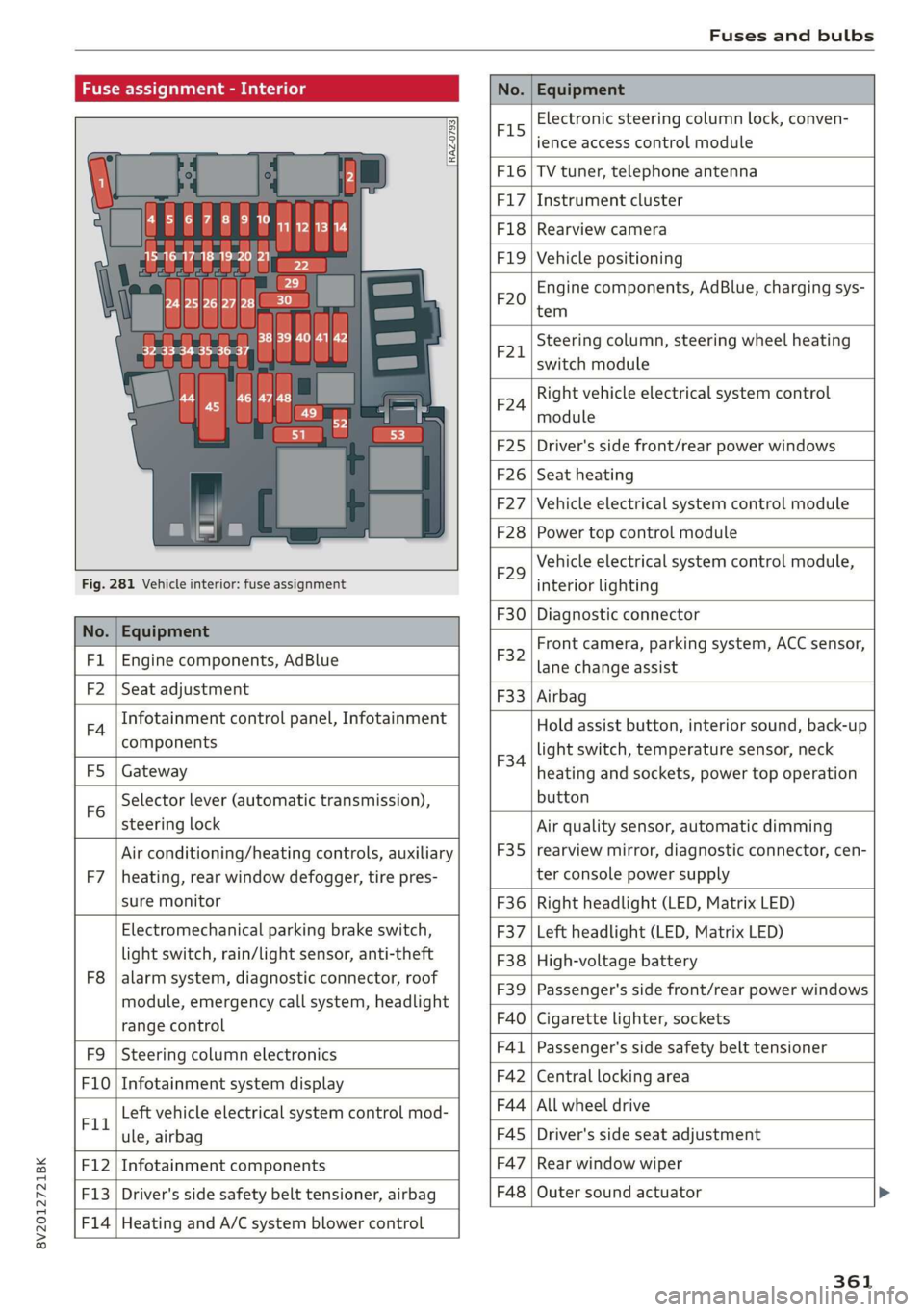
Fuse assignment - Interior
No. Equipment
RAZ-0793,
PO ee
15°16°17-18 19 20 21
PZ ply lip y ips}
ei Hes ole” So}
32°33 34 35 36 37
F15
Electronic steering column lock, conven-
ience access control module
F16 TV tuner, telephone antenna
F17 Instrument cluster
F18 Rearview camera
F1I9 Vehicle positioning
F20
Engine components, AdBlue, charging sys-
tem
F221
Steering column, steering wheel heating
switch module
F24
Right vehicle electrical system control
module
F25 Driver's side front/rear power windows
F26 Seat heating
F27 Vehicle electrical system control module
F28 Power top control module
Fig. 281 Vehicle interior: fuse assignment
F29
Vehicle electrical system control module,
interior lighting
No. Equipment
F30 Diagnostic connector
FL Engine components, AdBlue
F2 Seat adjustment
F32
Front camera, parking system, ACC sensor,
lane change assist
F4
Infotainment control panel, Infotainment
components
F33 Airbag
FS Gateway
Fo
Selector lever (automatic transmission),
steering lock
F34
Hold assist button, interior sound, back-up
light switch, temperature sensor, neck
heating and sockets, power top operation
button
Air conditioning/heating controls, auxiliary F35
Air quality sensor, automatic dimming
rearview mirror, diagnostic connector, cen-
F7 |heating, rear window defogger, tire pres- ter console power supply
sure monitor F36 | Right headlight (LED, Matrix LED)
Electromechanical parking brake switch, F37 | Left headlight (LED, Matrix LED)
light switch, rain/light sensor, anti-theft F38 | High-voltage battery
ae ene eee dent F39 | Passenger's side front/rear power windows
range control F40 | Cigarette lighter, sockets
F9 |Steering column electronics F41 | Passenger's side safety belt tensioner
F10 | Infotainment system display F42 | Central locking area
Tl Left vehicle electrical system control mod- F44 al ee
ule, airbag FAS | Driver's side seat adjustment
F12 | Infotainment components F47 | Rear window wiper
F13 | Driver's side safety belt tensioner, airbag F48 | Outer sound actuator
F14 | Heating and A/C system blower control
361
Page 384 of 400
Index
Audio player
Bluetooth audio player................ 214
Wi-Fi audio player...............00005 214
AUGIOTISCK san 4 2 wees 2 a wea.8 2 Aas a ¢ 222
Audi phone box......... 0. ce eee eee eee 171
Audi presense......... 0.00. c eee eee 125
MESSAGES saree 5 x sens 5 x seme 5 e ewe = 124,128
AUGISIGGIASSISE sivas ¢ < wacom 3 § suas 4 § Sac & 131
Cleaning the sensors...............004 343
MGSSAGES caszass » « annsoice & 0: cones @ 0 ornare « 6 cnene 135
Rear cross-traffic assist................ 134
Audi smartphone interface.......... 228, 233
Audi virtual cockpit
refer to Instrument cluster.............. 14
AUTO
Automatic headlights .................. 43
Climate control system ...........-.000. 66
Auto Lock (central locking system) ......... 25
Automatic belt retractor... .......0...05 248
Automatic transmission............-...0- 75
Automatic wipe/wash system............. 49
Auxiliary climate control................. 68
AUX input... 06. eee eee 217
Average consumption................005 22
Average speed... 1... cece eee eee 22
B
BACKIBUTEOM « seseins
Bag hOoks®. « csssiecs «a seams ve connate vm eevee © # sees 60
Balance:(SOund) aii os weve av owe va neues « 234
Band
refer to Frequency band............... 206
Bassi(SOunG) «axes wo swivius 0 a awaweie w stamens oY nae 234
Battery, scorn so sccm 6 2 serene © x aor 6 MEER oo 315
Charge level display.................00. 14
CHANGING scx ¢ < sacs x § anes & ¢ Same Fk eR 316
High-voltage battery...............008. 96
Winter operation.............2.00 eee 315
Battery (vehicle)
refer to High-voltage battery............ 96
Before driving............-.0 eee eens 237
Belt temsiomensten «+ serene a axnuoe a 0 acme 0 0 ae 252
Better route (navigation)................ 205
BOWED. i seiiss a somunse a & anosans & % wwe Ho omemaun & 8 66
382
Bluetooth
Audio player... ..... cece eee eee eee 214
Connecting acell phone............... 169
SOEIAGS wines sx sesame vo arene cee a a comes 233
BOOStiis «een oo eer oo sore os ee ©» eee Y 23
Boosterséats.. « « can 2 ¢ ees os eeu ee ees 287
BOOSETUNGtION = wee < 2 seme 2 2 eee 2 e sees 76
Boost pressure indicator................. 23
Brake fluid
Checking brake fluid level
BRAKES cyecy: 2 aqme 2 ¢ atone go tem ye eee ye
Brake assist
Brake fluid
Emergency braking function
HOE ssicoes + a avo 3 orem oa Ta oe Ra BTR
New brake pads
Break-in security feature................. 30
Breaking in
New brake pads........... 00. c ee eee eee 85
NEW TIRES sc « = cows « 2 cares & eee ¢ v een 326
Newevelicles. « css: sv wns se wesc a 2 amenes 3 6 78
Browser
refer to Media center...............00. 220
BUDS: a i cconine 2 os cesnors & awanawe so avai 8 ans He 362
Buttons
Control panel (MMI)................-. 146
Multifunction steering wheel......... 17,20
Programming (multifunction steering
wheel)... 0.0.0... cece eee eee eee eens 19
Switching the Infotainment system display
ON/OFF iccen xo meron oo ee ae Se oo poe © 8 147
Cable (USB adapter/AUX connector cable).. 217
California Proposition 65 Warning........ 305
Battery specitt@inss + sccmss ux suas a 6 onawents x a 315
Galblists s secs 2 2 semen 2 waew v anor ee eR 173
Calloptions ess s seca ss pen & x dees 5 eee 180
Capacities
Fureltanke: « 2 wc 2s wise + meni os mie a oo 380
Washer fluid reservoir...............-5 380
Car key... cece eee eee eee 26
Care washes x sass i a seesiice 6 0 arovacs 6 w waneane 0 ane 342
Catalytic Converters « sesci ss wave a 8 eres 6 6 303
CD drive (media drives)................. 212