roof AUDI A3 2020 Owner´s Manual
[x] Cancel search | Manufacturer: AUDI, Model Year: 2020, Model line: A3, Model: AUDI A3 2020Pages: 400, PDF Size: 107.47 MB
Page 287 of 400

8V2012721BK
Child safety
ride. The front seat is not the safest place for a
child in a forward-facing child seat. It is a very
dangerous place for an infant or a larger child in
a rearward-facing seat.
ZA WARNING
Not using a child safety seat, using the wrong
child safety seat or improperly installing a
child restraint increases the risk of serious
personal injury and death in a crash.
— Never install rear-facing child safety seats or
infant carriers on the front passenger seat -
even with an Advanced Airbag System. A
child will be seriously injured and can be kil-
led when the inflating airbag hits the child
safety seat or infant carrier with great force
and smashes the child safety seat and child
against the backrest, center armrest, door
or roof > page 254, Child restraints on the
front seat - some important things to
know.
— Always install rear-facing child safety seats
or infant carriers on the rear seat.
— Never install a rear-facing child restraint in
the forward-facing direction. Such restraints
are designed for the special needs of infants
and
very small children and cannot protect
them properly if the seat is forward-facing.
— If you must install a rearward facing child
safety seat on the front passenger seat be-
cause of exceptional circumstances and the
PASSENGER AIR BAG OFF light does not
come on and stay on, immediately install
the rear-facing child safety seat in a rear
seating position and have the airbag system
inspected by your Audi dealer.
— Never place or use any electrical device
(such as a laptop, CD player, electronic
games device, power inverter or seat heater
for child seats) on the front passenger seat
if the device is connected to the 12-volt
socket or the cigarette lighter socket.
— If a seat heater has been retrofitted or oth-
erwise added to the front passenger seat,
never install any child restraint system on
this seat.
— Make sure that there are no wet objects
(such as a wet towel) and no water or other
liquids on the front passenger seat cushion.
— Never place objects on the seat (such as a
laptop, CD player, electronic games device,
power inverter or seat heater for child
seats). These may influence the electrical
capacitance measured by the capacitive pas-
senger detection system and can also fly
around in an accident and cause serious per-
sonal injury.
— Always read and heed all WARNINGS when-
ever using a child restrained in a vehicle is
being used > page 245, Safety belts,
=> page 253, Airbag system and > page 278,
Important information.
Convertible child safety seats
Properly used convertible child safety seats can
help protect toddlers and children over age one
who weigh between 20 and 40 lbs. (9 and 18 kg)
in acrash.
B4L-1425
Fig. 228 Schematic overview: installation of the attach-
ments applicable to a LATCH seat
B4L-1426
Fig. 229 Schematic overview: installation of the seat using
the vehicle's safety belt system
» When using the vehicle safety belt to install a
child safety seat, you must first activate the
285
>
Page 288 of 400
Child safety
convertible locking retractor on the safety belt
to prevent the child safety seat from moving
=> page 289 or install the seat using the LATCH
attachments.
> Push the child safety seat down with your full
weight to get the safety belt really tight so that
the seat cannot move forward or sideways more
than one inch (2.5 cm) > page 289.
> If the child safety seat is equipped with a tether
strap, attach it to the tether anchors
=> page 294.
> Secure unused safety belts on the rear seat
=> page 284.
A toddler or child is usually too large for an in-
fant restraint if it is more than one year old and
weighs more than 20 lbs. (9 kg).
Toddlers and children who are older than one
year up to about 4 years old and weigh more than
20 lbs (9 kg) up to 40 lbs. (18 kg) must always be
properly restrained in a child safety seat certified
for their size and weight > fig. 228 and
> fig. 229.
The airbag on the passenger side makes the front
seat a potentially dangerous place for a child to
ride. The front seat is not the safest place for a
child in a forward-facing child safety seat. Itisa
very dangerous place for an infant or a larger
child in a rearward-facing seat.
against the backrest, center arm rest, door
or roof.
— Always install rear-facing child safety seats
on the rear seat.
— If you must install a rearward facing child
safety seat on the front passenger seat be-
cause of exceptional circumstances and the
PASSENGER AIR BAG OFF light does not
come on and stay on, immediately install
the rear-facing child safety seat in a rear
seating position and have the airbag system
inspected by your Audi dealer.
—The rear side of the child safety seat should
be positioned as close as possible to the
backrest on the vehicle seat.
— For adjustable head restraints: adjust or re-
move the rear seat head restraint if it is dif-
ficult to install the child seat with the head
restraint in place > page 57. Install the
head restraint again immediately once the
child seat is removed. Driving without head
restraints or with head restraints that are
not properly adjusted increases the risk of
serious or fatal neck injury dramatically.
— Always read and heed all WARNINGS when-
ever using a child restrained in a vehicle is
being used > page 245, Safety belts,
= page 253, Airbag system and > page 278,
Important information.
ZA WARNING
Not using a child safety seat, using the wrong
child safety seat or improperly installing a
child restraint increases the risk of serious
personal injury and death in a collision or oth-
er emergency situation.
— Children on the front seat of any car, even
with Advanced Airbags, can be seriously in-
jured or even killed when an airbag inflates.
A child in a rearward-facing child safety seat
installed on the front passenger seat will be
seriously injured and can be killed if the
front airbag inflates —- even with an Ad-
vanced Airbag System.
— The inflating airbag will hit the child safety
seat or infant carrier with great force and
will smash the child safety seat and child
286
ZA, WARNING
If exceptional circumstances require the use
of a forward-facing child restraint on the front
passenger's seat, the child's safety and well-
being require that the following special pre-
cautions be taken:
— Make sure the forward-facing seat has been
designed and certified by its manufacturer
for use on a front seat with a passenger
front and side airbag.
— Always follow the manufacturer's instruc-
tions provided with the child safety seat or
infant carrier.
— Always move the front passenger seat to the
highest position in the up and down adjust-
ment range and move it back to the rear-
most position in the seat's fore and aft ad-
justment range, as far away from the airbag
Page 291 of 400
8V2012721BK
Child safety
OFF light must come on and stay on, when-
ever the ignition is switched on.
— If the PASSENGER AIR BAG OFF light does
not come on and stay on, perform the
checks described > page 265, Monitoring
the Advanced Airbag System.
— Take the child restraint off the front passen-
ger seat and install it properly at one of the
rear seat positions if the PASSENGER AIR
BAG OFF light does not stay on whenever
the ignition is switched on.
— Always read and heed all WARNINGS when-
ever using a child restrained in a vehicle is
being used > page 245, Safety belts,
=> page 253, Airbag system and > page 278,
Important information.
Securing child safety
seats
Securing a child safety seat using a safety
ert
Safety belts for the rear seats and the front pas-
senger can be locked with the convertible locking
retractor to properly secure child safety seats.
The safety belts emergency locking retractors for
the rear seats safety belts and for the front pas-
senger’s seat safety belt have a convertible lock-
ing retractor for child restraints. The safety belt
must be locked so that belt webbing cannot un-
reel. The retractor can be activated to lock the
safety belt and prevent the safety belt webbing
from loosening up during normal driving. A child
safety seat can only be properly installed when
the safety belt is locked so that the child and
child safety seat will stay in place.
Always remember: Even though your vehicle is
equipped with an Advanced Airbag system, all
children, especially those 12 years and younger,
should always ride in the back seat properly re-
strained for their age and size.
ZA\ WARNING
Improperly installed child safety seats in-
crease the risk of serious personal injury and
death in a collision.
— Always make sure that the safety belt retrac-
tor is locked when installing a child safety
seat. An unlocked safety belt retractor can-
not hold the child safety seat in place during
normal driving or in a crash.
— Always buckle the child safety seat firmly in
place even if a child is not sitting init. A
loose child safety seat can fly around during
a sudden stop or in a collision.
— Always make sure that the rear seat backrest
to which the center rear safety belt* is at-
tached is securely latched whenever the rear
center safety belt is being used to secure a
child restraint.
—If the backrest is not securely latched, the
child and the child restraint will be thrown
forward together with the backrest and will
strike parts of the vehicle interior. The child
can be seriously injured or killed.
— Never install rear-facing child safety seats or
infant carriers on the front passenger seat.
A child will be seriously injured and can be
killed when the passenger airbag inflates.
— The inflating airbag will hit the child safety
seat or infant carrier with great force and
will smash the child safety seat and child
against the backrest, center armrest, door
or roof.
— Always install rear-facing child safety seats
or infant carriers on the rear seat.
— Forward-facing child safety seats or infant
carriers installed on the front passenger's
seat may interfere with the deployment of
the airbag and cause serious injury to the
child.
—It is safer to install a forward-facing child
safety seat on the rear seat.
— Always read and heed all WARNINGS when-
ever using a child restrained in a vehicle is
being used > page 278. Special precautions
apply when installing a child safety seat on
the front passenger seat > page 254, Child
restraints on the front seat - some impor-
tant things to know.
289
Page 292 of 400
Child safety
ZA WARNING
Always take special precautions if you must
install a forward or rearward-facing child re-
straint on the front passenger's seat in excep-
tional situations:
— Whenever a forward or rearward-facing
child restraint is installed on the front pas-
senger seat, the PASSENGER AIR BAG OFF
light must come on and stay on whenever
the ignition is switched on.
— If the PASSENGER AIR BAG OFF light does
not come on and stay on, perform the
checks described > page 265, Monitoring
the Advanced Airbag System.
— Take the child restraint off the front passen-
ger seat and install it properly at one of the
rear seat positions if the PASSENGER AIR
BAG OFF light does not stay on whenever
the ignition is switched on.
— Improper installation of child restraints can
reduce their effectiveness or even prevent
them from providing any protection.
— An improperly installed child restraint can
interfere with the airbag as it deploys and
seriously
injure or even kill the child.
— Always carefully follow the manufacturer's
instructions provided with the child safety
seat or carrier.
— After checking to make sure that the child
restraint is properly installed, make certain
that the child restraint is correctly recog-
nized by the capacitive passenger detection
system in the front passenger seat and that
the PASSENGER AIR BAG OFF light signals
the correct front passenger frontal airbag
status.
ZA\ WARNING
Forward-facing child restraints:
— Always make sure the forward-facing seat
has been designed and certified by its manu-
facturer for use on a front seat with a pas-
senger front and side airbag.
— Never put the forward-facing child restraint
up, against or very near the instrument pan-
el
290
— Always move the front passenger seat to the
highest position in the up and down adjust-
ment range and move it back to the rear-
most position in the seat's fore and aft ad-
justment range, as far away from the airbag
as possible, before installing the forward-
facing child restraint.
— Always make sure that the safety belt upper
anchorage is behind the child restraint and
not next to or in front of the child restraint
so that the safety belt will be properly posi-
tioned.
— Make sure that the PASSENGER AIR BAG
OFF light comes on and stays on all the time
whenever the ignition is switched on.
ZA WARNING
Rearward-facing child restraints:
-Achild in a rearward-facing child safety seat
installed on the front passenger seat will be
seriously injured and can be killed if the
front airbag inflates - even with an Ad-
vanced Airbag System.
— The inflating airbag will hit the child safety
seat or infant carrier with great force and
will smash the child safety seat and child
against the backrest, center armrest, door
or roof.
— Always be especially careful if you must in-
stall a rearward facing child safety seat on
the front passenger seat in exceptional cir-
cumstances.
— Make sure that the PASSENGER AIR BAG
OFF light comes on and stays on all the time
whenever the ignition is switched on.
— If the PASSENGER AIR BAG OFF light does
not come on and stay on, immediately in-
stall the rear-facing child safety seat ina
rear seating position and have the airbag
system inspected by your Audi dealer.
Activating the convertible locking retractor
Use the convertible locking retractor to secure a
child restraint.
Always heed the child safety seat manufacturer's
instructions when installing a child restraint in
Page 326 of 400
Wheels
Production options weight
means the combined weight of
those installed regular production
options weighing over 5 lbs.
(2.3 kg) in excess of those stand-
ard items which they replace, not
previously considered in curb
weight or accessory weight, in-
cluding heavy duty brakes, ride
levelers, roof rack, heavy duty
battery, and special trim.
Radial ply tire
means a pneumatic tire in which
the ply cords that extend to the
beads are laid at substantially
90 degrees to the centerline of
the tread.
Recommended inflation
pressure
see > page 322, Cold tire infla-
tion pressure.
Reinforced tire
means a tire designed to operate
at higher loads and at higher in-
flation pressures than the corre-
sponding standard tire. Rein-
forced tires may be identified as
“XL”, “xl”, “EXTRA LOAD”, or “RF”
on the sidewall.
324
Rim
means a metal support for a tire
ora tire and tube assembly upon
which the tire beads are seated.
Rim diameter
means nominal diameter of the
bead seat. If you change your
wheel size, you will have to pur-
chase new tires to match the new
rim diameter.
Rim size designation
means rim diameter and width.
Rim width
means nominal distance between
rim flanges.
Sidewall
means that portion of a tire be-
tween the tread and bead.
Speed rating (letter code)
means the speed at which a tire is
designed to be driven for extend-
ed periods of time. The ratings
range from 93 mph (150 km/h)
to 186 mph (298 km/h) > table
on page 320. You may not find
this information on all tires be-
cause it is not required by law.
The speed rating letter code,
where applicable, is molded on
the tire sidewall and indicates the >
Page 344 of 400

Care and cleaning
Care and cleaning
General information
Regular, proper care helps to maintain your vehi-
cle's value. It can also be a requirement when
submitting warranty claims for corrosion damage
and paint defects on the body.
The required cleaning and care products can be
obtained from an authorized Audi dealer or au-
thorized Service Facility. Read and follow the in-
structions for use on the packaging.
ZA WARNING
— Using cleaning and care products incorrectly
can be dangerous to your health.
— Always store cleaning and care products out
of reach of children to reduce the risk of poi-
soning.
@ For the sake of the environment
— Purchase environmentally-friendly cleaning
products if possible.
— Do not dispose of cleaning and care prod-
ucts with household trash.
Car washes
The longer that deposits such as insects, bird
droppings, tree sap or road salt remain on the ve-
hicle, the more the surface can be damaged. High
temperatures such as those caused by sunlight
increase the damaging effect.
Before washing, rinse off heavy deposits with
plenty of water.
Stubborn deposits such as bird droppings or tree
sap are best removed with plenty of water and a
microfiber cloth.
Also, wash the underside of your vehicle once
road salt stops being used for the season.
Pressure washers
When washing your vehicle with a pressure wash-
er, always follow the operating instructions pro-
vided with the pressure washer. This is especially
important in regard to the pressure and spraying
distance. Do not aim the spray directly at seals on
342
side windows, doors, the hood, the luggage com-
partment lid, or the panoramic glass roof* or at
tires, rubber hoses, insulating material, the pow-
er top*, sensors*, or camera lenses*. Keep a dis-
tance of at least 16 in (40 cm).
Plug-in hybrid drive: do not direct the stream of
water towards the wall mount clip*.
Do not remove snow and ice with a pressure
washer.
Never use cone nozzles or high pressure nozzles.
The water temperature must not be above 140 °F
(60 °C).
Automatic car wash
Spray off the vehicle before washing.
Make sure that the windows, the panoramic glass
roof*, and the power top” are closed and the
windshield wipers are off. Follow instructions
from the car wash operator, especially if there are
accessories attached to your vehicle.
If possible, use car washes that do not have
brushes.
Washing by hand
Clean the vehicle starting from the top and work-
ing downward using a soft sponge or cleaning
brush. Use solvent-free cleaning products.
Washing vehicles with matte finish paint by
hand
To reduce the risk of damaging the paint when
washing, first remove dust and large particles
from your vehicle. Insects, grease spots, and fin-
gerprints are best removed with a special cleaner
for matte finish paint.
Apply the product using a microfiber cloth. To re-
duce the risk of damaging the paint surface, do
not use too much pressure.
Rinse the vehicle thoroughly with water. Then
clean using a neutral shampoo and a soft micro-
fiber cloth.
Rinse the vehicle thoroughly again and let it air
dry. Remove any water residue using a chamois. >
Page 376 of 400
Accessories and technical changes
Accessories and
technical changes
Warranty
Your vehicle is covered by various warranties:
— New Vehicle Limited Warranty
— Limited Warranty Against Corrosion Perforation
— Emissions Control System Warranties: Federal
Emissions Control System Defect Warranty,
Federal Emissions Performance Warranty
— Applies to: USA models: Kansas Safety Belt
Limited Warranty
— Applies to: USA models: California Emissions
Control Warranties: Short-term Emissions De-
fects Warranty, Long-term Emissions Defects
Warranty, TZEV models Emissions Defects
Warranty, California Emissions Performance
Warranty
You can find detailed information in your Warran-
ty & Maintenance Booklet and in the California
Emissions Booklet*.
Audi Literature Shop
Service information is made available as soon as
possible after a model is introduced and can be
ordered in the Audi Literature Shop: http://
literature.audiusa.com
Driving in other
countries
Government regulations in the United States and
Canada require motor vehicles to comply with
emissions regulations and safety standards.
Therefore, vehicles that were produced for the
U.S. and Canadian markets are different from
vehicles produced for other countries.
If you plan to use your vehicle outside of the
United States or Canada, it is possible that:
— Fuel may have a significantly lower octane rat-
ing. Unsuitable fuels can cause engine damage.
— Proper maintenance and repair work may not
be possible because special service equipment,
tools, or measuring devices needed for your ve-
hicle may not be available.
374
— Replacement parts may not always be availa-
ble.
— Navigation systems for vehicles built for the
U.S.A. and Canada will not necessarily work in
Europe, and may not work in other countries.
() Note
Audi is not liable for damage to the vehicle re-
sulting from these country-specific differen-
ces.
Maintenance, repairs,
and technical modifi-
cations
Note the safety precautions > page 304, General
information and > page 354, Raising the vehicle.
General information
Due to the increasing complexity of technology in
these vehicles, as well as the safety and environ-
mental standards that apply, you can only per-
form a very limited amount of repairs and modifi-
cations to the vehicle yourself.
Proof of maintenance work may be required to
submit a claim within the warranty period.
We recommend that you have your vehicle serv-
iced by an authorized Audi dealer or authorized
Audi Service Facility and that Audi Genuine Parts
and Audi Genuine Accessories are used. This
helps to ensure that your vehicle's functionality,
performance, and safety are not impaired.
Maintenance and repairs
Your vehicle was designed to help keep mainte-
nance requirements to a minimum. Some regular
maintenance is required to help ensure that your
vehicle runs in a safe, economical, and reliable
manner. Please refer to your Warranty & Mainte-
nance Booklet for more detailed information
about vehicle maintenance.
When operating the vehicle under more extreme
operating conditions, for example when outside
temperatures are very low or in very dusty envi-
ronments, certain maintenance should be per-
formed between the specified intervals.
Page 382 of 400
Technical data
(er) Fah a(t)
Fuel tank, front wheel drive 13.2 gal (50.0 L)
Fuel tank, all wheel drive 14.5 gal (55.0 L)
Plug-in hybrid drive fuel tank 10.5 gal (40.0 L)
Windshield washer system 3.2 qt (3.0L)
Windshield and headlight washer system* 5.0 qt (4.7 L)
Windshield and headlight washer system*, S models 4.2 qt (4.0 L)
Windshield and headlight washer system*, RS models 3:7 qt3B5D
Weights
Le I Le
FANNON A
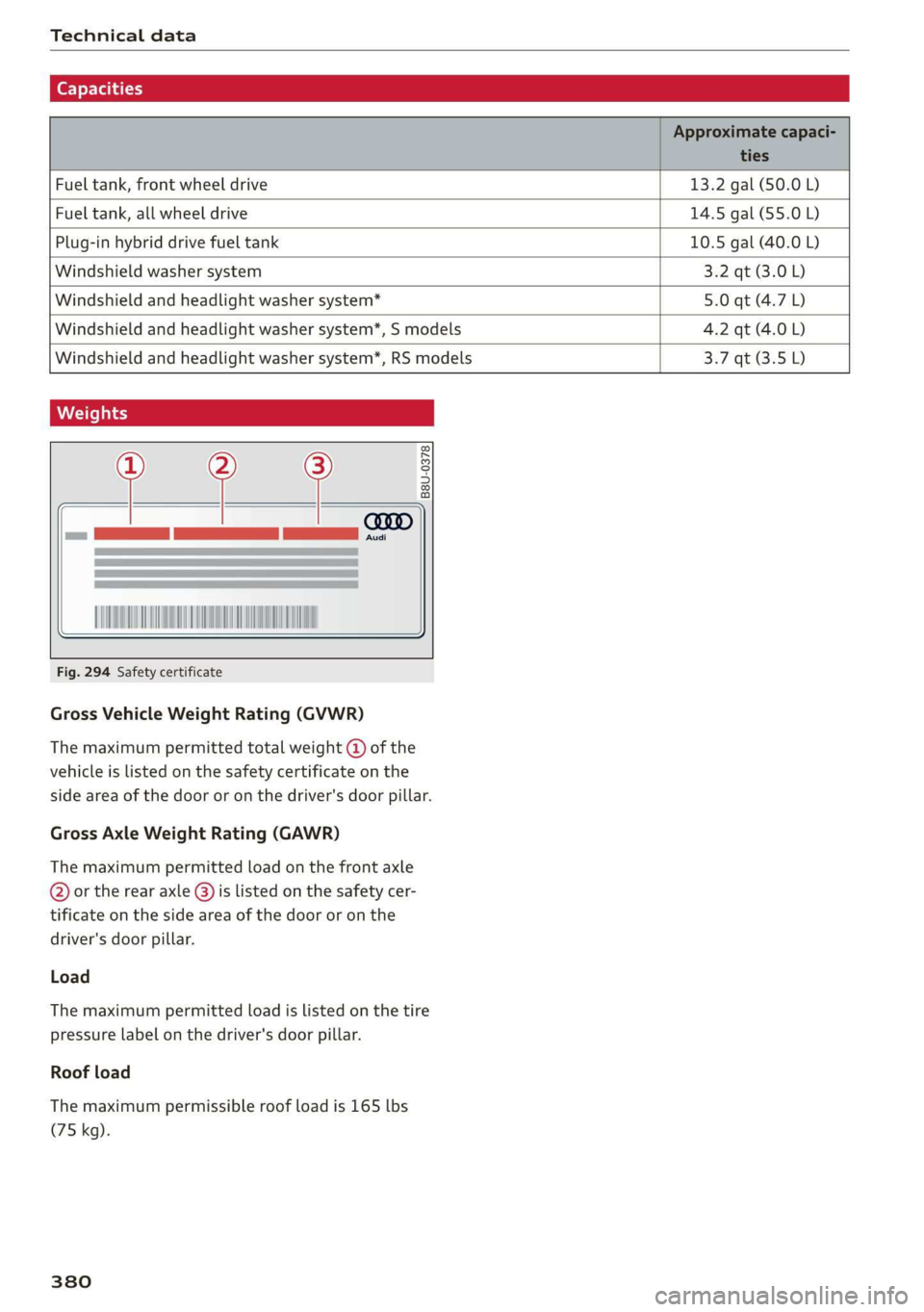
Fig. 294 Safety certificate
Gross Vehicle Weight Rating (GVWR)
The maximum permitted total weight @ of the
vehicle is listed on the safety certificate on the
side area of the door or on the driver's door pillar.
Gross Axle Weight Rating (GAWR)
The maximum permitted load on the front axle
@ or the rear axle @) is listed on the safety cer-
tificate on the side area of the door or on the
driver's door pillar.
Load
The maximum permitted load is listed on the tire
pressure label on the driver's door pillar.
Roof load
The maximum permissible roof load is 165 lbs
(75 kg).
380
Page 385 of 400

8V2012721BK
Cell phone
refer to Telephone...........-0eee eee 169
Cell phone compartment
refer to Audi phone box............... 171
Central locking. ...... 0c. sce e cece eee ee 25
Convenience key........-.--. eee eee e ees 28
Convenience opening and closing......... 34
Mechanically unlocking and locking....... 30
MESSAGG% = saws 7 2 ques « 2 mE s F aS « RoE 29
Remote control key..........0 eee eee ee 27
Setting... 26... cece eee eee 29
Central locking switch..............20-0. 29
Gertifications. . « srw. © suscuas «2 soaneue uo wines 377
Changing'the'scale « ssewic « 5 wwe o # eae ¥ eave 18
Charging
refer to Power sourceS.........-- 000 eee 59
Charging clip..............02..00 ee eee 103
Charging the battery (mobile devi-
(o) 171, 217, 218
Charging (plug-in hybrid drive)............ 97
Child restraints
Danger of using child restraints in the front
SGA = s gcse c x secu = 2 Bees & x Sees eo ee 254
Where can I get additional information
about child restraints and their use?..... 297
Child restraint system anchors........... 292
Child safety........ 0.0.0.0... eee eee eee 278
Important safety instructions for using child
Safety S@ats + meus is ewe yo ees es ewww ee 282
Methemamchorshes = sxncams u water « 5 wens «4 ane 294
Tether straps ..... 2... eee eee eee eee 294
Child safety lock
POWErWIRGOWS): « = smu = 2 seems ss mu < ee 33
ReaMmdOOrsts + wena ov nasi 2 v sues oH sean 2 so 33
Child safety seats........ 00... eee eee eee 284
BoostersSeatstin. i. « scm «x score + x mnie so ane 287
Convertible child seats............20.. 285
Convertible locking retractor........... 290
How do I properly install a child safety seat
in my vehicle?......... 02... c eee eae 282
Infantis@atss « s seme x sews 5 a eames 2 oes 284
Installing a child restraint using the LATCH
SyStEM . 2... eee 293
LATGHISYStEM): = sews « « sewn 5 7 noups 4 «eee 293
Mounting and releasing the anchorage
Hook... . eee eee 293
Safety instructions. « «secs + eeee ey vee 282
SOGUTING)s » +: seomen + w enews ¥ views ¥ Hume ae oe 289
Unused safety belts on the rear seat..... 284
Child seats
Lower anchorages..............000005 293
Classic ViQW.. ieee 19
Cleaning ......... eee eee ee eee eee 342
Cleaning/removing ice from windows...... 344
Cleaning Alcantara...............00000. 345
Cleaning artificial leather............... 345
Cleaning carbon components........ 344, 345
Cleaning controls « 2.23 ss eees «epee ee ee 345
Cleaning decorative parts/trim........... 344
Cleaning exhaust tail pipes.............. 344
Cleaning plastic parts...............00. 345
Cleaning textiles...................00. 345
Cleaning the tail lights.................. 343
Cleaning the windshield...............0.. 49
Climate control system
refer to 2-zone deluxe automatic climate
GORTIOL = vem: 2 5 nem cs eR s HERR Ee REE 65, 66
Clock... eee eee eee eee 230
Closing
Convenience closing ess « vewa ss wwe se oex 34
HOO « & sissies sina 6 8 omnis a ewan ow tne 305
Luggage compartment lid............... 31
Panoramic glass roof................055 35
POWOr Opis ss vescine so cose ¥ x essa s mewens Zo a 36
Windows... 1... cee cece cece eee eee eee 33
COASEG sccrozs » vases wv winengs ou eomeeae 6 e exemene 8 78
Cockpit (overview)i. « cscs « erassue x 6 mmcem ae conse 8
Golormnumber. ss ssc xe sees ov eases ao mewn 379
Coming home/Leaving home
refer to Entry/exit lighting.............. 45
Command (voice recognition system) ...... 162
CompartMent Sie. ss coves ov wren «veers wo rare 60
Compass inthe mirror............-000005 52
Compliance. « s seg: ss sees se Rees ee eee as 377
CONNE Chie: « s seen ce sees vs eens + ReeR oe oe 182
Audi connect e-tron services............ 185
Data plans.......... 0... eee eee eee 187
Data Privacy sc se oss s ence ss paeu si eer 372
InfotainMentix «= svesow a 2 wavwe so voscue eo aes 182
Infotainment services............-.00% 183
connect e-tron services...............0- 185
Connection manager.................4. 231
383
Page 387 of 400

8V2012721BK
Index
Dynamic volume
refer to System volume........---.00-5 235
E
E-mail...............0000 000 c eee eee 177
eco mode (climate control system)......... 66
Economical route wives so aicava a a wsnsens a 6 aienaie 197
EDL
refer to Electronic Differential Lock....... 93
EDR
refer to Event Data Recorder........... 371
Efficiency program... ... eee eee eee eee 23
Electrical system. .......2.-.0 ee eee eee 314
Electromechanical parking brake.......... 87
Electronic Differential Lock............... 94
Electronic immobilizer..............00005 26
Electronic Stabilization Control............ 93
Embedded)SIM Cat wavy. s waves » x eee 3 5 ee 183
Emergency assistance ............0 eee 348
Emergency braking function.............. 87
Emergency flashers.............0.000005 45
Emergency mode...................2005 77
Emergency operation
DOOrs 0... eee eee 30
Fuebfillerdoor's » = sry : 4 sews s eae s pee 301
Luggage compartment lid............... 32
Panoramic glass roof................-. 35
Emergency starting..................-. 364
Emissions control system..............- 303
Energy CONSUMENS « « sick 4 este oo weirs oo ave 22
Energy management............eceeeeee 82
Energy recovery
refer to Recuperation.................. 78
Engine
Breakingin.............2..2.02020020005 78
GCoGlaiitiowen: « 2 wage « 2 germs gz eee ge EE EE 311
Emerqeney:stops « sesscc x 2 same a v answes vv ase 71
Jump starting ........ cee cece eee eee 364
Jump starting (plug-in hybrid drive)...... 365
Start/Stop'SySteM sei os wes eo sosnene o + wore 83
Starting and stopping.................. 71
Engine braking effect
refer to Recuperation..............000. 78
Engine compartment
Opening and closing the hood.......... 305
OVERVIEW ecu 3 2 cows « @ eos ¢ eae go re 307
Safety precautions.................04. 304
Engine data
refer to Sport displays............000005 24
Engine oil
Adding ......... 00. c cee ee eee eee ee 307
CHANGING ox « « caw « paawy s mews oo Romy s & 310
Checking oil:leveli. . « csscie «0 vce wn meee a 307
Consumption...........0..-0.0 eee eee 307
DiPStick:: s sees = x ween 2 2 Bowe 2 ze eees Bae 307
Indicator light & cscs. x x wow xo coon ea menos 308
Replacement interval................. 318
Temperature display................0.. 23
Engine start system. ..............0..0-. 73
Engine stop
Goastings: « sss + ¢ sees + ¢ ceeie oo ews = 78, 83
Enhanced VieW « ase > mee s soem es eee ee 19
Entering characters/numbers (speller)... .. 153
Entering letters (speller)................ 153
Entertainment sliding menu............. 151
Entry/exit lighting. ............. 0... eee 45
Entry assistance
refer to Seats... 2... eee ee 55
Environment
Unleaded gasoline................205. 298
EPB
refer to Electromechanical parking brake.. 87
eSIM
refer to Embedded SIM card............ 183
Event: Data Recorder's « «sci. e s sxcciws 2 a eon © 371
Exterior lighting: < swe « = sews sy eee = 5 oes 43
Exterior MUrrOtScs: = = seus « 2 ees ae ween eo: 47
FOldin Qian 3 5 soane vx wens 2 ¥ anewens oo shea a 2 ae 47
Folding settings................0e ee eee 29
External voice operation................ 168
F
Factory default settings
Multi Media Interface................. 231
Fader (sound) ...........- 0c eee eee eee ee 234
Fastening
Booster seats..............0-00-0000. 287
Convertible child safety seats........... 285
Infant seats.......... 0... cee eee eee ee 284