seats AUDI A3 2020 Owner´s Manual
[x] Cancel search | Manufacturer: AUDI, Model Year: 2020, Model line: A3, Model: AUDI A3 2020Pages: 400, PDF Size: 107.47 MB
Page 257 of 400
8V2012721BK
Airbag system
about children and Advanced Airbags
=> page 278.
Even though your vehicle is equipped with an Ad-
vanced Airbag System, make certain that all chil-
dren, especially those 12 years and younger, al-
ways ride in the back seat properly restrained for
their age and size. The airbag on the passenger
side makes the front seat a potentially dangerous
place for a child to ride. The front seat is not the
safest place for a child in a forward-facing child
seat.
It can be a very dangerous place for an in-
fant or a child in a rearward-facing seat.
The Advanced Airbag System in your vehicle has
been certified to comply with the requirements
of United States Federal Motor Vehicle Safety
Standard (FMVSS) 208, as well as Canada Motor
Vehicle Safety Standard (CMVSS) 208 as applica-
ble at the time your vehicle was manufactured.
According to requirements, the front Advanced
Airbag System on the passenger side has been
certified for “suppression” for infants of about
12 month old and younger and for “low risk de-
ployment” for children aged 3 to 6 years old (as
defined in the standard).
The PASSENGER AIR BAG OFF light in the instru-
ment panel tells you when the front Advanced
Airbag on the passenger side has been turned off
by the electronic control unit.
Each time you switch on the ignition, the PAS-
SENGER AIR BAG OFF light will come on for a
few seconds and:
— will stay on if the front passenger seat is not
occupied,
—will stay on if the electrical capacitance meas-
ured by the capacitive passenger detection sys-
tem for the front passenger seat equals the
combined capacitance of an infant up to about
one year of age and one of the rearward-facing
or forward-facing child restraints listed in Fed-
eral Motor Vehicle Safety Standard 208 with
which the Advanced Airbag System in your vehi-
cle was certified. For a listing of the child re-
straints that were used to certify your vehicle's
compliance with the U.S. Safety Standard
=> page 280.
— will stay on if there is a small child or child re-
straint on the front passenger seat,
— will go off if the front passenger seat is occu-
pied by an adult as registered by the capacitive
passenger detection system > page 265, Moni-
toring the Advanced Airbag System.
The PASSENGER AIR BAG OFF light comes on
when electrical capacitance registered on the
front passenger seat is equal to or less than the
combined capacitance of a typical 1 year-old in-
fant and one of the rearward-facing or forward-
facing child restraints listed in Federal Motor Ve-
hicle Safety Standard 208 with which the Ad-
vanced Airbag System in your vehicle was certi-
fied.
If the total electrical capacitance registered on
the front passenger seat is more than that of a
typical 1 year-old child but less than the weight
of a small adult, the front airbag on the passen-
ger side can deploy (the PASSENGER AIR BAG
OFF light does not come on).
If the PASSENGER AIR BAG OFF light does not
come on, the front airbag on the passenger side
has not been turned off by the electronic control
unit and can deploy if the control unit senses an
impact that meets the conditions stored in its
memory.
For example, the airbag may deploy if:
—asmall child that is heavier than a typical 1
year-old child is on the front passenger seat (re-
gardless of whether the child is in one of the
child seats listed > page 280), or
—a child who has outgrown child restraints is on
the front passenger seat.
If the front passenger airbag is turned off, the
PASSENGER AIR BAG OFF light comes on in the
instrument cluster and stays on.
If the front passenger airbag deploys, the Federal
Standard requires the airbag to meet the “low
risk” deployment criteria to reduce the risk of in-
jury through interaction with the airbag. “Low
risk” deployment occurs in those crashes that
take place at lower decelerations as defined in
the electronic control unit > page 265, PASSEN-
GER AIR BAG OFF light.
255
>
Page 258 of 400
Airbag system
Always remember, a child seat or infant carrier
installed on the front seat may be struck and
knocked out of position by the rapidly inflating
passenger's airbag in a frontal collision. The air-
bag could greatly reduce the effectiveness of the
child restraint and even seriously injure the child
during inflation.
For this reason, and because the back seat is the
safest place for children - when properly restrain-
ed according to their age and size - we strongly
recommend that children always sit in the back
seat > page 278, Child safety.
Z\ WARNING
A child in a rearward-facing child seat instal-
led on the front passenger seat will be seri-
ously injured and can be killed if the front air-
bag inflates - even with an Advanced Airbag
System.
— The inflating airbag will hit the child seat or
infant carrier with great force and will
smash the child seat and child against the
backrest, center armrest, door or roof.
— Always install rear-facing child seats on the
rear seat.
— If you must install a rearward facing child
seat on the front passenger seat because of
exceptional circumstances and the PASSEN-
GER AIR BAG OFF light does not come on
and stay on, immediately install the rear-
facing child seat in a rear seating position
and have the airbag system inspected by
your Audi dealer.
— Forward-facing child seats installed on the
front passenger's seat may interfere with
the deployment of the airbag and cause seri-
ous personal injury to the child.
— Never put the forward-facing child restraint
up against or very near the instrument pan-
el,
— Always move the front passenger seat to the
highest position in the up and down adjust-
ment range and move it back to the rear-
most position in the seat's fore and aft ad-
justment range, as far away from the airbag
as possible, before installing the forward-
facing child restraint.
— Always make sure that the safety belt upper
anchorage is behind the child restraint and
not next to or in front of the child restraint
so that the safety belt will be properly posi-
tioned.
— Make sure that the PASSENGER AIR BAG
OFF light comes on and stays on all the time
whenever the ignition is switched on.
ZA WARNING
If, in exceptional circumstances, you must in-
stall a forward-facing child restraint on the
front passenger's seat:
— Always make sure the forward-facing seat
has been designed and certified by its manu-
facturer for use on a front seat with a pas-
senger front and side airbag.
ZA\ WARNING
To reduce the risk of serious injury, make sure
that the PASSENGER AIR BAG OFF light will
be displayed whenever a child restraint is in-
stalled on the front passenger seat and the ig-
nition is switched on.
— If the PASSENGER AIR BAG OFF light does
not stay on, perform the checks described
= page 265, Monitoring the Advanced Air-
bag System.
— Take the child restraint off the front passen-
ger seat and install it properly at one of the
rear seat positions if the PASSENGER AIR
BAG OFF light does not stay on.
— Have the airbag system inspected by your
Audi dealer immediately.
— Always carefully follow instructions from
child restraint manufacturers when instal-
ling child restraints.
ZA, WARNING
If, in exceptional circumstances, you must in-
stall a forward or rearward-facing child re-
straint on the front passenger's seat:
— Improper installation of child restraints can
reduce their effectiveness or even prevent
them from providing any protection.
256
Page 260 of 400
Airbag system
— Never hold the steering wheel at the 12
o'clock position or with your hands any-
where inside the steering wheel or on the
steering wheel hub. Holding the steering
wheel the wrong way increases the risk of
severe injury to the arms, hands, and head if
the driver airbag deploys.
ZA\ WARNING
Objects between you and the airbag will in-
crease the risk of injury in a crash by interfer-
ing with the way the airbag unfolds and/or by
being pushed into you as the airbag inflates.
— Always make sure nothing is in the front air-
bag deployment zone that could be struck
by the airbag when it inflates.
— Objects in the zone of a deploying airbag can
become projectiles when the airbag deploys
and cause serious personal injury.
— Never hold things in your hands or on your
lap when the vehicle is in use.
— Never place accessories or other objects
(such as cup holders, telephone brackets,
note pads, navigation systems, or things
that are large, heavy, or bulky) on the doors;
never attach them to the doors or the wind-
shield; never place them over or near or at-
tach them to the area marked ,, AIRBAG“ on
the steering wheel, instrument panel or the
seat backrests; never place them between
these areas and you or any other person in
the vehicle.
— Never attach objects to the windshield
above the passenger front airbag, such as
accessory GPS navigation units or music
players. Such objects could cause serious in-
jury in a collision, especially when the air-
bags inflate.
— Never recline the front passenger seat to
transport objects. Items can also move into
the deployment area of the side airbags or
the front airbag during breaking or in a sud-
den maneuver. Objects near the airbags can
fly dangerously through the passenger com-
partment and cause injury, particularly
when the seat is reclined and the airbags in-
flate.
258
Z\ WARNING
A person on the front passenger seat, espe-
cially infants and small children, will receive
serious injuries and can even be killed by be-
ing too close to the airbag when it inflates.
— Although the Advanced Airbag System in
your vehicle is designed to turn off the front
passenger airbag if an infant or a small child
is on the front passenger seat, nobody can
absolutely guarantee that deployment un-
der these special conditions is impossible in
all conceivable situations that may happen
during the useful life of your vehicle.
— The Advanced Airbag System can deploy in
accordance with the ,,low risk“ option for 3-
and 6-year-old children under the U.S. Fed-
eral Standard if a child with electrical capac-
itance greater than the combined capaci-
tance of a typical one-year old infant re-
strained in one of the forward facing or rear-
ward-facing child seats with which your ve-
hicle was certified is on the front passenger
seat and the other conditions for airbag de-
ployment are met.
— Accident statistics have shown that children
are generally safer in the rear seat area than
in the front seating position.
— For their own safety, all children, especially
12 years and younger, should always ride in
the back properly restrained for their age
and
size.
Advanced front airbag system
Your vehicle is equipped with a front Advanced
Airbag System in compliance with United States
Federal Motor Vehicle Safety Standard 208, as
well as Canada Motor Vehicle Safety Standard
(CMVSS) 208 as applicable at the time your vehi-
cle was manufactured.
The front Advanced Airbag System supplements
the safety belts to provide additional protection
for the driver's and front passenger's heads and
upper bodies in frontal crashes. The airbags in-
flate only in frontal impacts when the vehicle de-
celeration is high enough.
Page 261 of 400
8V2012721BK
Airbag system
The front Advanced Airbag System for the front
seat occupants is not a substitute for your safety
belts. Rather, it is part of the overall occupant re-
straint system in your vehicle. Always remember
that the airbag system can only help to protect
you, if you are sitting upright, wearing your safe-
ty belt and wearing it properly. This is why you
and
your passengers must always be properly re-
strained, not just because the law requires you to
be.
The Advanced Airbag System in your vehicle has
been certified to meet the “low risk” require-
ments for 3 and 6 year-old children on the pas-
senger side and very small adults on the driver
side. The low risk deployment criteria are intend-
ed to help reduce the risk of injury through inter-
action with the front airbag that can occur, for
example, by being too close to the steering wheel
and instrument panel when the airbag inflates.
In addition, the system has been certified to
comply with the “suppression” requirements of
the Safety Standard, to turn off the front airbag
for infants 12 months old and younger who are
restrained on the front passenger seat in child re-
straints that are listed in the Standard
=> page 280, Child restraints and Advanced front
airbag system.
“Suppression” requires the front airbag on the
passenger side to be turned off if:
—achild up to about one year of age is restrained
on the front passenger seat in one of the rear-
facing or forward-facing infant restraints listed
in Federal Motor Vehicle Safety Standard 208
with which the Advanced Airbag System in your
vehicle was certified. For a listing of the child
restraints that were used to certify your vehi-
cle's compliance with the US Safety Standard
=> page 280,
—a person is detected on the front passenger
seat that has an electrical capacitance that is
more than the total electrical capacitance of a
child that is about 1 year old restrained in one
of the rear-facing or forward-facing infant re-
straints (listed in Federal Motor Vehicle Safety
Standard 208 with which the Advanced Airbag
System in your vehicle was certified), the front
airbag on the passenger side may or may not
deploy.
The PASSENGER AIR BAG OFF light comes on
when the electronic control unit detects a total
electrical capacitance on the front passenger seat
that requires the front airbag to be turned off. If
the PASSENGER AIR BAG OFF light does not
come on, the front airbag on the passenger side
has not been turned off by the control unit and
can deploy if the control unit senses an impact
that meets the conditions stored in its memory.
If the total electrical capacitance registered on
the front passenger seat is more than that of a
typical 1 year-old, but less than the weight of a
small adult, the front airbag on the passenger
side may deploy (the PASSENGER AIR BAG OFF
light does not come on).
For example, the airbag may deploy if:
—asmall child that is heavier than a typical 1
year-old child is on the front passenger seat (re-
gardless of whether the child is in one of the
child seats listed S page 280),
—a child who has outgrown child restraints is on
the front passenger seat.
If the front passenger airbag is turned off, the
PASSENGER AIR BAG OFF light in the center of
the instrument panel will come on and stay on.
If the front passenger airbag deploys, the Federal
Standard requires the airbag to meet the “low
risk” deployment criteria to help reduce the risk
of injury through interaction with the airbag.
“Low risk” deployment occurs in those crashes
that take place at lower decelerations as defined
in the electronic control unit > page 265.
Always remember: Even though your vehicle is
equipped with Advanced Airbags, the safest place
for children is properly restrained on the back
seat. Please be sure to read the important infor-
mation in the sections that follow and be sure to
heed all of the WARNINGS.
ZA\ WARNING
To reduce the risk of injury when an airbag in-
flates, always wear safety belts properly. >
259
Page 263 of 400

8V2012721BK
Airbag system
the seat may prevent the Advanced Airbag Sys-
tem for the front passenger seat from doing its
job ina crash.
The front Advanced Airbag System consists
of the following:
— Crash sensors in the front of the vehicle that
measure vehicle acceleration/deceleration to
provide information to the Advanced Airbag
System about the severity of the crash.
— An electronic control unit, with integrated
crash sensors for front and side impacts. The
control unit “decides” whether to fire the front
airbags based on the information received from
the crash sensors. The control unit also “de-
cides” whether the safety belt pretensioners
should be activated.
— An Advanced Airbag with gas generator for the
driver inside the steering wheel hub.
— An Advanced Airbag with gas generator inside
the instrument panel for the front passenger.
— A capacitive passenger detection system under-
neath the front passenger seat cover. This sys-
tem measures the electrical capacitance of the
person in the seat. The information registered
is sent continuously to the electronic control
unit to regulate deployment of the front Ad-
vanced Airbag on the passenger side.
— An airbag monitoring system and indicator
light in the instrument cluster > page 265.
—Asensor in each front seat registers the dis-
tance between the respective seat and the
steering wheel or instrument panel. The infor-
mation registered is sent continuously to the
electronic control unit to regulate deployment
of the front Advanced Airbags.
— The PASSENGER AIR BAG OFF light comes on
and stays on in the center of the instrument
panel > page 304 and tells you when the front
Advanced Airbag on the passenger side has
been turned off.
—Asensor in the safety belt latch for the driver
and for the front seat passenger that senses
whether that safety belt is latched or not and
transmits this information to the electronic
control unit.
ZA WARNING
Damage to the front passenger seat can pre-
vent the front airbag from working properly.
— Improper repair or disassembly of the front
passenger and driver seat will prevent the
Advanced Airbag System from functioning
properly.
— Repairs to the front passenger seat must be
performed by qualified and properly trained
workshop personnel.
— Never remove the front passenger or driver
seat from the vehicle.
— Never remove the upholstery from the front
Passenger Seat.
— Never disassemble or remove parts from the
seat or disconnect wires from it.
— Never carry sharp objects in your pockets or
put them on the seat. The capacitive passen-
ger detection mat in the front passenger
seat will not function properly if it is punc-
tured.
— Never carry things on your lap or carry ob-
jects on the front passenger seat. Such ob-
jects can
influence the capacitance regis-
tered by the capacitive passenger detection
system, so that incorrect information is pro-
vided to the airbag control unit.
— Never store items under the front passenger
seat. Parts of the Advanced Airbag System
under the passenger seat could be dam-
aged, preventing them and the airbag sys-
tem from working properly.
— Never place seat covers or replacement up-
holstery that have not been specifically ap-
proved by Audi on the front seats.
— Seat covers can prevent the Advanced Airbag
System from recognizing child restraints or
occupants on the front passenger seat and
prevent the side airbag in the seat backrest
from deploying properly.
—If a seat heater has been retrofitted or oth-
erwise added to the front passenger seat,
never install any child restraint system on
this seat.
— Never use cushions, pillows, blankets, or
similar items on the front passenger seat.
The additional layers prevent the capacitive
261
Page 264 of 400

Airbag system
passenger detection system from accurately
measuring the capacitance of the child safe-
ty seat and/or the person on the seat and
thus keep the Advanced Airbag System from
working properly.
— Never place or use any electrical device
(such as a laptop, CD player, electronic
games device, power inverter or seat heater
for child seats) on the front passenger seat
if the device is connected to the 12-volt
socket or the cigarette lighter socket. Such
devices can influence the capacitance regis-
tered by the capacitive passenger detection
system, so that incorrect information is pro-
vided to the airbag control unit.
— If you must use a child restraint on the front
passenger seat and the child restraint man-
ufacturer's instructions require the use of a
towel, foam cushion or something else to
properly position the child restraint, make
certain that the PASSENGER AIR BAG OFF
light comes on and stays on whenever the
child restraint is installed on the front pas-
senger seat.
— If the PASSENGER AIR BAG OFF light does
not come on and stay on, immediately in-
stall child restraint in a rear seating position
and have the airbag system inspected by
your Audi dealer.
Z\ WARNING
If the front passenger seat gets wet, dry it im-
mediately.
— If liquid soaks into the front passenger seat,
this can keep the airbag system from work-
ing properly and may, for instance, deacti-
vate the passenger frontal airbag. If this
happens, the PASSENGER AIR BAG OFF
light will come on and stay on together with
the airbag indicator light Ea in the instru-
ment cluster.
— If liquid is pooled on the seat, but has not
soaked in, this may also keep the airbag sys-
tem from working properly and cause the
passenger frontal airbag to be enabled
(turned on), even though there is a properly
installed child restraint system on the seat.
Wet towels or other wet things on the seat
cushion can have the same effect. If the
front passenger frontal airbag is turned on,
the PASSENGER AIR BAG OFF light will turn
off.
How the Advanced Airbag System
components work together
The front Advanced Airbag System and the side
airbags supplement the protection offered by the
front three-point safety belts and the adjustable
head restraints* to help reduce the risk of injury
in a wide range of accident and crash situations.
Be sure to read the important information about
safety and heed the WARNINGS in this chapter.
Deployment of the Advanced Airbag System and
the activation of the safety belt pretensioners de-
pend on the deceleration measured by the crash
sensors and registered by the electronic control
unit. Crash severity depends on speed and decel-
eration as well as the mass and stiffness of the
vehicle or object involved in the crash.
On the passenger side, regardless of safety belt
use, the front passenger frontal airbag will be
turned off if the electrical capacitance measured
by the capacitive passenger detection system on
the front passenger seat is less than the amount
programmed in the electronic control unit. The
front passenger frontal airbag will also be turned
off if the capacitance measured by the system for
the front passenger seat equals that of an infant
of about one year of age in one of the child seats
that was used to certify the Advanced Airbag Sys-
tem under Federal Motor Vehicle Safety Standard
208. The PASSENGER AIR BAG OFF light comes
on and stays on to tell you when the front Ad-
vanced Airbag System on the passenger side has
been turned off > page 265.
ZA WARNING
To reduce the risk of injury when an airbag in-
flates, always wear safety belts properly.
— If you are unrestrained, leaning forward, sit-
ting sideways or out of position in any way,
your risk of injury is much higher.
— You will also receive serious injuries and
could even be killed if you are up against the
262
Page 265 of 400
8V2012721BK
Airbag system
airbag or too close to it when it inflates -
even with an Advanced Airbag > page 253.
TCM tee MoM dalla iol tLs
airbags
B4H-0271
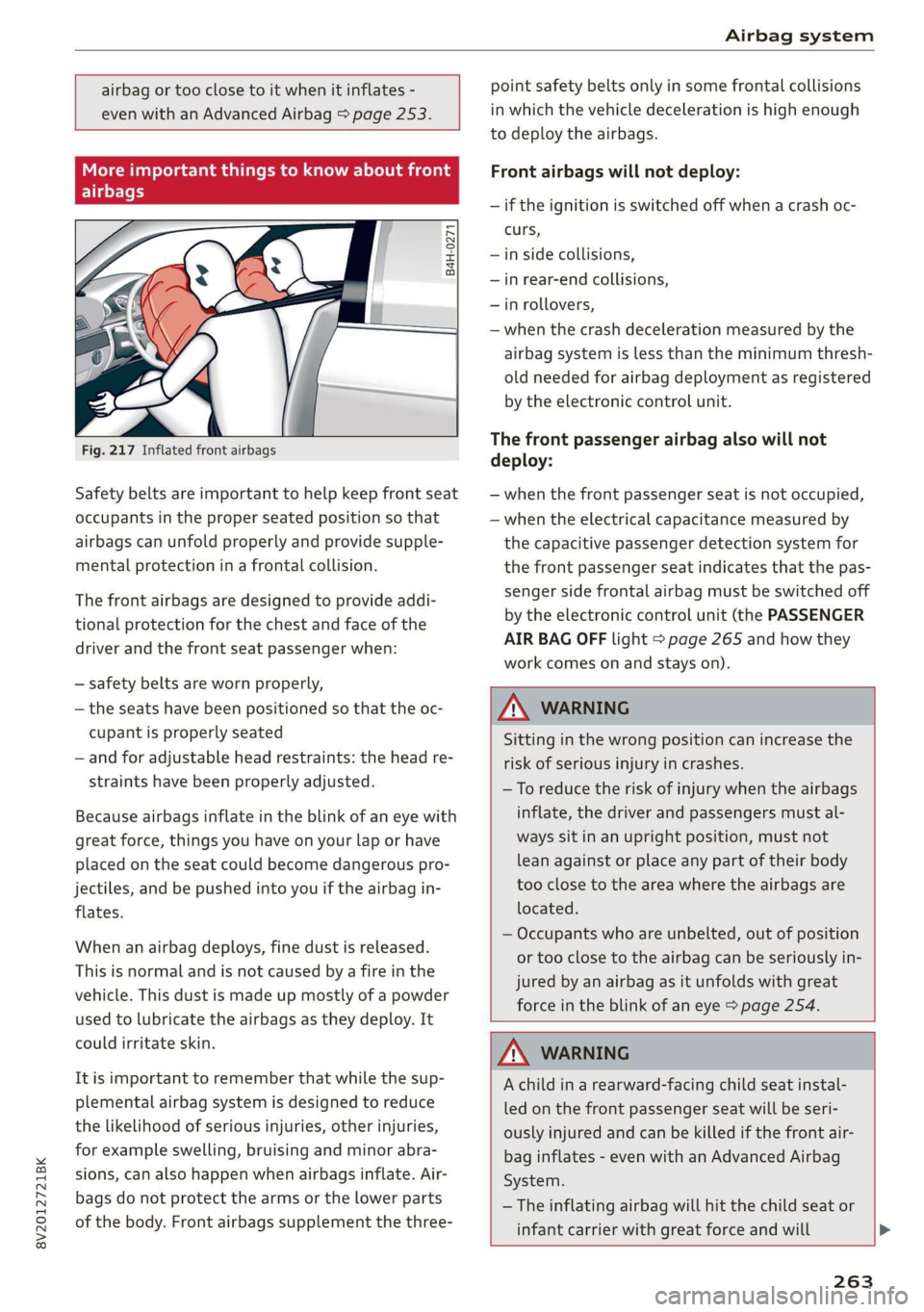
Fig. 217 Inflated front airbags
Safety belts are important to help keep front seat
occupants in the proper seated position so that
airbags can unfold properly and provide supple-
mental protection in a frontal collision.
The front airbags are designed to provide addi-
tional protection for the chest and face of the
driver and the front seat passenger when:
— safety belts are worn properly,
— the seats have been positioned so that the oc-
cupant is properly seated
—and for adjustable head restraints: the head re-
straints have been properly adjusted.
Because airbags inflate in the blink of an eye with
great force, things you have on your lap or have
placed on the seat could become dangerous pro-
jectiles, and be pushed into you if the airbag in-
flates.
When an airbag deploys, fine dust is released.
This is normal and is not caused by a fire in the
vehicle. This dust is made up mostly of a powder
used to lubricate the airbags as they deploy. It
could irritate skin.
It is important to remember that while the sup-
plemental airbag system is designed to reduce
the likelihood of serious injuries, other injuries,
for example swelling, bruising and minor abra-
sions, can also happen when airbags inflate. Air-
bags do not protect the arms or the lower parts
of the body. Front airbags supplement the three-
point safety belts only in some frontal collisions
in which the vehicle deceleration is high enough
to deploy the airbags.
Front airbags will not deploy:
— if the ignition is switched off when a crash oc-
curs,
— in side collisions,
—in rear-end collisions,
—in rollovers,
— when the crash deceleration measured by the
airbag system is less than the minimum thresh-
old needed for airbag deployment as registered
by the electronic control unit.
The front passenger airbag also will not
deploy:
— when the front passenger seat is not occupied,
— when the electrical capacitance measured by
the capacitive passenger detection system for
the front passenger seat indicates that the pas-
senger side frontal airbag must be switched off
by the electronic control unit (the PASSENGER
AIR BAG OFF light > page 265 and how they
work comes on and stays on).
ZA\ WARNING
Sitting in the wrong position can increase the
risk of serious injury in crashes.
—To reduce the risk of injury when the airbags
inflate, the driver and passengers must al-
ways sit in an upright position, must not
lean against or place any part of their body
too close to the area where the airbags are
located.
— Occupants who are unbelted, out of position
or too close to the airbag can be seriously in-
jured by an airbag as it unfolds with great
force in the blink of an eye > page 254.
ZA\ WARNING
A child in a rearward-facing child seat instal-
led on the front passenger seat will be seri-
ously injured and can be killed if the front air-
bag inflates - even with an Advanced Airbag
System.
— The inflating airbag will hit the child seat or
infant carrier with great force and will
263
Page 266 of 400

Airbag system
smash the child seat and child against the
backrest, center armrest, door or roof.
— Always install rear-facing child seats on the
rear seat.
— If you must install a rearward facing child
seat on the front passenger seat because of
exceptional circumstances and the PASSEN-
GER AIR BAG OFF light does not come on
and stay on, immediately install the rear-
facing child seat in a rear seating position
and have the airbag system inspected by
your Audi dealer.
ZA WARNING
Objects between you and the airbag will in-
crease the risk of injury in a crash by interfer-
ing with the way the airbag unfolds or by be-
ing pushed into you as the airbag inflates.
— Never hold things in your hands or on your
lap when the vehicle is in use.
— Never transport items on or in the area of
the front passenger seat. Objects could
move into the area of the front airbags dur-
ing braking or other sudden maneuvers and
become dangerous projectiles that can
cause serious personal injury if the airbags
inflate.
— Never place or attach accessories or other
objects (such as cup holders, telephone
brackets, large, heavy or bulky objects) on
the doors, over or near the area marked
“AIRBAG” on the steering wheel, instrument
panel, seat backrests or between those
areas and yourself. These objects could
cause injury in a crash, especially when the
airbags inflate.
— Never recline the front passenger's seat to
transport objects. Items can also move into
the area of the side airbag or the front air-
bag during braking or in a sudden maneuver.
Objects near the airbags can become projec-
tiles and cause injury, particularly when the
seat is reclined.
— Never place or transport objects on the front
passenger seat. Objects on the front passen-
ger seat could cause the capacitive sensor in
the seat to signal to airbag system that the
seat is occupied by a person when it in fact is
not, or that the person on the seat is heavier
than he or she actually is. The change in
electric capacitance because of such objects
can cause the passenger front airbag to be
turned on when it should be off, or can
cause the airbag to work in a way that is dif-
ferent from the way it would have worked
without objects on the seat.
— Always make sure that there is nothing on
the front passenger seat that will cause the
capacitive passenger detection system in
the seat to signal to the Airbag System that
the seat is occupied by a person when it is
not, or to signal that it is occupied by some-
one who is heavier than the person actually
sitting on the seat. The presence of an ob-
ject could cause the passenger front airbag
to be turned on when it should be off, or
could cause the airbag to work in a way that
is different from the way it would have
worked without the object on the seat.
ZA\ WARNING
The fine dust created when airbags deploy can
cause breathing problems for people with a
history of asthma or other breathing condi-
tions.
—To reduce the risk of breathing problems,
those with asthma or other respiratory con-
ditions should get fresh air right away by
getting out of the vehicle or opening win-
dows or doors.
— If you are in a collision in which airbags de-
ploy, wash your hands and face with mild
soap and water before eating.
— Be careful not to get the dust into your eyes,
or into any cuts or scratches.
— If the residue should get into your eyes,
flush them with water.
264
Page 268 of 400

Airbag system
The PASSENGER AIR BAG OFF light will show
the status of the front seat passenger's frontal
Advanced Airbag a few seconds after the igni-
tion is switched on and the airbag indicator
light goes off. The PASSENGER AIR BAG OFF
light:
— will stay on if the front passenger seat is not
occupied;
—will stay on if the electrical capacitance meas-
ured by the capacitive passenger detection sys-
tem for the front passenger seat equals the
combined capacitance of an infant up to about
one year of age and one of the rearward-facing
or forward-facing child restraints listed in Fed-
eral Motor Vehicle Safety Standard 208 with
which the Advanced Airbag System in your vehi-
cle was certified; For a listing of the child re-
straints that were used to certify your vehicle's
compliance with the U.S. Safety Standard
=> page 280.
— will go out if the front passenger seat is occu-
pied by an adult as registered by the capacitive
passenger detection system.
— The PASSENGER AIR BAG OFF light must come
on and stay on if the ignition is on and...
—a car bed has been installed on the front pas-
senger seat, or
—arearward-facing child restraint has been in-
stalled on the front passenger seat, or
—a forward-facing child restraint has been instal-
led on the front passenger seat,
—and if the electrical capacitance registered on
the front passenger seat is equal to or less than
the combined capacitance of a typical 1 year-
old infant and one of the rearward-facing or
forward-facing child restraints listed in Federal
Motor Vehicle Safety Standard 208 with which
the Advanced Airbag System in your vehicle was
certified.
If the front passenger seat is not occupied, the
front airbag will not deploy, and the PASSENGER
AIR BAG OFF light will stay on. Never installa
rearward-facing child restraint on the front pas-
senger seat, the safest place for a child in any
kind of child restraint is at one of the seating po-
sitions on the rear seat > page 254, Child re-
266
straints on the front seat - some important
things to know and > page 278, Child safety.
If the PASSENGER AIR BAG light comes
on...
If the PASSENGER AIR BAG OFF light comes on
when one of the conditions listed above is met,
be sure to check the light regularly to make cer-
tain that the PASSENGER AIR BAG OFF light
stays on continuously whenever the ignition is
on. If the PASSENGER AIR BAG OFF light does
not appear on and does not stay on all the time,
stop as soon as it is safe to do so and
— reactivate the system by turning the ignition off
for more than 4 seconds and then turning it on
again;
— remove and reinstall the child restraint. Make
sure that the child restraint is properly installed
and that the safety belt for the front passenger
seat has been correctly routed through the
child restraint as described in the child restraint
manufacturer's instructions;
— make sure that the convertible locking retractor
on the safety belt for the front passenger seat
has been activated and that the safety belt has
been pulled tight.
— make sure that no electrical device (such as a
laptop, CD player, electronic games device,
power inverter or seat heater for child seats) is
placed or used on the front passenger seat if
the device is connected to the 12-volt socket or
the cigarette lighter socket;
— make sure that no seat heater has been retrofit-
ted or otherwise added to the front passenger
seat;
— make sure that nothing can interfere with the
safety belt buckles and that they are not ob-
structed;
— make sure that there are no wet objects (such
as a wet towel) and no water or other liquids on
the front passenger seat cushion.
If the PASSENGER AIR BAG light still does
not come on...
If the PASSENGER AIR BAG OFF light still does
not come on and does not stay on continuously
(when the ignition is switched on),
Page 269 of 400
8V2012721BK
Airbag system
— take the child restraint off the front passenger
seat and install it properly at one of the rear
seat positions. Have the airbag system inspect-
ed by your Audi dealer immediately.
— move the child to a rear seat position and make
sure that the child is properly restrained ina
child restraint that is appropriate for its size
and age.
The PASSENGER AIR BAG light should NOT
come on...
The PASSENGER AIR BAG OFF light should NOT
come on when the ignition is on and an adult is
sitting in a proper seating position on the front
passenger seat. If the PASSENGER AIR BAG OFF
light comes on and stays on or flashes for about
5 seconds while driving, under these circumstan-
ces, make sure that:
— the adult on the front passenger seat is proper-
ly seated on the center of the seat cushion with
his or her back up against the backrest and the
backrest is not reclined,
— the adult is not taking weight off the seat by
holding on to the passenger assist handle
above the front passenger door or supporting
their weight on the armrest,
— the safety belt is being properly worn and that
there is not a lot of slack in the safety belt web-
bing,
— there are no aftermarket seat covers or cush-
ions or other things (such as blankets) on the
front passenger seat that might cause the ca-
pacitive passenger detection system to miscal-
culate electrical capacitance.
Mu elas see)
monitoring the Advanced Airbag System
— If the PASSENGER AIR BAG OFF light does
not go off when an adult who is not very
small is sitting on the front passenger seat
after taking the steps described above,
make sure the adult is properly seated and
restrained at one of the rear seating posi-
tions. Have the airbag system inspected by
your authorized Audi dealer before trans-
porting anyone on the front passenger seat.
ZA WARNING
An airbag system that is not functioning prop-
erly cannot provide supplemental protection
in a frontal crash.
—If the airbag indicator light > page 238
comes when the vehicle is being used, have
the system inspected immediately by your
authorized Audi dealer. It is possible that
the airbag will inflate when it is not sup-
posed to, or will not inflate when it should.
Z\ WARNING
— If the status of the Advanced Airbag System
has changed while the vehicle is moving, the
PASSENGER AIR BAG OFF light blinks for
about 5 seconds to catch the driver's atten-
tion. If this happens, always stop as soon as
it is safe to do so and check the steps descri-
bed above.
Z\ WARNING
If the front airbag inflates, a child without a
child restraint, or in a rearward-facing child
safety seat, or in a forward-facing child re-
straint that has not been properly installed
will be seriously injured and can be killed.
— Even though your vehicle is equipped with
an Advanced Airbag System, make certain
that all children, especially 12 years and
younger, always ride on the back seat prop-
erly restrained for their age and size.
— Always install forward or rear-facing child
seats on the rear seat — even with an Ad-
vanced Airbag System.
— If you must install a rearward-facing child
seat on the front passenger seat because of
exceptional circumstances and the PASSEN-
GER AIR BAG OFF light does not appear and
stay on, immediately install the rear-facing
child seat in a rear seating position and have
the airbag system inspected by your Audi
dealer.
— If, in exceptional circumstances, you must
install a forward-facing child restraint on
the front passenger seat, always move the
seat into its rearmost position in the seat's
267