belt AUDI A3 2020 Owner´s Manual
[x] Cancel search | Manufacturer: AUDI, Model Year: 2020, Model line: A3, Model: AUDI A3 2020Pages: 400, PDF Size: 107.47 MB
Page 295 of 400
8V2012721BK
Child safety
pred folacoy a)
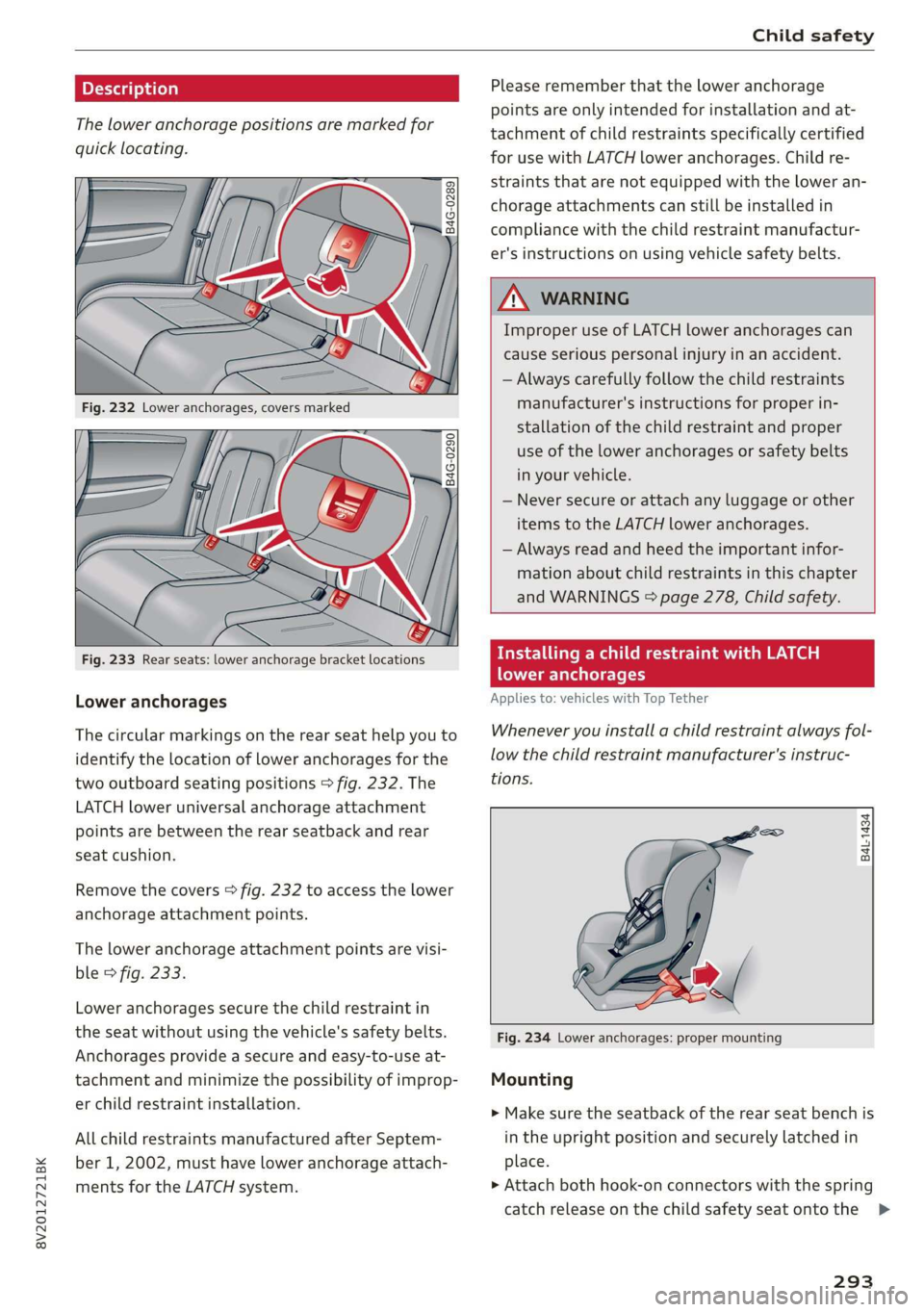
The lower anchorage positions are marked for
quick locating.
Fig. 233 Rear seats: lower anchorage bracket locations
Lower anchorages
The circular markings on the rear seat help you to
identify the location of lower anchorages for the
two outboard seating positions > fig. 232. The
LATCH lower universal anchorage attachment
points are between the rear seatback and rear
seat cushion.
Remove the covers > fig. 232 to access the lower
anchorage attachment points.
The lower anchorage attachment points are visi-
ble > fig. 233.
Lower anchorages secure the child restraint in
the seat without using the vehicle's safety belts.
Anchorages provide a secure and easy-to-use at-
tachment and minimize the possibility of improp-
er child restraint installation.
All child restraints manufactured after Septem-
ber 1, 2002, must have lower anchorage attach-
ments for the LATCH system.
Please remember that the lower anchorage
points are only intended for installation and at-
tachment of child restraints specifically certified
for use with LATCH lower anchorages. Child re-
straints that are not equipped with the lower an-
chorage attachments can still be installed in
compliance with the child restraint manufactur-
er's instructions on using vehicle safety belts.
Improper use of LATCH lower anchorages can
cause serious personal injury in an accident.
— Always carefully follow the child restraints
manufacturer's instructions for proper in-
stallation of the child restraint and proper
use of the lower anchorages or safety belts
in your vehicle.
— Never secure or attach any luggage or other
items to the LATCH lower anchorages.
— Always read and heed the important infor-
mation about child restraints in this chapter
and WARNINGS & page 278, Child safety.
Installing a child restraint with LATCH
lower anchorages
Applies to: vehicles with Top Tether
Whenever you install a child restraint always fol-
low the child restraint manufacturer's instruc-
tions.
B4L-1434
Fig. 234 Lower anchorages: proper mounting
Mounting
> Make sure the seatback of the rear seat bench is
in the upright position and securely latched in
place.
> Attach both hook-on connectors with the spring
catch release on the child safety seat onto the
293
Page 296 of 400
Child safety
LATCH lower anchorage so that the connectors
lock into place > fig. 234.
>» Pull on the connector attachments to make
sure they are properly attached to the LATCH
lower anchorage.
> Pull straps tight following the child restraint
manufacturer's instructions.
Releasing
> Loosen the tension on the straps following the
child restraint manufacturer's instructions.
> Depress the spring catches to release the an-
chorage hooks from the lower anchorages.
Remember: Use tether straps to help keep the
child restraint firmly in place.
ZA WARNING
Improper use of the LATCH system can in-
crease the risk of serious personal injury and
death in an accident.
— These anchors were developed only for child
safety seats using the “LATCH” system.
— Never attach other child safety seats, belts
or other objects to these anchors.
— Always make sure that you hear a click when
latching the seat in place. If you do not hear
a click the seat is not secure and could fly
forward and hit the interior of the vehicle, or
be ejected from the vehicle.
ZA WARNING
Improper installation of child restraints will
increase the risk of injury in an accident.
— Always follow the child restraint system
manufacturer's instructions for proper in-
stallation of the child restraint system and
proper use of tether straps as well as the
lower anchorages or safety belts in your ve-
hicle.
— Always read and heed the important infor-
mation and WARNINGS about child safety
and the installation of child restraint sys-
tems > page 278, Child safety.
294
Tether anchors and tether straps
5 S
zt 6
= o a
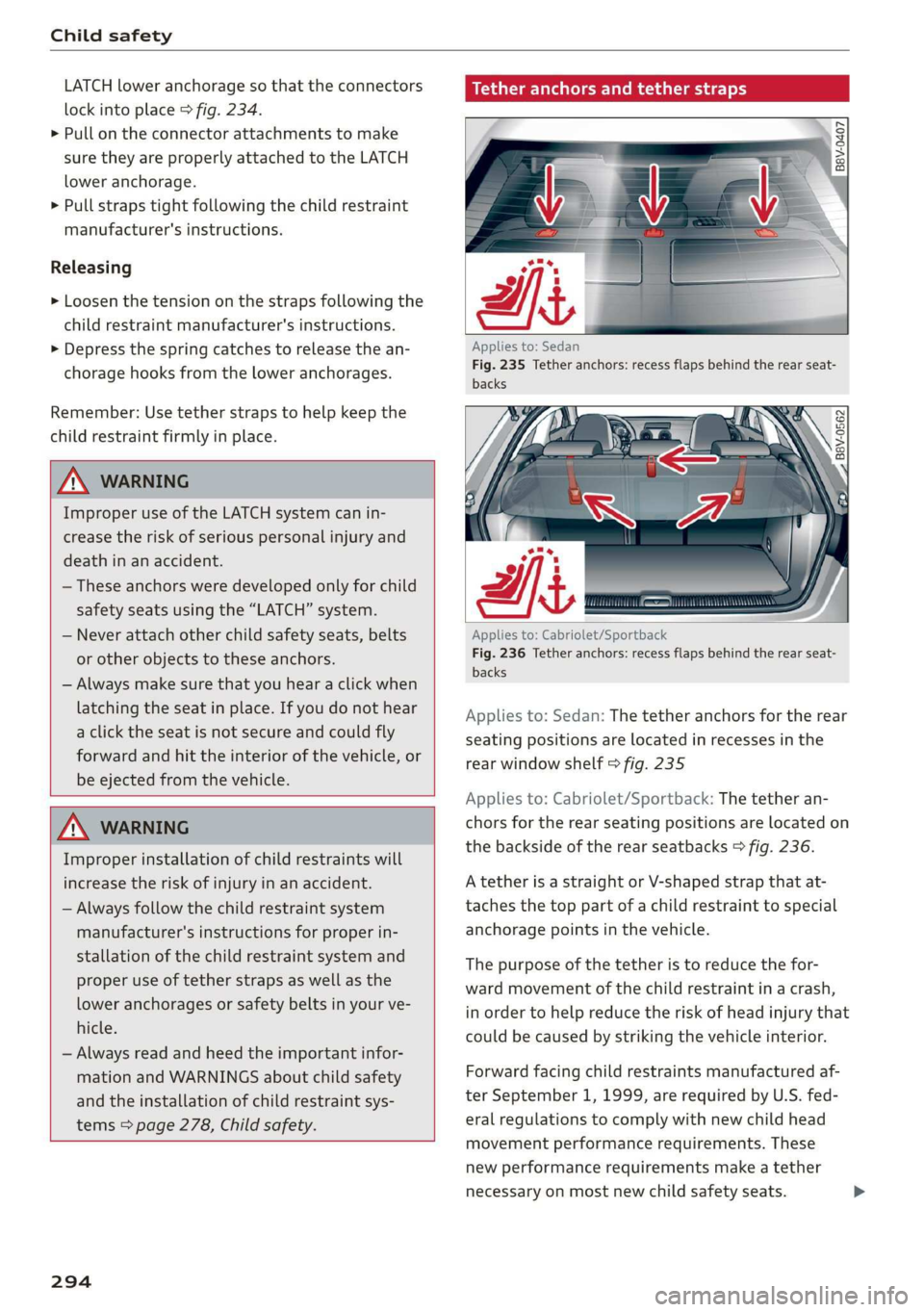
Applies to: Sedan
Fig. 235 Tether anchors: recess flaps behind the rear seat-
backs
B8V-0562
Applies to: Cabriolet/Sportback
Fig. 236 Tether anchors: recess flaps behind the rear seat-
backs
Applies to: Sedan: The tether anchors for the rear
seating positions are located in recesses in the
rear window shelf > fig. 235
Applies to: Cabriolet/Sportback: The tether an-
chors for the rear seating positions are located on
the backside of the rear seatbacks > fig. 236.
A tether is a straight or V-shaped strap that at-
taches the top part of a child restraint to special
anchorage points in the vehicle.
The purpose of the tether is to reduce the for-
ward movement of the child restraint in a crash,
in order to help reduce the risk of head injury that
could be caused by striking the vehicle interior.
Forward facing child restraints manufactured af-
ter September 1, 1999, are required by U.S. fed-
eral regulations to comply with new child head
movement performance requirements. These
new performance requirements make a tether
necessary on most new child safety seats.
Page 297 of 400
8V2012721BK
Child safety
A WARNING
Improper installation of child restraints will
— Always follow the instructions provided by
the manufacturer of the child restraint you
intend to install in your Audi.
— Improper use of child restraint anchors (in-
cluding tether anchors) can lead to injury in
a collision. The anchors are designed to
withstand only those loads imposed by cor-
rectly fitted child restraints.
— Never mount two child restraint systems on
one LATCH lower anchor point.
— Never attach two child restraint systems to
one tether strap or tether anchorage.
— Never attach a tether strap to a tie-down
hook in the luggage compartment.
— Never use child restraint tether anchorages
to secure safety belts or other kinds of occu-
pant restraints.
— Never secure or attach any luggage or other
items to the LATCH lower anchorages or to
the tether anchors.
— If you must install a rearward facing child
safety seat on the front passenger seat be-
cause of exceptional circumstances and the
PASSENGER AIR BAG OFF light does not
come on and stay on, immediately install
the rear-facing child safety seat in a rear
seating position and have the airbag system
inspected by your Audi dealer.
increase the risk of injury and death in a crash.
B8V-0565
Installing the upper tether strap on the
anchorage
B4L-1435
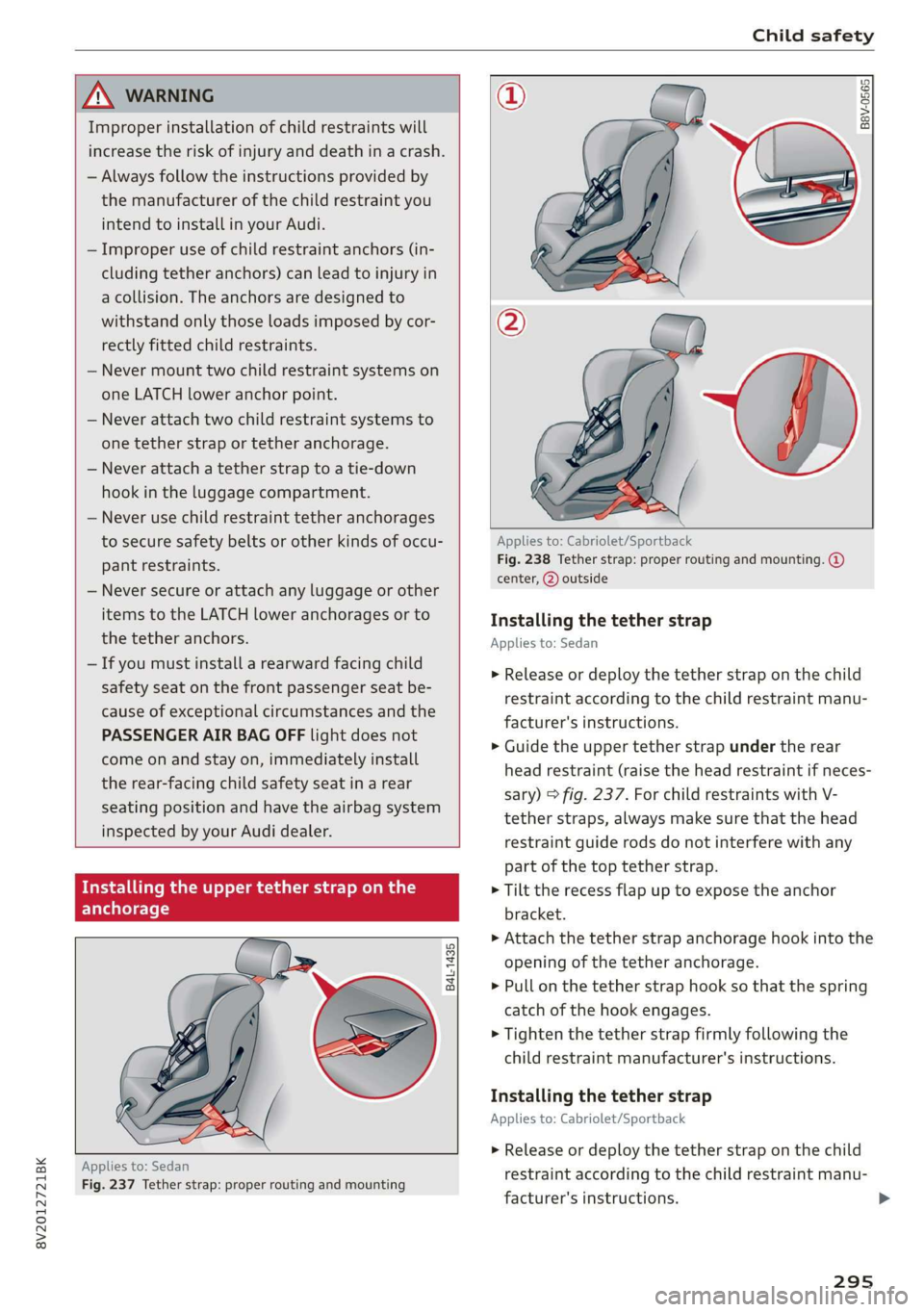
Applies to: Sedan
Fig. 237 Tether strap: proper routing and mounting
Applies to: Cabriolet/Sportback
Fig. 238 Tether strap: proper routing and mounting. @
center, @ outside
Installing the tether strap
Applies to: Sedan
> Release or deploy the tether strap on the child
restraint according to the child restraint manu-
facturer's instructions.
> Guide the upper tether strap under the rear
head restraint (raise the head restraint if neces-
sary) > fig. 237. For child restraints with V-
tether straps, always make sure that the head
restraint guide rods do not interfere with any
part of the top tether strap.
> Tilt the recess flap up to expose the anchor
bracket.
> Attach the tether strap anchorage hook into the
opening of the tether anchorage.
> Pull on the tether strap hook so that the spring
catch of the hook engages.
> Tighten the tether strap firmly following the
child restraint manufacturer's instructions.
Installing the tether strap
Applies to: Cabriolet/Sportback
> Release or deploy the tether strap on the child
restraint according to the child restraint manu-
facturer's instructions.
295
>
Page 298 of 400
Child safety
» Applies to: Sportback: Unlock the backrest and
fold it slightly forward > page 62, Increasing
the cargo area and locate the tether anchor be-
hind the rear seat backrest.
» Applies to: Cabriolet: Unlock the backrest and
fold it slightly forward > page 63, Pass-
through and locate the tether anchor behind
the rear seat backrest.
> Guide the upper tether strap under the rear
head restraint (raise the head restraint if neces-
sary) > fig. 238. For child restraints with V-
tether straps, always make sure that the head
restraint guide rods do not interfere with any
part of the top tether strap.
> Attach the tether strap anchorage hook into the
opening of the tether anchorage.
> Pull on the tether strap hook so that the spring
catch of the hook is engaged.
> Straighten the backrest back up into its upright
position and press it firmly into the locking
mechanism.
>» Tighten the tether strap firmly following the
child restraint manufacturer's instructions.
Releasing the tether strap
> Loosen the tension on the straps following the
child restraint manufacturer's instructions.
> Depress the spring catch on the hook and re-
lease it from the anchorage.
Remember: Use tether straps to help keep the
child restraint firmly in place.
ZA WARNING
Improper use of the LATCH system can in-
crease the risk of serious personal injury and
death in an accident.
— These anchors were developed only for child
safety seats using the “LATCH” system.
— Never attach other child safety seats, belts
or other objects to these anchors.
— Always make sure that you hear a click when
latching the seat in place. If you do not hear
a click the seat is not secure and could fly
forward and hit the interior of the vehicle, or
be ejected from the vehicle.
Z\ WARNING
Improper installation of child restraints will
increase the risk of injury in an accident.
— Always follow the child restraint system
manufacturer's instructions for proper in-
stallation of the child restraint system and
proper use of tether straps as well as the
lower anchorages or safety belts in your ve-
hicle.
— Always read and heed the important infor-
mation and WARNINGS about child safety
and the installation of child restraint sys-
tems > page 278, Child safety.
Using tether straps on rearward-facing
child restraints
Currently, few rear-facing child restraint systems
come with a tether. Please read and heed the
child restraint system manufacturer's instruc-
tions carefully to determine how to properly in-
stall the tether.
Z\ WARNING
A child in a rearward-facing child safety seat
installed on the front passenger seat will be
seriously injured and can be killed if the front
airbag inflates - even with an Advanced Airbag
System.
— The inflating airbag will hit the child safety
seat or infant carrier with great force and
will smash the child safety seat and child
against the backrest, center armrest, or
door.
— If you must install a rearward facing child
safety seat on the front passenger seat be-
cause of exceptional circumstances and the
PASSENGER AIR BAG OFF light does not
come on and stay on, immediately install
the rear-facing child safety seat in a rear
seating position and have the airbag system
inspected by your Audi dealer.
296
Page 299 of 400
8V2012721BK
Child safety
Additional information
Sources of information about child
restraints and their use
There are a number of sources of additional infor-
mation about child restraint selection, installa-
tion and use:
NHTSA advises that the best child safety seat is
the one that fits your child and fits in your vehi-
cle, and that you will use correctly and consis-
tently.
Try before you buy!
U.S. National Highway Traffic Safety Adminis-
tration
Tel.: 1-888-327-4236 (TTY: 1-800-424-9153)
http://www.nhtsa.gov
http://www.safercar.gov
National SAFE KIDS Campaign
Tel.: (202) 662-0600
http://www.safekids.org
Safety BeltSafe U.S.A.
Tel.: (800) 745-SAFE (English)
Tel.: (800) 747-SANO (Spanish)
http://www.carseat.org
Transport Canada Information Centre
Tel.: 1-800-333-0371 or call 1-613-998-8616 if
you are in the Ottawa area
http://www.tc.gc.ca/eng/roadsafety/menu.htm
Audi Customer Experience Center
Tel.: (800) 822-2834
297
Page 306 of 400
Checking and Filling
or authorized Audi Service Facility to have the
malfunction corrected.
The indicator light can also turn on if the fuel fill-
er cap is not closed correctly > page 2991).
ZA\ WARNING
Incorrect use of the connection port for the
On Board Diagnostic System can cause mal-
functions, which can then result in accidents
and serious injuries.
— Only allow an authorized Audi dealer or au-
thorized Audi Service Facility to read out the
engine data.
Engine compartment
(ee eel)
Special care is required if you are working in the
engine compartment
For work in the engine compartment, such as
checking and filling fluids, there is a risk of in-
jury, scalding, accidents, and burns. For this
reason, follow all the warnings and general
safety precautions provided in the following in-
formation. The engine compartment is a dan-
gerous area. > /\.
Z\ WARNING
— Turn the engine off.
— Switch the ignition off.
— Set the parking brake.
— Select the “P” (Park) selector lever position.
— Allow the engine to cool.
— Keep children away from the engine com-
partment.
— Never spill fluids on a hot engine. These flu-
ids (such as the anti-freezing agent con-
tained in the coolant) can ignite.
— Avoid short circuits in the electrical system.
— Never reach into the radiator fan. The fan is
temperature-controlled and can turn on
suddenly, even when the ignition is switched
off.
1) Depending on the engine and country
304
— Never open the hood when there is steam or
coolant escaping from the engine compart-
ment, because there is a risk that you could
be burned. Wait until no steam or coolant is
escaping.
Plug-in hybrid drive: the coolant expansion
tank cap is equipped with a seal that must
never be removed under any circumstances
=> page 312, fig. 251. If the coolant expan-
sion tank for the high-voltage system is not
sealed, please contact an authorized Audi
dealer or authorized Audi Service Facility.
Plug-in hybrid drive: the sealed cap must on-
ly be opened by an authorized Audi dealer or
authorized Audi Service Facility.
The cap on the coolant expansion tank must
never be opened as long as the coolant is
hot. The cooling system is under pressure.
There is a risk of burns
To protect your face, hands, and arms from
hot steam or coolant, cover the cap with a
thick cloth when opening.
Do not remove the engine cover under any
circumstances. This increases the risk of
burns.
Due to the risk of electric shock, never touch
the ignition cable or other components in
the electronic high-voltage ignition system
when the engine is running or is starting.
If a gear is engaged while the vehicle is sta-
tionary and the engine is running, do not
press the accelerator pedal inadvertently.
Pressing the accelerator pedal will cause the
vehicle to move, and this could result in an
accident.
If inspections or repairs must be performed
while the engine is running, moving compo-
nents (such as the ribbed belt, generator,
and radiator fan) pose an additional risk.
— Set the parking brake first and select the
“p” (Park) selector lever position.
— Always make sure that no parts of the
body, jewelry, ties, loose clothing, and
long hair can be caught in moving engine
Page 347 of 400
8V2012721BK
Care and cleaning
Component Situation Solution
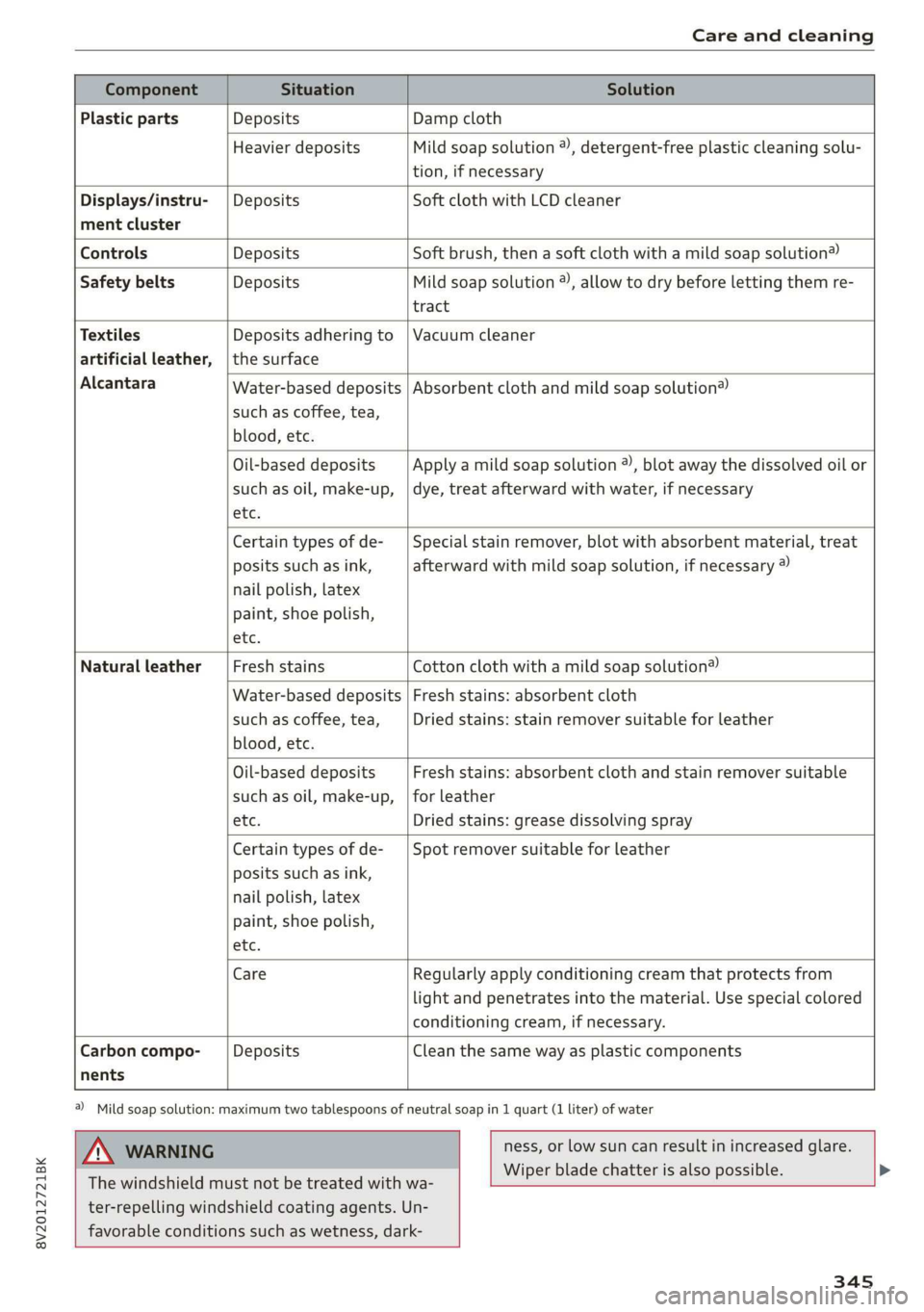
Plastic parts Deposits Damp cloth
Heavier deposits Mild soap solution 2), detergent-free plastic cleaning solu-
tion, if necessary
Water-based deposits
such as coffee, tea,
blood, etc.
Displays/instru- | Deposits Soft cloth with LCD cleaner
ment cluster
Controls Deposits Soft brush, then a soft cloth with a mild soap solution®)
Safety belts Deposits Mild soap solution ®), allow to dry before letting them re-
tract
Textiles Deposits adhering to | Vacuum cleaner
artificial leather, |the surface
Alcantara Absorbent cloth and mild soap solution®
Oil-based deposits
such as oil, make-up,
etc.
Apply a mild soap solution ®), blot away the dissolved oil or
dye, treat afterward with water, if necessary
Certain types of de-
posits such as ink,
nail polish, latex
paint, shoe polish,
etc.
Special stain remover, blot with absorbent material, treat
afterward with mild soap solution, if necessary ®
Natural leather Fresh stains Cotton cloth with a mild soap solution®
Water-based deposits
such as coffee, tea,
blood, etc.
Fresh stains: absorbent cloth
Dried stains: stain remover suitable for leather
Oil-based deposits
such as oil, make-up,
etc.
Fresh stains: absorbent cloth and stain remover suitable
for leather
Dried stains: grease dissolving spray
Certain types of de-
posits such as ink,
nail polish, latex
paint, shoe polish,
etc.
Spot remover suitable for leather
nents
Care Regularly apply conditioning cream that protects from
light and penetrates into the material. Use special colored
conditioning cream, if necessary.
Carbon compo- Deposits Clean the same way as plastic components
a) Mild soap solution: maximum two tablespoons of neutral soap in 1 quart (1 liter) of water
ZA WARNING
The windshield must not be treated with wa-
ter-repelling windshield coating agents. Un-
favorable conditions such as wetness, dark-
ness, or low sun can result in increased glare.
Wiper blade chatter is also possible.
345
Page 348 of 400
Care and cleaning
ZA WARNING
— Never immerse the Audi e-tron charging sys-
tem and connectors in water.
— The Audi e-tron charging system must only
be cleaned when the control unit is com-
pletely disconnected from the power supply
and from the vehicle.
@) Note
— Headlights and tail lights
— Never clean headlights or tail lights with a
dry cloth or sponge.
— Do not use any cleaning products that con-
tain alcohol, because they could cause
cracks to form.
— Wheels
— Never use any paint polish or other abra-
sive materials.
— Damage to the protective layer on the
rims, such as stone chips or scratches,
must be repaired immediately.
— Camera lenses
— Never use warm or hot water to remove
snow or ice from the camera lens. This
could cause the lens to crack.
— Never use abrasive cleaning materials or
alcohol to clean the camera lens. This
could cause scratches and cracks.
— Power top
— Remove bird droppings immediately.
— Never use gasoline, spot remover, ben-
zene, paint thinner or other solvents to re-
move.
— Door windows
— Remove snow and ice on windows and ex-
terior mirrors with a plastic scraper. To re-
duce the risk of scratches, move the scra-
per only in one direction and not back and
forth.
— Never remove snow or ice from door win-
dows and mirrors using warm or hot water
because this could cause cracks to form.
—To reduce the risk of damage to the rear
window defogger, do not apply any stick-
ers on the heating wires on the inside of
the window.
346
— Decorative parts and trim
— Never use chrome care or cleaning prod-
ucts.
— Paint
— To reduce the risk of scratches, the vehicle
must be free of dirt and dust before pol-
ishing or waxing.
—To prevent paint damage, do not polish or
wax the vehicle in direct sunlight.
—To reduce the risk of paint damage, do not
polish away rust spots.
— Remove cosmetics and sunscreen immedi-
ately because they could damage the
paint.
— Decorative decals
—To reduce the risk of damage, do not use
any rough powder or abrasive cleaning
products.
—To reduce the risk of damage, do not pol-
ish decorative decals that have a matte or
printed finish.
— Due to the risk of damage, do not use an
ice scraper to remove snow and ice on win-
dows with decorative decals on them.
— Displays and instrument cluster
— The displays/instrument cluster and the
trim surrounding them must not be
cleaned with dry cleaning methods be-
cause they could be scratched.
— Make sure that the instrument cluster is
switched off and has cooled off before
cleaning it.
— Make sure no fluids enter the spaces be-
tween the instrument cluster and the
trim, because that could cause damage.
— Controls
— Make sure that no fluids enter the con-
trols, because this could cause damage.
— Safety belts
— Do not remove the safety belts to clean
them.
— Never clean safety belts or their compo-
nents with chemicals or with corrosive flu-
ids or solvents and never allow sharp ob-
jects to come into contact with the safety
belts. This could cause damage to the belt
webbing.
Page 349 of 400
8V2012721BK
Care and cleaning
—If there is damage to the webbing, the
connections, the retractors, or the buck-
les, have them replaced by an authorized
Audi dealer or authorized Audi Service Fa-
cility.
— Textiles, artificial leather, and Alcantara
— Never treat artificial leather or Alcantara
with leather care products, solvents, floor
polish, shoe polish, spot remover, or simi-
lar products.
— Have a cleaning specialist remove stub-
born stains to reduce the risk of damage.
— Never use steam cleaners, brushes, hard
sponges, etc. when cleaning.
— Do not turn on the seat heating* to dry
the seat.
— Objects with sharp edges, such as zippers
or rivets on clothing or belts, can cause
damage to the surface.
— Open hook and loop fasteners, for exam-
ple on clothing, can damage seat covers.
Make sure hook and loop fasteners are
closed.
— Natural leather
— Never treat leather with solvents, floor
polish, shoe polish, spot remover or simi-
lar products.
— Objects with sharp edges, such as zippers
or rivets on clothing or belts, can cause
damage to the surface.
— Never use steam cleaners, brushes, hard
sponges, etc. when cleaning.
— Do not turn on the seat heating* to dry
the seat.
—To help prevent the leather from fading,
do not leave the vehicle in direct sunlight
for long periods of time. If leaving the ve-
hicle parked for long periods of time, you
should cover the leather to protect it from
direct sunlight.
— Wall mount clip
— Do not us any abrasive cleaning products
or any that contain alcohol, because these
increase the risk of discoloration.
@) Tips
— Insects are easier to remove from paint that
has been freshly waxed.
— Regular waxing can prevent rust spots from
forming.
— Decorative decals can age due to environ-
mental conditions, which can result in dam-
age such as brittleness. The color may fade
if exposed to excessive sunlight.
Taking your vehicle out
of service
If you would like to take your vehicle out of serv-
ice for a long period of time, contact an author-
ized Audi dealer or authorized Audi Service Facili-
ty. They will advise you of important measures,
such as corrosion protection, service, and storage
procedures. Also follow the information about
the vehicle battery > page 315.
347
Page 363 of 400
8V2012721BK
Fuses and bulbs
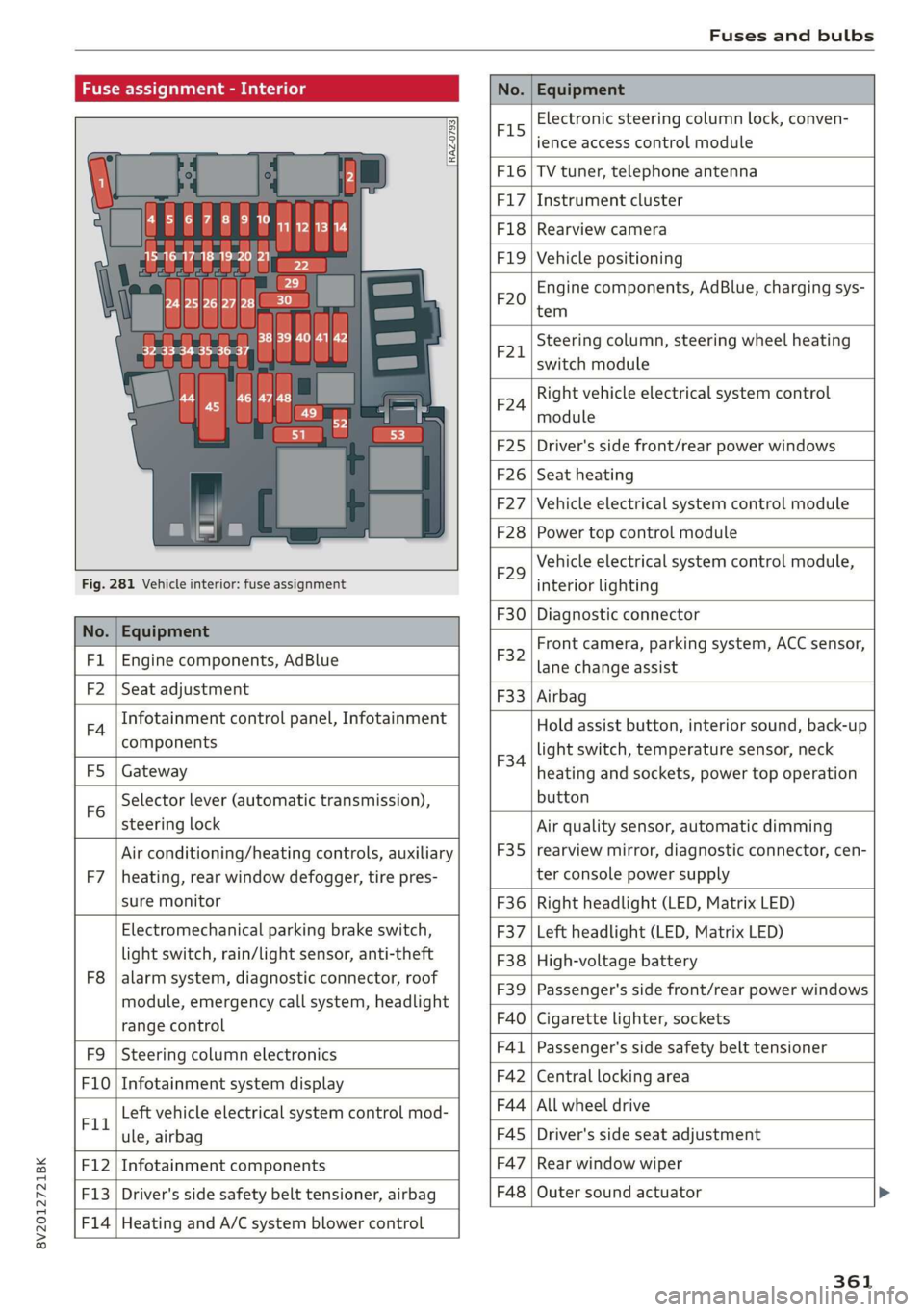
Fuse assignment - Interior
No. Equipment
RAZ-0793,
PO ee
15°16°17-18 19 20 21
PZ ply lip y ips}
ei Hes ole” So}
32°33 34 35 36 37
F15
Electronic steering column lock, conven-
ience access control module
F16 TV tuner, telephone antenna
F17 Instrument cluster
F18 Rearview camera
F1I9 Vehicle positioning
F20
Engine components, AdBlue, charging sys-
tem
F221
Steering column, steering wheel heating
switch module
F24
Right vehicle electrical system control
module
F25 Driver's side front/rear power windows
F26 Seat heating
F27 Vehicle electrical system control module
F28 Power top control module
Fig. 281 Vehicle interior: fuse assignment
F29
Vehicle electrical system control module,
interior lighting
No. Equipment
F30 Diagnostic connector
FL Engine components, AdBlue
F2 Seat adjustment
F32
Front camera, parking system, ACC sensor,
lane change assist
F4
Infotainment control panel, Infotainment
components
F33 Airbag
FS Gateway
Fo
Selector lever (automatic transmission),
steering lock
F34
Hold assist button, interior sound, back-up
light switch, temperature sensor, neck
heating and sockets, power top operation
button
Air conditioning/heating controls, auxiliary F35
Air quality sensor, automatic dimming
rearview mirror, diagnostic connector, cen-
F7 |heating, rear window defogger, tire pres- ter console power supply
sure monitor F36 | Right headlight (LED, Matrix LED)
Electromechanical parking brake switch, F37 | Left headlight (LED, Matrix LED)
light switch, rain/light sensor, anti-theft F38 | High-voltage battery
ae ene eee dent F39 | Passenger's side front/rear power windows
range control F40 | Cigarette lighter, sockets
F9 |Steering column electronics F41 | Passenger's side safety belt tensioner
F10 | Infotainment system display F42 | Central locking area
Tl Left vehicle electrical system control mod- F44 al ee
ule, airbag FAS | Driver's side seat adjustment
F12 | Infotainment components F47 | Rear window wiper
F13 | Driver's side safety belt tensioner, airbag F48 | Outer sound actuator
F14 | Heating and A/C system blower control
361