warning AUDI A3 CABRIOLET 2015 Owners Manual
[x] Cancel search | Manufacturer: AUDI, Model Year: 2015, Model line: A3 CABRIOLET, Model: AUDI A3 CABRIOLET 2015Pages: 302, PDF Size: 73.83 MB
Page 266 of 302
264 What do I do now?
-Always store the vehicle tool kit, the jack
and the replaced tir e in the luggage com
partment ¢
page 132.
Changing a wheel
When you change o wheel, follow these
quence described below step-by-step and in
exactly that order .
1. Remove the decorative wheel cover*. For
more details see also¢
page 264, Deco
rative wheel covers
or ¢ page 265,
Wheels with wheel bolt caps.
2 . Loosen the wheel bolts¢ page 265 .
3. Locate the proper mount ing point for the
jack and align the jack below that point
¢page 266.
4. Raise the car with the jack ¢ page 266.
5. Remove the
wheel with the flat tire and
then install
the spare ¢ page 267.
6. Tighten all wheel bolts lightly.
7 .
Lowe r the vehicle with the jack.
8 . Use the wheel bolt wrench and
firmly
tighten all whee l bolts c::> page 265.
9. Replace the decorative wheel cover*.
A WARNING
Always read and follow all WARNINGS and
information
c::> .&. in Raising the vehicle on
page
266 and c::> page 268.
After changing a wheel
A wheel change is not complete without the
doing the following .
• Always store the vehicle tool kit, the jack*
and the replaced tir e in the luggage com
partment ~
page 132 .
• Check the tire pressure on the spare wheel
i mmediately after mount ing it.
• As soon as possible, have the
tightening
torques
on a ll wheel bo lts checked with a
torque wrench. The correct tightening tor
que is 90 ft lb (120 Nm).
• Have the flat tire
replaced as soon as poss i
ble.
(D Tips
- If you notice that the wheel bolts a re
corroded and difficult to turn while
chang ing a tire, they should be rep laced
before you check the tightening torque.
- Drive at reduced speed until you have the
tightening torques checked.
- After changing a whee l, the tire pressure
in all four tires must be checked/correct
ed and the tire pressure monitoring indi
cator must be stored in the MMI
c::>page260.
Decorative wheel covers
Applies to vehicles: wit h decorative whee l covers
The decorative wheel covers must be removed
first to access the wheel bolts .
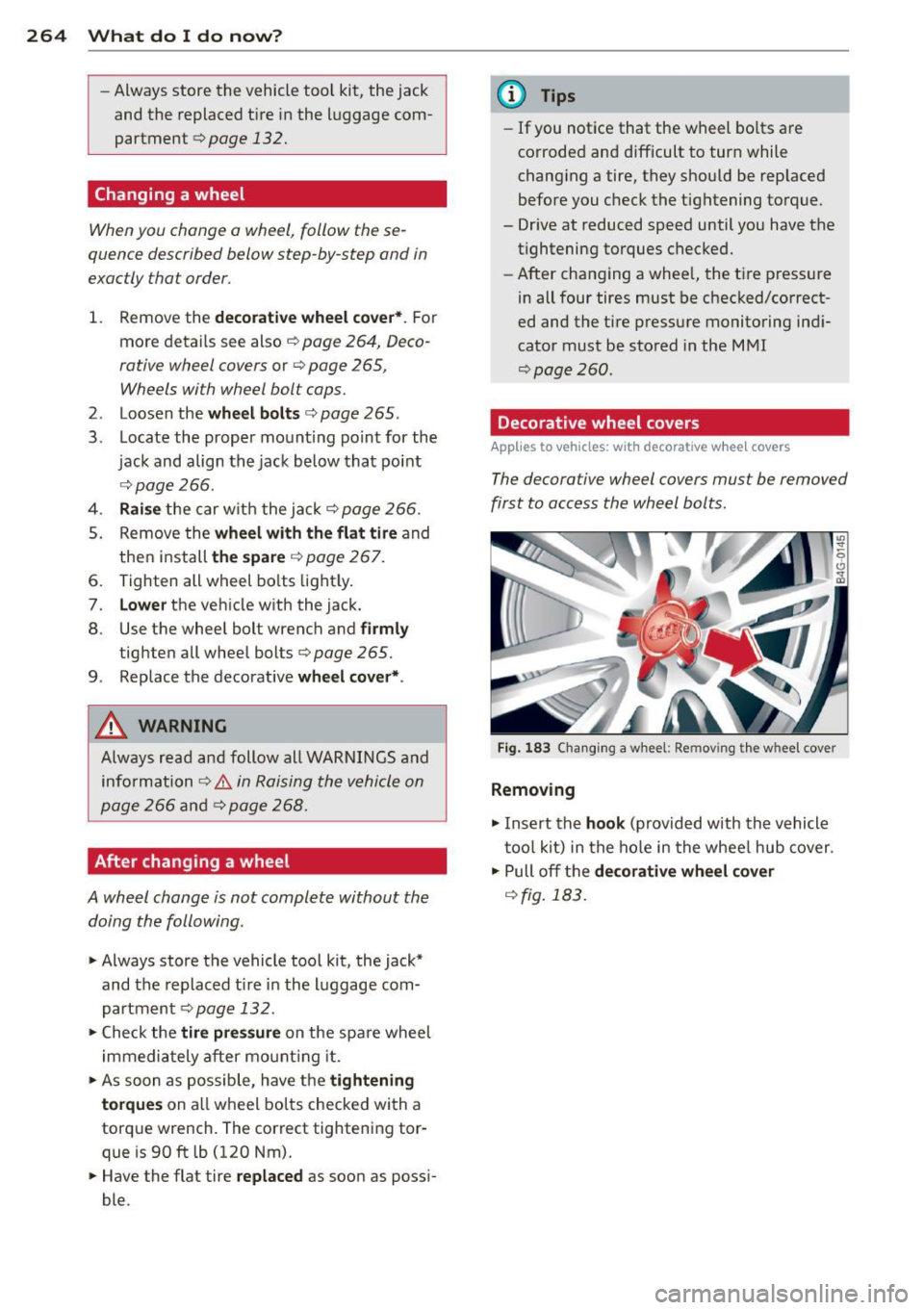
Fig. 183 Chang ing a wheel : Remov ing th e w heel cover
Removing
.,. Insert the hook (provided with the vehicle
tool kit) in the hole in the whee l hub cover .
.,. Pull
off the decorative wheel cover
c::>fig.183.
Page 267 of 302
....,
N
r--. > co
rl I.O
"' rl
"' rl
Wheels with wheel bolt caps
Applies to vehicles: with whee l bolts with caps
The caps must be removed first from the
wheel bolts before the bolts can be un
screwed.
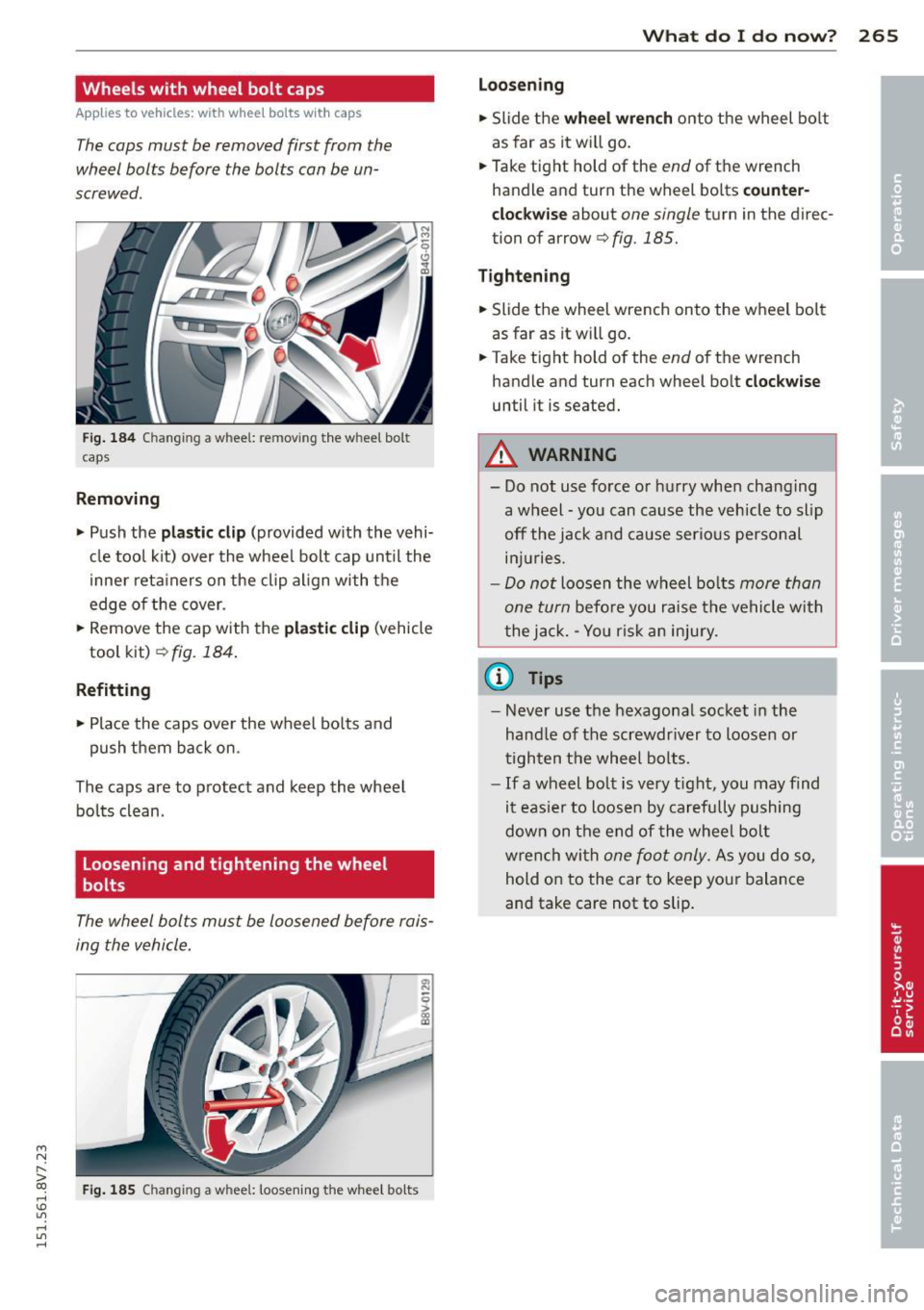
Fig . 184 Changing a wheel: removing the wheel bolt
caps
Rem oving
• Push the pla stic clip (provided w ith the vehi
cle tool kit) over the whee l bolt cap unt il the
inner reta iners on the clip align with the
edge of the cover.
• Remove the cap w ith the
pl as tic clip (vehicle
tool kit)
¢ fig. 184 .
Refitting
• Place the caps ove r the wheel bo lts and
push them back on .
The caps are to protect and keep the wheel bol ts clean.
Loosening and tightening the wheel
bolts
The wheel bolts must be loosened before rais
ing the vehicle .
Fig . 185 Changing a wheel: loosening the whee l bo lts
What do I d o now ? 265
Loosen ing
• Slide the wheel wr en ch onto the wheel bo lt
as far as it wi ll go .
• Take tight hold of the
end of the wrench
handle and turn the wheel bo lts
c ounter ·
cloc kwi se
about one single turn in the direc
tion of arrow¢
fig. 185.
T ightening
• Slide the wheel wrench onto the wheel bolt
as far as it w ill go.
• Take tight hold of the
end of the wrench
handle and turn each wheel bolt
clo ck wis e
until it is seated.
A WARNING
- Do not use force or hurry whe n chang ing
a wheel - you can cause the vehicle to slip
off the jack and cause ser ious personal
injuries.
- Do not loosen the wheel bo lts more than
one turn
befo re you raise the vehicle with
the jack. - Yo u risk an injury.
(D Tips
- Never use the hexagona l socket in the
hand le of the screwdr iver to loosen or
t ighten the wheel bolts.
- If a wheel bolt is very tight, you may find
it eas ier to loose n by carefully pushing
down on the end of the wheel bol t
wrench wi th
one foot only. As you do so,
hold on to the car to keep you r balance
and take care not to slip .
Page 268 of 302
266 What do I do n ow ?
Raising the vehicle
The vehicle must be lifted with the jack first
before the wheel can be removed .
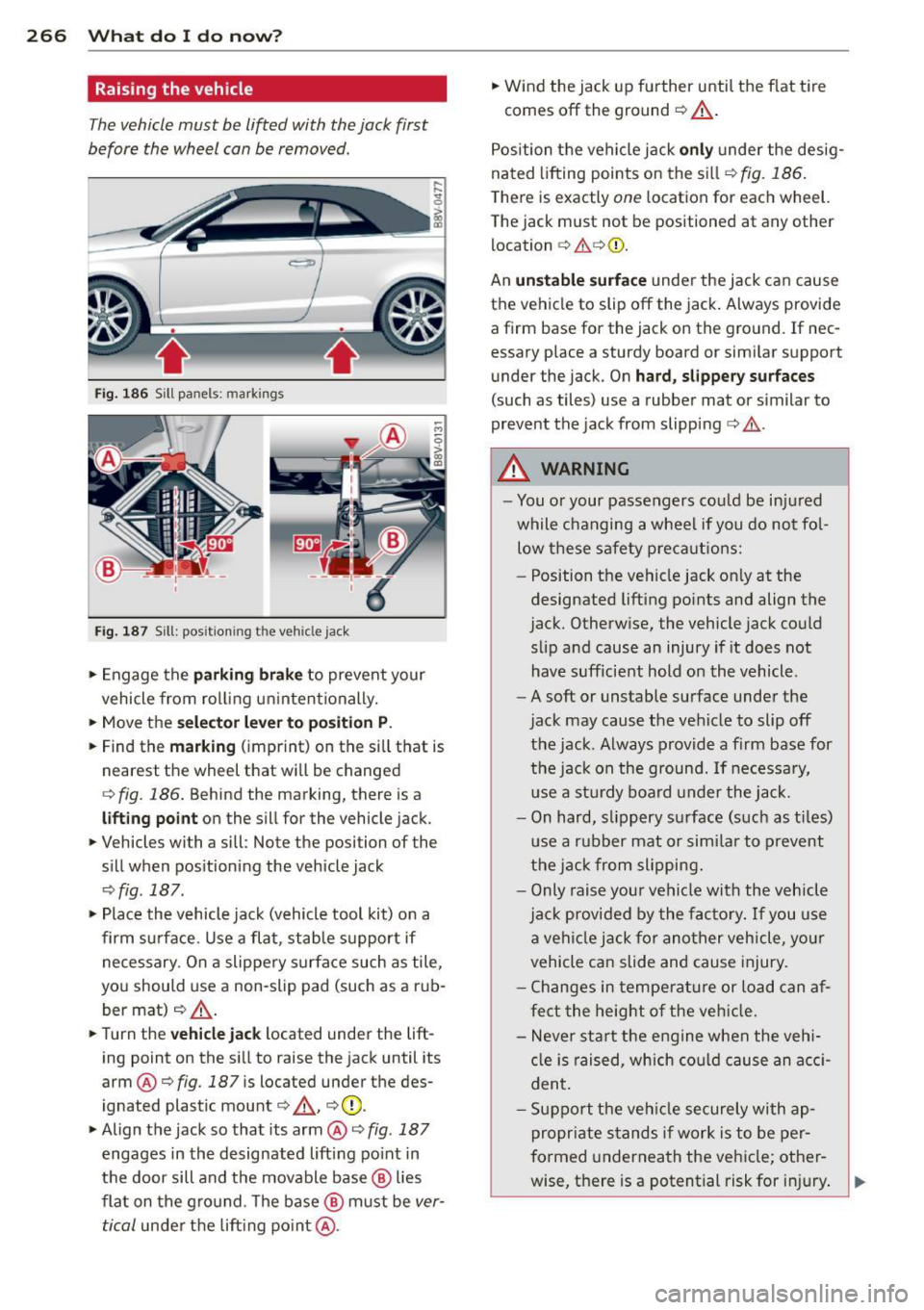
Fig. 186 Sill panels: mark ings
Fig. 187 Sill : posit ion ing the veh icle jack
., Engage the pa rkin g brak e to prevent your
vehicle from rolling un intentionally.
., Move the
se lect or l ever to po siti on P .
., Find the marking (imprint) on the sill that is
nearest the wheel that wi ll be changed
r::> fig. 186. Behind the marking, there is a
lifting po int on the sill for the vehicle jack.
., Vehicles with a sill : Note the position of the
s ill when pos itioning the vehicle jack
¢ fig . 187 .
., Place the vehicle jack (vehicle tool kit) on a
firm su rface. Use a flat, stab le support if
necessary. On a slippe ry surface such as tile,
you should use a non-slip pad (such as a rub
ber mat)
c::> A .
., Turn the vehicle jack located under the lift
ing point on the sill to raise the jack until its
arm @r=>
fig. 187 is located under the des
ignated plastic mount
c> A, r=>@ .
., Align the jack so that its arm@r=> fig. 187
engages in the designated lifting point in
the door sill and the movable base @ lies
flat on the gro und . T he base @ must be
ver
tical
under the lift ing po int @ . .,
Wind the jack up fu rther until the f lat tire
comes off the ground
r=> A.
Position t he vehicle jack only under the desig
nated lifting points on the si ll
¢fig. 186.
There is exactly one location for each wheel.
The jack must not be positioned at any other
location
r=> ,&. r=>Q).
An un sta ble surf ace under the jack can cause
the vehicle to slip off the jack . Always provide
a firm base for the jack on the ground . If nec
essary place a sturdy board or similar support
under the jack. On
hard, sl ipp ery su rfaces
(such as tiles) use a rubber mat or similar to
prevent the jack from slipping
c> ,&. .
A WARNING ~
-You or your passengers could be injured
while changing a wheel if you do not fo l
low these safety preca utio ns:
- Position the vehicle jack on ly at the
designated lifting points and align the
jack. Otherwise, the vehicle jack could
slip and cause an injury if it does not
have sufficient hold on the vehicle .
- A soft or unstable surface under the
jack may cause the vehicle to slip off
the jack . Always provide a firm base for
the jack on the ground. If necessa ry,
use a stu rdy board under the jack.
- On hard, slippery surface (such as t iles)
use a rubber mat or simi lar to prevent
the jack from slipping.
- Only raise your vehicle with the vehicle
jack provided by the fac to ry.
If you use
a vehi cle jack for another vehicle, your
vehicle can slide and cause injury.
- Changes in temperat ure or load can af
fect the height o f the veh icle .
- Never start the engine when the vehi cle is raised, which co uld cause an acc i
dent.
- Suppo rt the ve hicle securely with ap
propr iate s tands if work is to be per
formed underneath the vehicle; other
wise, there is a potential risk for in jury . .,.
Page 270 of 302
268 What do I do no w?
-Pull the reversible blade from the screw
driver before you use the hexagonal
socket in the handle to t urn the whee l
bo lts.
- When mounting tires with
unid ire ctional
t re ad design
make s ure the tread pat
tern is pointed the right way
¢ page 268.
-The wheel bolts should be clean and easy
to turn. Check for d irt and corrosion on
the mat ing su rfaces of both the whee l
and the hub. Remove all dirt from these
surfaces before remount ing the wheel.
Tires with unidirectional tread design
Tires with unidirectional tread design must be
mounted with their tread pattern pointed in the right direction.
Using a spare tire with a tread pattern
int ended fo r use in a specific dir ection
When us ing a spare tire w ith a tread pattern
i ntended for use in a specific direction, please
note t he following:
- The direction of rotation is marked by an ar
row on the side of the tire .
-If the spare t ire has to be installed in the in
correct direction, use the spare tire only
temporarily since the t ire will not be able to
achieve its optimum perfo rma nce character
ist ics with rega rd to aquaplaning, noise and
wea r.
- We recommend that you pay particular at
tent ion to this fact du ring wet weat her and
that you adjust your speed to match road
condit ions .
- Replace the fla t tire w ith a new one and
have it ins talled on your veh icle as soon as
possible to restore the handling advantages
of a unidirectiona l tire .
Notes on wheel changing
Please read the information ¢ page 248, New
tires and replacing tires and wheels
i f you are
go ing to use a spare t ire which is d ifferent
from the tires on your veh icle . After you change a tire:
-
Ch eck the tire pr essure on th e spar e imm e
diatel y after in stallation .
- Hav e th e whe el bolt tight ening torque
c h ec ked with a torque wr ench as soon as
po ssible by your author ized Audi de aler or
a qu alified servic e sta tion.
- With ste el and alloy wheel r im s, the wheel
bolt s ar e c orre ctl y tightened at a torque of
9 0 ft lb (120 Nm ).
- If you notice th at the wheel b olt s ar e co r
rod ed and diffi cult to turn w hile changing
a tire , the y should be repl aced before you
check the t ightening to rque.
- Repl ace the flat tire with a new o ne and
ha ve it in stalled on your vehicle as soon a s
possible. Remount the wheel cov er.
Until then , dri ve with extra care and at re
duc ed sp eed s.
A WARNING
-
- If you are going to equip your vehicle
with tires or rims which differ from those
which were factory installed, then be sure to read the information
¢ page 248,
New tires and replacing tires and
wheels.
- Always make sure the damaged wheel or
even a flat tire and the jack and tool kit
are properly secured in the luggage com
pa rtment and are not loose in the pas
senger compartment.
- In an accident or sudden maneuver they
could fly forwa rd, injuring anyone in the
veh icle.
- Always sto re damaged wheel , jack and
too ls se curely in the luggage compart
men t. Otherwise, in an accident or s ud
den maneuve r they could f ly forwa rd,
causing injury to passengers in the vehi
cle.
Page 271 of 302
....,
N
r--. > co
rl I.O
"' rl
"' rl
Fuses and bulbs
Electrical fuses
Replacing fuses
Fuses that have blown will have metal strips
that have burned through.
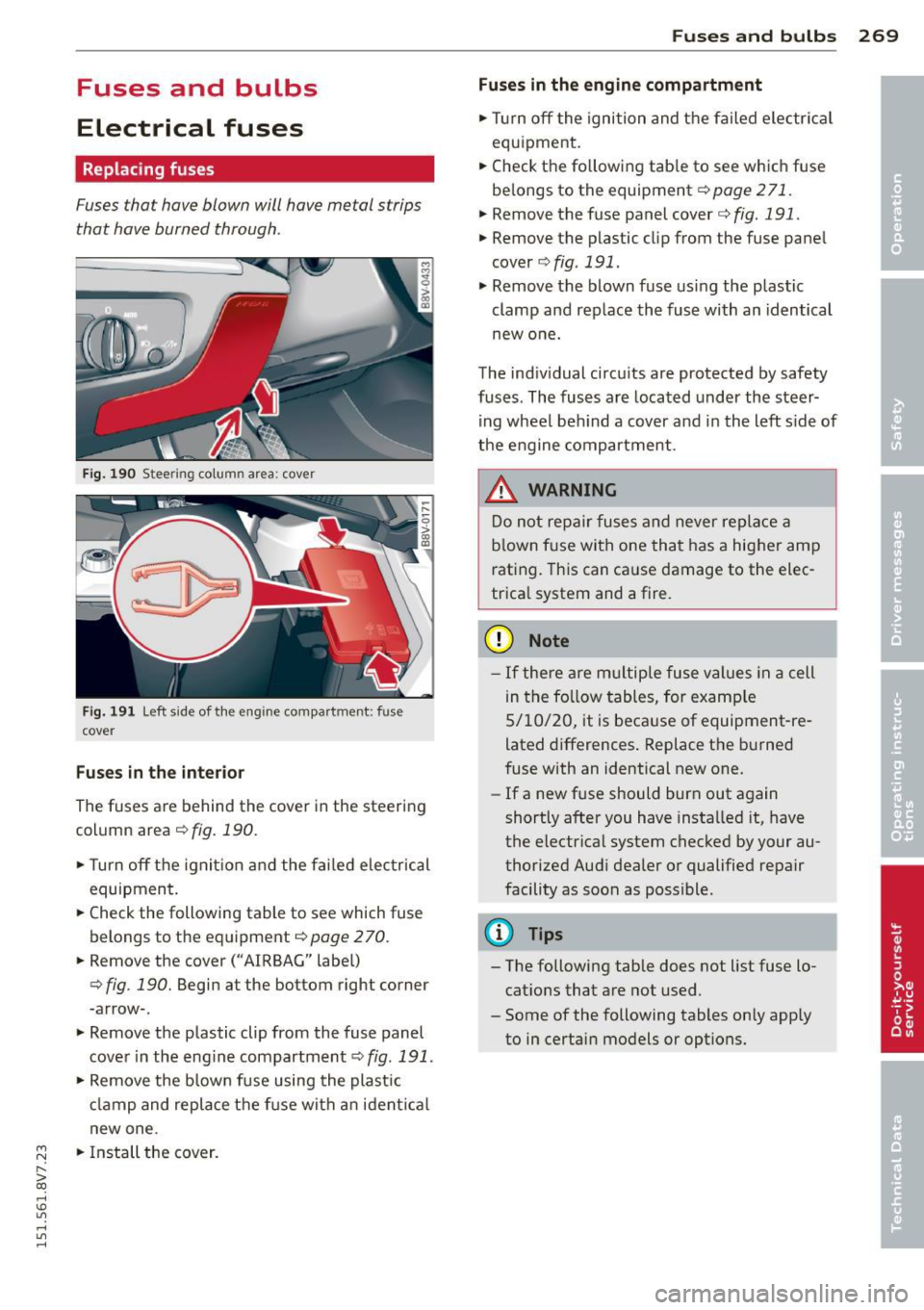
Fig. 190 Steering column area: cover
Fig. 191 Left side of the engine compartment: fuse
cover
Fuses in the interior
The fuses are behind the cover in the steering
column area¢
fig. 190.
•Turnoff the ignition and the fai led e lectrical
equipment.
• Check the following table to see which fuse
belongs to the eq uipment
¢page 270.
• Remove the cover(" AIRBAG" label)
¢ fig . 190. Begin at the bottom right corner
-arrow-.
• Remove the plastic clip from the fuse panel
cover in the eng ine compartment ¢
fig. 191.
• Remove the blown fuse using the plastic
clamp and replace the f use with an ident ica l
new one .
• Install the cover .
Fuses and bulbs 269
Fuses in the engine compartment
•Tu rnoff the ignition and the failed electrical
equipment.
• Check the fo llowing tab le to see which fuse
be longs to the equipment¢
page 271.
• Remove the fuse panel cover¢ fig. 191.
• Remove the plastic clip from the fuse pane l
cover
¢ fig. 191.
• Remove the blown fuse using the plastic
clamp and replace the fuse with an identical
new one.
The indiv idual circuits are protected by safety
fuses. The fuses are located under the steer
ing wheel beh ind a cover and in the left side of
the engine compartment .
_&. WARNING
-
Do not repair fuses and never replace a
blown fuse with one that has a higher amp
rat ing. This can ca use damage to the elec
trica l system and a fire .
(D Note
-If there are multip le fuse values in a cell
in the follo w tables, for example
5/10/20, it is because of equipment-re
lated differences. Replace the burned
fuse with an identical new one.
- If a new fuse should burn out again
shortly after you have insta lled it, have
the electrical system checked by your au
thorized Audi dealer or qualified repair
facility as soon as possible.
(D Tips
- The following table does not list fuse lo
cat ions that are not used.
- Some of the following tables only apply
to in certain models or options.
Page 274 of 302
272 Fuses and bulb s
Note that the following table was accurate
at the time of print ing and is subject to
change.
Bulbs
Replacing light bulbs
For your safety, we recommend that you have
your authorized Audi dealer replace burned out bulbs for you.
It is becoming increas ingly more and more
d iff icu lt to replace vehicle light bulbs s ince in
many cases, other parts of the car must first
be removed before you are able to get to the
bu lb . Thi s appl ies especia lly to the light bu lbs
in the front of your car which you can on ly
reach through the engine compartment .
Sheet metal and bulb ho lders can have sha rp
edges that can cause ser ious cuts, and parts
must be co rrectly taken apart and then prop
erly put back together to help prevent break
age of parts and long term damage from wa
ter that can enter housings that have not been
properly resealed.
For your safety, we recommend that you have
your authorized Audi dealer replace any bulbs
for you, since your dealer has the proper tools, the correct bulbs and the expertise.
Gas discharge lamps (Xenon lights):
Due to the high electrical vo ltage, have the
bu lbs rep laced by a qualified technician.
Headlights with Xenon light can be identified
by the high voltage sticker.
LE D headlights* require no ma intenance .
Please contact your authorized Aud i dealer if a
bu lb needs to be replaced.
A WARNING
Contact with high-voltage components of
the electrical system and improper re
placement of gas discharge (Xenon) head
light bulbs can cause serious personal in
jury and death . -
Xenon bulbs are pressurized and can ex
plode when being changed.
- Changing Xenon lamps requires the spe
cial training, instructions and equip
ment.
- Only an authorized Audi dealer or other
qualified workshop should change the
bulbs in gas discharge lamps.
A WARNING
--
There are parts with sharp edges on the
openings and on the bulb holders that can
cause ser ious cuts .
- If you are uncertain about what to do,
have the work performed by an author
ized Audi dealer or other qualified work
shop. Serious personal injury may result
from improperly performed work.
(D Tips
- If you st ill prefer to replace the light
bulbs yourself, be aware that the engine
compartment is a hazardous area to
work in
~ page 214~ &
-It is best to ask your authorized Audi
dealer whenever you need to change a
bulb.
Page 275 of 302
M N
" > co ,...., \!) ..,.,
,...., ..,., ,....,
Emergency situations
General
This chapter is intended for trained emer
gency crews and working personnel who have the necessary tools and equipment to
perform these operations.
Starting by pushing or
towing
(D Note
Vehicles with an automatic transmission
cannot be started by pushing or towing.
Starting with jumper
cables
If necessary, the engine can be started by
connecting it to the battery of another vehi
cle.
If the engine should fail to start because of a
discharged or weak battery, the battery can be
connected to the battery of
another vehicle,
using a
pair of jumper cables to start the en
gine.
Jumper cables
Use only jumper cables of sufficiently large
cross section to carry the starter current safe
ly. Refer to the manufacturer's specifications.
Use only jumper cables with
insulated termi
nal clamps which are distinctly marked :
plus(+) cable in most cases colored red
minus(-) cable
in most cases colored black.
A WARNING
Batteries contain electricity, acid, and gas.
Any of these can cause very serious or fatal
injury. Follow the instructions below for
safe handling of your vehicle's battery.
- Always shield your eyes and avoid lean
ing over the battery whenever possible.
- A discharged battery can freeze at tem
peratures just below 32 °F (0 °C). Before
Emergency situations 273
connecting a jumper cable, you must
thaw the frozen battery completely, oth
erwise it could explode.
- Do not allow battery acid to contact eyes
or skin. Flush any contacted area with
water immediately .
- Improper use of a booster battery to start a vehicle may cause an explosion.
- Vehicle batteries generate explosive gas
es. Keep sparks, flame and lighted ciga
rettes away from batteries.
- Do not try to jump start any vehicle with a low acid level in the battery.
- The voltage of the booster battery must
also have a 12-volt rating. The capacity
(Ah) of the booster battery should not be
lower than that of the discharged bat
tery . Use of batteries of different voltage
or substantially different "Ah" rating
may cause an explosion and personal in
JU ry.
- Never charge a frozen battery. Gas trap
ped in the ice may cause an explosion.
-Never charge or use a battery that has
been frozen. The battery case may have
be weakened.
- Use of batteries of different voltage or
substantially different capacity (Ah) rat
ing may cause an explosion and injury.
The capacity (Ah) of the booster battery
should not be lower than that of the dis
charged battery.
- Before you check anything in the engine
compartment, always read and heed all
WARNINGS ¢
page 214.
(D Note
-Applying a higher voltage booster bat
tery will cause expensive damage to sen
sitive electronic components, such as
control units, relays, radio, etc.
- There must be no electrical contact be
tween the vehicles as otherwise current
could already start to flow as soon as the
positive(+) terminals are connected. ..,. •
•
•
Page 277 of 302
M N ,....
> co ,...., \!) 1.1'1 ,...., 1.1'1 ,....,
installed. Make sure the cables do not get
caught in moving engine components .
11. Sw itch the heater fan and rear window de-
froster off.
12. Close the battery cover.
The battery is vented to the outside so that not gases enter the passenger compartment.
Make sure that the connected positive termi
nal clamps on the jump start cable have suff i
cient contact with metal.
A WARNING
Follow the warn ings and instructions from
the jump start cable manufacturer to re duce the risk of serious injuries and vehicle
damage .
If you are uns ure abo ut anything,
call roadside assistance.
- T he jump start cables must be long
enough so that the vehicles do not
touch.
- Route the jump sta rt cab les so they can
not get ca ught in the moving parts in the
engine compartment .
- Always read and follow the warnings be
fore checking anything in the engine
compartment <=>
page 214.
(D Note
Correctly jump start cables incorre ctly can
destroy the a lternator .
- Always connect the positive term inal(+)
to the positive terminal( +) and the neg
ative termina l (-) to the negative termi
nal(-) on the body ground point, but not
the negative termina l on the battery.
- Make sure the screw plugs on the batte ry
ce lls are insta lled securely. If not, tight
en the plugs before connecting the
clamps to the negat ive termina l on the
battery.
- P lease note that the connecting process
described be low for the jump start ca
bles is intended for when your vehicle is
being jump started. If you are jump
starting another vehicle, do not connect
the negat ive cab le to the negative termi
nal(·) on the drained battery, but rathe r
Emerg en cy si tuation s 275
connect it to a large metal component
that is bolted securely to the engine
bloc k, or to the engine block itsel f. If the
battery in the vehicle being jump started
is not vented to the outside, there is a
r isk of explosion due to hydrogen gas.
- Make sure that the connected positive
terminal clamps have sufficient contact
with metal.
- Do not use the battery negat ive terminal
for jump start ing or a malfunct ion could
occur in the vehicle electrical system.
Emergency towing
with commercial tow
truck
General hints
Your Audi requires special handling for tow
ing .
The following information is to be used by
commerc ial tow truck operators who know
how to operat e th eir equipment safely.
- Never to w you r Aud i. Towing will cause
damage to the engine and tran smission.
- Nev er wra p the s afety ch ains or wi nch ca
bles a round the brake li nes.
- To p revent unnece ssary dam age , your Aud i
must be t ranspo rted with a flat bed truck.
- To load the vehicle on to the fl at bed , us e
the towing loop fo und in the vehicle tool s
and attach to the front o r rear anchorage
<=> page 2 76 and <=> page 2 76.
A WARNING
A vehicle being towed is not safe for pas
sengers. Neve r allow anyone to ride in a
vehicle be ing towed, fo r any reason.
-
•
•
•
Page 278 of 302
2 76 Emergency situations
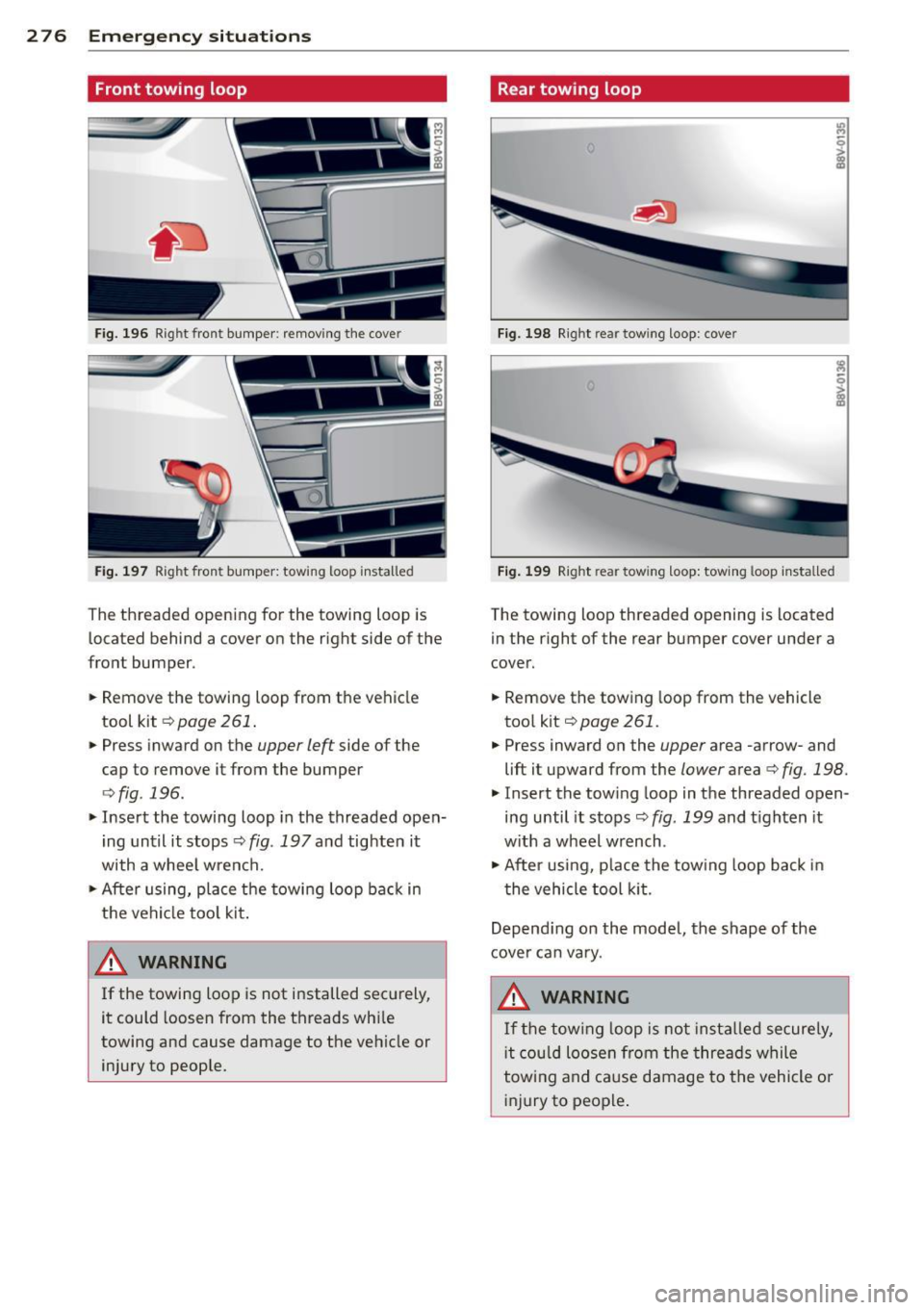
Front towing loop
Fig. 196 Right front bumper: removing the cove r
Fig. 197 Right front bumper: towing loop installed
The threaded opening for the towing loop is
located behind a cover on the right side of the
front bumper.
• Remov e the towing loop from the vehicle
tool kit¢
page 261 .
• Press inward on the upper le~ side of the
cap to remove it from the bumper
¢fig . 196.
• Insert the towing loop in the threaded open
ing until it stops¢
fig. 197 and tighten it
with a whee l wrench.
• After using, place the towing loop back in
the vehicle tool kit.
A WARNING
If the towing loop is not installed securely,
it could loosen from the threads while
towing and cause damage to the vehicle or
injury to people.
Rear towing loop
Fig. 198 Righ t rea r towing loop: cover
Fig. 199 Right rea r towing loop: towing loop installed
The towing loop threaded opening is located
in the right of the rear bumper cover under a
cover.
• Remove the towing loop from the vehicle
tool kit¢
page 261 .
• Press inward on the upper area -arrow-and
lift it upward from the
lower area¢ fig. 198.
• Insert the towing loop in the threaded open
ing until it stops ¢
fig. 199 and tighten it
w ith a wheel wrench .
• After using, p lace the towing loop back in
the vehicle tool kit.
Depending on the model, the shape of the
cover can vary .
.&_ WARNING
If the towing loop is not installed securely,
it could loosen from the threads while
towing and cause damage to the vehicle or
injury to people .
Page 279 of 302
....,
N
r--. > co
rl I.O
"' rl
"' rl
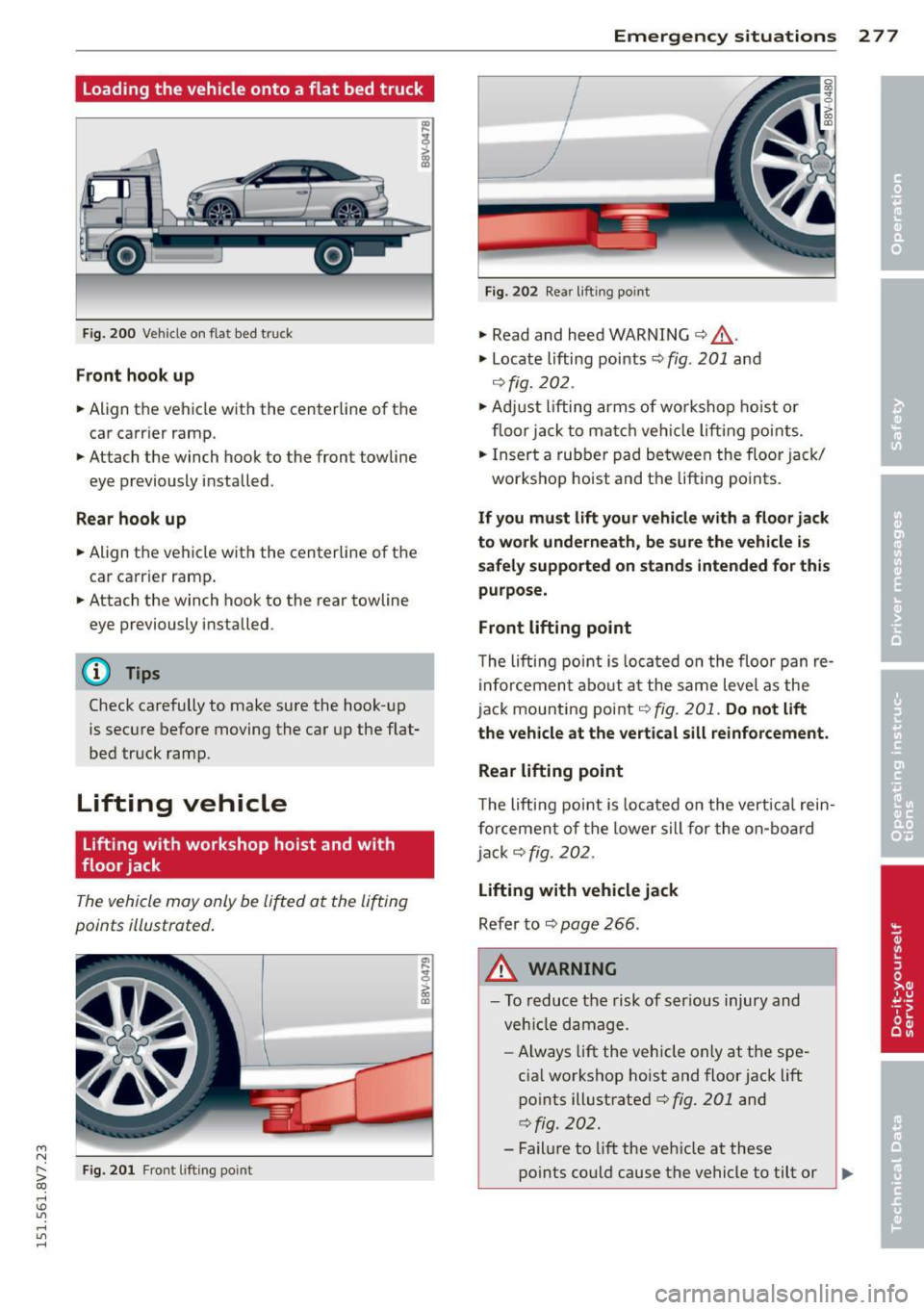
Loading the vehicle onto a flat bed truck
Fig. 200 Veh icle on flat bed truck
Front hook up
.. Align the vehicle with the centerline of the
car carr ier ramp.
.. Attach the winch hook to the front towline
eye previously installed .
Rear hook up
.. Align the vehicle with the centerline of the
car carrier ramp.
.. Attach the winch hook to the rear towline
eye previously installed.
(D} Tips
Check carefully to make sure the hook-up
is secure before moving the car up the flat
bed truck ramp.
Lifting vehicle
Lifting with workshop hoist and with
floor jack
The vehicle may only be lifted at the lifting
points illustrated .
Fig. 201 Front l ifting point
Emergency situations 2 77
Fig. 202 Rea r liftin g po int
.,. Read and heed WARNING c::> .&, .
.,. Locate lifting points c::> fig. 201 and
¢ fig. 202 .
.,. Adju st lifting arms of workshop hoist or
floor jack to match veh icle lifting points.
.. Insert a rubber pad between the floor jack/
workshop hoist and the lift ing points.
If you must lift your vehicle with a floor jack
to work underneath, be sure the vehicle is
safely supported on stands intended for this
purpose .
Front lifting point
T he lifti ng point is loca ted on the floo r pan re
info rcemen t about at the same level as the
jack mounting point
c::>fig. 201. Do not lift
the vehicle at the vertical sill reinforcement.
Rear lifting point
The lifting point is located o n the vert ica l rein
forcement of the lower sill for the on-board
jack
c::> fig. 202 .
Lifting with vehicle jack
Refer to c:;, page 266.
A WARNING
-To reduce the risk of ser ious injury and
vehicle damage .
- Always lift the vehicle only at the spe
cia l workshop hoist and floor jack lift
points illustrated
c:;, fig. 201 and
c:;, fig. 202.
- Failure to lift the veh icle at these
-
points could cause the vehicle to tilt or ..,.