ABS AUDI A3 CABRIOLET 2015 User Guide
[x] Cancel search | Manufacturer: AUDI, Model Year: 2015, Model line: A3 CABRIOLET, Model: AUDI A3 CABRIOLET 2015Pages: 302, PDF Size: 73.83 MB
Page 142 of 302
140 Safety belts
occupant will slam violently into the steering
wheel, instrument panel, windshield, or what
ever else is in the way
c::> fig. 133. This imp act
with the vehicle interior has all the energy
t hey had just before the crash.
Never rely on a irbags alone for protection.
Even when they deploy, airbags provide only
additional protection. Airbags are not sup
posed to deploy in all kinds of accidents. Al
though your Audi is equipped with airbags, all
vehicle occupants, including the driver , must
wear safety belts correctly in order to mini
mize the risk of severe injury or death in a
crash.
Remember too, that airbags will deploy only
once and that your safety belts are always
there to offer protection in those accidents in
which airbags are not supposed to deploy or
when they have already deployed . Unbelted
occupants can also be thrown out of the vehi
cle where even more severe or fatal injuries
can occur.
It is also important for the rear passengers to
wear safety belts correctly. Unbelted passen
gers in the rear seats endanger not only them
selves but also the driver and othe r passen
gers ~
fig. 134. In a frontal collision they will
be thrown forward violently, where they can
hit and injure the driver and/or front seat pas
senger .
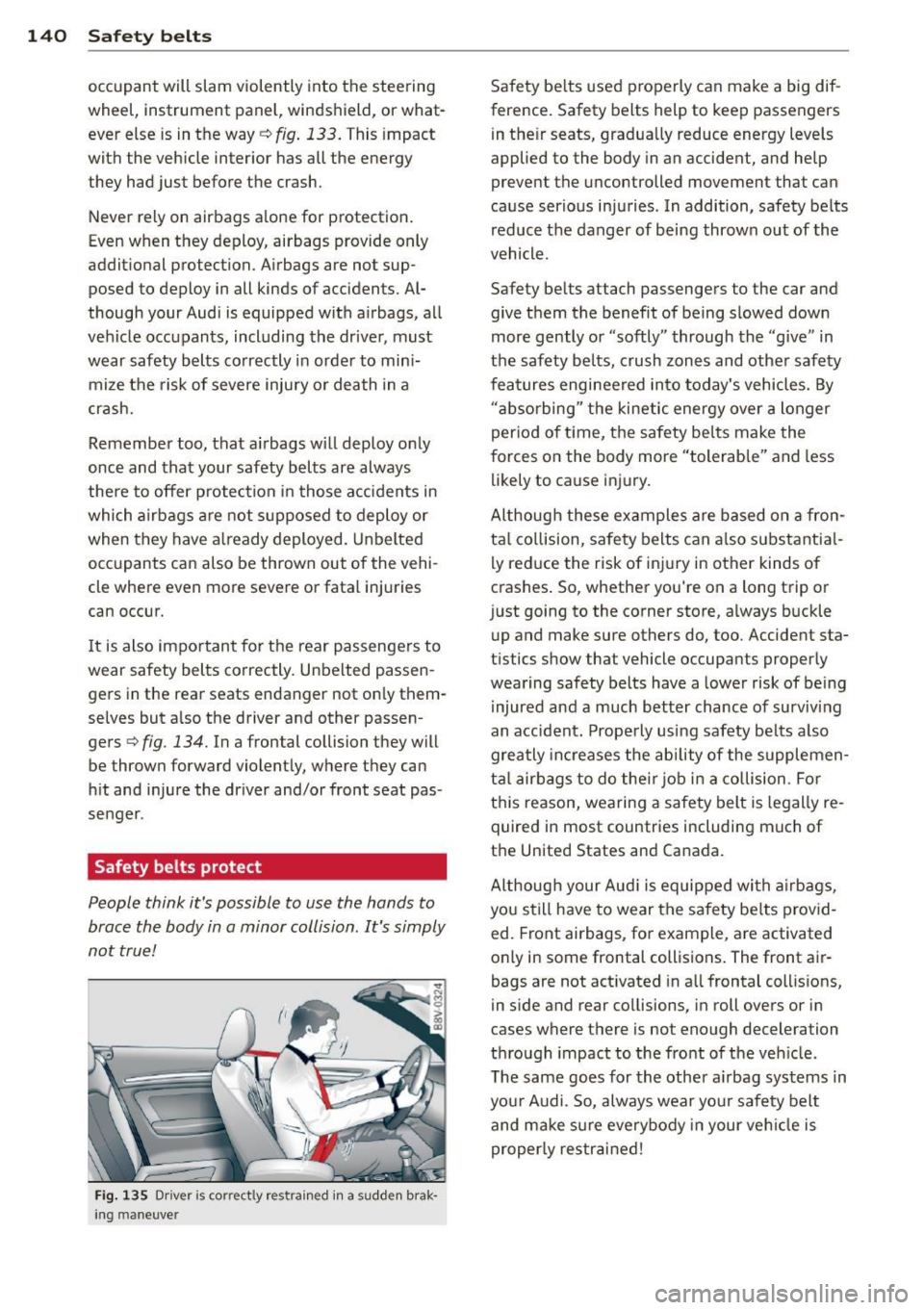
Safety belts protect
People think it's possible to use the hands to
brace the body in a minor collision . It's simply
not true !
Fig. 135 Driver is co rr ect ly re strain ed in a sudd en brak
ing maneuve r
Safety belts used properly can make a big dif
ference. Safety belts help to keep passengers
in their seats, gradually reduce energy levels
applied to the body in an accident, and help
prevent the uncontrolled movement tha t can
cause serious injuries . In addition, safety belts
reduce the danger of being thrown out of the
vehicle .
Safety belts attach passengers to the car and
give them the benefit of being slowed down
more gently or "softly" through the "give" in
the safety belts, crush zones and other safety
features engineered into today's vehicles. By
"absorbing " the kinetic energy over a longer
period of ti me, the safety belts make the
forces on the body more "tolerable" and less
likely to cause injury.
Although these examples are based on a fron
tal collision, safety belts can also substantial
ly reduce the r isk of injury in other kinds of
crashes. So, whether you're on a long trip or
just going to the corner store, always buckle up and make sure others do, too. Accident sta
tistics show that vehicle occupants properly
wearing safety belts have a lower risk of being
injured and a much better chance of surviving
an accident. Properly using safety belts also
greatly increases the ability of the supplemen
tal airbags to do their job in a collision . For
this reason, wearing a safety belt is legally re
quired in most countries including much of
the United States and Canada.
Although your Audi is equipped with airbags,
you still have to wear the safety belts provid
ed. Front airbags , for example, are activated
only in some frontal collisions. The front air
bags are not activated in all frontal collisions,
in side and rear collisions, in roll overs or in
cases where there is no t enough decelera tion
through impact to the front of the vehicle .
The same goes for the other airbag systems in
your Audi . So, always wear your safety belt
and make sure everybody in your vehicle is
properly restrained!
Page 153 of 302
M N
" > co ,...., \!) ..,.,
,...., ..,., ,....,
detailed information about airbags, safety
belts and child safety in this and the other
chapters that make up the owner's literature.
Please be sure to heed the WARNINGS -they
are ex tremely important for your safety and
the safety of your passengers, especially in
fants and small children .
A WARNING
Never rely on airbags alone for protection.
- Even when they deploy, airbags provide only supplemental protection .
- Airbag work most effectively when used
with properly worn safety belts .
- Therefore, always wear your safety belts
and make sure that everybody in your ve
hicle is properly restrained .
- Always hold the steering wheel with both
hands on the outside of the steering
wheel rim at the 9:00 o'clock and 3:00
o'clock positions to help reduce the risk
of personal injury if the driver's airbag in
flates.
- Never hold the steering wheel at the 12
o'clock position or with your hands any
where inside the steering wheel or on the
steering wheel hub. Holding the steering
wheel the wrong way increases the risk of severe injury to the arms, hands, and
head if the driver airbag deploys .
A WARNING
Objects between you and the airbag will
increase the risk of injury in a crash by in
terfering with the way the airbag unfolds
and/or by being pushed into you as the air
bag inflates.
- Always make sure nothing is in the front
airbag deployment zone that could be
struck by the airbag when it inflates.
- Objects in the zone of a deploying airbag
can become projectiles when the airbag
deploys and cause serious personal in
jury.
- Never hold things in your hands or on
your lap when the vehicle is in use .
-
Airbag system 151
-Never place accessories or other objects
(such as cup holders, telephone brackets,
note pads, navigation systems, or things
that are large, heavy, or bulky) on the
doors; never attach then to the doors or
the windshield; never place them over or
near or attach them to the area marked
,,AIRBAG " on the steering wheel, instru
ment panel or the seat backrests; never
place them between these areas and you
or any other person in the vehicle.
- Never attach objects to the windshield
above the passenger front airbag, such
as accessory GPS navigation units or mu
sic players. Such objects could cause seri
ous injury in a collision, especially when
the airbags inflate.
- Never recline the front passenger seat to transport objects. Items can also move
into the deployment area of the side air
bags or the front airbag during breaking
or in a sudden maneuver . Objects near
the airbags can fly dangerously through
the passenger compartment and cause
injury, particularly when the seat is re
clined and the airbags inflate.
A WARNING
-=
A person on the front passenger seat , es-
pecially infants and small children, will re
ceive serious injuries and can even be kil
led by being too close to the airbag when
it inflates.
- Although the Advanced Airbag System in your vehicle is designed to turn
off the
front passenger airbag if an infant or a
small child is on the front passenger
seat, nobody can absolutely guarantee
that deployment under these special conditions is impossible in all conceiva
ble situations that may happen during
the useful life of your vehicle.
- The Advanced Airbag System can deploy
in accordance with the ,,low risk" option
for 3-and 6-year-old children under the
•
•
•
Page 155 of 302
M N
" > co ,...., \!) 1.1"1 ,...., 1.1"1 ,....,
of a typical 1 year-old, but less than the
weight of a small adult, the front airbag on
the passenger s ide may deploy (the
PASSEN·
GER AIR BA G OFF
light does not come on).
For example, the a irbag may depl oy if:
- a small child that is heavier than a typical 1
year-o ld child is on the front passenger seat
(regardless of whether the child is in one of
the chi ld seats listed
page 171),
-a ch ild who has outgrown child rest raints is
on the front passenger seat.
I f the front passenger airbag is turned off, the
PA SSENGER AIR BAG OFF light in the center
of the inst rument panel w ill come on and stay
on.
If the front passenger airbag deploys, the
F ederal Standard requires the a irbag to meet
the " low ris k" deployment criteria to help re
d uce the risk of injury through interaction
with the airbag . "Low risk" deployment occurs
in those crashes that take place at lower de
celerations as defined in the electronic control
un it
r:::> page 158.
Alway s remember : Even though your vehicle
is equipped with Advanced Airbags, the safest
p lace for children is properly restrained on the
back seat. Please be sure to read the impor
tant information in the sect ions that follow
and be sure to heed all of the WARNINGS .
A WARNING
To reduce the risk of injury when an airbag
inflates, a lways wear safety belts prope rly.
- If you are unrestrained, lean ing forward,
sitting sideways or out of position in any
way, your risk of injury is much higher.
- You w ill also receive serious injuries and
cou ld even be killed if you are up against
the a irbag or too close to it when it in
fla tes - even with an Advanced Airbag
page 146 .
A WARNING ,~
A child in a rearward -facing child seat in -
stalled on the front passenger seat will be
-
A irbag system 153
seriously injured and can be killed if the
front airbag inflates - even w ith an Ad
vanced A irbag System.
- Altho ugh the Advanced Airbag System in
your veh icle is designed to turn off the
front airbag when a rearward-facing child restraint has been installed on the
front passenge r seat, nobody can abso
lutely guarantee that dep loyment is im
possible in all conceivable s ituations that
may happen dur ing the usef ul life of your
veh icle.
- The infla ting airbag will h it the ch ild seat
or infant carrier with g reat force and will
smash the child seat and child against
the backrest, center armrest, door, or
roof.
- Always install rearward-facing chi ld re
straints on the rear seat.
- If you must insta ll a rearwa rd fac ing
child seat on the front passenger seat because of exceptional circumstances
and the
PASSENGER AIR BAG OFF light
does not come on and stay on, immed i·
ately insta ll the rear-fac ing child seat in a
rea r seat ing pos ition and have the airbag
system inspected by you r Audi dealer .
A WARNING
If, in except iona l circumstances, you must
install a forward-facing child restraint on
the front passenge r's seat:
- Always ma ke sure the forward-facing
seat has been designed and cer tified by
its manufacture r for use on a front se at
with a passenger fron t and s ide a irbag .
- Never put the fo rward-facing child re
straint up against or ve ry near the instru
ment panel.
- Always move the passenge r seat into its
rea rmost pos ition in the seat's fore and
aft ad justment range, as fa r away from
the airbag as possible, before installing
the forward-fac ing chi ld restraint. The
backrest must be ad justed to an upright
position .
...
•
•
•
Page 165 of 302
....,
N
r--. > co
rl I.O
"' rl
"' rl
www.dtsc.ca.gov/hazardouswaste/perchlorate. When the vehicle or parts of the
restraint system includ ing airbag modules
and safety belts with pretensioners are
scrapped, all applicable laws and regula
tions must be observed. Your authorized
Audi dealer is familiar with these require
ments and we recommend that you have
your dealer perform this serv ice for you.
Other things that can affect Advanced
Airbag performance
Changing the vehicle's suspension system can
change the way that the Advanced Airbag Sys
tem performs in a crash. For example, using
tire-r im combinations not approved by Audi,
lowering the vehicle, changing the stiffness of
the suspension, including the springs, suspen
sion struts, shock absorbers etc. can change
the forces that are measured by the airbag sensors and sent to the electron ic control
unit. Some suspension changes can, for exam
ple, increase the force levels measured by the
sensors and make the airbag system deploy in
crashes in which it would not deploy if the
changes had not been made. Other kinds of
changes may reduce the force levels meas
ured by the sensors and prevent the airbag
from deploying when it should .
A WARNING
Changing the vehicle's suspension includ
ing use of unapproved tire-rim combina
tions can change Advanced Airbag per
formance and increase the risk of serious
personal injury in a crash.
- Never install suspension components
that do not have the same performance characteristics as the components origi
nally insta lled on your vehicle.
- Never use tire-rim combinations that
have not been approved by Audi.
Airbag system 163
Knee airbags
Description of knee airbags
Applies to vehicles: wi th knee airbags
The knee airbag system can provide supple
mental protection to properly restrained
front seat occupants.
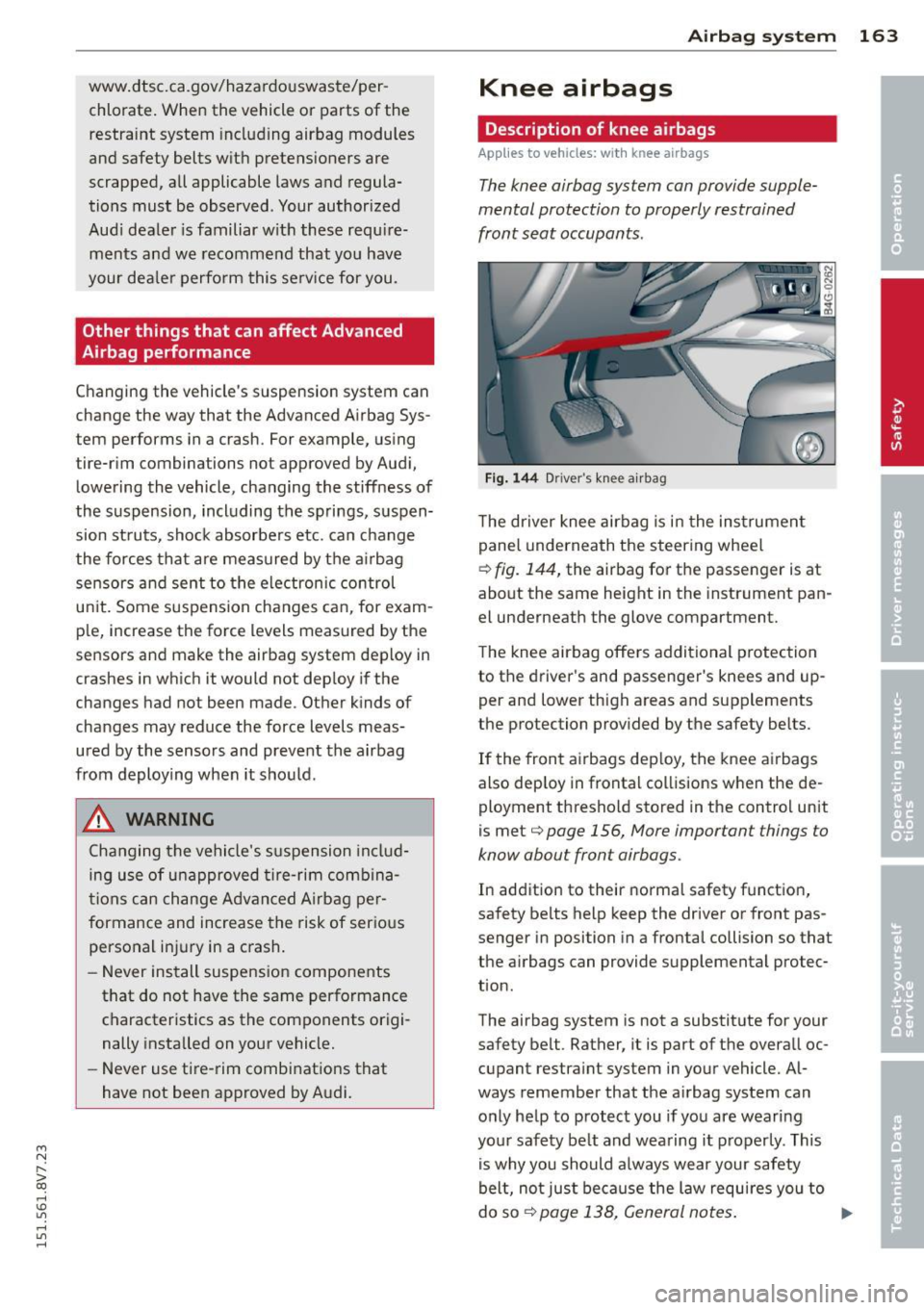
Fig. 144 Driver 's kn ee airbag
The dr iver knee airbag is in the instrument
panel underneath the steering wheel
¢
fig. 144, the airbag for the passenger is at
about the same height in the instrument pan
el underneath the glove compartment.
The knee airbag offers additional protection
to the driver's and passenger's knees and up
per and lower thigh areas and supplements
the protection provided by the safety belts.
If the front airbags deploy, the knee airbags
also dep loy in frontal collisions when the de
ployment threshold stored in the control unit
is met¢
page 156, More important things to
know about front airbags.
In addition to their normal safety function,
safety belts help keep the driver or front pas
senger in position in a frontal collision so that
the airbags can provide supplemental protec
tion.
The airbag system is not a substitute for your
safety belt. Rather, it is part of the overall oc
cupant restraint system in your vehicle. Al
ways remember that the airbag system can
only help to protect you if you are wearing
your safety be lt and wearing it properly. This
is why you should always wear your safety
belt, not just because the law requires you to
do so
¢page 138, General notes. ..,_
Page 190 of 302
188 Smart Technology
Smart Technology
Information about
data recorded by
vehicle control
modules
Your vehicle is not equipped with a crash data
recorder. This device is insta lled by some vehi
cle manufacturers to record data about crash
es so tha t it can be analy zed later. Crash data
recorders are also called "Event Data Record
ers (EDR)" .
In some legal jurisdictions, it is not permitted
to access or download data recorded by pre
installed crash data recorders in order to eval
uate a crash without clear consent of the vehi
cle owner .
Your veh icle is not equipped with a crash data
recorder. However it does contain a var iety of
e lectronic control modules for various vehicle
systems such as eng ine funct ion, exhaust
treatment or airbags and safety belts .
These electron ic control modules record vehi
cle data during normal driv ing for diagnosis
and repair purposes. The recording capab ility
of the electron ic control modules is lim ited to
data only- no sound is reco rded.
If t he control
mo dule detects a sys tem m alfu nction or other
change in sta tus, a very lim ited amount of da
ta is recorded for an extreme ly sma ll period of
time . Data t hat is recorded in s uch a case may
include veh icle speed, driving direction, the
load on the brakes and head restraints and
performance in the event of an acc iden t or
other change in status . The stored data can
only be read o r down loaded w ith specia l dev i
ces.
Electronic stabilization
control (ESC)
Description
The E lectronic Stabilization Cont rol (ESC) con
tr ibutes to d river safety. It reduces the risk of
slipp ing and improves driving stability. ESC detects critical situations such as the veh
icle
oversteering and understeering or the whee ls
are spinning . The vehicle is stabilized by ap
plying the brakes or reducing engine torq ue.
Once the ESC is activated, the ind icator light
Bl blinks in the instrument cluster .
The following systems are integrated in the ESC:
Anti -lock braking s ystem (ABS)
ABS prevents the whee ls from locking when
braking . The vehicle can still be steered even
during hard braking . App ly steady pressure to
the brake peda l. Do not pump the peda l. A
puls ing in the brake peda l ind icates that the
system is act ing to stabilize the ve hicle.
Brake assi st sy st e m
The brake assist system can decrease braking
distance .
It increases braking power when the
driver presses the brake peda l quickly in emer
gency s ituations. You m ust press and hold the
brake pedal until the dangerous situation is
over . In vehicles with adaptive cruise control*,
the brake assist system is more sens it ive if the
distance detected to the vehicle ahead is too
small.
Anti-slip regu lation (ASR )
ASR reduces engine power when the drive
wheels begin sp inning and adapts the force to
the road conditions. This makes it easier to
sta rt , accelerate and dr ive up inclines .
Electronic differenti al lock (EDL )
The EDL brakes whee ls that are spinning and
transfers the drive power to the other drive
wheel or wheels if the vehicle is equ ipped with
all wheel drive *). This function is not ava ilable
at h igher speeds .
In extreme cases, EDL automatically sw itches
off to keep t he b rake on the braked wheel
from overheat ing. The ve hicle is still working
co rrect ly. EDL w ill switch o n aga in automat i
ca lly when cond itions have ret urned to no r-
mal. .,._
Page 191 of 302
....,
N
r--. > co
rl I.O
"' rl
"' rl
Stee ring re comm endat ion
The ESC helps to stabilize the vehicle by
changing the steering torque.
Selective wheel torqu e control
Select ive wheel torque control is used when
driving on curves . The front wheel on the in
side of the curve or both wheels on the inside
of the curve are braked selective ly as needed.
This a llows more precise driving in curves.
Automatic post -collisi on brakin g system
The "Automatic post-collision braking system "
can help to reduce the risk of slidi ng and of
other coll is ions afte r an accident. I f the airbag
con tro l modu le detects a collision above ace r
tain vehicle speed, the vehicle is braked by the
ESC.
The vehicle does not brake automatically if:
- the driver presses the accelerator pedal, or
- the braking force generated by the pressed
brake pedal is greater than the braking force
that would be initiated by the system, or
- the ESC, the brake system or the vehicle
electrical system are not functioning.
A WARNING
-The ESC and its integrated systems can
not overcome the limits posed by natura l
physical laws. This is especially impor
tant on s lippery or wet roads. If the sys-
Switching on/off
Sm art Te chnol og y 189
terns beg in acting to stabilize your vehi
cle, you should immediately alter your
speed to match the road and traffic con
ditions . Do not let the increased safety
provided tempt you into taking r isks .
This could increase your risk of a co lli
SIOn.
- Please note the r isk of a coll is ion increas
es when driving fast, especially through
curves and on slippery or wet roads, and
when dr iv ing too close to objects ahead.
The ESC and its integrated systems can
not a lways prevent collisions -there is
still a risk of accidents!
- Press the accelerator pedal caref ully
when acce lerating on even, slippery sur
faces such as ice and snow. The drive
wheels can spin even when these control systems are installed and this can affect
driving stability and increase the r isk of a
coll is ion.
@ Tips
-ABS and ASR only function correctly
when all four wheels are equipped w ith
identical tires. Different t ire sizes can
lead to a reduct ion in engine power.
- You may hear noises when the systems
descr ibed are working.
- If the
Bl or [I] indicator light appears,
there may be a malfunction
¢ page 21.
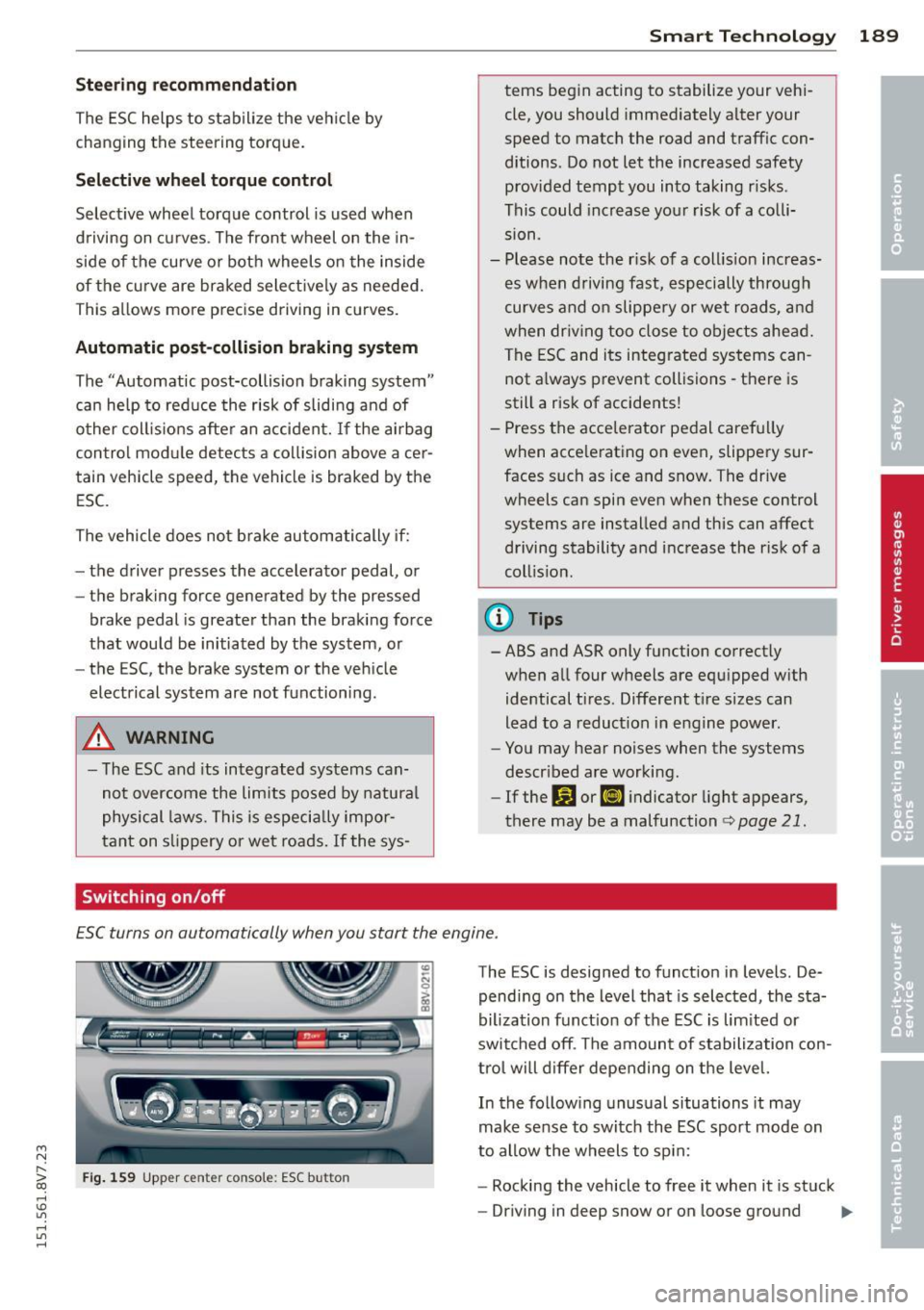
ESC turns on automatically when you start the engine .
Fig. 159 Upper c ente r conso le: ESC button
The ESC is designed to funct ion in levels . De
pend ing on the level that is selected, the sta
bilization funct ion of the ESC is lim ited or
swi tched off . The amoun t of stabilization con
trol wi ll differ depending on the level.
In the follow ing unusual situations it may
make sense to switch the ESC sport mode on
to allow the wheels to sp in:
- Rocking the vehicle to free it when it is stuck
- Driving in deep snow or on loose ground
IJJ-
Page 203 of 302
M N
" > co ,...., \!) ..,.,
,...., ..,., ,....,
Trailer towing Driving with a trailer
General information
Your Audi was designed primarily for passen
ger transportation .
If you plan to tow a tra iler, p lease remember
that the addit ional load will affect durab ility,
economy and performance .
Trailer towing not on ly places more stress on
the vehicle, it also calls for more concentra
tion from the driver.
F or this reason, a lways fo llow the operating
a n d driving instr uctions provided and use
common sense.
Technical requirements
Traile r hitch
Use a weight-carrying hitch conforming to the
gross trailer we ight. The hitch must be suita
b le for your veh icle and trailer and must be
mounted secure ly on t he veh icle's chassis at a
technically sound location . Use only a t railer
h itch w ith a removab le ball moun t. A lways
check with the tr ailer hitch man ufac tur er to
make sure that you are using the correct
hitch.
Do not use a bumper hitch.
T he hitc h must be installed in such a way that
it does not inte rfe re with the impac t-absorb
i ng b umper syst em. No modifica tions should
be made to the vehicle exhaus t and b rake sys
tems . From t ime to time, check that a ll hitch
mo unt ing bolt s remain securely fas tened.
W hen you are not tow ing a trailer, remove the
trai le r hi tch ball moun t. T h is prevents the
hi tch from causing damage sho uld your ve hi
cle be str uck from be hind
¢ &. .
Trailer brakes
If yo ur tra iler is equ ipped w it h a braking sys
tem, check to be su re that it conforms to a ll
r eg ulat io ns .
Trailer towin g 201
The trailer hyd ra ulic bra ke system must not be
direct ly connected to the vehicle's hydraulic
brake system .
Safety chains
Alw ays use saf ety chains between your ve hicle
and t he tra ile r.
Trailer lights
Tra iler lights must meet all reg ulations . Be
su re to check with your Audi dea ler fo r cor re ct
wir ing, swi tches and relays.
Mirrors
If you a re unable to see the traffic behind you
u sing the regula r outside m irrors, then you
must i nsta ll ext ended mir rors . It is important
t h at you
always have clea r vis ion to the rear .
.8, WARNING
-
Afte r removing the trailer hit ch, do no t
s tore i t in yo ur vehicle . In case of sudden
b raking, the h itch cou ld fly forwar d an d in
ju re you or yo ur passengers .
Operating instructions
Maximum trailer weight
A tra ile r fo r you r vehicle is limited to a ty pical
cl ass 1 or class 2 tra ile r.
Trailer load distribution
B e sure the loa d in the tr aile r is held secure ly
i n place to p reven t it from shift ing forw ard,
ba ckward or sideways.
Never allow a passenger to ride in a trailer
¢ &. in Driving instru ctions on page 20 2.
Engine cooling system
Towing a trailer makes the engine work hard
er . It is impo rtant that the cooling system's
perfo rmance is up to the additional load .
Make sure that the coo ling syst em has enough
f lui d.
Tire pressure
When towing a trailer , inflate the tires of your
vehicle to t he cold tire pressure listed under .,..
•
•
•
Page 205 of 302
M N
" > co ,...., \!) 1.1"1 ,...., 1.1"1 ,....,
different weight distribution. Safety, perform
ance and economy wi ll greatly depend on how
carefu lly you load your trailer and operate
your rig.
Before you actually tow your trailer, practice
turning, stopping and backing up in an area
away from traffic. Keep practicing until you
have become comp letely familiar with the way
your vehicle- trailer combination behaves and
responds .
Backing up is d ifficult and requires practice.
Backing up with a trai ler generally requires
stee ring action opposite to that when backing
up your vehicle without a trailer .
Maintain a greater distance between your ve
hicle and the one in front of you. You will need
more room to stop. To compensate for the
trailer, you will need a larger than normal
turn ing radius.
When passing, remember that you cannot ac
celerate as fast as you normally would be
cause of the added load. Make sure you have
enough room to pass . After passing, allow
p lenty of room for your tra iler before chang
ing lanes again.
Avoid jerky starts, sharp turns or rapid lane
changes.
(D Tips
- Do not tow a tra iler during the break-in
period of your vehicle.
- If you tow a trailer, your Audi may re
quire more frequent maintenance due to
the extra load
¢ page 282 .
Parking on a slope
Do not park on a slope with a trailer. If i t can
not be avoided, do so only after doing the fol
lowing:
When parking:
.. Apply the foot brake.
.. Have someone place chocks under both the
vehicle and the trailer wheels.
Trailer towing 203
.. With chocks in place, slowly release the
brakes until the wheel chocks absorb the
load .
.. Turn the wheels towards the curb.
.. Apply the parking brake.
.. Select the P selector lever posit ion.
When re starting after parking:
.. App ly the foot brake.
.. Start the engine.
.. Select the
0/5 selector lever position.
.. Release the parking brake and slowly pull
out and away from the wheel chocks .
.. Stop and have someone retr ieve the wheel
chocks.
(D Tips
If you move the selector lever of the auto
matic transmission to
P before applying
the parking brake and before blocking the
whee ls, you may have to use more force
lat er to move the lever out of the
P posi
tion.
•
•
•
Page 209 of 302
M N
" > co ,...., \!) 1.1"1 ,...., 1.1"1 ,....,
Care and cleanin g 207
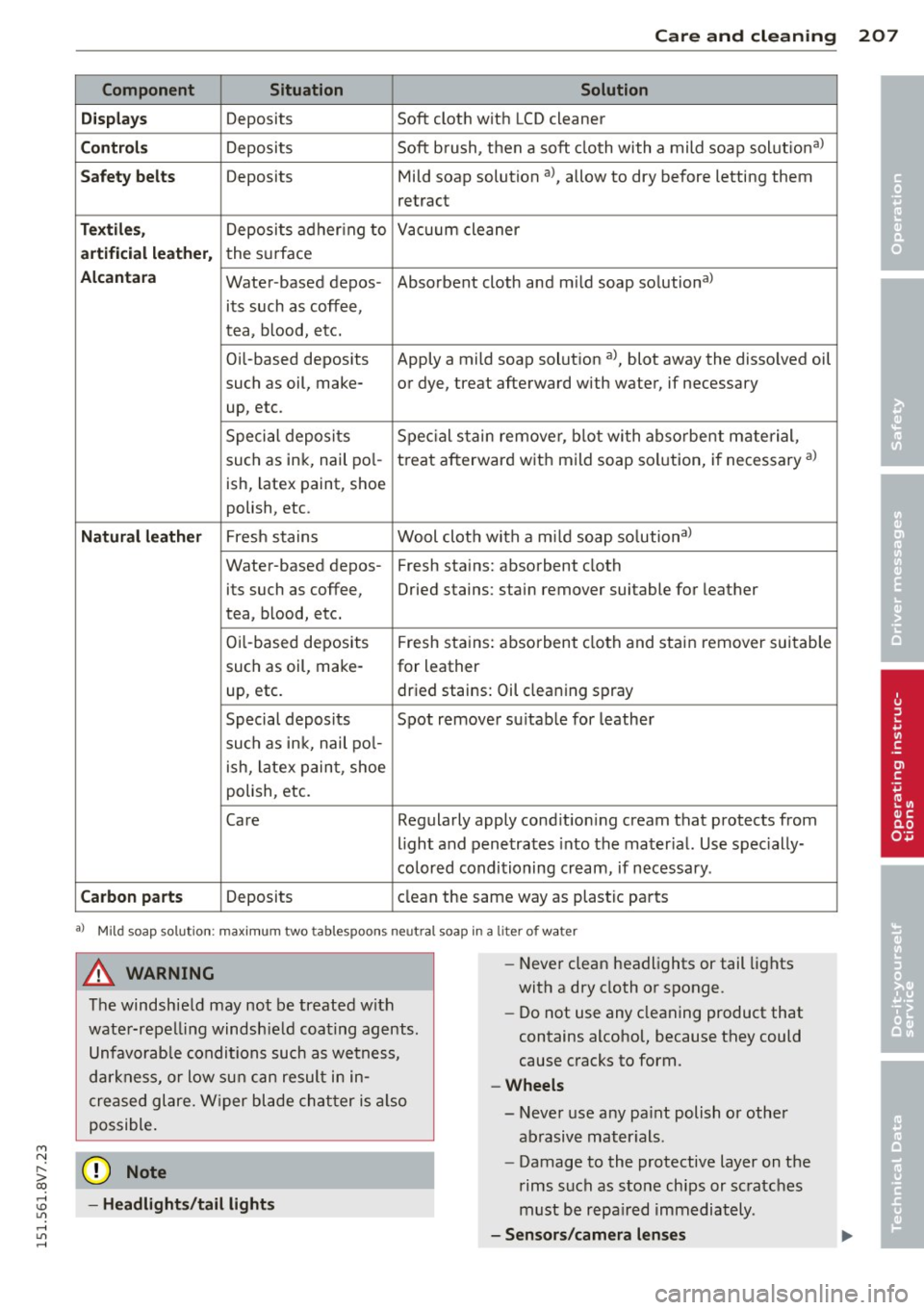
Component Situ ation Solution
D ispl ays
Deposits Soft clotlh with LCD cleaner
Controls Deposits Soft brush, then a soft cloth with a mild soap solutiona>
Sa fet y bel ts Deposits Mild soap solution a>, allow to dry before letting them
retract
Te xtil es, Deposits adher ing to Vacuum cleaner
a rtificial l eather, the surface
Alc ant ara Water-based depos- Absorbernt cloth and mild soap solutional
its such as coffee,
tea, blood, etc.
Oil-based deposits Apply a mild soap solution al, blot away the disso lved oil
such as oil, make- or dye, treat afterward with water, if necessary
up, etc.
Special depos its Spec
ial stain remover, b lot with absorbent material,
such as ink, nail po l- t reat afterward with mild soap solution, if necessary a)
ish, latex paint, shoe
polish, etc.
Natur al le ather Fresh stains Wool cloth with a m
ild soap solutional
Water-based depos- Fresh stains: absorbent cloth
its such as coffee, Dried stains: stain remover suitable for leather
tea, blood, etc.
Oi l-based deposits Fresh stains: absorbent cloth and stain remover suitable
such as oil, make- for leather
up, etc. dried stains: Oil cleaning spray
Special deposits Spot remover suitable for leather
such as ink, nail po l-
ish, latex paint, shoe
polish, etc.
Care Regularly apply condit ioning cream that protects from
l ight and penetrates into the mater ial. Use specially-
colored conditioning cream, if necessary .
Car bon part s Deposits clean the same way as plastic parts
al Mild soap solut ion : max imum two tablespoons neutral soap in a liter of water
A WARNING
The windshield may not be treated with
water-repelling windsh ie ld coating agents.
Unfavorab le conditions such as wetness,
da rkness, or low sun can result in in
creased glare. W iper blade chatter is a lso
possible.
- Headlight s/tail light s
-
-Never clean headlights or tail lights
with a dry cloth or sponge.
- Do not use any cleaning product that
contains alcohol, because they could
cause cracks to form.
-Wheels
- Neve r use any pa int polish or other
abrasive mater ials.
- Damage to the protective layer on the
rims such as stone chips or scratches
must be repa ired immediately .
-Se nsor s/camera l ense s
•
•
•
Page 224 of 302
222 Checking and Filling
After you switch the engine off, the auxiliary
fan can continue running for up to 10 minutes
- even with the ignition off. It can even switch
on again later by itself
c:> .&. , if
- the temperature of the engine coolant rises
due to the heat build-up from the engine in
the engine compartment, or
- the engine compartment heats up beca use
the vehicle is parked in intense sunlight.
A WARNING
- To reduce the risk of personal injury
nev
er touch the radiator fan.
- The auxiliary electr ic fan is temperature
contro lled and can switch on sudden ly
even when the engine is not running.
- The auxiliary radiator fan switches on au tomatically when the engine coolant
reaches a certain temperature and will
continue to run until the coolant temper
ature drops.
Brake fluid
Checking brake fluid level
N
N
;;;
" 00 co
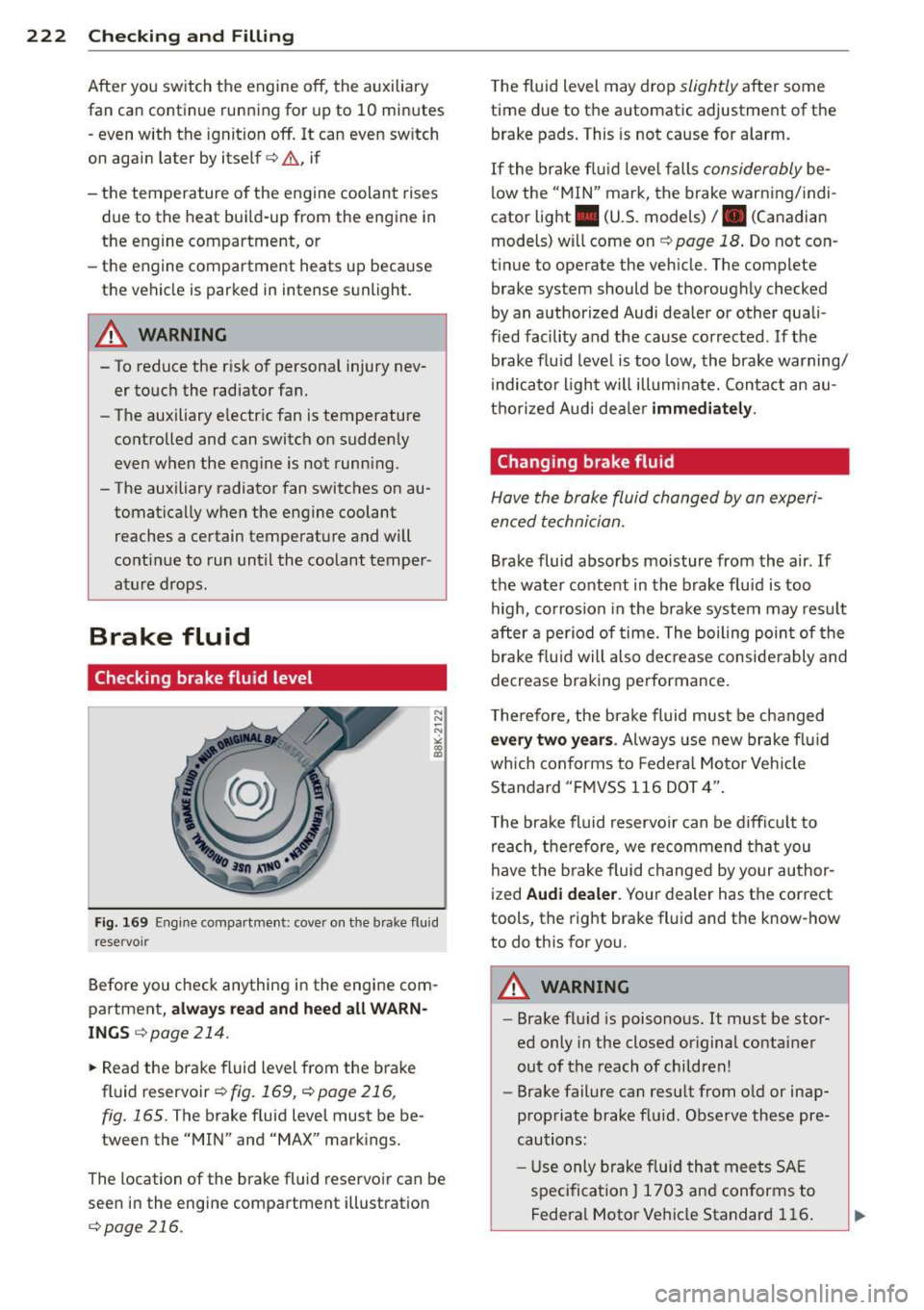
Fig . 169 Engine compartment : cove r on the brake flu id
r eservoir
Before you check anything in the engine com
partment,
always read and heed all WARN ·
INGS c:> page 214.
.. Read the brake fluid level from the brake
fluid reservoir
c:> fig.169, c:>poge216 ,
fig. 165.
The brake f luid level must be be
tween the "MIN" and "MAX" markings.
The location of the brake fluid reservoir can be
seen in the engine compartment illustration
c:> page 216 .
The fluid level may drop slightly after some
time due to the automatic adjustment of the
brake pads . This is not cause for a larm.
If the brake f luid level falls
considerably be
low the "MIN" mark, the brake warning/indi
cator light . (U.S. models)
I. (Canad ian
models) will come on
c:> page 18 . Do not con
tinue to operate the vehicle. The complete brake system should be thoroughly checked
by an authorized Audi dealer or other quali
fied facility and the cause corrected. If the
brake fluid level is too low, the brake warning/
indicator ligh t will illuminate. Contact an au
thorized Audi dea ler
immediately.
Changing brake fluid
Have the broke fluid changed by an experi
enced technician.
Brake fluid absorbs moisture from the air. If
the water content in the brake f luid is too
high, corrosion in the brake system may result
after a period of time. The boiling point of the
brake fluid will also decrease considerably and
decrease braking performance.
T he refo re, the brake fluid must be changed
every two years. Always use new brake fluid
wh ich conforms to Federal Motor Vehicle
Standard "FMVSS 116 DOT 4".
T he brake fluid reservoir can be difficult to
reach, therefore, we recommend that you
have the b rake fluid changed by your author
ized
Audi dealer. Your dealer has the correct
tools, the right brake fluid and the know-how
to do this for you .
A WARNING
---Brake flu id is poisonous. It must be stor
ed only in the closed or iginal container
out of the reach of children!
- Brake failure can resu lt from o ld or inap·
propriate brake flu id. Observe these pre·
cautions:
- Us e only brake fluid that meets SAE
specification
J 1703 and conforms to
Federa l Motor Vehicle Standard 116.