inflation pressure AUDI A3 CABRIOLET 2015 User Guide
[x] Cancel search | Manufacturer: AUDI, Model Year: 2015, Model line: A3 CABRIOLET, Model: AUDI A3 CABRIOLET 2015Pages: 302, PDF Size: 73.83 MB
Page 247 of 302
M N
" > co ,...., \!) 1.1'1 ,...., 1.1'1 ,....,
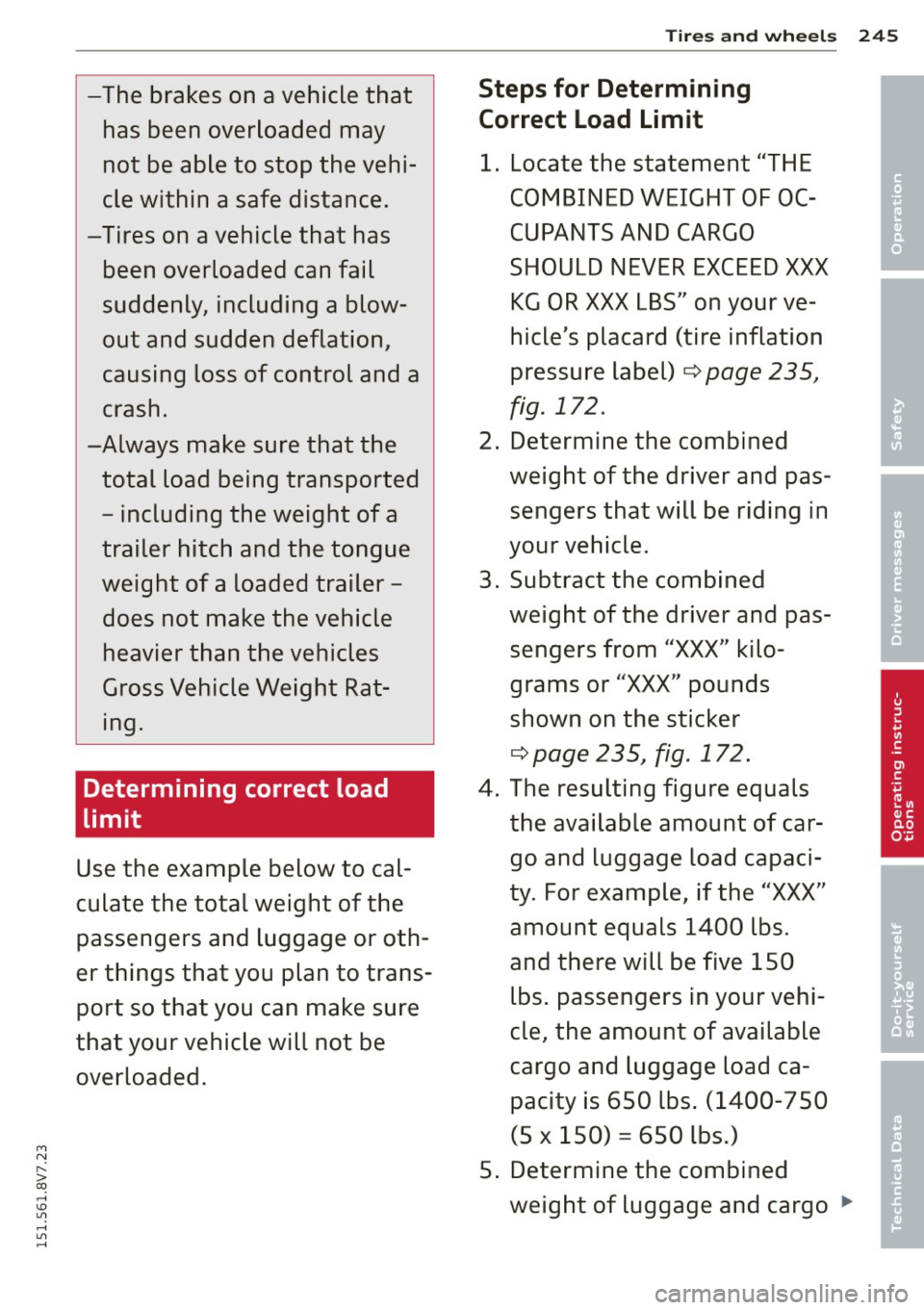
-The brakes on a vehicle that
has been overloaded may
not be able to stop the vehi
cle within a safe distance.
-Tires on a vehicle that has been overloaded can fail
suddenly, including a blow
out and sudden deflation,
causing loss of control and a
crash.
-Always make sure that the total load being transported
- including the weight of a
trailer hitch and the tongue
weight of a loaded trailer -
does not make the vehicle
heavier than the vehicles
Gross Vehicle Weight Rat
ing.
Determining correct load
limit
Use the example below to cal
culate the total weight of the
passengers and luggage or oth
er things that you plan to trans
port so that you can make sure
that your vehicle will not be overloaded.
Tires and wheels 245
Steps for Determining
Correct Load Limit
1. Locate the statement "THE
COMBINED WEIGHT OF OC
CUPANTS AND CARGO
SHOULD NEVER EXCEED XXX KG OR XXX LBS" on your ve
hicle's placard (tire inflation
pressure label)
¢ page 235,
fig. 172.
2. Determine the combined
weight of the driver and passengers that will be riding in
your vehicle.
3. Subtract the combined
weight of the driver and pas
sengers from
"XXX" kilo
grams or
"XXX" pounds
shown on the sticker
r:::> page 235, fig. 172.
4. The resulting figure equals the available amount of cargo and luggage load capaci
ty. For example, if the
"XXX"
amount equals 1400 lbs.
and there will be five 150 lbs. passengers in your vehi
cle, the amount of available
cargo and luggage load ca
pacity is 650 lbs. (1400-7 50
(5
X 150) = 650 lbs.)
5. Determine the combined
weight of luggage and cargo ""
' •
•
' •
Page 254 of 302
252 Tires a nd whee ls
tires beca use they meet the
h ighest standards regarding
safety and driving characteris
t ics when used correctly. Your
autho rized Audi dealer w ill
g lad ly provide you with more
information.
Tire ply composition and materials used
T he number of plies indicates
the number of layers of rubber
coated fabric in the tire. In gen
eral, the greater the number of
plies , the more weight a tire
can support . Tire manufactur
ers also must indicate the ma
ter ia ls in the tire, wh ich include
steel, nylon, polyester, and oth
ers .
Ma ximum Load Rating
This number indicates the max
imum load in kilograms and
pounds that can be carried by
the tire.
Tire quality grading for
treadwear, traction , and
temperature resistance
Tread wear, traction and tem
perature grades¢
page 254.
Maximum Permissible
Inflation Pressure
This number is the greatest
amount of air pressure that
should ever be put in the tire
under normal driving condi
tions.
A WARN ING
-Using incorrect or unmatch
ed tires and/or wheels or improper tire and wheel
combinations can lead to loss of control, collis ion and
serious personal injury.
-Always use tires, rims and
wheel bolts that meet the
specifications of original
factory-installed tires or
other combinations that
have been specifically ap
proved by the vehicle manu
facturer.
- Tires age even if they are
not being used and can fail
suddenly, especially at high
speeds. Tires that are more
than 6 years old can only be
used in an emergency and
then with special care and
at lower speeds.
-Never mount used tires on
your vehicle if you are not
Page 259 of 302
M N ,....
> co ,...., \!) 1.1'1 ,...., 1.1'1 ,....,
In certain circumstances, you may not use
wheel bo lts from a different vehicle -
even if it
i s the same mode l
Qpage 284.
A WARNING
Improperly tightened or maintained wheel
bolts can become loose caus ing loss of
control, a collision and ser ious personal in
jury .
- Always keep the wheel bolts and the
threads in the wheel hubs clean so the
wheel bolts can turn easily and be prop
erly t ightened.
- Never grease or oil the wheel bolts and
the threads in the wheel hubs. They can
become loose w hile d riving if greased or
o iled,
even if tightened to the spec ified
torq ue.
- Only use wheel bo lts that belong to the
rim being ins talled.
- Never use different whee ls bolts on your
vehicle .
- Always maintain the correct tightening
torque fo r the wheel bolts to reduce the
risk of a wheel loss. If the tigh teni ng tor
que of the wheel bolts is too low, they
can loosen and come out when the vehi
cle is moving . If the tightening torque is
too high, the whee l bolts and threads
can be damaged and the wheel ca n be
come loose .
(D Note
The specified torque for the wheel bo lts is
90 ft lb (120 Nm) w ith a tolerance of
± 7,4 ft lb(± 10 Nm). Torque whee l bolts
diagonally. After changing a wheel, the
torque must be checked as soon as possi
b le with a torque wrench -prefe rably by an
author ized Audi dealer or qualified wo rk
shop.
Low aspect ratio tires
Your Audi is factory-equipped with low aspect
ratio tires . These tires have been thorough ly
tested and been selected spec ifically for your
model for the ir superb performance, road feel
Tire s an d wheel s 257
and handling under a variety o f driving condi
tions. Ask your authorized A udi dealer for
more details .
T he low aspec t ratio of these tires is ind icate d
by a numera l of
55 or le ss in the tire's size
designation. The numera l represents the ratio
of the t ire's sidewa ll height in relation to its
tread width expressed in percentage.
Conven
tiona l tires have a he ight/w idth rat io of 60 or
more .
The performance of low-a spect-ratio tire s is
particularl y sens it iv e to improper inflation
pressure. It is therefore important that low
a spect ratio tir es are inflated to the specified
pre ssure and that the inflation pr essure i s
regularly checked and ma intain ed . Tire pr es
s ure s should be checked at lea st on ce a
month and alway s bef ore a long trip
~ page 240 , Checking tire pressure .
A Word about Low Aspect Ratio and High
Performance Ti res
Hig h pe rformance tires are des igned for bet
ter performance and handling in warm cli
mates. When driving in cold, snowy or icy
weather, you sho uld equ ip your vehicle w it h
four all-season or winter tires, which
offer
better traction under those condit ions. We
suggest you use the Audi recommended win
te r or a ll-season tires specified for you r Audi.
High performance tires a lso have a lower as
pect ratio that aids performance and han
dling . Driving over rough or damaged road
surfaces, as well as debr is, cu rbs and other
obstacles can cause serious damage to
whee ls, tires, vehicle body, and suspens ion
parts . B e carefu l to avo id road hazards and re
du ce your speed , espec ia lly if your vehicle is
equipped wi th low prof ile tires .
Please a lso remember when making your se
lection that, wh ile these tires deliver respon
s ive handling, t hey m ay ride less comfo rtably
and make more noise than o thers . Finally,
these tires may wear more quickly than other
c h oices.
IJJ>
•
•
•
Page 260 of 302

258 Tires and wheels
It is important that the inflation pressu re is
regularly checked and maintained at recom
mended levels .
Fo r more informat ion please ask your A udi
dealer for more details .
What you can do to avoid tire and rim
damage
L ow aspect ratio tires can be damaged more
easi ly by impact with potho les, curbs, gu llies
or ridges on the road, particularly if the tire is
underinflated.
I n o rder to minim ize the occurrence of impact
damage to the tires of your vehicle, we recom
mend that you observe the following precau
tions:
- Always maintain recommended inflation
pressures. Check your tire pressure every
2,000 miles (3,000 km) and add air if neces
sary.
- Drive carefu lly on roads with potholes, deep
gullies or ridges. The impact from driving
through or over such obstacles can damage
your tires. Impact with a curb may also cause damage to your tires.
- After any impact, immediately inspect your
tires or have them inspected by the nearest
authorized Audi dealer . Replace a damaged
t ir e as soon as possible.
- Inspect your tires every 2,000 miles (3,000
km) for damage and wear . Damage is not al
ways easy to see. Damage can lead to loss of
air and underinflation, wh ich could eventu
ally cause t ire failure.
If you believe that a
t ir e may have been damaged, replace the
tire as soon as possible.
- T hese tires may wea r more quickly than oth
ers.
- Please a lso remember that, while these tires
deliver respons ive handling, they may ride
less comfortably and make more noise than
other choices.
Reduced performance in winter/cold
season conditions
All tires are designed for certain purposes.
The low aspect ratio, ultra high performance ti
res or iginally installed on your vehicle are in
tended for maximum dry and wet road per
formance and handling. They are not suitable
for cold, snowy or icy weather conditions. If
you drive under those circumstances, you
should equ ip your vehicle with all-season or
winter tires, which offer better traction unde r
those conditions. We suggest you use the rec
ommended snow o r all-season tires specified
for your vehicle, or thei r equivalent.
Refer to~ page
255 for more detailed infor
mation regarding winter tires.
Tire pressure
monitoring system
ill General notes
Each tire, including the spare (if provided),
shou ld be checked monthly when co ld and in
flated to the inflat ion pressure recommended
by the vehicle man ufactur er on the veh icle
placard or tire inflation pressure labe l. (If your
vehicle has tires of a different size than the
size indicated on the vehicle placard or tire in
flation pressure label, you should determine
the proper t ire inflation pressure for those
t i res).
As an added safety feature, your vehicle has been equipped with a tire pressure monitoring
system (TPMS) that illuminates a low tire
pressure telltale when one or more of your
t ir es is signif icantly under-inflated. According
ly, when the low tire pressure telltale illumi
nates, you shou ld stop and check you r tires as
soon as possible, and inflate them to the
proper p ressure. Driving on a sign ificantly un
der -inflated tire causes the tire to overheat
and can lead to tire fa ilure . Under-inflation al
so reduces fuel eff iciency and tire tread life,
and may affect the vehicle's handling and
stopp ing ability.
Please note that the TPMS is not a substitute
for proper tire maintenance, and it is the driv
er's responsibility to maintain correct tire
pressure, even if under-inflation has not
Page 291 of 302
M N ,....
> co ,...., \!) 1.1'1 ,...., 1.1'1 ,....,
Cockpit (overview) . . . . . . . . . . . . . . . . . . . . 8
Cold tire inflation pressure ............ 235
Coming home ...... ..... .. .... .. .. .. 51
Compartments ............ .... .. .. .. 64
Compass in the mirror ........... .... . 57
Compliance .. .. .............. ... ... 285
Consumer Information . . . . . . . . . . 134, 282
Consumption (fuel) ........ .. .. .. .. .. 27
Contacting NH TSA ............ ... .. . 134
Convenience key Emergency operation . . . . . . . . . . . . . . . . 80
Indicator light ........... .. .. .. .. .. 81
Starting the engine (START ENGINE ST OP
button) .... .. .............. ... .... 78
Stopping the engine (S TART ENGINE
STOP button) . . . . . . . . . . . . . . . . . . . . . . 79
Switching the ignition on .. .. .. .. .. .. 78
unlocking/locking ........ .. .. .. .. .. 34
Convenience opening/closing
Convertible child safety seats
Convertible locking retractor .
. .. .. .. .. 39
176
Activating .. ................. .. .. . 182
Deactivating . . . . . . . . . . . . . . . . . . . . . . 182
Using to secure a child safety seat l80, 182
Coolant
refer to Engine coolant ....... ... .. . 220
Cool ing mode (automatic climate control
system) . .. .. ................. .. .. .. 72
Cooling mode (manual climate control sys-
tem) .. .. .. .. .. ........ ... .. .. .. .. .. 71
Cooling system Adding coolant ........... .... .. .. . 221
Coolant level checking ..... .. .. .. .. . 221
Coolant temperature indicator .. ... ... 12
Indicator light ... .. ...... .. .. .. .. .. 19
Cornering light . ........... .. .. .. .. .. 50
C rash data recorde r (EDR) 188
Cruise control system Changing speed . . . . . . . . . . . . . . . . . . . . 86
Description ............... ... ... ... 85
Preselecting speed . . . . . . . . . . . . . . . . . . 86
Sw itching off . ........... .. .. .. .. .. 86
switch ing on ............. .... .. .. .. 85
Cup holders . . . . . . . . . . . . . . . . . . . . . . . . . 64
Current consumption . . . . . . . . . . . . . 26, 27
Index 289
D
Data recorder . . . . . . . . . . . . . . . . . 188, 194
Date display . . . . . . . . . . . . . . . . . . . . . . . . 10
Daytime running lights ........... .... . 49
Decla rat ion of compliance
Adaptive cruise control . . . . . . . . . . . . . 28S
Audi side assist .... .............. . 285
Cell phone package . . . . . . . . . . . . . . . . 285
Convenience key .... .............. . 285
Electronic immobilizer .......... .. .. 285
Homelink universal remote control . .. 285
Remote control key . . . . . . . . . . . . . . . . 285
Defective light bulb warning
Indicator light ... .. ................ 24
Defrost ing (windshield)
automat ic climate control system . . . . . 73
manual climate control system ........ 71
DEF (instrument cluster) ... .. .... .... . 11
Deluxe automatic climate control
refer to Climate control system (auto-
ma tic) ...... .. .. .. . ............... 72
Determining correct load limit ....... . 245
Digital compass . .. .. . ............ .. . 57
Dimensions . .. .. .. ................. 280
D imming the rearv iew mirror ..... .. .. . 56
Distance ......... .. ..... ........... 27
Door/rear lid warning 26
Door contact sw itch . . . . . . . . . . . . . . . . . . 52
Driver information system .......... .. . 26
CD/radio display .. .. . .. .. .. .... .... . 26
Door/rear lid warning ............... 26
Driver messages . . . . . . . . . . . . . . . . . . . . 13
Efficiency program . . . . . . . . . . . . . . . . . . 28
Ind icator lights .. .... ......... .... . 13
On-board computer ............ .. .. . 27
Outside temperature display . . . . . . . . . . 26
Service interval display . . . . . . . . . . . . . . 13
Using the mu ltifunction steering wheel . 26
Driver seating position ........... .... 127
Drive select
refer to Audi drive select ............ 107
Driving safely 126
Driving through water .. ......... .. .. 197
Driving time
Dust filter 27
refer to Pollutant
filter ............ .. 70
•
•