belt AUDI A3 CABRIOLET 2015 Repair Manual
[x] Cancel search | Manufacturer: AUDI, Model Year: 2015, Model line: A3 CABRIOLET, Model: AUDI A3 CABRIOLET 2015Pages: 302, PDF Size: 73.83 MB
Page 190 of 302
188 Smart Technology
Smart Technology
Information about
data recorded by
vehicle control
modules
Your vehicle is not equipped with a crash data
recorder. This device is insta lled by some vehi
cle manufacturers to record data about crash
es so tha t it can be analy zed later. Crash data
recorders are also called "Event Data Record
ers (EDR)" .
In some legal jurisdictions, it is not permitted
to access or download data recorded by pre
installed crash data recorders in order to eval
uate a crash without clear consent of the vehi
cle owner .
Your veh icle is not equipped with a crash data
recorder. However it does contain a var iety of
e lectronic control modules for various vehicle
systems such as eng ine funct ion, exhaust
treatment or airbags and safety belts .
These electron ic control modules record vehi
cle data during normal driv ing for diagnosis
and repair purposes. The recording capab ility
of the electron ic control modules is lim ited to
data only- no sound is reco rded.
If t he control
mo dule detects a sys tem m alfu nction or other
change in sta tus, a very lim ited amount of da
ta is recorded for an extreme ly sma ll period of
time . Data t hat is recorded in s uch a case may
include veh icle speed, driving direction, the
load on the brakes and head restraints and
performance in the event of an acc iden t or
other change in status . The stored data can
only be read o r down loaded w ith specia l dev i
ces.
Electronic stabilization
control (ESC)
Description
The E lectronic Stabilization Cont rol (ESC) con
tr ibutes to d river safety. It reduces the risk of
slipp ing and improves driving stability. ESC detects critical situations such as the veh
icle
oversteering and understeering or the whee ls
are spinning . The vehicle is stabilized by ap
plying the brakes or reducing engine torq ue.
Once the ESC is activated, the ind icator light
Bl blinks in the instrument cluster .
The following systems are integrated in the ESC:
Anti -lock braking s ystem (ABS)
ABS prevents the whee ls from locking when
braking . The vehicle can still be steered even
during hard braking . App ly steady pressure to
the brake peda l. Do not pump the peda l. A
puls ing in the brake peda l ind icates that the
system is act ing to stabilize the ve hicle.
Brake assi st sy st e m
The brake assist system can decrease braking
distance .
It increases braking power when the
driver presses the brake peda l quickly in emer
gency s ituations. You m ust press and hold the
brake pedal until the dangerous situation is
over . In vehicles with adaptive cruise control*,
the brake assist system is more sens it ive if the
distance detected to the vehicle ahead is too
small.
Anti-slip regu lation (ASR )
ASR reduces engine power when the drive
wheels begin sp inning and adapts the force to
the road conditions. This makes it easier to
sta rt , accelerate and dr ive up inclines .
Electronic differenti al lock (EDL )
The EDL brakes whee ls that are spinning and
transfers the drive power to the other drive
wheel or wheels if the vehicle is equ ipped with
all wheel drive *). This function is not ava ilable
at h igher speeds .
In extreme cases, EDL automatically sw itches
off to keep t he b rake on the braked wheel
from overheat ing. The ve hicle is still working
co rrect ly. EDL w ill switch o n aga in automat i
ca lly when cond itions have ret urned to no r-
mal. .,._
Page 196 of 302
194 Smart T echnol ogy
not used then is being generated in o rder to
maintain an optimal battery charge level.
(D Tips
- Energy management cannot overcome
the laws o f physics. Note that the charge
l evel and length of the battery life are
li mited .
- When the starting ability is endangered,
the (•) indicator light turns on
c> page20.
What you should know
Maintaining the starting ability is the highest
priority .
A lot of stress is p laced on the battery when
driving short distances, in traffic, and at co ld
times of the year. A lot of energy is used but
little is generated.
It is also critical when the
engine is not running but electrical equip ment is switched on . In this case, energy is
used but none is generated .
In situations like this, energy management
will actively regulated the distribut ion of en
ergy.
L ong periods wi thout u se
If you do not drive your vehicle for several
days or weeks, e lectrica l equipment is gradu
ally sca led back or switched off. This reduces
energy use and ensures the vehicle will be
able to start after long periods of time. Some
conven ience functions such as opening with
the remote control key may not be ava ilable.
These convenience functions w ill be availab le
again o nce you swi tch the ign ition on and
start the engine.
With the engine switched off
For example, if you listen to the radio when
the eng ine is sw itched off, the battery w ill
d rain .
A warning text w ill appear if energy consump
tion could impair starting ab ility .
The message shows that you need to start the
engine in order to charge the battery.
With the en gine running
Although e lectrical energy is gene rated while
driving, the battery can dra in. This can happen
when litt le energy is generated, and much is
u sed and the charge leve l of the battery is not
optimal.
T o restore the balance of ene rgy, components
that require large amounts of energy are tem
porari ly scaled back or switched off. Heating
systems in particular require a great deal of
energy. If you notice, for example, that the
seat heating* or rear window defroster is not
worki ng, then it has been temporar ily reduced
or switched off . These systems are available
again as soon as the energy balance has been
resto red.
In add ition, you may notice that the idle
speed has slightly increased. That is normal
and no cause for concern. Due to the in
c reased idling speed, the additional required
energy w ill be gene rated and the battery will
be charged.
Notice about data
recorded by the Event
Data Recorder and
vehicle control
modules
E v ent D ata Reco rder
This vehicle is equ ipped with an Event Data
Recorder (EDR). The main purpose of an EDR
is to record, in certain crash or near crash-like
situations, such as an a irbag deployment or
hitting a road obstacle, data that will assist in
understanding how a vehicle's systems per
formed . T he EDR is des igned to record data
related to vehicle dynam ics and safety sys
tems fo r a short period of time, typically
30 seconds or less . The EDR in this vehicle is
designed to record such data as:
- How various systems in your vehicle were
operating;
- Whether or not the driver and passenge r
safety belts were b uckled/fastened;
Page 197 of 302
M N
-How far (if at all) the driver was depressing
the accelerator and/or brake pedal; and,
- How fast the vehicle was traveling.
These data can he lp provide a better under
standing of the circumstances in which crash
es and injuries occur. NOTE: EDR data are re
corded by your vehicle only if a non-trivial
crash situation occurs; no data are recorded by
the EDR under normal driving conditions and
no personal data (e.g., name, gender, age,
and crash location) are recorded. However,
other parties, such as law enforcement, could
comb ine the EDR data with the type of per
sonally identify ing data routinely acquired
during a crash invest igation.
To read data recorded by an EDR, special
equ ipment is required, and access to the veh i
cle or the EDR is needed . In add ition to the ve
hicle manufacturer, other parties, such as law
enforcement, that have the special equip
ment, can read the information if they have
access to the vehicle or the EDR.
Some state laws restrict the retrieval or down
loading of data stored by EDRs installed in a
vehicle for the express pu rpose of retr ieving
data after an accident or crash event without
the owner's consent.
Aud i will not access the EDR and/or sim ilar
data or give it to others -
- unless the vehicle owner (or lessee if the ve
hicle has been leased) agrees; or
- upon the official request by the police; or
- upon the order of a court of law or a govern-
ment agency; or
- for the defense of a lawsuit through the ju
dicial discovery process .
- Audi may also use the data for research
about vehicle operation and safety perform
ance or provide the data to a third party for
research purposes without identifying the
specific vehicle or information about the
identity of its owner or lessee and only after
the recorded vehicle data has been ac-
S: cessed. co ,...., \!) 1.1'1 ,...., 1.1'1 ,....,
Smart Technology 195
Vehicle control modules
Your vehicle is also equipped with a number of
electronic control modules for various vehicle
systems, such as engine management, emis
sion control, airbags, and safety belts.
T hese electronic control modu les record data
during norma l vehicle operation that may be
needed by trained technicians for diagnostic
and repair purposes. The recording capability
of these modules is limited to data (no sound
is recorded). Only a small amount of data is
actually recorded over a very lim ited period of
time, or stored when a system fault is detect
ed by a control module. Some of the data
stored may relate to vehicle speed, direction,
or braking, as well as restraint system use and
performance in the event of a crash. Stored
data can also only be read and downloaded
with special equipment that is directly con
nected to the vehicle.
(D Tips
Your vehicle may be equipped with Audi
connect. Your use of certain Audi connect
features requires wireless services that are
provided by a third party wire less telecom
munications provider. For details regard
ing how information obtained through
Audi connect is collected, processed,
transmitted, used, and shared, please see
your contract with the wireless telecom
munications provider and the "About Audi
connect" tab in your vehicle's
MMI: I MENU I
button > Audi connect > About Audi con
nect.
•
•
•
Page 210 of 302
208 Care and cleaning
-Never use warm or hot water to re
move snow or ice from the camera
lens. This could cause the lens to crack.
- Never use abrasive cleaning materials
or alcohol to clean the camera lens.
Th is could cause scratches and cracks.
-Power top
- Remove bird droppings immediately.
- Never use gasoline, spot remover, ben-
zene, paint thinner or other solvents to
remove.
- Door windows
- Remove snow and ice on windows and
exterior mirrors with a plastic scraper.
To avoid scratches, move the scraper
only in one direction and not back and
forth.
- Never remove snow or ice from door
windows and mirrors using warm or
hot water because this could cause
cracks to form.
- To avoid damage to the rear window
defogger, do not apply any stickers on
the heating wires on the inside of the
window.
- Decorative parts/trim
- Never use chrome care or cleaning
products.
- Paint
- To reduce the risk of scratches, the ve-
hicle must be free of dirt and dust be
fore polishing or waxing.
- To prevent paint damage, do not polish or wax the vehicle in direct sunlight.
- To reduce the risk of paint damage, do
not polish away rust spots.
- Remove cosmetics and sunscreen im
mediately -these could damage the
paint.
- Displays
-To avoid scratches, do not use dry
cleaning methods on displays.
- Controls
- Make sure that no fluids enter the con-
trols, because this could cause dam
age.
- Safety belts
- Do not remove the safety belts to clean
them.
- Never clean safety belts or their com
ponents chemically or with corrosive
fluids or solvents and never allow sharp objects to come into contact
with the safety belts. This could cause
damage to the belt webbing.
- If there is damage to the webbing, the
connections, the retractors or the buck
les, have them replaced by an author
ized dealer.
- Textiles/artificial leather/Alcantara
- Never treat artificial leather/Alcantara
with leather care products, solvents,
floor polish, shoe polish, spot remove
or similar products.
- Have a specialist remove stubborn
stains to prevent damage.
- Never use steam cleaners, brushes,
hard sponges, etc. when cleaning.
- Do not turn on the seat heating* to dry
the seat.
- Objects with sharp edges such as zip
pers, rivets on clothing or belts can
cause damage to the surface.
- Open hook and loop fasteners, for ex
ample on clothing, can damage seat
covers. Make sure hook and loop fas
teners are closed.
- Natural leather
- Never treat leather with solvents, floor
polish, shoe polish, spot remover or
similar products.
- Objects with sharp edges such as zip
pers, rivets on clothing or belts can
cause damage to the surface.
- Never use steam cleaners, brushes,
hard sponges, etc. when cleaning.
- Do not turn on the seat heating* to dry
the seat.
- To help prevent the leather from fad
ing, do not leave the vehicle in direct
sunlight for long periods of time . If
leaving the vehicle parked for long pe
riods of time, you should cover the
leather to protect it from direct sun-
light. ...
Page 216 of 302
214 Check ing and F illin g
•Pullon the cover carefu lly ¢ fig. 162. The
tab on the cover must point forward in the direction you are pulling when pu lling on
the cover.
• To open the fuel filler door, press on the left
side
¢ page 212, fig . 160 .
{Q) Note
Only pull on the cover unt il you feel resist
ance. You will not hear it release . Other
w ise you could damage the emergency re
lease mechanism.
Hood
Working in the engine compartment
Special care is required if you are working in the engine compartment
F o r w ork in th e eng in e c omp artm ent su ch as
c h ecking and fi llin g fluid s, t he re i s a risk of
inj ury, sca lding, accid ents, a nd b urn s. Fo r
thi s re aso n, follow all the follow in g listed
war ning s and ge neral safety p recaution s.
T he engine compartment is a d ang ero us
area. ¢,& .
A WARNING
To reduce the risk of injur ies, complete the
following steps before opening the hood:
- Turn the engine off.
- Switch the ignition off.
- Set the parking brake.
- Place the selector lever in the P position .
- Let the engine coo l down.
- Never open the hood when you see that
steam o r coolant drips from the engine
c ompartment- there is a danger of
burns! Wait until no steam or coolant
flows out.
- Keep chi ldren away from the engine com
partment.
- Never spill flu ids on a hot eng ine. These
fluids (such as the freeze protection con
tained in the coolant) can catch fire .
- Avo id short circuits in the electrical sys
tem, especially the battery . -
When working in the engine compart
ment, remember that the radiator fan
can switch on even if the ignition is
sw itched off, which increases the risk of
personal injury.
- Never open the cap on the coolant ex
pans ion tank when the eng ine is warm.
The cooling system is unde r pressure.
- To protect your face, hands, and arms
from hot steam or coolant, cover the cap
with a large cloth when opening .
- Do not remove the engine cover under any circumstances. This increases the
risk of burns .
- If tests need to be performed with the engine runn ing, there is add itiona l dan
ge r due to moving components (such as
the ribbed belt, generator and radiator
fan) and from the high voltage ignit ion
system.
- Never reach into the radiator fan. The
electric auxilia ry fan is controlled by
temperature and can switch on sudden ly .
- Pay attention to the fo llow ing warnings
listed when work on the fuel system or
on the e lectrica l equipment is required.
- Always disconnect the vehicle battery
from the vehicle e lectr ical system
- Do not smoke
- Never work near open flames
- Always have a working fire exting uisher
nearby
- To reduce the risk of electric s hock and
inj ury, never touch the fo llowing compo
nents when the engine is running or is
be ing started :
- Ig nition cable
- Other compone nts in the electronic
high voltage ign it ion system
- If you must check or perform work on the eng ine while it is runn ing:
- Set the parking brake and place these
lector lever in the P (park) position
first.
- Always proceed with extreme caution
so that clot hing, jewe lry or long hai r do
not become caught in the radiator fan, ..,.
Page 217 of 302
....,
N
r--. > co
rl I.O
"' rl
"' rl
fan belt or other moving components or do not come into contact w ith hot
components. T ie back long hair before
beginning work and do not wear cloth ing that can hang down into the en
g ine .
- Limit your exposure to exhaust and
chemicals to as short a time as poss ible
c::;, &. .
& WARNING
California P ropos ition 65 Warning:
- Engine exhaust, some of its constituents,
and certain veh icle components conta in
o r emit chemicals known to the State of
Californ ia to cause cancer and b irth de
fec ts and reproduct ive harm . In addition,
certain fluids conta ined in vehicles and
certain products of component wear con
tain or emit chemicals known to the State of California to cause cancer and
birth defects or other reproductive harm.
- Battery posts, terminals and related ac
cessories contain lead and lead com pounds , chemicals known to the State of
Californ ia to cause cancer a nd reproduc
t ive harms . Wash hands after handling .
(D Note
When filling fluids, be sure not to m ix the
fluids up. Othe rwise severe malfunctions
and e ng ine damage will occur .
@ For the sake of the environment
You should regularly check the ground un
der your vehicle in orde r to detect leaks
quickly . If there are visible spots from oil
or other fluids, b ring your veh icle to an au
thori zed Audi dealer or qualified repair fa
cility to be checked .
Checking and Fillin g 215
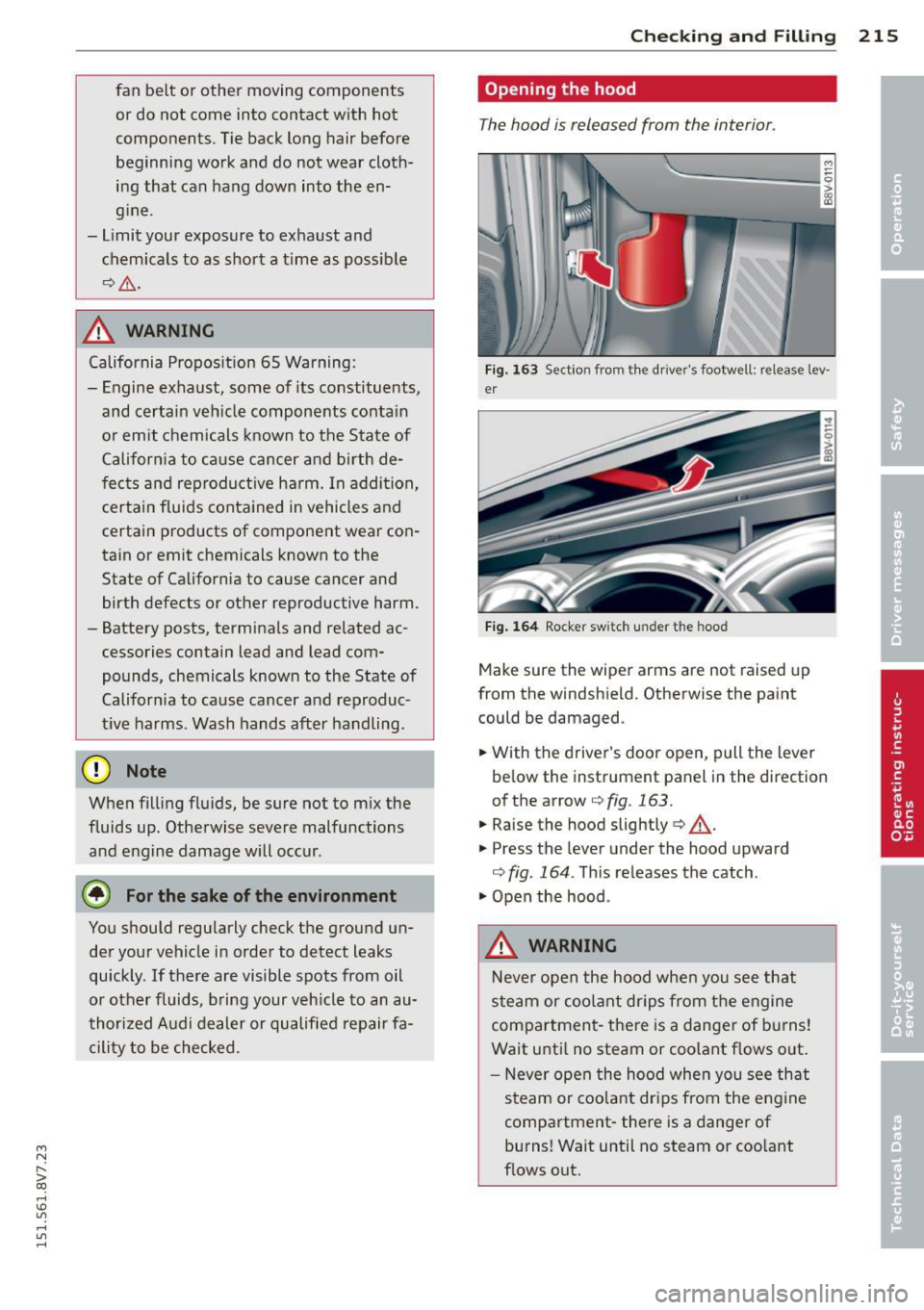
Opening the hood
The hood is released from the interior .
Fig. 163 Se ct io n fro m t he dr iver 's footwell : release Lev ·
er
Fi g. 1 64 Rocke r sw it ch under t he hood
Make sure the wiper arms are not raised up
from the windshield. Otherwise the paint could be damaged .
... With the drive r's door open, pull the lever
be low the instrument panel in the direction
of the arrow
¢ fig. 163.
.,. Raise the hood slightly c::;, ,A .
.,. Press the lever under the hood upward
¢ fig . 164 . This releases the catch .
.,. Open the hood .
& WARNING
Never open the hood whe n you see that
steam or coo lant drips from the engine
compartment -there is a danger of b urns!
Wait unti l no steam or coolant flows o ut.
- Never open the hood when you see that
steam or coolant dr ips from the engine
compartment- there is a danger of burns! Wait until no steam or coo lant
flows out.
-
Page 246 of 302
244 Tires and wheels
load. The maximum load in
cludes the number of passen
gers that the vehicle is intend
ed to carry ("seating capacity")
with an assumed weight of
150 lbs (68 kg) for each pas
senger at a designated seating
position and the total weight of
any luggage in the vehicle. If
you tow a trailer, the weight of
the trailer hitch and the tongue
weight of the loaded trailer
must be included as part of the
vehicle load .
The
Gross Axle Weight Rating
("GAWR") is the maximum load
that can be applied at each of
the vehicle's two axles.
The Gross Vehicle Weight Rat ing and the Gross Axle Weight Rating are listed on the safety
compliance sticker label locat
ed on the driver's side 8-pillar.
Your Audi has 5 seating posi
tions, 2 in the front and 3 in the rear for total seating capacity
of 5. Each seating position has
a safety belt
¢ page 138, Safe
ty belts.
The fact that there is an upper
limit to your vehicle's Gross Ve
hicle Weight Rating means that the total weight of whatever is
being carried in the vehicle (in
cluding the weight of a trailer hitch and the tongue weight of
the loaded trailer) is limited.
The more passengers in the ve
hicle or passengers who are
heavier than the standard
weights assumed mean that less weight can be carried as
luggage.
The tire pressure label on your
Audi also lists the maximum
combined weight of all of the
occupants and luggage or other
cargo that the vehicle can carry.
For the location of the label
¢page 235, fig. 172.
A WARNING -
Overloading a vehicle can
cause loss of vehicle control,
a crash or other accident, se
rious personal injury, and
even death.
-Carrying more weight than your vehicle was designed to carry will prevent the ve
hicle from handling properly
and increase the risk of the
loss of vehicle control.
Page 272 of 302
2 70 Fuses and bulbs
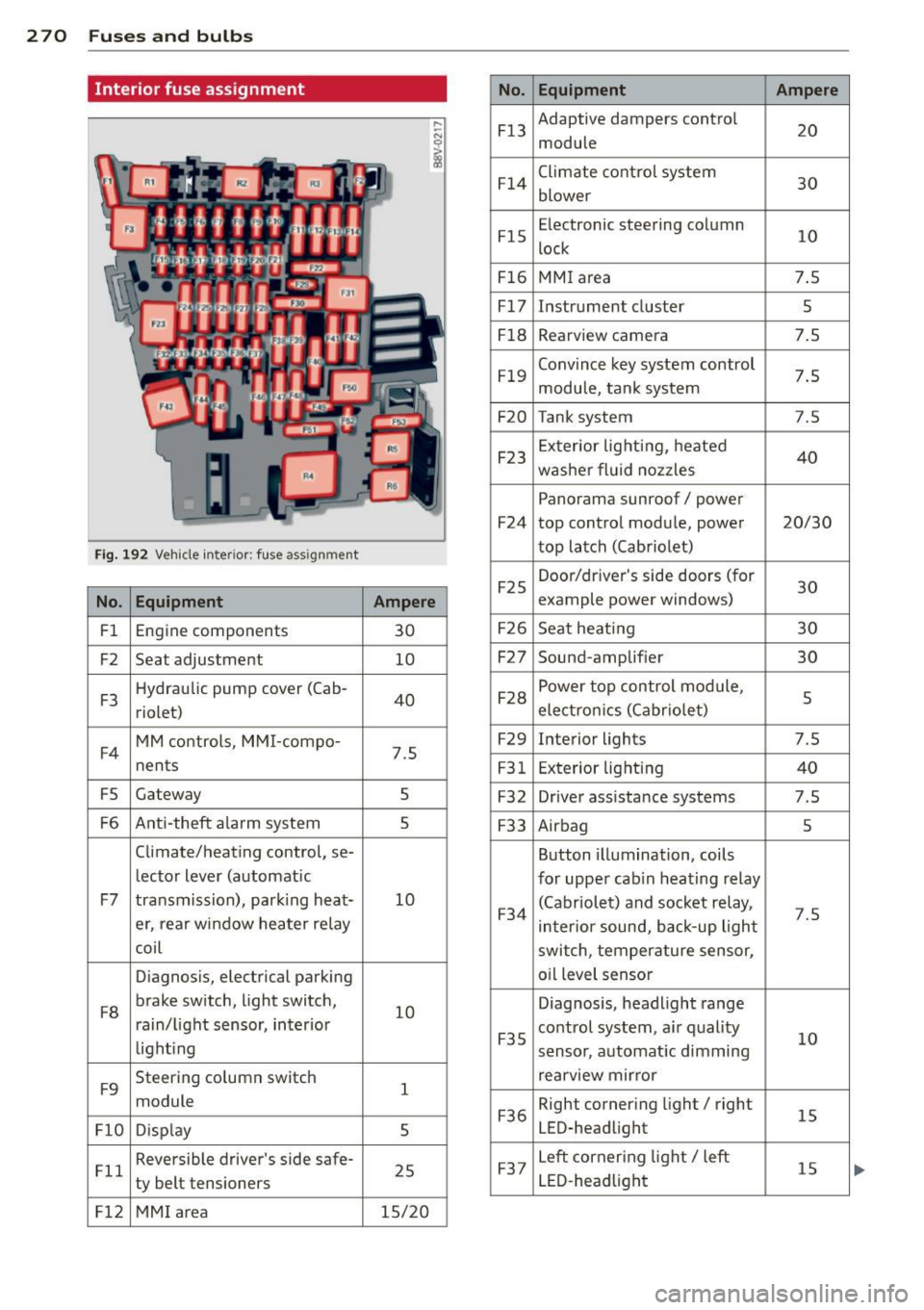
Interior fuse assignment
No. Equipment Ampere
Fl 3 Adaptive dampers contro
l
20
module
Fl4 Climate
control system
30
blower
Fl S E
lectronic steering column
10
lock
Fl6 MM I area 7.5
Fl7 Instrument cluster 5
Fl8 Rearview camera
7.5
F l9 Convince key
system control
7.5
module, tank system
F20 Tank system
7.5
F23 E
xterior lighti ng, heated
40
washe r fl ui d nozzles
Panorama sunroof/ power
F24 top control module, power 20/30
Fig. 192 Vehicle inter ior : fuse assignment top latch (Cabriolet)
No. Equipment Ampere
F25 Door/dr
iver's side doors (for
30
example power windows)
Fl Engine components 30 F26 Seat heat
ing 30
F2 Seat adjustment 10 F27
Sound-amplif
ier
30
F3 Hydraulic pump
cover (Cab-
40
riolet) F28
Power top control module,
5
elect ro ni cs (Cabr io let)
F4 M
M co ntrols, M MI-compo-
7.5
nents F29
Inte
rior lights
7.5
F3 1 E xterior lighting
40
F5 Gateway
5
F32 Driver ass istance systems 7.5
F 6 Anti-theft a
larm system
s F33 Airbag 5
Climate/heating control, se-
Button illumination, coils
lector lever (automatic
for upper cab in heating relay
F7 transmission), park ing heat- 10
er, rear window heater re lay F34 (Cabriolet) and socket relay,
7.5
in ter ior sound, back-up light
coil switch, temperature sensor,
Diagnosis, electrical parking oil level sensor
F 8 brake
switch, light switch,
10
rain/ light sensor, interior
light ing Diagnosis, headlight range
F35 co
ntrol system, a ir quality
10
sensor, a utomat ic dimming
F9 Steering column
switch
1
module
Fl0 D isp lay 5 rearview mir
ror
F36 Right
corner ing light/ right
15
LED-headlight
Fll Reversible driver's
side safe-
25
ty belt tensioners F37
Left corner
ing light/ left
15
L E D- headlight
Fl 2 M MI area 15/20
Page 273 of 302
....,
N
" > co
rl I.O
"' rl
"' rl
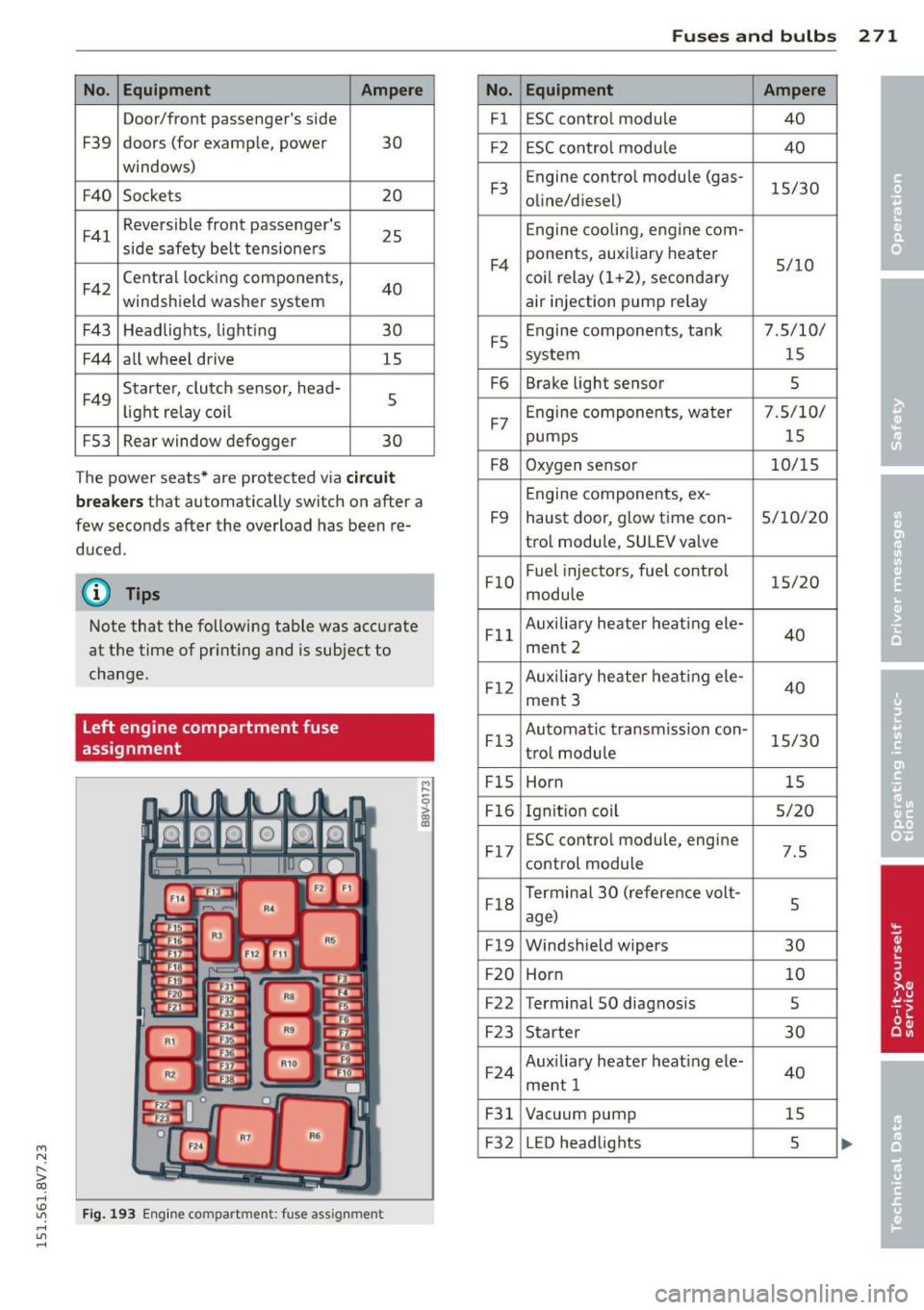
No. Equipment Ampere
Door/front passenger's side
F39 doors (for examp le, power
30
windows)
F40 Sockets 20
F41 Reversible front
passenger's
25
side safety belt tensioners
F42 Central locking components,
40
windshield washer system
F43 Headlights, light ing 30
F44 all wheel drive
15
F49 Starte
r, clutch sensor, head-
5
light re lay coil
FS3 Rear window defogger 30
The power seats* are protected v ia
ci rc uit
b reaker s
that automatically sw itch on after a
few seconds after the overload has been re
duced.
(D Tips
Note that the following table was accurate
at the time of print ing and is subject to
change.
Left engine compartment fuse
assignment
F ig. 193 Engine compartme nt: fuse assignment
No.
Fl
F2
F3
F4
F5
F6
F7
F8
F9
FlO
F ll
F12
Fl3
FlS
F l 6
F l 7
Fl8
F19
F20
F22
F23
F24
F3 1
F32
Fu se s and bulb s 2 71
Equipment Ampere
E5C contro l modu le 40
ESC contro l modu le 40
Engine control module (gas-
15/30
oli ne/d iesel)
Engine cooling, eng ine com-
ponents, auxiliary heater 5/10
coi l relay (1+2), secondary
air injection pump relay
Engine components, tank 7.5/10/
system 15
Brake light sensor 5
Engine components, wa ter 7.5/10/
pumps 15
Oxygen sensor
10/15
Engine compone nts, ex-
haust door, glow time con- 5/10/20
tro l module, SU LEV valve
Fuel injectors, fuel control
15/20
module
Auxiliary heater heating ele- 40
ment 2
Auxilia ry heater heat ing ele-
40
ment 3
Automat ic transmiss ion con-
15/30
t ro l module
Horn 15
Ignit ion coil 5/20
ESC contro l module, engine
7.5
control module
T ermina l 30 (reference volt-
5
age)
Windsh ie ld wipers
30
Horn 10
Termina l 50 diagnosis
5
Starter 30
Auxilia ry heater heat ing ele-
40
ment 1
Vacuum pump 15
L E D head lights 5
Page 286 of 302
28 4 Con sum er Inf ormation
in P (Park position) and the park brake is
applied.
@) For the sake of the environment
- Changing the engine settings wi ll ad
versely affect emission levels . This is det
rimental to the environment and increas
es fue l consumption .
- Always observe env ironmental regula
tions when disposing of old engine oil,
used brake fluid, dirty engine coolant,
spent batteries or worn out tires.
- Undeployed airbag modules and preten
sioners might be classif ied as Perchlo
rate Material -spec ial handling may ap
ply, see www .dtsc .ca .gov/hazardous
waste/perch lorate . When the veh icle o r
parts of the restraint system including
airbag modules safety belts wit h preten
s ioners are scrapped, all appl icable laws
and regulations must be observed. Your
a utho rized Audi dea ler is familiar with
these requirements and we recommend
that you have your dealer perform this
serv ice for you .
Additional accessories,
modifications and
parts replacement
Additional accessories and parts
replacement
Always consult an authorized Audi dealer be
fore purchasing accessories .
Your vehicle incorporates the latest safety de
sig n features ensuring a high standard of ac
tive and passive safety .
This safety could be compromised by non-ap proved changes to the veh icle. For this reason ,
if parts have to be replaced, p lease observe
the following points when installing addition
a l accessories:
Approved Audi accessor ies and genuine Audi
parts a re ava ilable from authorized Aud i deal
e rs. These dea
lers a lso have the necessary facili
ties, tools and trained specialists to install the
parts and accessories proper ly .
A WARNING
=
Using the wrong spare parts or using non-
approved accessories can cause damage to
the veh icle and ser ious perso na l injury .
- Use on ly accessories express ly approved
by Audi and genuine Audi spare parts
- These parts and accessories have been
specia lly designed to be used on your ve
h icle.
- Never install accessor ies such as tele
phone crad les or beverage ho lders on a ir
bag covers or within the airbag deploy
ment zones . Do ing so wi ll increase the
ris k of injury if a irbags are triggered in an
accident!
- Before you check anything in the engine
compa rtment, always read and heed a ll
WARNINGS
c:::> page 214 .
(D Note
-If items other than genu ine Audi spare
parts, add-on equipment and accessory
items are used o r if repair wo rk is not
performed ac cord ing to spe cified meth
ods, this c an resu lt in seve re damage to
yo ur vehicle's eng ine and body (such as
co rrosion) and adversely affect yo ur vehi
cle's warranty.
- If emergency repairs must be performe d
elsewhere , have the vehicle examined by
an authorized Audi dealer as soon as
possible.
- The manufacturer cannot be held liable
for damage wh ich occ urs due to failure
to comply with these stipu lations.
Technical Modifications
Our guidelines must be complied with when
t echnical modifica tions are made.
Always consult an authorized Audi dealer be-
fore start ing work on any modifications. ll>-