engine overheat AUDI A3 CABRIOLET 2015 Owners Manual
[x] Cancel search | Manufacturer: AUDI, Model Year: 2015, Model line: A3 CABRIOLET, Model: AUDI A3 CABRIOLET 2015Pages: 302, PDF Size: 73.83 MB
Page 14 of 302
12 Instrum ent s and indicator lamp s
Fuel level
The display @
c;, page 10, fig. 3 only works
when the ignition is sw itched on . When the
d isplay has reached the reserve mark, the bot
tom LED wi ll turn red and the
tD indicator
light turns on¢
page 23 . The bottom LED
blinks red when the fue l level is very low .
The on -board computer shows the range
based on the fuel leve l
c;, page 2 7, On-board
computer display.
F or the tank capac ity in yo ur vehicle , refer to
the Tec hnical Data ¢
page 280.
CJ) Note
Never d rive until the tank is completely
empty. The irregular supp ly of fuel that re
sults from that can cause the engine to
misfire. Uncombusted f uel will then enter
the exha ust system. This can cause over
heating and damage to the catalytic con
verter .
Coolant temperature indicator
The coolant temperature ind icator @
c::> page 10, fig . 3 only works when the ignition
is switched on . T o prevent engine damage, ob
serve the fo llow ing notes about the tempe ra
ture ranges.
Cold range
If only the LEDs at the bottom of the gauge
turn on, the engine has not reached operat ing
temperature yet . Avoid high engine speeds,
fu ll acce le rat ing and heavy engine loads.
Norm al range
The engine has reached its operating temper
ature once the LEDs up to the center of the
gauge turn on under normal driving condi
tions. The L EDs higher up may turn on if the
engine is under heavy load or the o uts ide tem
perat ure is h igh. This is not a cause for con
cern as long as the. indicator light in the
display does not t urn on. Hot range
If the L
EDs in the upper area of the d isp lay
and the. indicator light in the instrumen t
cluster disp lay t urn on, the coo lant tempe ra
ture is too high
c::> poge 19.
A WARNING
-Always observe the warning in
c;, page 214 before opening the hood
and checking the engine coolant level.
- Never open the eng ine hood if you see or
hear steam, or if you see engine coo lant
dripping from the engine compartment .
You could burn yourself. Let the engi ne
coo l off first until you can no longe r see
or hea r steam or coolant escaping.
([) Note
- Add itiona l headlights and other compo
ne nts in front of the a ir intake impairs
the cooling eff ect of the coolant. This in
creases the risk of the engine over heat
ing dur ing high outs ide temper atures
and heavy eng ine load .
- The front spoiler also he lps to distr ibute
cooling air correct ly wh ile driving.
If the
spoiler is damaged, the coo ling effect
wi ll be impai red and the risk of the en
gine overheating will increase. See an au
thorized Audi dealer o r authorized Aud i
Service Facility for ass istance.
Page 21 of 302
M N ,....
> co ,...., \!) ..,.,
,...., ..,., ,....,
-If the brake system indicator light turns
on together with the ABS and ESC indica
tor lights, the ABS/ESC regulating func
t ion may be malfunct ion ing . Funct ions
that stabilize the vehicle are no longer
available . Th is could cause the rear of the
vehicle to swerve, wh ich increases the
risk that the vehicle will slide. Drive care
fully to the nearest authorized Audi deal
er or authorized Audi Service Facility and
have the malfunction corrected .
PARKl<® >f' l®i Electromechanical p arking
brake
If the . (USA models) I. (Canada models)
indicator light turns on, the park ing brake was
set .
• (USA models) /. (Canada models) Cau
tion: Vehicle parked too steep
When the indicator light blinks and this mes
sage appears, there is not enough braking
power to keep the veh icle from rolling. The
brakes have overheated. The vehicle could roll
away even on a small incline.
• (USA models) /. (Canada models)
Please press brake pedal to release parking
brake
To release the parking brake, press the brake
pedal and press the
[2] button at the same
time , or start dr iv ing wi th hill s tart assist
¢ page 83 , S tarting from a stop.
Ill Parking brake!
There is a parking brake malfunction. Drive to
an authorized Audi dealer or authorized Audi
Service Facility immediately to have the mal
function corrected .
Ill Parking brake: limited functionality!
There is a parking brake malfunction. Drive to
an author ized Audi dealer or authorized Audi
Service Facility immediately to have the mal
function corrected.
litJ;):t :);Q3~ (USA models ) / ~ (Canada mod
els) Please release parking brake
Instruments and indicator lamps 19
Release the parking brake if this message ap
pears.
j:lj;J:t:);JJJ~ (USA models) /~(Canada mod
els) Parking brake auto release unavailable
If this message appears , press the brake pedal
first and then release the pa rking brake .
j:(;j;)J:);J:1:0 (USA models) / ¢@'A
When the indicator light blinks and this mes
s a ge appears, there is not enough braking
power to keep the vehicle from rolling. The
brakes have overheated. Th e veh icle could roll
away even on a sma ll incline .
IIJ;):11:);J:1:0 (USA models) /~(Canada mod
els) Parking brake is applied
If this message appears, press the brake pedal
first and then release the parking brake if nec
essary.
(D Tips
For additional informat ion on the parking
brake, refer to¢
page 82.
-L Cooling system
• Switch off engine and check coolant lev
el!
The coolant level is too low or the coo lant
temperature is too high.
Do not continue driving and switch the engine
off . Check the coolant level¢
page 220.
- If the coolant level is too low, add coolant
¢page 221. Only continue driving once the
ind icator light turns off .
- If the coolant level is correct, the problem
may be caused by a malfunction in the radia
tor fan. Do not continue driving. See an au
thorized Audi dealer or authorized Audi
Service Facility for assistance.
• Coolant temperature too high! Let engine
run with vehicle stationary
Let the engine run at idle fo r a few minutes to
cool down . .,..
•
Page 115 of 302
Stopping /p ar kin g
If the se lector lever is not in the P position
when you open the driver's door, the vehicle
could ro ll. In vehicles with a convenience key* ,
the following message appears:
S hift to P,
othe rwise veh icle c an roll away. Door s do not
lock if leve r is not in P .
You will also hear a
warn ing tone.
~ Press and ho ld the brake pedal c:> _& .
~ Set the parking brake.
~ Select the P selector lever pos ition.
Stopp ing on an inclin e
~ Always press the brake pedal to hold the ve
hicle in p lace and prevent it from "rolling
back"
c:> _& . Do not try to prevent the vehi
cle from "rolling back" when a gear is en
gaged by increasing the eng ine speed
c:> Q).
Starting on an incline in vehicle s wi thout
Hill Hold*
~ Set the parking brake.
~ With the driving gear se lected, press the ac
celerator pedal carefully. The parking brake
will release automat ically if your safety belt
is fastened .
Starting on an incline i n vehicle s with Hill
Hold*
~ With the driving gear selected, remove your
foot from the brake pedal and press the ac
celerato r pedal
c:> page 84, Hill hold.
Under certain circumstances, (such as driving
in the mountains or towing a tra iler), it may
be usefu l to switch temporarily to the manual
shift p rogram in order to adjust the gears to
the dr iving condit ions by hand
c:> page 115.
When parking on a level surface, simply place
the selector leve r in the P pos ition. On in
clines, activate the parking bra ke first and
then move the selector lever to the P posit ion
q page 82. This prevents the loc king mecha
nism from being loaded too heavily and wi ll
~ make it easier to move the selector lever out
" iii of the P position.
,...., \!) 1.1"1 ,...., 1.1"1 ,....,
Automa tic tran sm iss ion 113
A WARNING
- The vehicle can roll even when the en
gine is sw itched off.
- Unintended vehicle movement can lead
to serious injuries.
- Never leave your vehicle with the engine running while in gear. If you must leave
your veh icle when the engine is running,
set the parking brake and move these
lector lever to the P position.
- Power is still transferred to the wheels
when the engine is running at idle . To
prevent the vehicle from "c reeping", you
must keep your foot on the brake when
the engine is running and the se lector
lever is in the D, Sor R position or "tip
tronic" mode is selected .
- Do not inadvertently press the accelera
tor peda l when the vehicle is stationary.
Otherwise the vehicle wi ll start to move
immed iate ly, even if the parking brake is
set. Th is could resu lt in a crash.
- Do not press the accelerator pedal when
changing the selector lever position
while the vehicle is stationary and the engine is running.
- Never engage the R or P selector leve l
positions while dr iv ing. It could cause a
crash.
- Before driving down a steep slope, re
duce your speed and shift into a lower
gear with "tiptronic". -
- Do not ride the brakes or press the brake
pedal too often or too long when driving
downhill . Constant braking causes the
brakes to overheat and substantially re
duces braking pe rformance, increases
b ra ki ng distance or causes complete fa il
ure of the brake system.
- I f you must stop on an in cl ine, always
hold the vehicle in place with the foot
bra ke or parking brake to p reven t it from
rolling back .
- Neve r hold the vehicle on an incline with
a slipping clutch . The clutch opens a uto -
matica lly when it becomes too hot from
~
•
Page 116 of 302
114 Automatic tran smi ssion
the overload. The ml indicator light
turns on and a message appears
¢ page 116 when the clutch is overload
ed .
- If the engine must run while you are
working in the eng ine compartment with
the hood open, make sure a gear is not
engaged. The selector lever must be
firmly in the
P pos it ion and locked in
place and the pa rking brake must be set
¢ page 214. Otherwise, the veh icle
cou ld beg in moving when the eng ine
speed is high, even with the parking
brake set.
@ Note
- When stopping on an incline, do not try
to hold the vehicle in place by pressing
the accelerator peda l while a driving gear
i s selected. This can cause the automatic
transmission to overheat and can dam
age it. Set the park ing brake or press the
brake pedal to prevent t he veh icle from
r o lli ng .
- Allow ing the vehicle to roll when the en
gine is stopped and the selector lever is
i n the N pos ition will damage the auto
matic transmission beca use it is not lu
bricated unde r those circu mstances.
- The transm ission can ove rheat and be
damaged under certa in driving and traf
fic conditions such as frequent starts,
creeping for a long time, or s top-and -go
traff ic. W hen the
ml or . indicator
li ght turns on, stop the vehicle at the
next oppo rtunity and let the transmis
s ion coo l
¢ page 116 .
- Allow ing the ve hicle to roll when the en
gine is stopped w ill damage the 5 tron ic
transmission because it is not lubricated
¢ page 2 75, Emergency towing with
commercial tow truck.
(D Tips
For safety reasons, the park ing brake re
leases automatically only when the driver's
door is closed and dr iver's safety be lt is
fastened.
Hill descent control
Applies to veh icles: w ith S tronic transm iss io n
Hill descent control assists the driver when
driving down hills .
Hill descent contro l is activated when these
lector lever is in the Dor 5 position and you
press the brake pedal. The transm ission auto
matically selects a gear that is su itab le for the
incl ine. Hill descent cont ro l tries to ma inta in
t h e speed ac hieved at the t ime of b raking,
within physica l and tec hni cal limitations. If
may sti ll be necessary to ad just the speed
with the brakes . Because hill descent control
cannot shift down farther than 3rd gea r, it
may be necessary to sh ift into t iptronic mode
i n very steep areas . In this case, shift into 1st
or 2nd gear in t iptron ic mode to use the en
gine's brak ing force to relieve the brakes .
Hill descent contro l sw itches off once the h ill
levels out or you press the accelerator pedal.
On vehicles with a cruise contro l system*
¢ page 85, hill descent control is also activat
ed when the speed is set.
A WARNING
--
H ill descent control cannot overcome
physical lim itations, so it may not be ab le
to maintain a constant speed unde r a ll
conditions. A lways be ready to apply the
b rakes.
Page 119 of 302
....,
N
r--. > co
rl I.O
"' rl
"' rl
with the engine running (at id le) in the P se
l ecto r lever positio n. The n the indicator light
and the message turn off , d rive to an author
i z ed A udi dealer or qualified repair facility im
mediately to have the malfunct ion corrected.
If the i ndicator light and the drive r message
do not tur n off, do not cont inue dr iv ing. See
an author ized Audi dealer or authori zed A udi
S ervi ce Fa cility for assis tan ce.
DD Transmiss ion malfunction: you can con
tinue driving
Drive to an authori zed Aud i dea ler or a uthor
ized Audi Service Facility immed iate ly to have
the ma lfunction corrected .
DD Transmission malfunction: no reverse
gear (you can continue driving )
Drive to an aut ho rized Aud i dea le r o r a uthor
ized A udi Service Facility immed iate ly to have
the ma lfunction cor rected .
DD Transmi ssion malfunction: You can con
tinue dri ving in D until engine off
D rive t he ve hicle away from mov ing t raff ic and
par k. See an au thori zed A ud i d ealer or au tho r
iz ed A udi Service Faci lity for assis tance .
DD Transmi ssion overheating! Please adapt
driving style
Continue dr iving moderate ly . W hen t he indi
cator light tur ns off, you can continue dr iving
normally .
DD Transmiss ion : Please press brake pedal
and select gear again
I f the tra nsmission mal functions beca use the
temperature is too high , a message appears
when the transmission is cooled.
Autom atic transm ission 11 7
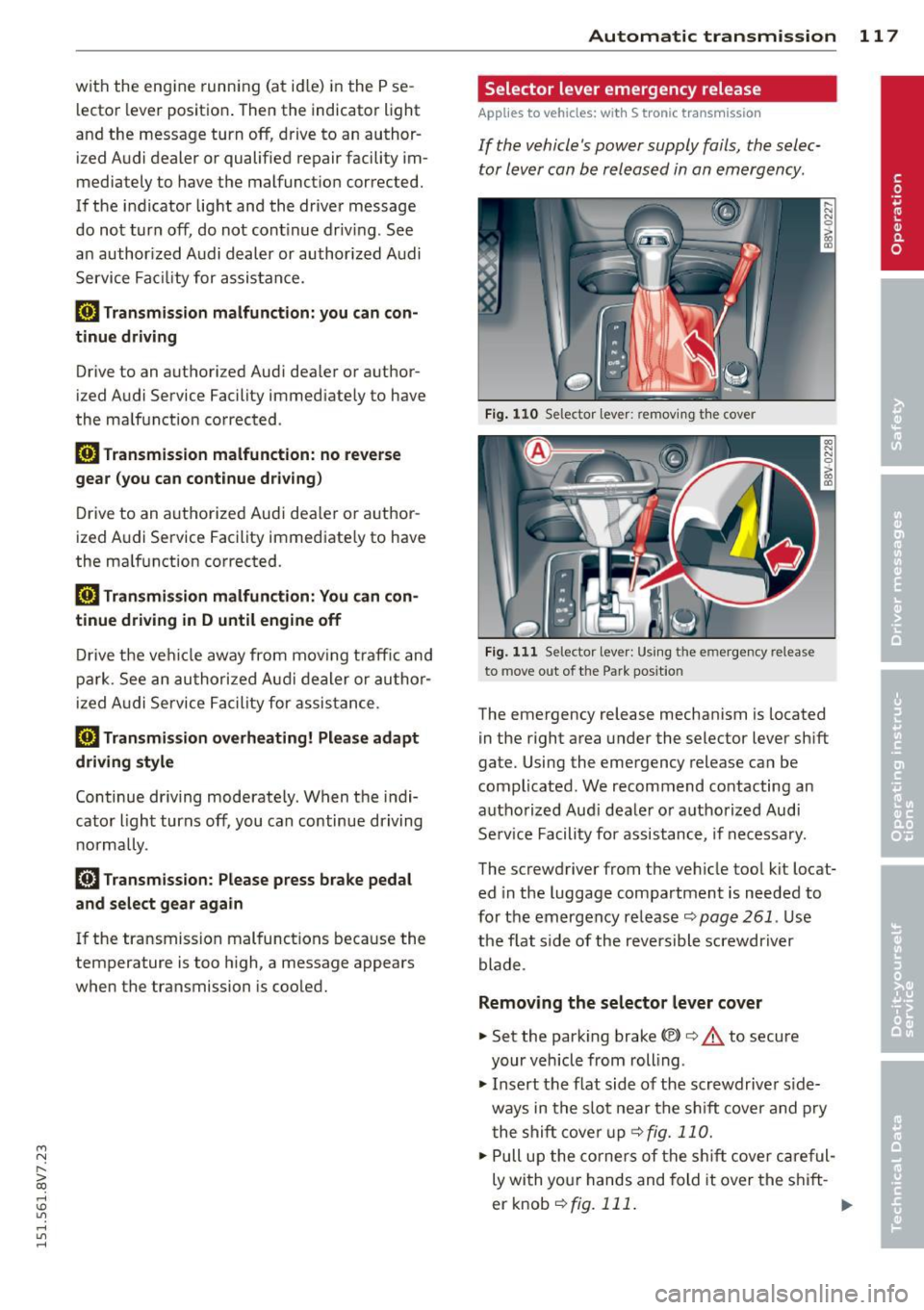
Selector lever emergency release
Applies to vehicles: with S tronic transmission
If the vehicle's power supply fails , the selec
tor lever can be released in an emergency .
Fig. 110 Se lector leve r: remov ing t he cover
Fig . 1 11 Se lector lev er: Us ing t he e mergency re lea se
to move out of the Park pos it io n
The emergency release mechanism is located
in the right area under the selector lever sh ift
gate. Using the emergency release ca n be
complicated. We recommend contacting an
autho rized Aud i dea le r or a uthorized Audi
Se rv ice Facili ty for assistance, if necessa ry.
The screwdriver from the ve hicle too l kit locat
ed in the luggage compa rtment is needed to
fo r the em ergency re lease <=:>
page 261 . Use
the flat side of the reversible screwdriver
blade .
Removing the selector lever cover
... Set the park ing brake «e)) <=:> &. to secure
your veh icle from rolling .
... Insert t he flat side of the scr ewdrive r side
ways in the s lot near the s hift cover a nd p ry
t he shift cove r up
<=>fig. 11 0 .
... Pull u p the co rners of the s hift cove r ca reful
ly wi th yo ur hands and fold it over the s hift-
er knob
r::!) fig. 111 . ..,.
Page 190 of 302
188 Smart Technology
Smart Technology
Information about
data recorded by
vehicle control
modules
Your vehicle is not equipped with a crash data
recorder. This device is insta lled by some vehi
cle manufacturers to record data about crash
es so tha t it can be analy zed later. Crash data
recorders are also called "Event Data Record
ers (EDR)" .
In some legal jurisdictions, it is not permitted
to access or download data recorded by pre
installed crash data recorders in order to eval
uate a crash without clear consent of the vehi
cle owner .
Your veh icle is not equipped with a crash data
recorder. However it does contain a var iety of
e lectronic control modules for various vehicle
systems such as eng ine funct ion, exhaust
treatment or airbags and safety belts .
These electron ic control modules record vehi
cle data during normal driv ing for diagnosis
and repair purposes. The recording capab ility
of the electron ic control modules is lim ited to
data only- no sound is reco rded.
If t he control
mo dule detects a sys tem m alfu nction or other
change in sta tus, a very lim ited amount of da
ta is recorded for an extreme ly sma ll period of
time . Data t hat is recorded in s uch a case may
include veh icle speed, driving direction, the
load on the brakes and head restraints and
performance in the event of an acc iden t or
other change in status . The stored data can
only be read o r down loaded w ith specia l dev i
ces.
Electronic stabilization
control (ESC)
Description
The E lectronic Stabilization Cont rol (ESC) con
tr ibutes to d river safety. It reduces the risk of
slipp ing and improves driving stability. ESC detects critical situations such as the veh
icle
oversteering and understeering or the whee ls
are spinning . The vehicle is stabilized by ap
plying the brakes or reducing engine torq ue.
Once the ESC is activated, the ind icator light
Bl blinks in the instrument cluster .
The following systems are integrated in the ESC:
Anti -lock braking s ystem (ABS)
ABS prevents the whee ls from locking when
braking . The vehicle can still be steered even
during hard braking . App ly steady pressure to
the brake peda l. Do not pump the peda l. A
puls ing in the brake peda l ind icates that the
system is act ing to stabilize the ve hicle.
Brake assi st sy st e m
The brake assist system can decrease braking
distance .
It increases braking power when the
driver presses the brake peda l quickly in emer
gency s ituations. You m ust press and hold the
brake pedal until the dangerous situation is
over . In vehicles with adaptive cruise control*,
the brake assist system is more sens it ive if the
distance detected to the vehicle ahead is too
small.
Anti-slip regu lation (ASR )
ASR reduces engine power when the drive
wheels begin sp inning and adapts the force to
the road conditions. This makes it easier to
sta rt , accelerate and dr ive up inclines .
Electronic differenti al lock (EDL )
The EDL brakes whee ls that are spinning and
transfers the drive power to the other drive
wheel or wheels if the vehicle is equ ipped with
all wheel drive *). This function is not ava ilable
at h igher speeds .
In extreme cases, EDL automatically sw itches
off to keep t he b rake on the braked wheel
from overheat ing. The ve hicle is still working
co rrect ly. EDL w ill switch o n aga in automat i
ca lly when cond itions have ret urned to no r-
mal. .,._
Page 193 of 302
M N ,....
> co ,...., \!) 1.1'1 ,...., 1.1'1 ,....,
Corrosion
Leaving the vehicle parked for long periods of
time, low mi leage and avoiding heavy braking
can contribute to corrosion on the brake ro
tors and dirty brake pads.
If you usually avoid heavy braking or if there is
corrosion present, occasiona l heavy braking at
high speeds is recommended to clean the
brake rotors and pads~,& .
Brake system malfunction
if you notice that the brake pedal t ravel has
suddenly gotten larger, then a brake circuit
may have failed . Drive to you r authorized Audi
dealer or qualified repair facility immediately
to have the problem corrected. On the way
there, drive with reduced speed and keep in
mind that a long braking distance and in
creased pressure on the brake pedal will be
necessary .
Low brake fluid level
When the brake fluid level is low, ma lfunc
tions in the brake system may occur . The
brake fluid level is electronically monitored.
Brake booster
The brake booster amplifies the pressure you
apply to the brake pedal. It only works when
the eng ine is running.
A WARNING
-You should on ly perform braking maneu
vers to clean the brakes when the road condit ions perm it . Never put others on
the road at risk -never forget the risk of
acc idents!
- On steep slopes, reduce the speed and
select a lower gear or lower selector lev
er posi tion. Drive as little as possible
wh ile pressing the bra ke peda l and avoid
putt ing your left foot on the brake pedal
whi le driving. This could ca use the brakes
to overheat and impair the efficiency of
the brakes.
- Do not let the brakes "grind" by always
keeping yo ur foot on the brake peda l.
Smart Technolog y 191
This can cause the brakes to overheat in-,
crease wear and increase braking dis
tance unnecessar ily.
- Certain weather and operating condi
tions such as driving through water, driv
ing in heavy rain or driving after washing
your veh icle can impa ir the effectiveness
of the brakes. In the winter, ice may
bui ld up on the brake pads, rotors and
drums . Check these components by brak
ing caref ully. App lying the brakes care
fu lly several times dries the brakes and
removes ice build-up .
- The effic iency of the brakes can also be
impaired by driving for long stretches on
roads covered with salt without using the
brakes. You can remove salt deposits
from the brake rotors and pads by care
fully applying the brakes several times.
- If the front spoiler is damaged or you in
stall another spoiler, make sure the front
wheel brakes are ventilated properly.
Otherwise, the brake system could over heat, wh ich reduces their effectiveness .
- Failure of a brake circuit impa irs braking
performance, wh ich increases braking
d istance . Avoid driving the vehicle and
have it towed it to the nearest author
i z ed Audi dealer or authorized Audi Serv
ice Facility.
- Do not let your veh icle roll w ith the en
gine switched off under any circumstan
ces .
- If the brak e booster is not working, you
wi ll have to press much harder on the
brake peda l to compensate for the lack
of the booster.
(D Note
-Never let the brakes "rub" by pressing
the pedal lightly when braking is not
really necessary. This causes the brakes
to overheat and increases braking dis
tance and causes wear.
- Before driving on a long stretch with
steep s lopes, reduce your speed and shift
to the next lower gear This makes use of
the engine brak ing effect and relieves ..,.
•
•
•
Page 199 of 302
M N ,....
> co ,...., \!) 1.1"1 ,...., 1.1"1 ,....,
Driving through water
on roads
Note the following to avoid vehicle damage
when driving through water, for example on
flooded roads:
- The water must not be any higher than the bottom of the vehicle body.
- Do not drive faster than wa lking speed.
A WARNING
After driving through water or mud, the
braking effect can be reduced due to mois
ture on the brake discs and brake pads. A
few careful brake applications should dry off the brakes.
([) Note
Vehicle components such as the engine,
transmission, suspension or electrical sys
tem can be severely damaged by driving
through water.
- Determ ine the depth before driving
through water.
- Do not stop the vehicle, drive in reverse
or switch the engine off when driving
through water .
- Keep in mind that oncoming vehicles may create waves that raise the water
level and make it too deep for your vehi
cle to drive through safely.
- Avoid dr iving through salt water (corro
s ion).
Catalytic converter
App lies to vehicles: with gasoline engine
It is very important that your emission con
trol system (catalytic converter) is function
ing properly to ensure that your vehicle is run
ning in an environmentally sound manner.
.,. Always use lead-free gaso line¢ page 210,
Fuel supply .
.,. Never run the tank down all the way to emp-
ty .
Dri ving and the en vironm ent 197
.,. Never put too much motor oi l in your engine
¢ page 218, Adding engine oil 't:::r..
.,. Never try to push- or tow -start your vehicle.
T he catalytic converter is an efficient "clean
up" device bui lt into the exhaust system of
the vehicle . The cata lytic converter burns
many of the pollutants in the exhaust gas be
fore they are released into the atmosphere .
The exclusive use of unleaded fuel is critically important for the life of the catalytic convert
er and proper functioning of the engine.
A WARNING
The temperature of the exhaust system is h igh, both when driv ing and after stopping
the eng ine.
- Never touch the exhaust tail pipes once
they have become hot. This could result
in burns.
- Do not park or operate the vehicle in
areas where the hot exhaust system may
come in contact with dry grass, brush,
fue l spill or other material wh ich can
cause a fire.
- Do not apply additional undercoating or
rustp roofing o n or nea r the exhaust
manifold, exhaust pipes, catalyti c con
verter or heat shields . Dur ing driving, the
substance used for undercoating could
overheat and cause a fire.
([) Note
-Be aware that just one tank filling with
leaded fuel w ill already ser iously de
grade the performance of the catalytic
converter .
- Do not exceed the cor rect engine oil level
~page 218.
-Do not drive until the fue l tank becomes
completely empty . The engine cou ld mis
fire . Unburned fuel could also get into
the exhaust system and th is cou ld cause
the catalytic converter to overheat.
- Do not switch off the ignition while the
vehicle is moving.
- Do not continue to operate your vehicle
under these conditions, as otherwise fuel ..,_ •
•
•
Page 200 of 302
198 Driving and the environment
can reach the cata lytic converter. This
could result in overheating of the con
verter, requ iring its replacement.
- To assure efficient operation of the Emis
sion Control System:
- Have your veh icle ma intained properly
and in accordance with the service rec
ommendations in your Warranty
&
Ma intenance booklet.
- Lack of proper maintenance as well as
improper use of the vehicle will impa ir
the function of the emission control
system and could lead to damage.
@ For the sake of the environment
Even when the Emission Contro l System is
operating properly, the exhaus t gas can
have a sulfur-like exhaust gas smell under
some operating states. This depends on
the sulfur content of the fue l being used .
Using a different brand of fuel may help,
or filling the tank w ith lead-free super
grade gasoline.
Placing your vehicle
out of service
If you wou ld like to take your vehicle out of
service for a longer t ime, contact your author
ized Audi dealer or qualified repair facility.
They will advise you of important measures,
such as corrosion protection, maintenance
and storage procedures. Also follow the infor
mat ion about the battery
¢ page 223.
Operate your vehicle
economically and
minimize pollution
General
Your personal style of driving will determine
the economy of your vehicle, as well as ex
haust and noise levels .
Fuel economy, environmental impact, and
wear on your engine, brakes and t ires largely
depend on three factors: -your
personal driving style
- operating conditions
- technical limitations
If you ant ic ipate what you need to do next and
drive econom ically, you can easily cut your
fuel consumpt ion by 1O-lS percent . This sec
t ion w ill give you some tips on how you can
help the env ironment and your pocketbook.
(D Tips
The consumption estimates as published
by ENVIRONMENTAL PROTECTION AGENCY
(EPA) and Transport Canada may not corre
spond to your actual consumption on the
road, which will vary depending upon vehi
cle load and speed, road and weather con
ditions, trip length, etc.
Drive smoothly and keep a lookout
ahead
Vehicles use the most fuel when they are ac
celerating.
.,. Avoid unnecessary accelerating and braking.
Vehicles use the most fuel when they are ac
ce lerating. If you anticipate what is going to
happen next, you will need to brake less and,
thus, acce lerate less. Let the vehicle coast
whenever possible -for example when you see
that the next traffic light is red.
Avoid full throttle '
Driving at moderate speeds saves fuel and
improves your mileage.
.,. Try and keep well below your car's maximum
speed.
Acce lerating gently reduces fue l consump
tion, engine wear, and does not disturb the
environment.
Fuel consumpt ion, exhaust emissions and en
gine noise increase disproportionate ly at high
speeds. If you drive at approximately three
quarters of top speed, fuel consumption wi ll
be reduced by one half. Never drive faster
1111>
Page 204 of 302
202 Trailer towing
"Full load" on the label located on the driver's
side B-pillar (visible when the door is open).
Inflate trailer tires to trai ler and t ire manufac
turers' specif ications.
Lights
Check to make sure both vehicle and trailer
lights are working properly.
Safety chains
Be sure trailer safety chains are properly con
nected from the trailer to the hitch on the ve
hicle. Leave enough slack in the chains to per
mit turning corners. When you install safety
chains, make sure they wi ll not drag on the
road when you are driving.
The chains should cross under the trailer
tongue to prevent it from dropping in case of
separation from the hitch.
Driving instructions
Driving with a trailer always requires extra
care and consideration.
To obtain the best possible handling of vehicle
and trailer, please note the following:
.. Do not tow a loaded tra iler when your car it
self is not loaded.
.,. Be espec ially car efu l when passing other
vehicles.
.. Observe speed limits.
.. Do not drive at the maximum permissible
speed.
.. Always apply brakes early .
.. Monitor the temperature gauge.
Weight distribution
Towing a loa ded trai ler with an empty ca r re
sults in a high ly unstable distribution of
weight . If this cannot be avoided, drive at very
low speeds only to avoid the risk of losing
steering control.
A "balanced" rig is easier to operate and con
trol. This means that the tow vehicle should be loaded to the extent poss ible and permissi
ble, while keeping the trailer as light as possi
ble under the circumstances . Whenever possi- ble,
transfer some cargo to the luggage com
partment of the tow vehicle while observing
tong ue load requirements and vehicle loading
considerations.
Speed
T he higher the speed, the more difficult it be
comes for the driver to control the rig. Do not
drive at the maximum permissible speed . Re
duce your speed even more if load, weather or
wind conditions are unfavorable -particularly
when going downhill.
Reduce vehicle speed
immediately if the trail
er shows the slightest sign of sway ing.
Do not
try to stop the swaying by accelerating.
Observe speed limits . In some areas, speeds
for vehicles towing trai lers are lower than for
regular vehicles .
Always apply brakes early. When driving
downhi ll, shift into a lower gear to use the en
gine braking effect to s low the vehicle. Use of
the brakes alone can cause them to overheat
and fail.
Coolant temperature
The coolant temperature gauge~ page 12
must be observed carefu lly. The coolant tem
perature can increase if you drive on long in
clines in a low gear at high engine speeds. Re
duce your speed immediately if the LEDs in
the top part of the d isplay turn on .
For more information about indicator lights,
refer to. ~
page 19 .
A WARNING
Anyone not properly restrained in a mov
ing vehicle is at a much greater risk in an
accident. Never let anyone ride in your car
who is not properly wearing the restraints
provided by Audi.
Trailer towing tips
Important to know
Your vehicle handles differently when towing
a trai ler because of the additional weight and ..,.