parking brake AUDI A3 CABRIOLET 2016 User Guide
[x] Cancel search | Manufacturer: AUDI, Model Year: 2016, Model line: A3 CABRIOLET, Model: AUDI A3 CABRIOLET 2016Pages: 272, PDF Size: 67.88 MB
Page 79 of 272

Automatic transmission
stuck by "rocking" it. The selector lever lock en
gages if the lever stays in the N position longer
than approximately 2 seconds when the brake
pedal is not pressed .
Interlock button
The interlock button in the selector lever handle
prevents you from moving the selector lever in
advertently while in some se lector lever posi
tions. The positions that require the lock button
to be pressed are marked in color in the illustra
tion
c> fig. 80.
Ignition key safety interlock*
You can only remove the key from the ignition af
ter switching the ignition off if the selector lever
is in the P position. The selector lever wi ll be
locked in the P position as long as the key is not
in the ignition .
A WARNING
Read and follow all WARNINGS. c> A in Selec
tor lever positions on page 76.
(D Tips
-If the se lector lever does not engage, there
i s a malfunction . The eng ine is disabled to
prevent the vehicle from driving off unin
tentiona lly . Press the brake pedal br iefly to
al low the selector lever lock to engage
again .
-If the vehicle does not move forward or in
r everse even though a drive position is se
lected, proceed as follows:
- >If the vehicle does not move in the desired
direction, the system may not have engaged
the drive position correctly. Press the brake
pedal and select the drive position again.
-> If the vehicle st ill does not move in the de
sired direction, there is a system malfunc
tion. See an authorized Audi dealer or au
thorized Audi Service Facility for assistance
to have the system checked.
78
Driving tips
Applies to: vehicles with automatic transmissions
The transmission shifts up and down automati
cally when in the driving gears.
Fig. 81 Sect ion of t he ce nter console: se lector lever with
interlock button
The engine will only be able start when the selec
tor lever is in the P or N pos itions . At low temper
atures (below 14 °F (-10 °()), the engine can only
be started when the selector lever is in the P po
sition.
Starting from a stop
"' Press and hold the brake pedal.
"' Press and hold the interlock button in these
lector lever handle, select the desired selector
lever position such as D
c> page 76 and release
the lock button.
"' Wait a moment until the transmission shifts.
You will notice a slight movement when the gear engages.
"' Release the brake pedal and press the accelera
tor pedal
c> .&. -
Stopping temporarily
"'Keep the vehicle stationary using the braking
pedal, for example at traffic lights .
"' Do not press the acce lerator pedal when doing
this.
"' To prevent the vehicle from rolling when you
start driving, set the parking brake when stop
ping on steep incl ines
c> ,&. .
"'The parking brake will release automat ically
and the vehicle will start moving once you p ress
the acce lera tor pedal. Requirement: the driv
er's doo r must be closed and the driver's safety
belt must be fastened . ..,.
Page 80 of 272
<( co .... N ,.__
N .... 0 ,.__
> co
Stopping /p ark ing
If the selecto r lever is not in the P position when
you open the driver's door, the vehicle could rol l.
I n vehicles with a convenience key*, the message :
Shift to P, v eh icle can roll awa y. Doo rs can be
lo cked onl y i n P
appears. You will also hear a
warning tone.
~ Press and hold the brake pedal¢.&_ .
~ Set the parking brake.
~ Select the P selector lever pos ition.
Stopp ing on an incline
~ Always press the brake peda l to hold the vehi
cle in place and prevent it from "rolling back"
¢
A -Do not try to prevent the vehicle from
"ro lling back" when a gear is engaged by in
creasing the engine speed¢@) .
Starting on a n incline in vehicl es w ithout Hill
H old *
~ Set the parking brake.
~ With the driving gear se lected, press the acce l
erator pedal carefully. The parking brake re
leases automatically . Requirement: the driver's
door must be closed and the driver's safety belt
must be fastened .
Starting on an incline in vehicle s with Hill
Hold*
~ With the driving gear selected, remove your
foot from the brake pedal and press the accel
erator pedal¢
page 75, Hill hold.
Under certain c ircumstances, (such as driving in
the mountains or towing a trailer), it may be use
fu l to sw itch temporari ly to the manua l shift pro
g ram in orde r to adjust the gears to t he d riving
conditions by hand
¢ page 81 .
When parking on a level surface , simply place the
se lector lever in the P position. On inclines, acti
vate the parking b rake first and then move the
selecto r lever to the P position
¢ page 73. This
prevents the locking mechanism from being
l oaded too heavi ly and wi ll make it easier to
move the selector lever out of the P position.
Autom atic tran sm iss ion
A WARNING
- The vehicle can roll even when the eng ine is
sw itched off .
- Unintended vehicle movement can lead to
serious injuries .
- Never leave your veh icle w ith the engine
running while in gear. If you must leave
your veh icle when the engine is running, set
the park ing brake and move the selector lev
er to the P posit ion.
- Power is still transferred to the wheels when the engine is runn ing at idle. To pre
vent the vehicle from "creeping", yo u must
keep your foot on the b rake when the en
g ine is r unning and the selector lever is in
the D, Sor R position or " tip tronic" mode is
selected.
- Do not in adver ten tly press the accelerator
pedal when the vehicle is stationary. Other
wise the vehicle wi ll start to move immedi
ately, even if the parking brake is set. This
could result in a crash.
- Do not press the acce lerator pedal when
changing the se lector lever position while
the vehicle is stationary and the engine is running.
- Never engage the R or P selector level pos i
tions while dr iv ing.
It could cause a crash.
- Before driving down a steep slope, reduce your speed and sh ift into a lower gear w ith
"t i ptronic".
- Do not r ide the brakes or press the brake
pedal too often or too long when dr iving
downhill. Constant braking causes the brakes to overheat and substant ially re
duces bra king performance, increases b rak
ing d istance or causes comp lete failure of
the brake sys tem.
- I f you must stop on an incline, a lways hold
the vehicle in place w it h the foot brake or
p ar king brake to p reve nt i t from rolling
back.
- Never hold the vehicle on an incline with a
slipp ing clu tc h . The clutch opens automati
cally when it becomes too hot from the
overload . The
mJ indicator light turns on
79
Page 81 of 272

Automatic transmissio n
and a message appears~ page 82 when
the clutch is overloaded.
- If the engine must run while you are work
ing in the engine compartment with the
hood open, make sure a gear is not engag
ed. The selector lever must be firmly in the
P position and locked in place and the park
ing brake m ust be set~
page 188. Other
wise, the vehicle could begin moving when
the engine speed increases, even with the
par king brake set.
{UJ Note
- When stopp ing on a n incline, do not t ry to
ho ld the vehicle in p lace by press ing the ac
ce le ra to r pedal wh ile a driv ing gear is se
l ected. Th is can ca use the au toma tic trans
mission to overheat and can damage it. Set
the parking brake or press the brake pedal
to prevent the vehicle from rolling .
- A llow ing the vehicle to ro ll when the eng ine
is stopped and the se lector lever is in the N
position will damage the automatic trans
mission because it is not l ubricated under
those circumstances.
- The transmiss ion can overheat and be dam
aged under certa in driving and traffic cond i
tions such as frequent starts, creep ing for a
long time, or stop-and-go traffic . W hen the
@l or. indicator light turns on, stop the
vehicle at the next oppo rt u nity and let the
transmission coo l~
page 82.
- Allow ing the veh icle to roll when the eng ine
i s stopped will damage the S tron ic trans
mission beca use it is not l ubricated
¢ page 246, Towing with a tow truck .
(D Tips
For safety reasons, the parking brake releases
automatically only when the driver's door is
closed and driver 's safety belt is fastened.
80
· Hill descent control
App lies to: vehicles with automatic transmissions
The hill descent control system assists the driver
when driving downhill .
Hill descent control is act ivated when the selec
tor lever is in the D or S position and you press
the brake pedal. The transmission automatically
selects a gear that is s uitable for the incline. H ill
descent control tries to maintain the speed ach
i eved at the t ime of braking, w it hi n phys ical and
technica l lim itations . If may still be necessary to
adjust the speed w ith the brakes. Because h ill de
scent control cannot shift down farther tha n 3rd
gear, it may be necessary to shift into tiptronic
mode in very steep areas. In this case, shift into 1st or 2nd gear in tiptronic mode to use the en
gine's braking force to relieve the brakes.
Hill descent control switches
off once the decline
l evels out or you press the accelerator pedal.
On vehicles with a cru ise control system*
¢ page 88, hi ll descent control is a lso activated
when the speed is set.
A WARNING
Hill descent contro l cannot overcome physical
limitations, so it may not be able to ma intain
a constant speed under all conditions. A lways
be ready to app ly the brakes.
Page 85 of 272
Automatic transmission
Selector lever emergency release
.,. Press and hold the yellow release button with
the screwdriver ~
fig. 85 .
.,. Press the release button in the se lector lever @
and move the lever into the N position .
.,. Clip the shift cover back into the shift gate after
using the emergency release .
If the vehicle must be pushed or towed due to a
power failure (for example, the battery is dead),
the selector lever must first be moved to the N
position using the emergency release mecha
n ism.
A WARNING
Only move the selector lever out of the P posi
t ion when the parking brake is set.
If that
does not work, secure the vehicle with the
brake pedal. Otherwise, the vehicle could
start to move unintentionally when the selec
tor lever is moved out of the P position.
84
Page 88 of 272
<( co .... N ,.__
N .... 0 ,.__
> co
Before you actually tow your trailer, practice
turning, stopping and backing up in an area away
from traff ic. Keep practicing until you have be
come completely familiar with the way your vehi
cle-trailer combination behaves and responds.
Backing up is difficult and requires practice.
Backing up with a trailer generally requires steer
ing action opposite to that when backing up your
vehicle without a trailer.
Maintain a greater distance between your vehicle
and the one in front of you. You wi ll need more
room to stop. To compensate for the trailer, you
will need a larger than normal turning radius.
When passing, remember that you cannot accel
erate as fast as you norma lly would because of
the added load. Make sure you have enough room
to pass. After passing, allow plenty of room for
your trailer before changing lanes again.
Avoid jerky starts, sharp turns or rap id lane
changes.
@ Tips
- Do not tow a trailer during the break-in peri
od of your vehicle.
- If you tow a trailer, your Audi may require
more frequent maintenance due to the ex
tra load
<=> page 2 53.
Parking on a slope
Do not pork on a slope with a trailer. If it cannot
be avoided, do so only ofter doing the following:
When parking:
.. Apply the foot brake .
.. Have someone pla ce chocks under both the ve
hicle and the trailer wheels .
.. With chocks in place, slowly release the brakes
until the wheel chocks absorb the load .
.. Turn the wheels towards the curb .
.. Apply the parking brake .
.. Select the P selector lever position.
When restarting after parking :
.. Apply the foot brake.
.. Start the engine .
.. Select the D/S selector lever position.
Trailer mode
.. Release the parking brake and slowly pull out
and away from the wheel chocks.
.. Stop and have someone retrieve the whee l
chocks.
{!) Tips
If you move the selector lever of the automat
ic transmission to P before applying the park
ing brake and before blocking the wheels, you
may have to use more force later to move the
lever out of the P posit ion.
87
Page 97 of 272
Ass is t
- Always follow applicable traffic laws, use
common sense and select a distance to
vehicles ahead that takes the current traffic,
road and weather conditions into account .
(D Tips
Distan ce 3
is set automatically each time you
switch the ignition on. If you would like to set
another d istance as the standard setting, you
can have the
Ad apti ve cruis e control menu
added/ enabled by an authorized Aud i dealer
or authorized Audi Service Fac ility.
Setting the driving program
Applies to: vehicles with Audi adaptive cruise control
A ad aptive cru ise cont rol d riving program is ad
justable on veh icles w ithout A udi drive selec t*.
• In the MMI, se lect: the
I MENU I b utton > C ar >
Sy stem s*
cont rol button > Drive r assi st >
Adaptiv e crui se c ontrol > Driving program >
Comfort /Standard /Dynamic .
Selecting the driving mode
Applies to: vehicles with Audi adaptive cruise control
The adaptive cruise contro l dr iving program is ad
justable for vehicles with Audi drive select usi ng
the driving mode.
• Se lect the des ired dr iving mode
C o mfort , Auto ,
Dynamic or Indi vidual *
with the knob
~page 106 .
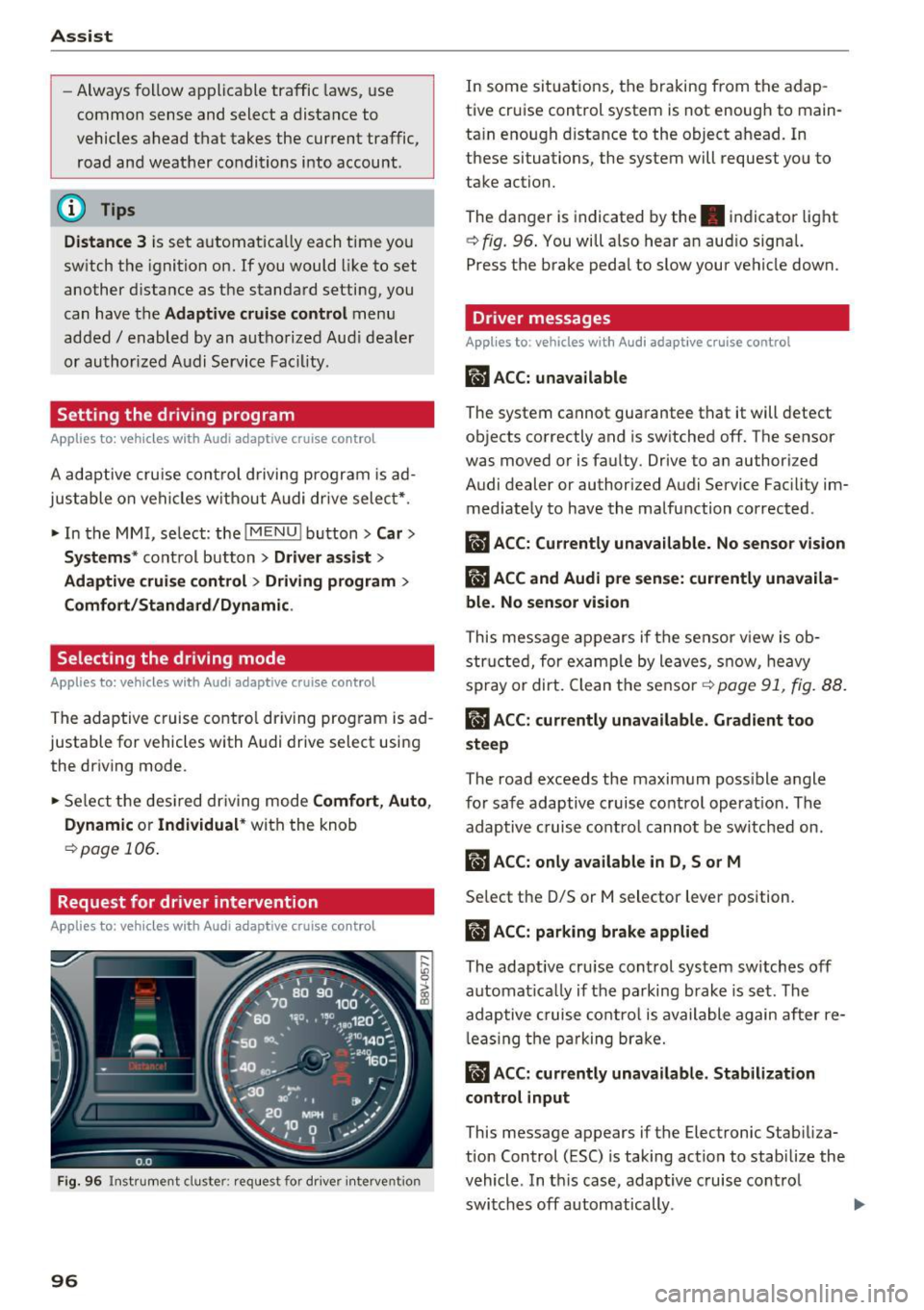
Request for driver intervention
Applies to: vehicles with Audi adaptive cruise control
Fig. 96 Instrument d uster : req uest for d river intervention
96
In some sit uations, the braking from the adap
tive cruise control system is not enough to main
ta in enough d istance to the object ahead. In
these situations, the system will request you to
take action.
The danger is indicated by the. indicator light
~fig. 96 . You will also hear an aud io signa l.
Press the brake pedal to slow your vehicle down.
Driver messages
Applies to : vehicles with Audi adaptive cruise control
m'J ACC: unava ilable
The system cannot guarantee that it will detect
objects correctly and is switched off. The sensor
was moved or is faulty. Drive to an author ized
Audi dealer or authorized Audi Service Fac ility im
med iate ly to have the malfunction corrected.
ilJ A CC: Cur rentl y una vailable. No sensor vision
ilJ ACC and Audi pre sense: currently unavaila
ble. No sensor vi sion
This message appears if the sensor v iew is ob
struc ted, for examp le by leaves, snow, heavy
spray or dirt. Clean the se nsor
r=.> page 91, fig. 88.
II ACC: currentl y una vailable . Gradient too
steep
The road exceeds the maxim um poss ible angle
fo r safe adaptive cruise control operat ion. The
adaptive cruise contro l cannot be sw itched on.
rlJ ACC: onl y available in D, Sor M
Select the D/S or M selector lever position.
ii ACC: parking brake applied
The adaptive cru ise control system sw itches off
automat ica lly if the parking brake is set. The
adap tive cruise co ntro l is available again after re
l eas ing the p arking brake.
ii ACC: curr ently unavailable . Stabilization
control input
This message appears if the Electronic Stab iliza
tion Control (ESC) is taking action to stab ilize the
vehicle . In th is case, adaptive cruise co ntrol
switches off automatically .
Page 188 of 272
Checking and Filling
"'Never put too much motor oil in your engine
¢ page 193 , Checking the engin e oil lev el and
adding oil.
"'Never try to push- or tow-star t your vehicle.
The catalytic converter is an efficient "clean-up"
device built into the exhaust system of the v ehi
cle. The catalytic converter burns many of the pollutants in the exhaust gas before they are re
leased into the atmosphere .
The exclusive use of unleaded fuel is critically im
portant for the life of the catalytic converter and
proper functioning of the engine.
A WARNING
The temperature of the exhaust system is
high, both when driving and after stopping
the engine.
-
- Never touch the exhaust tail pipes once they
have become hot . This could result in burns .
- Do not park or operate the vehicle in areas
where the hot exhaust system may come in
contact with dry grass, brush , fuel spill or
other material which can cause a fire.
- Do not apply additional undercoating or
rustproofing on or near the exhaust mani
fold, exhaust pipes, catalytic converter or heat shields. During driving, the substance
used for undercoating could overheat and
cause a fire.
(D Note
- Be aware that just one tank filling with
leaded fuel will already seriously degrade
the performance of the catalytic converter.
- Do not exceed the correct engine oil level
¢page 193.
-Do not drive until the fuel tank becomes
completely empty. The engine could mis
fire. Unburned fuel could also get into the
exhaust system and this could cause the
catalytic converter to overheat.
- Do not switch off the ignition while the vehi
cle is moving.
- Do not continue to operate your vehicle un
der these conditions, as otherwise fuel can reach the catalytic converter. This could re-
188
sult in overheating of the converter, requir
ing its replacement.
- To assure efficient operation of the Emis
sion Control System:
- Have your vehicle maintained properly and
in accordance with the service recommen
dations in your Warranty
& Maintenance
booklet.
- Lack of proper maintenance as well as im
proper use of the vehicle will impair the
function of the emission control system
and could lead to damage.
@ For the sake of the environment
Even when the Emission Control System is op
erating properly, the exhaust gas can have a
sulfur-like exhaust gas smell under some op
erating states. This depends on the sulfur
content of the fuel being used. Using a differ
ent brand of fuel may help, or filling the tank
with lead-free super grade gasoline.
Engine compartment
Working in the engine compartment
Special care is required if you are working in the
engine compartment
For work in the engine compartment, such as
checking and filling fluids, there is a risk of in
jury, scalding, accidents, and burns. For this
reason, follow all the following listed warnings
and general safety precautions. The engine
compartment is a dangerous area.
£:=? &. -
A WARNING
To reduce the risk of injuries, complete the
following steps before opening the hood:
- Turn the engine off.
- Switch the ignition off.
- Set the parking brake.
- Place the selector lever in the P position .
- Let the engine cool down .
- Never open the hood when you see that
steam or coolant drips from the engine
compartment- there is a danger of burns!
Wait until no steam or coolant flows out .
-
Page 189 of 272
<( co .... N ,.__
N .... 0 ,.__
> co
-Keep children away from the engine com
partment.
- Never spill fluids on a hot engine. These flu
ids (such as the freeze protection contained
in the coolant) can catch fire .
- Avoid short circuits in the e lectrical system,
especially the battery.
- When working in the engine compartment,
remember that the radiator fan can switch
on even if the ignition is switched off, which
increases the risk of personal injury.
- Never open the cap on the coolant expan
sion tank when the engine is warm. The
cooling system is under pressure.
- To protect your face, hands, and arms from
hot steam or coolant, cover the cap with a
large cloth when opening.
- Do not remove the engine cover under any
circumstances . This increases the risk of
burns.
- If tests need to be performed w ith the en
gine running, there is additional danger due
to moving components (such as the ribbed
belt, alternator and radiator fan) and from
t he high vo ltage ig nition system.
- Never reach into the radiator fan . The e lec
t ric a uxiliary fan is cont rolled by tempera
t ur e and can switch on sudde nly.
- Pay atte ntion to the fo llow ing warnings list
ed when wo rk on the fuel system or on t he
ele ct rical eq uipment is requ ired.
- Always d isconnect the ve hicle battery
from the vehicle electrical system
- Do not smoke
- Never work near open flames
- Always have a working fire ex tinguisher
nearby
- T o red uce the risk of e lec tric shoc k and in
jury, neve r touch the followi ng components
when the eng ine is r unning or is being star t
ed :
- Ignition cable
- Other components in the electronic high
voltage ignition system
- If you must check or perform work on the
engine while it is runn ing:
Ch eck ing and Filling
-Set the parking brake and place the selec
tor lever in the P (park) posit ion first.
- Always proceed with extreme caution so
that clothing, jewelry or long hair do not become caught in the radiator fan, fan
belt or other moving components or do
not come into con tact with ho t compo
nen ts . Tie bac k long hair befo re beginn ing
work and do not wea r clothing that can
hang down into t he engine.
- Lim it yo ur exposure to exhaust and chemi
cals to as short a time as possible
~ .&. .
&_ WARNING
Ca lifo rnia Proposition 65 Warning:
- E ngine exhaust, some of its const ituents,
and certa in vehicle components conta in or
emit chemi cals know n to the State of Cali
forni a to ca use cance r and birth defects and
reproductive harm. In add ition, cert ain flu
ids contained in vehicles and certain prod
ucts of component wea r contain or em it
chemicals known to the State o f Californ ia
to cause cancer and birth defects or other reproductive harm .
- Battery posts, term inals and related acces
sories contain lead and lead compounds,
chemicals know n to the State of Californ ia
to cause cancer and reproductive harms .
Wash hands afte r handling .
(D Note
When filling fluids, be sure not to m ix the f lu
i ds up. Otherwise severe malfunctions and en
gine damage will occur .
@) For the sake of the environment
You should regularly check the ground under
your vehicle i n order to detect leaks quic kly. If
the re are visible spots from o il or other fluids,
bring your veh icle to an authorized Audi deal
er o r autho rize d Aud i Serv ice Facility to be
chec ke d .
189
Page 234 of 272
Emerg enc y assis ta nc e
-If the spare tire is more than 6 years old,
use it only in an emergency and with ex
treme caution and careful dr iving .
- The spare tire is intended on ly for tempora
ry and short-term use. It should be replaced
as soon as possible with the normal wheel and t ire .
- After mounting the compact spare t ire, the
t ire pressure must be checked as soon as
poss ible . The tire pressure of the compact
spare tire must be
61 psi (420 kPA); other
wise, you risk hav ing an accident.
- Do not drive faster than
50 mph (80 km/h).
You risk hav ing an accident.
- Avoid full -throttle accelerat ion, heavy brak
ing, and fast cornering. You risk having an
acc ident.
- Never dr ive using more than one spare
wheel and tire. You risk having an acc ident .
- Normal summer or winter tires must not be mounted on the compact spare wheel rim.
- For technical reasons, the use of tire chains
on the spare tire is not perm itted. If it is
necessary to drive with t ire chains, the spare
wheel must be mounted on the front axle in
the event of a flat in a rear tire. The new ly
available front wheel m ust then be insta lled
in place of the rear wheel with the flat tire.
Installing the tire chain before mounting
the wheel and tire is recommended.
- Loose items in the passenger compartment
can cause serious personal injury during
hard braking or in an accident. Never store
the inflatable spare t ire or jack and too ls in
the passenger compartment.
- Normal summer or winter tires must not be
mounted on the compact spare wheel rim.
Replacing wheels
Before changing a wheel
Observe the following precautions for your own
and your passenger's safety when changing a
wheel.
.,. After you experience a tire failure, pull the car
well away from moving traff ic and try to reach
le vel ground before you stop¢_& .
234
.. All passengers should lea ve th e car and move
to a safe location (for instance, behind the
guardrail) ¢ _& .
.. Engage the
par king br ake to prevent your vehi
cle from rolling unintentionally¢_& .
.. Move
selec tor le ve r to p osition P ¢ _& .
.. If you are towing a tra iler , u nhitch the trailer
from your vehicle.
.. Ta ke the
jac k¢ page 230 and the spar e tir e
¢ page 233 out of the luggage compa rtment.
A WARNING
-
You or your passengers could be injured while
changing a whee l if you do not follow these
safety precautions:
- If you have a flat tire, move a safe distance off the road. Turn off the engine, turn the
emergency f lashers on and use other warn
ing dev ices to alert other motorists.
- Make sure that passengers wait in a safe
place away from the vehicle and well away
from the road and traff ic.
- To help prevent the veh icle from moving
suddenly and possibly slipping off the jack,
always fully set the parking brake and block
the wheel diagonally opposite the wheel be
ing cha nged . When one front wheel is lifted
off the ground, placing the Automat ic
T ransmiss ion in P (Park) will
not prevent the
veh icle from moving.
- Before you change a whee l, be sure the
gro und is level and firm . If necessary, use a
sturdy board under the jack.
- Always sto re the vehicle too l kit, the jack
and the replaced tire in the luggage com
par tment
¢page 130.
Changing a wheel
When you change a wheel, follow the sequence
described below step-by-step and in exactly that
order.
1. Remove the decorati ve wh eel co ver* . For
more detai ls see also ¢
page 235, Decora
tive wheel covers
or ¢ page 235, Wheels
with wheel bolt caps .
2. Loosen the wh ee l bolt s ¢page 236.
Page 236 of 272
Emergency assistance
The caps are to protect and keep the whee l bolts
clean.
Loosening and tightening the wheel bolts
Th e wheel bolts must be loosened before raising
the vehicle.
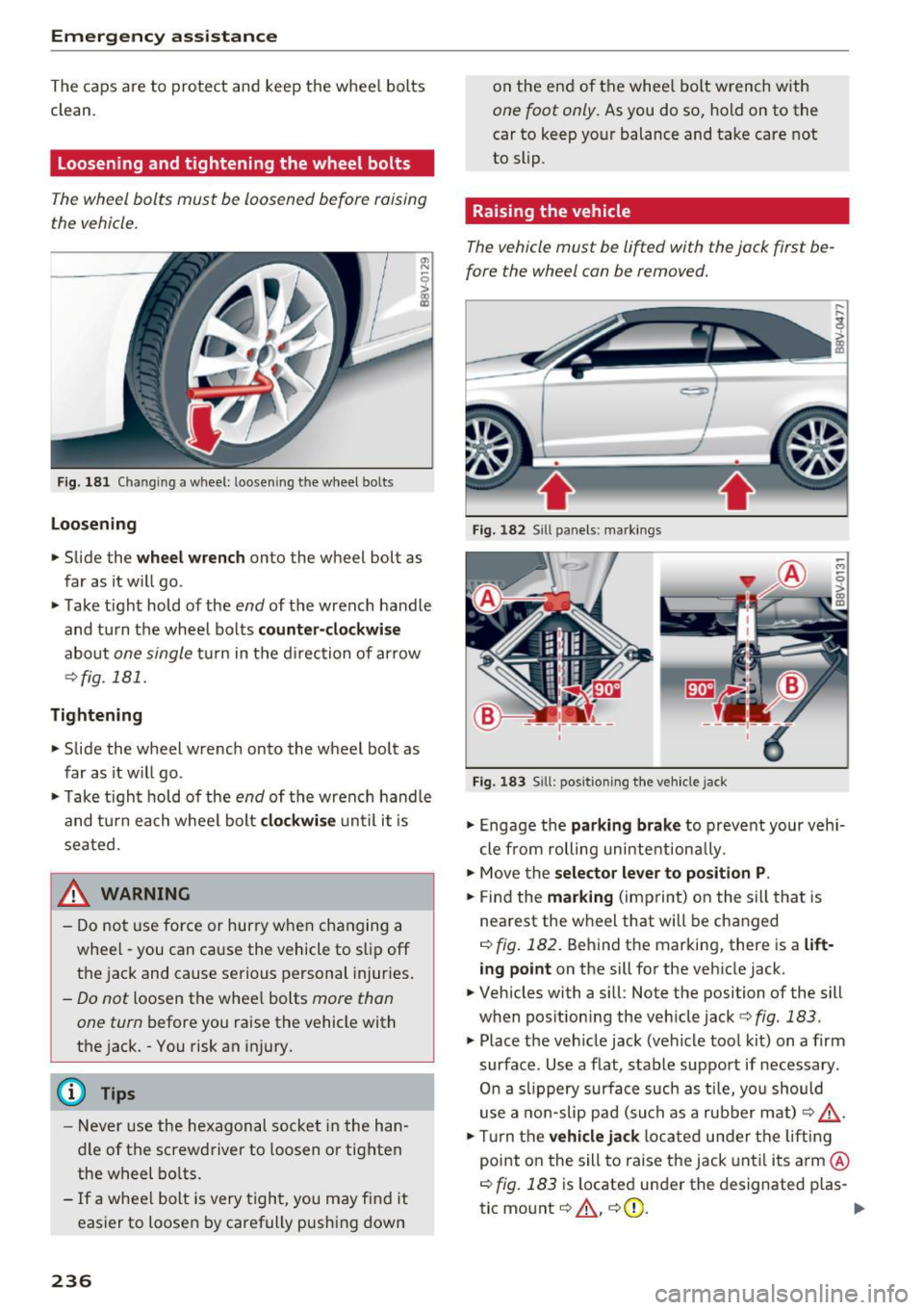
Fig . 181 Cha ngin g a wheel: loosening t he w heel bolts
Loosening
• Slide the wheel wrench onto the wheel bolt as
far as it w ill go .
• Take tight hold of the
end of the wrench handle
and turn the wheel bolts
counter-clockwise
about one single tur n in the direction of arrow
c:::>fig . 181.
Tightening
• Slide the wheel wrench onto the wheel bolt as
far as it w ill go .
• Ta ke tight hold of the
end of the wrench handle
and turn each whee l bolt
clockwise until it is
seated.
_& WARNING
- Do not use force or hurry when changing a
wheel -you can cause the vehicle to slip off
the jack and cause serious personal injuries.
-Do not loosen the whee l bolts more than
one turn
before you raise the vehicle with
the jack . - You risk an injury .
(D Tips
-Never use the hexagonal socket in the han
dle of the screwdriver to loosen o r tighten
the wheel bolts.
- If a whee l bolt is very tight, you may find it
easier to loosen by carefully push ing down
236
on the end of the whee l bolt wrench with
one foot only. As you do so, hold on to the
car to keep your balance and take care not
to slip .
Raising the vehicle
The vehicle must be lifted with the jack first be
fore the wheel can be removed.
Fig. 182 Sill panels: marking s
Fig. 183 S ill: pos itio ning the vehicle jack
• Engage the parking brake to prevent your vehi
cle from rolling unintentiona lly .
• Move the
selector lever to position P .
• Find the marking (imprint) on the sill that is
nea rest the wheel that will be changed
c:::>fig. 182. Behind the marking, there is a lift
ing point on the sill for the vehicle jack.
• Vehicles with a sill : Note the position of the sill
when position ing the veh icle jack
c:::> fig. 183 .
• Place the veh icle jack (vehicle tool kit) on a firm
surface . Use a f lat, stable support if necessary .
On a slippery surface such as tile, you should
use a non-slip pad (such as a rubber mat)
c:::> & -
• Tur n the vehicle jack located under the lifting
point on the sill to raise the jack until its arm @
c:::> fig. 183 is located under the designated plas-
tic mount
c:::> ,&. , c:::>(D . "'