wheel AUDI A3 CABRIOLET 2016 Manual PDF
[x] Cancel search | Manufacturer: AUDI, Model Year: 2016, Model line: A3 CABRIOLET, Model: AUDI A3 CABRIOLET 2016Pages: 272, PDF Size: 67.88 MB
Page 223 of 272
<( co .... N r--N .... 0 r--> co
Indicat or lights
IE -Loss of pressure in at least one ti re c::> ,& .
Check the tires and replace or repair if necessary.
Check/correct the pressures of all four tires. Then
store the tire pressures in the MMI
<=:>page 223.
mm (T ire Pressure Monitoring System) Tire
press ure: System malfuncti on!.
Ifm appears
after switching the ignition on or whi le driving
and the
IE indicator light in the instrument clus
ter blinks for approximately one minute and then
stays on, there is system malfunction . Try to
store the correct tire pressures
c::> page 223 . If
the indicator light does not turn off or turns on
again after a short period of time, drive to an au
thor ized Audi dealer or authorized Audi Service
Faci lity immediately to have the malfunction cor
rected.
A WARNING
- If the tire pressure warning light IE in the
instrument cluster turns on, the pressure in
one or more tires is too low . Reduce the ve
hicle speed immediately and avo id any hard
steering or braking maneuvers. Stop as soon as possible, check the tire and inflate the
t ire to the correct pressure, which is speci
fied on the tire pressure label on the veh icle
<=:> page 214. Driving w ith a t ire with low
pressure c auses the t ire to overheat and can
result in failure of the tire . Low pressure can
also have a negative effect on the driving
and braking behavior of the vehicle .
- T he driver is responsib le for maintaining the
correct tire pressures . You must check the
tire pressures regularly .
- Under certain conditions (such as a sporty
driv ing style, winter conditions or unpaved
roads), the pressure monitor indicator may
be delayed.
- Do not use run-flat tires on your vehicle . Us
ing them when not permitted can lead to
vehicle damage or accidents .
(D Tips
-The tire pressure monitoring system can al
so stop working when there is an ESC mal
function.
Tir es and wheel s
- Us ing snow chains may result in a system
ma lfunction.
- The tires with the identification "AO" or
"RO"
c::> page 211 have been matched with
your Audi tire pressure monitoring system .
We recommend that you use these tires.
- The tire pressure monitoring system can on
ly monitor the tire pressure of the driving
tires. Check the tire pressure of the spare
wheel in the luggage compartment so that if necessary it is ready for use.
Storing tire pressures
App lies to : vehicles wi th Tir e Pressure Mo nito rin g Sys te m in
dic ator
A change in tire pressur e or a change in tires
must be stored in the syst em .
The tire press ure is stored in the MM I.
.,. Make sure before storing that the t ire pressures
of all four tires meet the specified values and
are adap ted to the load. O therwise the system
could malfunction
c::> page 214.
.. Switch on the ignition.
.,. Select: the I MENU I button> Ca r> Sys tem s*
con trol button > S er vice & control > Tire pre s
s u re m on itor > Stor e tire pressu re > Yes , sto re
no w.
(D Tips
Do not store the tire pressures if snow chains
are installed. Otherw ise the system could
malfunction.
223
Page 225 of 272
<( co .... N ,.__
N .... 0 ,.__
> co
A WARNING
-Only wash the vehicle when the ignition is
off and follow the instructions from the car
wash operator to reduce the risk of acci dents.
- To reduce the risk of cuts, protect yourself from sha rp metal components when wash
ing the underbody or the inside of the wheel
housings.
- After washing the vehicle, the bra king effect
may be de layed due to mo isture on the
bra ke rotors or i ce in the w inte r. The brake s
must be dried fi rst w ith a few care ful brake
applications .
Q) Note
-If yo u wash t he vehi cle in an au toma tic car
wash, yo u m ust fold the exte rior m irrors i n
to re duce the risk of damage to the mirrors .
Power folding exterior m irrors * must on ly
be fo lded in and out using the power folding
funct ion.
- To p revent paint damage, do not wash the
vehicle in d irect sunlight.
Ca re and cleaning
- To re duce the risk of damage, do not wash
the power top with a pressure washer .
- T o red uce the risk of damage to the surface,
do not use insect removing sponges, kitche n
sponges o r similar items .
- M atte finish painted veh icle components:
- To reduce the risk of damage to the sur-
face, do not use polishing agents or hard
wax.
- Never use protective wax. It can destroy
the matte finish effect.
- Do not place any stickers or magnetic
signs on vehicle parts painted with matte
finish paint. The paint could be damaged
when the stickers or magnets are re
moved.
@ For the sake of the environment
Only wash t he veh icle in facili ties s pec ially de
s igned for that pu rpose. This will reduce the
r isk of dirty wate r contamina ted with o il from
ente ring the sewe r sys tem.
Cleaning and care information
When cleaning and caring for individua l vehicle
components, refer to the follow ing tables . The
information contained there is simp ly recom
mendations. For quest ions or for components t
h at are not listed, cons ult an authorize d Audi
dealer or authorized Audi Service Fac ility . Also
f o llow the information found in c> ,& .
Exterior cleaning
Component Situation Solution
Windshield wiper
Deposits <=> page 50 , Cleaning windshield wiper blades
blades
Headlights /
Deposits So
ft sponge with a mild soap solutiona)
Tail light s
Sensors /
Deposits Sensors: soft cloth w it h solvent-free cleani ng solut io n
Camera len ses Camera lenses: soft clot h w ith alcoho l-free cleaning sol u-
tion
Snow/ice Hand br ush/solvent-free de-icing spray
Wheels Road salt Water
Brake dust Acid-free special cleaning solution
Exhaust tail pipe s Road salt Wate
r, clean ing so lution su itab le for s tainless stee l, if ne e-
essa ry
225
Page 230 of 272

Emerg ency assis ta nce
Emergency assistance
Trunk escape latch
Applies to: vehicles with trunk escape latch (A3 sedan)
In case of an emergency, the rear lid can be
opened from the inside using the trunk escape
latch.
Fig. 172 luggage compartment: t runk escape latch
.,. Push the latch in the direction of the arrow un
til the lock releases .
The trunk escape latch inside the rear lid is made of fluo rescent mater ial to glow in the dark.
_& WARNING
The trunk escape latch is to be used only in an
emergency .
General information
.,. Park the vehicle as far as poss ible from moving
traff ic in the event of a flat tire. In the event of
a flat t ire, park the vehicle on a level surface. It
you are on a steep incline, be especia lly careful.
.,. Set the park ing brake.
.,. Place the selector lever in the P position.
.,. Switch the emergency flashers on.
.,. Put on a reflective vest, if available .
.,. Set up the warning triangle, if available .
.,. Have the passengers exit the vehicle . They
should move to a safe place, for example be
hind a guard rail.
_& WARNING
Pay attention to the steps above. They are for
your protection and the for the safety of other
drivers.
2 30
Equipment
Vehicle tool kit
Applies to: vehicles with vehicle tool kit
Fig. 173 lu gg age compartmen t: cargo floor cove r fo lded
upward (example)
The vehicle tool kit, t ire repa ir set* and compres
sor* are stored in the luggage compartment un
der the floor cover~
fig. 173 .
.,. Hook the p lastic hook@ into the luggage com
partment seal.
.,. Unhook the cargo floor before closing the lug
gage compartment lid.
_& WARNING
Improper use of the vehicle jack can cause se
rious personal injuries.
- Never use the screw driver hex head to
tighten wheel bolts, since the bolts cannot
attain the necessary tightening torque if you
use the hex head, potentially causing an ac
cident.
- The factory-supplied jack is intended only
for your veh icle model. Under no circum
stances should it be used to lift heavy
vehicles or other loads; you risk injuring
yourself .
- Never start the engine when the veh icle is
raised, which co uld cause an accident .
- Support the vehicle securely with a ppropri
ate stands if work is to be pe rformed under
neath the vehicle; otherwise, there is a po
tential risk for injury.
- Never use the jack supplied with your Audi
on another vehicle, particularly on a heavier
one. The jack is only su itable for use on the
vehicle it came with. ..,.
Page 233 of 272
<( co ..... N
" N ..... 0 r--. > 00
A WARNING
If the tire pressure is less than 19 psi
(130 kPA) after 10 minutes of driving , then
the ti re is too severely damaged . Do not con
tinue dr iv ing . See an authorized Audi dealer
or authorized Aud i Servi ce Fac ility for assis
tance .
A WARNING
Pay attent ion to the following after repair ing
the tire:
- Do not drive faster than SO mph (80 km/h).
- Avoid hard acceleration, brak ing sharp ly,
and fast cornering.
- The veh icle may become more difficult to
control.
- If the t ire is too severely damaged, see an
authorized Audi dealer or authorized Aud i
Service Facility for assistance .
@ For the sake of the environment
You can give the used tire sealant bottle to an
author ized Audi dealer or authorized A udi
Serv ice Facility for disposal.
(I_) Tips
Remember to obtain a new bottle of sealant
from an authorized Aud i dea ler or authorized
Aud i Service Facility after repairing a tire.
Spare tire
General information
Applies to: vehicles with space-saving spare tire (compact
spare tire)
Fig. 177 L ugg age co mpa rtment : ca rgo floo r cover folded
up ward
Em ergen cy a ssis tanc e
Fig. 178 Spa re t ire (examp le )
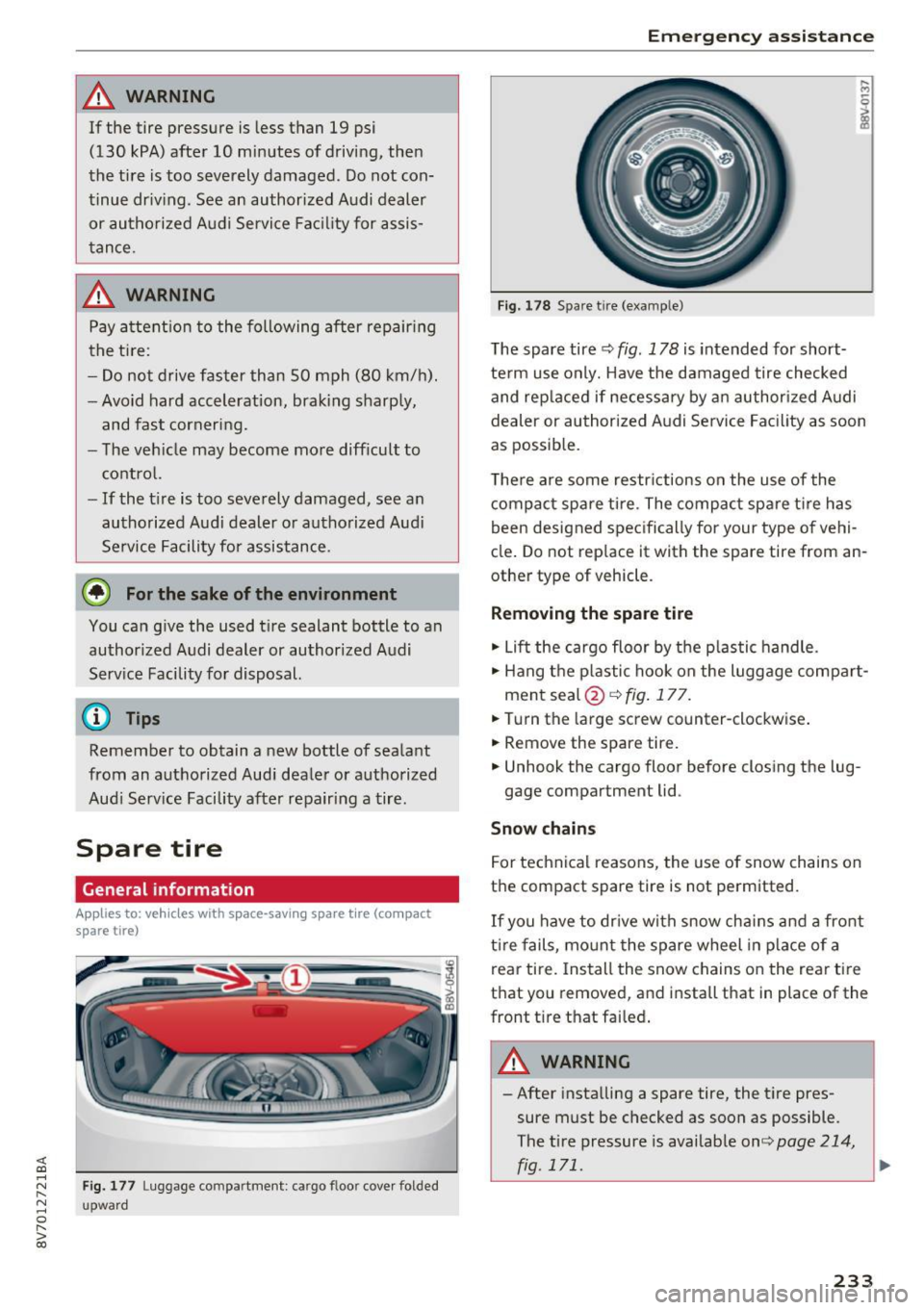
The spare tire ¢ fig. 178 is intended for short
te rm use only. Have the damaged tire checked
and replaced if necessary by an author ized Audi
dealer or authorized A udi Service Facility as soon
as possible.
T here are some restr ictions on the use of the
compact spare tire . The compact spare t ire has
been designed specifically for your type of vehi
cle. Do not rep lace it with the spare tire from an
other type of vehicle.
Removing the spare tire
.,. Lift the cargo floor by the p lastic handle .
.,. Hang the plastic hook on the luggage compart -
ment seal@¢
fig. 177.
.,. Turn the large screw counter-clockwise .
.,. Remove the spare tire.
.. Unhook the cargo floor befo re closing the lug -
gage compartment lid .
Snow chains
For technical reasons, the use of snow chains on
the compact spare tire is not permitted.
If you have to dr ive with snow chains and a front
t ire fails, mo unt the spare wheel in p lace of a
rear tire. Install the snow chains on the rear tire
that you removed, and install that in place of the
front t ire that fai led .
A WARNING
--After installing a spare tire, the t ire pres
sure must be checked as soon as possible.
The tire pressure is available one:>
page 214,
-
rg.111 . ~
233
Page 234 of 272
Emerg enc y assis ta nc e
-If the spare tire is more than 6 years old,
use it only in an emergency and with ex
treme caution and careful dr iving .
- The spare tire is intended on ly for tempora
ry and short-term use. It should be replaced
as soon as possible with the normal wheel and t ire .
- After mounting the compact spare t ire, the
t ire pressure must be checked as soon as
poss ible . The tire pressure of the compact
spare tire must be
61 psi (420 kPA); other
wise, you risk hav ing an accident.
- Do not drive faster than
50 mph (80 km/h).
You risk hav ing an accident.
- Avoid full -throttle accelerat ion, heavy brak
ing, and fast cornering. You risk having an
acc ident.
- Never dr ive using more than one spare
wheel and tire. You risk having an acc ident .
- Normal summer or winter tires must not be mounted on the compact spare wheel rim.
- For technical reasons, the use of tire chains
on the spare tire is not perm itted. If it is
necessary to drive with t ire chains, the spare
wheel must be mounted on the front axle in
the event of a flat in a rear tire. The new ly
available front wheel m ust then be insta lled
in place of the rear wheel with the flat tire.
Installing the tire chain before mounting
the wheel and tire is recommended.
- Loose items in the passenger compartment
can cause serious personal injury during
hard braking or in an accident. Never store
the inflatable spare t ire or jack and too ls in
the passenger compartment.
- Normal summer or winter tires must not be
mounted on the compact spare wheel rim.
Replacing wheels
Before changing a wheel
Observe the following precautions for your own
and your passenger's safety when changing a
wheel.
.,. After you experience a tire failure, pull the car
well away from moving traff ic and try to reach
le vel ground before you stop¢_& .
234
.. All passengers should lea ve th e car and move
to a safe location (for instance, behind the
guardrail) ¢ _& .
.. Engage the
par king br ake to prevent your vehi
cle from rolling unintentionally¢_& .
.. Move
selec tor le ve r to p osition P ¢ _& .
.. If you are towing a tra iler , u nhitch the trailer
from your vehicle.
.. Ta ke the
jac k¢ page 230 and the spar e tir e
¢ page 233 out of the luggage compa rtment.
A WARNING
-
You or your passengers could be injured while
changing a whee l if you do not follow these
safety precautions:
- If you have a flat tire, move a safe distance off the road. Turn off the engine, turn the
emergency f lashers on and use other warn
ing dev ices to alert other motorists.
- Make sure that passengers wait in a safe
place away from the vehicle and well away
from the road and traff ic.
- To help prevent the veh icle from moving
suddenly and possibly slipping off the jack,
always fully set the parking brake and block
the wheel diagonally opposite the wheel be
ing cha nged . When one front wheel is lifted
off the ground, placing the Automat ic
T ransmiss ion in P (Park) will
not prevent the
veh icle from moving.
- Before you change a whee l, be sure the
gro und is level and firm . If necessary, use a
sturdy board under the jack.
- Always sto re the vehicle too l kit, the jack
and the replaced tire in the luggage com
par tment
¢page 130.
Changing a wheel
When you change a wheel, follow the sequence
described below step-by-step and in exactly that
order.
1. Remove the decorati ve wh eel co ver* . For
more detai ls see also ¢
page 235, Decora
tive wheel covers
or ¢ page 235, Wheels
with wheel bolt caps .
2. Loosen the wh ee l bolt s ¢page 236.
Page 235 of 272
<( co ..... N
" N ..... 0 r--. > 00
3. Locate the proper mounting point for the
jack and align the jack below that poin t
¢page 236.
4. Raise the car with the jack¢ page 236.
5. Remove the wheel with the flat tire and then
install
the spare ¢ page 238.
6. Tighten all wheel bolts lightly.
7. Lower the veh icle with the jack.
8. Use the wheel bolt wrench and firmly tighten
all wheel bolts
¢page 236 .
9. Replace the decorative wheel cover* .
_& WARNING
Always read and follow all WARNINGS and in
formation
¢ .&. in Raising the vehicle on
page
237 and ¢ page 239.
After changing a wheel
A wheel change is not complete without the do
ing the following .
.,. Always store the vehicle tool kit, the jack* and
the replaced tire in the luggage compartment
¢ page 130.
.,. Check the tire pressure on the spar e wheel im
mediate ly after mount ing it .
.,. As soon as possible, have the
tightening tor
ques
on all wheel bolts checked with a torque
wrench . The correct tightening torque is
90 ft
lb
(120 Nm) .
.,. Have the flat tire
replaced as soon as possible .
(D Tips
-If you notice that the wheel bolts are cor
ro ded and difficult to turn while changing a
tire , they should be replaced before you
check the tightening torque .
- Drive at reduced speed until you have the
tightening torques checked.
-Af ter changing a wheel, the tire pressure in
all four tires must be checked/corrected and
the tire pressure monitoring indicator must
be stored in the MMI
9page 223.
Emergency assistance
Decorative wheel covers
Applies to: vehicles with decorative wheel covers
The decorative wheel covers must be removed
first to access the wheel bolts .
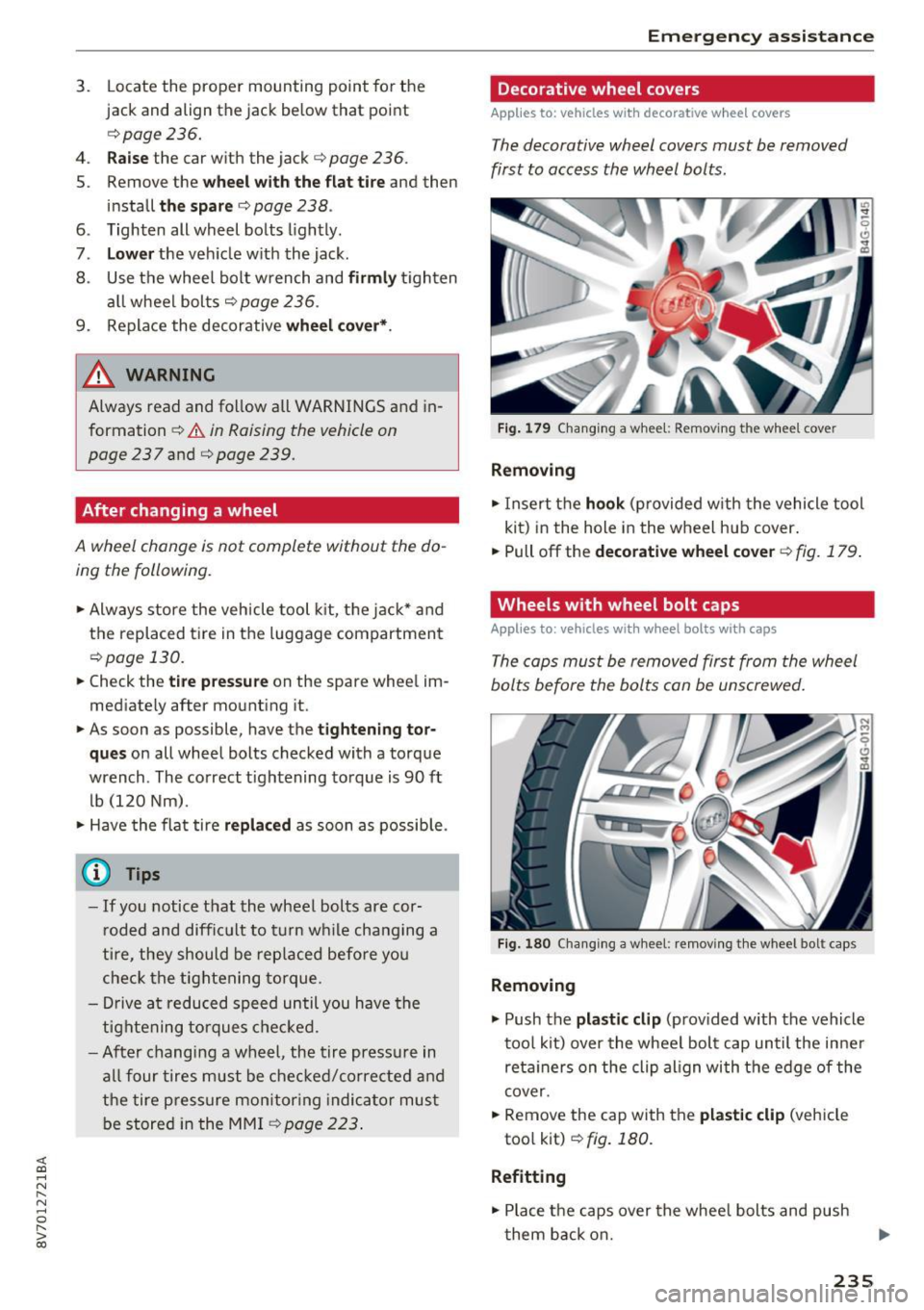
Fig. 179 Changing a whe el: Removin g the wh eel cov er
Removing
.,. Insert the hook (provided w ith the vehicle tool
kit) in the hole in the wheel hub cover.
.,. Pull off the
decorative wheel cover¢ fig. 179.
Wheels with wheel bolt caps
Applies to: vehicles with wheel bolts w,th caps
The caps must be removed first from the wheel
bolts before the bolts can be unscrewed.
Fig. 180 Chang ing a whee l: removing th e whee l bol t cap s
Removing
.,. Push the plastic clip (provided with the vehicle
tool kit) over the wheel bolt cap until the inne r
reta iners on the clip align with the edge of the
cover.
.,. Remove the cap with the
plastic clip (vehicle
tool kit)
¢ fig. 180.
Refitting
.,. Place t he caps over the wheel bolts and push
t hem back on.
235
Page 236 of 272
Emergency assistance
The caps are to protect and keep the whee l bolts
clean.
Loosening and tightening the wheel bolts
Th e wheel bolts must be loosened before raising
the vehicle.
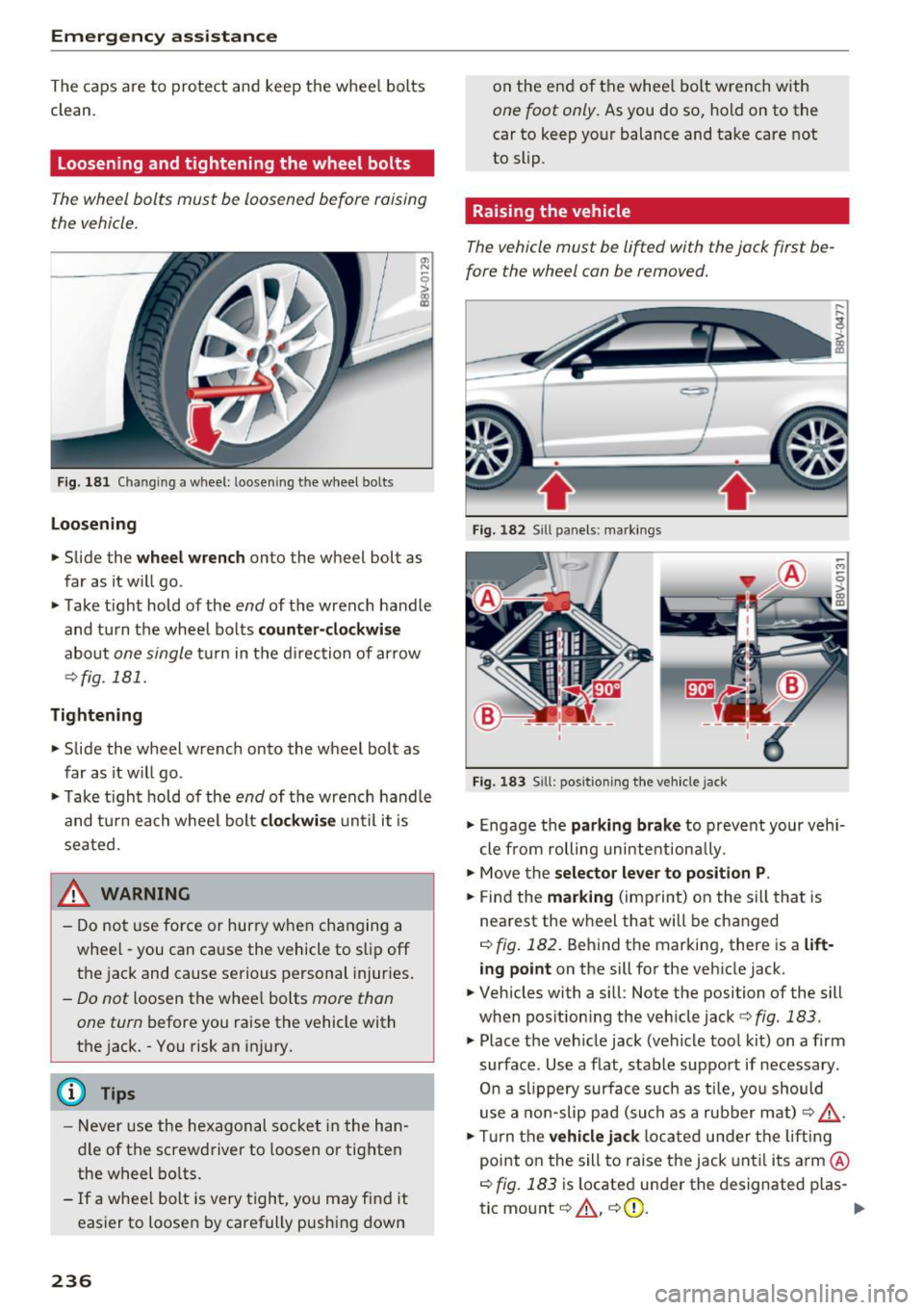
Fig . 181 Cha ngin g a wheel: loosening t he w heel bolts
Loosening
• Slide the wheel wrench onto the wheel bolt as
far as it w ill go .
• Take tight hold of the
end of the wrench handle
and turn the wheel bolts
counter-clockwise
about one single tur n in the direction of arrow
c:::>fig . 181.
Tightening
• Slide the wheel wrench onto the wheel bolt as
far as it w ill go .
• Ta ke tight hold of the
end of the wrench handle
and turn each whee l bolt
clockwise until it is
seated.
_& WARNING
- Do not use force or hurry when changing a
wheel -you can cause the vehicle to slip off
the jack and cause serious personal injuries.
-Do not loosen the whee l bolts more than
one turn
before you raise the vehicle with
the jack . - You risk an injury .
(D Tips
-Never use the hexagonal socket in the han
dle of the screwdriver to loosen o r tighten
the wheel bolts.
- If a whee l bolt is very tight, you may find it
easier to loosen by carefully push ing down
236
on the end of the whee l bolt wrench with
one foot only. As you do so, hold on to the
car to keep your balance and take care not
to slip .
Raising the vehicle
The vehicle must be lifted with the jack first be
fore the wheel can be removed.
Fig. 182 Sill panels: marking s
Fig. 183 S ill: pos itio ning the vehicle jack
• Engage the parking brake to prevent your vehi
cle from rolling unintentiona lly .
• Move the
selector lever to position P .
• Find the marking (imprint) on the sill that is
nea rest the wheel that will be changed
c:::>fig. 182. Behind the marking, there is a lift
ing point on the sill for the vehicle jack.
• Vehicles with a sill : Note the position of the sill
when position ing the veh icle jack
c:::> fig. 183 .
• Place the veh icle jack (vehicle tool kit) on a firm
surface . Use a f lat, stable support if necessary .
On a slippery surface such as tile, you should
use a non-slip pad (such as a rubber mat)
c:::> & -
• Tur n the vehicle jack located under the lifting
point on the sill to raise the jack until its arm @
c:::> fig. 183 is located under the designated plas-
tic mount
c:::> ,&. , c:::>(D . "'
Page 237 of 272
<( co .... N ,.__
N .... 0 ,.__
> co
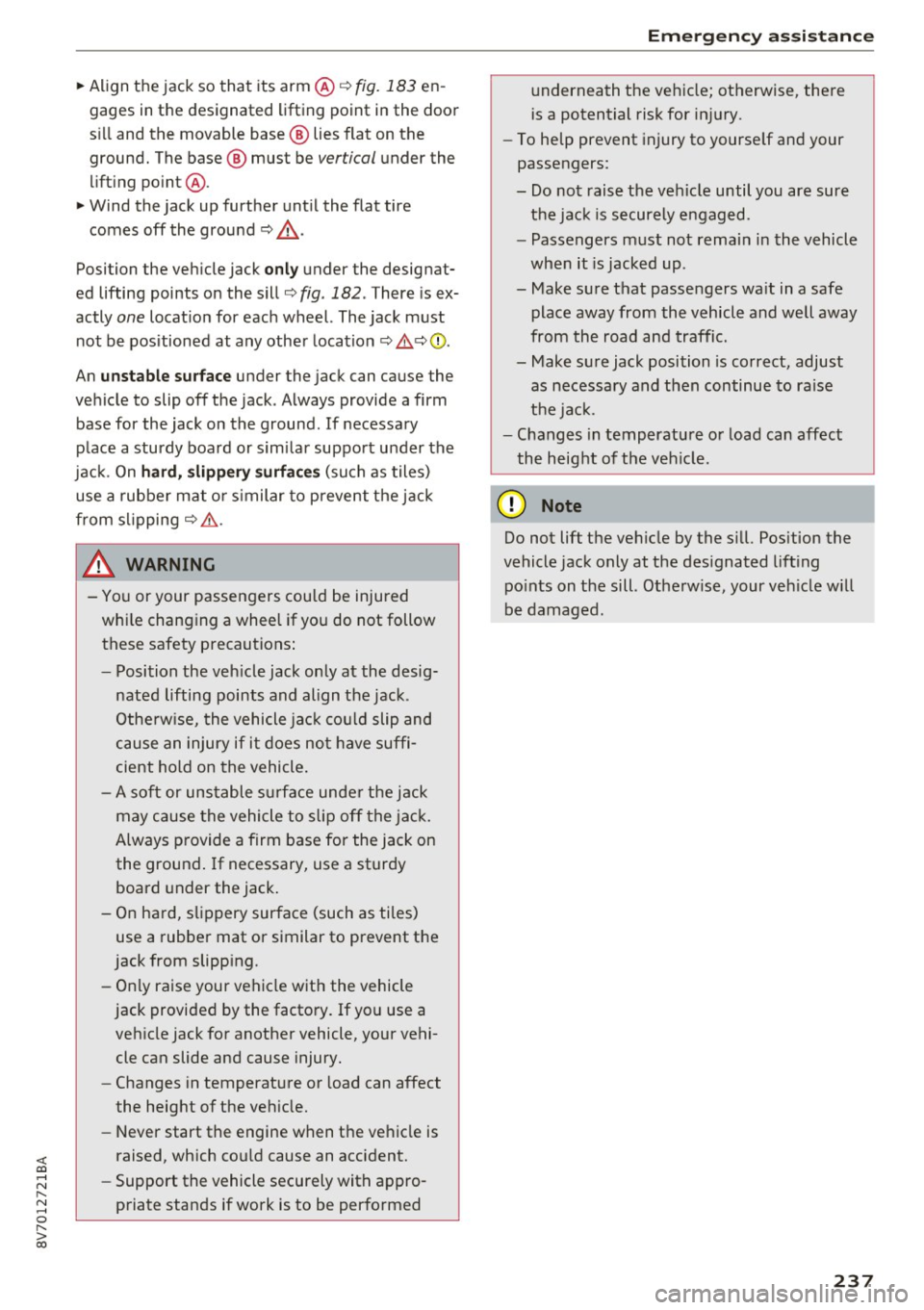
~ Align the jack so that its arm@¢ fig. 183 en
gages in the designated lifting point in the door
s ill and the movable base ® lies flat on the
ground. The base ® must be
vertical under the
lifting po int @ .
~ Wind the jack up further until the flat tire
comes off the ground ¢
,&.
Position the veh icle jack on ly under the designat
ed lifting points on the sill¢
fig. 182 . There is ex
actly
one locat ion for each wheel. The jack must
not be positioned at any other location ¢ _8. ¢(D .
An
u nstable surface under the jack can cause the
ve hicle to slip off the jack . Always provide a firm
base for the jack on the ground. If necessary
place a sturdy boa rd or sim ilar support under the
jack . On
hard, sli ppery surfac es (such as tiles)
use a rubbe r mat o r similar to prevent the j ack
from sli pping ¢.&. .
& WARNING
-
-Yo u or your passengers could be injured
whi le changing a wheel if you do not follow
these safety precautions :
- Position the veh icle jack only at the desig
nated lifting points and align the jack .
Othe rw ise, the vehicle jac k c ou ld slip and
cause an injury if it does no t have suffi
cient hold on the vehicle.
- A soft or unstable s urface unde r the jack
may cause the vehicle to slip off the jac k.
Always p rovide a firm base for the jack on
the ground . If necessary, use a sturdy
board under the jack .
- On hard, s lippery surface (such as tiles)
use a rubber mat or similar to prevent the
jack from slipp ing.
- On ly raise your vehicle with the vehicle
jack provided by the factory. If you use a veh icle jack for another vehicle, your vehi
cle can slide and cause injury.
- Changes in temperature or load can affect
the height of the veh icle.
- Never start the engine when the vehicle is
raised, which co uld cause an accident.
- Support the vehicle securely with appro
p riate stands if work is to be performed
Em ergenc y ass is tanc e
underneath the vehicle; otherwise, there
is a potential risk for injury.
- To help prevent injury to yourse lf and your
passengers:
- Do not raise t he vehicle until you are sure
the jack is securely engaged.
- Passengers m ust not remain in the vehicle
when it is jacked up .
- Make sure that passengers wa it in a safe
place away from the vehicle and well away
from the road and traffic.
- Make sure jack position is correct, adjust
as necessary and then continue to raise
t h e jack.
- Changes in temperatu re or load can affect
the height of the veh icle.
(D Note
Do not lift the vehicle by the s ill. Pos it ion the
vehicle jack only at the des ignated lift ing
po ints on the sill. Ot herw ise, your veh icle w ill
be damaged.
237
Page 238 of 272
Emergency assistance
Taking the wheel off/installing the spare
Follow these instructions step-by-step for chang
ing the whee l.
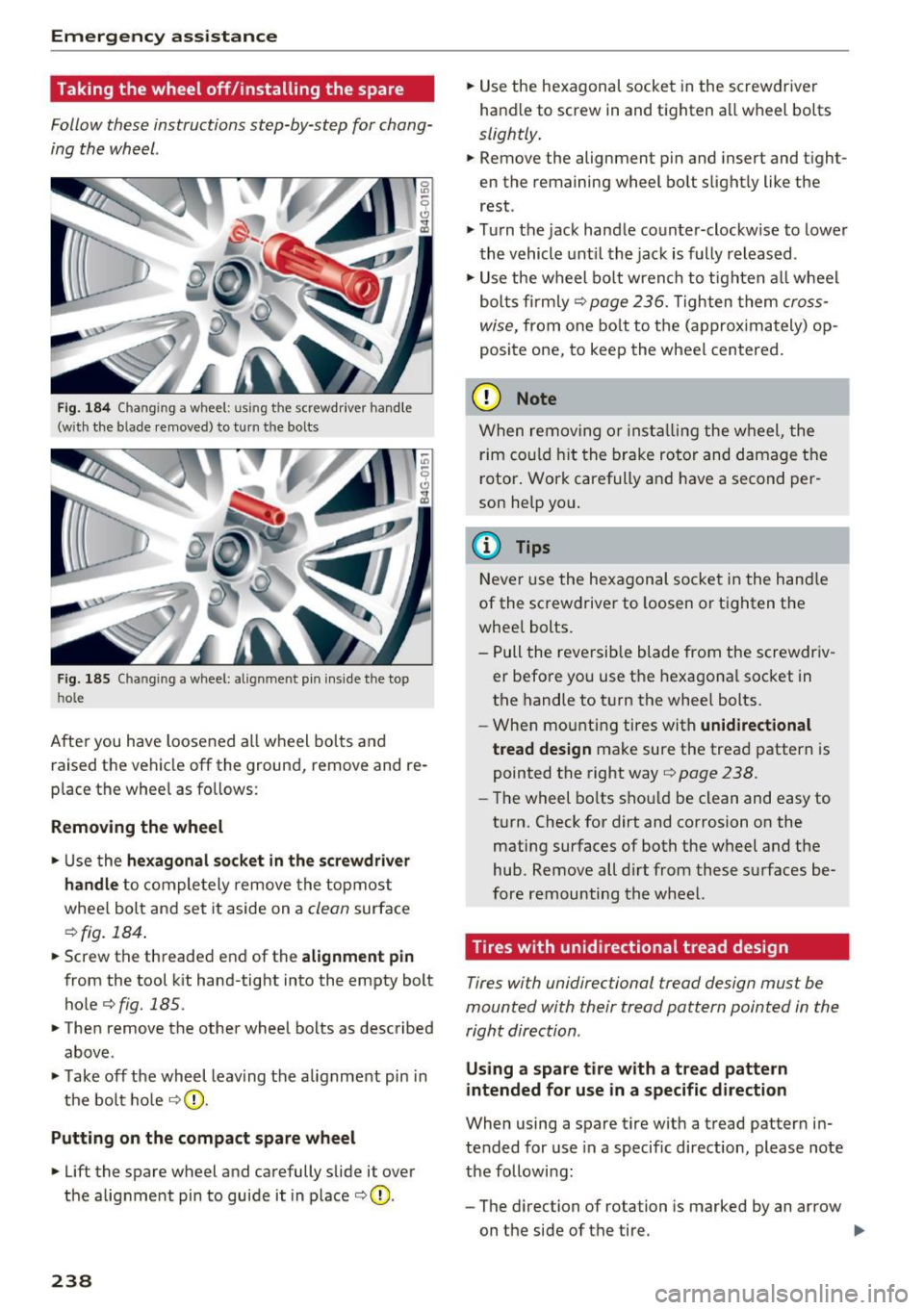
F ig. 184 Chang ing a wheel: using the screw driver ha ndl e
(wit h th e bla de re m oved) to turn the bol ts
F ig . 185 Chang ing a whee l: alignment p in inside t he top
hole
Afte r you h ave loose ned a ll w heel bo lts and
raised t he ve hicl e off the groun d, remove and re
p lace the whee l as fo llows:
Removing the wheel
• Use the hexagonal so cket in the screwdriver
handle
t o comple tely remove the topmost
whee l bolt and se t it aside on a
clean surface
~fig. 184 .
• Scre w the th reade d end of the alignment pin
from the tool kit hand-tight into the empty bolt
hole
c> fig. 185 .
• The n remove the other wheel bolts as described
above.
• Takeoff the wh eel leav ing the a lignm ent pin in
t h e bolt ho le
¢ 0 .
Putting on the compact spare wheel
• Lift the spare wheel and carefully slide it ove r
the alignme nt pin to gui de it in place
c> 0 .
238
• Use the hexagonal socket in the screwdriver
handle to screw in and tighten a ll wheel bo lts
slightly .
• Remove the alignment pin and insert and tight
en the remaining wheel bo lt s light ly like the
rest .
• Tur n t he jack hand le co unter-clockw ise to lowe r
the vehicl e until t he ja ck is fu lly released .
• Use the wheel bo lt wren ch to tig hte n all wheel
bolts firm ly¢
page 236. T igh ten them cro ss
wise,
from one bo lt to t he (a pprox ima tely) op
posite one, to keep the wheel centered.
(D Note
W hen re mov ing o r installin g the w heel, the
rim co uld hit the bra ke r otor an d damage t he
r otor . Work care fully and h ave a second per
son he lp yo u.
(D Tips
Neve r use the he xagonal socke t in the han dle
of the sc rew drive r to loosen or t ighten the
whee l bolts .
- Pull the reve rsible blade from the screwdr iv
er befo re yo u use t he hexagona l so cket in
t h e handle to t urn the whee l bolts.
- W he n mo unting tires with
unidirectional
tread design
make sure the trea d pattern is
pointed t he right way~
page 238.
-Th e wheel bolts s ho uld be clean an d easy to
t u rn. Check fo r dirt and corrosion o n the
mati ng surfaces of both the wheel and the
hub. Remove all dirt from these s urfaces be
fore r emounting the whee l.
Tires with unidirectional tread design
Tires with unidirectional tread design must be
mounted with their tread pattern pointed in the
right direction .
Using a spare tire with a tread pattern
intended for use in a specific direction
When using a spare tire wit h a tread patter n in
te nded for use in a specific direction, please note
the followi ng:
- The direction of rotation is marked by an arrow
on the side of the tire. ..,.
Page 239 of 272
<( co .... N r--N .... 0 r--> co
-If the spare tire has to be installed in the incor
rect direction, use the s pare tire only tempora
ri ly s ince the tire w ill not be ab le to achieve its
opt imum performance c haracter istics with re
gard to aquaplaning, noise and wear .
- We recommend that you pay particular atten
tion to this fact during wet weathe r and that
yo u ad just yo ur speed to match road condi
t io ns.
- Replace t he f lat t ire with a new one and have it
insta lled on yo ur vehicle as soon as possible to
r e store the handling adva ntages of a unid irec
t io na l t ire .
Notes on wheel changing
Please read the i nfo rma tion ¢ page 211 if y ou
ar e goi ng to use a sp are tir e which i s different
fr om t he tires on yo ur vehicle.
Af ter you ch an ge a tire:
-Check the tire pressure on the spare immedi
ately after installation.
- Have the wheel bolt tightening torque
checked with a torque wrench as soon as pos
sible by your authorized Audi dealer or a
qualified service station .
- With steel and alloy wheel rims, the wheel
bolts are correctly tightened at a torque of
90 ft lb (120 Nm) .
- If you notice that the wheel bolts are corroded
and difficult to turn while changing a tire,
they should be replaced before you check the
tightening torque.
- Replace the flat tire with a new one and have
it installed on your vehicle as soon as possi
ble . Remount the wheel cover.
Until then, drive with extra care and at reduced
speeds .
.8, WARNING
- If you are going to e quip yo ur ve hicl e w ith
tir es or r ims w hic h diff er from t hose whi ch
w ere fa cto ry i nst alled, t hen be s ure t o read
t h e informat ion ¢pa ge
211.
- Alw ays mak e sure the d amag ed whee l or
even a flat tire and t he jack and tool ki t are
-
Emergency assistance
proper ly sec ure d in the l ugga ge compart
ment a nd a re not loose in the passenger
compa rtm ent.
- In an accident or sudden maneuver they
could fly forward, injuring a nyone in the ve
h icle.
- A lways sto re damaged wheel, jack and tools
securely in the l uggage compartment. Ot h
erw ise , in an acc ident or sud den maneuve r
they cou ld fly forwar d, causing injury to pas
s en ger s in the vehicle .
239