air condition AUDI A3 SEDAN 2017 Owner's Manual
[x] Cancel search | Manufacturer: AUDI, Model Year: 2017, Model line: A3 SEDAN, Model: AUDI A3 SEDAN 2017Pages: 400, PDF Size: 67.32 MB
Page 274 of 400
Airbag system
-Therefore, always wear your safety belts and
make sure that everybody in your vehicle is
properly restrained.
- Always hold the steering wheel with both
hands on the outside of the steering wheel
rim at the 9:00 o 'clock and 3 :00 o'clock po
sitions to help reduce the risk of personal in
jury if the driver's airbag inflates .
- Never hold the steering wheel at the 12
o'clock position or with your hands any
where inside the steering wheel or on the steering wheel hub. Holding the steering
wheel the wrong way increases the risk of
severe injury to the arms, hands, and head if
the driver airbag deploys.
A WARNING
Objects between you and the airbag will in
crease the risk of injury in a crash by interfer
ing with the way the airbag unfolds and/or by
being pushed into you as the airbag inflates.
- Always make sure nothing is in the front air-
-
bag deployment zone that could be struck
by the airbag when it inflates.
- Objects in the zone of a deploying airbag
can become projectiles when the airbag de
ploys and cause serious personal injury.
- Never hold things in your hands or on your lap when the vehicle is in use .
- Never place accessories or other objects
(such as cup holders, telephone brackets,
note pads, navigation systems, or things
that are large, heavy, or bulky) on the doors;
never attach then to the doors or the wind
shield; never place them over or near or at
tach them to the area marked
,.AIRBAG" on
the steering wheel, instrument panel or the
seat backrests; never place them between
these areas and you or any other person in
the vehicle.
- Never attach objects to the windshield
above the passenger front airbag, such as
accessory GPS navigation units or music players. Such objects could cause serious in
jury in a collision, especially when the air bags inflate .
272
-Never recline the front passenger seat to
transport objects. Items can also move into
the deployment area of the side airbags or
the front airbag during breaking or in a sud
den maneuver . Objects near the airbags can
fly dangerously through the passenger com
partment and cause injury, particularly
when the seat is reclined and the airbags in
flate.
A WARNING
A person on the front passenger seat, espe
cially infants and small children, will receive
serious injuries and can even be killed by be ing too close to the airbag when it inflates .
- Although the Advanced Airbag System in
-
your vehicle is designed to turn off the front
passenger airbag if an infant or a small child
is on the front passenger seat, nobody can
absolutely guarantee that deployment un
der these special conditions is impossible in
all conceivable situations that may happen
during the useful life of your vehicle.
-The Advanced Airbag System can deploy in
accordance with the .,low
risk" option for 3-
and 6-year-old children under the U.S . Fed
eral Standard if a child with electrical capac
itance greater than the combined capaci
tance of a typical one-year old infant re
strained in one of the forward facing or rear
facing child safety seats with which your ve
hicle was certified is on the front passenger
seat and the other conditions for airbag de
ployment are met.
- Accident statistics have shown that children
are generally safer in the rear seat area than
in the front seating position.
- For their own safety, all children, especially
12 years and younger, should always ride in
the back properly restrained for their age and size.
Advanced front airbag system
Your vehicle is equipped with a front Advanced
Airbag System in compliance with United States
Federal Motor Vehicle Safety Standard 208, as
well as Canada Motor Vehicle Safety Standard
..,.
Page 282 of 400
Airbag system
The PASSENGER AIR BAG OFF light will show
the status of the front seat passenger 's frontal
Advanced Airbag a few seconds after the igni
tion is switched on and the airbag indicator
light goes off . The PASSENGER AIR BAG OFF
light:
- will stay on if the front passenger seat is not
occupied;
- will stay on if the electrical capacitance meas
ured by the capacitive passenger detection sys
tem for the front passenger seat equals the combined capacitance of an infant up to about
one year of age and one of the rearward-facing
or forward-facing child restraints listed in Fed
era l Motor Vehicle Safety Standard 208 w ith
wh ich the Advanced Airbag System in your vehi
cle was certified; Fo r a lis ting of the child re
strain ts that were used to certify you r vehi cle's
compliance with the U.S. Safety Standard
¢ page 295 .
-will go out if the front passenger seat is occu
pied by an adult as registered by the capacitive
passenger detection system.
- The
PASSENGER AIR BAG OFF light must come
on and stay on if the ignition is on and ...
- a car bed has been installed on the front pas
senger seat, or
- a rearward -facing child restraint has been in
stalled on the front passenger seat, or
- a fo rwa rd-facing child restra int has been instal
led on the front passenger seat,
- and if the e lectrica l capac itance registered on
the front passenger seat is eq ua l t o or less than
the combined capacitance of a typica l 1 year
o ld infant and one of the rearward -facing or
forward-facing child restraints listed in Federal
Motor Vehicle Safety Standard 208 w ith which
the Advanced Airbag System in your vehicle was
certified.
If the front passenger seat is not occupied, the
front airbag will not deploy, and the
PASSENGER
AIR BAG OFF
light will stay on. Never install a
rearward-fac ing c hild restraint on the front pas
senger seat, the safest place for a child in any
kind of child restraint is at one of the seating po
sitions on the rear seat
¢page 268, Child re-
280
straints on the front seat -some important
things to know
and ¢ page 292, Child safety.
If
the PASSENGER AIR BAG light comes
on ...
If the PASSENGER AIR BAG OFF light comes on
when one of the conditions listed above is met,
be sure to check the light regularly to make cer
ta in that the
PASSENGER AIR BAG OFF light
stays on continuously whenever the ignition is
o n. If the
PASSENGER AIR BAG OFF light does
not appear on and does not stay on all the time,
stop as soon as it is safe to do so and
- reactivate the system by turn ing the ignit ion
off for more than 4 seconds and then turn ing it
on again;
- remove and re install the child restraint. Make
sure that the child restraint is properly instal
led and that the safety belt for the front pas
senge r seat has been correct ly routed through
the child restraint as described in the child re
straint manufactu rer's inst ruct ions;
- ma ke sure that the convert ible lock ing retrac
to r on the safety belt for the front passenge r
seat has been activated and that the safety belt
has been pulled tight.
- make sure that no electric al device (s uch as a
laptop, CD p laye r, e lectronic games device,
power inverte r or seat heater for chi ld safety
seats) is placed or used on the front passenger
seat if the device is connected to the 12-volt
socket or the cigarette lighter socket;
- make sure that no seat heater has been retro
fitted or otherw ise added to the front passen
ger seat;
- make sure that nothing can interfere with the
safety belt buckles and that they are not ob structed;
- make sure that there are no wet ob jects (such
as a wet towel) and no water or other liquids on
the front passenger seat cushion .
If the PASSENGER AIR BAG light still does
not come on ...
If the PASSENGER AIR BAG OFF light still does
not come on and does not stay on continuously
(when the ign ition is sw itched on),
..,
Page 294 of 400
Child safety
Child safety
Important information
Introduction
The rear seat is generally the safest place in a
collision .
The physical principles of what happens when
your vehicle is in a crash apply also to children
¢ page 259, What happens to occupants not
wearing safety belts? .
But unlike adults and
teenagers, their muscles and bones are not fully
developed. In many respects children are at
g reater r isk of serious injury in crashes than
adults .
Because children's bodies are not fully devel
oped, they require restraint systems especially
des igned for their size, weight, and body struc
ture. Many countries and all states of the United
States and provinces of Canada have laws requir
ing the use of approved child restraint systems
for infants and small children .
In a frontal crash at a speed of 20-35 mph
(30-56 km/h) the forces acting on a 13 -pound
(6 kg) infant will be more than 20 times the
weight of the child. This means the weight of the child would suddenly be more than 260 pounds
(120 kg) . Under these conditions, only an appro
priate child restraint properly used can reduce
the risk of serious injury . Child restra ints, like
adu lt safety belts, must be used properly to be
effect ive. Used improperly, they can increase the
risk of serious injury in an acc ident.
All ch ildren, especially those 12 years and young
er must always ride in the back seat properly re
stra ined for their age and size. If you must insta ll
a child restraint on the front passenger seat in
exceptional circumstances, be sure to read and
heed the important information and warnings
¢ page 268. Infants and other children who are
properly restrained in an appropriate child re
straint that is for their si ze and age can benefit
from the protection that supplemental side air
bags provide in some kinds of crashes .
For more information please see information
provided by the:
292
-National Highway Traffic Safety Administration
(NHTSA), currently at: http :/ /www.safe
rcar.gov (for the USA)
-Transport Canada Information Centre, current-
ly at: http://www.tc.gc.ca (for Canada)
Consult the child safety seat manufacturer's in
structions in order to be sure the seat is right fo r
your chi ld's
size ¢ page 296, Important safety
instructions for using child safety seats .
Please
be sure to read and heed all of the important in
formation and WARNINGS about child safety,
Advanced Airbags, and the installation of child
restra ints in this chapter .
There is a lot you need to know about the Ad
vanced Airbags in your vehicle and how they work
when infants and children in child restraints are
on the front passenger seat . Because of the large
amount of important informat ion , we cannot re
peat it all here. We urge you to read the detailed
i nformation in this owner's manual about airbags
and the Advanced Airbag System in your vehicle
and the very important information about trans
porting children on the front passenger seat.
Please be sure to heed the WARNINGS -they are
extremely important for your safety and the safe
ty of your passengers, especially infants and
small children .
A WARNING
-Accident statistics have shown that children
are generally safer in the rear seat area than
in the front seat ing pos ition. Always restrain
any child age 12 and under in the rear.
-All vehicle occupants and especially children
must be restra ined prope rly whenever rid ing
in a vehicle. An un restrained or improperly
restrained child could be injured by striking
the interior or by being ejected from the ve
hicle during a sudden maneuver or impact.
An unrestrained or improperly restrained
child is a lso at greater risk of injury or death
through contact w ith an inflating airbag.
-A suitable ch ild restraint properly installed
and used at one of the rear seating positions
provides the highest degree of protect ion
for infants and small children in most acc i
dent situat ions.
Page 326 of 400
Checking and Filling
When the engine is warm it can be slightly above the upper marking.
Adding coolant
Plug-in hybrid drive* : Your vehicle has two cool
ant expansion tanks that are separate from each
other. The smaller of the two expansion tanks
must not be opened
¢ page 104. Read and fol
low the important safety precautions ¢
A in
Coolant on page 105 .
Requirement: there must be a residual amount of
coolant in the expansion tank
¢ (D .
~ Let the engine cool down.
~ Place a cloth over the coolant expansion tank
cap and unscrew the cap counterclockwise
¢_&. .
~ Add coolant mixed in the correct ratio
¢page 323 up to the upper marking.
~ Make sure that the fluid level remains stable.
Add more coolant if necessary.
~ Close the cap securely.
Coolant loss usually indicates there is a leak . Im
mediately drive your vehicle to an authorized
Audi dealer or authorized Audi Service Facility
and have the cooling system inspected.
If the
cooling system is not leaking, a loss can come
from the coolant boiling through overheating
and being pushed out of the cooling system.
.,&. WARNING
The cooling system is pressurized and can be
come very hot. To reduce the risk of burns
from hot coolant:
- Do not open the coolant expansion tank cap
when the engine is hot. This increases the
risk of burns.
- Stop the engine and allow it to cool.
- Protect your face, hands and arms from es-
caping coolant and steam by covering the
coolant tank cap with a large, thick cloth.
- Turn the coolant tank cap counterclockwise
slowly and keep light pressure on the cap.
- To reduce the risk of burns, do not allow any
antifreeze or coolant to drip onto the ex
haust system or hot engine components.
324
The ethylene glycol in engine coolant can
catch fire under certain circumstances.
- The coolant additive and the coolant can be
dangerous to your health. For this reason,
keep the coolant in the original container
and away from children . There is a risk of
poisoning.
- When working in the engine compartment,
remember that the radiator fan can switch
on even if the ignition is switched off, which
increases the risk of injury.
(D Note
Do not add coolant if the expansion tank is
empty . Air could enter the cooling system and
damage the engine . If this is the case, do not
continue driving . See an authorized Audi deal
er or authorized Audi Service Facility for assis
tance.
- Before the start of winter, have an author
ized Audi dealer or authorized Audi Service
Facility check if the coolant additive in your
vehicle matches the percentage appropriate
for the climate. This is especially important
when driving in colder climates.
- If the appropriate coolant additive is not
available in an emergency, do not add any
other additive. You could damage the en
gine. If this happens, only use water and re
store the correct mixture ratio with the
specified coolant additive as soon as possi
ble .
- Only refill with new coolant.
- Radiator sealant must not be mixed with the coolant.
· Radiator fan
The radiator fan switches on automatically by it
self
An auxiliary electric radiator fan switches on and
off depending on coolant temperature and other
vehicle operating conditions.
After you switch the engine off, the auxiliary fan
can continue running for up to 10 minutes
-even
with the ignition off.
It can even switch on again
later by
itself ¢.& , if .,..
Page 344 of 400
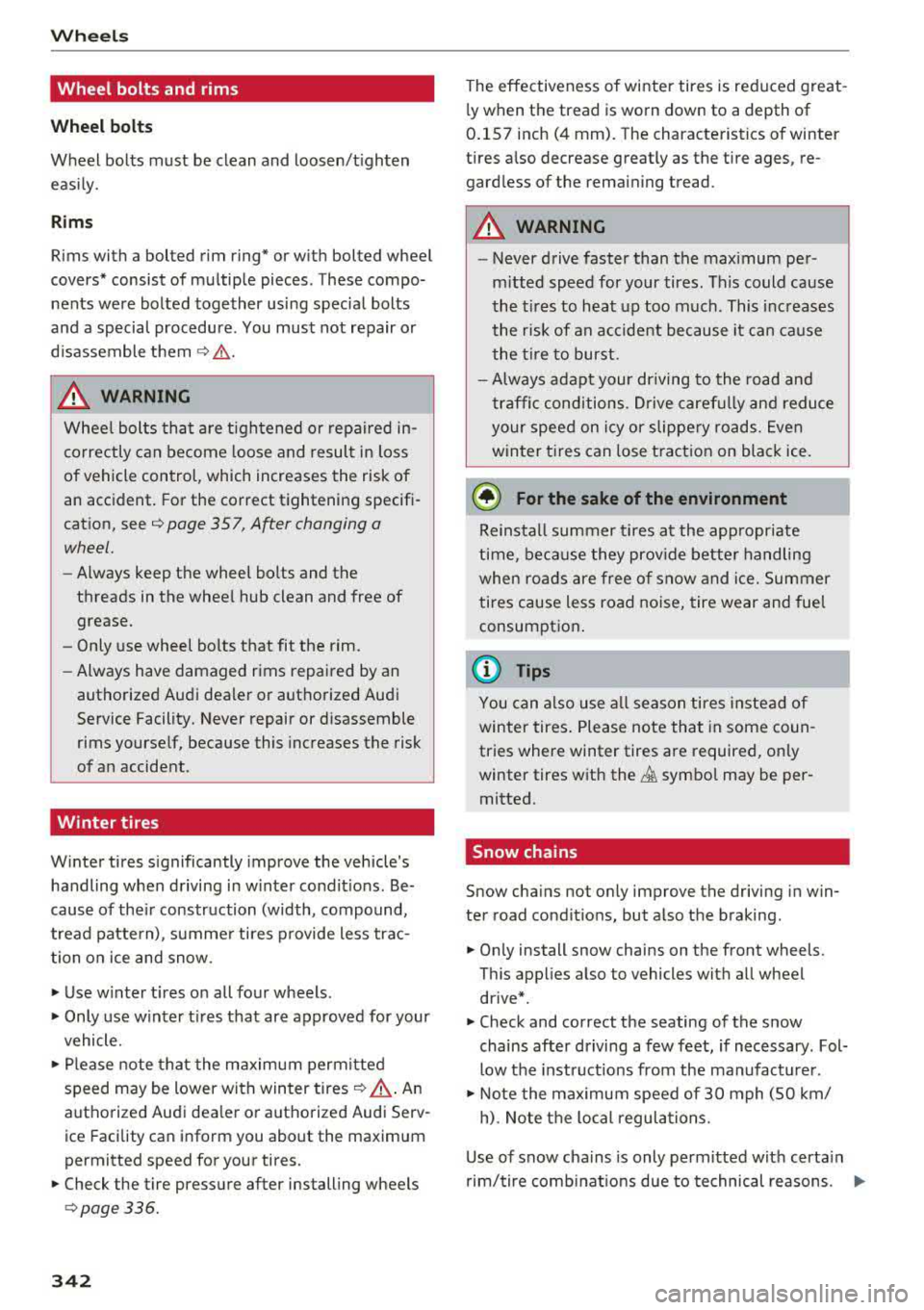
Wheels
Wheel bolts and rims
Wheel bolts
Wheel bolts must be clean and loosen/tighten
easily .
Rims
Rim s with a bolted r im ring * or with bolted wheel
covers* consist of multiple pieces. These compo
nents were bolted together using special bolts
and a special procedure . You must not repair or
disassemble
them ¢_&. .
..&, WARNING
Wheel bolts that are tightened or repaired in
correctly can become loose and result in loss
of vehicle control , which increases the risk of
an accident. For the correct tightening specifi
cation, see
¢ page 35 7, After changing a
wheel.
- Always keep the wheel bolts and the
threads in the wheel hub clean and free of
grease.
- Only use wheel bolts that fit the rim.
- Always have damaged rims repaired by an
authorized Audi dealer or authorized Audi
Service Facility. Never repair or disassemble
rims yourself, because this increases the risk
of an accident .
Winter tires
Winter tires significantly improve the vehicle 's
handling when driving in winter conditions. Be
cause of their construction (width, compound,
tread pattern) , summer tires provide less trac
tion on ice and snow.
.,. Use winter tires on all four wheels .
.,. Only use winter tires that are approved for your
vehicle.
.,. Please note that the maximum permitted
speed may be lower with winter tires
¢ _&. .An
authorized Audi dealer or authorized Audi Serv
ice Facility can inform you about the maximum
permitted speed for your tires.
.. Check the tire pressure after installing wheels
¢ page 336.
342
The effectiveness of winter tires is reduced great
ly when th e tread is worn down to a depth of
0.157 inch (4 mm). The characteristics of winter
tires also decrease greatly as the tire ages, re
gardless of the remaining tread.
'
..&, WARNING
- Never drive faster than the maximum per
mitted speed for your tires. This could cause
the tires to heat up too much. This increases
the risk of an accident because it can cause
the tire to burst .
- Always adapt your driving to the road and
traffic conditions . Drive carefully and reduce
your speed on icy or slippery roads . Even
winter tires can lose traction on black ice.
{® For the sake of the environment
Reinstall summer tires at the appropriate
time, because they provide better handling
when roads are free of snow and ice. Summer
tires cause less road noise, tire wear and fuel
consumption.
(D Tips
You can also use all season tires instead of
winter tires. Please note that in some coun
tries where winter tires are required, only
winter tires with the
& symbol may be per
mitted.
Snow chains
-
Snow chains not only improve the driving in win
ter road conditions, but also the braking.
.. Only install snow chains on the front wheels.
This applies also to vehicles with all wheel drive* .
.. Check and correct the seating of the snow
chains after driving a few feet, if necessary . Fol
low the instructions from the manufacturer .
.,. Note the maximum speed of 30 mph (SO km/
h). Note the local regulations.
Use of snow chains is only permitted with certain
rim/tire combinations due to technical reasons.
.,.
Page 345 of 400
CXl CXl .... N ,.__
N .... 0 N > 00
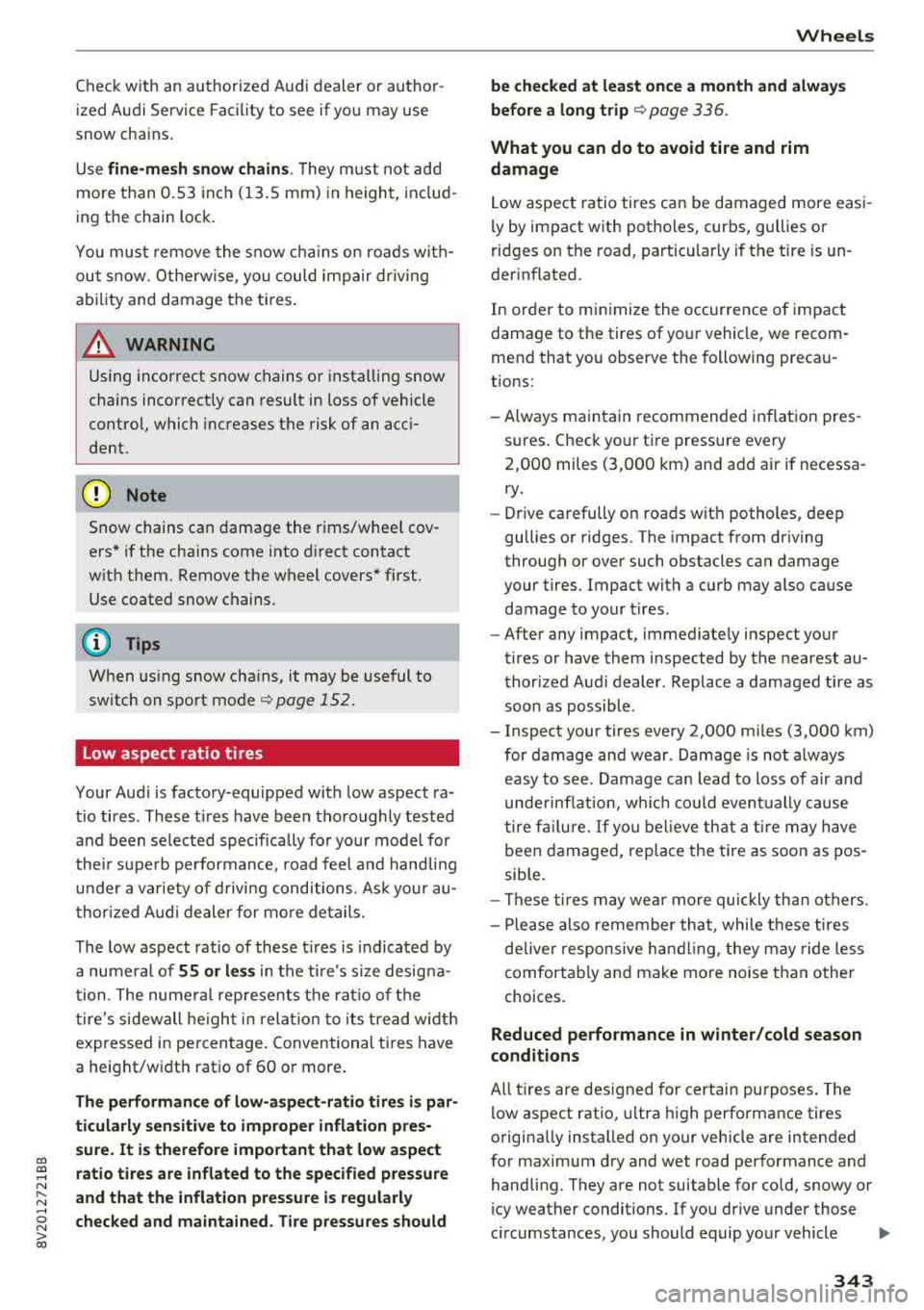
Check with an authorized Audi dealer or author
ized Audi Service Facility to see if you may use
snow chains .
Use
fine-mesh snow chains . They must not add
more than 0.53 inch (13 .5 mm) in height, includ
ing the chain lock.
You must remove the snow chains on roads with
out snow. Otherw ise, you could impair driving
ability and damage the tires.
~ WARNING
Using incorrect snow chains or installing snow
chains incorrectly can result in loss of vehicle
control, which increases the risk of an acc i
dent.
0 Note
Snow chains can damage the rims/wheel cov
ers * if the chains come into direct contact
w ith them. Remove the wheel covers * first.
Use coated snow chains.
(D Tips
When using snow cha ins, it may be useful to
sw itch on sport mode
¢page 152.
Low aspect ratio tires
Your Aud i is factory-equipped with low aspect ra
tio tires. These t ires have been thoroughly tested
and been selected specifically for you r model for
their superb performance, road feel and handling
under a va riety of driving conditions. As k your au
thorized Audi dealer for mo re de tails.
The low aspect ratio of these tires is indicated by
a numera l of
55 or less in the tire's size designa
tion . The numeral represents the ratio of the
tire's sidewall height in relation to its tread width
expressed in percentage. Conventional tires have
a height/w idth rat io of 60 or more .
The performance of low-aspect-ratio tires is par
ticularly sensitive to improper inflation pres
sure. It is therefore important that low aspect
ratio tires are inflated to the specified pressure
and that the inflation pressure is regularly
checked and maintained. Tire pressures should
Wheels
be checked at least once a month and always
before a long trip
¢ page 336 .
What you can do to avoid tire and rim
damage
Low aspect ratio tires can be damaged more easi
ly by impact w ith potholes, curbs, gullies or
ridges on the road, particularly if the tire is un
der inflated.
In order to minimize the occurrence o f impact
damage to the tires of your vehicle, we recom
mend that you observe the following precau
t ions:
-Always maintain recommended inflation pres
sures . Check your tire pressure every
2,000 miles (3,000 km) and add air if necessa
ry.
-Drive carefully on roads with potholes, deep
gullies or ridges. The impact from driving
through or over such obstacles can damage
your tires. Impact with a curb may also cause damage to your tires.
-After any impact, immediate ly inspect your
tires or have them inspected by the nearest au
thorized Audi dealer . Replace a damaged tire as
soon as possible .
-Inspect your tires every 2,000 m iles (3,000 km)
for damage and wear . Damage is not a lways
easy to see. Damage can lead to loss of air and
unde rinflation, w hich could even tually cause
t ire fa ilure.
If yo u bel ieve that a tire may have
been damaged, replace the tire as soon as pos
sible.
-These tires may wear more quickly than others.
-Please also remember that, while these tires
deliver responsive handlin g, they may ride less
comfortably and make more noise than other
choices.
Reduced performance in winter/cold season
conditions
All tires are designed for certain purposes. The
low aspect ratio, ultra high performance tires
origina lly installed on your vehicle are intended
for maximum dry and wet road performance and
handling. They are not suitable for cold, snowy or
icy weather conditions. If you drive under those
c ir cumstances, you should equip your vehicle
..,.
343
Page 352 of 400
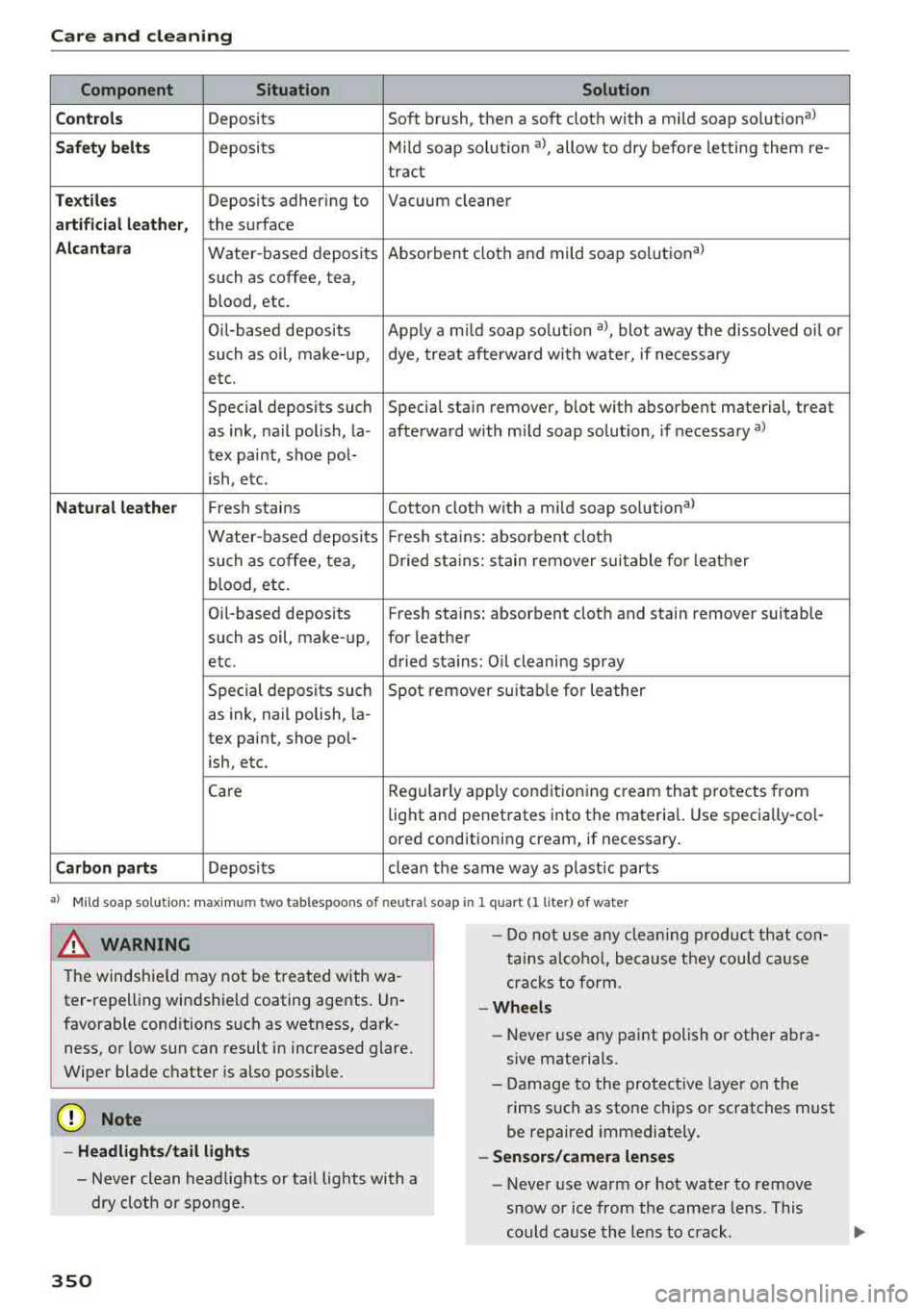
Care and cleaning
Component Situation Solution
C ont rols
Deposits Soft brush, then a soft cloth with a mild soap solution a)
Safet y belt s Deposits M
ild soap so lution a), allow to dry befo re letting them re-
tract
Te xt ile s Deposits adhering to Vacuum cleaner
artifi cial le athe r, the surface
Alcantara Water -based deposits Absorbent cloth and mild soap solutional
such as coffee, tea,
blood , etc.
Oi l-based deposits Apply a m ild soap so lution al, blot away the dissolved oi l or
such as oil, make-up , dye, treat afterward with water, if necessary
etc.
Special deposits such Special sta in remover, blot with absorbent material, treat
as ink, na il polish, la -afterward with mild soap solution, if necessary al
tex paint, shoe pol-
ish, etc.
N atu ral leath er Fresh stains Cotton cloth with a mild soap so lutiona )
Water-based deposits Fresh sta iins: absorbent cloth
such as coffee, tea , Dried st ains: stain remover suitable fo r leathe r
blood , etc.
Oil-based deposits Fresh
sta iin s: absorbent cloth and stain remover suitable
such as oil, make -up, for leather
etc. dried stains: Oil cleaning spray
Special deposits such Spot remover suitab
le for leather
as ink, nail polish, la-
tex paint, shoe pol-
ish, etc.
Care Regularly apply conditioning cream that protects from
light and penetrates into the materia l. Use specially-co l-
ored cond itioning cream, if necessary .
Carbon part s Deposits clean the same way as plastic parts
a) M ild soap so lution: maxim um two tabl espoo ns o f neu tral s oa p in 1 quart (l lite r) of water
8_ WARNING
-The windshie ld may not be treated with wa-
ter-repelling windshield coating agents. Un
favorable conditions such as wetness, dark ness, or low sun can result in increased glare.
Wiper blade chatter is also possible.
Q;) Note
- Headl ights /tail li ght s
- Never clean headlights or ta il lights with a
dry cloth or sponge .
350
-
-Do not use any clea ning product that con
tains alco ho l, because they could cause
crac ks to form.
-Whe els
- Never use any paint polish or other abra-
sive materials.
- Damage to the protect ive layer on the
rims such as stone chips or scratches must
be repaired immediately.
- Sensors /camera lenses
- Never use warm or hot water to remove
snow or ice from the camera lens . This
could cause the lens to crack.
Page 367 of 400
a, co ..... N
" N ..... 0 N > 00
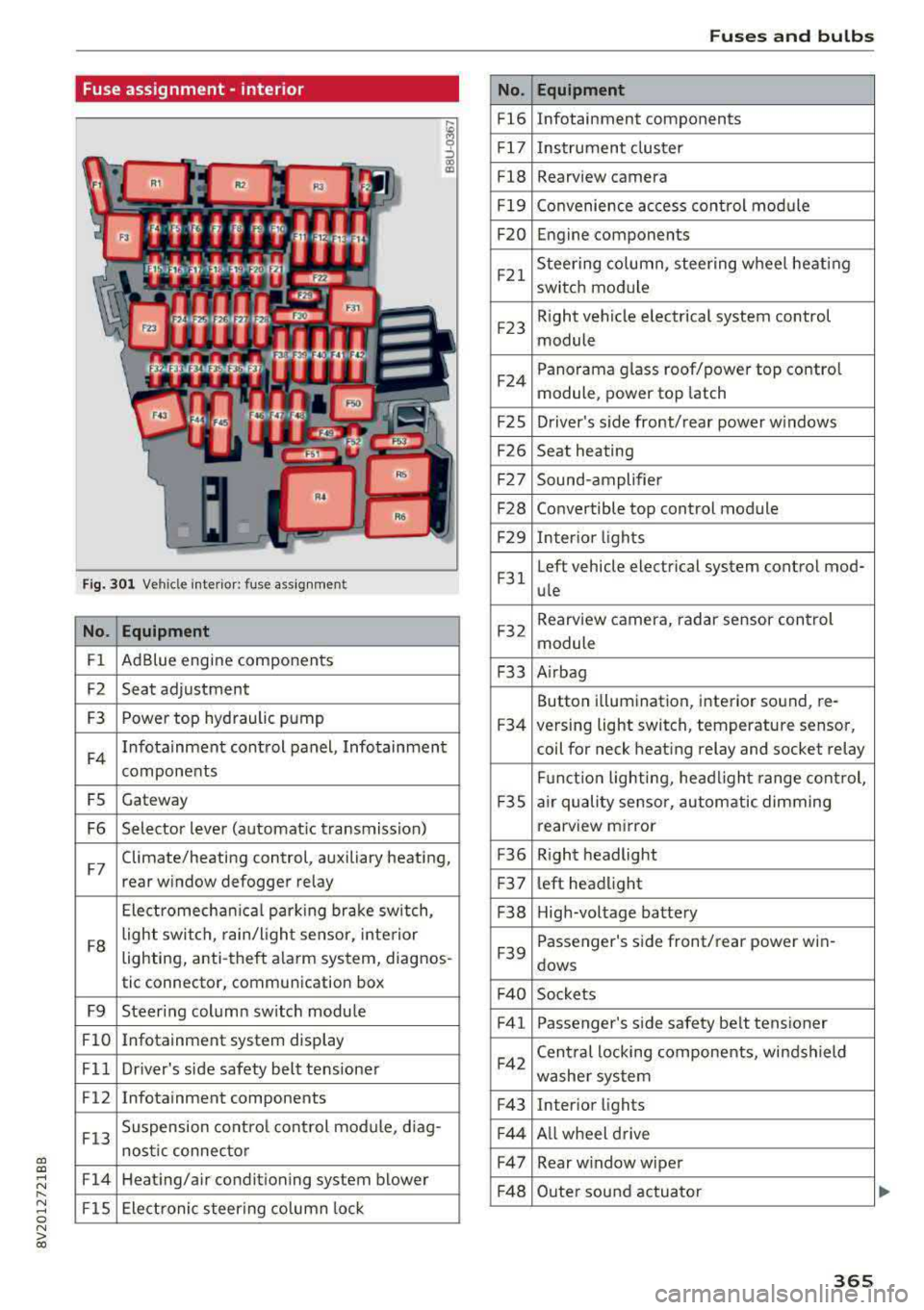
Fuse assignment -interior
Fig. 301 Vehicle interior: fuse assignment
No. Equipment
Fl Ad
Blue engine components
F2 Seat adjustment
F3 Power top hyd
raulic pump
F4 Infotainment control panel, Infotainment
components
FS Gateway
F6 Selector lever (automat ic transmission)
F7 Climate/heating control, auxiliary heating,
rear window defogger relay
Electromechan ica l parking brake sw itch,
F8 light switch,
rain/light sensor, inte rior
lighting, anti-theft alarm system, diagnos -
tic connector, communication box
F9 Steering column sw itch module
Fl0 Infotainment system display
Fll Dr iver's side safety belt tens ioner
F12 Infotainment components
F13 Suspension
control control module, diag-
nostic connector
F14 Heating/air conditioning system blower
FlS Electronic steering column lock
No .
Fl6
F 17
Fl8
F 19
F20
F21
F2 3
F24
F 2S
F26
F 27
F28
F2 9
F 31
F32
F33
F34
F 3S
F36
F3 7
F38
F39
F 40
F41
F42
F43
F44
F47
F4 8
Fuses and bulbs
Equipment
Infotainment components
Instrument cluster
Rearview camera
Convenience access cont rol module
Engine components
Steering column, steering wheel heating
switch module
Right vehicle electrical system control
module
Panorama glass roof/power top control
module, power top latch
Driver's s ide front/rear power w indows
Seat heating
Sound-amplifier
Convertible top control module
Interior lights
Left vehicle electrical system control mod-
ule
Rearview camera, radar sensor control
module
A irbag
Button i llumination, interior sound, re-
versing light switch, temperature sensor,
coil for neck heating relay and socket relay
Fu nct ion lighting, headl ight range control,
a ir quality sensor, automatic dimming
rearview mirror
R ight headlight
l eft headlight
High-voltage battery
Passenger's s ide front/rear power win -
dows
Sockets Passenger's side safety belt tensioner
Cen tral locking components, windshield
washer system
Interior lights
Al l wheel drive
Rear w indow wiper
Outer sound actuator
365
Page 380 of 400
Consumer information
Consumer information
Warranty coverages
Your Audi is covered by the following warran
ties:
- New Vehicle Limited Warranty
- Limited Warranty Against Corrosion Perfora-
tion
- Emissions Control System Warranty
- Emissions Performance Warranty
- California Emissions Control Warranty (USA
vehicles only)
- California Emissions Performance Warranty
(USA vehicles only)
Detailed information regarding your warranties
can be found in your
Warranty & Maintenance
booklet .
Operating your vehicle
outside the U.S.A. or
Canada
Government regulati ons in the United States and
Canada require that automobi les meet specific
emission regulations and safety standards.
Therefore, vehicles built for the U.S.A. and Cana
da differ from vehicles sold in other countries.
If you plan to take your vehicle outside the conti
nenta l limits of the United States or Canada,
there is the poss ibility that:
- un leaded fue ls for vehicles with catalytic con
verter may not be available;
- fuel may have a considerably lower octane rat
ing . Improper fuel may cause engine damage;
- service may be inadequate due to lack of proper
service facilities, tools or testing equipment;
- r eplacement parts may not be readily available.
- Nav igation systems for veh icles built for the
U.S .A . and Canada will not necessarily work in
Europe, and may not work in other countries
outside North America.
378
(D Note
Audi cannot be responsib le for mechanical
damage that could result from inadequate
fuel, service or parts ava ilability.
Audi Service Repair
Manuals and Literature
Audi Official Factory Service Manuals and Litera
ture are published as soon as poss ible after mod
el introduction . Service manuals and literature
are available to order from the Audi Technical Lit
erature Ordering Center at :
www.audi.techliterature .com
Maintenance
General '
Your vehicle has been designed to help keep
maintenance requirements to a minimum. How
ever, a certain amount of regular maintenance is
still necessary to assure your vehicle's safety,
economy and reliability . For detailed vehicle
maintenance consult your Warranty & Mainte
nance booklet .
Under difficult operating conditions, for exam
ple at extremely low outside temperatures, in
very dusty regions, when towing a trailer very fre
quently, etc., some service work should be per
formed between the intervals specified. This ap
plies particularly to:
- oil changes, and
- cleaning or replac ing the a ir filter .
'
@) For the sake of the environment
By regularly maintain ing your vehicle, you
help make sure that em iss ion standards are
maintained, thus minimizing adverse effects
on the environment .
Important considerations for you and your
vehicle
The increasing use of electronics, sophisticated
fuel injection and emission control systems, and
the generally increas ing technica l complexity of
..,_
Page 381 of 400
CXl CXl .... N ,.__
N .... 0 N > 00
today's automobiles, have steadily reduced the
scope of maintenance and repairs which can be
carried out by vehicle owners.
Also, safety and
environmental
concerns place very strict limits
on the nature of repairs and adjustments to en
gine and transmission parts which an owner can perform .
Maintenance, adjustments and repairs usually re
quire special tools, testing devices and other
equipment available to specially trained work
shop personnel in order to assure proper per
formance, reliability and safety of the vehicle and its many systems.
Improper maintenance, adjustments and repairs
can impair the operation and reliability of your
vehicle and even void your vehicle warranty .
Therefore, proof of servicing in accordance with
the maintenance schedule may be a condition for upholding a possible warranty claim made within
the warranty period.
Above all , operational safety can be adversely af
fected, creating unnecessary risks for you and
your passengers.
If in doubt about any servicing, have it done by
your authorized Audi dealer or any other properly equipped and qualified workshop. We strongly urge you to give your authorized Audi dealer the
opportunity to perform all scheduled mainte nance and necessary repairs. Your dealer has the
facilities, original parts and trained specialists to keep your vehicle running properly .
Performing limited maintenance yourself
The following pages describe a limited number of
procedures which can be performed on your vehi
cle with ordinary tools, should the need arise and
trained personnel be unavailable. Before per
forming any of these procedures, always thor
oughly read all of the applicable text and careful ly follow the instructions given . Always rigorously
observe the
WARNINGS provided .
Before you check anything in the engine com
partment, always read and heed all WARNINGS
c::> .&. and c::> page 316 .
Consumer information
A WARNING
-Serious personal injury may occur as a result
of improperly performed maintenance, ad
justments or repairs .
- Always be extremely careful when working
on the vehicle. Always follow commonly ac
cepted safety practices and general com mon sense. Never risk personal injury.
- Do not attempt any of the maintenance,
checks or repairs described on the following pages if you are not fully familiar with these
or other procedures with respect to the ve hicle, or are uncertain how to proceed.
- Do not do any work without the proper tools
and equipment. Have the necessary work
done by your authorized Audi dealer or an
other properly equipped and qualified work
shop.
- The engine compartment of any motor vehi cle is a potentially hazardous area. Never
reach into the area around or touch the radi
ator fan.
It is temperature controlled and
can switch on suddenly - even when the en
gine is off . The radiator fan switches on au
tomatically when the coolant reaches a cer
tain temperature and will continue to run
until the coolant temperature drops.
- Always switch off the ignition before anyone
gets under the vehicle.
-Always support your vehicle with safety
stands if it is necessary to work underneath
the vehicle . The jack supplied with the vehi
cle is not adequate for this purpose and
could collapse causing serious personal in
jury.
- If you must work underneath the vehicle
with the wheels on the ground, always make
sure the vehicle is on level ground, that the
wheels are always securely blocked and that
the engine cannot be started.
- Always make sure the transmission selector
lever (automatic transmission) is in P (Park
position) and the park brake is applied .
II>
379