flat tire AUDI A3 SEDAN 2018 User Guide
[x] Cancel search | Manufacturer: AUDI, Model Year: 2018, Model line: A3 SEDAN, Model: AUDI A3 SEDAN 2018Pages: 404, PDF Size: 62.3 MB
Page 345 of 404
u. 00 .-<
Wheels
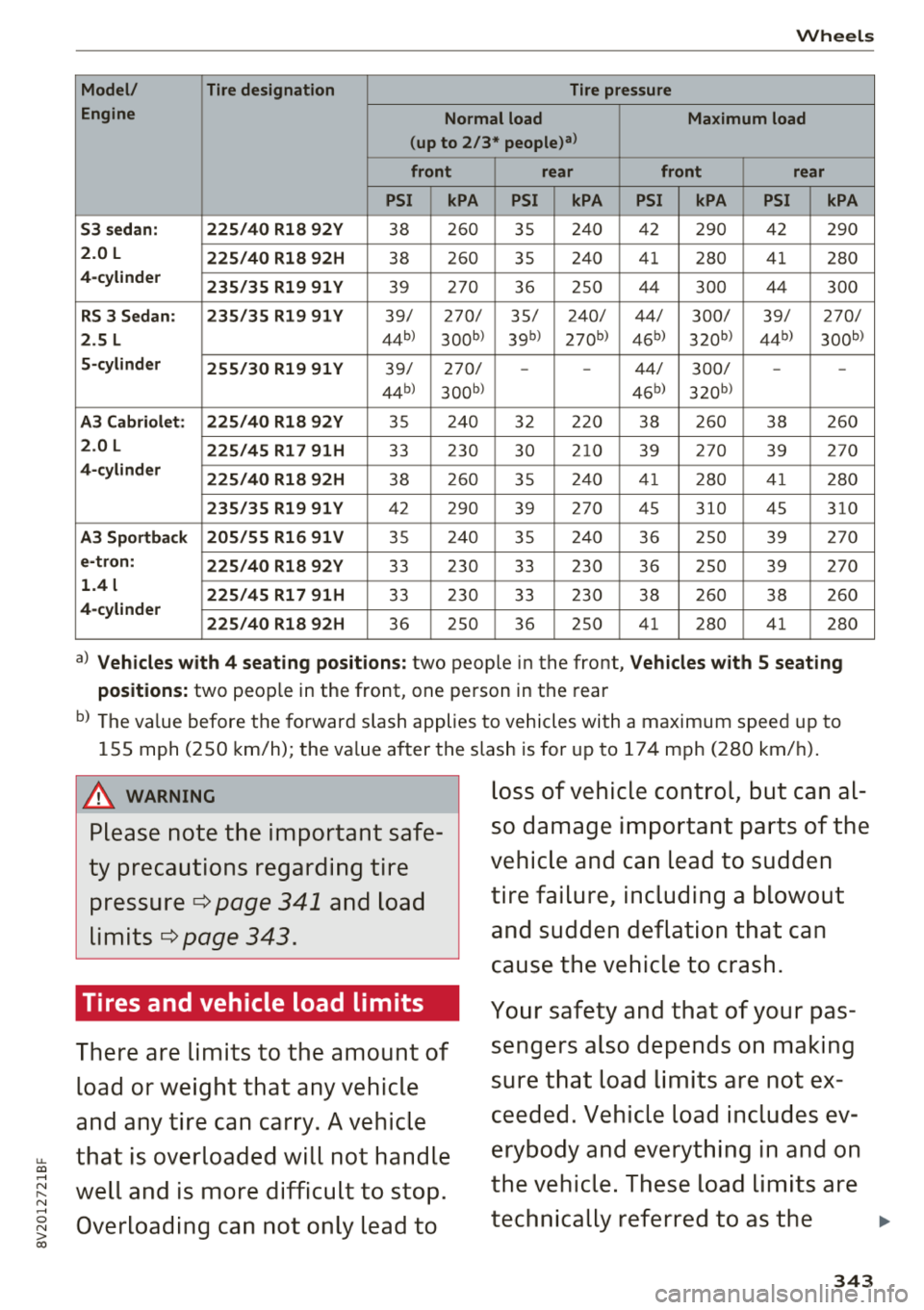
Model/ Tire designation Tire pressure
Engine Normal load Maximum load
(up to 2/3*
people)a>
front rear front rear
PSI kPA PSI kPA PSI kPA PSI kPA
S3 sedan: 225/40 Rl8 92Y
38 260 35 240 42 290 42 290
2.0 L
225/40 Rl8 92H 38 260 35 240 41
280 41
280
4-cylinder
235/35 Rl9 91 Y 39 270 36 250 44 300 44 300
RS 3 Sedan: 235/35 Rl9 91 Y 39/ 270/ 35/ 240/ 44/ 300/ 39/ 270/
2.5 L 44b) 300b) 39b) 270b ) 45b) 320b) 44b) 300b)
5-cylinder
255/30 Rl9 91 Y 39/ 270/ --44/ 300/ --
44b) 3oob> 45b) 320 b)
A3 Cabriolet: 225/40 Rl8 92Y 35 240 32 220 38 260 38 260
2.0 L
225/45 Rl7 91H 33 230 30 210 39 270
39 270
4-cylinder
225/40 Rl8 92H 38 260 35 240 41 280 41 280
235/35 Rl9 91 Y 42
290 39 270
45
310 45
310
A3 Sportback 205/55 Rl6 91 V 35 240 35 240 36 250 39 270
e-tron:
225/40 Rl8 92Y 33 230 33 230 36 250 39 270
1.4 l 225/45 Rl7 91H 33
230 33 230 38 260 38 260
4-cylinder
225/40 Rl8 92H
36 250 36 250 41
280 41
280
a) Vehicles with 4 seating positions: two people in the front, Vehicles with S seating
positions:
two peop le in the front, one person in the rear
b) The value before the forward slash applies to vehicles with a maximum speed up to
155 mph (250 km/h) ; the value after
the· slash is for up to 174 mph (280 km/h).
A WARNING
Please note the important safe
ty precautions regarding tire
pressure
c:::> page 341 and load
Lim its
c:::> page 343.
Tires and vehicle load limits
There are limits to the amount of load or weight that any vehicle
and any tire can carry. A vehicle
that is overloaded will not handle loss of vehicle control, but can al
so damage important parts of the
vehicle and can lead to sudden
tire failure, including a blowout
and sudden deflation that can
cause the vehicle to crash.
~ well and is more difficult to stop. Your safety and that of your pas
sengers also depends on making
sure that load limits are not ex
ceeded. Vehicle load includes ev
erybody and everything in and on
the vehicle . These load limits are
.-<
~ Overloading can not only lead to
00
technically referred to as the ..,
343
Page 346 of 404
Wheels
vehicle's Gross Veh ic le Weig ht
R ati ng
("GVWR").
The "GVWR" includes the weight
of the basic vehicle, all factory in
stalled accessories, a full tank of
fuel, oil, coolant and other fluids
plus maximum load. The maxi
mum load includes the number of
passengers that the vehicle is in
tended to carry ("seating capaci
ty") with an assumed weight of 150 lbs . (68 kg) for each passen
ger at a designated seating posi
tion and the total weight of any luggage in the vehicle. If you tow
a trailer, the weight of the trailer
hitch and the tongue weight of
the loaded trailer must be includ
ed as part of the vehicle load .
The
Gro ss Ax le W eight Rating
("GAWR") is the maximum load
that can be applied at each of the
vehicle's two axles .
T he fact that there is an upper
limit to your vehicle's Gross Vehi
cle Weight Rating means that the
total weight of whatever is being
carried in the vehicle (including
the weight of a trailer hitch and
the tongue weight of the loaded
trailer) is limited . The more pas
sengers in the vehicle or passen -
344
gers who are heavier than the
standard weights assumed mean
that less weight can be carried as luggage .
The Gross Vehicle Weight Rating and the Gross Axle Weight Rat ing
are listed on the safety compli
ance sticker labe l located on the
driver's side B-pillar.
1.8. WARNING
Overloading a vehicle can cause loss of vehicle control, a crash
or other accident, serious per
sonal injury, and even death.
-Carrying more weight than your vehicle was designed to carry will prevent the vehicle
from handling properly and increase the risk of the loss of
vehicle control.
-The brakes on a vehicle that has been overloaded may not
be able to stop the vehicle
within a safe distance .
-Tires on a vehicle that has been overloaded can fail sud
denly, including a blowout and
sudden deflation, causing loss
of contro l and a crash.
-Always make sure that the to tal load being transported
-..
Page 347 of 404
u. a, ... N
" N ... 0 N > a:,
including the weight of a trail
er hitch and the tongue
weight of a loaded trailer -
does not make the vehicle
heavier than the vehicle's
Gross Vehicle Weight Rating.
Determining correct load
limit
Use the example below to calcu
late the total weight of the pas
sengers and luggage or other
things that you plan to transport
so that you can make sure that
your vehicle will not be overload ed.
Steps for Determining Correct Load Limit
1. Loc ate the statement "THE
COMBINED WEIGHT OF OCCU
PANTS AND CARGO SHOULD
NEVER EXCEED XXX KG OR XXX
LBS " on your vehicle's placard
(tire inflation pressure label)
¢ page 341, fig. 2 77.
2. Determine the combined
weight of the driver and pas
sengers that will be riding in
your vehicle.
3. Subtract the combined weight of the driver and passengers
from "XXX" kilograms or "XXX"
Wheels
pounds shown on the sticker
¢ page 341, fig. 2 77.
4. The resulting figure equals the
available amount of cargo and
luggage load capacity. For ex
ample, if the
"XXX" amount
equals
1400 lbs. and there will
be five
150 lbs . passengers in
your vehicle, the amount of
available cargo and luggage
load capacity is
650 lbs.
(1400-750 (5 X 150) =
650 lbs.)
5. Determine the combined
weight of luggage and cargo
being loaded on the vehicle.
That weight may not safely ex
ceed the available cargo and
luggage load capacity calculat
ed in Step 4.
6. If your vehicle will be towing a trailer, load from your trailer
will be transferred to your ve hicle. Consult this manual to
determine how this reduces
the available cargo and lug
gage load capacity of your vehi
cle.
.,.Check the tire sidewall
(¢ page 331, fig . 275) to deter
mine the designated load rating
for a specific tire.
345
Page 350 of 404
Wheels
The grade C corresponds to a leve l of perform
ance which all passenger car tires must meet un
der the Federa l Motor Vehicle Safety Standard
No.
109. Grades Band A represent higher levels
of performance on the laboratory test wheel than
the minimum required by law.
A WARNING -
The traction grade ass igned to this tire is
based on straight-ahead braking traction
tests, and does not include acce le rat ion, cor
ne ring, hydroplaning or peak traction charac
teristics.
A WARNING
Th e temperatu re grade for this tire is estab
lished for a tire that is properly inflated and
not overloaded. Excessive speed, underinfla
tion, or excessive loading, either separate ly or
in combination, can cause heat buildup and
possible tire failure.
A WARNING
-
-
Temperature grades apply to tires that are properly inflated and not over or underinflat
ed.
Tire Pressure Monitoring System indicator
(J.) General notes
Each t ire, including the spare (if provided),
should be checked monthly when cold and inflat
ed to the inflation pressure recommended by the
ve hicl e manufacturer on the vehicle placard or
tire in flat ion press ure label. ( If yo ur vehicle has
t ires of a different siz e than the size indicated on
the vehicle placard or tire inflation pressure la
be l, you should determine the proper tire infla
tion pressure for those t ires) .
As an added safety feature, your veh icle has been
equipped with a tire pressure monitoring system
(TPMS) that illuminates a low tire pressure te ll
tale when one or more of your t ires is significant
ly under-inflated. Accordingly, when the low tire
pressure tellta le illuminates, you should stop and
348
check your tires as soon as possible, and inflate
them to the proper pressure . Driving on a signifi
cant ly under-inflated t ire causes the t ire to over
heat and can lead to tire fa ilure . Under-inflation
also reduces fue l eff iciency and tire tread life,
and may affect the vehicle's handling and stop
ping ability .
Please note that the TPMS is not a substitute for
proper tire maintenance, and it is the dr iver's re
spons ibility to maintain correct tire pressure,
even if under-inflation has not reached the level
to trigger illumination of the TPMS low tire pres
su re te lltale.
Your vehicle has also been equipped with a TPMS
malfunction indicator to indicate when the sys
tem is not operating prope rly . The TPM S mal
function indicator is combined with the low tire
pressure telltale. When the system detects a
malfunction, the telltale will flash for approxi
mately one minute and then remain continuously
illuminated. This sequence wi ll continue upon
s ub sequent vehicle start-ups as long as the mal
funct ion exists.
When the malfunction indicator is illuminated,
the system may not be able to detect or signal
l ow tire pressure as intended. TPMS malfunctions
may occur for a variety of reasons, including the
i nstallation of replacement or alternate tires or
wheels on the veh icle that prevent the TPMS
from functioning properly. Always check the
TPMS ma lfunction telltale after replac ing one or
more tires or wheels on you r vehicle to ens ure
that the rep lacement or alternate tires and
whee ls allow the TPMS to continue to function
properly.
Tire Pressure Monitoring System indicator
appears
App lies to : vehicles wit h Tire Pressure Mo nitor ing System in
dicator
The tire pressure indicator in the instrument
cluster informs you if the tire pressure is too low
or if there is a system malfunction .
Using the ABS sensors, the tire pressure monitor
in g system compares the tire tread circumfer
en ce and vibration characteristics of the
Page 351 of 404
u. 00 .-< N l' N .-< 0 N > 00
individual tires. If the pressure changes in one or
more tires, this is indicated in the instrument
cluster display with an
RE ind icator light and a
message . If only one tire is affected, the location
of that tire w ill be ind icated.
The tire pressures must be stored in the menu
d isp lay aga in each time the press ures c hange
(sw itching between part ial and fu ll load p res
sure) or after changing or replac ing a tire on your
ve hicle
r=>page 349 . The t ire pressure monitor
in g sys tem only monito rs t he tire pressure you
have stored . Refe r to the ti re p ressure labe l for
the recommended ti re p ressure for you r veh icle
r=>page 341, fig. 278.
Tire tread circumference and v ibrat ion character
i stics can change a nd cause a t ire pressure warn
in g if:
- the tire pressure i n one or more tires is too low
- the tire has structura l damage
- the tire was replaced o r the tire p ressure was
changed and it was not stored
r=> page 349
- one si de of the vehicle is more heavily loaded
than the other
- th e whee ls on one ax le are mo re heavi ly loaded
t h an the others (for examp le, w hen tow ing a
trailer or when driv ing up and down hills)
- snow c hains a re installed
- the spare t ire* is ins talle d
- on ly one tire w as replaced on each ax le
Indicator lights
RE -loss of pressu re in at least one tire r=> ,&. .
Check the ti res and rep lace o r repa ir if necessary .
C heck/ co rrect t he p ressures of a ll four tires. Then
s to re t he ti re p ressures i n the men u
r=> page 349 .
mm (Ti re Pressure Monitori ng System) Tire
pressure: malfunction! See owner's manual. If
mm appears after switching t he ign it io n on o r
while driving and the
RE i ndicato r light in the in
s trumen t cluster blinks fo r approxim ately one
minu te and t hen stays o n, there is system ma l
f u nction. Check/cor rect the pressu res on all fo ur
tires an d sto re t he p ressures
r=> page 349. If the
ind icator light does turn
off or turns on again af
ter a short per iod of t ime, drive to an author ized
Wheels
Audi dealer or author ized A udi Se rvice Fac ility im
med iate ly to have the ma lfu nction co rrected.
A WARNING
--
- If the tire p ressure ind icator appears in the
instr ument cluster disp lay, reduce your
speed immediately and avoid any hard
steer ing o r braking maneuvers . Stop as soon
as poss ible and check the tires and the ir
p ressures.
- The drive r is responsible fo r maintain ing the
correct tire press ures . You must check the
tire p ressures regularly.
- Unde r ce rtain condit ions (such as a sporty
d riving s tyle, win ter condi tions or unpaved
roads), the pressu re moni tor indicator may
be de layed.
- Do not use run -flat tires on your vehicle. Us
ing them when no t pe rm itted can lead to
veh icle d amage o r acc id en ts .
(D Tips
- The tire p ressure mon itoring system can al
so s top working w hen
th ere is a n ESC/ ABS
m alfunc tion.
- Us ing snow chains may resul t in a system
m alfu nction.
- The tire p ressure mon itoring system in your
Audi was calibrat ed with "Audi Original
Ti res"
r=>page 33 7. Usi ng these tires is rec
ommende d.
- The tire p ressure mon itoring system can on
ly moni to r the tire p res sure o f the d riving
t ires. Check the tir e press ure o f the spare
wheel in the l uggage compa rtment so tha t
if necessary it is ready for use .
Storing tire pressures
Applies to: vehicles wit h Tir e Pressure Monito rin g Syste m in·
dicator
A change in tire pr essure or a change in tires
must be stored in the system.
Make su re before stori ng that the tire p ressures
of all fo ur tir es meet the specified val ues and a re
adapted to the load
r=> pag e 339. .,,.
349
Page 352 of 404
Wheels
~ Select in the Infotainment system: IMENUI but
ton
> Vehicle > left control button > Service &
checks > Tire pressure monitoring > Store tire
pressure> Yes, store now.
(D Tips
Do not store the tire pressures if snow chains
are installed.
Tire pressure monitoring
system
(.L) General notes
Each tire, including the spare (if provided),
should be checked monthly when cold and inflat
ed to the inflation pressure recommended by the
vehicle manufacturer on the vehicle placard or
tire inflation pressure label. (If your vehicle has
tires of a different size than the size indicated on
the vehicle placard or t ire inflation pressure la
bel, you should determine the proper tire infla
tion pressure for those tires).
As an added safety feature, your vehicle has been
equ ipped w ith a t ire pressure monitoring system
(TPMS) that illuminates a low tire pressure tell
tale when one or more of your tires is significant
ly under-inflated. Accordingly, when the low tire
pressure telltale illuminates, you should stop and
check your tires as soon as possible, and inflate
them to the proper pressure. Driving on a signifi
cantly under-inflated tire causes the tire to over heat and can lead to tire failure . Under -inflation
also reduces fuel efficiency and tire tread life,
and may affect the vehicle's handling and stop
p in g ability.
Please note that the TPMS is not a substitute for
proper tire maintenance, and it is the driver's re
sponsibility to maintain correct tire pressure,
even if under-inflation has not reached the leve l
to trigger illuminat ion of the TPMS low tire pres
sure telltale .
Your vehicle has also been equipped with a TPMS
malfunct ion indicator to indicate when the sys
tem is not operating properly. The TPMS mal
function indicator is combined with the low tire
pressure telltale. When the system detects a
350
malfunction, the telltale will flash for approxi
mately one minute and then remain continuously
illuminated. This sequence will continue upon
subsequent vehicle start-ups as long as the mal
function exists.
When the malfunction indicator is illuminated,
the system may not be able to detect or signal
low tire pressure as intended. TPMS malfunctions
may occur for a variety of reasons, including the
installation of replacement or alternate tires or
wheels on the vehicle that prevent the TPMS
from functioning properly. Always check the
TPMS malfunction tel ltale after replac ing one or
more tires or wheels on your vehicle to ensure
that the replacement or alternate tires and
wheels allow the TPMS to continue to function
properly.
Description
Applies to: vehicles with tire pressure monitoring system
The tire pressure monitoring system monitors
the pressure in the four tires when driving.
The system uses sensors that measure the tema
perature and pressure in the tires. The data is
sent from these sensors to the control module by
radio frequency .
The tire pressure monitoring system shows the
current pressures and temperatures of the tires
in the Infotainment system while driving
¢ page 351. It also compares the current tire
pressures with the stored tire pressures and
gives a warning if the tire pressure is different
from what is stored
¢ page 351.
The system does not detect if the stored tire
pressures match the recommended tire pres
sures . You must store the tire pressures again
¢ page 352:
- every time the tire pressures change, for exam
ple when the load in the vehicle changes,
- after replacing a tire, or
- if wheels with new wheel sensors are used.
Page 353 of 404
u. 00 .-< N l' N .-< 0 N > 00
A WARNING
-The tire pressure monitoring system assists
the driver in monitoring tire pressures . The
driver is responsible for having the tires in
flated to the correct pressure.
- Do not change the tire pressure when the
temperature of the tire is extremely high.
This could result in serious damage to the
tire and even cause the tire to burst, in
creasing the risk of an accident.
- A tire with low pressure flexes more. This
heats the tire up too much. This could cause
the tread to separate and even cause the
tire to burst, increasing the risk of an acci
dent.
- The tire pressure monitoring system does
not warn about damage or defects in the
tire construction that could cause the tire to burst, for example . Inspect your tires regu
larly .
(D Tips
-If tires are replaced, the sensors/valves do
not need to be removed or replaced. Just re
placed the valve stem and, if necessary, the
valve and the wheel electronics. If you have
questions, see an authorized Audi dealer or
authorized Audi Service Facility .
- An incorrect display or a malfunction in the
tire pressure monitoring system can occur
after using the tire mobility kit . Have the
sensors replaced by an authorized Audi
dealer or authorized Audi Service Facility.
- For an explanation on conformity with the
FCC regulations in the United States and the
Industry Canada regulations, see
r=;,page 386.
Displaying tire pressures/temperatures
Applies to: vehicles with tire pressure mo nito ring system
Requirement: you must be driving the vehicle.
"'Select in the Infotainment system: the I MENU I
button > Vehicle > left control button > Service
& checks > Tire pressure monitoring > Display
tire pressures.
Wheels
The current tire pressures are shown in green,
yellow or red numbers in the Infotainment sys
tem:
- Green: the current tire pressure and the speci
fied tire pressure are approximately the same.
- Yellow: the current tire pressure is too low
compared to the specified tire pressure.
-Red: the current tire pressure is extremely low
compared to the specified tire pressure .
The specified tire pressure is the last tire pres
sure that was stored
r=;, page 352.
Note that the tire pressure also depends on the
temperature of the tire. The tire pressure in
creases as the engine becomes warmer while
driving.
A WARNING
Read and follow the important information
and notes
"*page 350.
(D Tips
The tire pressure or temperature is not dis
played while the vehicle is stationary and in
adaptation mode. Dashes--.-- are shown in
place of the pressure and temperature.
ill Tire pressure loss
Applies to: vehicles with tire press ure mo nito ring system
-
If the [tE indicator light turns on, the pressure in
at least one tire is too low or new sensors were
not adapted:
RE Indicator light turns on after turning the
ignition on
The tire pressure is too low compared to the
specified pressure .
.,. Check and store the tire pressure(s) the next
time it is possible
"*page 352.
RE Indicator light turns on while driving
Wheels with new sensors were not adapted or
the tire pressure has reached a critical level com
pared to the specified pressure.
"'Avoid unnecessary steering and braking maneu-
vers.
..,_
351
Page 362 of 404
Emergency assistance
Emergency assistance
Trunk escape latch
Applies to: vehicles with trunk escape latch (Sedan and Cab
r io let)
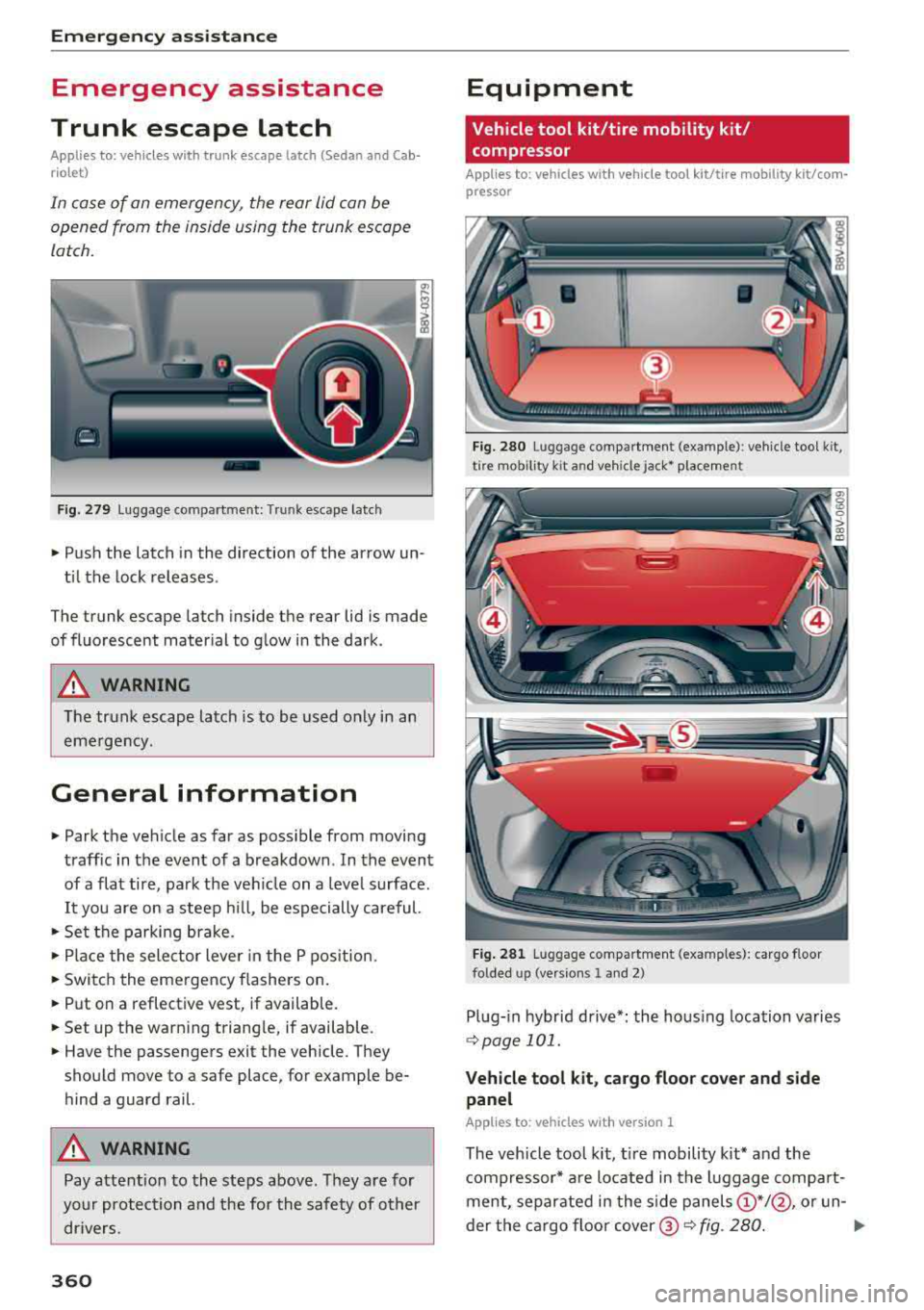
In case of an emergency , the rear lid can be
opened from the inside using the trunk escape
latch.
Fig. 279 L uggage co mpar tment: T runk esc ape latch
• Push the latch in the direction of the arrow un
til the lock releases .
The trunk escape latch inside the rear lid is made
of fluorescent material to glow in the dark .
_&. WARNING
The trunk escape latch is to be used only in an
emergency.
General information
• Park the vehicle as far as possible from moving
traff ic in the event of a breakdown . In the event
of a flat tire , park the vehicle on a leve l surface.
It you are on a steep hill, be especially careful.
• Set the parking brake.
• Place the selector lever in the P pos ition.
• Switch the emergency flashers on.
• Put on a reflective vest, if available.
• Setup the warning triangle, if available.
• Have the passengers exit the vehicle. They
should move to a safe place, for example be
hind a guard rail.
_&. WARNING
Pay attention to the steps above . They are for
your protection and the for the safety of other
dr ivers .
360
Equipment
Vehicle tool kit/tire mobility kit/
compressor
Applies to: vehicles wi th vehicle tool kit/tire mobility kit/com
pressor
Fig. 280 L u ggage compartment (ex ample): ve hicle tool kit,
tire mob ility k it a nd vehicle jack* placemen t
Fig. 281 Lug gage compartment (examp les ): cargo floor
fo lded up (ver sions 1 and 2)
Plug-in hybrid drive*: the hous ing location varies
~ page 101.
Vehicle tool k it , cargo floor cover and side
panel
Applies to: vehicles with version 1
The vehicle tool kit, tir e mobility kit* and the
compressor* are located in the luggage compart
ment, separated in the s ide
panels @*/@ , or un-
der the cargo floor cover @¢
fig. 280. II>-
Page 364 of 404
Emergency assistance
-If tire sealant gets in your eyes or on your
skin, thoroughly rinse the affected area im
mediately with clean water.
-Do not inhale the fumes .
-If you swallow any of the tire sealant, thor-
oughly rinse your mouth immediately and
drink a lot of water. Do not induce vomiting .
Seek medical attention immediately.
-Change your clothes immediately if they get
tire sealant on them.
-If an allergic reaction occurs, seek immedi
ate medical attention .
-Keep the tire sealant away from children .
-In vehicles with a tire pressure monitoring
system*, using tire sealant can results in an
incorrect display or a system malfunction .
Drive carefully to the nearest authorized
Audi dealer or authorized Audi Service Facili
ty.
(D Tips
- If sealant leaks, allow it to dry in place . You
can then peel it off like a sticker .
- Note the expiration date on the sealant bot
tle . Replace the tire sealant at an author
ized Audi dealer or authorized Audi Service
Facility.
- Radio reception can be interrupted when operating the compressor* .
- Obey all laws.
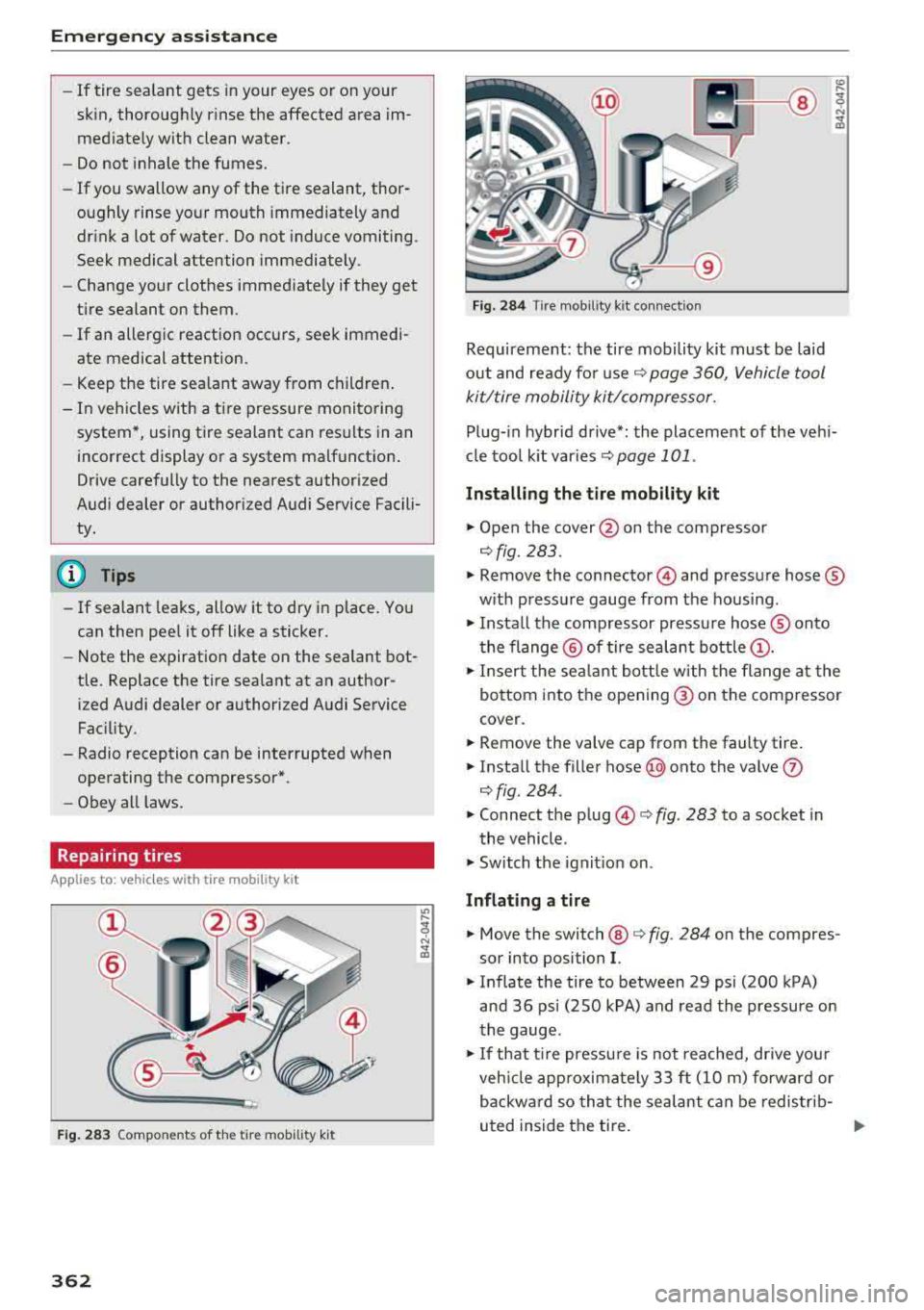
Repairing tires
Applies to: vehicles with tire mob ility kit
Fig. 283 Compo nents of the tire mobilit y kit
362
Fig. 284 Ti re mobil ity k it connec tion
Requirement: the tire mobility kit must be laid
out and ready fo r
use¢ page 360, Vehicle tool
kit/tire mobility kit/compressor.
;1i
Plug-in hybrid drive*: the placement of the vehi
cle tool kit
var ies ~ page 101 .
Installing the tire mobility kit
"" Open the cover @on the compressor
¢fig. 283.
""Remove the connector © and pressure hose ®
with pressure gauge from the housing .
""Insta ll the compressor pressure hose® onto
the flange @ of tire sealant
bottle @.
""Insert the sealant bottle with the flange at the
bottom into the opening ® on the compressor
cover.
"" Remove the valve cap from the faulty tire .
""Install the filler hose (@ onto the valve (J)
¢fig. 284.
"" Connect the plug ©¢ fig. 283 to a socket in
the vehicle .
.,. Switch the ignition on.
Inflating a tire
"" Move the switch @¢ fig. 284 on the compres
sor into position
I.
"" Inflate the tire to between 29 psi (200 kPA)
and 36 psi (250 kPA) and read the pressure on
the gauge .
""If that tire pressure is not reached, drive your
veh icle approximately 33
ft (10 m) forward or
backward so that the sealant can be redistrib-
uted inside the tire.
..,.
Page 365 of 404
u. 00 .-< N l' N .-< 0 N > 00
A WARNING
-Read and follow the manufacturer's safety
precautions o n the compressor and in th e
in structions on t he bottle of sealant .
- If a tire pressure of 29 ps i (200 kPA) cannot
r e ached after inflating for 6 minutes, then
the tire is too severely damaged . Do not
continue d riving.
- If the t ire cannot be repaired with the tire
sealant, see an authorized Audi dealer or au
tho rized Aud i Serv ice Facility for ass istance.
(D Tips
Do not operate the compressor for more than
six m inutes continuously, or it can overheat.
Once the compressor has coo led, you can con
tinue to use it.
Completing
Applies to: vehicles with tire mobility kit
.,. Affix the st icke r that says "max . S O mph (max .
80 km/h)" that is provided with the tire mobili
ty kit within the driver's field of vision .
.,. Stop the vehicle after driving for about 10 mi
nutes and check the tire pressure.
.,. If the t ire pressure is lower than 19 ps i (130
kPA), then the tire is too severely damaged. Do
not cont inue driving.
A WARNING
Pay attent ion to the following after repair ing
the ti re:
- Do not drive faster than SO mph (80 km/h) .
- Avoid hard acceleration, brak ing sharp ly,
and fast cornering.
- The veh icle may become more diff icult to
control.
- If the t ire is too severely damaged, see an
authorized Audi dealer or authorized Aud i
Service Facility for assistance .
@ For the sake of the environment
You can give the used t ire sealant bottle to an
author ized Audi dealer or authorized Audi
Serv ice Facility for disposal.
Em ergenc y ass is tanc e
(D Tips
Remember to obtain a new bott le of sealant
from an authorized A udi dealer or authorized
Audi Service Fac ility after repairing a tire.
Replacing wheels
Before changing a wheel
Observe the following precautions for your own
and your passenger's safety when changing a wheel.
.,. After you experience a t ire failure, pull the car
we ll away from moving traffic and try to reach
level grou nd befo re yo u stop ¢&, .
.,. All passengers should leave the car and move
t o a safe location ( for ins tance, behind the
gua rdrail) ¢&, .
.,. Engage the pa rking brake to prevent your vehi
cle from rolling unintentiona lly ¢
_A .
.,. Move selector le ver to position P ¢ _A .
... Jfyou are towing a trai ler, unhitch the trailer
from your vehicle.
.,. Take the jack ~ page 360 and the sp a re tire
ca:;, page 369 out of the luggage compartment .
A WARNING
You or you r passengers could be injure d while
ch anging a whee l if you do no t follow these
safety precaut ions :
- If you have a fla t tire, move a safe dis tance
off the road. Turn off the eng ine, turn the
emergency flashers on and use other warn
ing devices to alert other motorists.
- Make sure that passenge rs wait in a safe
p lace away from the vehicle and well away
from the road and traffic.
- To help preven t the vehicle from moving
suddenly and possib ly slipping off the jack,
always fully set the park ing brake and bloc k
the front and back of the wheel diagonally
opposite the wheel being changed. When
one front wheel is lifted off the ground,
p lacing the Au toma tic Transmission in P
(Park) will
not prevent the vehicle from
mov ing.
363