child lock AUDI A4 2008 B8 / 4.G User Guide
[x] Cancel search | Manufacturer: AUDI, Model Year: 2008, Model line: A4, Model: AUDI A4 2008 B8 / 4.GPages: 342, PDF Size: 13.14 MB
Page 119 of 342
Driving117
Controls
Safety
Driving tips
General maintenance
Self-help
Technical data If you press in the key without pressing the clutch or brake pedal,
the ignition will be switched on or off. The steering lock is released
when the ignition is switched on. Diesel engines continue to be
automatically preheated.
The key can be removed only when the ignition is off. The key has to
be pressed in briefly to switch off the ignition. On vehicles with an
automatic gearbox, the selector lever has to be in position P.
Electrical components with a high power consumption are switched
off temporarily while you start the engine.
When starting from cold the engine may be a little noisy for the first
few seconds until oil pressure has built up in the hydraulic tappets.
This is quite normal and no cause for concern.
If the engine fails to start immediately, the starter will be switched
off automatically after a few seconds. Try to start the engine again.
Driver message in the instrument cluster display
Press brake pedal to start engine
This message appears on vehicles with an automatic gearbox if you
try to start the engine without first pressing the brake pedal.
Press clutch pedal to start engine
This message appears on vehicles with a manual gearbox if you try
to start the engine without first pressing the clutch pedal.
Engage N or P to start engine
This message will appear if you try to start the engine when the
selector lever of the automatic gearbox is not in P or N.
Shift to P, otherwise vehicle can roll away. Doors do not lock if lever
is not in P. or Please move selector lever to position P. Vehicle
cannot be locked.
For safety reasons, this message will appear and a warning buzzer
will sound if the selector lever of the automatic gearbox is not in
position P after you switch off the ignition. Put the selector lever in
position P; otherwise the vehicle can roll away. If the lever is not in position P you will not be able to lock the vehicle using the exterior
locking switch on the door handle or the remote control key.
Steering lock
The steering is locked when the key is not in the ignition. The
steering lock acts as a theft deterrent.
WARNING
•
Always take the key with you when you leave the vehicle.
Otherwise the engine can be started or power-operated equip-
ment such as the electric windows can be used. This could result
in serious injury.
•
Never leave children or disabled people alone in the car. The
doors could be locked with the remote control key and the occu-
pants could become trapped in the vehicle. The vehicle occupants
could be exposed to extremely high or low temperatures,
depending on the time of year.
•
Never remove the key from the ignition while the vehicle is
moving. The steering lock could engage suddenly, and you would
not be able to steer the car.Caution
•
If a malfunction occurs in the electronic ignition lock, a flashing
symbol and the message Ignition lock defective will appear in the
instrument cluster display.
•
Avoid high engine speeds, full throttle and extreme load condi-
tions until the engine has reached its normal operating tempera-
ture, otherwise this can damage the engine.For the sake of the environment
Do not warm up the engine by running it with the car stationary. You
should drive off immediately whenever possible. This will help avoid
unnecessary exhaust emissions.
document_0900452a81b1b9de.book Seite 117 Donnerstag, 26. Juli 2007 9:16 09
Page 124 of 342
Driving 122a fault in the parking brake. Have the fault repaired by a qualified
workshop without delay ⇒page 32.
Note
•
The parking brake can be applied at any time - even when the
ignition is switched off. However, the ignition must be switched on
before the parking brake can be released.
•
Any slight noise which may be heard when the parking brake is
applied or released is quite normal and no cause for concern.
•
The parking brake runs an automatic test cycle at regular inter-
vals when the vehicle is parked. This may also cause a slight noise,
which is normal.
Parking
Please note the following points to ensure there is no risk
of the car rolling away accidentally after it is parked.Parking t he c ar
– Use the foot brake to stop the vehicle.
– Pull the switch to apply the parking brake.
– Automatic gearbox: Move the selector lever to P.
– Switch off the engine ⇒.
– Manual gearbox: Engage the first gear.
When parking on slopes
– Turn the steering wheel so that the vehicle would roll into
the kerb if it did start to move accidentally.
WARNING
•
Always take the key with you when leaving the vehicle – even
if you only intend to be gone for a short time. This is especially
important if children are left in the car. They might otherwise be
able to start the engine, release the parking brake or use power-
operated equipment such as the electric windows - this could lead
to injuries.
•
Do not leave anyone (especially children) in the vehicle when it
is locked. Locked doors could delay assistance in an emergency,
potentially putting lives at risk.
Driving away from a standstill
The parking brake auto release function releases the
parking brake automatically when you wish to start
moving.Applying the parking brake when stopping
– Pull the switch to apply the parking brake.
Releasing the parking brake when driving away
– Drive off in the normal way: the parking brake will be
released automatically and the vehicle will start moving.On vehicles with automatic gearbox, you can apply the parking
brake when stopping at traffic lights, etc. Then you do not have to
hold the car with the footbrake, as the parking brake will stop it
creeping forward while a gear is engaged in the automatic transmis-
sion. When you drive off in the normal way, the parking brake will be
released automatically and the vehicle will start moving.
Driving away on a slope
When driving away on a gradient, the parking brake auto release
function prevents the vehicle from rolling back unintentionally. The
document_0900452a81b1b9de.book Seite 122 Donnerstag, 26. Juli 2007 9:16 09
Page 195 of 342
Safe driving193
Controls
Safety
Driving tips
General maintenance
Self-help
Technical data inside. In this case the child would be unable to get out of the
vehicle without help. This could have fatal consequences.
•
Never allow children to play in or around the vehicle. Always
close and lock the boot lid and all the doors when you leave the
vehicle.
•
Never let passengers ride in the luggage compartment. All
occupants must be properly restrained by the seat belts at all
times ⇒page 194.Note
•
Air circulation in the vehicle helps reduce fogging of the
windows. Used air escapes through ventilation slots in the rear of
the vehicle. Make sure that these ventilation slots are not
obstructed.
•
Suitable belts for securing loads to the fastening rings* are
commercially available.
Applies to vehicles: with fastening ringsFastening rings
Unsecured loads are a hazard to all vehicle occupants.There are fastening rings in the luggage compartment
which can be used to secure luggage and other objects
⇒page 79.
– Use the fastening rings to secure items safely in the
luggage compartment ⇒ in “Loading the luggage
compartment” on page 79.During a collision or an accident, even small and light objects can
possess so much energy that they can cause very severe injuries.
The amount of this “kinetic energy” depends on the speed of the vehicle and the weight of the object. The most significant factor,
however, is the speed of the vehicle.
An example: An object weighing 4.5 kg is lying unsecured in the
vehicle. During a frontal collision at a speed of 50 km/h, this object
generates a force corresponding to 20 times its weight. That means
that the effective weight of the object increases to about 90 kg. You
can imagine the severity of the injuries which might be sustained if
this “projectile” strikes an occupant as it flies through the
passenger compartment.
WARNING
If items of luggage or other objects are secured to the fastening
rings with inappropriate or damaged retaining cords, injuries
could result in the event of sudden braking or a collision.•
To prevent pieces of luggage or other objects from flying
forward, always use appropriate retaining cords which are prop-
erly secured to the fastening rings.
•
Never secure a child seat on the fastening rings.
WARNING (continued)
document_0900452a81b1b9de.book Seite 193 Donnerstag, 26. Juli 2007 9:16 09
Page 197 of 342
Seat belts195
Controls
Safety
Driving tips
General maintenance
Self-help
Technical data
Important safety instructions for using seat belts
There are a number of safety points concerning the seat
belts which you should remember. This will help to reduce
the risk of injury in an accident.
WARNING
•
The seat belts can only provide maximum protection if the
seats are adjusted properly ⇒page 73, “Seats and storage”.
•
To ensure proper protection, it is important to wear the seat
belts in the correct position ⇒page 197, “How to wear seat belts
properly”. Ensure that the seat belts are worn exactly as recom-
mended in this chapter. Belts which are not worn properly can
increase the risk of injury in accidents considerably.
•
Do not allow the seat belt to become twisted or jammed, or to
rub on any sharp edges.
•
Never allow two passengers (even children) to share the same
seat belt. It is especially dangerous to place a seat belt over a child
sitting on your lap.
•
Do not wear the belt over hard or fragile objects (such as
glasses or pens, etc.) because this can cause injuries.
•
Loose, bulky clothing (such as an overcoat over a jacket)
impairs the proper fit and function of the belts.
•
The belts must be kept clean, otherwise the retractors may not
work properly ⇒page 250, “Seat belts”.
•
The slot in the seat belt buckle must not be blocked with paper
or other objects, as this can prevent the latch plate from engaging
properly.
•
The latch plate of the belt must always be engaged in the
correct buckle for that seat, otherwise the belt will not be fully
effective.
•
Check the condition of the seat belts at regular intervals. If you
notice that the belt webbing, fittings, retractor mechanism or buckle of any of the belts is damaged, the belt must be replaced
by a qualified workshop.
•
The seat belts must not be removed or modified in any way. Do
not attempt to repair a damaged belt yourself.
•
Seat belts which have been worn in an accident and stretched
must be replaced by a qualified workshop. The belt anchorages
should also be checked.
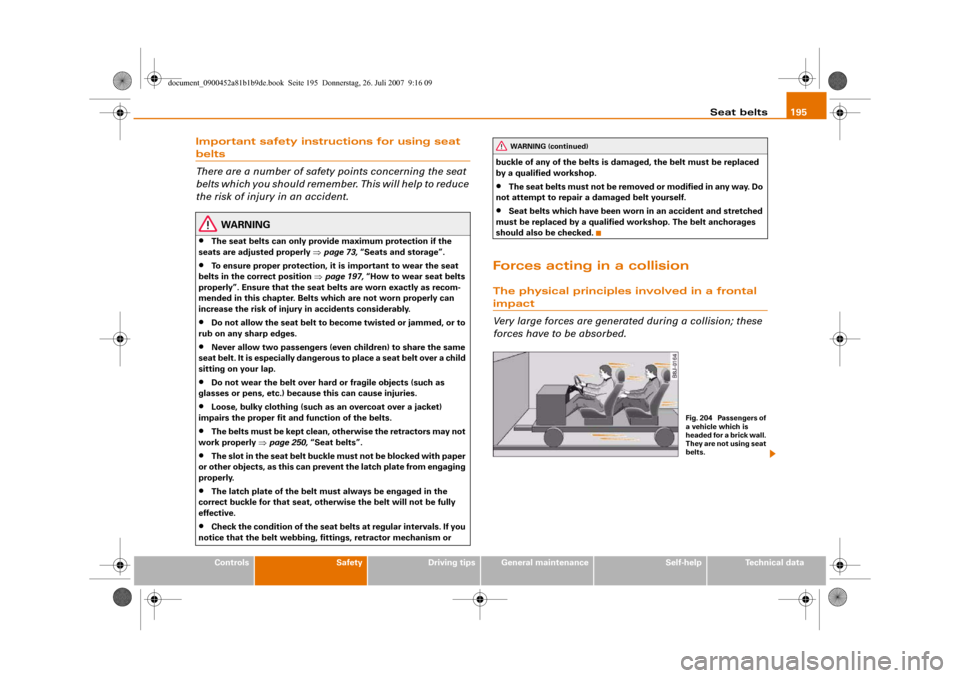
Forces acting in a collisionThe physical principles involved in a frontal impact
Very large forces are generated during a collision; these
forces have to be absorbed.
WARNING (continued)
Fig. 204 Passengers of
a vehicle which is
headed for a brick wall.
They are not using seat
belts.
document_0900452a81b1b9de.book Seite 195 Donnerstag, 26. Juli 2007 9:16 09
Page 200 of 342
Seat belts 198The height of the front seat on your vehicle can be adjusted in order
to match the position of the seat belt to your height.
WARNING
•
The diagonal part of the belt should never be positioned across
the neck, but roughly over the centre of the shoulder; it should fit
closely against the upper part of the body. The lap part of the belt
must be worn tightly across the hips, and not over the abdomen
⇒page 197, fig. 210. Pull the belt tight if necessary to take up any
slack.
•
Always make sure that belt is positioned properly. Incorrectly
worn seat belts can give rise to injuries even in a minor collision.
•
Seat belts worn too loose can result in injuries because they
allow excessive forward movement in a crash; the occupant will
be brought to a sudden stop by the belt webbing.
Wearing and adjusting the seat belts during pregnancy
To afford the best protection for the unborn child it is
important for the mother to wear the seat belt properly at
all times.
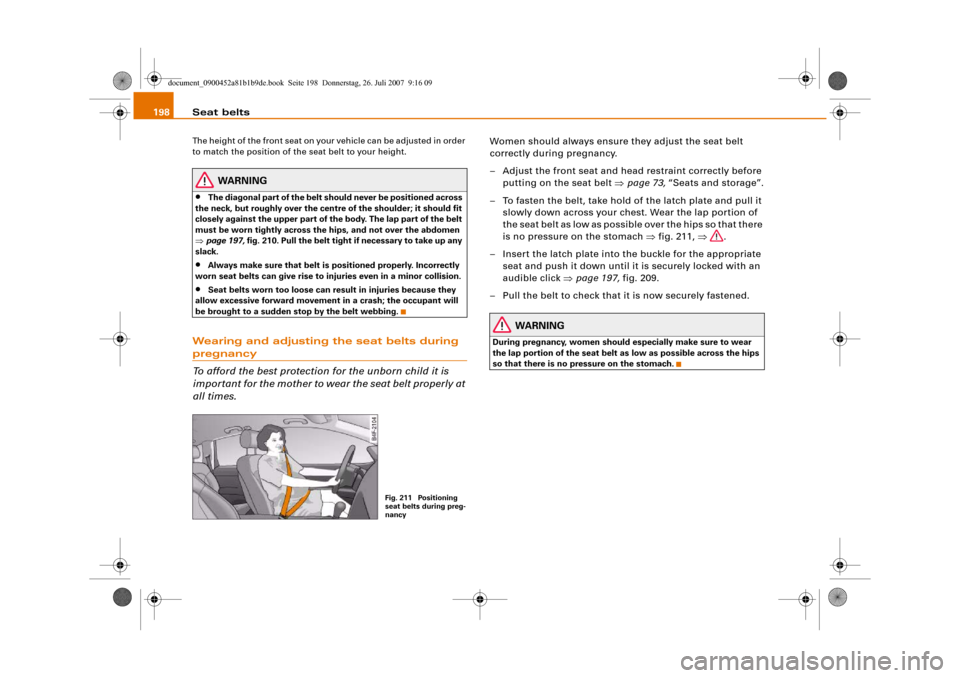
Women should always ensure they adjust the seat belt
correctly during pregnancy.
– Adjust the front seat and head restraint correctly before
putting on the seat belt ⇒page 73, “Seats and storage”.
– To fasten the belt, take hold of the latch plate and pull it
slowly down across your chest. Wear the lap portion of
the seat belt as low as possible over the hips so that there
is no pressure on the stomach ⇒fig. 211, ⇒.
– Insert the latch plate into the buckle for the appropriate
seat and push it down until it is securely locked with an
audible click ⇒page 197, fig. 209.
– Pull the belt to check that it is now securely fastened.
WARNING
During pregnancy, women should especially make sure to wear
the lap portion of the seat belt as low as possible across the hips
so that there is no pressure on the stomach.
Fig. 211 Positioning
seat belts during preg-
nancy
document_0900452a81b1b9de.book Seite 198 Donnerstag, 26. Juli 2007 9:16 09
Page 265 of 342
Checking and topping up fluids263
Controls
Safety
Driving tips
General maintenance
Self-help
Technical data
Changing brake fluid
When required, the brake fluid should be changed by a
competent mechanic with the proper equipment.Brake fluid gradually absorbs moisture from the atmosphere. If the
water content in the brake fluid is too high, this may cause corrosion
in the brake system over time. In addition, the boiling point of the
brake fluid will be considerably reduced. This could adversely affect
the braking ability in certain circumstances.
For this reason the brake fluid must be changed periodically.
Your vehicle's Service Schedule will tell you when the brake fluid has
to be changed.
It is advisable to have the brake fluid changed as part of a regular
Inspection Service at your Audi workshop. They are familiar with the
procedure and have the necessary special tools and spare parts as
well as the proper facilities for disposing of the old fluid.
Use only the genuine brake fluid specified by the factory Qualified
workshops know that the brake fluid “DOT 4” is approved by Audi.
The brake fluid must be fresh and unused.
WARNING
•
Brake fluid is poisonous; store it in the sealed original container
in a safe place out of reach of children.
•
Heavy use of the brakes may cause a vapour lock if the brake
fluid is left in the system for too long. This would seriously affect
the efficiency of the brakes and the safety of the car – risk of acci-
dent.Caution
Please note that brake fluid will attack the paintwork on contact.
For the sake of the environment
If the fluid has to be drained out of the brake system, use an appro-
priate container to catch the used brake fluid and dispose of it in the
proper manner.BatteryGeneral notes
All work on batteries requires specialist knowledge.The battery is virtually maintenance-free. It is checked as part of the
Inspection Service.
We recommend that you replace a battery once it is older than 5
years.
When an airbag is triggered, the battery will, under certain circum-
stances, be disconnected from the on-board power supply for
safety reasons ⇒ in “General notes on airbag system” on
page 201.
Disconnecting the battery
If the battery is disconnected, some of the vehicle's functions will
become inoperative (e.g. electric windows). These functions will
require resetting after the battery is reconnected. For this reason,
the battery should only be disconnected from the vehicle's electrical
system when absolutely necessary.
If the vehicle is not used for long periods
If you do not drive your vehicle for a period of several days or weeks,
the power management will gradually shut off the on-board
systems one by one, or reduce the amount of current they are using.
This limits the amount of power consumed and helps to ensure reli-
able starting even after a long period ⇒page 226.
document_0900452a81b1b9de.book Seite 263 Donnerstag, 26. Juli 2007 9:16 09
Page 266 of 342
Checking and topping up fluids 264Please note that certain convenience features, such as the Audi
advanced key*, the remote control key or the electrical seat adjust-
ment may not be available when you unlock the vehicle. These func-
tions will be restored when you switch on the ignition and start the
engine.
Winter conditions
At low temperatures the battery has to work very hard. It also
provides only a fraction of the starting power it has at normal
temperatures.
For this reason, we recommend having the battery checked and
charged if necessary before the start of winter ⇒page 265.
WARNING
•
All work on batteries requires specialist knowledge. For queries
regarding the vehicle battery please contact an Audi dealership or
other qualified workshop (risk of chemical burns / risk of explo-
sion).
•
The battery must not be opened. Do not attempt to make any
changes to the electrolyte level of the battery. Otherwise, there is
a risk that a mixture of oxygen and hydrogen gas can accumulate
and cause an explosion.Note
If the vehicle is to be left standing for a period of several weeks at
extremely low temperatures, the battery should be removed from
the vehicle. This ensures that it cannot “freeze up” and be
damaged.
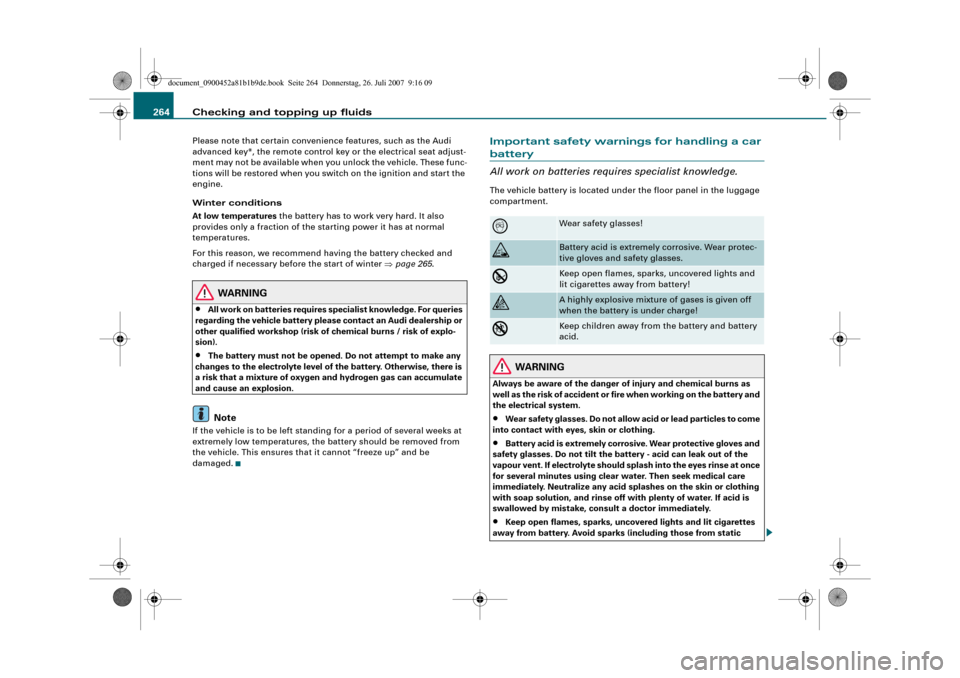
Important safety warnings for handling a car battery
All work on batteries requires specialist knowledge.The vehicle battery is located under the floor panel in the luggage
compartment.
WARNING
Always be aware of the danger of injury and chemical burns as
well as the risk of accident or fire when working on the battery and
the electrical system.•
Wear safety glasses. Do not allow acid or lead particles to come
into contact with eyes, skin or clothing.
•
Battery acid is extremely corrosive. Wear protective gloves and
safety glasses. Do not tilt the battery - acid can leak out of the
vapour vent. If electrolyte should splash into the eyes rinse at once
for several minutes using clear water. Then seek medical care
immediately. Neutralize any acid splashes on the skin or clothing
with soap solution, and rinse off with plenty of water. If acid is
swallowed by mistake, consult a doctor immediately.
•
Keep open flames, sparks, uncovered lights and lit cigarettes
away from battery. Avoid sparks (including those from static
Wear safety glasses!
Battery acid is extremely corrosive. Wear protec-
tive gloves and safety glasses.
Keep open flames, sparks, uncovered lights and
lit cigarettes away from battery!
A highly explosive mixture of gases is given off
when the battery is under charge!
Keep children away from the battery and battery
acid.
document_0900452a81b1b9de.book Seite 264 Donnerstag, 26. Juli 2007 9:16 09
Page 334 of 342
Index 332CCapacities . . . . . . . . . . . . . . . . . . . . . . . . . 321
Car keys . . . . . . . . . . . . . . . . . . . . . . . . . . . . 43
Care of vehicle . . . . . . . . . . . . . . . . . . . . . 244
Catalytic converter . . . . . . . . . . . . . . . . . . 229
Central locking system . . . . . . . . . . . . . . . 42
Boot lid . . . . . . . . . . . . . . . . . . . . . . . . . . 51
Deadlock mechanism . . . . . . . . . . . . . . 48
Fuel tank flap . . . . . . . . . . . . . . . . . . . . 252
Locking . . . . . . . . . . . . . . . . . . . . . . . . . . 48
Locking and unlocking the vehicle from
inside . . . . . . . . . . . . . . . . . . . . . . . . . . 49
Manual locking . . . . . . . . . . . . . . . . . . . 51
Opening and closing windows . . . . . . 54
Sun roof . . . . . . . . . . . . . . . . . . . . . . . . . 54
Switches on driver's door . . . . . . . . . . 49
Unlocking . . . . . . . . . . . . . . . . . . . . . . . . 48
Cetane number . . . . . . . . . . . . . . . . . . . . . 251
Changing a wheel . . . . . . . . . . . . . . . . . . . 288
Changing bulbs
SeeBulbs . . . . . . . . . . . . . . . . . . . . . . . 304
Chassis number . . . . . . . . . . . . . . . . . . . . 321
Child safety . . . . . . . . . . . . . . . . . . . . . . . . 210
Side airbags . . . . . . . . . . . . . . . . . . . . . 212
Child safety seat . . . . . . . . . . . . . . . . . . . . 213
Child seat categories . . . . . . . . . . . . . 213
Fitting . . . . . . . . . . . . . . . . . . . . . . . . . . 216
ISOFIX system . . . . . . . . . . . . . . . . . . . 218
On front passenger's seat . . . . . . . . . 211
Safety notes . . . . . . . . . . . . . . . . . . . . . 210
Child-proof catches
Rear doors . . . . . . . . . . . . . . . . . . . . . . . 53Cigarette lighter . . . . . . . . . . . . . . . . . . . . . 87
Cleaning . . . . . . . . . . . . . . . . . . . . . . . . . . . 244
Cleaning Alcantara . . . . . . . . . . . . . . . . . . 250
Cleaning seat covers
Alcantara . . . . . . . . . . . . . . . . . . . . . . . 250
Natural leather . . . . . . . . . . . . . . . . . . 249
Textile covers . . . . . . . . . . . . . . . . . . . . 247
Cleaning textile covers and trim parts . . 247
Clock, setting . . . . . . . . . . . . . . . . . . . . . . . 13
Closing
Bonnet . . . . . . . . . . . . . . . . . . . . . . . . . 256
Sun roof . . . . . . . . . . . . . . . . . . . . . . . . . 55
Coat hooks . . . . . . . . . . . . . . . . . . . . . . . . . . 91
Colour code . . . . . . . . . . . . . . . . . . . . . . . . 321
coming home . . . . . . . . . . . . . . . . . . . . . . . 59
Compact temporary spare wheel
SeeSpare wheel . . . . . . . . . . . . . . . . . 284
Compartment for (sun)glasses . . . . . . . . . 91
Compass in mirror . . . . . . . . . . . . . . . . . . . 71
Controls and displays
Overview . . . . . . . . . . . . . . . . . . . . . . . . . . 9
Convenience open/close function . . . . . . 54
Cooling system
Anti-freeze additive . . . . . . . . . . . . . . . 260
Checking coolant level . . . . . . . . . . . . 261
Coolant . . . . . . . . . . . . . . . . . . . . . . . . . 260
Coolant temperature gauge . . . . . . . . . 11
Malfunction . . . . . . . . . . . . . . . . . . . . . . 33
Radiator fan . . . . . . . . . . . . . . . . . . . . . 262
Topping up coolant . . . . . . . . . . . . . . . 261Cruise control system
Adjusting stored speed . . . . . . . . . . . 126
Indicator lamp . . . . . . . . . . . . . . . . . . . . 19
Pre-selecting a speed . . . . . . . . . . . . . 127
Switching off . . . . . . . . . . . . . . . . . . . . 127
Switching on . . . . . . . . . . . . . . . . . . . . 125
See alsoadaptive cruise control . . . . 128
Cup holders . . . . . . . . . . . . . . . . . . . . . . . . . 85
Current fuel consumption . . . . . . . . . . . . . 25
DDate display . . . . . . . . . . . . . . . . . . . . . . . . . 13
Daytime running lights . . . . . . . . . . . . . . . 59
DCP
SeeDynamic gear control program . 166
Deactivating front passenger's airbag . . 208
Deadlock mechanism . . . . . . . . . . . . . . 42, 48
Defrosting windows . . . . . . . . . . . . . . 98, 106
Deluxe automatic air conditioner . . . . . . . 93
Air distribution . . . . . . . . . . . . . . . . . . . 97
Air outlets . . . . . . . . . . . . . . . . . . . . . . . . 99
Air outlets for rear passengers . . . . . . 99
Air recirculation mode . . . . . . . . . . . . . 97
Automatic mode . . . . . . . . . . . . . . . . . . 95
Basic settings . . . . . . . . . . . . . . . . . . . . 100
Blower . . . . . . . . . . . . . . . . . . . . . . . . . . . 96
Controls . . . . . . . . . . . . . . . . . . . . . . . . . 94
Defrosting . . . . . . . . . . . . . . . . . . . . . . . 98
Description . . . . . . . . . . . . . . . . . . . . . . . 93
Economical operation . . . . . . . . . . . . . 100
Heated rear window . . . . . . . . . . . . . . . 98
Seat heating, front . . . . . . . . . . . . . . . 114
document_0900452a81b1b9de.book Seite 332 Donnerstag, 26. Juli 2007 9:16 09
Page 335 of 342
Index333
Controls
Safety
Driving tips
General maintenance
Self-help
Technical data Supplementary heater . . . . . . . . . . . . 101
Switching on and off . . . . . . . . . . . . . . . 95
Temperature . . . . . . . . . . . . . . . . . . . . . . 96
Deluxe automatic air conditioner plus . . 101
AC mode . . . . . . . . . . . . . . . . . . . . . . . . 107
Air distribution . . . . . . . . . . . . . . . . . . . 106
Air outlets . . . . . . . . . . . . . . . . . . . . . . . 107
Air outlets for rear passengers . . . . . 108
Air recirculation mode . . . . . . . . . . . . 105
Automatic mode . . . . . . . . . . . . . . . . . 103
Automatic recirculation . . . . . . . . . . . 109
Auxiliary heating . . . . . . . . . . . . . . . . . 110
Auxiliary heating - remote control . . . 113
Auxiliary heating - running time . . . . 112
Basic settings . . . . . . . . . . . . . . . . . . . . 109
Blower . . . . . . . . . . . . . . . . . . . . . . . . . . 104
Controls . . . . . . . . . . . . . . . . . . . . . . . . 102
Defrosting . . . . . . . . . . . . . . . . . . . . . . . 106
Description . . . . . . . . . . . . . . . . . . . . . . 101
Economical operation . . . . . . . . . . . . . 108
Heated rear window . . . . . . . . . . . . . . 106
Supplementary heater . . . . . . . . . . . . 110
Switching on and off . . . . . . . . . . . . . . 103
Synchronisation . . . . . . . . . . . . . . . . . . 109
Temperature . . . . . . . . . . . . . . . . . . . . . 104
Diesel . . . . . . . . . . . . . . . . . . . . . . . . . . . . . 251
Diesel particulate filter . . . . . . . . . . . . 38, 229
Engine oil . . . . . . . . . . . . . . . . . . . . . . . 257
Digital clock . . . . . . . . . . . . . . . . . . . . . . . . . 13
Digital compass . . . . . . . . . . . . . . . . . . . . . . 71
Digital speedometer . . . . . . . . . . . . . . . . . . 23
Dimensions . . . . . . . . . . . . . . . . . . . . . . . . 320Dipped headlights . . . . . . . . . . . . . . . . . . . . 57
Defective . . . . . . . . . . . . . . . . . . . . . . . . . 37
DIS
SeeDriver information system . . . . . . . 21
Distance control system
Seeadaptive cruise control . . . . . . . . 128
Door catches/boot lid warning . . . . . . . . . 24
Doors
Child-proof catches . . . . . . . . . . . . . . . . 53
Manual locking . . . . . . . . . . . . . . . . . . . . 51
Driver
SeeSitting position . . . . . . . . . . . . . . . 188
Driver information system . . . . . . . . . . . . . 21
Auto-check control . . . . . . . . . . . . . . . . 30
Bulb monitor . . . . . . . . . . . . . . . . . . . . . 37
CD and radio display . . . . . . . . . . . . . . . 22
Digital speedometer . . . . . . . . . . . . . . . 23
Door catches/boot lid warning . . . . . . . 24
Driver messages . . . . . . . . . . . . . . . . . . 30
On-board computer . . . . . . . . . . . . . . . . 25
Outside temperature display . . . . . . . . 22
Red symbols . . . . . . . . . . . . . . . . . . . . . . 31
Service interval display . . . . . . . . . . . . . 24
Speed warning . . . . . . . . . . . . . . . . . . . . 28
Yellow symbols . . . . . . . . . . . . . . . . . . . 35
Driver messages . . . . . . . . . . . . . . . . . . . . . 30
Driving
Run flat tyres . . . . . . . . . . . . . . . . . . . . 275
Driving abroad
Headlights . . . . . . . . . . . . . . . . . . . . . . . 59
Unleaded fuel . . . . . . . . . . . . . . . . . . . . 251
Driving away from a standstill . . . . . . . . . 122
Driving away when towing a trailer . . . . 123Driving on left . . . . . . . . . . . . . . . . . . . . . . . 59
Driving on right . . . . . . . . . . . . . . . . . . . . . . 59
Driving safety . . . . . . . . . . . . . . . . . . . . . . . 187
Driving time . . . . . . . . . . . . . . . . . . . . . . . . . 25
Dust filter
Deluxe automatic air conditioner . . . . . 93
Deluxe automatic air conditioner plus . .
101
DVD player . . . . . . . . . . . . . . . . . . . . . . . . . . 80
Dynamic gear control program . . . . . . . . 166
Dynamic steering . . . . . . . . . 16, 36, 159, 222
EEconomical driving . . . . . . . . . . . . . . . . . . 229
EDL
SeeElectronic differential lock . . . . . . . 19
Electric seat adjustment
SeeSeat adjustment . . . . . . . . . . . . . . . 74
Electric windows . . . . . . . . . . . . . . . . . . . . . 53
Central locking system . . . . . . . . . . . . . 54
Convenience open/close function . . . . 54
Malfunctions . . . . . . . . . . . . . . . . . . . . . . 55
Settings . . . . . . . . . . . . . . . . . . . . . . . . . . 55
Electrical accessories
SeeElectrical socket . . . . . . . . . . . . . . . 88
Electrical socket . . . . . . . . . . . . . . . . . . . 87, 88
Electro-mechanical parking brake . . . . . . 124
Auto release function . . . . . . . . . . . . . 122
Driving away from a standstill . . . . . . 122
Driving away when towing a trailer . . 123
Emergency braking function . . . . . . . 123
Malfunction . . . . . . . . . . . . . . . . . . . . . 123
document_0900452a81b1b9de.book Seite 333 Donnerstag, 26. Juli 2007 9:16 09