height AUDI A4 2008 B8 / 4.G Owners Manual
[x] Cancel search | Manufacturer: AUDI, Model Year: 2008, Model line: A4, Model: AUDI A4 2008 B8 / 4.GPages: 342, PDF Size: 13.14 MB
Page 75 of 342
Seats and storage73
Controls
Safety
Driving tips
General maintenance
Self-help
Technical data
Seats and storageManual adjustment of front seatsApplies to vehicles: with manual seat adjustmentSeat adjuster controls
There are several seat adjustment functions for your
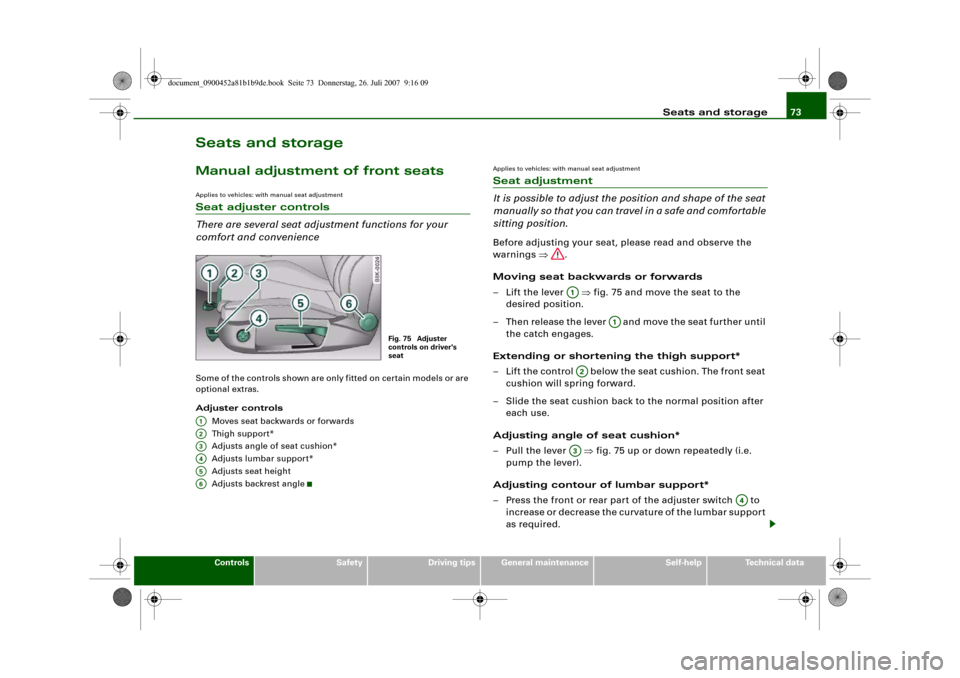
comfort and convenienceSome of the controls shown are only fitted on certain models or are
optional extras.
Adjuster controls
Moves seat backwards or forwards
Thigh suppor t*
Adjusts angle of seat cushion*
Adjusts lumbar support*
Adjusts seat height
Adjusts backrest angle
Applies to vehicles: with manual seat adjustmentSeat adjustment
It is possible to adjust the position and shape of the seat
manually so that you can travel in a safe and comfortable
sitting position.Before adjusting your seat, please read and observe the
warnings ⇒.
Moving seat backwards or forwards
– Lift the lever ⇒fig. 75 and move the seat to the
desired position.
– Then release the lever and move the seat further until
the catch engages.
Extending or shortening the thigh support*
– Lift the control below the seat cushion. The front seat
cushion will spring forward.
– Slide the seat cushion back to the normal position after
each use.
Adjusting angle of seat cushion*
– Pull the lever ⇒fig. 75 up or down repeatedly (i.e.
pump the lever).
Adjusting contour of lumbar support*
– Press the front or rear part of the adjuster switch to
increase or decrease the curvature of the lumbar support
as required.
Fig. 75 Adjuster
controls on driver's
seat
A1A2A3A4A5A6
A1
A1
A2A3
A4
document_0900452a81b1b9de.book Seite 73 Donnerstag, 26. Juli 2007 9:16 09
Page 76 of 342
Seats and storage 74
Adjusting height of lumbar support*
– Press the top or bottom part of the adjuster switch to
move the lumbar support upwards or downwards as
required.
Raising or lowering the seat
– Pull the lever ⇒page 73, fig. 75 up or down repeat-
edly (i.e. pump the lever).
Adjusting backrest angle
– Lean forwards to take your weight off the backrest.
– Turn the adjuster wheel ⇒page 73, fig. 75 to set the
angle of the backrest as required.
WARNING
•
Never adjust the driver's seat when the vehicle is moving - this
could lead to an accident.
•
Be careful when adjusting the seat height. Careless or uncon-
trolled use of the seat adjustment can cause injuries.
•
Do not drive with the backrests of the front seats reclined too
far as otherwise the seat belt and airbag could fail to restrain the
wearer properly in an accident, possibly leading to injury.
Electric adjustment of front seatsSeat adjuster controls
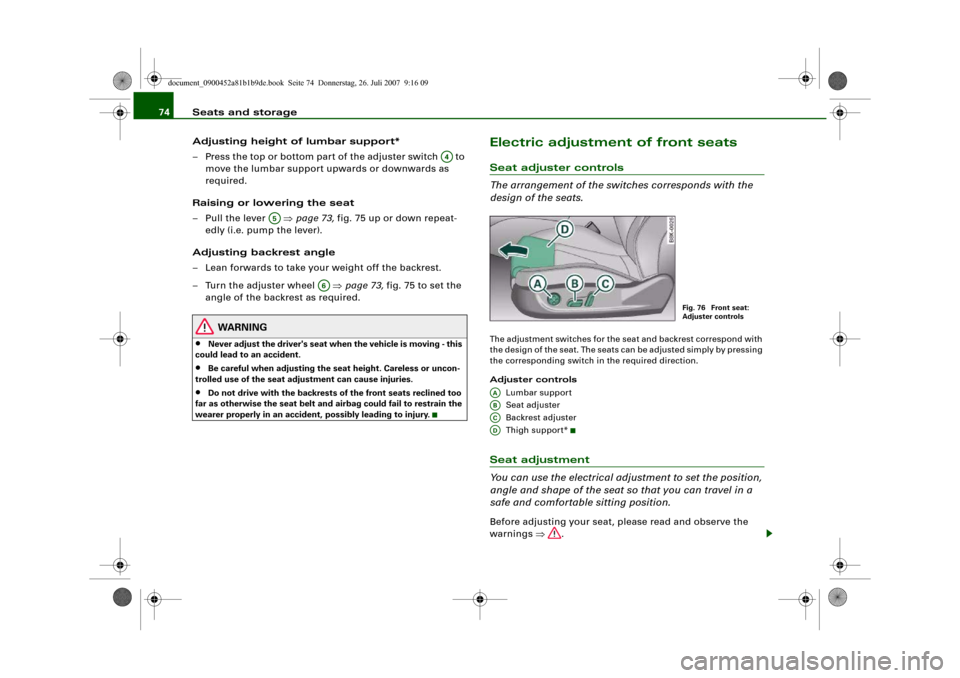
The arrangement of the switches corresponds with the
design of the seats.The adjustment switches for the seat and backrest correspond with
the design of the seat. The seats can be adjusted simply by pressing
the corresponding switch in the required direction.
Adjuster controls
Lumbar support
Seat adjuster
Backrest adjuster
Thigh suppor t*Seat adjustment
You can use the electrical adjustment to set the position,
angle and shape of the seat so that you can travel in a
safe and comfortable sitting position.Before adjusting your seat, please read and observe the
warnings ⇒.
A4
A5
A6
Fig. 76 Front seat:
Adjuster controls
AAABACAD
document_0900452a81b1b9de.book Seite 74 Donnerstag, 26. Juli 2007 9:16 09
Page 77 of 342
Seats and storage75
Controls
Safety
Driving tips
General maintenance
Self-help
Technical data
Adjusting contour of lumbar support
– Press the front or rear of switch to increase or
decrease the curvature of the lumbar support as
required.
Adjusting height of lumbar support
– Press the top or bottom of adjuster switch to move the
lumbar support upwards or downwards as required.
Moving seat backwards or forwards
– Press switch ⇒page 74, fig. 76 forwards or back-
wards.
Adjusting seat height
– Press switch up or down.
Raising/lowering seat at front
– Press the front of switch up or down.
Raising/lowering seat at rear
– Press the rear of switch up or down.
Adjusting backrest angle
– Press switch forwards or backwards.
Extending or shortening the thigh support*
– Lift the control below the seat cushion. The front seat
cushion will spring forward.
– Slide the seat cushion back to the normal position after
each use.
WARNING
•
Never adjust the driver's seat when the vehicle is moving - this
could lead to an accident.
•
The electrical seat adjustment also works when the ignition is
off and when the key is not in the ignition. To avoid accidental inju-
ries, never leave children unattended in the vehicle.
•
Be careful when adjusting the seat height. Careless or uncon-
trolled use of the height adjustment can cause injuries.
•
Do not drive with the backrests of the front seats reclined too
far as otherwise the seat belt and airbag could fail to restrain the
wearer properly in an accident, possibly leading to injury.
Seat memoryMemory for driver's seat
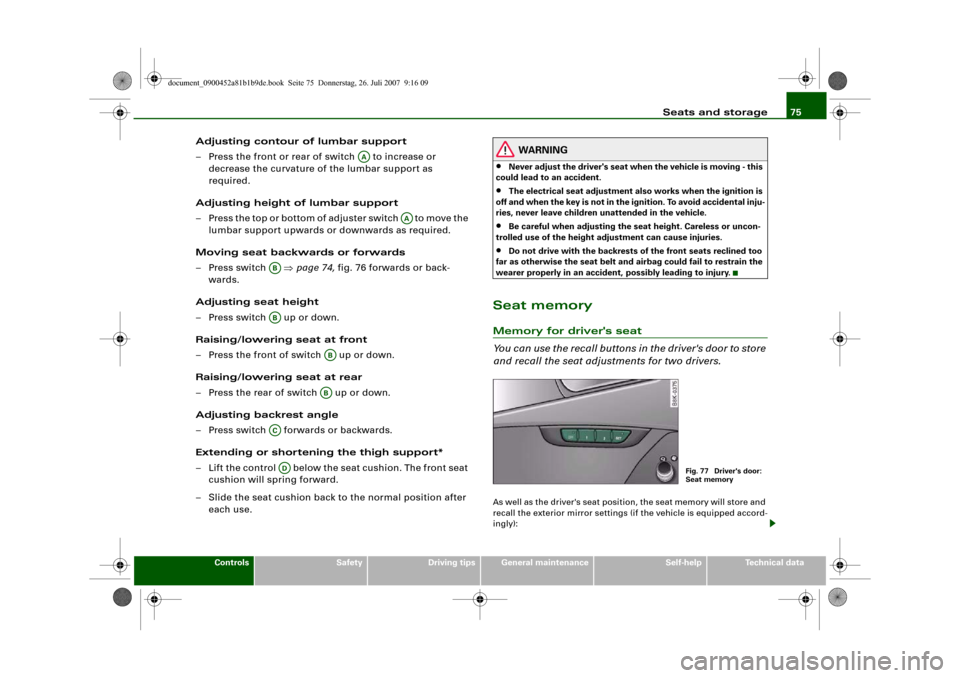
You can use the recall buttons in the driver's door to store
and recall the seat adjustments for two drivers.As well as the driver's seat position, the seat memory will store and
recall the exterior mirror settings (if the vehicle is equipped accord-
ingly):
AA
AA
ABAB
ABAB
ACAD
Fig. 77 Driver's door:
Seat memory
document_0900452a81b1b9de.book Seite 75 Donnerstag, 26. Juli 2007 9:16 09
Page 79 of 342
Seats and storage77
Controls
Safety
Driving tips
General maintenance
Self-help
Technical data
Applies to vehicles: with seat memoryActivating memory for remote control key
The relevant function must be activated on the sound
system or MMI* so that the settings stored in the memory
can be recalled using the remote control key.– Select: Function selector button > Seat adjustment
> Driver's seat > Remote control key > on.
Head restraintsAdjusting the front head restraints
In combination with properly worn seat belts, the head
restraints offer effective protection. However, they must
always be properly adjusted to suit the height of the occu-
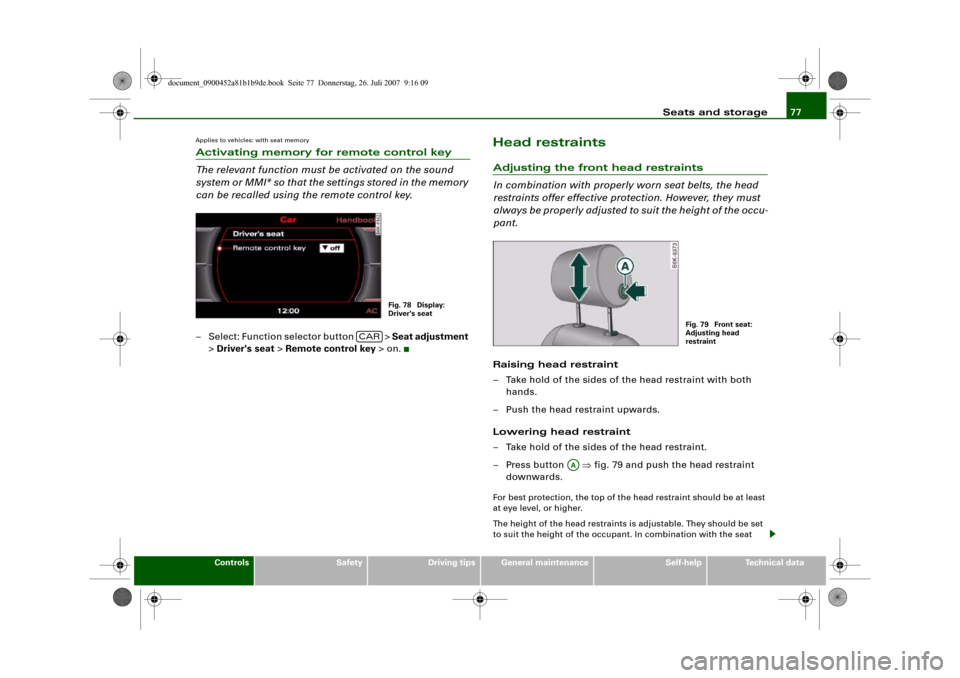
pant.Raising head restraint
– Take hold of the sides of the head restraint with both
hands.
– Push the head restraint upwards.
Lowering head restraint
– Take hold of the sides of the head restraint.
– Press button ⇒fig. 79 and push the head restraint
downwards.For best protection, the top of the head restraint should be at least
at eye level, or higher.
The height of the head restraints is adjustable. They should be set
to suit the height of the occupant. In combination with the seat
Fig. 78 Display:
Driver's seat
CAR
Fig. 79 Front seat:
Adjusting head
restraint
AA
document_0900452a81b1b9de.book Seite 77 Donnerstag, 26. Juli 2007 9:16 09
Page 118 of 342
Driving 116DrivingSteeringApplies to vehicles: with manually adjustable steering columnAdjusting the steering wheel position
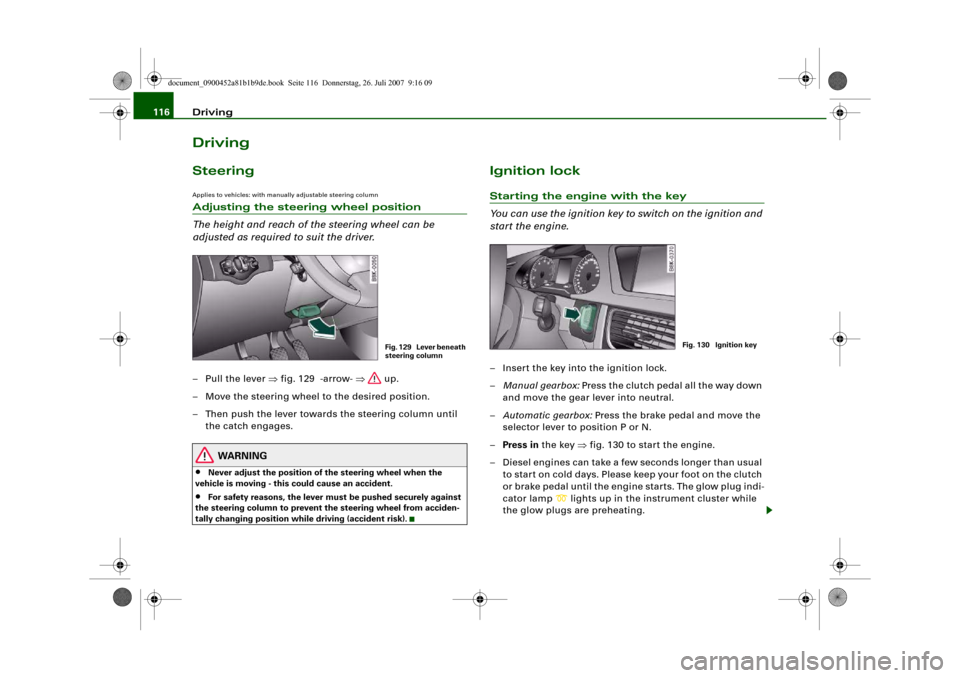
The height and reach of the steering wheel can be
adjusted as required to suit the driver.– Pull the lever ⇒fig. 129 -arrow- ⇒ up.
– Move the steering wheel to the desired position.
– Then push the lever towards the steering column until
the catch engages.
WARNING
•
Never adjust the position of the steering wheel when the
vehicle is moving - this could cause an accident.
•
For safety reasons, the lever must be pushed securely against
the steering column to prevent the steering wheel from acciden-
tally changing position while driving (accident risk).
Ignition lockStarting the engine with the key
You can use the ignition key to switch on the ignition and
start the engine.– Insert the key into the ignition lock.
–Manual gearbox: Press the clutch pedal all the way down
and move the gear lever into neutral.
–Automatic gearbox: Press the brake pedal and move the
selector lever to position P or N.
–Press in the key ⇒fig. 130 to start the engine.
– Diesel engines can take a few seconds longer than usual
to star t on cold days. Please keep your foot on the clutch
or brake pedal until the engine starts. The glow plug indi-
cator lamp
lights up in the instrument cluster while
the glow plugs are preheating.
Fig. 129 Lever beneath
steering column
Fig. 130 Ignition key
document_0900452a81b1b9de.book Seite 116 Donnerstag, 26. Juli 2007 9:16 09
Page 188 of 342
Safe driving 186Safe drivingGeneral notesSafety is the first priority
Your safety is our first priority.This chapter contains important information, tips, sugges-
tions and warnings that you should read and observe for
your own safety and the safety of your passengers.
WARNING
•
The information in this chapter is important for the driver of
the vehicle and all passengers. The other chapters in this manual
(and, where applicable, in the other literature supplied with the
vehicle) contain further important notes which you should read
and observe for your own safety and that of your passengers.
•
Ensure that the complete vehicle wallet is always in the vehicle.
This is especially important when you lend or sell the vehicle to
others.
Safety features
The safety features listed here are part of the vehicle's
occupant restraint system. They work together to help
reduce the risk of injury in a wide variety of accident situ-
ations.Your safety and the safety of your passengers should not be left to
chance. In the event of an accident, the safety features incorporated
in your vehicle are capable of reducing the risk of injury. These are
just a few of the safety features in your Audi:•
Optimised three-point seat belts for all seats,
•
Belt force limiters for the front seats,
•
Belt pre-tensioners for the front seats,
•
Head restraints for all seats,
•
Optimised protection against injuries of the cervical vertebrae,
•
Front airbags,
•
Side airbags in the front seat backrests and on the outer rear
seats*,
•
Head-protection airbags (sideguard system),
•
“ISOFIX” mountings* for “ISOFIX” child safety seats on the rear
seats,
•
Height-adjustable head restraints on the seats,
•
Adjustable steering column.
These individual safety features are harmonised to provide you and
your passengers with the best possible protection in accident situ-
ations. However, they can only be effective if you and your passen-
gers sit in the correct position and adjust and use the safety equip-
ment properly.
For these reasons, this chapter explains why these safety features
are so important, how they can protect you, what you need to
remember when using them, and how you and your passengers can
gain the most benefit from them. There are also a number of impor-
tant safety warnings which you and your passengers should always
observe in order to minimise the risk of injury.
Safety is everyone's responsibility!
document_0900452a81b1b9de.book Seite 186 Donnerstag, 26. Juli 2007 9:16 09
Page 200 of 342
Seat belts 198The height of the front seat on your vehicle can be adjusted in order
to match the position of the seat belt to your height.
WARNING
•
The diagonal part of the belt should never be positioned across
the neck, but roughly over the centre of the shoulder; it should fit
closely against the upper part of the body. The lap part of the belt
must be worn tightly across the hips, and not over the abdomen
⇒page 197, fig. 210. Pull the belt tight if necessary to take up any
slack.
•
Always make sure that belt is positioned properly. Incorrectly
worn seat belts can give rise to injuries even in a minor collision.
•
Seat belts worn too loose can result in injuries because they
allow excessive forward movement in a crash; the occupant will
be brought to a sudden stop by the belt webbing.
Wearing and adjusting the seat belts during pregnancy
To afford the best protection for the unborn child it is
important for the mother to wear the seat belt properly at
all times.
Women should always ensure they adjust the seat belt
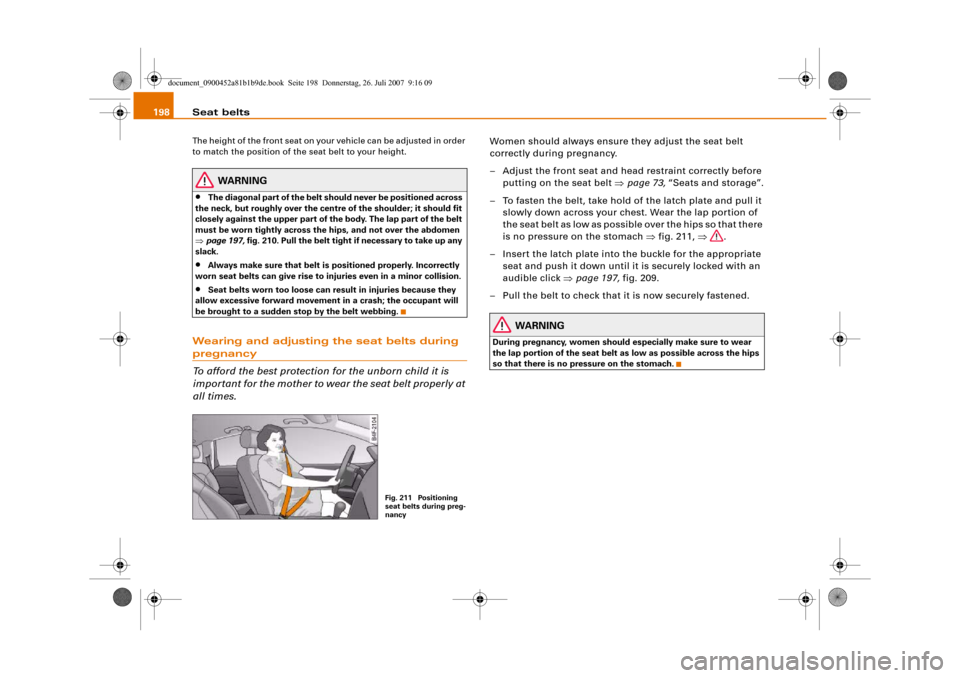
correctly during pregnancy.
– Adjust the front seat and head restraint correctly before
putting on the seat belt ⇒page 73, “Seats and storage”.
– To fasten the belt, take hold of the latch plate and pull it
slowly down across your chest. Wear the lap portion of
the seat belt as low as possible over the hips so that there
is no pressure on the stomach ⇒fig. 211, ⇒.
– Insert the latch plate into the buckle for the appropriate
seat and push it down until it is securely locked with an
audible click ⇒page 197, fig. 209.
– Pull the belt to check that it is now securely fastened.
WARNING
During pregnancy, women should especially make sure to wear
the lap portion of the seat belt as low as possible across the hips
so that there is no pressure on the stomach.
Fig. 211 Positioning
seat belts during preg-
nancy
document_0900452a81b1b9de.book Seite 198 Donnerstag, 26. Juli 2007 9:16 09
Page 201 of 342
Seat belts199
Controls
Safety
Driving tips
General maintenance
Self-help
Technical data
Applies to vehicles:Seat belt height adjustment
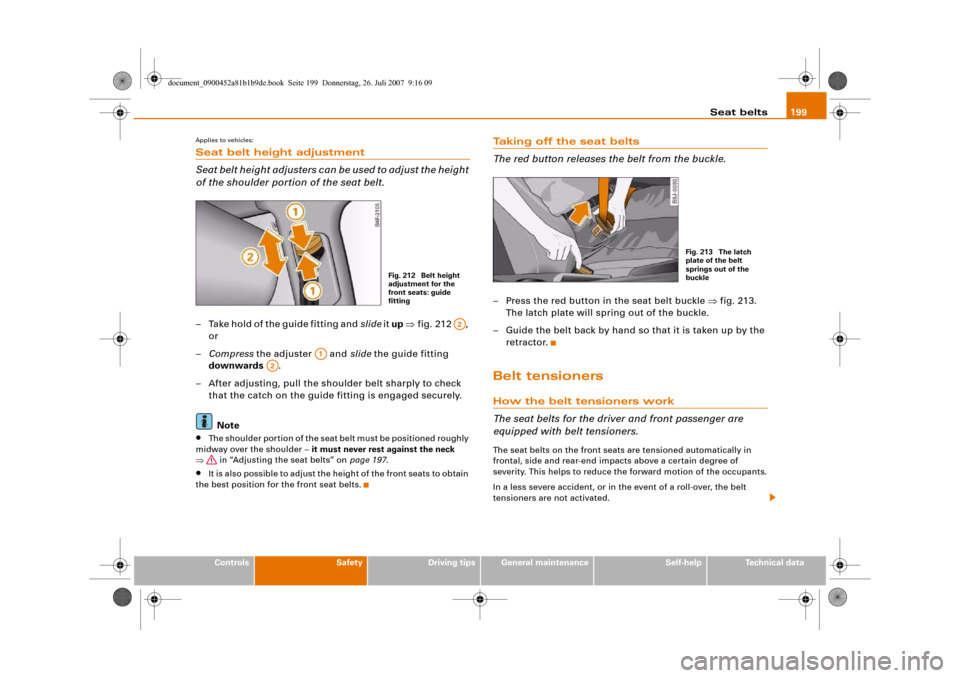
Seat belt height adjusters can be used to adjust the height
of the shoulder portion of the seat belt.– Take hold of the guide fitting and slide it up ⇒fig. 212 ,
or
–Compress the adjuster and slide the guide fitting
downwards .
– After adjusting, pull the shoulder belt sharply to check
that the catch on the guide fitting is engaged securely.
Note•
The shoulder portion of the seat belt must be positioned roughly
midway over the shoulder – it must never rest against the neck
⇒ in “Adjusting the seat belts” on page 197.
•
It is also possible to adjust the height of the front seats to obtain
the best position for the front seat belts.
Taking off the seat belts
The red button releases the belt from the buckle.– Press the red button in the seat belt buckle ⇒fig. 213.
The latch plate will spring out of the buckle.
– Guide the belt back by hand so that it is taken up by the
retractor.Belt tensionersHow the belt tensioners work
The seat belts for the driver and front passenger are
equipped with belt tensioners.The seat belts on the front seats are tensioned automatically in
frontal, side and rear-end impacts above a certain degree of
severity. This helps to reduce the forward motion of the occupants.
In a less severe accident, or in the event of a roll-over, the belt
tensioners are not activated.
Fig. 212 Belt height
adjustment for the
front seats: guide
fitting
A2
A1
A2
Fig. 213 The latch
plate of the belt
springs out of the
buckle
document_0900452a81b1b9de.book Seite 199 Donnerstag, 26. Juli 2007 9:16 09
Page 206 of 342
Airbag system 204Important safety notes on the front airbag system
There are a number of safety points concerning the airbag
system which you should remember. This will help to
reduce the risk of injury in an accident.
WARNING
•
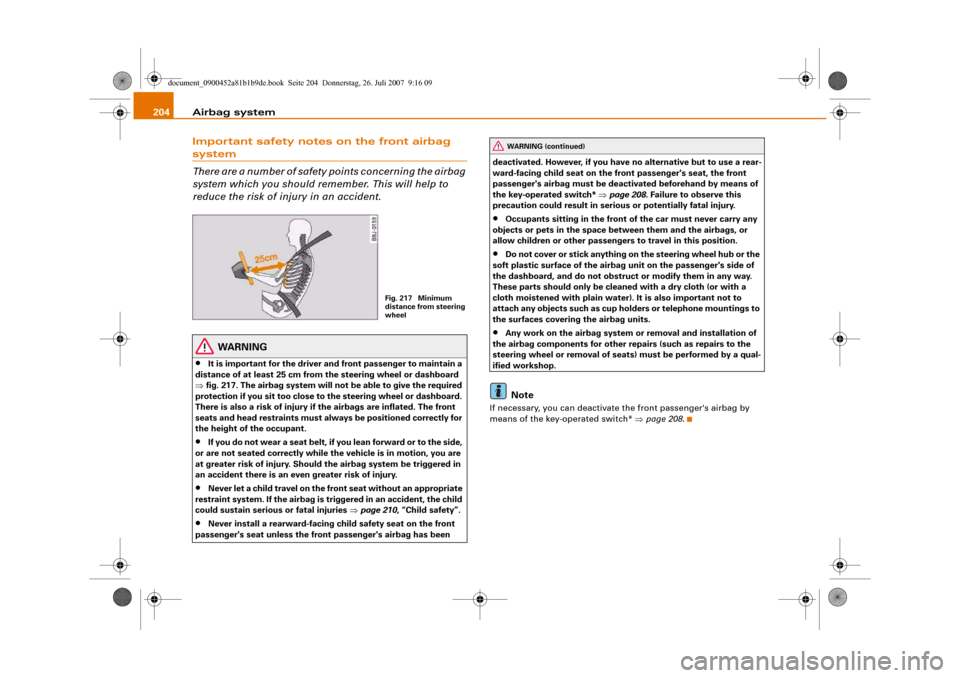
It is important for the driver and front passenger to maintain a
distance of at least 25 cm from the steering wheel or dashboard
⇒fig. 217. The airbag system will not be able to give the required
protection if you sit too close to the steering wheel or dashboard.
There is also a risk of injury if the airbags are inflated. The front
seats and head restraints must always be positioned correctly for
the height of the occupant.
•
If you do not wear a seat belt, if you lean forward or to the side,
or are not seated correctly while the vehicle is in motion, you are
at greater risk of injury. Should the airbag system be triggered in
an accident there is an even greater risk of injury.
•
Never let a child travel on the front seat without an appropriate
restraint system. If the airbag is triggered in an accident, the child
could sustain serious or fatal injuries ⇒page 210, “Child safety”.
•
Never install a rearward-facing child safety seat on the front
passenger's seat unless the front passenger's airbag has been deactivated. However, if you have no alternative but to use a rear-
ward-facing child seat on the front passenger's seat, the front
passenger's airbag must be deactivated beforehand by means of
the key-operated switch* ⇒page 208. Failure to observe this
precaution could result in serious or potentially fatal injury.
•
Occupants sitting in the front of the car must never carry any
objects or pets in the space between them and the airbags, or
allow children or other passengers to travel in this position.
•
Do not cover or stick anything on the steering wheel hub or the
soft plastic surface of the airbag unit on the passenger's side of
the dashboard, and do not obstruct or modify them in any way.
These parts should only be cleaned with a dry cloth (or with a
cloth moistened with plain water). It is also important not to
attach any objects such as cup holders or telephone mountings to
the surfaces covering the airbag units.
•
Any work on the airbag system or removal and installation of
the airbag components for other repairs (such as repairs to the
steering wheel or removal of seats) must be performed by a qual-
ified workshop.Note
If necessary, you can deactivate the front passenger's airbag by
means of the key-operated switch* ⇒page 208.
Fig. 217 Minimum
distance from steering
wheel
WARNING (continued)
document_0900452a81b1b9de.book Seite 204 Donnerstag, 26. Juli 2007 9:16 09
Page 212 of 342
Child safety 210Child safetyPoints to remember if children are
travelling in the carIntroduction
Statistics show that children are generally safer on the
rear seat than on the front passenger's seat.Children under 12 years of age should normally travel on the rear
seat
2). Children travelling on the rear seat must use a child restraint
system or the seat belts provided, depending on their age, height
and weight. For safety reasons, the child restraint system should be
installed behind the front passenger's seat.
The physical principles involved and the forces acting in a collision
apply to children just as much as adults ⇒page 195, “Forces acting
in a collision”. But, unlike adults, children do not have fully devel-
oped muscle and bone structures. This means that children are
subject to a greater risk of injury.
To reduce this risk, children must always use special child restraint
systems when travelling in the car.
Use only child restraint systems which are officially approved under
the European standard ECE R 44 and are suitable for the child. ECE R
refers to the Economic Commission of Europe Recommendation,
which categorises child restraint systems in 5 groups ⇒page 213,
“Child seat categories”. Child restraints that have been tested and
approved under the ECE R 44 standard bear the ECE-R 44 test mark
on the seat (the letter E in a circle with the test number below it).
We recommend using child restraint systems from the range of
Audi Genuine Accessories available from Audi dealers. The
“Huckepack” range includes suitable restraint systems for all ages. These systems have been specially developed and tested for use in
Audi vehicles and comply with the ECE-R 44 standard.
Follow the manufacturer's instructions and observe any statutory
requirements when installing and using child restraints ⇒ in
“Important safety notes for using child safety seats”.
Important safety notes for using child safety seats
Correct use of child safety seats can help to reduce the
risk of injury in an accident.
WARNING
•
All vehicle occupants, especially children, must wear a seat
belt while the vehicle is in motion.
•
Children who are less than 1.5 metres tall must not wear a
normal seat belt without a child restraint, as this could cause inju-
ries to the abdominal and neck areas.
•
Babies and children must never travel on another occupant's
lap.
•
A suitable child safety seat can protect your child ⇒page 213,
“Child safety seats”.
•
Never allow two children to occupy one child safety seat.
•
Never leave a child without supervision in a child safety seat.
•
Never allow a child to travel in the car without a suitable child
restraint.
•
Never allow a child to stand up or kneel on a seat while the car
is moving. In an accident, the child could be catapulted through
the car, causing possibly fatal injuries to itself and other occu-
pants.
2)Observe any restrictions or regulations to the contrary.
document_0900452a81b1b9de.book Seite 210 Donnerstag, 26. Juli 2007 9:16 09