steering wheel AUDI A4 2013 Owner's Manual
[x] Cancel search | Manufacturer: AUDI, Model Year: 2013, Model line: A4, Model: AUDI A4 2013Pages: 302, PDF Size: 75.61 MB
Page 187 of 302
Intelligent technology Notice about data
recorded by vehicle
control modules
Your vehicle is not equipped with an Event Da
ta Recorder (EDR), installed by some manu
facturers for the express purpose of capturing
data for retrieval after an accident or crash
event. EDR's are sometimes called "crash re
corders".
Some state laws restrict the retr ieval or down
loading of data stored by EDR's that were in
stalled in a vehicle for the express purpose of
retrieving data after an accident or crash
event without the owner's consent.
Although your vehicle is not equipped with an
EDR, it is equipped with a number of electron
ic control modules for various vehicle systems
such as, for examp le, engine function, emis
sion control, as well as for the airbags and
safety belts.
These electronic control modules also record
vehicle-related data during norma l vehicle op
eration for diagnostic and repair purposes.
The recording capacity of the electronic con
trol modules is limited to data (no sound is re
corded) and only a small amount of data is ac
tually recorded over a very limited period of
time and stored when a system fault or other
condition is sensed by a control unit. Some of
the data then stored may relate to vehicle
speed, direction, braking as we ll as restraint
system use and performance in the event of a
crash or other condition. Stored data can only be read and downloaded with special equip
ment.
Electronic Stabilization
Control (ESC)
Description
ESC helps to improve road holding and vehicle
dynamics to help reduce the probability of
skidding and loss of veh icle control. It works
only when the engine is running. ESC detects
Intelligent technology 185
certain difficult driving situations, including
when the vehicle is beginning to spin (yaw)
out of control and helps you to get the veh icle
back under control by se lectively braking the
wheels, and/or reducing engine power and
providing steering ass istance to help hold the
vehicle on the driver's intended course. The in
dicator light
JjJ in the instrument cluster
blinks when ESC is taking action to help you
control the vehicle.
ESC has limitations .
It is important to remem
ber that ESC cannot overcome the laws of
physics.
It will not always be able to help out
under all conditions you may come up against.
For example, ESC may not always be able to
help you master situations where there is a
sudden change in the coefficient of friction of
the road surface. When there is a section of dry road that is suddenly covered with water,
slush or snow, ESC cannot perform the same
way it would on the dry surface. If the vehicle
hydroplanes (rides on a cushion of water in
stead of the road surface), ESC will not be
able to help you steer the vehicle because con
tact with the pavement has been interrupted
and the vehicle cannot be braked or steered .
During fast cornering, particularly on winding
roads, ESC cannot always deal as effectively
with difficult driving situations than at lower
speeds. When towing a trailer, ESC is not able
to help you regain control as it would if you
were not tow ing a trailer.
A lways adjust your speed and driving style to
road, traffic and weather conditions. ESC can
not override the vehicle's physical limits, in
crease the available traction, or keep a vehicle
on the road if road departure is a result of
driver inattention. Instead, ESC improves the
poss ibility of keeping the vehicle under con
trol and on the road dur ing extreme maneu
vers by using the driver's steering inputs to
help keep the vehicle going in the intended di
rection. If you are traveling at a speed that
causes you to run off the road before ESC can
provide any assistance, you may not experi
ence the benefits of ESC.
•
•
Page 188 of 302
186 Intelligent technology
ESC includes and/or works together with the
anti-lock brake system (ABS), brake assist sys
tem, anti-slip regulation (ASR) , e lectronic dif
ferential lock (EDL), dynamic steering" and
e lectronic interaxle differentia l lock* /selective
wheel torque control* . ESC is switched on all
the t ime. I n certa in s ituations whe n you need
l ess t raction, you can switch
off ASR by p ress
i ng the bu tto n
[ru ¢ page 188, fig. 176 or
¢ page 188, fig. 177. Be sure to sw itch ASR
on aga in when yo u no longer need less t rac
tion .
Anti -lock braking system (ABS)
ABS prevents the wheels from locking up
when braki ng. The veh icle can still be steered
even d uring h ard br aking. Apply ste ady p res
sure to the brake pedal. Do no t pump the ped
a l. A pulsing in the brake peda l indicates t hat
the system is he lping yo u to b rake the vehicle .
Brake assist system
The brake assis t system can decrease b ra ki ng
d ista nce. It increases braking power w hen the
d river p resses the brake pedal quic kly in eme r
gency situations . You must p ress and hold the
brake peda l until the situation is over. In
vehicles w ith adapt ive cru ise contro l", the
brake assist system is more sensit ive if the
d ista nce detected to t he vehicle a head is too
small.
Anti-slip regulation (ASR)
ASR reduces engine power when the drive
wheels begin to spin and adapts the fo rce to
the road condit ions. This makes it eas ier to
start , accelerate and drive up hills.
Electronic differenti al lock (EDL )
The ED L brakes wheels that are spinn ing and
transfers the drive power to the other drive
wheel or whee ls if t he vehicle is equipped with
all-w heel drive*. This function is available up
to about 60 mph (100 km/h).
In extreme cases, EDL automat ica lly switches
off to help keep the bra ke on the braked whee l
from overheating. EDL wi ll switch on again au-tomat
ica lly when conditions have ret urned to
no rma l.
Dynamic steering*
On vehicles wi th dynam ic steering*, ESC he lps
st abi liz e the steer ing in cr itical situ ations.
Electronic interaxle differential lock* /
selective wheel torque control*
T he elec troni c int eraxle differentia l lock (front
whee l dr ive) o r th e se lec tive whee l torque
control (all-whee l dr ive) oper ates when dr iv
ing t hro ugh curves. The front wheel on the in
side of the c urve or both whee ls on the inside
of the c urve are b raked se lectively as needed.
This m inimizes sliding in the front wheels and
allows for more precise driving through
curves . The applicable system may not acti
vate when dr iving in wet o r snowy cond itions.
A WARNING
- ESC, ABS, ASR, EDL dynam ic steering*
a nd the ele ct roni c interaxle d ifferential
lo ck* /se lective whee l torque con trol *
cannot ove rcome the laws of physics .
This is especially important on sli ppery
or wet roads.
If the systems beg in acting
to stabilize your veh icle, yo u should im
mediately change your speed to match
the road and traffic conditions . Do not
let the increased safety prov ided by
these systems tempt you to take r isks.
Doing so will increase the risk of a loss of
veh icle cont ro l, col lision and ser ious pe r
sonal injur ies.
- Always ada pt your speed to road, traffi c
a nd wea ther conditions. The r isk of los-
ing con trol of the vehicle i ncreases when
d riving too fast, es pec ia lly through
curves and o n slippe ry or wet roads, an d
when dr iv ing too close to vehicles up
ahead. ESC, ABS, the brake ass ist sys
tem, ASR, EDL dynam ic steer ing* and the
e lectronic inte raxle differentia l lock*/se
lec tive whee l to rque control* cannot p re-
-
vent co llisi ons. ~
Page 192 of 302
190 Intelligent technology
to brake. This may cause the brakes to
overheat, premature wear and increased
stopp ing distance.
- Under certain climatic and operating
condit ions such as passing through wa
ter, driving in heavy ra in or after wash ing
the vehicle, the effect iveness of the
brakes can be reduced . In winter, ice can
accumulate on the brake pads, linings,
discs and drums. Carefully apply brakes
f or a test . B rakes will dry a nd ice coat
ings will be cleaned off after a few ca re
ful brake applications.
- Driv ing for an extended pe riod of time on
salt -covered roads without using you r
brakes can also affect braking efficiency.
Clean off accumulated salt coating from
brake discs and pads w ith a few careful
brake applicat ions.
- If you damage the front spoiler, or if you
install a different spoiler, be sure the air
flow to the front brakes is not obstruct
ed . O therwise the brake system could
overheat reducing the effectiveness of
the ent ire brake system.
- Failure of one brake c ircuit will impair
the braking capability resulting in an in creased stopp ing distance. Avoid driv ing
the vehicle and have it towed to t he near
est author ized Audi dealer or qualif ied
workshop.
- Never let the vehicle roll to a stop w ith
the engine shut off.
- If the brake booster is not working, for
example when towing your ve hicle, or
because the b rake booste r has somehow
been damaged, the brake pedal must be
pressed considerab ly harder to make up
for the lack of booster assistance.
Electro-mechanical
power assist, dynamic
steering
The electro-mechanical power assist helps
the driver when steering.
Power steer ing adapts electronically based on
the veh icle speed.
Indicator lights and messages
• Ste ering d efe ct ive ! Do not d rive vehicle!
If this indicator light turns on and stays on
a nd this message appears, the power steering
may have failed .
Do
not continue driving. See your authorized
Audi dealer or other qualified repair facility
for assistance.
'Tij D ynamic steer ing: Sy stem f au lt! You c an
cont inue d riving
If the indicator l ight turns on and the mes
sage appears, the stee ring may be more diffi
c ul t to move o r more sensitive than usua l. The
steering wheel may a lso be at an ang le when
driv ing straight.
Drive slowly to your authorized Audi dea ler or
qualified workshop to have the ma lf u nction
corrected.
'Tij Dynamic stee rin g: initializing
If this driver message appears and the indica
tor light is flashing on the instrument panel, dynamic steer ing* is being re initia lized . On ce
you start the engine after t his is finished, the
steering wheel will be easy to move . Re-initi
alizat ion might be necessary if the steering
whee l was moved hard to the left and right
whi le the vehicle was not moving. The display
goes out as soon as initiali zation is complete.
A WARNING
-Have the dynamic steering* system mal
function repa ired as soon as possible by an
authorized Audi dealer or any qualified
workshop - r is k of accident!
-
Page 193 of 302
@ Tips
- If the . or
fT j indicator light on ly stays
on for a short t ime, you may continue
driving.
- The dynamic steering* stability systems
are not available in the event of a system
malfunction.
- For additional information on dynamic
steering*, refer to
c:> page 113.
Driving with your
quattro ®
Applies to vehicles: with a ll-wheel drive
With all-wheel drive, all four wheels are driv
en.
Gener al inform ati on
W ith all-wheel drive, power is distributed to
all four wheels . This happens automatically
depending on your dr iving style and the road
conditions at the t ime. See also
c:> page 185.
A center different ial distr ibutes the dr iv ing
power var iably to the front and rear axle . It
works together with selective wheel torque
control, which activates when driving throug h
curves
c:> page 186. With the spo rt d ifferen
tial*, power dist ribution to the rear wheels is
variable and can be adjusted with drive select
c:> page 113.
The all-wheel drive concept is designed for
h igh engine power. Yo ur vehicle is exception
ally powerful and has exce llent driving charac
teristics both under normal driving conditions
and on snow and ice. Always read and fo llow
safety precautions
c:> A .
Winter t ir e s
When driv ing in the w inter, your veh icle w ith
all-wheel drive has an advantage,
even with
regular tires. In winter road conditions it may
be advisable to mount winter tires (or all-sea
son t ires) for improved driveability and brak
ing: these tires must be mounted on
a ll four
w heels . See also c:> page 250, Winter tires .
Intellig ent technolog y 191
Tire chain s
Where tire chains are mandatory on certain roads, this no rma lly also applies to veh icles
with all-wheel drive
c:> page 251, Snow
chains.
Replacing wheels /tires
Vehicles with a ll-wheel drive must always
have tires of t he same s ize. A lso avoid tires
with different tread depths . For detai ls see
page
c:> page 246, New tires and replacing
tires and wheels .
Off-Road driving?
You r A udi does no t have enough ground clear
ance to be used as an off-road vehicle .
It is
therefore best to avoid rough tracks and un
even terrain as much as possib le . Also refer to
c:> page 194.
A WARNING
Always adjust your dr iving to road and traf
f ic conditions. Do not let the extra safety
afforded by all-wheel drive tempt you into
taking extra risks .
- Although the all-wheel drive is very ef
fective, always remember that braking
capacity is lim ited by tire traction. You
should therefore not d rive at excessive
speeds on icy or slippe ry road surfa ces.
- On wet road surfaces, be careful not to
drive too fast because the front wheels
co uld begin to slide on top of the water
(aquaplaning) . If this should occur, yo u
will have no warning from a s udden in
crease in engine speed as w ith a front
wheel drive veh icle. Always drive at
speeds which are su ited to the road con
ditions -risk of crash.
•
•
Page 237 of 302
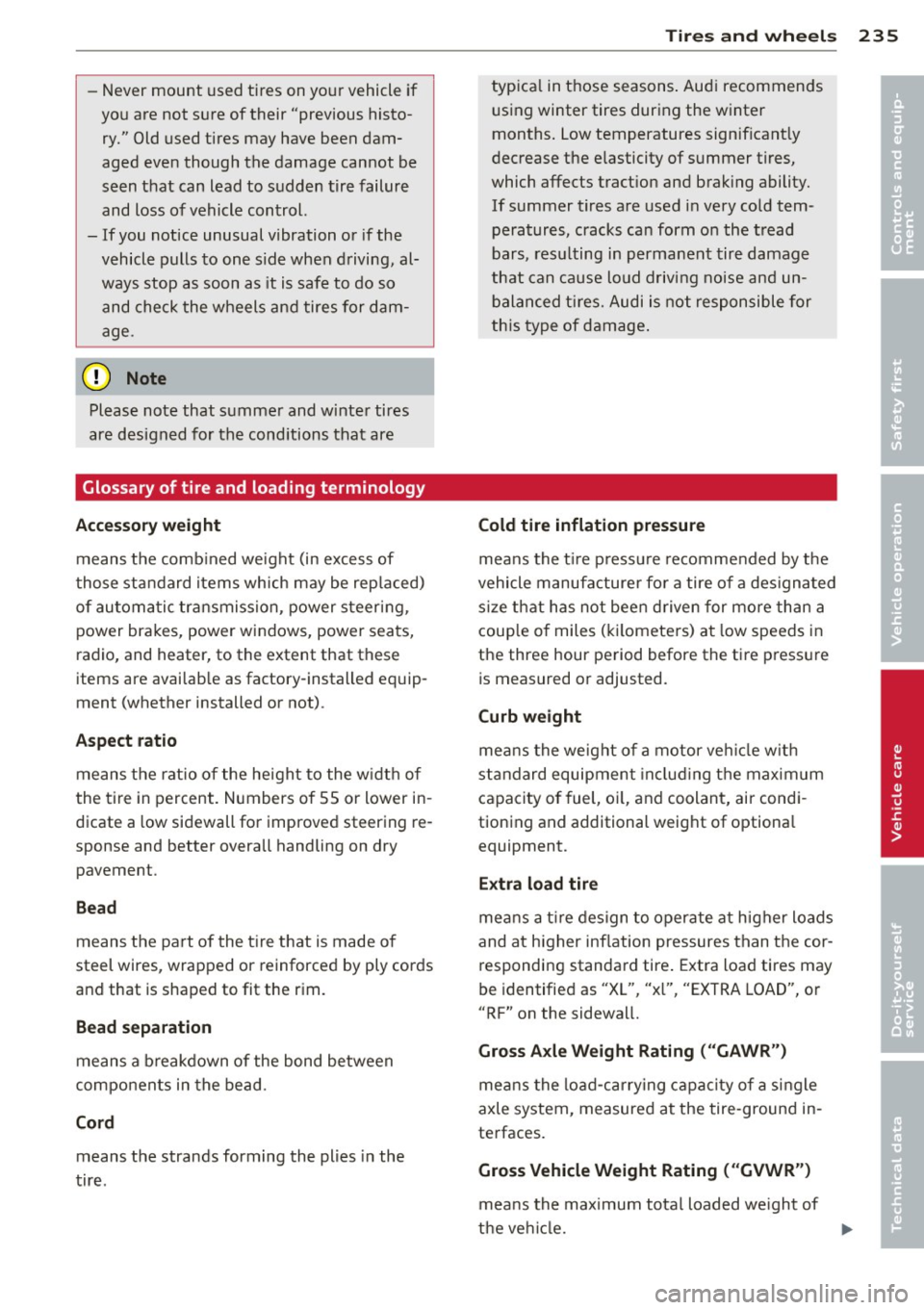
-Never mount used tires on yo ur vehicle if
yo u are not sure of their "previous histo
ry." Old used tires may have been dam
aged even though the damage cannot be
seen that can lead to sudden tire failure
and loss of vehicle control.
- If you notice unusual vibration or if the
vehicle pulls to one side when d riving, al
ways stop as soon as it is safe to do so
and check the wheels and tires for dam
age .
(D Note
Please note that summe r and wi nte r tires
are designed for the cond itions that are
Glossary of tire and loading terminology
Accessory weight means the comb ined weight (in excess of
those sta ndard items which may be rep laced)
of au toma tic transmission, power steer ing ,
power brakes, power windows, power seats,
radio, and heater, to the extent that these
items are availab le as factory-installed equip
ment (whether installed or not) .
Aspect ratio
means the rat io o f the height to the w idth of
the tire in percent . Numbers of 55 or lower in
dicate a low sidewall for improved steering re
sponse and better overa ll handling on dry
pavement .
Bead
means the part of the t ire t hat is made o f
steel wires, wrapped or reinforced by ply cords
and that is shaped to fit the r im.
Bead separation
means a b reakdown of the bond between
components in the bead .
Cord means the strands forming the plies in the
tire.
Tire s an d wheel s 235
typica l in those seasons . Aud i recommends
using winter tires during the winter
months . Low temperatures signif icant ly
dec rease the e lasticity of summer t ires,
which affects tract ion and brak ing ability.
If summer t ires are used i n very co ld tem
peratures, cracks ca n form o n the tread
bars , res ulting in perma nen t tire damage
that can cause loud driving noise and un
bala nced ti re s. Audi i s not respon sible for
th is type of damage .
Cold tire inflation pressure
means the t ire p ress ure recommended by t he
vehicle manufacture r fo r a tire o f a des ignated
s ize t hat has not bee n driven for more than a
coup le o f miles (k ilometers) at low speeds in
the three hour period before the tire press ure
is m easured or adjusted.
Curb weight
me ans the we ight of a motor ve hicle with
st andard equipmen t incl ud ing the max imum
capacity of fuel, oi l, and coolant, air condi
tioning and additional weig ht of optiona l
equipment.
Extra load tire
means a t ire design to oper ate a t higher load s
and at higher inflation pressures than the cor
responding standa rd tire . Extra load tires may
be identified as "XL", "x l", "EXTRA LOAD", o r
"RF" on the sidewal l.
Gross Axle Weight Rating ("GAWR")
me ans the load-ca rry ing capac ity of a single
axle system , measured at the tire -ground in
te rfaces.
Gross Vehicle Weight Rating ( "GVWR ")
mea ns the maximum total loaded we ight of
the ve hicl e. .,..
•
•
Page 247 of 302
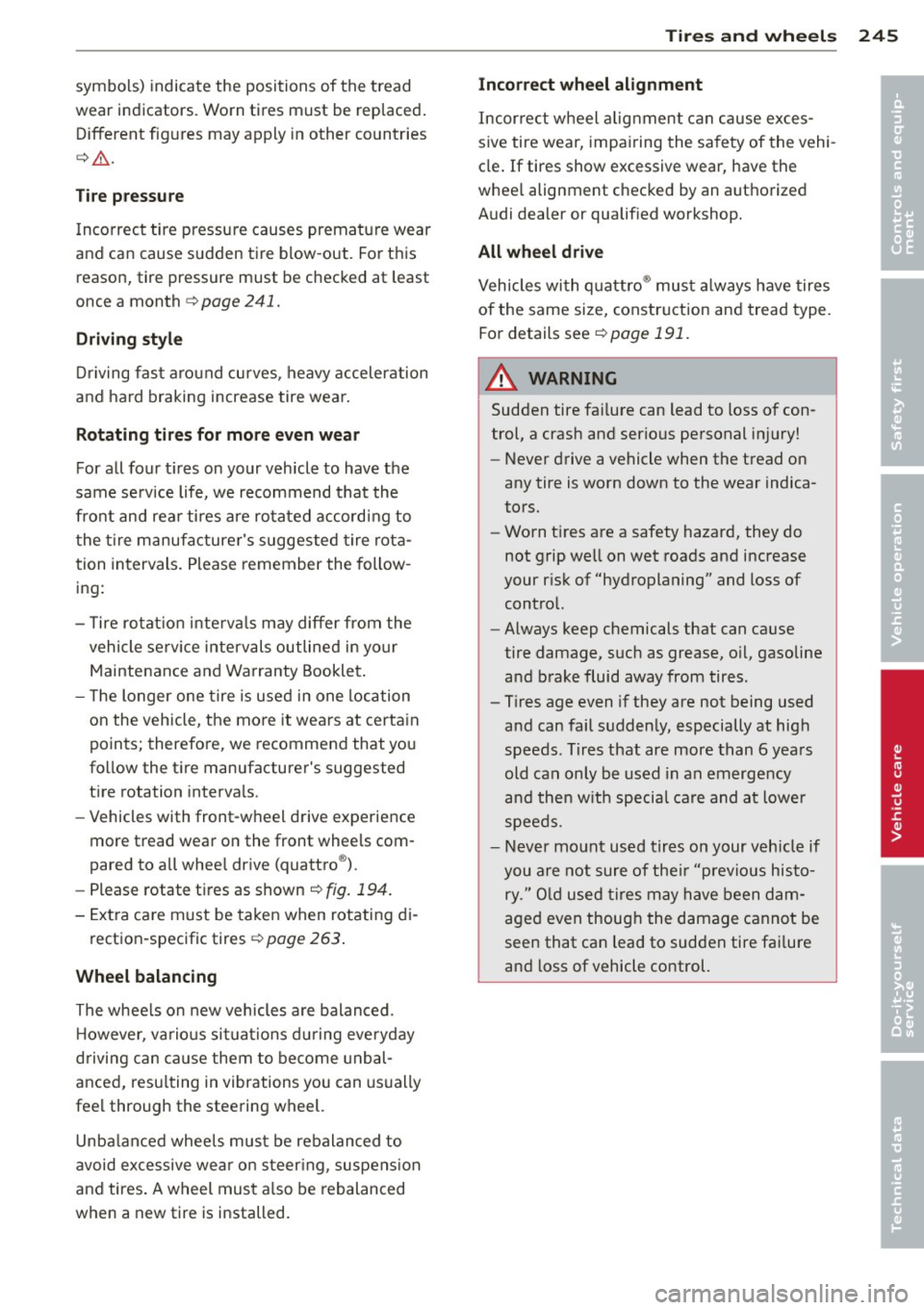
symbols) indicate the positions of the tread
wear indicators. Worn tires must be replaced.
Different fig ures may apply in other co untries
c:> .&. .
Tir e pres sure
Incorrect tire pressure causes premature wear
and can cause sudden tire blow -out. For this
reason, tire pressure must be checked at least
once a month
c:> page 241.
Driving sty le
Driving fast around curves , heavy acceleration
and hard braking increase tire wear .
Rotating tires for mo re even wear
For all four t ires on your vehicle to have the
same se rvice life, we recommend that the
fro nt and rea r tires are rotated according to
the t ire manufacture r's suggested tire rota
tion intervals. Please remember the follow
ing:
- T ire rotat ion inte rva ls may differ from the
vehicle service intervals outlined in your
Maintenance and Wa rranty Booklet .
- T he longer one tire is used in one location
on the vehicle, the more it wears at certa in
points; therefore, we recommend that you
fo llow the t ire manufacturer's suggested
t ire rotation intervals .
- Vehicles with front -wheel drive experience
more tread wear on the front wheels com
pared to all whee l drive (quattro ®).
- Please rotate tires as shown
c:> fig. 194.
-Extra care must be taken when rotating di-
rection-specific tires
c:> page 263 .
Wheel balancing
The wheels on new vehicles are balanced .
H oweve r, va rio us situations d uring eve ryday
driving can cause them to be come unbal
anced, resu lting in vibrations you can us ually
feel through the steering wheel.
Unba lanced wheels must be rebalanced to
avoid excessive wea r on s teer ing , suspens ion
and tires. A wheel must a lso be rebalanced
when a new tire is installed.
Tire s an d wheel s 245
Incorrect wheel alignment
Incor rect wheel alignment can cause exces
sive tire wear, impairing the sa fety of the vehi
cle . If tires show excessive wear, have the
whee l alignment checked by an a uthorized
Audi dealer or qualified workshop.
All wheel drive
Vehicles wi th quattro ® must a lways have tires
of the same size, construction and tread type. For details see
<=:> page 191.
_8 WARNING
Sudden tire fa ilure can lead to loss of con
trol, a crash and serious personal injury!
- Never drive a vehicle when the tread on
any tire is worn down to the wear indica
tors.
- Worn ti res are a safety hazard, they do
not grip well on wet roads and increase
your r isk of "hydroplaning" and loss of
control.
- Always keep chemicals that can cause
tire damage, such as grease, o il, gasoline
and brake fluid away from tires .
- Tires age even if they are not being used
and can fail sudden ly, especially at high
speeds. T ires that are more than 6 years
old can only be used in an emergency
and then w ith special care and at lower
speeds.
- Never mount used tires on your veh icle if
you are not sure of the ir "previous histo
ry ." O ld used tires may have been dam
aged even though the damage cannot be
seen that can lead to sudden tire fai lure
and loss of vehicle control. •
•
Page 287 of 302

A
Accessories . . . . . . . . . . . . . . . . . . . . 64, 282
AC (automatic climate control) ... .. .. .. 77
adaptive cruise control
Vehicles with manual transmission .. .
101
Adaptive cruise control ...... .. .. .. .. .. 99
C leaning sensors/camera ... ... .. .. . 205
Messages .. ................ ... ... 107
Request for driver intervention . . . . . . . 105
Setting the driving program .. .. .. .. . 104
Adaptive dampers .......... .. .. .. .. . 113
Adaptive light ................ ... ... . 47
Adaptive Light (defective) ......... .. .. 22
Adding
Engine coolant ........... .. .. .. ...
227
Engine oil .. ................ ... ... 224
Windshield washer fluid ......... .. . 233
Additional accessories
Additives 282
Engine oil .. ............. .... .. .. . 224
Adjustable steering column ... ... .. .. .. 80
Adjusting
Air distribution (automatic climate con-
trol) . . . . . . . . . . . . . . . . . . . . . . . . . . . . . .
78
Instrument illumination ... .. .. .. .. .. 50
Steering column .................... 80
Temperature (automatic climate control) 78
Airbag
Warning/indicator lights ... .. .. .. .. ..
20
Airbag system . . . . . . . . . . . . . . . . . 145, 162
Advanced Airbag System ....... ... .. 149
Advanced Airbag System components . 152
Care ... ... . .... ... ..... ..... .. ... 158
Children . .. ............. .... .. .. . 167
Child restraints ........... .. .. .. ... 168
Components (front airbags) . ... .. .. . 152
Danger of fitting a child safety seat on
the front passenger seat . . . . . . . . . . . .
146
Disposal . .. .. ........... .. .. .. ... 158
Front airbags . . . . . . . . . . . . . . . . 149, 150
How do the front airbags work? . . . . . . 154
How many airbags does my vehicle
have? ... ... ............. ...... ..
152
How the Advanced Airbag System com-
ponents work together .... .. .. .. .. .
153
Important things to know .. .. .. .. .. . 145 Index 285
Indicator light
..... ............... 156
Monitoring . ... .... ............... 156
PASSENGER AIR BAG OFF light ....... 156
Repairs ... .. .. .. ................. 158
Safety instructions ................. 158
Side airbags ..... .. ............... 160
Side curtain airbags .. .... .. .... .... 163
Weight-sensing mat ............... 167
When must the system be inspected? . 156
all-wheel drive .. .. ................. 191
Alloy wheels .. .... .. ............... 208
All wheel drive
Winter tires . .. .. .... ........... ..
250
Alternator
refer to Generator . . . . . . . . . . . . . . . . . . 17
Anti-freeze
refer to Engine coolant system ....... 226
Anti-lock braking system ............. 185
Warning/ind icator lights ........ .. .. . 19
Anti-slip regulation .. ... ....... .... . 185
Anti-theft alarm warning system ........ 32
Anti-theft systems
Electronic immobilizer .............. .
38
Armrest ...... .. .. ................. . 60
Ashtray . . . . . . . . . . . . . . . . . . . . . . . . . . . .
63
Asterisk
What does it mean when something is marked with an asterisk? . . . . . . . . . . . . . .
6
Audi braking guard
refer to braking guard ............. .. 99
Audi drive select ..... ............... 113
Adaptive dampers ................. 113
Description .. .. ...... ............. 113
Dynamic steering . ... ... .... ... .. .. 113
Setting the driving mode ............ 114
Sport differential . .. .. .. ...... .... . 113
Audi Service Repair Manuals and Litera-
ture
280
AUTO Automatic climate control .......... ..
78
Automatic headlights ............... 47
Auto Lock . . . . . . . . . . . . . . . . . . . . . . . . . . 32
Automatic belt retractor ......... .... 140
Automatic car wash
refer to Washing ... .............. . 203
•
•
Page 295 of 302
Optional equipment
Marked with an asterisk . . . . . . . . . . . . . . . 6
Othe r equipment (effic iency program) 28
Outside m irrors
refer to Exter ior mirrors . . . . . . . . . . . . . 50
Outside temperature display ... .. .. .. .. 24
Owner's manual How the Owner 's Manua l is o rganized . . . 6
p
Paint
Touch-up . .. .. .. .. .. .... ... .. .. .. . 207
Paint No ... .. ................. .. ... 275
P arce l shelf . ... .. ........ ... .. .. .. .. 75
Park assist . ................ ...... .. 116
Parking ..... .. .. .. .. .... ... .. .. .... 86
Automatic transmission . . . . . . . . . . . . . 93
Valet park ing ............ .... .. .. .. 45
P ark ing brake . ..... .... ... .. .. .. .. .. 85
also refer to Electromechanical parking
brake . ..... .. .. ... . .... ... .. .. .... 85
P ark ing system ............ .. .. .. .. . 116
C le a ning sensors/c amer a .... .. .. .. . 205
Rear . ..... ... .. .. ..... ... .. .. ... 116
Rear,withrearviewcamera ... .. .. .. . 117
P ark ing system (rear) ............ .... 116
Adj ust ing the wa rning tones .. .. .. .. . 117
Park ing system (rear, w ith rear v iew cam-
era) Park ing mode 1 . ............. ... .. 120
P ark ing mode 2 ............. ... ... 121
S afety precautions ........ .... .. .. . 118
Sw itchi ng on/off ......... .. .. .. .. . 119
Sw itching rear view camera on/off ... . 122
Part it ion net . . . . . . . . . . . . . . . . . . . . 70, 7 1
Parts rep lacement . ..... ... .. .. .. .. . 282
P ass-t hrough . . . . . . . . . . . . . . . . . . . . . . . . 7 4
PASSENGER AIR BAG OFF light . . . . . . . . 156
Passive safety system .... ... .. .. .. .. . 127
P eda ls .. .. ... ...... ............. .. 132
Phys ica l pr inc iples of a frontal coll is ion . 138
P olishing .. .. .... ............. .. .. . 20S
Pollutant filter (automatic AC system) . .. 76
Power seat adjustment . . . . . . . . . . . . . . . . . . . . 60
Inde x 293
Power locking system . . . . . . . . . . . . . . . . . 32
Emergency locking . .. ... ...... ... .. . 38
Power w indows . ... . .. ... .... ... .. . 43
Rear lid ... .. .. .. ................. . 39
Se lective unlock feature ............ . 3 7
Settings ........ .. ................ 37
Slid ing/tilting sunroof .. .. .. ... ... .. . 43
Power steering
refer to Electro-mechanical power as-
s ist ...... .. .. .. .. . .............. 190
Power w indow
Convenience opening/closing . ... .. .. . 43
Power w indows .. .. .... ........... .. . 42
Child safe ty locks . . . . . . . . . . . . . . . . . . . 42
Malfunctions .. .. ................. . 44
Pregnant women Spec ial considerations when wear ing a
safety belt . . . . . . . . . . . . . . . . . . . . . . . 142
Proper occupant seating positions ... .. 128
Proper safety belt position ..... ... .. .. 141
Proper seating posi tion
Front passenger ................... 129
O ccupants . .. .. .. .... ........... .. 128
Rea r passengers .. .... ........... .. 130
Protective liner .. .. .... ... .... .... .. . 7S
Q
Quart z clock . . . . . . . . . . . . . . . . . . . . . . . . 12
qua tt ro®
refer to all-wheel drive
191
Question What happens to unbelted occupants? 138
Why safe ty belt s? ............. .... 13 7
R
Radiator fan 228
Rain/ light sensor
Head lights .. .. .. .... ........... .. . 47
Intermittent (w indshield w ipers) . .. .. . S3
Sensor defective . . . . . . . . . . . . . . . . . . . . 22
Reading lights ....... . .. .. ..... ... .. . 50
Rea r doo r su n shade . . . . . . . . . . . . . . 52, 53
Rear fog lights .. ...... ............. . 47
Rea r lid
Automatic operation . .. ..... ... .. .. . 40
Emergency re lease . .. ... .... ... .. .. . 41
•
•
Page 297 of 302
Incorrect seat position . . . . . . . . . . . . . . 13 1
Occupants .. ..... ..... ... .. .. .. ... 128
Rear passengers . . . . . . . . . . . . . . . . . . . 130
Seat memo ry . . . . . . . . . . . . . . . . . . . . . . . 62
Seats Adjusting . . . . . . . . . . . . . . . . . . . . . 59, 60
Driver's seat . . . . . . . . . . . . . . . . . . . . . . . 58
F old ing .. .. ............. .... .. .. .. 69
F ront passenge r's seat . . . . . . . . . . . . . . . 59
H ead res traints .......... .. .. .. .. .. 6 1
Number o f seats
Safety guide lines 13
7
58
Secur ing attachments ...... .. .. .. .. .. 73
Select ive unlock feature ..... .. .. .. .. .. 37
Selector lever . . . . . . . . . . . . . . . . . . . . . . . 92
Emergency release ..... ... .. .. .. .. .. 98
Selector leve r emergency release . . . . . . . 98
Service and disposal Safety belt pretens ioner . . . . . . . . . . . . 144
Service interval disp lay . . . . . . . . . . . . . . . . 29
Service pos ition
refer to Replac ing wipe r blades . .. .. .. 54
SET button . . . . . . . . . . . . . . . . . . . . . . . . . 11
Shift indicator (eff ic iency p rogram) . ... .. 28
Side airbags Descr ipt ion . ................ ... ... 160
H ow t hey wo rk ........... .... .. .. . 16 2
side assist Adjusting the brightness ... .. .. .. .. . 111
Sensor range
Side assist 110
Activating and deactivating . .. .. .. .. . 111
Cleaning sensors ......... .. .. .. .. . 205
Descr ipt io n ..... .... ... .. .. .. .. .. . 109
Side curtain ai rbags ..... ... .. .. .. .. . 163
Description ..... .. .... ... .. .. .. ... 163
How they work ........... .. .. .. ... 164
Safety instructions ........ .. .. .. .. . 165
Side marker lights . ..... ... .. .. .. .. .. 47
Ski sack ... ... ............. ...... ... 74
Sliding/tilting sunroof Conven ience opening/closing . .. .. .. .. 43
Emergency closing ........ .. .. .. .. .. 45
Opening and clos ing ...... .. .. .. .. .. 44
Sunshade ............ ...... .... .. .
Snow chains 44
25 1
Inde x 295
Socket
12 -volt ... .. .. .... . ... ...... ... .. . 64
Sound system disp lay . . . . . . . . . . . . . . . . . 24
Sources of information abo ut child re-
stra ints and their use . .... .... ... .. .. 184
Spare tire ... .. .... .. . .. .. ..... ... .. 256
Speedometer . . . . . . . . . . . . . . . . . . . . . . . 12
Speed rat ing letter code .............. 247
Speed warning system ........... .... . 87
Sport d ifferential .. .. ... ....... .... . 113
Ind icator lamp ... .. ................ 22
S TAR T E NGINE STOP button (conven ience
ke0 ..... .. .. .. .. .. ................ 84
START ENG INE S TO P button (Convenience
key) .. ... .. .. .... .. . .. .. ..... ... .. . 83
Starting from rest .................. .. 86
Starting off w ith a trailer ......... .. .. . 87
Star ting the engine . . . . . . . . . . . . . . 80, 83
Steering Locking the steering ................ 80
olso refer to Electro-mechan ica l powe r
ass ist .. .. .. .. .. .. .. ........... .. 190
Steering wheel Adjusting steering col umn ......... .. 80
Ind icator light . . . . . . . . . . . . . . . . 18, 190
Steps for determin ing correct load limit . 243
Stopping the eng ine . . . . . . . . . . . . . . 82, 84
Storage ...... .. .... .......... ...... 64
Storage compartments . . . . . . . . . . . 66 , 75
S tronic .. .. .. .. .. .. . ... ...... ... .. . 91
Se lector lever .. .. .... ............. . 92
S t ronic transmission
Emergency re lease . . . . . . . . . . . . . . . . . . 98
Launc h Control P rog ram ... .... ... .. . 97
Sunroof .. .. .. .. .. .. ............... . 44
also refer to Slid ing/tilting s unroof . .. . 44
Sun shades Rea r doo rs . . . . . . . . . . . . . . . . . . . . 52, 53
Rear window ..... .. . .. .. ..... ... .. . 53
Su n visors .. .. .. .. .... ........... .. . 52
Symbols
refer to Warn ing/ indicator lights . .. .. . 13
T
Tachometer . . . . . . . . . . . . . . . . . . . . . . . . . 11
T e chnical modifications .......... .. .. 283
•
•