ECO mode AUDI A4 2015 Owner's Guide
[x] Cancel search | Manufacturer: AUDI, Model Year: 2015, Model line: A4, Model: AUDI A4 2015Pages: 304, PDF Size: 74.86 MB
Page 223 of 304
M N
~ co
rl I.O
"' rl
"' rl
Brake fluid
Checking brake fluid level
The brake fluid level can be checked with a
quick glance.
N
N
;:;;
" 03
"'
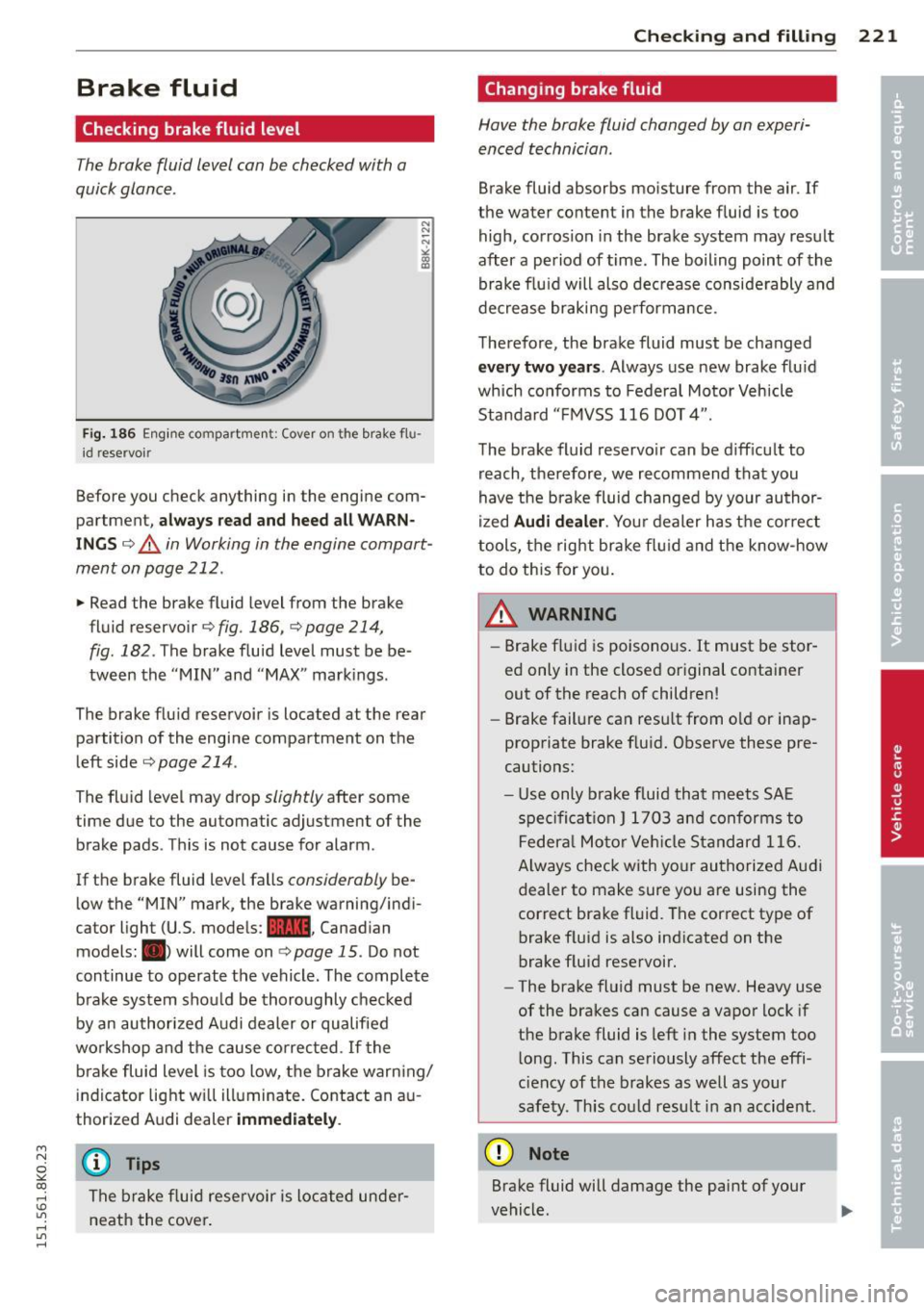
Fi g. 186 Eng ine compartment: Cover on the brake flu
id reservoi r
Before you check anything in the engine com
partment,
a lwa ys read and heed a ll W ARN
ING S c:> .&.. in Working in the engine compart
ment on page 212 .
~ Read the brake fluid level from the brake
fluid reservoir
c:> fig. 186, <=> page 214,
fig . 182.
The brake flu id level must be be
tween the "MIN" and "MAX" markings.
The brake fluid reservoir is located at the rear
partition of the engine compartment on the
left side
<::;> page 214 .
The fluid level may drop slightly after some
time due to the automatic adjustment of the
brake pads . This is not cause for alarm .
If the brake fluid level falls
considerably be
low the "MIN" mark, the brake warning/indi
cator light (U.S. models:~, Canadian
models: .) will come on
r:> page 15. Do not
continue to operate the vehicle. The complete b rake system shou ld be thoroughly checked
by an authorized A udi dealer or qualified
workshop and the cause co rrected . If the
b rake fluid level is too low, the brake warn ing/
indicator light w ill illuminate. Contact an au
thorized Audi dealer
immediately .
@ Tips
The brake f luid reservoir is located under
neath the cover .
Checking and fillin g 221
Changing brake fluid
Have the brake fluid changed by an experi
enced technician.
Brake fluid absorbs moisture from the air. If
the water content in the brake fluid is too
high, corrosion in the brake system may result
after a period of time . The boiling point of the
brake flu id will also dec rease considerably and
decrease braking pe rformance.
Therefore, the brake fluid must be changed
every two years. Always use new brake flu id
which conforms to Federal Motor Vehicle
Standard "F MVSS 116 DOT 4".
The brake fluid reservo ir can be d iff icult to
reach, the refore, we recommend that you
have the brake fluid changed by your author
i zed
Audi d ealer. Your dealer has t he correct
tools, the right brake fl uid and t he know-how
to do this for you .
A WARNING -.
-Brake fluid is poisonous . It must be stor
ed only in the closed original container
out of the reach of children!
- Brake failure can resu lt from o ld or inap
propriate brake f luid. Observe these pre
cautions:
- Use only brake fluid that meets SAE
spe cificat ion
J 1 7 03 and conforms to
Federa l Moto r Ve hicl e Standard 116.
Always check with yo ur authorized Audi
dealer to make sure yo u are using the
correct bra ke fluid. The correct type of
brake f luid is also indicated on the
brake f luid reservoir.
- The brake fluid must be new. Heavy use
of the brakes can cause a vapor lock if
the brake fluid is left in the system too
l ong. This can seriously affect the effi
c iency of the brakes as well as your
safety. Th is cou ld resu lt in an accident.
(D Note
Brake fluid will damage the paint of your
vehicle .
Page 238 of 304
236 Tires a nd whee ls
If you wish to improve comfort See the illustration ¢ fig. 189
when operating the vehicle at for the location of the label on
normal load (up to 3 occu -driver's side B-pillar (color of
pants), you can adjust tire the actual label and exact loca-
pressures to those specified tion on the vehicle will vary
for normal vehicle load. Before slight ly) .
operat ing the vehicle at maxi -Note that the following table is
mum load, you must increase accurate a t the time of going to
the ti re pressures to those press and is subject to change .
specified for maximum vehicle In the event of discrepancies ,
load¢&. the tire p ressure labe l is locat-
Bear in mind that the tire pres- ed on the driver's side 8-pi llar
sure monitoring system* can a lways takes precedence .
on ly monitor the tire pressures
The table be low lis ts the rec -
you have sto red . The system
ommended cold tire inflation
does not recogn ize t he load
pressures for the Audi model
condition of your vehic le.
covered by your Owner's Li tera-
T he effect iveness of the tire ture at the veh icle's capac ity
p ressure mon itor ing system* weight and the tire sizes instal -
will be impaire d if you st ore led on the respect ive mode ls as
normal load press ures but then original eq uipment, or as a fac -
operate the vehicle at its max i- tory optio n.
...
mum load¢&.
Page 258 of 304
256 Tires and wheels
be fitted over the wheel bolts. These are
available from authorized Audi dealers.
A WARNING
Using the wrong snow chains for your vehi
cle or installing them incorrectly can in
crease the risk of loss of control leading to
serious personal injury.
- Snow chains are available in different
sizes. Always make sure to follow the in
structions provided by the snow chain
manufacturer .
- When driving with snow chains never
drive faster than the speed permitted for
your specific snow chains.
- Always observe local regulations .
- Remove snow chains before driving on
roads not covered with snow to avoid
damaging tires and wearing the snow
chains down unnecessarily .
- Snow chains, which come into direct con
tact with the wheel rim, can scratch or
damage it . Therefore, make sure that the
snow chains are suitably covered . Check
the position of the snow chains after
driving a few yards and correct if neces
sary. Follow the instructions from the
snow chain manufacturer when doing so.
(D Tips
Where snow chains are mandatory oncer
tain roads, this normally also applies to
vehicles with all wheel drive.
Wheel bolts
Wheel bolts must always be tightened to the
corr ect torque.
The design of wheel bolts is matched to the
factory installed rims. If different rims are fit
ted, the correct wheel bolts with the right
length and correctly shaped bolt heads must
be used. This ensures that wheels are fitted
secu rely and that the b rake system functions
correctly . In certain circumstances, you may not use
wheel bolts from a different vehicle -even if it
is the same model ¢
page 285.
A WARNING "--
Improperly tightened or maintained wheel
bolts can become loose causing loss of
control, a collision and serious personal in
jury .
- Always keep the wheel bolts and the
threads in the wheel hubs clean so the
wheel bolts can turn easily and be prop erly tightened.
- Never grease or oil the wheel bolts and
the threads in the wheel hubs. They can become loose while driving if greased or
oiled, even if tightened to the specified
torque.
- Only use wheel bolts that belong to the
rim being installed .
- Never use different wheels bolts on your
vehicle.
- Always maintain the correct tightening
torque for the wheel bolts to reduce the
risk of a wheel loss. If the tightening tor
que of the wheel bolts is too low, they
can loosen and come out when the vehi
cle is moving. If the tightening torque is
too high, the wheel bolts and threads
can be damaged and the wheel can be
come loose.
Q) Note
The specified torque for the wheel bolts is
90 ft lbs. (120 Nm) with a tolerance of
± 7,4 ft lbs. (± 10 Nm). Torque wheel bolts
diagonally . After changing a wheel, the
torque must be checked as soon as possi
ble with a torque wrench -preferably by an
authorized Audi dealer or qualified work
shop .
Low aspect ratio tires
Your Audi is factory-equipped with low aspect
ratio tires. These tires have been thoroughly
tested and been selected specifically for your model for their superb performance, road feel ..,.
Page 264 of 304
262 What do I do now ?
• Always store the vehicle tool kit, the jack *
and the replaced tire in the luggage com
partment ¢
page 132.
Stowing the infl atable spare tir e
• Release the air by unscrew ing the va lve
stem.
• Screw the valve stem back in afterwards.
• Wait a few hours before p lacing the wheel in
the spare wheel well¢.&_ .
• Secure the wheel with the large screw.
• Fold the cargo floor back down.
Aft er usi ng th e inflat able sp are wh eel
The inflatable spare tire can be re-used as
long as it is not damaged and is not worn
down to the tread wear indicators¢&. .
When you let the air out of the inflatable
spare tire, it does not assume its folded shape
again for several hours . Until then, it cannot
be p laced back in the spare wheel well and
stowed securely .
A WARNING
-Never use the spare tire if it is damaged
or if it is worn down to the tread wear in
dicators.
- If the inflatable spare tire is more than 6
years old, use it only in an emergency and w ith extreme caut ion and caref ul
dr iv ing .
- The inflatable spare tire is intended only
for temporary and short-term use.
It
should be replaced as soon as possible
with the norma l wheel and tire.
- T he tire pressure value for the inflatable
spare t ire is located on the drive r's side
8 -pilla r
¢page 234, fig. 190.
-Maximum perm iss ible speed is SO mph
(80 km/h).
- Avoid full-throttle acce le rat ion, heavy
braking, and fast corner ing.
- When the air is let out of the inflatable
spare wheel, it does not ass ume its fold
ed shape for severa l hours. Until t hen, it
cannot be p laced back in the spare wheel
we ll and stowed secu rely . -
Never drive with more than one inflata
ble spare tire.
- For technical reasons, the use of tire
chains on the inflatable spare tire is not
perm itted. If it is necessary to drive with
tire chains, the inflatab le spare wheel
must be mounted on the rear axle in the
event of a f lat in a front tire . The newly
availab le rear whee l must then be instal
led in place of the front whee l with the
f lat t ire. Instal ling the tire chain before
mount ing the wheel and tire is recom
mended .
- L oose items in the passenger compart
ment can cause serious personal injury
during hard braking or in an accident.
Never store the inflatable spare tire or
jack* and too ls in the passenger com
partment.
(D Note
- The inflatable spa re tire has been deve l
oped specifically for this vehicle mode l.
It must not be exchanged or used for
other vehicle models. Sim ilarly, inflata
ble t ires from other vehicle models must
not be used.
- Normal summer or w inter tires must not
be installed on the inflatable t ire rim.
Inflating inflatable
spare tire
Applies to veh icles: w ith inflatable spare t ire
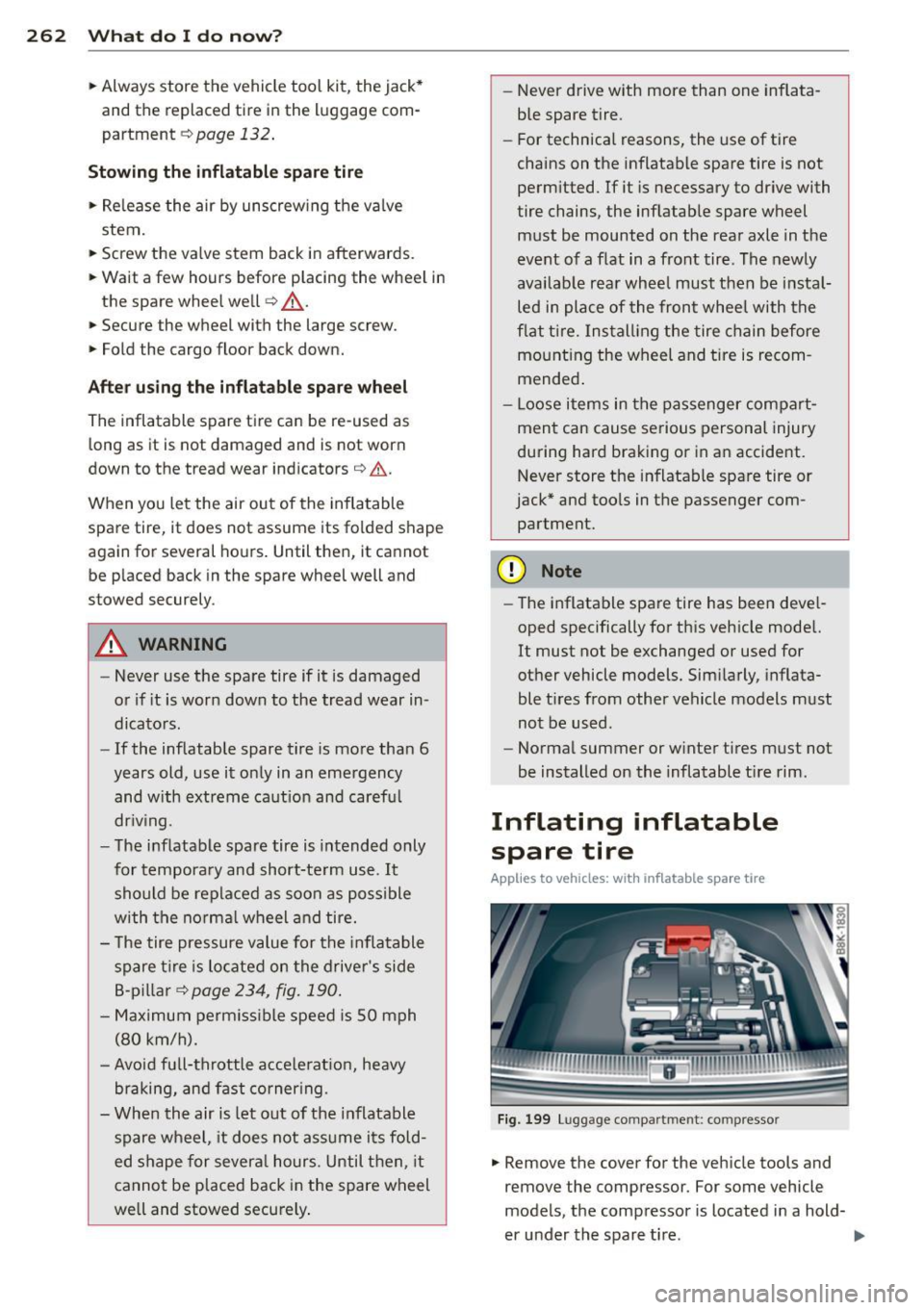
F ig. 199 Lu gg age compart ment: co mpressor
• Remove the cover for the veh icle tools and
remove the compressor. For some vehicle
models, the compressor is located i n a hold-
er under the spare tire . .,.
Page 274 of 304
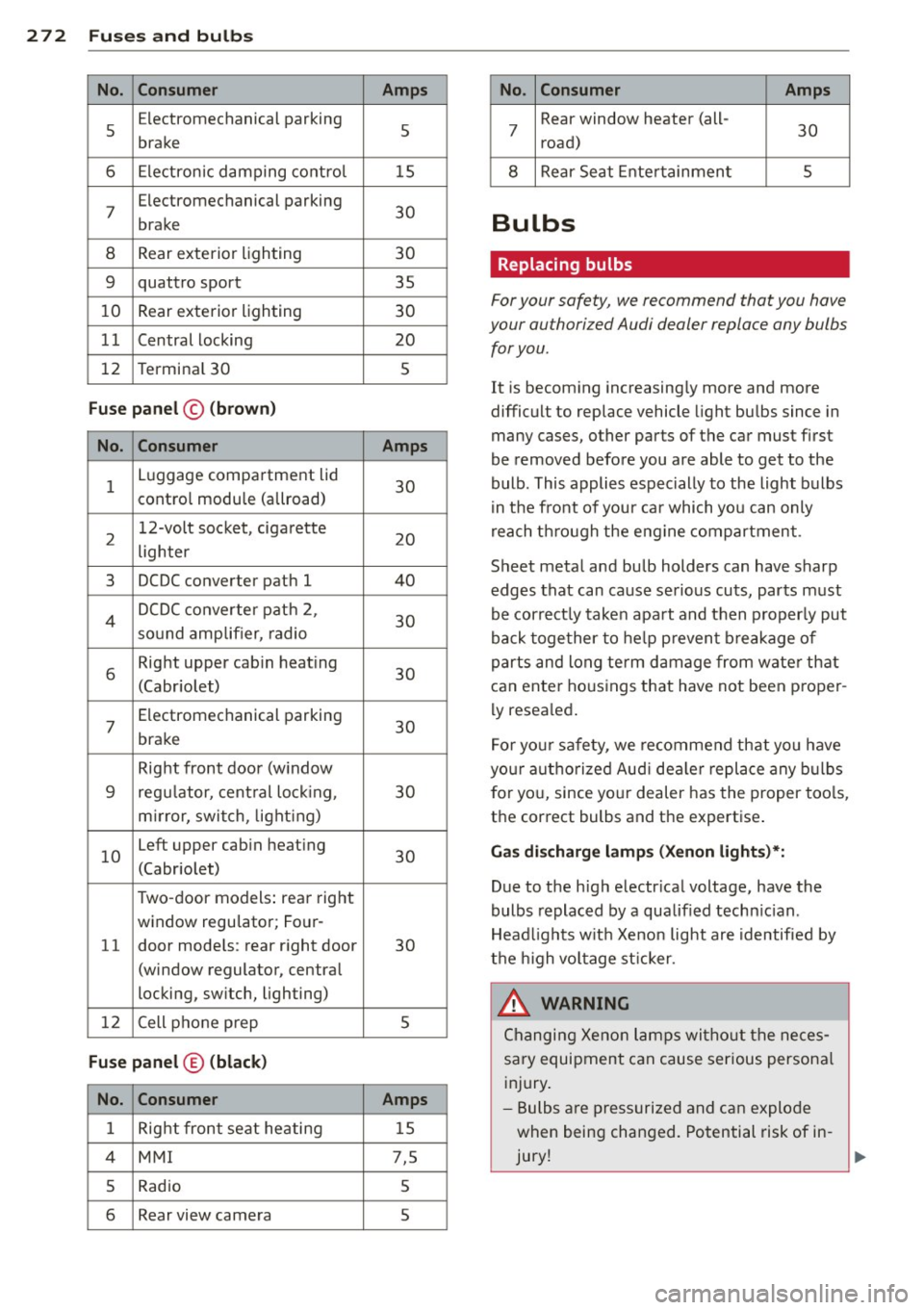
272 Fuses and bulb s
No. Consumer
5 Electromechanical parking
brake
6 Electronic damping control
7
Electromechanical parking
brake
8 Rear exterior lighting
9 quattro sport
10 Rear exterior lighting
11 Central locking
12 Terminal
30
Fuse panel © (brown)
No. Consumer
1 Luggage compartment lid
contro l module (allroad)
2 12-volt
socket, cigarette
lighter
3 DCDC converter path 1
4 DCDC converter path 2,
so und amp lifier, radio
6
Right upper cab in heat ing
(Cabr iolet)
7
Electromechanical parking
brake
Right front door (w indow
9 regu lator, central locking,
mirror, switch, lighting)
1 0 Left upper cabin
heating
(Cabr iolet)
T wo -door models : rear right
window regu lator; Four-
11 door models: rear r
ight door
(window regulator, central
locking, sw itch, lighting)
12 Cell phone prep
Fuse panel © (black)
No. Consumer
1 Right front seat heating
4
MMI
5 Radio
6 Rear view camera
Amps
5
15
30
30
35
30
20 5
Amps
30
20
40
30
30
30
30
30
30
5
Amps
15
7,5
5
5
No . Consumer Amps
7 Rear window heater (all-
30
road)
8 Rear Seat Entertainment s
Bulbs
Replacing bulbs
For your safety, we recommend that you hove
your authorized Audi dealer replace any bulbs
for you.
It is becoming increasingly more and more
difficult to replace vehicle light bulbs since in
many cases, other parts of the car must first
be removed before you are able to get to the
bulb. This applies especially to the light bulbs
in the front of your car which you can only
reach through the engine compartment .
Sheet metal and bulb holders can have sharp
edges that can cause serious cuts, parts must
be correctly taken apart and then properly put
back together to help prevent breakage of
parts and long term damage from water that
can enter housings that have not been p roper
l y resea led.
For your safety, we recommend that you have
you r authorized Aud i dea ler replace any bulbs
for you, since yo ur dealer has the proper too ls,
the correct bulbs and the expertise .
Gas discharge lamp s (Xenon lights)*:
Due to the high electr ical voltage, have the
bulbs replaced by a qualif ied techn ic ian.
Headlights wit h Xenon light are identified by
the high voltage sticker.
_&. WARNING
Changing Xenon lamps witho ut the neces
sa ry equipment can cause serious persona l
injury.
- Bulbs are pressurized and can explode
when being changed. Potential risk of in
jury!
-
Page 277 of 304
M N
~ co
rl I.O
"' rl
"' rl
@ Tips
The discharged battery must be properly
connected to the vehicle's electrical sys
tem. When jump starting or charg ing the
battery, never connect the negative
ground cable to the battery negat ive post
because the ba ttery manager system must
be ab le to detect the battery's state of
charge. Always connect the negative
g round cab le to the negative ground pos t
of t he battery manager cont ro l unit.
Use of jumper cables
Make sure to connect the jumper coble
clomps in exactly the order described b elow!
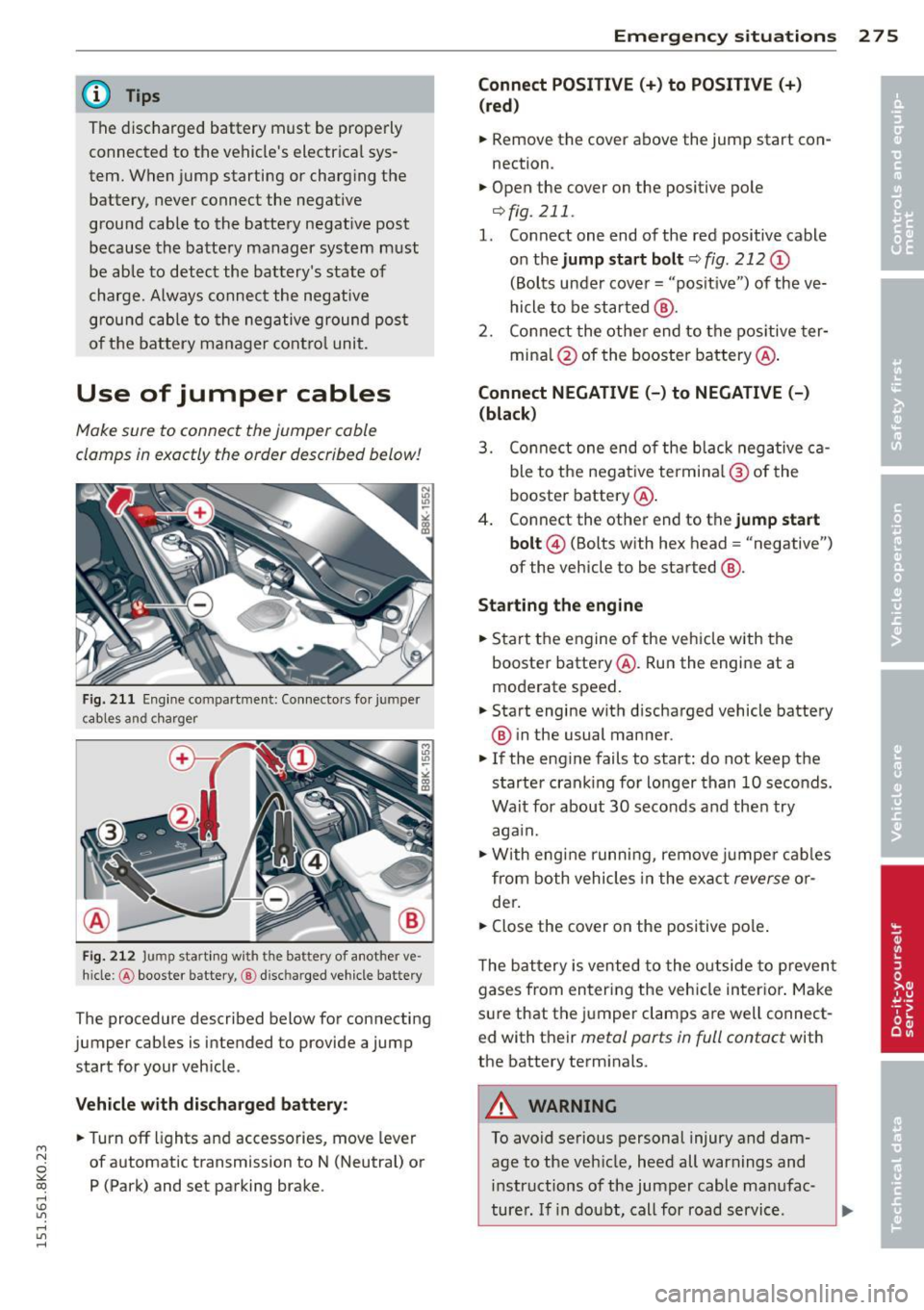
Fi g. 21 1 Eng ine co mpar tment: Co nnecto rs fo r jum per
c ab les a nd c har ge r
F ig. 212 Jump start in g w ith t he ba ttery of a not her ve ·
hi cle :@ booster battery, @ disc harged veh icle battery
The procedure described below for connecting
jumper cables is intended to provide a jump
start for your veh icle .
Vehicle with di scharged battery :
~Turnoff lights and accessories , move lever
of automatic transmission to N (Neutral) or P (Park) and set parking brake .
Emergency situ ation s 2 7 5
Connect POSITIVE(+) to POSITIVE(+ )
(red )
~ Remove the cover above the jump start con
nection .
~ Open the cover on the positive pole
¢fig . 211 .
1. Connect one end of the red positive cable
on the
jump sta rt bolt c::;, fig. 212 (D
(Bolts under cove r= "posit ive ") of the ve
hicle to be started @.
2 . Conne ct the othe r end to the pos itive ter -
mina l@ of the booster battery @.
Connect NEGATIVE (-) to NEGATIVE (-)
(black )
3. Co nnect one end o f the b lack neg ative c a
ble to the nega tive te rmi na l@ of the
booster battery @.
4 . Connect the other end to the
jump start
bolt @
(Bolts with hex head = "negative")
of the vehicle to be started @.
Starting the engine
~ Start the engine of the ve hicle with the
booste r battery @. Run the engine at a
moderate speed.
~ Start engine with d ischarged vehicle battery
® in the usual manner .
~ If the engine fails to start: do not keep t he
starter cran king for lo nger than 10 seconds .
Wait for about 30 seco nds and the n try
aga in.
~ W ith engi ne runni ng, remove jumpe r cab les
from both vehicles in the exa ct
reverse o r
der .
~ Close the cover on the positive pole .
T he b attery is vented to the o utside to p reven t
gases from en tering the veh icle in ter ior . Ma ke
s ur e that the j umper clamps a re well connect
e d with their
metal ports in full contact with
the batte ry term inals.
A WARNING
To avoid serious personal injury and dam
age to the vehicle, heed all warnings and
in structions of the jumper cable ma nufac-
turer . If i n dou bt, call for road servic e.
Ill>
Page 285 of 304
'"" N
0 ::.,: co ,...., \!) 1.1"1 ,...., 1.1"1 ,....,
Consumer Information
Warranty coverages
Your Audi is covered by the following war
ranties :
- New Vehicle Limited Warranty
- Limited Warranty Against Corrosion Perfo-
ration
- Emissions Control System Warranty
- Emissions Performance Warranty
- California Emissions Control Warranty (USA
vehicles only)
- California Emissions Performance Warranty
(USA vehicles only)
Detailed information regarding yo ur warran
ties can be found in your
Warranty & Mainte
nance booklet .
Operating your vehicle
outside the U.S.A. or
Canada
Government regulations in the United States
and Canada require that automobiles meet
specific emission regulations and safety
standards. Therefore, veh icles built for the
U.S.A. and Canada differ from vehicles sold in
other countries .
I f you p lan to take your vehicle outside the
continental limits of the United States or Can
ada, there is the possibility that:
- unleaded fuels for vehicles with cata lytic
converter may not be available;
- fuel may have a considerably lower octane
rating . Improper fuel may cause engine
damage;
- service may be inadequate due to lack of
proper service facilities, tools or testing
equipment;
- replacement parts may not be readily availa
ble.
- Navigation systems for vehicles built for the
U.S.A. and Canada will not necessari ly work
in Europe, and may not work in other coun
tries outside of North America.
Consumer Information 283
@ Note
Audi cannot be responsible for mechanical
damage that could result from inadequate
fuel, serv ice or parts availab ility.
Audi Service Repair
Manuals and Literature
Audi Offic ial Factory Service Manuals and Lit
erature are published as soon as possible after
model introduct ion. Service manuals and lit
erat ure are available to order from the Audi
T echnical Literature Ordering Center at:
www.audi.techliterature.com
Maintenance
' General
Your vehicle has been designed to help keep
maintenance requirements to a m inimum.
However, a certain amount of regular mainte
nance is still necessary to assure your vehicle's
safety, economy and reliability . For detailed
vehicle maintenance consult your Warranty
&
Maintenance booklet.
Under difficult operating conditions , for ex
ample at extremely low outside temperatures,
in very dusty regions, when towing a trailer
very frequently, etc., some serv ice work
shou ld be pe rformed between the intervals
specified. This applies particularly to:
- oil changes, and
- cleaning or replacing the air filter.
® For the sake of the environment
By regularly maintaining your veh icle, you
help make sure that emission standards
are maintained, thus min imiz ing adverse
effects on the environment .
Important considerations for you and
your vehicle
The increasing use of electronics, sophistica t
ed fuel injection and emission contro l sys-
tems, and the genera lly increasing technica l ..,_
•
•
Page 292 of 304
29 0 Index
Child restra ints
D ang er of using child restraints in th e
front seat . . . . . . . . . . . . . . . . . . . . . . . . 145
Where can I get addit ional information
about child restra ints and their use? . . 183
C hild restraint system anchors ..... .. . 179
Ch ild safety .. ................ ... ... 165
Conve rtible locking retracto r .. .. ..... 175
I mportant safety instructions fo r using
ch ild safety seats ....... .. .. .. .. .. . 168
I mportant things to know when driving
with chi ldren .. .. ..... ... .. .. .... . 165
Installing a child restraint us ing the
LATCH system . . . . . . . . . . . . . . . . . . . . . 180
Lower anchorages .......... .. .... . 180
Mount ing and releasing the anchorage
hook .. .... .......... ...... ... .. . 180
Tether anchors ............... .. ... 181
Tether st raps .......... .. .. .. .. .. . 18 1
Ch ild safety locks
Power windows . ..... .... .. .. .. .. .. 42
Rear doors . .............. ... .. .. .. 41
C hild safety seats .. ..... ... .. .. .... . 17 1
Booster se ats . . . . . . . . . . . . . . . . . . . . . 173
Convertible c hild seats .... .. .. .... . 172
Convertible locking retracto r .. .. ..... 175
Danger of us ing c hild restra ints in the
front seat . . . . . . . . . . . . . . . . . . . . . . . . 145
H ow do I proper ly install a child safety
seat in my vehicle? ...... .. .. .. .. .. . 168
I nfant sea ts ............. .. .. .. .. . 17 1
I ns tall ing . . . . . . . . . . . . . . . . . . . . . . . . 17 5
LATCH system .. .. ..... ... .. .. .... . 180
Safety instructions ..... ... .. .. .... . 168
Unused safety belts on the rear seat . . 170
C igare tte lig hte r . . . . . . . . . . . . . . . . . . . . . 65
C leaning .. .. ................ ... .. .
202
Climate controls . . . . . . . . . . . . . . . . . . . . . 78
C lima te con trol system
Automat ic recircula tion .... .. .. .. .. . . 81
Supp lementary hea ter ... .. .. .. .... . . 81
synchronizing .. . ...... ... .. .. .... .. 81
C lock ....... .......... ...... ... .. .. 12
C losing
Power windows .......... .. .. .... .. 42
Sliding/tilting sunroof ...... ..... .. .. 43
Sunshade .. ................ ... ... . 43 Closing/opening
at the lock cylinder . . . . . . . . . . . . . . . . . . 3 7
by remote control . . . . . . . . . . . . . . . . . . 34
with the centra l locking switch ... .... . 3S
with the conven ience key ........ .... . 35
Co ld tire infla tion pressure ..... ... .. .. 234
Coming home . . . . . . . . . . . . . . . . . . . . . . . 50
Compact spare ti re . ............. .... 260
also refer to Spare tire .......... .. .. 260
Compartments . . . . . . . . . . . . . . . . . . . . . . 68
Compass in the m irror ... .. ... ..... .. . 58
Compliance ..... .. .. ... ..... ... .. .. 286
Consumer Informa tio n . . . . . . . . . . 134, 283
Contacting NHTSA . ... .......... .. .. 134
Controls Cleaning . ..... .. .. ... ..... ... .. .. 204
Convenience key Indi cator lights .. ... .......... .. .. . 86
Star ting engine (S TART E NGIN E STOP
button) ... .... .. ... .. ..... ... .. .. . 85
Stopping the engine (START ENGINE
STOP button) . . . . . . . . . . . . . . . . . . . . . . 86
Switching on ignition ........... .... . 85
unlocking/lock ing ............. .... . 35
Convenience opening/clos ing ... .. .. .. . 42
Convertib le child safe ty seats ........ . 172
Convertib le locking retractor
Activating . .. .. .. ............. .. .. 177
Deact ivat ing ... .. ... .... ...... .... 178
U sing to secure a child safety seat 1.75, 177
Coolant system .... .. ... ..... ... .. .. 218
Cooling mode (automat ic climate co ntrol) 79
Cooling System Expansion tank . .. .......... ...... . 218
Cornering light .... .. .... .... ... .. .. . 49
Cru ise cont ro l
Changi ng speed .. ............. .. .. . 91
Presett ing you r speed .......... .... . 92
Switching off .... .. ... ..... ... .. .. . 92
Switching on ..... ... .. ..... ... .. .. . 91
Cruisi ng range ... .. ............. .... . 24
( u pholder .. .... .. ............. .... . 67
D
Data recorder . . . . . . . . . . . . . . . . . . . . . . 184
Date d isp lay .... .. ............. .... . 12
Page 293 of 304
"" N
0 ::.,: co ,...., \!) 1.1'1 ,...., 1.1'1 ,....,
Index 291
-----------------------------------.......
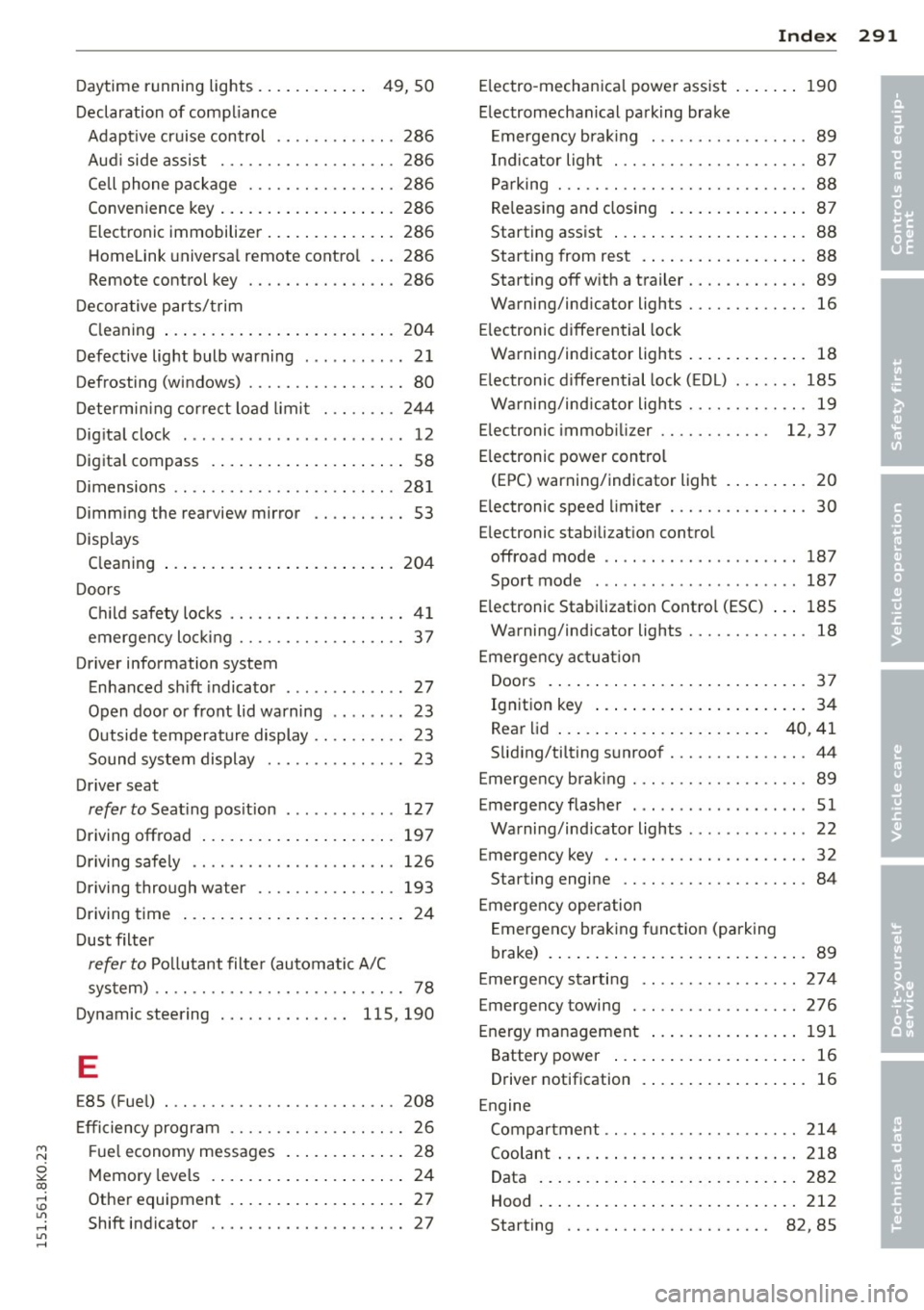
Daytime running lights. . . . . . . . . . . . 49, 50
Declaration of compliance Adapt ive cruise control .... .. .. .. .. . 286
Aud i side assist .......... .. .. .. ... 286
Cell phone pa ckage ....... .. .. .. .. . 286
Conve nience key ... .... ... .. .. .. ... 286
Elect ronic immobilizer .. ... .. .. .. .. . 286
Homelink universa l remote contro l .. . 286
Remote control key ....... .. .. .. .. . 286
D ecora tive parts/ trim
C lean ing ... .... ...... ... .. .. .. ... 204
Defective light bulb warning . . . . . . . . . . . 2 1
Defrosting (windows) ....... .. .. .. .. .. 80
D etermi ning correct load limi t ... .. .. . 24 4
Dig ita l clock ........... ...... .... ... 12
Dig ita l compass . .. ..... ... .. .. .. .... 58
D imensions .. ............. .... .. ... 28 1
Dimming the rearview mirror . . . . . . . . . . 53
D isp lays
C leaning ... .. .... .... ... .. .. .. ... 204
D oors
C hi ld safety loc ks ......... .. .. .. .. .. 41
emergency loc king ........ .. .. .. .. .. 3 7
Driver information system Enhanced sh ift indicato r .... ... ... ... 27
Open doo r or front lid warning . . . . . . . . 23
Outside temperat ure display .. .. .. .. .. 23
Sound system display . . . . . . . . . . . . . . . 23
Driver seat
refer to Seat ing pos ition 127
Driving off road ... ...... ... .. .. .. ... 197
D riving safe ly ............. .... .. ... 126
Driving through water . . . . . . . . . . . . . . . 193
D riving time . . . . . . . . . . . . . . . . . . . . . . . . 24
Dust filter
refer to Po llutant filte r (automatic A/C
system) .. .. ............. .... .. .. .. 78
Dynamic steering . . . . . . . . . . . . . . 115 , 190
E
E85 (Fue l) . .. ............. .... .. ... 208
E ffi ciency program . . . . . . . . . . . . . . . . . . . 26
Fu el economy messages . . . . . . . . . . . . . 28
M emory leve ls . . . . . . . . . . . . . . . . . . . . . 24
Othe r equipment . ..... ... .. .. .. .. .. 27
Shift indicator ........... .. .. .. .... 27 E
lectro -mechan ica l power ass ist ... .. .. 190
E lectromechanical pa rk ing brake
E mergency bra king ................ . 89
Ind icator lig ht . .. .... ........... .. . 87
Parking ... .. .. .. ................. . 88
Re leas ing and closing ... .... ... .. .. . 87
Starting assist ...... .. .. ..... ... .. . 88
Starting from rest . ... .. .... ... .. .. . 88
Starting off w ith a trailer ........ .. .. . 89
Warning/ind icator lights ............. 16
E lectronic differential lock
Warning/indicator lights ..... ... .. .. . 18
El ectronic d ifferential lock ( EDL) ... .. .. 185
Wa rning/ind icator lights ........ .. .. . 19
E lectronic immob ilizer . . . . . . . . . . . . 12, 37
E lectronic power con trol
(EPC) warning/indicator light . . . . . . . . . 20
El ectronic speed limi ter ............... 30
E lectronic stab ilizat ion contro l
offroad mode . . . . . . . . . . . . . . . . . . . . . 187
Sport mode . . . . . . . . . . . . . . . . . . . . . . 187
E lectronic Stabilization Contro l (ESC) ... 185
Warning/ind icator lights ............. 18
Emergency ac tua tion
Doors . ... .. .... ... .. .. ..... ... .. . 37
Ignition key ..... .. . .. .. ..... ... .. . 34
Rea r lid . . . . . . . . . . . . . . . . . . . . . . . 40, 41
Slid ing/ti lting s unroof ............... 44
E merge ncy br aking . .... ......... .. .. . 89
Emergency flasher ..... .. .... .... ... . 51
w . /' d' l' h arnmg m 1cator 19 ts . . . . . . . . . . . . . 22
Emergency key .. ................... . 32
Starting engine ............... .... . 84
Emergency operation Emergency bra king funct ion (parking
brake) . ... .. .... .. . .. .. ..... ... .. . 89
E mergency starti ng ................. 274
Emergency towing .................. 276
Energy management .. .. ..... ... .. .. 191
Battery power ... .. . ... .... ... .. .. . 16
Driver notification . .. .. ..... ... .. .. . 16
En gine
Compartment .. ................... 214
Coolant ... .. .. .... .. ... ..... ... .. 218
Data ... .. .. .... .. . .. .. ..... ... .. 282
Hood ... .. .. .... .. . .. .. ..... ... .. 212
Starting . . . . . . . . . . . . . . . . . . . . . . 82, 85
•
•
Page 295 of 304
_______________________________ ___:I~n ~d ~e:.::x 293
Fue l
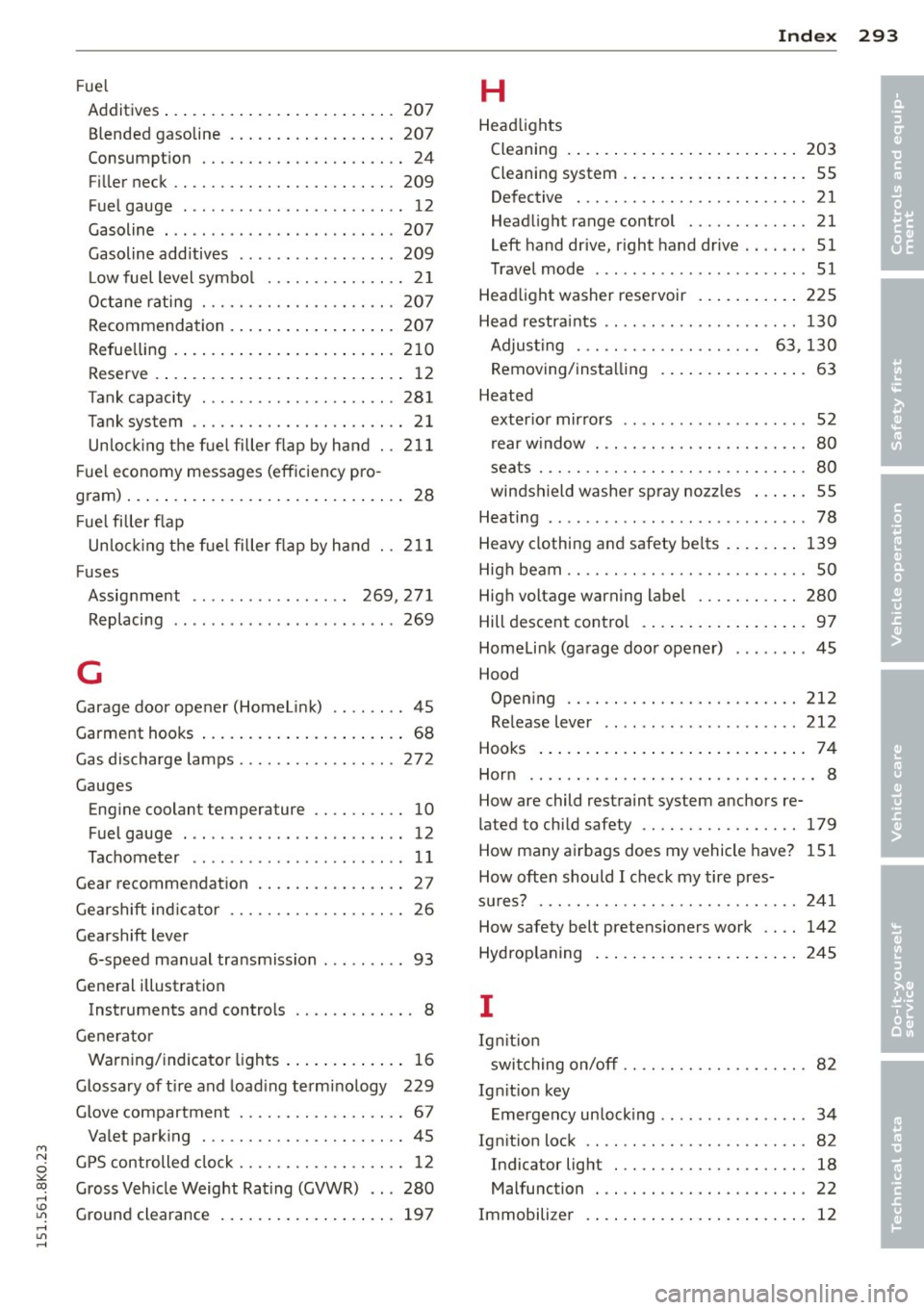
Additives ... ..... ..... ... .. .. .. ... 207
Blended gasoline . ..... ... .. .. .. .. . 207
Consumpt ion . . . . . . . . . . . . . . . . . . . . . .
24
Filler neck .. ............. .... .. ... 209
Fue l gauge . ................ ... ... . 12
Gasoline ... ... .. .. ...... .. .. .. .. . 207
Gasoline additives ........... .... .. 209
L ow fuel level symbo l . . . . . . . . . . . . . . . 2 1
Octane r ating ............ .... .. ... 20 7
Recommenda tion . ..... ... .. .. .. .. . 20 7
Refue lling . ... .... .... ... .. .. .. ... 210
Reserve .... .... .. .... ... .. .. .. .... 12
T ank capacity . ........... .. .. .. ... 281
Tank system ............. .... .. .... 21
Unlock ing the fue l filler f lap by hand . . 211
F ue l economy messages (eff iciency pro-
gram) ..... .. .. .... .. .... ... .. .. .... 28
F ue l filler flap
Un loc king the f ue l filler fl ap by hand . . 211
Fuses Assignment . . . . . . . . . . . . . . . . . 269, 271
R l . ep acing .................. .... .. 269
G
Garage door ope ner (Homel ink) .. .. .. .. 45
Garment hooks . . . . . . . . . . . . . . . . . . . . . . 68
Gas discharge lamps ........ .. .. .. .. . 27 2
Gauges Eng ine coolant tempera ture .. .. .. .. .. 10
Fuel gauge ..................... ... 12
Tac hometer . . . . . . . . . . . . . . . . . . . . . . . 11
Gear recommendat ion ...... .. .. .. .. .. 2 7
G h.ft . d'
ea rs
I in 1cator . . . . . . . . . . . . . . . . . . . 26
Gearshift lever 6-speed manual tra nsmission . ....... . 93
General illustration
H
Head lights
Cleaning . ... .... .. . .. .. ..... ... .. 203
Cleaning system . . . . . . . . . . . . . . . . . . . . 55
Defective . . . . . . . . . . . . . . . . . . . . . . . . . 21
Head light range control ............ . 21
Left hand dr ive, r ight hand drive .. .. .. . 51
Trave l mode ...... ................. 51
Head light washer reservoir .... ... .. .. 225
Head restra ints .. .. ................. 130
Adjus ting . . . . . . . . . . . . . . . . . . . . 63, 130
Remov ing/insta lling . .. ..... ... .. .. . 63
Heated exter io r mir rors . . . . . . . . . . . . . . . . . . . . 52
r ear w indow . .. .. .... ........... .. . 80
sea ts ..... .. .. .. .... ............. . 80
windshield washer sp ray nozz les . . . . . . 55
Heating .......... .. ..... ........... 78
Heavy clothing and saf ety be lts . ... .. .. 139
Hig h beam .. .. .. .. .. . ... ........... . SO
Hig h voltage warning label ......... .. 280
Hill descent contro l .. . .. ..... ... .. .. . 97
Homelink (ga rag e doo r opener) ..... .. . 45
Hood
Open ing .. .. .. .. .... ............. 212
Re lease lever .. .. .. . .. ... ... .. .. .. 212
Hooks ... .. .. .... .. . .. .. ..... ... .. . 74
Hor n .. .... .. .... ..... ... ... ... ... .. 8
How are child restraint system anchors re-
lated to chi ld safety ........... .. .... 179
How many ai rbags does my vehicle have?
How often should I check my tire pres-
su res?
How safe ty bel t pre ten sioners w ork .. . .
Hydrop la ni ng ..... .. . .. .. ..... ... . . 151
2 41
142
24S
Instruments and contro ls . . . . . . . . . . . . . 8
I
Gene ra to r
Warn ing/ indicator ligh ts ... .. .. .. .. .. 16
Glossary of t ire and load ing te rm inology 229
Glove compartment . . . . . . . . . . . . . . . . . . 6 7
Va let pa rk ing ............ .... .. .. .. 45
G PS controlled clock . ..... .. .. .. .. .. .. 12
Gross Veh icle Weight Rat ing (GVWR) ... 280
Ground cl earance ... .... ... .. .. .. .. . 197 Ig
nition
swi tching on/off .. ...... .. .. ... .... . 82
Ig nitio n key
E m ergency unlock ing .......... .... .. 34
Ign it ion lock .. .. .. ...... .. ... ...... . 82
Indic ato r light . .. ........... ...... . 18
Mal func tion . . . . . . . . . . . . . . . . . . . . . . . 22
Immobilizer . . . . . . . . . . . . . . . . . . . . . . . . 12
•
•