brake light AUDI A4 2015 Owner's Guide
[x] Cancel search | Manufacturer: AUDI, Model Year: 2015, Model line: A4, Model: AUDI A4 2015Pages: 304, PDF Size: 74.86 MB
Page 201 of 304
'"" N
0 ::.,: co ,...., \!) ..,.,
,...., ..,., ,....,
Trailer towing Driving with a trailer
General information
Your Audi was designed primarily for passen
ger transportation .
If you plan to tow a tra iler, p lease remember
that the addit ional load will affect durab ility,
economy and performance .
T railer towing not on ly places more stress on
the vehicle, it also calls for more concentra
tion from the driver.
F or this reason, a lways fo llow the operating
and driving instructions provided and use
common sense.
Technical requirements
Traile r hitch
Use a weight-carrying hitch conforming to the
gross trailer we ight. The hitch must be suita
b le for your veh icle and trailer and must be
mounted secure ly on t he veh icle's chassis at a
technically sound location . Use only a t railer
h itch w ith a removab le ball moun t. A lways
check with the tr ailer hitch man ufac tur er to
make sure that you are using the correct
hitch.
Do not use a bumper hitch.
T he hitc h must be installed in such a way that
it does not inte rfe re with the impac t-absorb
i ng b umper syst em. No modifica tions should
be made to the vehicle exhaus t and b rake sys
tems . From t ime to time, check that a ll hitch
mo unt ing bolt s remain securely fas tened.
W hen you are not tow ing a trailer, remove the
trai le r hi tch ball moun t. T h is prevents the
hi tch from causing damage sho uld your ve hi
cle be str uck from be hind
¢ &. .
Trailer brakes
If yo ur tra iler is equ ipped w it h a braking sys
tem, check to be su re that it conforms to a ll
r eg ulat io ns .
Trailer towin g 199
The trailer hyd ra ulic bra ke system must not be
direct ly connected to the vehicle's hydraulic
brake system
¢ &. .
Safety chains
Alw ays use s afety chains between your ve hicle
and t he tra ile r.
Trailer lights
Tra ile r lights m ust meet all reg ulations . Be
su re to check w ith your authorized Audi dealer
fo r c orrec t w iri ng, sw itches, and relays.
Mirrors
If you a re unable to see the traffic behind you
u sing the regula r outside m irrors, then you
must insta ll ext ended mir ro rs. It is important
t h at you
always have clea r vis io n to the rear .
.8, WARNING
- If a trai ler has elec trica l br ake s plea se
no te th at t hese bra kes are not activat ed
by the fa ctory -fit ted control unit -risk of
accident!
- After removing the t railer hi tch, do no t
s to re it in yo ur vehicle . In case of sudden
brak ing, the hitch could fly fo rward and
in ju re you or yo ur passenge rs .
Operating instructions
Maximum traile r we ight
-
A trai ler fo r you r vehicle is limited to a typical
class 1 or class 2 tra iler.
Trailer load distribution
B e sure the lo ad in the tra iler is h eld secure ly
i n p lace to p reven t it from shifting fo rward,
backward or sideways.
Never allow a passenger to ride in a trailer
¢ &. in Driving instru ctions on page 200.
Engine cooling system
T owing a t railer ma kes t he engine wor k hard
er . It is impo rta nt that the cooling system's
perfo rman ce is up to the additional load.
Make sure tha t the coo ling sys tem h as enough
f lu id . .,..
•
•
Page 202 of 304

200 Trailer towing
Tire pressure
When towing a trai le r, inflate the tir es of your
vehicle to the cold tire pressure listed under
"Full load" on the label located on the driver 's
side B-pillar (visible when the door is open).
Inflate trailer tires to trailer and tire manufac
turers' specifications.
Lights
The headlight settings should be checked with
the trailer attached before dr iving off. Check
to make sure both vehicle and tra iler lights
are working properly.
Safety chains
Be sure trailer safe ty cha ins are properly con
nected from the trailer to the hitch on the ve
hicle. Leave eno ugh slack in the chains to per
mit turning corners. When you install safety
cha ins, make sure they w ill not drag on the
road when you are driving.
The chains shou ld cross under the trai ler
tongue to prevent it from dropping in case of
separation from the hitch.
Driving instructions
Driving with a trailer always requires extra
care and consideration.
To obtain the best possible handling of vehicle
and trai ler, p lease note the following:
.,. Do not tow a loaded trailer when your car it
self is not loaded .
.,. Be especia lly careful when passing other
vehicles .
.,. Observe speed limits .
.,. Do not drive at the maximum permissible
speed.
.,. Always apply brakes early.
.,. Monitor the temperature gauge.
Weight distribution
Towing a loaded trai ler with an empty car re
sults in a highly unstable distribution of
weight . If this cannot be avo ided, drive at very
low speeds only to avoid the risk of losing
steering control. A "ba
lanced" rig is easier to operate and con
tro l. This means that the tow vehicle should
be loaded to the extent possible and permissi
ble, while keep ing the trai ler as light as possi
ble under the c ircumstances. Whenever poss i
ble, transfer some cargo to the luggage com
partment of the tow veh icle while obse rving
tongue load requi rements and vehicle load ing
considerations.
Speed
The higher the speed, the more d iff icu lt it be
comes for the driver to control the rig. Do not
drive at the maximum permissible speed. Re
duce your speed even more if load, weather or
wind conditions are unfavorable -pa rticularly
whe n going downhill.
Reduce veh icle speed
immediately if the trail
er shows the slightest s ign of sway ing.
Do not
try to stop the swaying by accelerating.
Observe speed limits . In some areas, speeds
for vehicles tow ing tra ilers are lower than for
regular vehicles .
Always apply brakes early. When driving
downh ill, shift into a lower gear to use the en
gine braking effect to slow the vehicle. Use of
the brakes alone can cause them to overheat
and fail.
Coolant temperature
The coolant temperature gauge c> page 10
must be observed carefully . If the needle
moves close to the upper end of the scale, re
duce speed immediately and/or turn off the
air conditioner.
If the coolant temperature warning light •
i n the i nstrument cluster starts flashing, pull
off the road, stop and let the engine
idle for
abo ut two minutes to prevent heat build-up .
_& WARNING
Anyone not properly restrained in a mov
ing vehicle is at a much greater risk in an
accident . Never let anyone ride in your car
who is not p roper ly wea ring the restraints
provided by Audi.
-
Page 205 of 304
'"" N
0 ::.,: co ,...., \!) 1.1"1 ,...., 1.1"1 ,....,
Vehicl e ca re a nd cl eanin g 203
& WARNING
-Only wash the vehicle when the ignition
is off and follow the instructions from
the car wash operator to reduce the risk
of accidents.
- To reduce the risk of cuts, protect your
self from sharp meta l components when
washing the underbody or the inside of
the wheel housings.
- After washing the vehicle, the braking ef
fect may be delayed due to moisture on
the brake rotors or ice in the winter . The
brakes must be dried first with a few
careful brake applicat ions .
{[) Note
-If you wash the vehicle in an automatic
car wash, you must fold the exterior m ir
rors in to reduce the r isk of damage to
the mirrors . Power folding exterior m ir
ro rs* must only be folded in and out us
i ng the power folding function.
- To prevent pa int damage, do not wash
the veh icle in direct sunl ight. -
To reduce the r isk of damage to the sur
face, do not use insect removing spong es, kitchen sponges or similar items.
- Matte finish painted vehicle compo
nents :
- To reduce the risk of damage to the
surface, do not use polishing agents or hard wax.
- Never use car wash cycles that apply
protective wax.
It can destroy the
matte fi nish effect.
- Do not place any stickers or magnet ic
signs on vehicle parts painted w ith
matte fi nish paint. The paint cou ld be
damaged when the stickers o r magnets
are removed.
@ For the sake of the environment
Only wash the vehi cle in facilities spec ial ly
designed for that purpose . This will red uce
the risk of dirty water contam inated with
oil from entering the sewer system.
Cleaning and care information
When clean ing and caring for individua l vehi
cle components, refer to the fo llow ing tab les .
The informa tion contained there is s imply rec
ommendations. For questions or for compo- nents that are not listed
, refer to an author
ized Audi dea ler or qua lified workshop. A lso
fol low the information fo und in ¢ ,&. .
Cleanin g exte rior
Component Situation Solution
Wiper blade s
Dirty ¢ page 5 6, Cleaning windshield wiper blades
Hea dlight s/ Dirty Soft sponge with a mild soap solution a>
t a il light s
Sen sors /
Dirty Sensors: soft cloth with a so lvent-free cleaning product
came ra lens es Camera lenses: soft cloth with an alcohol-free cleaning
solution
Snow/ice Hand brush/so
lvent-free de-icing spray
Wheels Road sal t Water
Brake d ust Acid-free special cleaning so
lution
Ex haust tail Road sa lt Water, cleaning solut io n suitable for sta inless steel, if
pipe s necessary
•
•
Page 214 of 304
212 Checking and filling
Checking and filling
Engine hood
Releasing and opening the engine hood
The engine hood is released from inside the
vehicle .
Fig. 180 Driver's side footwe ll: e ngin e hood release
lever
... -- - -=-
Fig. 181 Release lever u nde r the engine hood
Before opening the engine hood, make sure
that the windshield wipers are flat against the
windshield. Otherwise, they could damage the
pa int on the hood.
... With the driver's door open, pull the lever
under the instrument panel in the direction
of the arrow
c> fig . 180.
... Raise the hood slightly c> .&,
... Press the rocker switch under the hood up
ward
c> fig . 181 . This releases the catch.
... Open the hood.
A WARNING
Hot engine coo lant can burn you.
- T o reduce the risk of being burned, never
open the hood if you see or hear steam
or coolant escaping from the engine
compartment. Wait until no steam or coo
lant can be seen or heard before care
fully opening the hood.
Closing the engine hood
... Pull the hood down until the pressure from
the struts is reduced .
... Let the hood
drop down and latch in place.
Do not try to push it shut; it may fail to en
gage
c> .&, .
A WARNING
-
A hood that is not completely latched
could fly up and b lock your view while driv
ing.
- When you close the engine hood, check it
to make sure the safety catch has proper
ly engaged . The hood shou ld be flush
with the surrounding vehicle body parts.
-If you notice while driving that the hood
is not secured properly, stop at once and
close it.
Working in the engine compartment
Be especially careful whenever you work in
the engine compartment.
Whenever you must perform any work in the
engine compartment, for example checking
and filling different fluids , there is a risk of
injury , burns and accidents. To prevent per
sonal injury always observe the following
WARNINGS. The engine compartment of any
vehicle is a hazardous area
c> ,&..
A WARNING
-To help avoid injury, before you check any-
thing under the hood:
- Turn off the engine.
- Remove the ignition key.
- Apply the parking brake.
- Move selector lever of automatic trans-
mission to "P" (Park); put manual trans
mission in Neutral.
- Always let the engine cool down. Hot
components will burn skin on contact .
Page 223 of 304
M N
~ co
rl I.O
"' rl
"' rl
Brake fluid
Checking brake fluid level
The brake fluid level can be checked with a
quick glance.
N
N
;:;;
" 03
"'
Fi g. 186 Eng ine compartment: Cover on the brake flu
id reservoi r
Before you check anything in the engine com
partment,
a lwa ys read and heed a ll W ARN
ING S c:> .&.. in Working in the engine compart
ment on page 212 .
~ Read the brake fluid level from the brake
fluid reservoir
c:> fig. 186, <=> page 214,
fig . 182.
The brake flu id level must be be
tween the "MIN" and "MAX" markings.
The brake fluid reservoir is located at the rear
partition of the engine compartment on the
left side
<::;> page 214 .
The fluid level may drop slightly after some
time due to the automatic adjustment of the
brake pads . This is not cause for alarm .
If the brake fluid level falls
considerably be
low the "MIN" mark, the brake warning/indi
cator light (U.S. models:~, Canadian
models: .) will come on
r:> page 15. Do not
continue to operate the vehicle. The complete b rake system shou ld be thoroughly checked
by an authorized A udi dealer or qualified
workshop and the cause co rrected . If the
b rake fluid level is too low, the brake warn ing/
indicator light w ill illuminate. Contact an au
thorized Audi dealer
immediately .
@ Tips
The brake f luid reservoir is located under
neath the cover .
Checking and fillin g 221
Changing brake fluid
Have the brake fluid changed by an experi
enced technician.
Brake fluid absorbs moisture from the air. If
the water content in the brake fluid is too
high, corrosion in the brake system may result
after a period of time . The boiling point of the
brake flu id will also dec rease considerably and
decrease braking pe rformance.
Therefore, the brake fluid must be changed
every two years. Always use new brake flu id
which conforms to Federal Motor Vehicle
Standard "F MVSS 116 DOT 4".
The brake fluid reservo ir can be d iff icult to
reach, the refore, we recommend that you
have the brake fluid changed by your author
i zed
Audi d ealer. Your dealer has t he correct
tools, the right brake fl uid and t he know-how
to do this for you .
A WARNING -.
-Brake fluid is poisonous . It must be stor
ed only in the closed original container
out of the reach of children!
- Brake failure can resu lt from o ld or inap
propriate brake f luid. Observe these pre
cautions:
- Use only brake fluid that meets SAE
spe cificat ion
J 1 7 03 and conforms to
Federa l Moto r Ve hicl e Standard 116.
Always check with yo ur authorized Audi
dealer to make sure yo u are using the
correct bra ke fluid. The correct type of
brake f luid is also indicated on the
brake f luid reservoir.
- The brake fluid must be new. Heavy use
of the brakes can cause a vapor lock if
the brake fluid is left in the system too
l ong. This can seriously affect the effi
c iency of the brakes as well as your
safety. Th is cou ld resu lt in an accident.
(D Note
Brake fluid will damage the paint of your
vehicle .
Page 224 of 304
222 Check ing and filling
@ For the sake of the environment
Becau se of the pr oblem of proper disposa l
of brake flu id as we ll as the special tools
requ ired and the necessary expert ise, we
recommend that you have the brake fluid
changed by your author ized Audi dealer.
Battery
General information
Unde r normal operating conditions, the bat
tery in your Audi does not need any mainte
nance. With
high outside temperatures or
long daily dr ives we recommend that you have
the electro lyte level checked by an authorized
Aud i dea ler o r qualified workshop . The elec
trolyte leve l sho uld a lso be checked each t ime
the battery is charged ¢
page 224.
Have the battery checked when you take your
ve hicle in for service . Yo u are well adv ised to
replace a bat tery that is older tha n 5 yea rs .
W ith certa in types of a irbag deployment, t he
battery is d isconnected from the vehicle elec
tr ica l system fo r safety reasons ¢
& in Re
pair, core and disposal of the airbags on
page 157.
Disconnecting the battery terminals
Some veh icle functions (power w indow regu
lato rs, for example) are lost if the battery ter
m inals a re discon nected. These functions have
to be re lea rned after the batte ry terminals a re
connec ted agai n. T o prevent this, the battery
should o nly be d isconnec ted from the vehicle
e lec trica l syste m when absolu tely necess ary
for repairs.
Vehicles not driven for long periods
I f yo u do not drive you r vehicle over a pe riod
of severa l days or weeks, elec trical co m po
nen ts are gr adually cu t back o r swi tched off .
T his reduces energy consumption and main
tains sta rting capab ility over a lon ger period
¢ page 191.
Some o f the conven ien ce f unct ions m ay no t
ope rate, su ch as the in ter ior lights o r the power seat adjus
tment. The convenience
funct ions wi ll be available again when yo u
tu rn on the ignition and sta rt t he engine.
Winter operation
Du ring the w inte r mon ths , b att ery capac ity
tends to dec rease as temperatures drop . This
is beca use more power is a lso consumed w hile
starting, and the headlights, rear win dow de
f ogger, etc., are used more often.
Avoid unnecessa ry powe r consumpt ion, pa r
ticu lar ly in ci ty traffic o r when traveling only
sho rt distances . Let yo ur autho rized A udi
dealer check the capacity of the vehicle bat
tery before w inter sets in ¢
page 224. A well
charged battery will not on ly prevent starting
problems when the weather is cold, but will
also last longer .
@ Tips
If your vehicle is left standing for seve ral
weeks at extremely low temperatures, the
vehicle battery s hou ld be removed and
s tored w her e it w ill not freeze. This will
preve nt i t fr om be ing d amaged and having
t o be repla ced .
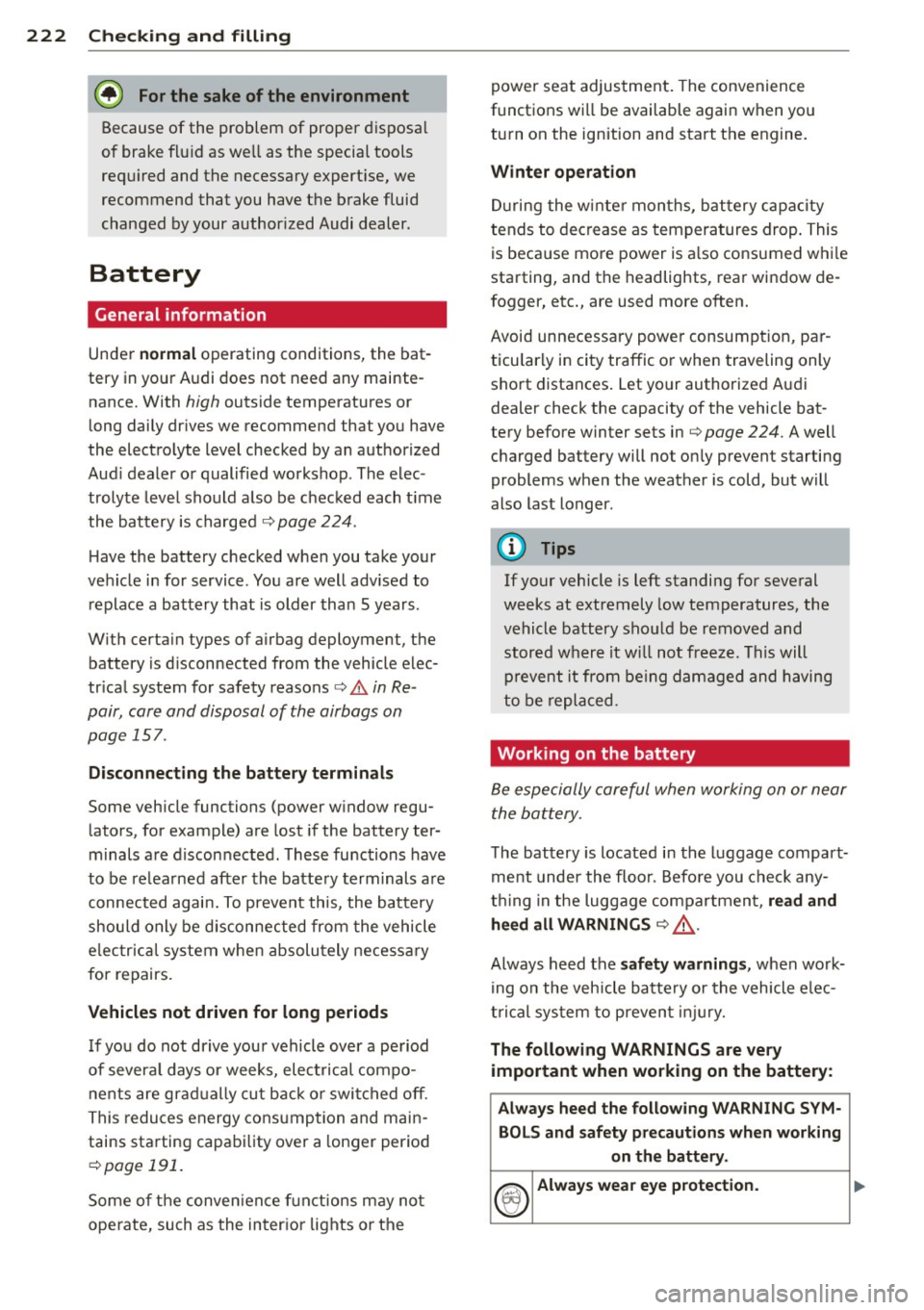
Working on the battery
Be especially careful when working on or near
the battery.
The battery is located in the luggage compar t
ment under the floor . Befo re you che ck any
t hi ng in the luggage co mpartment,
read and
heed all WARNINGS
¢ .&, .
Always heed the safety warnings , when work
i ng on the veh icle ba tte ry or the vehicle e le c
t ric al sys tem to p reven t inju ry.
The following WARNINGS are very
important when working on the battery:
Always heed the following WARNING SYM ·
BOLS and safety precautions when working
on the battery .
®
Always wear eye protection .
Page 269 of 304
'"" N
0 ::.,: co ,...., \!) 1.1'1 ,...., 1.1'1 ,....,
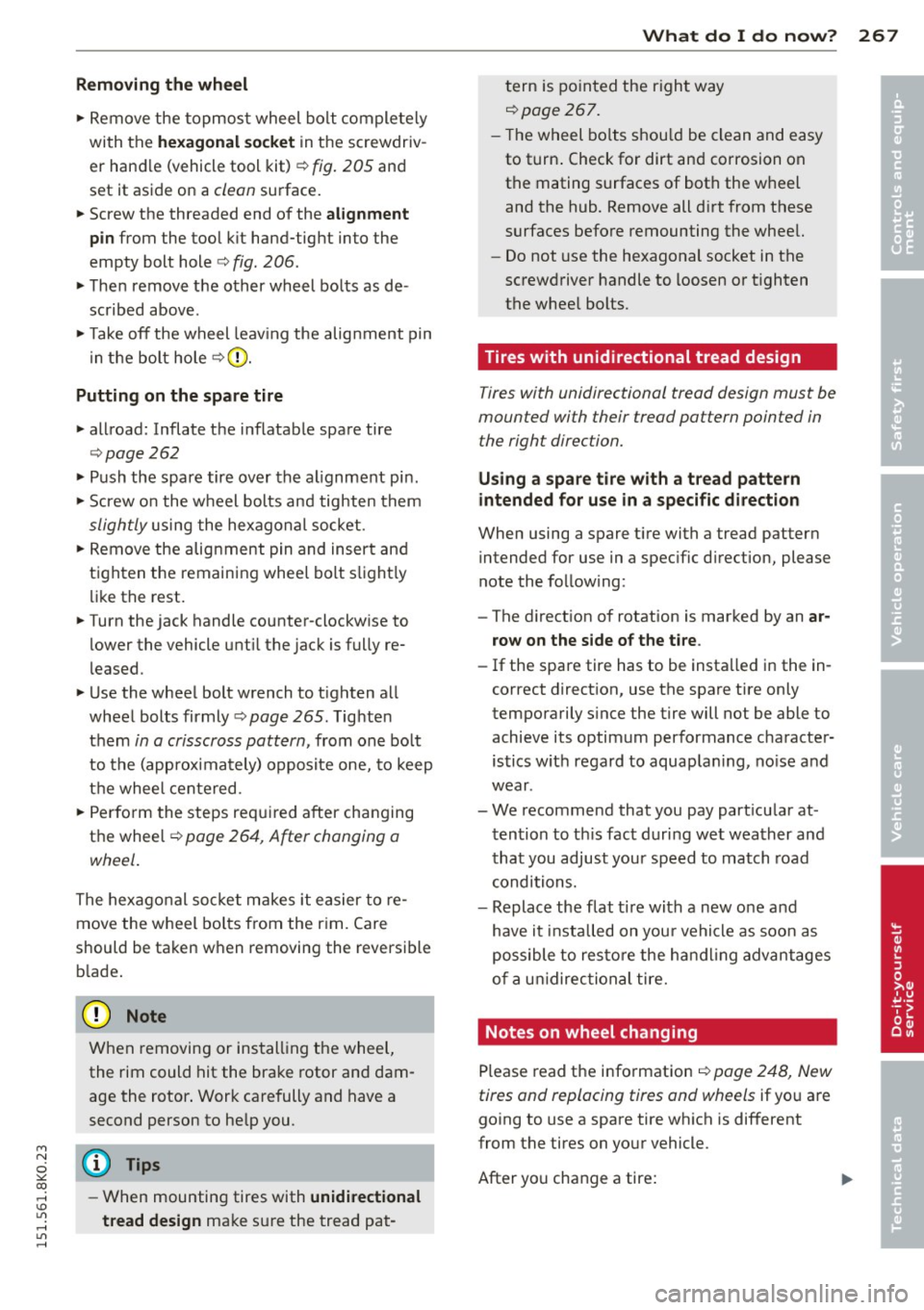
Removing the wheel
"' Remove the topmos t wheel bolt completely
with the
he xagonal socket in t he screwdriv
er hand le (vehicle tool kit)
c::> fig. 205 and
set it aside on a
clean surface.
"' Screw the threaded end of the
alignment
pin
from the tool k it hand-tight into the
empty bolt hole
c::> fig. 206.
"'T hen remove the other wheel bo lts as de
scribed above .
"'T ake off the wheel leav ing the alig nment pin
i n t he bolt hole
c::> CJ).
Putting on the spare tire
"' allroad : Inflate the inflatable spare tire
c::> page 262
"' Push the spare tire over the a lignment pin.
"' Screw o n the w heel bolts and tighten them
slightly using the hexagonal socket.
"' Remove the alignment pin and insert and
t ighten the remaining whee l bo lt s light ly
Li ke the rest.
"' Turn the jack handle counter-clockw ise to
lower the vehicle unt il the jack is f ully re
l eased .
"' Use the wheel bolt w rench to t ighten all
whee l bolts firmly
c::> page 265. Tig hten
them
in a crisscross pattern, from one bo lt
to the (approx imately) opposi te o ne, to keep
t h e whee l cen te red.
"'P erfo rm the steps req uired after changing
t h e whee l
c::> page 26 4, After changing a
wheel .
The hex agonal so cket m akes it easier to re
move the w heel bo lts from the r im . Care
should be taken when removing the reversible
b lade .
@ Note
When removing or ins tal ling the wheel,
the rim could hit the brake rotor and dam
age the rotor . Wor k carefully and have a
second person to he lp you.
@ Tips
- When mounting tires with unidirectional
tread design
ma ke s ure the tread pat-
What do I do now? 267
'
tern is po inted the righ t way
c::> page 267.
- T he w heel bolts shou ld be clean an d easy
to t urn . Check fo r dirt an d corrosion on
the mating surfaces of both the w heel
and the hub. Remove all d irt from these
surfaces before remounting the whee l.
- Do not use the hexagonal socket in the
sc rewd river handle to loosen or t ighten
the whee l bolts.
Tires with unidirectional tread design
Tires with unidirectional tread design must be
mounted with their tread pattern pointed in
the right direction.
U si ng a spa re tire with a tread pattern
intended for use in a specific di rection
When using a spare t ire with a tread patter n
intended for use in a spec ific d irection, please
note the following :
- The d irect ion of rotation is marked by an
ar
row on the side of the t ire .
-If the spare tire has to be insta lled in the in
correct d irect ion, use the spare tire only
temporarily s ince the tire will not be able to
achieve its optimum performance cha racte r
istics w it h regard to aquap la ni ng, no ise and
wear .
- We recommend that you pay part icu lar at
t en tion to th is fact during wet weather and
that you adjust your speed to match road
condi tions.
- Replace the flat t ire wi th a new one a nd
have it insta lled o n you r vehicle as soo n as
pos sible to res to re the hand ling advant ages
o f a u nidirec tional tire.
Notes on wheel changing
Please read t he info rmation c::> page 248, New
tires and replacing tires and wheels
if yo u a re
going to use a spare tire wh ich is different
from the tires on your vehicle.
After yo u change a tire:
IJI,-
•
•
Page 272 of 304
2 70 Fuses and bulbs
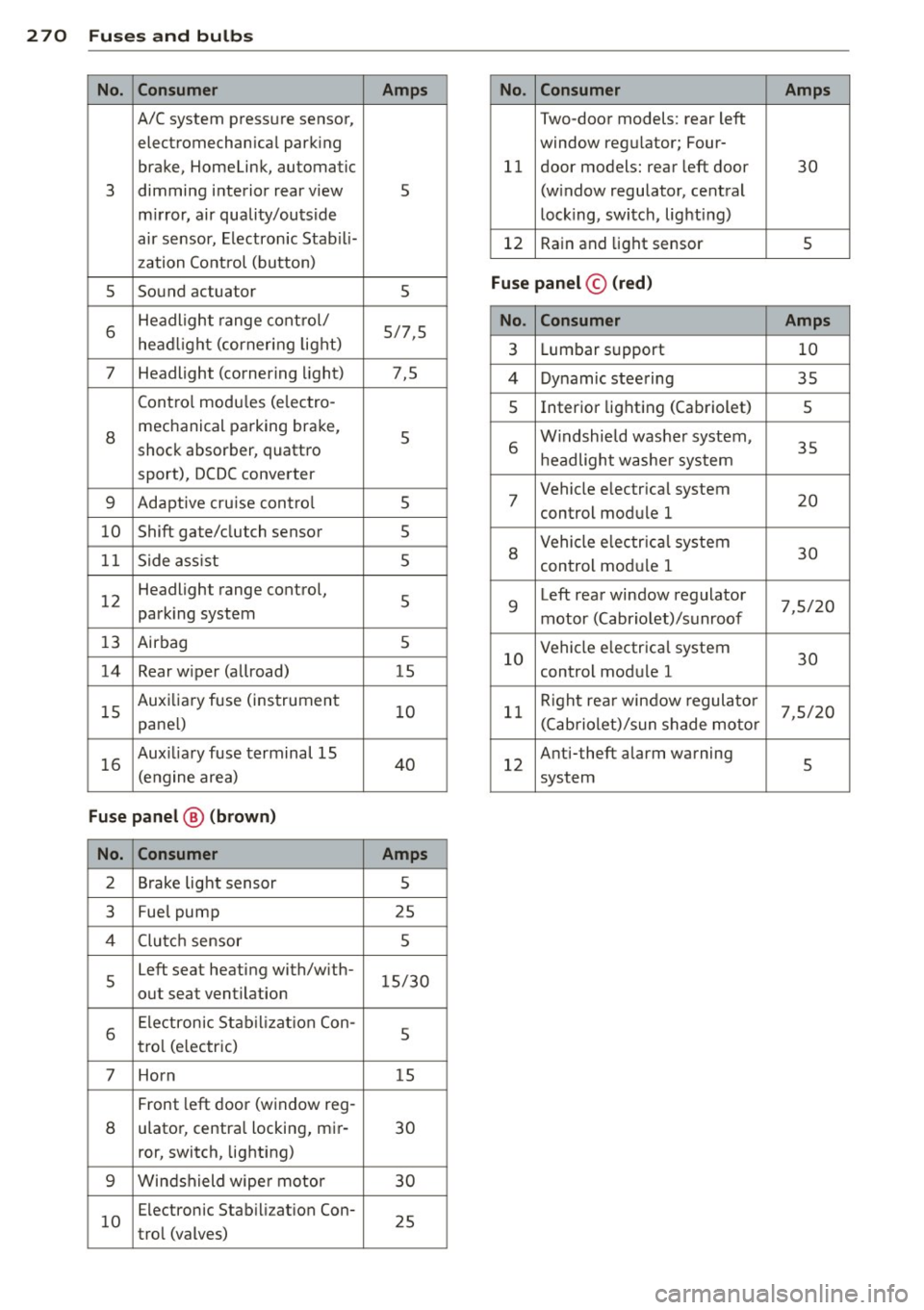
No. Consumer Amps No. Consumer Amps
A/C system pressure sensor, Two-door models: rear left
electromechanical parking window regulator; Four-
brake, Homelink, automatic 11 door models: rear
left door
30
3 dimming interior rear view
5 (window regulator, central
m irror, air quality/outside locking, switch, lighting)
air sensor, Electronic Stab ili-
12 Rain
and light sensor
5
zation Control (button)
5 Sound actuator 5
Fuse panel© (red)
6 Headlight
range control/
5/7,5
head light (corner ing light)
No . Consumer Amps
3 Lumbar support 10
7 Headlight (cornering light) 7,5
4 Dynamic steering
35
Contro l modu les (electro-
5 Interior lighting (Cabriolet)
5
8 mechanical parking brake,
5
shock absorber, quattro
sport), DCDC converter
9 Adaptive cruise control 5 6
W
indshield washer system,
35
headlight washer system
7 Vehicle electrical system
20
control module 1
10 Shift gate/clutch sensor
5
11 Side ass ist 5
8
Vehicle electr ica l system
30
control module 1
12 Headlight range control,
5
parking system 9 Left rear window regulator
7,5/20
motor (Cabriolet)/sunroof
13 Airbag 5
14 Rear wiper (allroad) 15 10
Vehicle e
lectrica l system
30
control module 1
15 Auxiliary fuse (instrument
10
pane l) 11 Right
rear window regulator
7,5/20
(Cabriolet)/sun shade motor
16 Aux
iliary fuse terminal 15
40
(engine area) 12 Anti-theft alarm warning
s system
Fuse panel
@ (brown)
No. Consumer Amps
2 Brake light sensor 5
3 Fuel pump 25
4 Clutch sensor 5
5 Left seat heating with/with-
15/30
out seat ventilation
6 Electronic Stabilization
Con-
5
trol (electric)
7 Horn 15
Front left door (window reg-
8 ulator, centra
I locking, mi r-
30
ror, switch, lighting)
9 Windshield wiper motor 30
10 Electronic Stabi
lization Con-
25
trol (valves)
Page 274 of 304
272 Fuses and bulb s
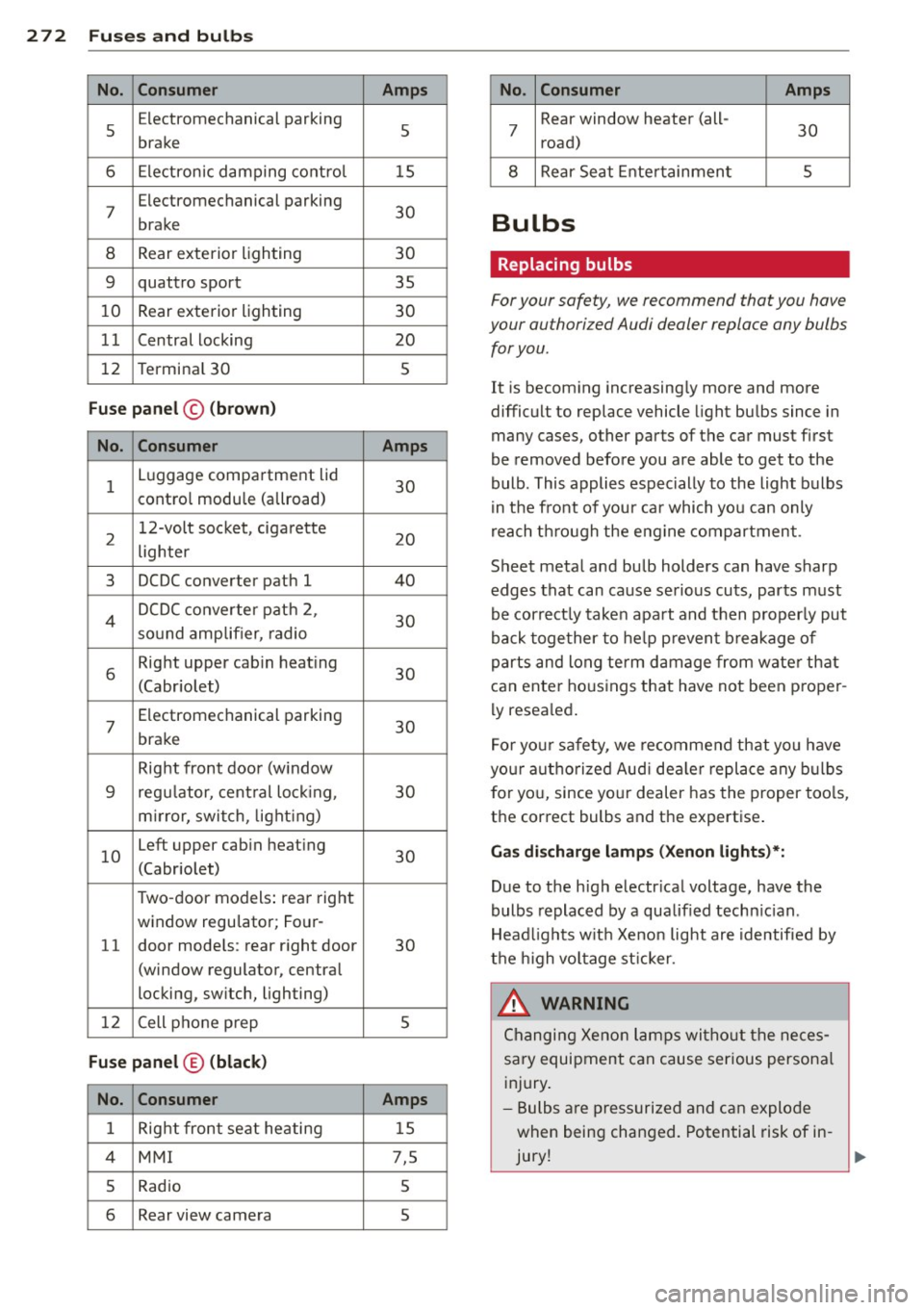
No. Consumer
5 Electromechanical parking
brake
6 Electronic damping control
7
Electromechanical parking
brake
8 Rear exterior lighting
9 quattro sport
10 Rear exterior lighting
11 Central locking
12 Terminal
30
Fuse panel © (brown)
No. Consumer
1 Luggage compartment lid
contro l module (allroad)
2 12-volt
socket, cigarette
lighter
3 DCDC converter path 1
4 DCDC converter path 2,
so und amp lifier, radio
6
Right upper cab in heat ing
(Cabr iolet)
7
Electromechanical parking
brake
Right front door (w indow
9 regu lator, central locking,
mirror, switch, lighting)
1 0 Left upper cabin
heating
(Cabr iolet)
T wo -door models : rear right
window regu lator; Four-
11 door models: rear r
ight door
(window regulator, central
locking, sw itch, lighting)
12 Cell phone prep
Fuse panel © (black)
No. Consumer
1 Right front seat heating
4
MMI
5 Radio
6 Rear view camera
Amps
5
15
30
30
35
30
20 5
Amps
30
20
40
30
30
30
30
30
30
5
Amps
15
7,5
5
5
No . Consumer Amps
7 Rear window heater (all-
30
road)
8 Rear Seat Entertainment s
Bulbs
Replacing bulbs
For your safety, we recommend that you hove
your authorized Audi dealer replace any bulbs
for you.
It is becoming increasingly more and more
difficult to replace vehicle light bulbs since in
many cases, other parts of the car must first
be removed before you are able to get to the
bulb. This applies especially to the light bulbs
in the front of your car which you can only
reach through the engine compartment .
Sheet metal and bulb holders can have sharp
edges that can cause serious cuts, parts must
be correctly taken apart and then properly put
back together to help prevent breakage of
parts and long term damage from water that
can enter housings that have not been p roper
l y resea led.
For your safety, we recommend that you have
you r authorized Aud i dea ler replace any bulbs
for you, since yo ur dealer has the proper too ls,
the correct bulbs and the expertise .
Gas discharge lamp s (Xenon lights)*:
Due to the high electr ical voltage, have the
bulbs replaced by a qualif ied techn ic ian.
Headlights wit h Xenon light are identified by
the high voltage sticker.
_&. WARNING
Changing Xenon lamps witho ut the neces
sa ry equipment can cause serious persona l
injury.
- Bulbs are pressurized and can explode
when being changed. Potential risk of in
jury!
-
Page 277 of 304
M N
~ co
rl I.O
"' rl
"' rl
@ Tips
The discharged battery must be properly
connected to the vehicle's electrical sys
tem. When jump starting or charg ing the
battery, never connect the negative
ground cable to the battery negat ive post
because the ba ttery manager system must
be ab le to detect the battery's state of
charge. Always connect the negative
g round cab le to the negative ground pos t
of t he battery manager cont ro l unit.
Use of jumper cables
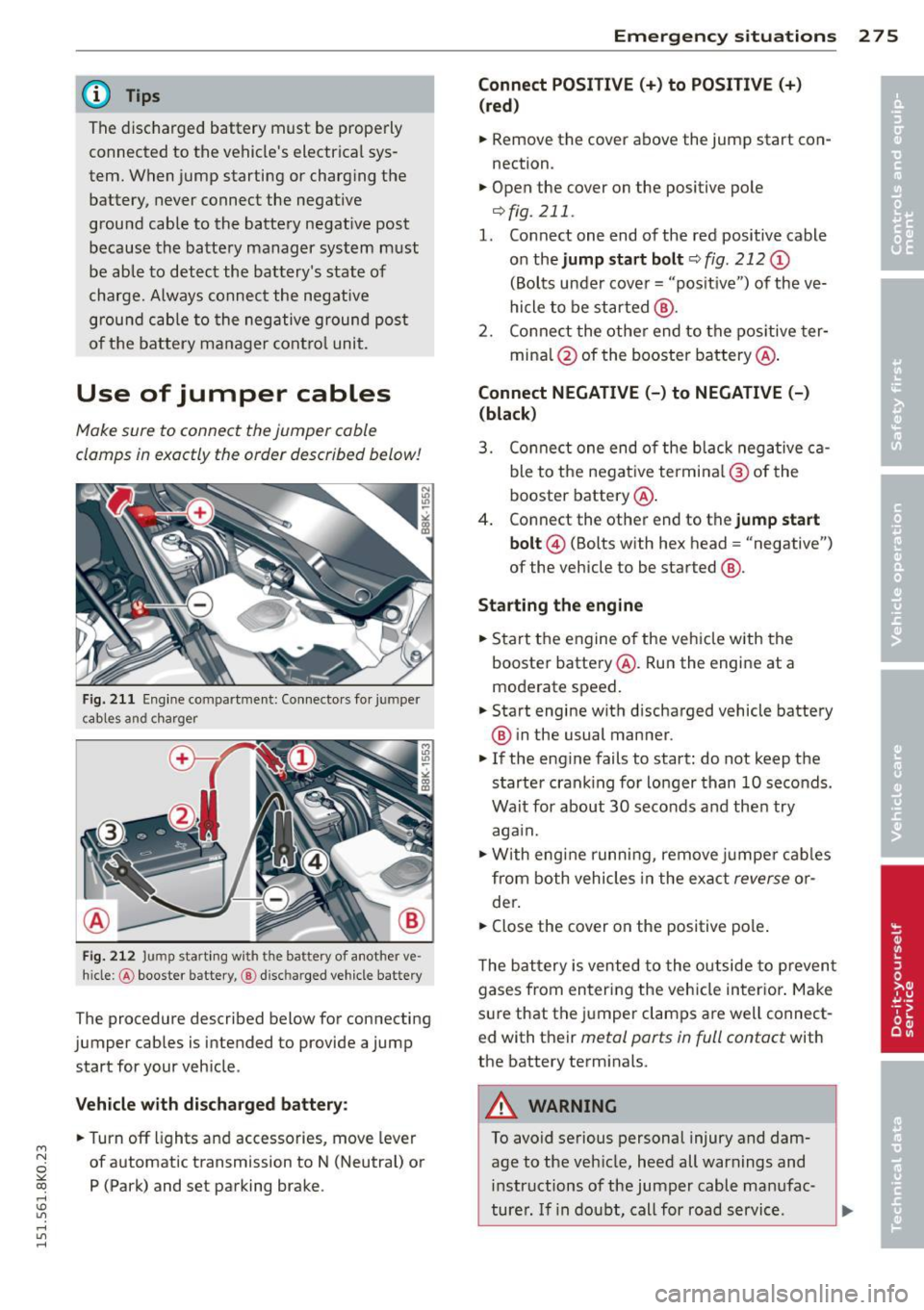
Make sure to connect the jumper coble
clomps in exactly the order described b elow!
Fi g. 21 1 Eng ine co mpar tment: Co nnecto rs fo r jum per
c ab les a nd c har ge r
F ig. 212 Jump start in g w ith t he ba ttery of a not her ve ·
hi cle :@ booster battery, @ disc harged veh icle battery
The procedure described below for connecting
jumper cables is intended to provide a jump
start for your veh icle .
Vehicle with di scharged battery :
~Turnoff lights and accessories , move lever
of automatic transmission to N (Neutral) or P (Park) and set parking brake .
Emergency situ ation s 2 7 5
Connect POSITIVE(+) to POSITIVE(+ )
(red )
~ Remove the cover above the jump start con
nection .
~ Open the cover on the positive pole
¢fig . 211 .
1. Connect one end of the red positive cable
on the
jump sta rt bolt c::;, fig. 212 (D
(Bolts under cove r= "posit ive ") of the ve
hicle to be started @.
2 . Conne ct the othe r end to the pos itive ter -
mina l@ of the booster battery @.
Connect NEGATIVE (-) to NEGATIVE (-)
(black )
3. Co nnect one end o f the b lack neg ative c a
ble to the nega tive te rmi na l@ of the
booster battery @.
4 . Connect the other end to the
jump start
bolt @
(Bolts with hex head = "negative")
of the vehicle to be started @.
Starting the engine
~ Start the engine of the ve hicle with the
booste r battery @. Run the engine at a
moderate speed.
~ Start engine with d ischarged vehicle battery
® in the usual manner .
~ If the engine fails to start: do not keep t he
starter cran king for lo nger than 10 seconds .
Wait for about 30 seco nds and the n try
aga in.
~ W ith engi ne runni ng, remove jumpe r cab les
from both vehicles in the exa ct
reverse o r
der .
~ Close the cover on the positive pole .
T he b attery is vented to the o utside to p reven t
gases from en tering the veh icle in ter ior . Ma ke
s ur e that the j umper clamps a re well connect
e d with their
metal ports in full contact with
the batte ry term inals.
A WARNING
To avoid serious personal injury and dam
age to the vehicle, heed all warnings and
in structions of the jumper cable ma nufac-
turer . If i n dou bt, call for road servic e.
Ill>