wheel AUDI A4 2015 Workshop Manual
[x] Cancel search | Manufacturer: AUDI, Model Year: 2015, Model line: A4, Model: AUDI A4 2015Pages: 304, PDF Size: 74.86 MB
Page 245 of 304
Tires and wheels 243
and can lead to sudden tire fail- The Gross Axle Weight Rating •
ure, including a blowout and ("GAWR") is the maximum load • '
sudden
deflation that can cause that can be applied at each of
the vehicle to crash. the vehicle's two axles.
Your safety and that of your The Gross Vehicle Weight Rat- passengers also depends on ing and the Gross Axle Weight
making sure that load limits are Rating are listed on the safety
not exceeded. Vehicle load in- compliance sticker label locat-
eludes everybody and every- ed on the driver's side B-pillar.
thing in and on the vehicle. Your Audi has 5 seating posi-
These load limits are technical- tions, 2 in the front and 3 in the ly referred to as the vehicle's rear for total seating capacity
Gross Vehicle Weight Rating of 5. Each seating position has
("GVWR"). a seat belt¢
page 136~ Safety
The "GVWR" includes the belts.
weight of the basic vehicle, all The fact that there is an upper
factory installed accessories, a limit to your vehicle's Gross Ve-
full tank of fuel, oil, coolant hicle Weight Rating means that
and other fluids plus maximum the total weight of whatever is
load. The maximum load in- being carried in the vehicle (in-
eludes the number of passen- eluding the weight of a trailer
gers that the vehicle is intend- hitch and the tongue weight of
ed to carry ("seating capacity") the loaded trailer) is limited.
with an assumed weight of The more passengers in the ve- 150 lbs. (68 kg) for each pas- hicle or passengers who are
senger at a designated seating heavier than the standard
position and the total weight of weights assumed mean that
any luggage in the vehicle . If less weight can be carried as
you tow a trailer, the weight of luggage. the trailer hitch and the tongue The tire pressure label on your
'"" weight of the loaded trailer N
Audi also lists the maximum 0 ::.,:
must be included as part of the co .... combined weight of all of the \!) 1.1'1
vehicle load . .... 1.1'1 ....
Page 247 of 304
M N
~ co
rl I.O
"' rl
"' rl
shown on the sticker
c=> page 234, fig. 189.
4. The resulting figure equals
the available amount of car go and luggage load capaci
ty. For example, if the
"XXX"
amount equals 1400 lbs.
and there will be five
150
lbs . passengers in your vehi
cle, the amount of available
cargo and luggage load ca
pacity is
650 lbs. (1400-750
(5
X 150) = 650 lbs.)
5. Determine the combined
weight of luggage and cargo being loaded on the vehicle.
That weight may not safely
exceed the available cargo
and luggage load capacity
calculated in Step
4.
6. If your vehicle will be towing
a trailer, load from your trail
er will be transferred to your
vehicle . Consult this manual
to determine how this re
duces the available cargo
and luggage load capacity of
your vehicle .
.,.Check the tire sidewall
{c:> page 248, fig. 193) to de
termine the designated load
rating for a specific tire.
Tires and wheels 245
Tire service life
The service life of tires depends
on a lot of different things in
cluding proper installation and
balancing, correct tire pressure
and driving style.
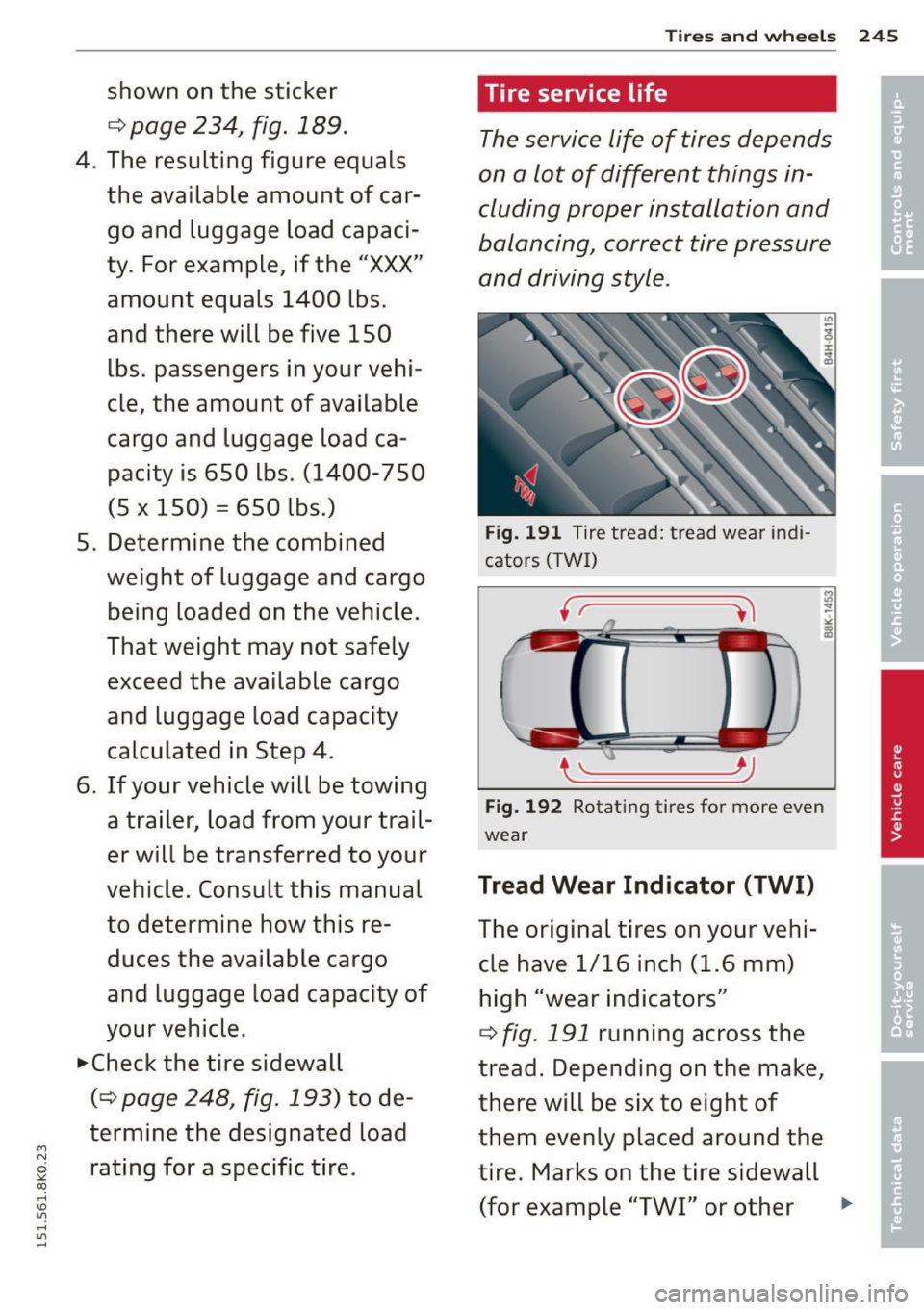
Fig. 191 Tire tread : tread wear indi
cators (TWI)
Fig. 192 Rotating tires for more even
wear
Tread Wear Indicator (TWI)
The original tires on your vehi
cle have
1/16 inch (1.6 mm)
high "wear indicators"
c=> fig. 191 running across the
tread. Depending on the make,
there will be six to eight of
them evenly placed around the
tire. Marks on the tire sidewall (for example "TWI" or other
Page 248 of 304
246 Tires and whee ls
symbols) indicate the positions
of the tread wear indicators .
Worn tires must be replaced. Different figures may apply in
other countries
s> .1:. .
Tire pressure
Incorrect tire pressure causes
premature wear and can cause
sudden tire blow-out. For this
reason, tire pressure must be
checked at least once a month
r::::>page239 .
Driving style
Driving fast around curves,
heavy acceleration and hard
b raking increase tire wear .
Rotating tires for more even
wear
For all four tires on your vehic le
to have the same service life,
we recommend that the front and rear tires are rota ted ac
cord ing to the tire man ufactur
er's s uggested tire rotat ion in
tervals. Please remember the
following:
-Tire rotation intervals may dif fer from the vehicle service in
tervals outlined in your Main
tenance and Warranty Book let . -
The longer one tire is used in
o ne location on the ve hicle,
the more it wears at certain points; therefore, we recom
mend tha t you follow the tire
manufact ure r's suggested tire
rotat ion interva ls .
- Vehicles with front -wheel
drive expe rience more tread
wear on the front whee ls com
p ared to all wheel drive (q uat
tro).
-Please rota te t ires as shown
r::::> fig . 192 .
-Extra care must be taken when
rotat ing direction-speci fic
tires c:> page 26 7.
Wheel balancing
The wheels on new vehicles are
balanced . Howeve r, various sit
uations d uring everyday drivi ng
can cause them to become un
balanced , resulting in vibra
tions you can usu ally feel
through the s teering wheel.
Unbalanced wheels must be re
ba lanced to avoid excessive
wea r on steering, suspension
and tires. A wheel must also be
rebalanced when a new tire is
insta lled .
Page 249 of 304
Incorrect wheel alignment
Incorrect wheel alignment can
cause excessive tire wear, im
pairing the safety of the vehi
cle. If tires show excessive
wear, have the wheel alignment checked by an authorized Audi
dealer or qualified workshop.
All wheel drive
Vehicles with quattro must al
ways have tires of the same size, construction and tread
type. For details see
¢ page 190 .
A WARNING
Sudden tire failure can lead
to loss of control, a crash and
serious personal injury!
-Never drive a vehicle when the tread on any tire is worn
down to the wear indica
tors.
-Worn tires are a safety haz ard, they do not grip well on
wet roads and increase your risk of "hydroplaning" and
loss of control.
- Always keep chemicals that
can cause tire damage, such
as grease, oil, gasoline and brake fluid away from tires.
-
Tires and wheels 24 7
-Tires age even if they are not being used and can fail
suddenly, especially at high
speeds. Tires that are more
than 6 years old can only be
used in an emergency and
then with special care and at lower speeds.
-Never mount used tires on your vehicle if you are not
sure of their "previous histo ry ." Old used tires may have
been damaged even though
the damage cannot be seen
that can lead to sudden tire
failure and loss of vehicle
control.
•
•
'
Page 250 of 304
248 Tires and wheels
New tires and replacing
tires and wheels
New tires and wheels have to
be broken in.
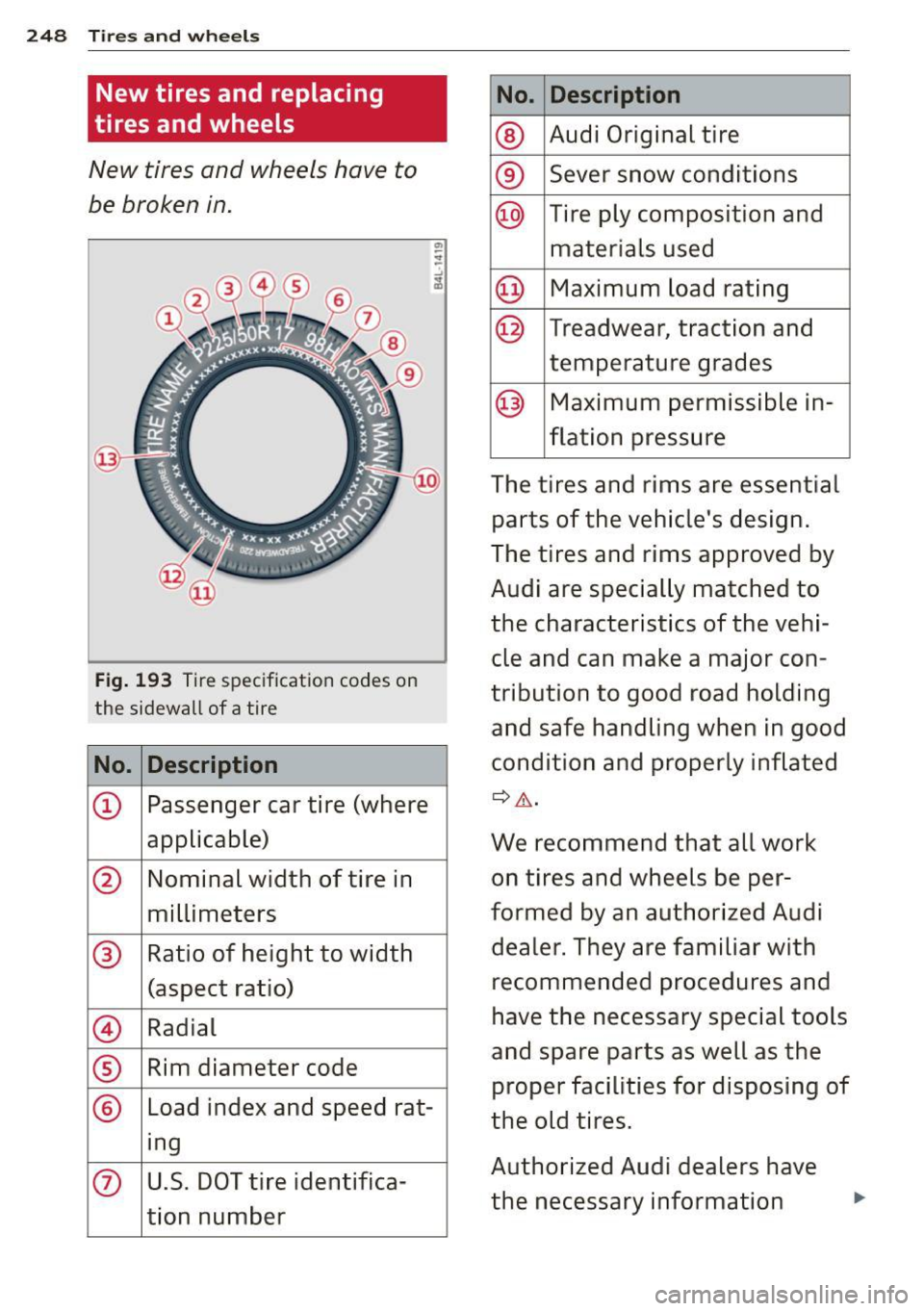
Fig. 193 Tire specification codes on
the sidewall of a tire
No. Description
CD Passenger car tire (where
applicable)
@ Nominal width of tire in
millimeters
@ Ratio of height to width
(aspect ratio)
© Radial
® Rim diameter code
® Load index and speed rat-
1ng
(j) U.S. DOT tire identifica -
tion number
No. Description
® Audi Original tire
® Sever snow conditions
@ Tire ply composition and
materials used
@ Maximum load rating
@ Treadwear, traction and
temperature grades
@ Maximum permissible in-
flation pressure
The tires and rims are essential
parts of the vehicle's design.
The tires and rims approved by
Audi are specially matched to
the characteristics of the vehi
cle and can make a major con
tribution to good road holding and safe handling when in good
condition and properly inflated
¢ A .
We recommend that all work
on tires and wheels be per
formed by an authorized Audi
dealer. They are familiar with recommended procedures and
have the necessary special tools
and spare parts as well as the
proper facilities for disposing of
the old tires.
Authorized Audi dealers have
the necessary information
Page 251 of 304
about technical requirements
for installing or changing t ires
and rims.
Replacing tires and wheels
Tires should be replaced at least in pairs and not individu
ally (for example both front
tires or both rear tires togeth er) .
Be sure to read and heed the in
formation to the tire pressure monitoring system*
¢ page 257.
Always buy replacement radial
tires that have the same specifi
cations as the tires approved
for your vehicle by Audi. Re
placement tires must always
have the same load rating spec
ification as the original equip
ment or approved optional tires
listed in the table¢
page 234.
Audi-approved specification
tires are specially matched to
your vehicle and its load limits and can contribute to the im
portant roadholding, driving
characteristics, and safety of
the vehicle. The table ( ¢
page 234) lists specifica
tions of the tires approved for
I
Tires and wheels 249
the Audi models covered by
your Owner's Literature.
The tire pressure label located on driver's side B-pillar
( c::> page 234J fig. 190) lists the
specifications of the original
equipment tires installed on
your vehicle at the time it was
manufactured.
Federal law requires tire manu
facturers to place standardized information on the sidewall of
all tires
¢fig. 193. This infor
mation identifies and describes
the fundamental characteris
tics, the quality grade of the
tire and also provides a tire identification number for safety
standard certification and in
case of a recall.
Tire specifications
Knowledge of tire specifications
makes it easier to choose the
correct tires. Radial tires have
the tire specifications marked on the sidewall , for example:
P255 / 35 R19 96V XL
This contains the following in-
formation: ..,..
•
•
'
Page 252 of 304
250 Tires and wheels
p Indicates the tire is for pas-
senger cars (where applica- ble)
255 Nominal tire width in mm
of the tire from sidewall
edge to sidewall edge. In
general, the larger the num-
ber, the wider the tire
35 Height/width ratio in per-
cent (aspect ratio)
R Tire construction: Radial
19 Rim diameter code (in in-
ches)
96 Load rating code
Y Speed rating letter code
XL (or "xl" "EXTRA LOAD" or , 1
"RF" Indicates that the tire is
a"Reinforced" or an "Extra
Load" tire
M+S (or "M/5") Indicates that
the tire has some mud and snow capability
The tires could also have the in-
formation of direction of rota-
tion
c:::> page 228.
Tire manufacturing date
The manufacturing date is also
indicated on the tire sidewall
l ) For t ires with a maximum speed ca
pability ov er 149 mph (240 km/h) ,
tire manufacturers sometimes use
the letters "ZR."
(possibly only on the inner side
of the wheel):
"DOT ... 2214 ... " means, for
example, that the tire was pro-
duced in the 22nd week of
2014.
Speed rating (letter code)
The speed rating letter code on
the wheels indicates the maxi -
mum permissible road speeds
c:::> A in Winter tires on
page 255.
P up to 93 mph (150 km/h)
Q up to 99 mph (158 km/h)
R up to 106 mph (170 km/h)
s up to 110 mph (180 km/h)
T up to 118 mph (190 km/h)
u up to 124 mph (200 km/h)
H up to 130 mph (210 km/h)
V up to 149 mph (240 km/h)1
)
z over 149 mph (240 km/h)1)
W up to 168 mph (270 km/h)1
)
Y up to 186 mph (298 km/h)1)
Your vehicle is normally factory
equipped with tires, which pos-
sess excellent driving character- istics and give your Audi
....
Page 253 of 304
Tires and wheels 251
optimum driving comfort. An tires because they meet the •
electronic speed limiter highest standards regarding • '
¢ page 30 will normally pre-
safety and driving characteris-
vent your vehicle from going tics when used correctly . Your
faster than the tire speed rating authorized Audi dealer will ¢
&,. . gladly provide you with more
U.S. DOT Tire Identification
information.
Number (TIN) and tire
Tire ply composition and
manufacture date materials used
This is the tire's "serial num-The number of plies indicates
ber" . It begins with the letters
the number of layers of rubber-
"DOT" and indicates that the coated fabric in the tire. In gen-
tire meets all federal stand -
eral, the greater the number of
ards. The next two numbers or plies, the more weight a tire
letters indicate the plant where can support. Tire manufactur-
it was manufactured, and the ers also must indicate the ma-
last four numbers represent the terials in the tire, which include
week and year of manufacture. steel, nylon, polyester, and oth-
For example , the numbers
ers.
2214 mean that the tire was
Maximum Load Rating
produced in the 22nd week of
2014. The other numbers are This number indicates the max-
marketing codes that may or imum load in kilograms and
may not be used by the ti re pounds that can be carried by
manufacturer. This information the tire.
is used to contact consumers if
Tire quality grading for
a tire defect requires a recall. treadwear, traction, and
Audi Original tire temperature resistance
Tires with the identification
Tread wear, traction and tern-
"AO " or "RO" have been special- perature
grades¢
page 254.
'"" N
ly matched with your Audi. We 0 ::.,: co ,....,
recommend using only these \!) 1.1'1 ,...., 1.1'1 ,....,
Page 254 of 304
252 Tires and wheels
Maximum Permissible
Inflation Pressure
This number is the greatest
amount of air pressure that
should ever be put in the tire
under normal driving condi
tions.
.&_ WARNING
-Using incorrect or unmatch ed tires and/ or wheels or improper tire and wheel
combinations can lead to loss of control, collision and
serious personal injury.
-Always use tires, rims and wheel bolts that meet the
specifications of original
factory-installed tires or
other combinations that have been specifically ap
proved by the vehicle manu
facturer.
-Tires age even if they are
not being used and can fail
suddenly, especially at high
speeds. Tires that are more
than 6 years old can only be used in an emergency and
then with special care and
at lower speeds.
-Never mount used tires on your vehicle if you are not sure of their "previous
histo
ry." Old used tires may have
been damaged even though
the damage cannot be seen
that can lead to sudden tire
failure and loss of vehicle
control.
-All four wheels must be fit ted with radial tires of the
same type, size (rolling cir
cumference) and the same
tread pattern. Driving with different tires reduces vehi
cle handling and can lead to
a loss of control.
-If the spare tire is not the
same as the tires that are
mounted on the vehicle -for
example with winter tires -
only use the spare tire for a
short period of time and
drive with extra care. Refit
the normal road wheel as soon as safely possible.
-Never drive faster than the maximum speed for which
the tires on your vehicle are
rated because tires that are
driven faster than their rat
ed speed can fail suddenly.
-Overloading tires cause heat build-up, sudden tire fail
ure, including a blowout
..
Page 255 of 304
and sudden deflation and loss of control.
-Temperature grades apply to tires that are properly in
flated and not over or un
derinflated.
-For technical reasons it is not always possible to use
wheels from other vehicles_ 1n some cases not even
wheels from the same vehi
cle model.
-If you install wheel trim discs on the vehicle wheels
I
make sure that the air flow
to the brakes is not blocked.
Reduced airflow to the
brakes can them to over
heat, increasing stopping
distances and causing a col lision.
-Run flat tires may only be used on vehicles that were
equipped with them at the
factory. The vehicle must have a chassis designed for
run flat tires and a factory
installed tire pressure moni
toring system* that indi cates a loss of tire pressure.
Incorrect use of run flat
tires can lead to vehicle damage or accidents. Check
Tires and wheels 253
with an authorized Audi dealer or tire specialist to
see if your vehicle can be
equipped with run flat tires.
If run flat tires are used
I
they must be installed on all
four wheels. Mixing tire types is not permitted.
(D Note
-For technical reasons, it is not generally possible to
use the wheel rims from
other vehicles. This can hold
true for wheels of the same
vehicle type.
-If the spare tire is different from the tires that you have mounted on your vehicle
(for example winter tires or
wide profile tires), then use
the spare tire for a short pe riod of time only and drive
with extra care. Replace the
flat tire with the tire match ing the others on your vehi
cle as soon as possible.
-Never drive without the valve stem cap. The valves could get damaged.
I),
•
•
'